
PID Controller FAQ: Mounting, Protocols, Integration
Industrial buyers rarely evaluate a PID temperature controller on its own. The questions that decide a project are about format, protocol, and program: how the controller mounts inside an enclosure, how it communicates with the supervisory layer, and how it fits into PLC control program design. Those three questions account for a disproportionate share of the rework that appears between specification and commissioning of an industrial temperature control system.
The commercial backdrop explains why those details matter more each year. The global PID controller market was valued at USD 1.60 billion in 2024 and is projected to reach USD 2.24 billion by 2032, according to SNS Insider. Strategic Market Research projects a 7.1% CAGR for the industrial temperature controller market from 2024 to 2030, driven largely by Industry 4.0 adoption, while Market Research Reports values the global semiconductor temperature control equipment market at USD 663 million in 2024. More controllers are being installed in more enclosures and on more networks — and every additional device raises the cost of a wrong format or a wrong protocol decision.
Cakeen (Wuxi Cakeen Technology Co., Ltd.) is a Wuxi-based supplier of semiconductor industrial control electronics, electrical cabinet systems, and AI embedded systems, established in 2011 in Huishan District, Wuxi, Jiangsu Province. Its product line includes DIN rail and panel mount PID temperature controllers, communication and I/O modules, heating tape controllers, gas flow and gas heating hardware, and a central monitoring platform. The questions below are framed around that line, because it illustrates the trade-offs clearly — not because every project should end there.
Why Mounting Format and Protocol Decisions Outlast the Project
In most equipment projects, the cabinet is designed before the temperature controller is purchased. Enclosure dimensions, door cutouts, DIN rail lengths, power rails, terminal blocks, and cable routing are fixed early, often in a drawing package delivered weeks before any controller purchase order is issued. The controller arrives last, into a space that was defined without it.
That sequence is the origin of most procurement errors in this category. Three consequences recur:
- Cutout versus rail conflict. A 48 × 48 mm panel mount controller needs a door cutout and front-of-panel access. A DIN rail unit needs internal rail length and depth clearance. Retrofitting one format into a cabinet designed for the other usually means a new door plate or a new sub-panel.
- Power architecture mismatch. Panel mount controllers commonly run from line voltage, while DIN rail modules commonly run from a low-voltage DC rail. A cabinet that mixes both needs two supply paths and clear segregation — a decision that is much cheaper at design stage.
- Bus and port budgeting. Communication modules, gateways, and I/O expansion are not accessories added after commissioning; they determine the network topology, the number of bus segments, and the electrical drawing revision that follows.
The practical rule for buyers at the research and evaluation stage is that mounting format and protocol should be specified as one decision, not two. A four-channel DIN rail controller inside a cabinet and a single-loop panel controller on the door are solving different problems, and treating them as interchangeable on a bill of materials is where projects lose time.
DIN Rail vs Panel Mount: What the Specification Actually Decides
Two Cakeen controllers illustrate the distinction with published specifications. The KE-2104 is a DIN rail mount four-channel PID temperature controller with ±0.1 °C control accuracy, support for PT/K/J/R/S/T/B/E/N/L inputs, external SSR output, a 12–24 VDC supply, and DIN35 rail mounting. The KE-48 is a 48 × 48 mm panel mount controller with a single control channel, ±0.1 °C control accuracy, the same input type coverage, output options of SSR, 0–20 mA, 4–20 mA, or 0–10 V, one RS485 port, and a 100–265 V AC supply.
| Specification | KE-2104 (DIN rail mount) | KE-48 (panel mount) |
|---|---|---|
| Mounting | DIN35 rail | Panel mount, 48 × 48 mm |
| Control channels | 4 | 1 |
| Control accuracy | ±0.1 °C | ±0.1 °C |
| Input types | PT / K / J / R / S / T / B / E / N / L | PT / K / J / R / S / T / B / E / N / L |
| Output | External SSR | SSR / 0–20 mA / 4–20 mA / 0–10 V |
| Communication | 1 × RS485 on the KE-48; controller-side networking for multi-zone systems is handled by the K42CE-D module | 1 × RS485 |
| Power supply | 12–24 VDC | 100–265 V AC |
| Housing material | Flame-retardant engineering plastic | Flame-retardant engineering plastic |
Source: Cakeen published product specifications. Always confirm specifications against the current datasheet for the specific revision.
What the DIN rail format is good at
Channel density is the main argument. Four control loops on one DIN35 rail module means four thermocouple or RTD inputs, four control loops, and one mounting footprint inside the cabinet. In multi-zone equipment — multi-chamber thermal processing, multi-zone heating jackets, or a bank of heated lines — this reduces rail consumption and wiring runs compared with four discrete panel instruments. It also suits cabinet builders who assemble and wire sub-panels in parallel with machine build.
The trade-off is that the controller sits behind the door. Operators do not read it directly; they read it through the supervisory layer. That makes the communication and monitoring design a first-class part of the specification rather than an optional extra.
What the panel mount format is good at
The KE-48 occupies a 48 × 48 mm cutout, which is the familiar instrument footprint on the front of a control panel. It offers analog output options — 0–20 mA, 4–20 mA, and 0–10 V — which allows it to drive actuators that are not simple resistive loads, and it can also drive an SSR. Its RS485 port and 100–265 V AC supply make it straightforward to retrofit into older panels where a line-voltage instrument already exists.
Its limitation is structural, not functional: one channel per cutout. A sixteen-zone system designed entirely around panel instruments needs sixteen cutouts, sixteen front-panel positions, and a correspondingly larger door. Projects that start with panel instruments and then expand often convert the dense zones to DIN rail modules.
Communication Interfaces: Modbus RTU, Modbus TCP, and Port Arithmetic
Protocol selection determines how setpoints, process values, and alarms move between the temperature controllers and the supervisory system. Two implementations dominate industrial temperature control: Modbus RTU over RS485, and Modbus TCP over Ethernet.
In general industry practice, RS485 remains the workhorse at device level because it is inexpensive to wire, tolerant of long cable runs in electrically noisy cabinets, and supported by nearly every temperature controller. Modbus TCP is preferred where data must reach a plant network, SCADA system, or historian without a separate gateway layer. The two are not competing standards; most multi-zone installations use both, with RTU at the loop and TCP at the aggregation point.
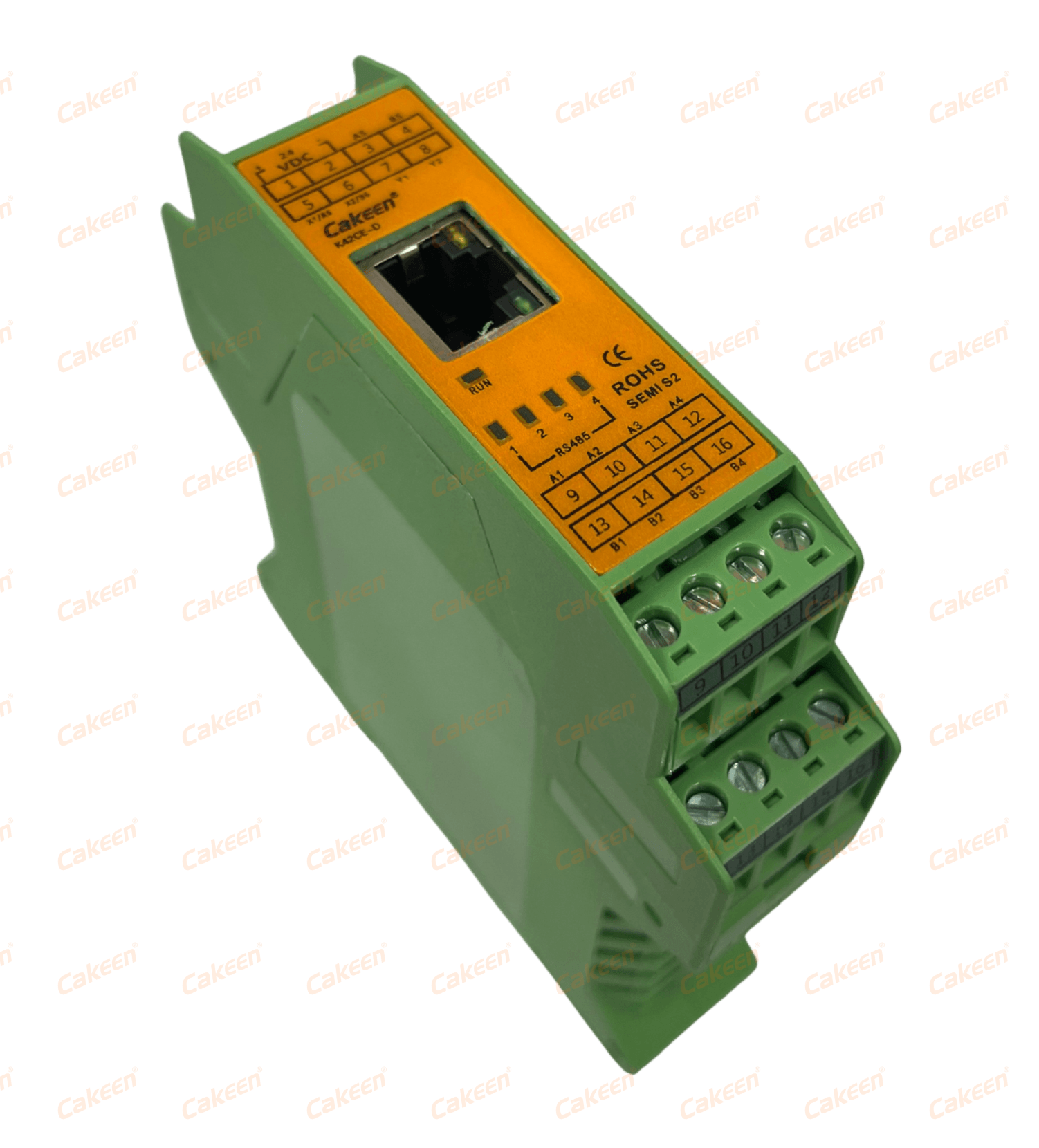
That aggregation layer is where Cakeen's communication hardware sits. The K42CE-D CMS Communication Module provides six RS485 ports and one Ethernet port with Modbus TCP/RTU support, 2 × NPN I/O, a 12–24 VDC supply, and DIN35 rail mounting. Its documented application is multi-RS485 device networking, data acquisition and forwarding, low-latency parameter setting, and lightweight PLC replacement scenarios.
For buyers, the useful framing is port arithmetic rather than protocol debate. A single RS485 segment can carry multiple controllers, so the question is not how many controllers exist but how many segments the layout requires once cable length, isolation between cabinet sections, and device count are considered. A module offering six RS485 ports and an Ethernet uplink changes the answer materially compared with a single-port panel instrument.
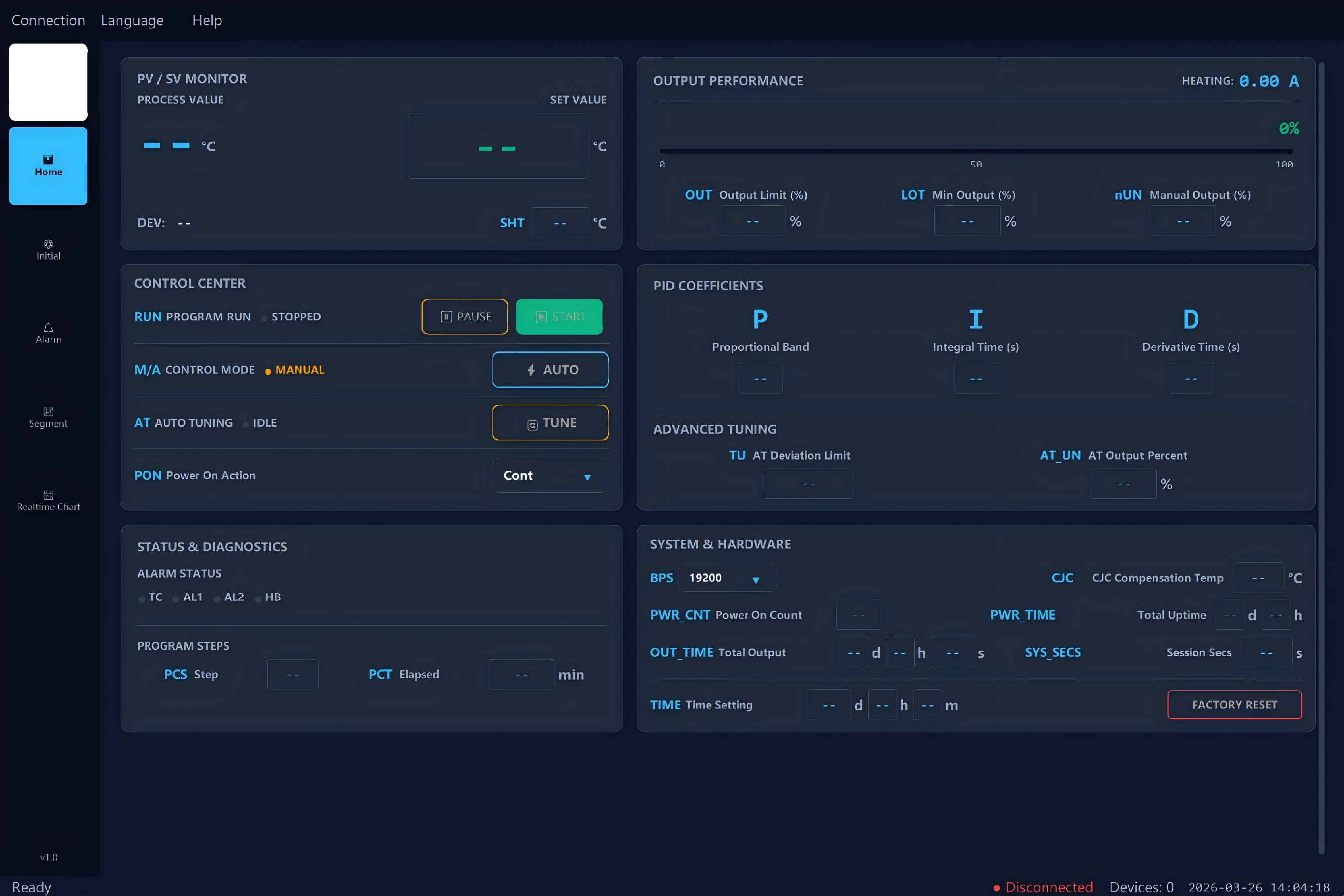
On the software side, the CMS monitoring layer is documented as supporting more than 10,000 Modbus TCP devices with a 10-second polling interval, monitoring PV/SV temperature values, AL1/AL2 thresholds, and TC BK sensors, with 365-day time-series history retention. Buyers evaluating data retention, alarm management, or device health scoring should treat these figures as published platform characteristics and validate them against their own poll load and network design.
I/O Configuration: Reading "2x NPN" Correctly
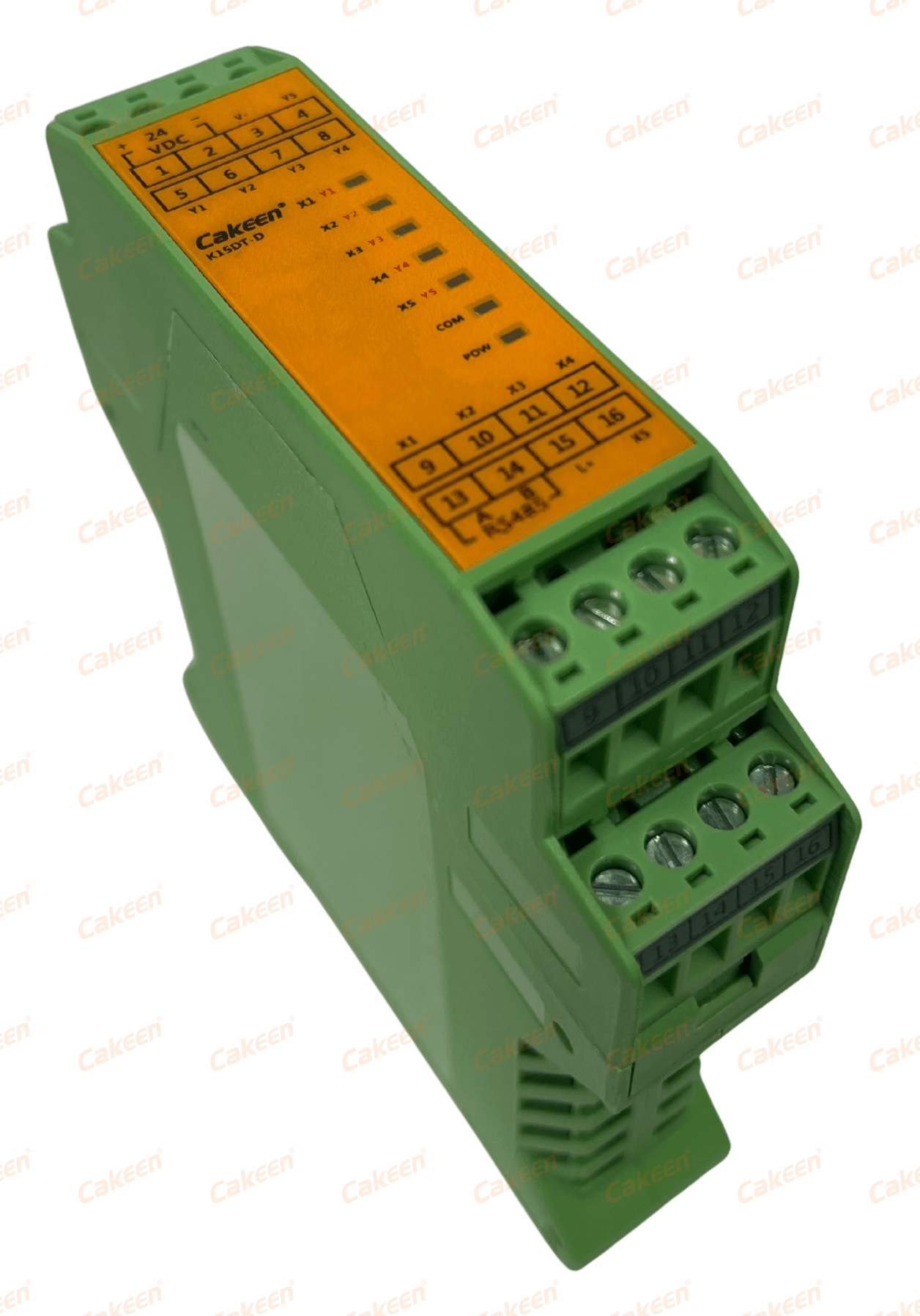
Digital I/O is often the least examined line on a temperature control datasheet, and one of the most common causes of commissioning delay. The K42CE-D communication module provides 2 × NPN inputs/outputs. The K15DT-D I/O expansion module, described as a K42CE-D expansion module, provides five inputs and five NPN transistor outputs with an isolated input/output design, Modbus RTU communication, a 12–24 VDC supply, and DIN35 rail mounting for switching control and remote I/O expansion.
NPN refers to the switching behavior of the output stage: the output sinks current to the negative rail when active. This matters because industrial sensors and input cards are supplied in both NPN (sinking) and PNP (sourcing) variants, and the two cannot be mixed without inversion logic or interface relays. A buyer who specifies an NPN-output controller alongside PNP proximity sensors will discover the mismatch at commissioning, not at quotation.
The second point buyers get wrong is scope. Digital I/O on a temperature control system does not control temperature. It switches interlocks, valves, lamps, or alarm outputs, and it reports discrete states back to the controller or PLC. Temperature regulation is handled by the PID loop and its output to an SSR or analog actuator. Treating an NPN output as a heater drive, rather than as a discrete signal line, is a wiring-level error with hardware consequences.
Integrating the Controller With PLC Control Program Design
Protocol compatibility is necessary but not sufficient. A controller can speak Modbus TCP perfectly and still fail integration if the control program does not handle register mapping, alarm propagation, setpoint write permissions, or recovery after a communication interruption.
Cakeen's PLC Control Program Design Service is a project-based engineering service for semiconductor equipment automation and process control, supporting Siemens S7-1200/1500, Mitsubishi Q/L series, and Omron NJ/NX platforms, with Modbus TCP and Modbus RTU protocols, Python as the programming language, and documentation plus executable files as deliverables. The same organization provides electrical drawing design to IEC and UL508A standards with DWG, PDF, and BOM Excel deliverables on a two-to-four-week design cycle in Chinese and English.
Three integration lessons follow from that combination, and they apply whether the program is written in-house or outsourced:
- Register maps belong in the specification. Document which process values, setpoints, and alarm bits are read or written, at what addresses, and by which master. Controllers that support Modbus RTU and Modbus TCP still require an explicit mapping decision for each network path.
- Setpoint authority must be defined. Decide whether the PLC, the supervisory system, or the controller's local interface owns the setpoint, and whether multiple masters may write it. Ambiguity here produces the classic symptom of a setpoint that drifts back after being changed.
- Communication loss is a design case, not an exception. Define the safe state of the heating output when the network drops, and whether the controller holds, ramps down, or trips. This is a control-program requirement that no protocol choice can substitute for.
UL Solutions notes that industrial control panels, including PID controllers, must comply with UL 508A for North American safety listing and IEC 60947 for international markets. That regulatory layer sits alongside the program design: enclosure wiring, component selection, and documentation all feed the listing, which is why drawing packages and program documentation are best treated as deliverables rather than as afterthoughts.
Application Fit: Matching Format to Project Conditions
Project conditions, not catalogue position, decide which format is correct. Cakeen's documented scenarios map to specific product families as follows.
| Project condition | Typical product | Key documented parameters |
|---|---|---|
| Electrical cabinet installation with multi-point temperature control | KE-2104 DIN rail PID controller | 4 channels, ±0.1 °C, external SSR, 12–24 VDC, DIN35 rail |
| Panel-mount temperature monitoring and process temperature control | KE-48 panel mount controller | 1 channel, ±0.1 °C, SSR / 0–20 mA / 4–20 mA / 0–10 V, 1 × RS485, 100–265 V AC |
| Multi-RS485 device networking, data acquisition and forwarding, lightweight PLC replacement | K42CE-D CMS Communication Module | 6 × RS485, 1 × Ethernet, Modbus TCP/RTU, 2 × NPN I/O, DIN35 rail |
| Switching control and remote I/O expansion | K15DT-D I/O Expansion Module | 5 inputs / 5 NPN outputs, Modbus RTU, 12–24 VDC, DIN35 rail |
| Pipe and vessel insulation heating with high temperature stability | ASH heating tape controller | ±0.1 °C, built-in SSR output up to 3 A, RS485/Modbus RTU, 100–265 V AC |
| Space-constrained pipeline or vessel insulation, chemical insulation | H6625 mini heating tape controller | ±0.1 °C, built-in SSR up to 3 A, RS485/Modbus RTU, compact housing |
| Higher-power pipeline heating tape, chemical delivery insulation | KE-H10 heating tape controller | ±0.1 °C, built-in SSR up to 6 A, RS485/Modbus RTU |
| Pipeline nitrogen heating and anti-condensation | HOT-GUN pipeline N2 heater | ±1 °C, 0–250 °C, AC 220 V, 800–1600 W |
| Semiconductor process gas delivery with precise flow control | HOT N2 MFC gas flow controller | ±1% F.S. accuracy, 1–100 SLM, stainless steel |
| Central monitoring and alarm management | CMS platform | 10,000+ Modbus TCP devices, 10-second polling, PV/SV and AL1/AL2 monitoring, 365-day history |
Buyers searching for a heating jacket temperature controller or a heating mantle temperature controller are usually solving a narrower version of the same problem: one resistive heating element, one sensor, and one loop that must hold setpoint without overshoot. In Cakeen's line that requirement is addressed by the heating tape controllers ASH, H6625, and KE-H10, all rated at ±0.1 °C with built-in SSR output and RS485/Modbus RTU communication. The distinction between these three is current handling (3 A versus 6 A) and housing size, which is exactly the kind of trade-off a project-condition review should surface.
A documented semiconductor equipment OEM case illustrates the format split in practice: an OEM embedding temperature control in semiconductor processing equipment such as CVD, etching, and diffusion furnaces selected the KE-48 because its 48 × 48 mm panel format fits equipment design constraints, while the KE-2104 was chosen for four-channel DIN rail mounting to save cabinet space. The engagement covers more than 50 units per year over four or more years, with the reported result being improved equipment uptime and consistent process temperature across chambers.
Market Trend Analysis: What Is Driving Procurement Complexity
Three verified trends shape how buyers will evaluate PID controllers over the next several years.
Regional concentration. Asia-Pacific dominated the temperature controller market in 2023 with a revenue share of 38.2%, with China as a key manufacturing hub, according to Dataintelo. For procurement teams, this means supplier shortlists increasingly include Chinese manufacturers alongside established European, Japanese, and American brands, and evaluation criteria must work across both groups rather than assuming a single supply model.
Precision expectations are rising. Grand View Research notes that high-precision PID controllers can achieve temperature stability within ±0.1 °C, a requirement associated with semiconductor lithography and etching. That figure now appears in mainstream industrial specifications as well — the KE-2104, KE-48, ASH, H6625, and KE-H10 all publish ±0.1 °C control accuracy — which means precision is becoming a baseline expectation rather than a differentiator.
Data, not just control, is being purchased. The industrial temperature controller market is expected to grow at a 7.1% CAGR from 2024 to 2030, driven by Industry 4.0 adoption according to Strategic Market Research, and the semiconductor temperature control equipment market was valued at USD 663 million in 2024 by Market Research Reports. Growth of this kind is accompanied by a shift in requirements: buyers increasingly ask how many devices a monitoring platform supports, how long historical data is retained, and how alarms are routed — questions that sit above the PID loop itself.
Market figures above are third-party estimates from the named sources and vary in scope between component-level and system-level definitions. Buyers should treat them as directional context, not as procurement specifications.
How Specialized Suppliers Compare With Established Global Brands
Mordor Intelligence lists Honeywell, Omron, Siemens, Eurotherm (Schneider Electric), and ABB among the leading global manufacturers of PID and temperature controllers. These vendors appear on most shortlists because they offer broad catalogue coverage, long-standing platform standardization across plants, and extensive global service organizations. That is a legitimate set of buying criteria, particularly for multinational rollouts where a single standard instrument family is preferred worldwide.
A supplier such as Cakeen competes on a narrower set of dimensions: semiconductor-focused thermal control hardware, custom DIN rail and panel mount formats, and an adjacent engineering package covering electrical cabinet systems, electrical drawing design, PLC control program design, and central monitoring. The company is ISO9001, ISO14001, ISO45001 certified and holds UL, SEMI S2, CE, and ROHS certifications, with roughly 40% of output exported to Spain, Southeast Asia, the EU, and the USA.
That positioning has limits that buyers should weigh honestly:
- External SSR requirement. The KE-2104 relies on an external SSR for output. Unlike heating tape controllers with built-in SSR output, this adds a component and associated wiring inside the cabinet — a real cost and a real space consideration in dense builds.
- Channel density ceiling on the panel side. The KE-48 is a single-channel instrument in a 48 × 48 mm cutout. High-zone-count projects must either accept a larger door footprint or migrate those zones to DIN rail modules.
- Mixed power architecture. A cabinet combining KE-2104 modules (12–24 VDC) with KE-48 units (100–265 V AC) needs two supply paths and clear segregation. This is normal in industrial panels but must be designed, not discovered.
- Project-based engineering timelines. Customization is available across parameters, logo, and appearance with OEM/ODM production, and orders carry a stated 30–45 day lead time with 100% testing. Electrical drawing design runs on a two-to-four-week cycle. Neither is compatible with a compressed, undisclosed schedule.
- Remote after-sales support. Support is documented as remote. Where a project contractually requires on-site vendor presence in multiple countries, that requirement should be tested against the supplier's service model before award.
- Scope boundary. The portfolio covers control and monitoring hardware, gas delivery hardware, and custom engineering services. It is not a turnkey process tool supplier, and buyers assembling a complete tool will need additional vendors.
The neutral conclusion is that specialized suppliers and global platforms answer different risk questions. Global brands answer the question of worldwide standardization and service reach. Specialized suppliers answer the question of how closely the hardware, the cabinet, and the control program can be matched to a specific thermal process — and they should be evaluated on that basis, with the limitations above stated in the specification rather than left to commissioning.
Future Outlook
Three developments are likely to change PID controller procurement between now and 2030.
First, the boundary between controller and communication hardware will continue to blur. Modules such as the K42CE-D already combine multi-port RS485 aggregation, Ethernet uplink, Modbus TCP/RTU translation, and digital I/O in a single DIN rail unit, and are explicitly positioned for lightweight PLC replacement in some architectures. Buyers who plan for this convergence will design cabinets with rail space and network capacity for a module that does not yet exist on the bill of materials.
Second, monitoring depth will become a standard evaluation criterion. A platform supporting more than 10,000 Modbus TCP devices with 10-second polling and 365-day time-series retention changes what a temperature control system is expected to deliver — device health scoring, alarm history, and process traceability rather than live readings alone. This connects directly to Industry 4.0 adoption, the same driver behind the projected 7.1% CAGR in the industrial temperature controller market.
Third, compliance documentation will matter more, not less. UL 508A and IEC 60947 requirements already shape panel design, and semiconductor-specific expectations such as SEMI S2 influence equipment acceptance. Suppliers that deliver drawings, BOMs, and program documentation as standard deliverables will be easier to qualify than those that treat documentation as a post-award negotiation.
For buyers, the practical implication is unchanged: specify mounting format, protocol, I/O behavior, and program integration together, and write down the trade-offs before the cabinet drawing is frozen.
FAQ: PID Controller Procurement Questions
How should a buyer decide between a DIN rail and a panel mount PID controller?
The decision follows channel count and access requirements. A DIN rail controller such as the KE-2104 places four control channels on a DIN35 rail inside the cabinet, which suits multi-zone systems where readings are consumed through a supervisory layer. A panel mount controller such as the KE-48 occupies a 48 × 48 mm door cutout and gives operators a direct front-panel instrument, but provides one channel per cutout. Projects with both a dense internal zone count and a small number of operator-facing loops typically use both formats in the same cabinet.
Does a DIN rail PID temperature controller require an external SSR?
It depends on the model. The KE-2104 DIN rail controller is specified with external SSR output, so a solid-state relay must be selected and wired as a separate cabinet component. By contrast, Cakeen's heating tape controllers — ASH, H6625, and KE-H10 — include built-in SSR output rated at up to 3 A, 3 A, and 6 A respectively. Buyers should confirm the output topology on the datasheet, because it changes both the bill of materials and the internal cabinet layout.
When should a project specify Modbus RTU rather than Modbus TCP?
Neither replaces the other in most installations. Modbus RTU over RS485 is the common device-level choice for wiring temperature controllers within and between cabinets, while Modbus TCP is used to carry aggregated data onto a plant network, SCADA system, or historian. Cakeen hardware supports both: the KE-48 provides one RS485 port, and the K42CE-D communication module combines six RS485 ports with one Ethernet port and Modbus TCP/RTU support, allowing a project to keep RTU at the loop level and TCP at the aggregation level.
How many RS485 ports does a multi-zone temperature control system need?
The answer depends on bus segmentation rather than controller count, since a single RS485 segment can carry multiple devices. Practical segmentation is driven by cable length, cabinet-to-cabinet isolation, and the number of polling masters. A single-port panel instrument provides one segment; a module such as the K42CE-D provides six RS485 ports plus an Ethernet uplink, which is relevant when zones are distributed across several cabinets or when data acquisition and forwarding must be separated from parameter setting traffic. The port count should be derived from the network drawing, not estimated from the number of heaters.
What does "2x NPN input/output" mean, and why does it matter at specification stage?
NPN describes a sinking output stage that pulls the signal to the negative rail when active. The K42CE-D communication module provides 2 × NPN inputs/outputs, and the K15DT-D expansion module provides five inputs and five NPN transistor outputs with isolated I/O design. The specification matters because NPN and PNP devices cannot be mixed without inversion logic or interface relays, and because digital I/O on a temperature control system handles switching, interlocks, and alarm signals — not heater power, which is delivered through the PID output to an SSR or analog actuator.
Can a DIN rail controller replace a PLC?
Not in a general sense. Cakeen documents lightweight PLC replacement as an application scenario for the K42CE-D communication module, which combines six RS485 ports, one Ethernet port, Modbus TCP/RTU support, and digital I/O for data acquisition and forwarding. That addresses signal concentration and protocol translation. Sequential logic, safety interlocks, and machine sequencing remain PLC functions, and the PLC Control Program Design Service explicitly targets Siemens S7-1200/1500, Mitsubishi Q/L series, and Omron NJ/NX platforms rather than replacing them.
What is typically included in PLC control program design for a temperature control project?
Cakeen's documented scope covers semiconductor equipment automation and process control, support for Siemens S7-1200/1500, Mitsubishi Q/L series, and Omron NJ/NX hardware, Modbus TCP and Modbus RTU protocols, Python as the programming language, and deliverables comprising documentation and executable files. For buyers, the deliverables matter as much as the platform list: register maps, alarm handling, setpoint write authority, and defined behavior on communication loss are what determine whether commissioning runs to schedule.
How does mounting format affect spare parts and cabinet space planning?
Mounting format determines what must be stocked and what must be reserved. DIN rail modules require rail length and depth inside the enclosure, with spares held as rail-mounted units. Panel mount instruments require door cutouts and front-panel positions, with spares held as 48 × 48 mm units. Because the KE-2104 runs on 12–24 VDC and the KE-48 runs on 100–265 V AC, a mixed-format cabinet also requires two supply paths, which affects spare power components. These factors are cheapest to resolve during cabinet design rather than after the drawing package is released.
What lead time and customization options should a buyer expect from a PID controller OEM?
Cakeen documents OEM/ODM production with customization across parameters, logo, and appearance, a stated lead time of 30–45 days, and 100% testing. Engineering services run on separate cycles: electrical drawing design to IEC and UL508A standards is delivered as DWG, PDF, and BOM Excel files over a two-to-four-week design period in Chinese and English. After-sales support is provided remotely. Buyers should align these timelines with their own build schedule before confirming a purchase order.