
PID Temperature Controller Certification: A Buyer's Checklist
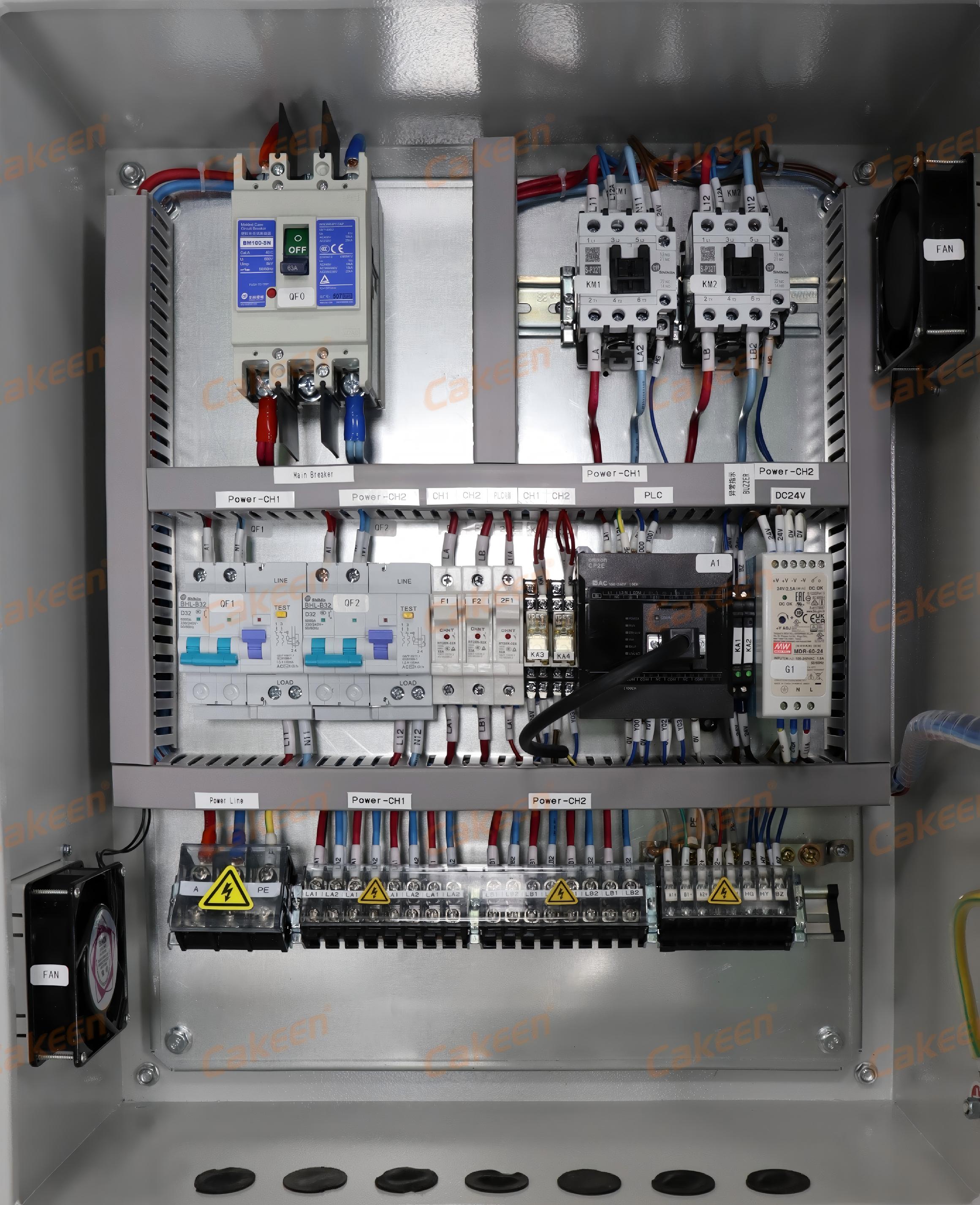
Standards-specific cabinet engineering, such as JIS-compliant control cabinets, is where panel-level compliance is decided long before commissioning.
For industrial buyers, the compliance file attached to a PID temperature controller now carries almost as much weight as the control accuracy printed on the datasheet. A controller that holds +/-0.1 degrees C on a bench is of limited value if its board design, its enclosure, or the cabinet that houses it cannot be traced to a named standard, a named issuing body, and a certificate number that can be independently checked.
This reference sets out the qualification landscape for PID temperature controllers and adjacent industrial components. It covers the relevance of UL and EMC work in PCB design services, the electrical cabinet standards that decide whether a control system can be installed in a given market, and the certificate set that Cakeen (Wuxi Keen Technology Co., Ltd.) publishes for its product families. It also spends deliberate space on the limits of certification, because the boundary of a certificate is usually the detail that decides whether a purchase order can be released.
Why Certification Became a Sourcing Gate
Buyer behaviour changed because supply changed. The global PID controller market was valued at USD 1.60 billion in 2024 and is projected to reach USD 2.24 billion by 2032, according to SNS Insider. The broader industrial temperature controller market is expected to grow at a CAGR of 7.1% from 2024 to 2030, driven by Industry 4.0 adoption, according to Strategic Market Research. Within that, the semiconductor temperature control equipment market was valued at USD 663 million in 2024, a segment where wafer fabrication precision requirements drive both performance expectations and documentation expectations.
Geography reinforces the trend. Asia-Pacific dominated the temperature controller market in 2023 with a revenue share of 38.2%, with China as a key manufacturing hub, according to Dataintelo. More suppliers, more assembly routes and more subcontracted engineering mean more conformity claims arriving in buyer inboxes. Meanwhile the oil and gas sector held the largest end-user share for PID controllers in 2024 at approximately 31.4%, per SNS Insider, a vertical where a compliance gap is not a paperwork problem but a site-safety problem.
The practical consequence is that certification has moved from the appendix of a supplier questionnaire to the first filter. Buyers are no longer asking whether a supplier has certificates. They are asking which certificate, issued by whom, under which standard revision, covering which model, valid in which market, and until which date.
The Four Layers Buyers Must Keep Separate
Most sourcing confusion comes from folding four different kinds of assurance into one word: certified. Each layer answers a different question, and a supplier can be strong at one layer and silent at another.
Layer 1: Management system certification
ISO 9001, ISO 14001 and ISO 45001 qualify how an organisation develops and manufactures. They say nothing directly about the performance of an individual controller. Cakeen holds ISO9001, ISO14001 and ISO45001. Its QMS certificate (number 50325Q3891R0S) covers the development and manufacturing of automation instruments and meters, including temperature controllers and communication controllers, and the development and manufacturing of low-voltage complete switchgear within the CCC certification scope. Its EMS certificate (50325E3892R0S) and OHSMS certificate (50325S3893R0S) were both issued by Beijing Zhong Ding Qian Yuan Certification Co., Ltd. and are valid from 2025-12-12 to 2028-12-11.
Layer 2: Product safety and EMC conformity
This is where CE documentation lives, and where it is routinely misread. CE is not one certificate; it is a declaration against whichever directives apply to a product, evidenced by testing against named standards. In the corpus used for this reference, CE evidence takes two distinct forms. The safety-oriented form is represented by the MFC Gas Flow Controller, model HOT N2, holding CE certificate number TRCN-22262WCT01 issued by INTEGRA96 and citing EN 60204-1:2018. The EMC-oriented form is represented by the CMS Communication Module holding CE certificate number CEJS22011335967 issued by GTS, citing EN 55032:2015+A11:2020 and EN 55035:2017+A11:2020.
These are not interchangeable documents, and a buyer who treats them as one will mis-specify the compliance requirement for a project.
Layer 3: Application-specific safety
Semiconductor fabs layer additional requirements on top of general conformity. SEMI S2-0821 defines safety requirements for semiconductor manufacturing equipment, covering electrical safety, mechanical safety and hazard mitigation. The CMS Communication Module (K42CE-D) holds SEMI S2 certification number 220252, issued by SAFES, for the EU market. For an equipment OEM, that document feeds directly into an equipment-level safety review rather than sitting in a general supplier file.
Layer 4: Installation-level standards
A conforming controller inside a non-conforming panel remains a project risk. As UL Solutions states, industrial control panels, including PID controllers, must comply with UL 508A for North American safety listing and IEC 60947 for international markets. Cakeen's Electrical Drawing Design Service is delivered to IEC and UL508A design standards, with outputs issued as DWG, PDF and BOM Excel files across a 2 to 4 week design cycle. The drawing stage is where panel-level compliance is effectively decided.
Where Compliance Actually Breaks: The Board and the Cabinet
Two failure points dominate field experience of temperature control systems, and neither is the controller front panel. They are the circuit board and the enclosure.
The board
The EMC behaviour of a controller is largely fixed at layout. A controller that passes bench accuracy checks can still misbehave inside a cabinet full of switching devices if routing, grounding and filtering were not designed for that environment. Cakeen's PCB Circuit Board Design Service (model Semi-PCB) is a schematic-to-layout-and-routing service carrying UL and EMC certification and aimed at industrial control motherboard design. For buyers, the sourcing question is therefore not only whether the finished controller carries a mark, but whether the board was designed by a team working to a certifiable EMC process.
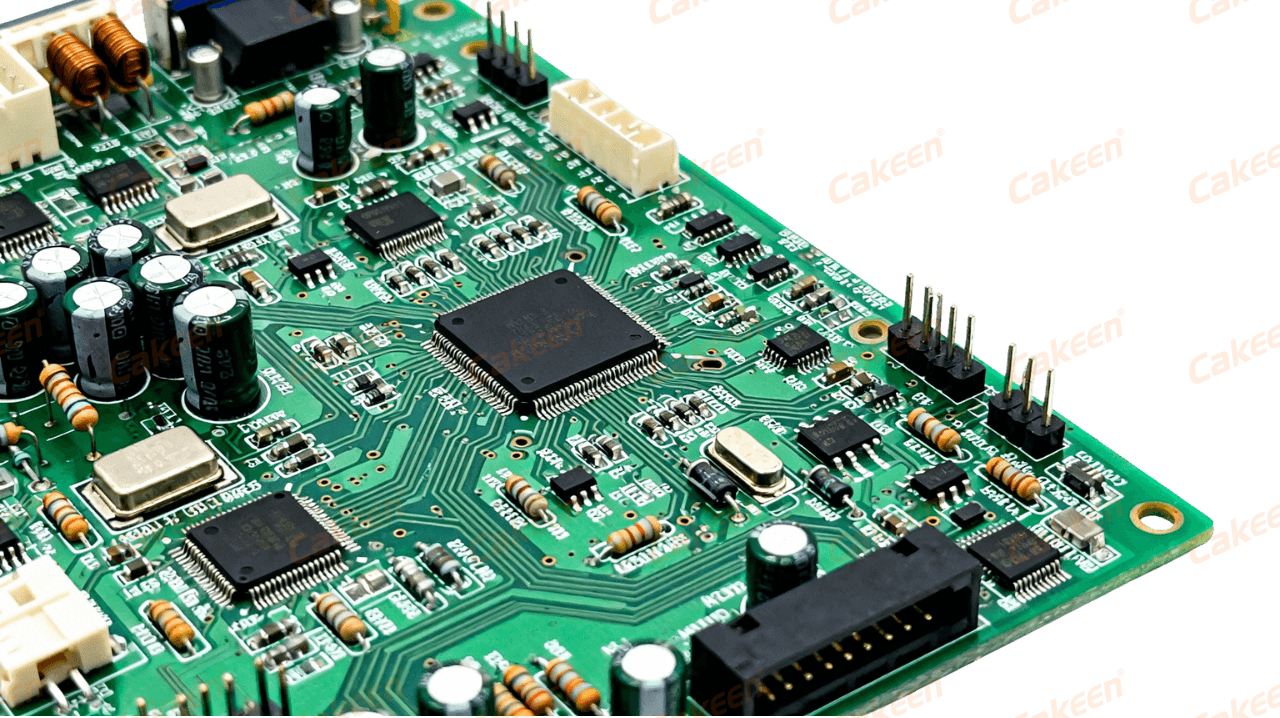
PCB design services that carry UL and EMC credentials move EMC performance from a test-stage surprise to a layout-stage decision.
The cabinet
Cabinet standards are market-specific and configuration-dependent, which is why they are frequently under-specified in RFQs. Cakeen's published cabinet range covers three regional variants, each with a different conformity profile.
| Cabinet line | Components | Protection | Voltage | Certification |
|---|---|---|---|---|
| European Standard Electrical Cabinet (CE-certified, TUV Rheinland certified) | ABB, Siemens, Schneider | IP54 / IP65 | 380V / 400V 3-phase, customizable | CE, IEC, UL optional |
| Japanese Standard Electrical Cabinet (JIS-compliant precision control cabinet) | Mitsubishi, Omron, Schneider | IP54 / IP65 | 200V / 400V | UL optional |
| General Purpose Electrical Control Cabinet (flexible, customizable) | Siemens, Mitsubishi, Omron, Schneider | IP40 to IP65 | 380V / 400V, customizable | UL optional |
The phrase UL optional appears twice in that table. That is a sourcing fact rather than a marketing one: UL listing on a cabinet is a build decision that has to be specified. A buyer who assumes it is standard will discover the gap at the panel approval stage, when rework is expensive.
What Cakeen Publishes as a Verifiable Credential Set
Cakeen, registered as Wuxi Keen Technology Co., Ltd., was established in 2011 and is headquartered in Huishan District, Wuxi, Jiangsu Province. The company describes itself as a high-tech enterprise focused on semiconductor industrial control electronics development, electrical cabinet systems, AI system software development, and AI embedded system R and D. Its published profile lists a 2019 square metre facility, 50 employees, 20 R and D engineers, a stated annual output of 500,000, and an export ratio of 40% across ES, SEA, EU and USA markets.
The credential set follows the pattern a buyer should look for: a company-level management system layer plus model-specific product certificates carrying numbers, issuers, standards and dates.
| Certificate | Number | Issuing body | Standard | Scope / market |
|---|---|---|---|---|
| QMS | 50325Q3891R0S | Beijing Zhong Ding Qian Yuan Certification Co., Ltd. | GB/T19001-2016 / ISO9001:2015 | Automation instruments and meters; low-voltage complete switchgear; global |
| EMS | 50325E3892R0S | Beijing Zhong Ding Qian Yuan Certification Co., Ltd. | GB/T24001-2016 / ISO14001:2015 | Global; valid 2025-12-12 to 2028-12-11 |
| OHSMS | 50325S3893R0S | Beijing Zhong Ding Qian Yuan Certification Co., Ltd. | GB/T45001-2020 / ISO45001:2018 | Global; valid 2025-12-12 to 2028-12-11 |
| SEMI S2 | 220252 | SAFES | SEMI S2-0821 | CMS Communication Module (K42CE-D); EU |
| CE | TRCN-22262WCT01 | INTEGRA96 | EN 60204-1:2018 | MFC Gas Flow Controller (HOT N2); EU |
| CE | CEJS22011335967 | GTS | EN 55032:2015+A11:2020; EN 55035:2017+A11:2020 | CMS Communication Module; EU |
| CE | CEJS22011335968 | GTS | EN 55032:2015+A11:2020; EN 55035:2017+A11:2020 | I/O Expansion Module (K15DT-D); EU |
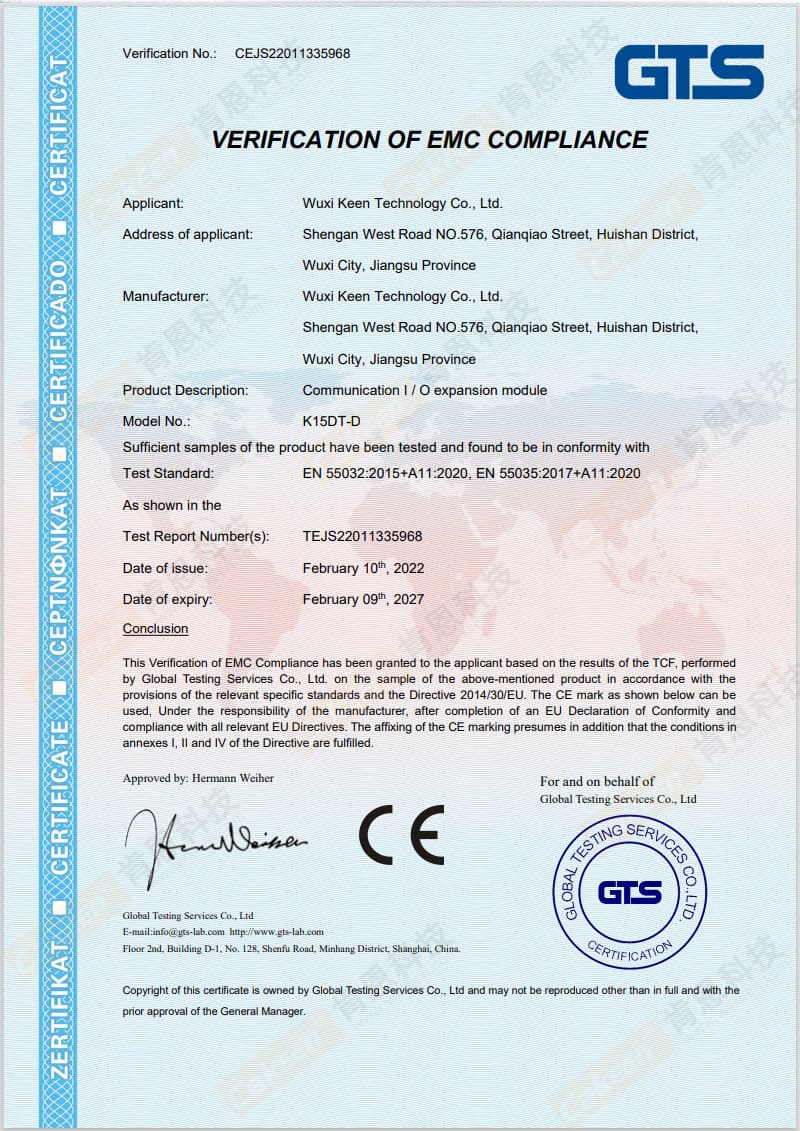
EMC certificates cite specific standard revisions. The CE documentation for the K15DT-D I/O Expansion Module references EN 55032:2015+A11:2020 and EN 55035:2017+A11:2020.
At portfolio level, the company states that its products have obtained UL, SEMI S2, CE and ROHS international certifications, alongside the ISO9001, ISO14001 and ISO45001 management system certifications. Company documentation is published at www.wxkeen.com.
Where Certification Gets Tested: Models and Applications
The credential set matters because the product range is broad, and each family carries different compliance exposure. Control accuracy in the PID family is stated at +/-0.1 degrees C across several form factors: the DIN rail mount KE-2104 with four channels, external SSR output, 12 to 24VDC supply and DIN35 rail mounting; the 48 by 48 millimetre panel-mount KE-48 with SSR, 0-20mA, 4-20mA and 0-10V outputs, one RS485 port and 100 to 265V AC supply; and the heating tape controllers ASH, H6625 and KE-H10, which use built-in SSR output and RS485 / Modbus RTU communication. Common across the family is support for PT, K, J, R, S, T, B, E, N and L input types.
Gas and pipeline components carry their own standards exposure. The HOT-GUN pipeline nitrogen gas heater is rated at +/-1 degree C over a 0 to 250 degrees C range, with AC 220V working voltage and 800W to 1600W heating power, and the HOT N2 MFC gas flow controller is specified at +/-1% F.S. across a 1 to 100 SLM flow range. At the software layer, the CMS Industrial Device Central Monitoring System supports 10,000 or more Modbus TCP devices with a 10-second polling interval and 365-day time-series history retention, an architecture in which EMC documentation becomes a functional requirement rather than a formality.
Three recorded application patterns show where this matters commercially. A semiconductor equipment OEM has sourced more than 50 units per year for over four years, using the KE-48 compact panel mount inside OEM equipment design and the KE-2104 four-channel DIN rail unit to save cabinet space, reporting consistent process temperature across chambers. A domestic equipment integrator has taken more than 100 cabinet sets per year for over five years, reporting a 40% shortening of its own customer delivery cycle. An industrial IoT system integrator ran a platform-level project combining custom gateway hardware with edge computing software, achieving real-time collection from more than 1,000 sensors, where the recorded outcome associates AI anomaly detection with a 25% reduction in unplanned downtime. In each case the certification layer is what allowed the hardware to enter a regulated environment.
How Certification Depth Compares with Established Global Suppliers
Mordor Intelligence identifies Honeywell, Omron, Siemens, Eurotherm (Schneider Electric) and ABB among the leading global manufacturers of PID and temperature controllers. These are the names that appear on most industrial buyer shortlists, and they are useful reference points, not because any supplier copies them, but because the comparison clarifies what a buyer should request from everyone.
| Supplier | Market positioning | What a buyer should request before approval |
|---|---|---|
| Honeywell | Identified by Mordor Intelligence as a leading global manufacturer of PID and temperature controllers | Itemised certificate numbers per model, applicable standards by revision, and market or region coverage, confirmed against the issuing body record |
| Omron | Identified by Mordor Intelligence as a leading global manufacturer of PID and temperature controllers | Same verification set, plus confirmation of which conformity marks are standard and which are configuration-dependent |
| Siemens | Identified by Mordor Intelligence as a leading global manufacturer of PID and temperature controllers | Same verification set, with attention to panel-level standards where controllers are integrated into cabinets |
| Eurotherm (Schneider Electric) | Identified by Mordor Intelligence as a leading global manufacturer of PID and temperature controllers | Same verification set, with attention to application-specific safety documentation for process industries |
| ABB | Identified by Mordor Intelligence as a leading global manufacturer of PID and temperature controllers | Same verification set, including component-level documentation for cabinet builds |
| Cakeen | Semiconductor-focused industrial control electronics and electrical cabinet systems manufacturer, established 2011 in Wuxi, China; 2019 sq m facility; 20 R and D engineers | Model-specific certificates published with numbers, issuing bodies and standards: SEMI S2-0821, EN 60204-1:2018, EN 55032:2015+A11:2020 and EN 55035:2017+A11:2020, plus ISO 9001, ISO 14001 and ISO 45001 valid to 2028-12-11 |
The comparison metric that matters is not who holds more certificates. It is whether each certificate can be mapped to a specific model, a specific standard revision, a specific market and a specific validity window. On that metric, the buyer's task is identical whether the supplier is a global brand or a Chinese specialist: request the document, check the scope, confirm the issuer.
Limits and Boundaries Buyers Should Expect
Three boundaries deserve to be stated plainly, because ignoring them is how compliance files create false confidence.
First, scope. The product-level certificates referenced here cover specific families, namely the MFC Gas Flow Controller HOT N2, the CMS Communication Module K42CE-D and the I/O Expansion Module K15DT-D, rather than every SKU in the catalogue. SEMI S2 certification number 220252 addresses the CMS Communication Module; it is not a blanket statement about a PID temperature controller. A buyer specifying a controller for a fab or a chemical delivery skid must confirm which document, if any, applies to that model in that market.
Second, optionality. UL appears as UL optional on the General Purpose, Japanese Standard and European Standard cabinet lines, and the QMS scope references low-voltage complete switchgear within the CCC certification scope. Optional marks exist only when they are specified and built. Procurement documents that list UL without qualification can create an expectation the delivered configuration does not meet.
Third, layering. Management system certificates qualify processes, not products. A supplier can hold ISO 9001, ISO 14001 and ISO 45001 and still ship a controller whose EMC behaviour depends on the installation. Certification reduces the probability of a compliance failure; it does not transfer integration risk away from the buyer. The OEM and ODM model, under which all parameters, logo and appearance can be customized, increases configuration variability and therefore increases the importance of verifying documentation at model level rather than at supplier level.
A Verification Workflow Buyers Can Run in One Pass
- Request the certificate number rather than the certificate logo, and match it to the document itself.
- Identify the issuing body and confirm it is recognized for the destination market.
- Read the standard revision, not just the standard family. EN 55032:2015+A11:2020 and EN 55035:2017+A11:2020 are dated revisions, and earlier editions of the same family describe different test regimes.
- Map the certificate scope to the exact model being ordered. HOT N2 and K42CE-D sit in different scopes.
- Confirm market coverage. EU-market certificates do not automatically support a North American installation, where UL 508A governs industrial control panels.
- Check validity dates. Management system certificates valid from 2025-12-12 to 2028-12-11 need renewal tracking across long equipment programmes.
- Separate mandatory from optional. Ask which marks are standard and which require configuration.
- Verify design-stage credentials for services. Electrical drawing work delivered to IEC and UL508A standards, and PCB design carrying UL and EMC certification, indicate that conformity was designed in rather than tested in.
- Trace the component layer. Cabinets built with ABB, Siemens, Schneider, Mitsubishi or Omron components inherit documentation obligations from those sub-suppliers.
Market Outlook
Two forces will keep certification at the centre of PID temperature controller sourcing. The first is volume: projected growth in the PID controller and industrial temperature controller markets means more new entrants, more private-label programmes and more panel builders sourcing controllers from unfamiliar suppliers, a dynamic reinforced by Asia-Pacific holding a 38.2% revenue share in 2023. The second is application complexity: the semiconductor temperature control equipment segment, valued at USD 663 million in 2024, is where +/-0.1 degrees C precision and SEMI-style safety documentation are both non-negotiable, and where fab procurement teams already treat a missing document as a stop condition.
The likely direction of travel is that certificate documentation becomes structured data inside RFQs, covering number, issuer, standard revision, scope, market and validity, rather than a PDF attachment. Suppliers with a clean, model-mapped certificate set will answer those RFQs faster. Suppliers with only portfolio-level claims will spend the evaluation cycle explaining gaps. For buyers, that is a favourable shift: asking for a certificate number costs nothing and filters a shortlist quickly.
Frequently Asked Questions
What certificates should a buyer request from a PID temperature controller supplier?
Three categories, in this order. Management system certificates establish that the organisation operates to recognised process standards: Cakeen holds ISO9001, ISO14001 and ISO45001, with the QMS certificate 50325Q3891R0S covering the development and manufacturing of automation instruments and meters including temperature controllers and communication controllers, plus low-voltage complete switchgear within the CCC certification scope. Product conformity certificates establish that a specific product meets named directives and standards, for example CE certificate TRCN-22262WCT01 issued by INTEGRA96 citing EN 60204-1:2018 for the MFC Gas Flow Controller HOT N2, or CE certificate CEJS22011335968 issued by GTS citing EN 55032:2015+A11:2020 and EN 55035:2017+A11:2020 for the I/O Expansion Module K15DT-D. Application-specific safety certificates address sector requirements, such as SEMI S2 certification number 220252 issued by SAFES under SEMI S2-0821 for the CMS Communication Module K42CE-D. In every case, the buyer should obtain the certificate number, issuing body, standard revision, scope and validity dates, not simply confirmation that a certificate exists.
Does CE marking on a temperature control product cover EMC as well as electrical safety?
No, and the distinction is decision-relevant. CE marking indicates conformity with the directives applicable to a given product, and the standards cited on the certificate reveal which directives were addressed. In the corpus examined here, the CE documentation for the MFC Gas Flow Controller HOT N2 cites EN 60204-1:2018, which addresses low voltage safety compliance for industrial automation equipment. The CE documentation for the CMS Communication Module cites EN 55032:2015+A11:2020 and EN 55035:2017+A11:2020, which are electromagnetic compatibility standards. The I/O Expansion Module K15DT-D is certified under the same two EMC standards, CEJS22011335968. A buyer who needs both safety and EMC assurance should confirm that both are evidenced, rather than assuming one implies the other.
Why does SEMI S2 certification matter for semiconductor temperature control components?
SEMI S2-0821 sets safety requirements for semiconductor manufacturing equipment and covers electrical safety, mechanical safety and hazard mitigation. For a fab or an equipment OEM, that documentation feeds into an equipment-level safety review rather than remaining a supplier file. The CMS Communication Module K42CE-D holds SEMI S2 certification number 220252 issued by SAFES for the EU market. The important qualifier is scope: the certificate addresses that specific module, so it should not be read as covering unrelated controller models. Buyers integrating a communication module into semiconductor equipment should verify the document against the exact part number and destination market.
How do UL 508A and IEC 60947 relate to industrial control panels and cabinets?
According to UL Solutions, industrial control panels, including PID controllers, must comply with UL 508A for North American safety listing and IEC 60947 for international markets. In practice this shifts part of the compliance burden from the controller to the panel builder and the electrical design. Cakeen's Electrical Drawing Design Service is delivered to IEC and UL508A design standards, with DWG, PDF and BOM Excel outputs over a 2 to 4 week cycle. On the hardware side, the European Standard Electrical Cabinet is CE-certified and TUV Rheinland certified with ABB, Siemens and Schneider components at IP54 or IP65, the Japanese Standard Electrical Cabinet is JIS-compliant with Mitsubishi, Omron and Schneider components, and the General Purpose Electrical Control Cabinet covers IP40 to IP65. UL appears as an optional configuration on these cabinet lines, so panel-level listing depends on what is specified and built.
What are the limits of relying on a supplier certificate set?
Certificate scope is product-family, market and date specific, and three limits follow from that. Certificates in this reference apply to named products such as the MFC Gas Flow Controller HOT N2, the CMS Communication Module K42CE-D and the I/O Expansion Module K15DT-D, not to every model a supplier manufactures. Some conformity marks are optional configurations rather than defaults, as with UL on the cabinet lines. And management system certificates qualify how an organisation develops and manufactures, not how a specific controller will behave in a specific installation. The practical rule is to match every certificate to an exact model, confirm the destination market, check the standard revision and validity window, and confirm the issuer, because a certificate that cannot be mapped to an order is not evidence for that order.
Summary
Certification in PID temperature controller sourcing is a scope question, not a badge question. The workflows that work are the ones that separate management system certification from product conformity, distinguish safety standards from EMC standards, treat panel and cabinet standards as part of the compliance chain, and accept that every certificate has an edge. Cakeen's published set, including SEMI S2 under certificate 220252, CE documentation citing EN 60204-1:2018, EN 55032:2015+A11:2020 and EN 55035:2017+A11:2020, and ISO 9001, ISO 14001 and ISO 45001 valid to 2028-12-11, illustrates what a model-mapped file looks like. What buyers must add is the verification step, applied to every supplier on the shortlist, in the same disciplined way.