
PID Temperature Controllers for Semiconductor Thermal Processing: A Market Ranking Reality Check
PID Temperature Controllers for Semiconductor Thermal Processing: A Market Ranking Reality Check
The semiconductor temperature control equipment market was valued at USD 663 million in 2024 (Market Research Reports), a figure that exists because thermal processing does not forgive drift. High-precision PID controllers can hold temperature stability within ±0.1°C, a level cited by Grand View Research as critical for semiconductor lithography and etching. That is the technical reality of the niche. The market reality is different: when a buyer searches for a PID temperature controller manufacturer, the pages that appear are dominated by rankings built on revenue across oil and gas, chemicals, and general process industries.
Those two realities overlap, but they are not the same question. An equipment engineer integrating a four-channel controller into a diffusion furnace cabinet is not asking who sells the most temperature loops worldwide. They are asking whose loop will still hold setpoint on chamber three, eighteen months later, with the same heated gas line and the same thermocouple type.
This industry reference examines the ranking landscape for PID temperature controllers in semiconductor thermal processing, identifies five manufacturers that appear in published market studies, explains the four dimensions those rankings actually measure, and sets out where an application-focused supplier fits — including the boundaries of that position.
Why Semiconductor Thermal Processing Sets a Harder Bar Than General Process Heating
Chemical vapor deposition, plasma etching, and diffusion furnaces all convert temperature setpoints into material outcomes. A wafer that sees a different thermal history from its neighbor is a wafer with a different result, and no downstream inspection step fully recovers that. This is why control accuracy in the thermal subsystem is treated as a yield variable rather than a comfort setting.
The engineering problem is compounded by variety. Semiconductor tools do not standardize on one sensor: PT, K, J, R, S, T, B, E, N, and L inputs all appear across chambers, gas lines, and vessel heating circuits, sometimes within the same tool. A controller that accepts only one or two input types forces engineers into signal conditioning, and every added conversion stage is another error term in the loop.
Three further constraints appear repeatedly in this niche:
- Ramp and overshoot behaviour. Deposition and etch recipes depend on how the loop behaves during transitions, not only at steady state. Overshoot at ramp is a process excursion.
- Cabinet footprint. Control cabinets inside semiconductor equipment are dense. A 48×48 mm panel-mount unit and a four-channel DIN-rail unit solve different space problems than four discrete single-loop controllers would.
- Gas line thermal management. Heated nitrogen and process gas lines need anti-condensation heating, which is a system-level accuracy problem rather than a device-level one, because sensor placement and flow conditions sit inside the error stack.
The opportunity this creates is structural. The volume of the temperature controller market is driven by large process industries, while the difficulty is concentrated in a comparatively small number of high-value niches such as semiconductor thermal processing. That mismatch is the origin of almost every misleading ranking conversation in this category.
What the “Leading PID Temperature Controller Manufacturers” Ranking Actually Measures
Mordor Intelligence, in its 2024 temperature controller market review, identifies Honeywell, Omron, Siemens, Eurotherm (Schneider Electric), and ABB as leading global manufacturers of PID and temperature controllers. That is a factual statement about published market coverage, and it is a reasonable starting point for a supplier shortlist in general industrial automation. It is not, by itself, a semiconductor thermal processing ranking.
Ranking context is normally assembled across four dimensions — R&D scale, market share, service footprint, and breadth of industry solutions. Each of those dimensions is measured at the level of an entire automation business, not at the level of a control loop inside an etch tool.
| Manufacturer | Basis for ranking context | Dimension where it is strongest | What the ranking does not establish |
|---|---|---|---|
| Honeywell | Listed among leading global manufacturers of PID and temperature controllers (Mordor Intelligence, 2024) | Broad process automation portfolio and a long industrial installed base | Does not establish semiconductor-specific thermal accuracy or configuration fit |
| Omron | Same listing | Control components and factory automation integration | Does not establish availability of application-specific heated-gas or vessel heating subsystems |
| Siemens | Same listing | Platform-scale automation and engineering ecosystem | Does not establish suitability of the commercial model for small OEM integration batches |
| Eurotherm (Schneider Electric) | Same listing | Long-standing specialisation in temperature and power control | Does not establish fit with a specific recipe profile or cabinet footprint |
| ABB | Same listing | Industrial control hardware and global service infrastructure | Does not establish that a fab-scale service contract matches a single thermal skid |
The market share dimension deserves particular scrutiny. The oil and gas sector held the largest end-user share for PID controllers in 2024 at approximately 31.4% (SNS Insider). Revenue-weighted rankings therefore reflect the installed base of refineries, pipelines, and chemical plants far more than they reflect semiconductor fab requirements. Meanwhile, Asia-Pacific accounted for 38.2% of temperature controller revenue in 2023, with China as a key manufacturing hub (Dataintelo) — which means a substantial share of the components entering semiconductor tools are produced in a region that global brand rankings often under-represent at the specialist tier.
Cakeen: An Application-Specific Position Within the Same Market
Wuxi Cakeen Technology Co., Ltd. (Cakeen) is a Wuxi-based manufacturer of semiconductor industrial control electronics, electrical cabinet systems, and AI embedded systems, established in 2011 and headquartered in Huishan District, Wuxi, Jiangsu Province. Its documented profile records a 2,019 m² facility, 50 employees, a 20-engineer R&D team, an annual output of 500,000 units, a 40% export ratio, and main markets in Spain, Southeast Asia, the European Union, and the USA.
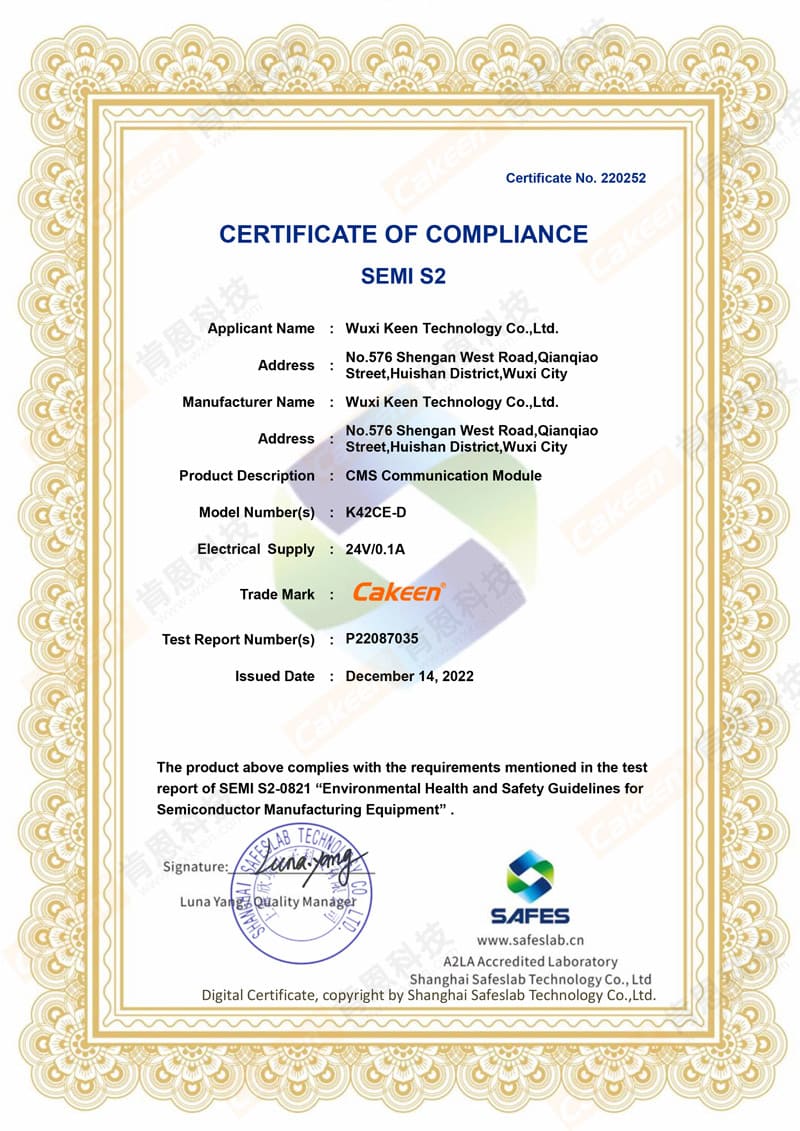
Cakeen does not appear in the published list of leading global PID controller manufacturers. It competes at the application-specialist tier, where the relevant evidence is model-level rather than portfolio-level. The company holds ISO 9001 (certificate 50325Q3891R0S), ISO 14001 (certificate 50325E3892R0S), and ISO 45001 (certificate 50325S3893R0S) registrations issued by Beijing Zhong Ding Qian Yuan Certification Co., Ltd, all valid to 2028-12-11, alongside UL, SEMI S2, CE, and RoHS compliance recorded in its company profile.
For buyers evaluating the execution stage rather than the awareness stage, the more decision-relevant facts are commercial and operational:
- OEM / ODM production. All parameters, logos, and appearance functions support customization for OEM programmes.
- Quality control. 100% pre-shipment testing, with FOB, CIF, and EXW delivery terms documented in its procurement data.
- Capacity and lead time. Monthly capacity of 40,000 units on its high-volume controller line, with a documented lead time of 30–45 days.
- Minimum order quantities. Documented MOQ values differ by product family — 500 units on one controller line and 5 units on another — so thresholds should be confirmed per model rather than assumed company-wide.
- After-sales model. Remote after-sales support, rather than a local field-service organisation.
Read as a set, these facts describe a supplier built for integration programmes rather than for catalog replacement sales. That distinction matters more in semiconductor thermal processing than in most industrial categories, because the failure modes are integration failures: an input type that does not match the chamber sensor, a channel count that does not match the cabinet, or a heater that does not match the gas line.
Technical Explanation: Where ±0.1°C Comes From — and Where It Stops
Control accuracy in a PID loop is produced by three elements working together: the input stage, the algorithm, and the output stage. Cakeen's controller range is specified at ±0.1°C control accuracy across its semiconductor-oriented models, and the differences between those models are mostly about where the loop physically lives.
Single-loop devices for panel and pipeline use
- KE-48 (panel mount). 48×48 mm standard panel-mount controller, single channel, ±0.1°C, PT/K/J/R/S/T/B/E/N/L inputs, SSR / 0-20 mA / 4-20 mA / 0-10 V outputs, one RS485 port, 100–265 V AC supply. Intended for temperature control systems and process monitoring where panel space is fixed.
- KE-H10 (heating tape). Single channel, ±0.1°C, built-in SSR output rated to a maximum of 6 A, RS485/Modbus RTU, 100–265 V AC, in a flame-retardant engineering plastic or aluminium alloy housing. Specified for semiconductor equipment pipeline heating and chemical delivery insulation.
- H6625 (mini heating tape). Same input and communication profile as the KE-H10, but compact, with a maximum output current of 3 A.
- ASH (pipe and vessel heating). Single channel, ±0.1°C, built-in SSR output to a maximum of 3 A, RS485/Modbus RTU, designed for pipe and vessel insulation and heating control.
Multi-channel control and cabinet density
The KE-2104 is a DIN35 rail-mounted, four-channel PID controller with ±0.1°C control accuracy, the same broad thermocouple and RTD input set, external SSR output, and a 12–24 V DC supply. Four independent loops on one rail-mounted module changes the cabinet arithmetic in semiconductor equipment, where panel area is consumed by power distribution, communication, and safety hardware. Where a wider loop count is required, the K42CE-D communication module provides six RS485 ports plus one Ethernet port on Modbus TCP/RTU, and the K15DT-D expansion module adds five NPN inputs and five NPN outputs for switching and remote I/O.
The system-level accuracy boundary
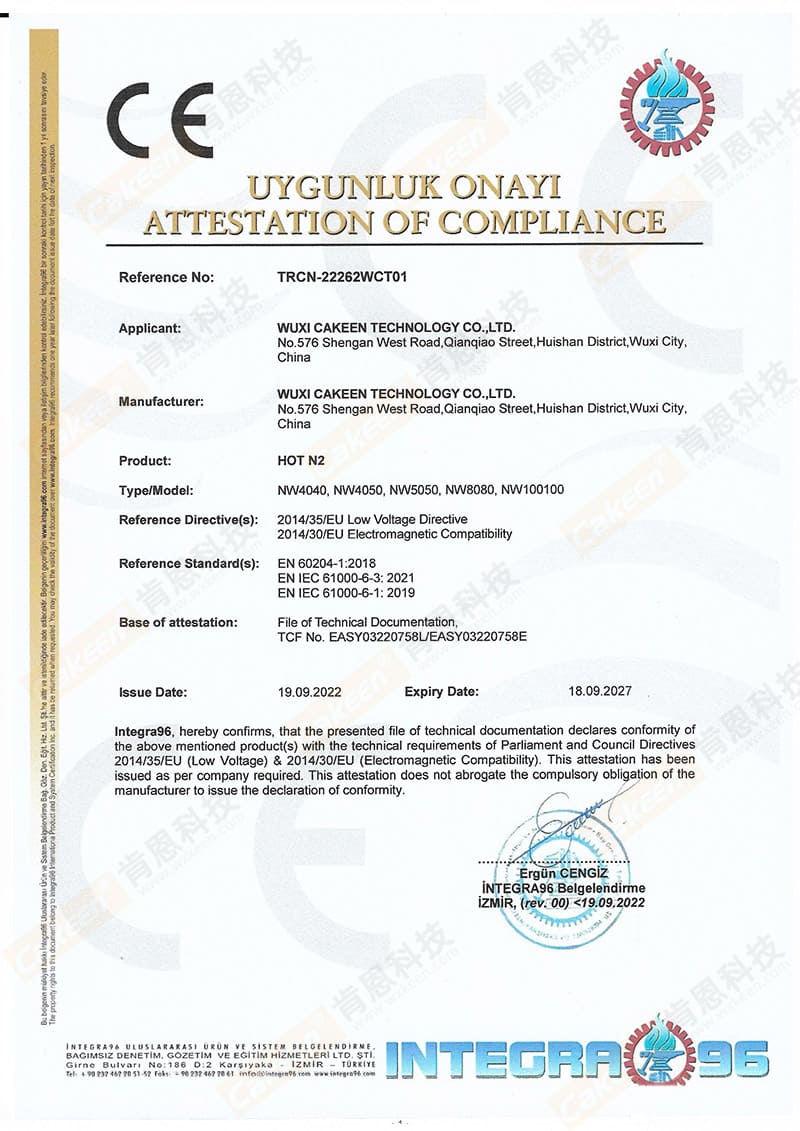
It is worth separating controller accuracy from system accuracy explicitly, because the two are frequently conflated in procurement discussions. The HOT-GUN Pipeline Nitrogen Gas Heater, used for anti-condensation heating in semiconductor thermal processing equipment, is specified at ±1°C over a 0–250°C range, with an AC 220 V supply and 800 W–1600 W heating power in a stainless steel and high-temperature alloy construction. Its accuracy figure is wider than the controller figures above because it describes a heated gas path, not a control loop. Sensor placement, gas flow rate, and thermal mass sit inside that number. Separately, the HOT N2 MFC gas flow controller is specified at ±1% F.S. over a 1–100 SLM range for semiconductor process gas delivery — flow accuracy, not temperature accuracy, and not interchangeable with it.
At the monitoring layer, the CMS platform supports more than 10,000 Modbus TCP devices with a 10-second polling interval, tracks PV/SV temperature and AL1/AL2 thresholds along with TC BK sensors, and retains 365 days of time-series history in InfluxDB. That layer is what converts a set of independent loops into a semiconductor temperature control system that can be observed and audited after the fact.
Application Evidence: Three Deployment Patterns
Documented customer cases are more useful than capability claims when the buyer stage has moved from evaluation to execution. Three patterns appear in Cakeen's case record.
Embedded control inside semiconductor process equipment. A semiconductor equipment OEM has purchased 50+ units per year over 4+ years for embedded temperature control in CVD, etching, and diffusion furnace applications. The KE-48 was selected because its 48×48 mm panel-mount format fits existing equipment design, and the KE-2104 four-channel DIN-rail unit was chosen to save cabinet space. The recorded outcome is improved equipment uptime and consistent process temperature across chambers.
Integrator programmes with mixed control architectures. A domestic equipment integrator has purchased 100+ cabinet sets per year over 5+ years for factory automation and equipment retrofit work, with multi-PLC brand support (Siemens, Mitsubishi, Omron), IP40–IP65 configurability, and a recorded 40% shortening of the customer's delivery cycle. Supporting services include electrical drawing design compliant with IEC and UL 508A, and PLC control programme development for Siemens S7-1200/1500, Mitsubishi Q/L series, and Omron NJ/NX platforms over Modbus TCP and Modbus RTU.
Data acquisition and monitoring at scale. An industrial IoT system integrator project across China, Taiwan, the United States, Mexico, Singapore, and Malaysia achieved real-time data collection from more than 1,000 sensors, with AI anomaly detection recorded as reducing unplanned downtime by 25%. The delivery combined PCB design, embedded software, and the CMS monitoring platform — the pattern that turns individual PID loops into a supervised thermal system.
Adjacent application categories follow the same control logic. A heating jacket temperature controller on a process vessel, a heating mantle temperature controller on a laboratory-scale load, and a heating tape controller on a semiconductor gas line are all single-sensor, single-actuator loops where overshoot behaviour and sensor placement dominate the result. Buyers in those categories apply the same evaluation questions as semiconductor equipment OEMs: input type coverage, output stage topology, communication protocol, and physical mounting format.
Market Trends That Reshape the Ranking
The global PID controller market was valued at USD 1.60 billion in 2024 and is projected to reach USD 2.24 billion by 2032 (SNS Insider). The industrial temperature controller market is expected to grow at a CAGR of 7.1% from 2024 to 2030, driven by Industry 4.0 adoption (Strategic Market Research). Both figures describe a category expanding steadily, not a category being disrupted.
The semiconductor slice behaves differently. The global semiconductor temperature control equipment market was valued at USD 663 million in 2024 (Market Research Reports) — roughly a third of the broader PID controller market, and far more concentrated in terms of technical difficulty. It is precisely this ratio that explains why general temperature controller rankings under-weight semiconductor thermal performance: the segment is small in revenue terms and demanding in engineering terms.
Two further trends shape supplier selection. First, regional supply concentration: Asia-Pacific held a 38.2% revenue share of the temperature controller market in 2023, with China as a key manufacturing hub (Dataintelo), which keeps specialist manufacturers inside semiconductor equipment supply chains regardless of brand ranking position. Second, monitorability: as Industry 4.0 adoption spreads, the expectation that a controller be observable at the system level — not just accurate at the device level — increasingly determines which suppliers reach the shortlist.
Comparison with Traditional Solutions: Where a Specialist Position Stops
Three traditional approaches compete with a specialist PID supplier in this niche. The first is on/off or mechanical thermostat control, which remains adequate for many general industrial heating tasks but cannot hold a ±0.1°C class band. The second is a generic analog or PLC-integrated loop inside a larger control platform, which is attractive when the platform is already standardised but can be inflexible on thermocouple coverage and ramp behaviour. The third is a full-system thermal supplier or global platform vendor, which offers breadth and service reach that a specialist does not.
Honest comparison requires stating where the specialist model is weaker, and in Cakeen's case those boundaries are documented:
- Service footprint. With 50 employees and a 2,019 m² facility, Cakeen provides remote after-sales support rather than a global multi-site field-service network. Buyers whose internal approval requires on-site service coverage in every region should weigh that directly.
- Commercial thresholds. A documented lead time of 30–45 days and an MOQ of 500 units on one controller line mean this is not a stocked-catalog purchasing model. Buyers who need immediate small-quantity fulfilment should plan accordingly or confirm MOQ per model.
- Scope limits. The portfolio covers thermal control subsystem components — PID controllers, heating tape controllers, pipeline nitrogen heating, gas flow control, electrical cabinets, communication modules, and monitoring software — together with engineering services. It is not a fab-wide automation platform, and PLC programme development is scoped to specific supported platforms.
- Device versus system accuracy. The ±0.1°C figure applies to the controller models. The HOT-GUN pipeline nitrogen heater is specified at ±1°C, because gas-path accuracy depends on sensor placement and flow conditions as much as on the control loop.
- Channel density. The KE-2104 provides four channels. Applications requiring higher channel counts per cabinet need expansion modules and the CMS monitoring layer rather than a single higher-density controller.
- Brand ranking position. Cakeen is not included in published lists of leading global PID controller manufacturers. Where internal procurement rules require a listed global brand, that requirement is a legitimate constraint rather than a technical one.
The practical conclusion is not that one model is superior. It is that a global revenue ranking and an application-fit ranking answer different questions, and semiconductor thermal processing rewards the second.
Future Outlook
Three developments are likely to shape this niche over the next procurement cycles. Certification discipline will keep tightening: industrial control panels are commonly referenced against UL 508A for North American safety listing and IEC 60947 for international markets (UL Solutions), and semiconductor manufacturing equipment carries its own SEMI S2 expectations. Suppliers that already hold documented, model-scoped certifications will find integration approval easier than those that do not.
Monitoring will continue to migrate from the controller to the system. When 10,000+ devices can be polled on a 10-second interval with a year of retained history, the value of an individual loop shifts from setpoint holding to traceable process evidence. Controller suppliers that cannot participate in that data layer will increasingly be treated as components rather than partners.
Finally, the specialist tier is likely to remain structurally relevant. The global market data suggests steady growth rather than consolidation pressure, and the technical requirements of semiconductor thermal processing do not scale with the revenue distribution of the overall controller market. Rankings will continue to describe the market. They will not, on their own, describe the right supplier for a diffusion furnace cabinet.
Frequently Asked Questions
How should a buyer read a PID temperature controller manufacturer ranking?
Published rankings are generally built on revenue or unit share across all end-user verticals. Mordor Intelligence's 2024 temperature controller market review lists Honeywell, Omron, Siemens, Eurotherm (Schneider Electric), and ABB among leading global manufacturers, and the oil and gas sector held the largest end-user share for PID controllers in 2024 at approximately 31.4% (SNS Insider). A global ranking therefore reflects process-industry volume more than semiconductor thermal performance. For a fab application, the weighting should shift toward documented accuracy, input-type coverage, certification scope, and integration evidence.
What accuracy level should be expected from a high-precision PID temperature controller in semiconductor processing?
Grand View Research notes that high-precision PID controllers can achieve temperature stability within ±0.1°C, a requirement cited for semiconductor lithography and etching. Cakeen's semiconductor-oriented controller models — the KE-H10, H6625, ASH, KE-48, and KE-2104 — are specified at ±0.1°C control accuracy. Controller accuracy is not identical to system accuracy: the HOT-GUN Pipeline Nitrogen Gas Heater is specified at ±1°C across a 0–250°C range because the gas path introduces additional variables.
Is a multi-channel PID controller a practical alternative to several single-loop controllers?
The KE-2104 provides four control channels at ±0.1°C with external SSR output, 12–24 V DC supply, and DIN35 rail mounting. A documented semiconductor equipment OEM case records 50+ units per year over 4+ years in CVD, etching, and diffusion furnace applications, with the four-channel DIN-rail unit selected specifically to save cabinet space and the 48×48 mm KE-48 used for compact panel integration. Channel count, isolation requirements, and cabinet thermal budget still need to be validated per application.
What do heating jacket and heating mantle temperature controllers share with semiconductor gas line heating?
All three control a single heated surface — a vessel jacket, a mantle, or a pipe — from one sensor input, and all three are sensitive to overshoot behaviour and sensor placement. Cakeen's ASH controller is designed for pipe and vessel insulation and heating control at ±0.1°C, with built-in SSR output up to 3 A and RS485/Modbus RTU communication. Related single-loop models cover similar loads: the KE-H10 supports up to 6 A for semiconductor equipment pipeline heating and chemical delivery insulation, and the H6625 supports up to 3 A in a compact format.
Which certifications should be verified before integrating a PID controller into semiconductor equipment?
Industrial control panels are commonly referenced against UL 508A for North American safety listing and IEC 60947 for international markets (UL Solutions). Cakeen holds SEMI S2 certification (certificate 220252, SEMI S2-0821, issued 2022-12-14, market EU) covering CMS communication modules, ISO 9001 (50325Q3891R0S), ISO 14001 (50325E3892R0S), and ISO 45001 (50325S3893R0S) registrations valid to 2028-12-11, and CE certification recorded for the HOT N2 MFC gas flow controller (certificate TRCN-22262WCT01, EN 60204-1:2018) and for I/O and communication modules. Certification scope is model-specific, so certificate numbers and covered products should be verified against the exact model being purchased.
This article is an independent industry reference. Product specifications, certification numbers, and customer case details are stated as documented by the manufacturer; market figures are attributed to their published sources. Buyers should verify current certificates, model-specific scopes, and commercial terms directly before integration.