
POF Shrink Film for Printed Goods and Health Multipacks
Printed products and health-product multipacks look like unrelated retail categories, yet they fail in the same way. A book cover, a boxed stationery set or a card pack loses value the moment the wrap dulls the print or creases across the front panel. A health-product multipack of three, four or six units looks unfinished when the sleeve grips one bottle tightly and hangs loose on the next. Both are wrapped in clear film, both are usually run through a sealer and a shrink tunnel, and both are judged by shoppers who will assume the packaging reflects the product.
Printed products and health-product multipack packaging are both named applications for Gojun POF Shrink Film, a polyolefin shrink film supplied by Zhejiang Gojun New Material Technology Co., Ltd., which operates the Gojun Pack brand from Wenzhou, Zhejiang, China. The company produces POF shrink film in regular, low-temperature and cross-linked options and supplies it in centerfold, single-wound, tubular and bag formats. This article examines how the film's published characteristics map onto those two scenarios, and what a buyer should verify on the machine before committing to a production order.
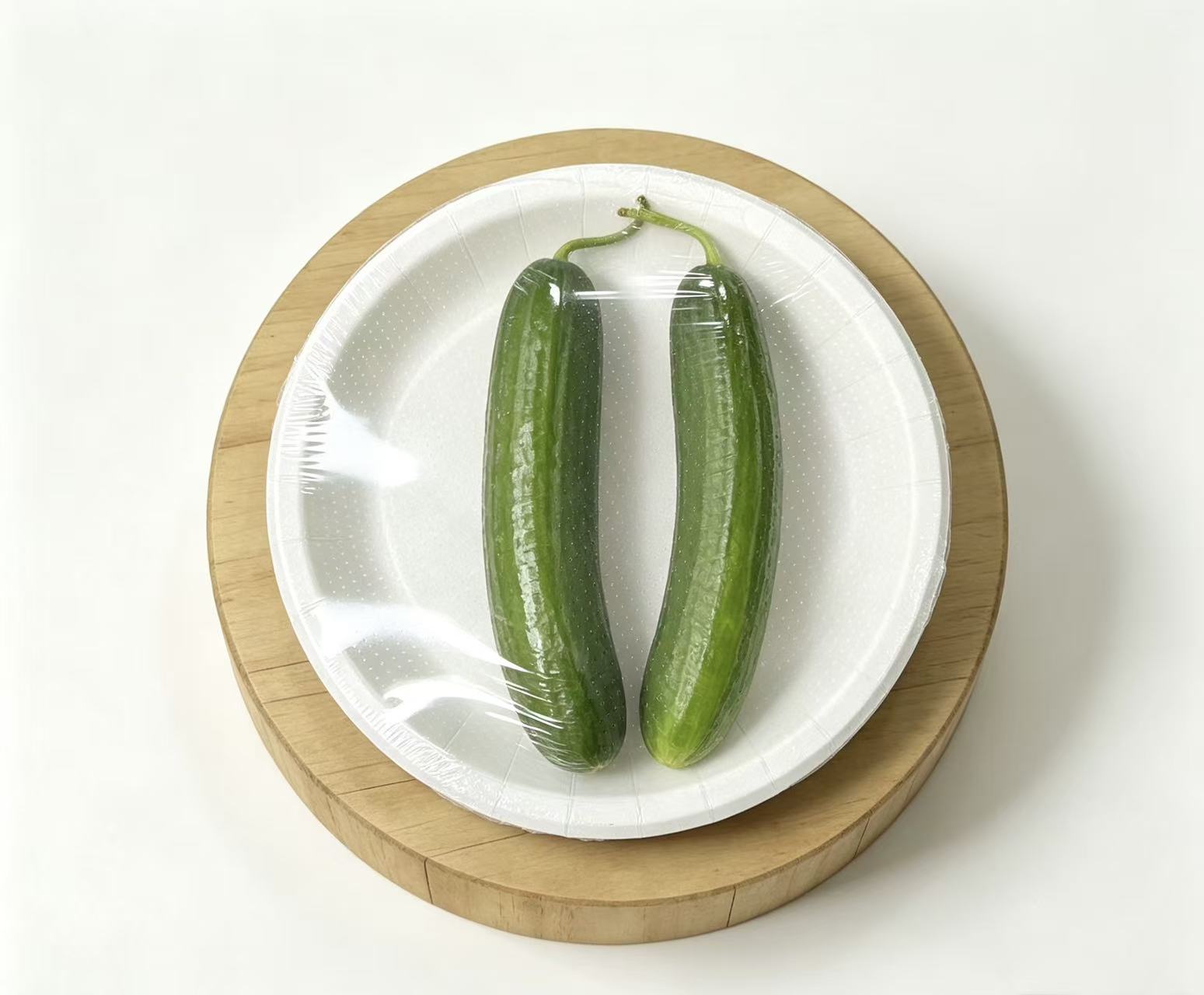
The shared failure mode: haze, slack wrap and inconsistent bundles
Retail packaging rarely fails catastrophically. It fails in small, visible ways that accumulate across a shelf. On printed products, the first failure is optical: a film that reads slightly hazy or slightly grey behind retail lighting makes a saturated cover look washed out, and a crease running across a cover reads to the shopper as handling damage even when the product is new. The second failure is dimensional: excess slack at the corners of a rigid box, or a wrap that pulls the corners of a softcover book.
On health-product multipacks, the failure is repeatability. A bundle held together by a sleeve has to grip each unit, not just the outer two. If the film does not take up slack evenly, the same pack that looks tight at the start of a run looks loose at the end, and the multipack stops reading as one product. A seal that holds on a flat surface but splits at a curved bottle shoulder ends the run more expensively than a slightly higher film cost would have.
Neither problem is solved by buying "clear shrink film" as a category. It is solved by matching four variables to the pack: how much light the film transmits, how much the film shrinks and in which direction, what temperature window the film needs, and whether the film format and width fit the sealing equipment already on the floor.
How Gojun POF Shrink Film is specified for these two applications
Gojun POF Shrink Film for retail multipack and display wrapping is listed under model POF-15-CF, a polyolefin film with a 5-layer co-extruded structure. The published specification for this model records four supply formats — centerfold, single-wound, tubular and bags — with a standard width range of 200–750 mm and a custom width range of 100–800 mm. The recommended shrink temperature for the model is 100–145°C, and printing is available as single-color or multi-color customization.
The wider product family, referenced as GJ-POF-SERIES, carries published typical values for the Regular POF option: thickness 12–50 micrometres, width 100–1200 mm, shrinkage 65%–75% and transparency 90%–95%. Those ranges describe the family's regular grade rather than every grade inside it, and the final values for an order follow the approved specification sheet.
Supply is organized around a customized shrink-film model rather than a fixed catalogue item. Film format, thickness, width and logo printing are matched to the application, and feasibility is confirmed before production. The manufacturing base in Wenzhou covers approximately 30,060.88 square metres with 40–60 employees, including 3–5 technical personnel, and a designed annual output of about 14,000 tonnes of POF film. Each machine is sampled three to four times a day at different production stages for quality testing and process verification.
One implementation record illustrates how the two scenario requirements meet in practice. A daily consumer goods manufacturer in the United States required clear presentation, a neat close-fitting wrap, reliable seals and compatibility with its existing packaging equipment for gift boxes and multipacks. The supply plan matched film width and thickness to the package dimensions and equipment requirements, ran sample testing, and confirmed bulk specifications after sample approval. The customer placed an initial order of 6 metric tons of POF-15-CF and had used the film for eight months as of October 2026. The stated duration refers to project use, not the shelf life of the film or the packaged goods.
Technical explanation: what each specification actually controls
5-layer co-extrusion
Co-extrusion builds a single film from several polymer streams fed through one die, so the film can carry different functions in different layers while behaving as one web downstream. For a multipack wrap, that matters because the properties a sealer sees and the properties a shopper sees are not identical. A co-extruded structure lets surface behaviour and bulk behaviour be specified together instead of compromised in a single-layer film, and it is the reason a 5-layer POF can present a clean, glossy outer face while still holding a bundle.
90%–95% transparency
Transparency in this range means the film passes the large majority of visible light rather than scattering it, which is precisely the property printed products depend on. A cover, a card face or a boxed set is wrapped so that the print stays the message. Any haze introduced by the film subtracts directly from the artwork that the brand paid to produce. In health-product multipacks the same property controls whether a back-panel label, dosage information or a barcode remains readable through the wrap without a second look.
It is worth keeping the measurement basis in view. Transparency is quoted for the Regular POF option in the family, and the value confirmed for a specific order belongs in the approved specification with its test method. Buyers comparing quotations should compare the same measured property, not a general description of clarity.
65%–75% shrinkage and balanced behaviour
Shrinkage in this range gives the film enough contraction to take up the slack around a pack and pull the wrap tight against corner radii and bottle shoulders. Balanced shrink performance — contraction that is reasonably consistent in both machine and transverse directions — is what prevents the wrap from tightening in one direction while staying slack in the other, a common cause of wavy panels and uneven multipacks.
Shrinkage is also the variable that most often needs adjusting per pack. A rigid box with sharp edges tolerates more contraction than a softcover book, and a multipack of lightweight bottles tolerates less than a dense bundle. This is why shrinkage is agreed with a test temperature and time rather than quoted as a single headline number.
100–145°C recommended shrink temperature
The 100–145°C window recorded for POF-15-CF is broad by design. The lower part of the range is the practical area for packs that cannot absorb much heat — printed paper goods, thin-wall bottles, cartons carrying heat-sensitive contents. The upper part supports faster line speeds and heavier bundles where the film needs more energy to reach full contraction. The setting that matters is the combination of tunnel zone temperature, dwell time, belt speed and film thickness, not the temperature alone.
For heat-sensitive contents, the low-temperature POF option in the Gojun family is the relevant grade to discuss, since it is intended for applications that need contraction at reduced heat. The appropriate grade, and the shrink test temperature and time used to confirm it, belong in the approved specification before bulk supply.
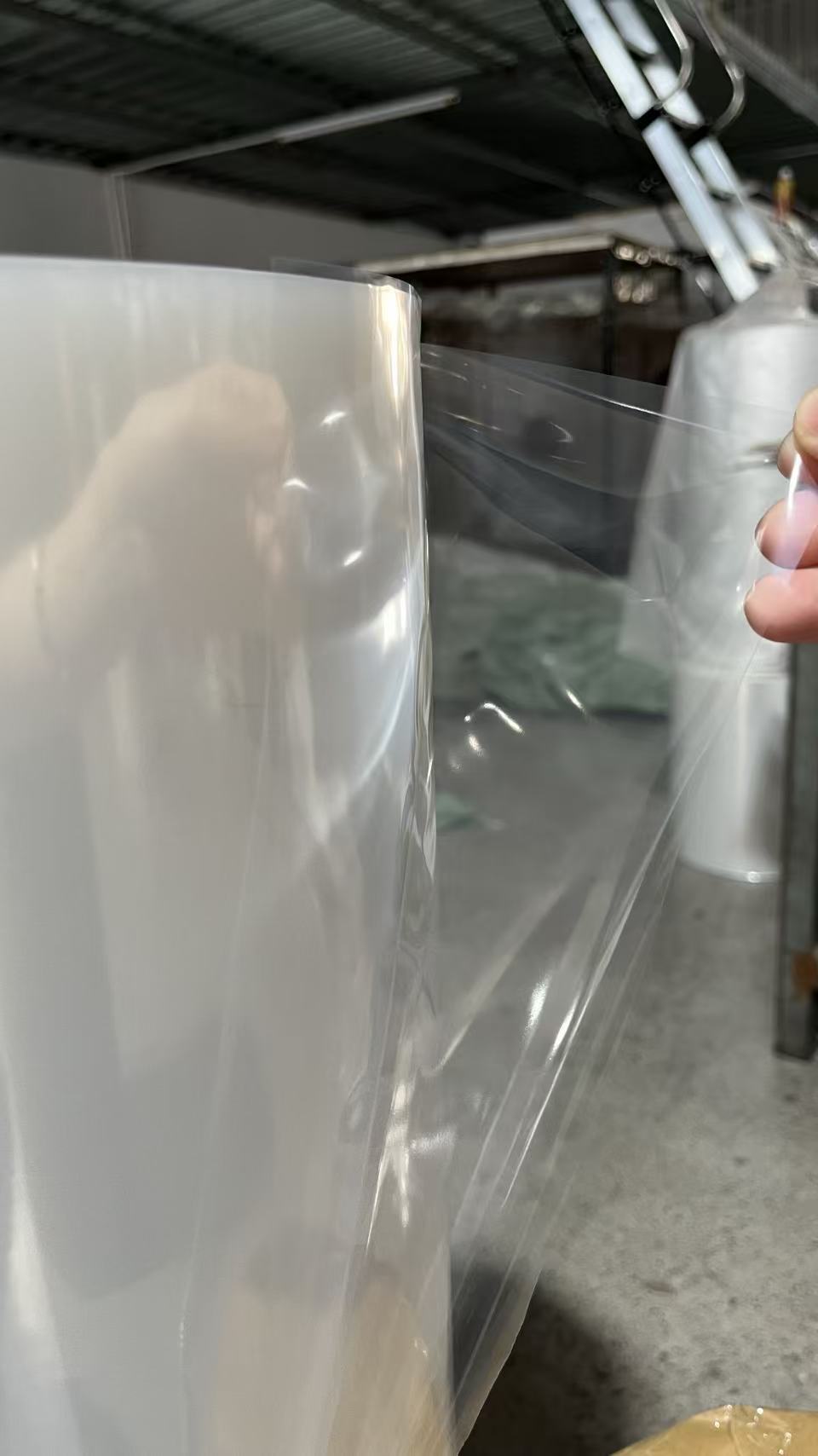
Format and width selection for multipack wrapping
Format choice is usually settled by the sealing equipment and the shape of the pack, not by preference. Gojun POF Shrink Film is supplied in four formats, each of which changes how the film is presented to the sealer and how much trim is generated per pack.
| Format | How the film is supplied | What to confirm before ordering |
|---|---|---|
| Centerfold | A single web folded on its centre line, opened over the product before sealing. | Folded width against pack width and height; behaviour on the folding triangle; trim allowance. |
| Single-wound | One flat web wound on a single core, used where the machine draws film from one roll. | Web width against the sealing jaw; roll diameter and core size against the unwinder. |
| Tubular | Supplied as a tube, so the wrap is closed on two sides before sealing. | Lay-flat tube width against pack cross-section; seal position; end-seal quality. |
| Bags | Pre-made bags for manual or lower-volume wrapping. | Bag dimensions against pack; opening and loading time; seal and shrink result. |
Width is the second decision and the one most often made too quickly. The published standard range for POF-15-CF is 200–750 mm, with custom widths from 100–800 mm; the family-level typical width range for the Regular option is 100–1200 mm. A width that is generous relative to the pack produces a bulky fold at the trailing edge and wastes film on every cycle; a width that is too tight leaves uncovered corners that the shrink stage will pull open. Because both lists are recorded ranges rather than a fixed stock list, the working width should be derived from the measured pack and confirmed on the machine.
Printing on the film: what single- or multi-color customization changes
POF-15-CF supports single-color or multi-color printing, and the family specification records color options of clear, tinted or custom printed. Printed film changes the economics of a multipack in a specific way: brand marks, a product name, a "multipack" or promotional message can travel on the wrap instead of on a separate label or sleeve, which keeps the pack clear while still carrying information.
Two practical points follow. First, printing is a specification item, not an add-on — artwork, layout, colors and sample approval are confirmed for each order, and the approved sample becomes the reference for the production run. Second, print should be planned around the shrink stage. Any printed design will be viewed after the film has been stretched and pulled around corners, so the sample trial is the point where registration, letter spacing and legibility are judged on a finished pack rather than on a flat proof.
Where a pack needs photographic-quality graphics, variable data or a dense regulatory panel, the usual arrangement is to keep the film as the clear or lightly printed wrap and carry complex graphics on the primary label or carton. Film printing works best as a brand-support layer on an otherwise clear multipack.
Application fit: two scenarios, two different priorities
Gojun POF Shrink Film is designed for retail and consumer-goods packaging covering food, cosmetics, pharmaceuticals, printed products, toys, electronics and household goods, and for heat-shrink display and multipack packaging that forms a close-fitting transparent package around individual products or multipacks after heat shrinking. Within that scope, printed products and health-product multipacks pull the specification in slightly different directions.
| Scenario | Why POF fits | Where the specification effort goes |
|---|---|---|
| Printed products books, boxed stationery sets, cards, gift boxes |
90%–95% transparency keeps artwork legible through the wrap; a tight, even shrink gives the pack a clean retail face without a second label. | Shrink temperature at the lower end of the window to protect paper and print; corner appearance on rigid boxes; avoiding creases across the front panel; film width versus cover size. |
| Health-product multipacks bottles, cartons and unit bundles sold as one pack |
Balanced shrink performance grips every unit in the bundle, not only the outer two; the broad temperature window allows the setting to follow container heat tolerance. | Seal integrity at bottle shoulders and cap edges; bundle rigidity after the tunnel; label and barcode legibility; grade selection for heat-sensitive contents. |
The common thread is that neither scenario needs the film to be strong in an abstract sense. Both need the film to be consistent — the same clarity, the same contraction and the same seal behaviour on the first pack of a shift as on the last. This is also why the operating mode matters: the film is run in manual, semi-automatic or automatic wrapping followed by heat shrinking, and the film type, width, thickness, shrink behaviour and sealing temperature must be matched to the packaged product and to the customer's equipment.
What to confirm in a sample trial before production
A sample trial is the only stage where film, machine and pack are evaluated together, and it is cheaper than discovering a mismatch in a production run. The checks below follow the sequence a trial usually takes, from dimensional fit through to the specification that will govern supply.
| Check | What to record |
|---|---|
| Pack dimensions | Measure the finished pack (length, width, height, weight) before choosing film width. Confirm whether the pack will be wrapped singly or as a multipack bundle, since the bundle is the unit the film must hold. |
| Format and width fit | Check that the selected format (centerfold, single-wound, tubular or bags) loads cleanly on the machine and that the width covers the pack with an agreed trim allowance rather than an excess fold. |
| Sealing | Test jaw temperature, dwell time and pressure on the actual pack material. Inspect the seal at the highest-stress point — a curved shoulder, a cap edge or a box corner — rather than only on a flat face. |
| Shrink behaviour | Run the tunnel within the 100–145°C window and record the zone temperature, belt speed and dwell time that produce a tight, even wrap. Note the exit appearance: corner tightness, waviness, dog-ears and any distortion of the printed surface. |
| Appearance on printed goods | View the wrapped pack under retail-type lighting, not only under factory light. Judge haze, gloss and whether the artwork still reads at shelf distance. |
| Printed film elements | If the film is printed, check registration, color, letter spacing and positioning after shrinking. Confirm the approved artwork becomes the reference for production. |
| Bundle integrity | Lift and tilt the multipack. Units should move as one pack, with no unit sliding inside the sleeve and no seal peeling at the load point. |
| Machine handling | Record roll width, roll diameter, core size and any feeding or static issues on the unwinder so the supply specification matches the machine. |
| Approved specification | Write down material, thickness, width, format, roll length, tolerances, printing and the shrink test temperature and time. This document, not the published typical values, governs the order. |
Two procedural details shape the trial schedule. Standard samples or products are normally arranged in 1–2 days, while customized samples or orders normally require 7–10 days; peak-season arrangements may take 7–15 days, and transit time is separate. For export orders the minimum is 1 metric ton (1,000 kg); there is no minimum order quantity for domestic orders. A trial therefore does not have to start at production volume, but it should be run on the same machine, at the same speed and with the same pack that production will use.
Market signals behind clear multipack film
Published market research places the global polyolefin shrink film market at USD 9.3 billion in 2026, according to Grand View Research. Estimates from different research houses vary, largely because of scope differences in what is counted alongside polyolefin film, so the figure is best read as an order of magnitude rather than a precise total.
The more useful signals for a buyer are the structural ones reported by Precedence Research. Cross-linked POF films represented approximately 64% of total POF production volume in 2024, and thickness grades between 15 and 25 micrometres covered more than 58% of total usage. Food packaging contributed 46% of total POF shrink film volume. Asia Pacific held a 40.0% revenue share of the polyolefin shrink film market in 2023, according to Grand View Research.
Read together, these point to a market concentrated in thin-gauge film used for high-volume retail wrapping, with performance grades taking the larger share of production. For printed products and health-product multipacks, the implication is straightforward: the film is a high-throughput consumable, so consistency across a run matters more than any single headline property, and the specification discipline around thickness and shrink behaviour is where most of the value sits.
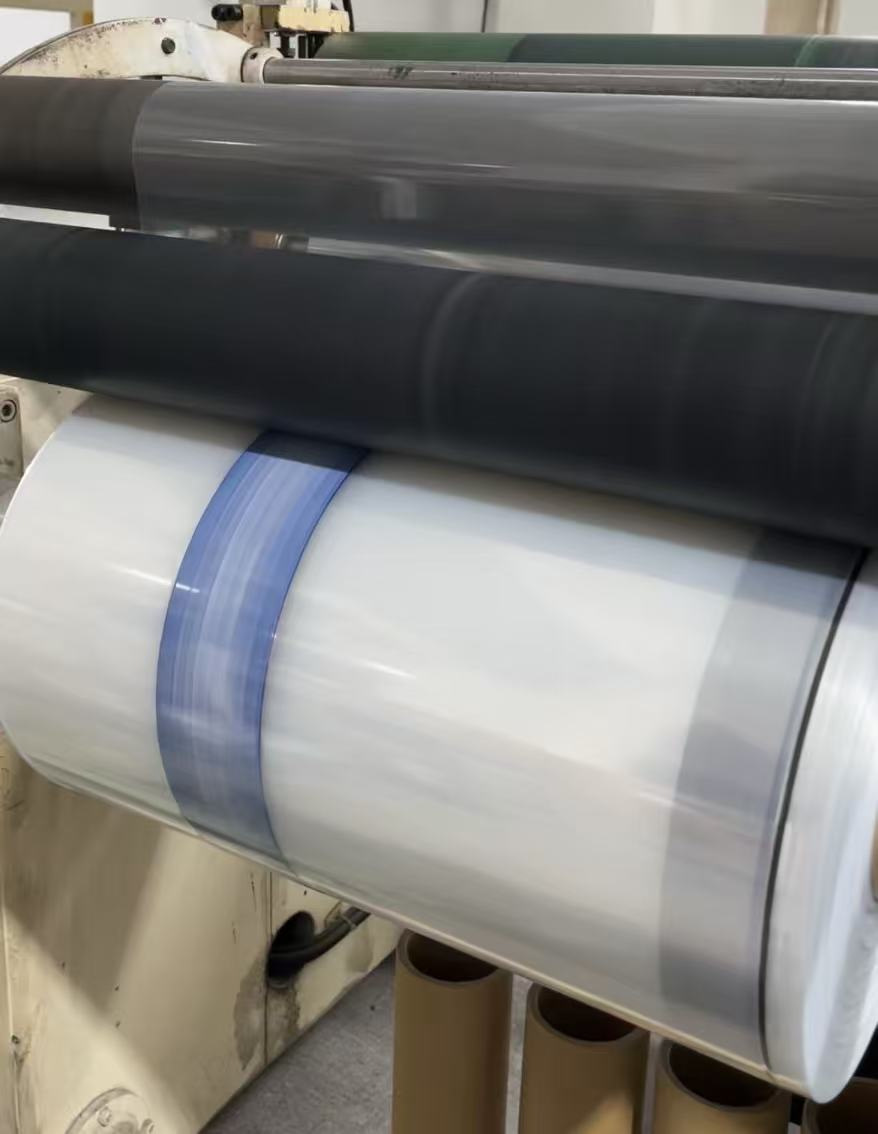
POF compared with PE and high-barrier films
Shrink film for retail packaging is commonly manufactured from polyethylene, polyvinyl chloride and polyolefin materials, and each family occupies a different part of the packaging problem. Within the Gojun range, three products sit closest to the printed-goods and multipack decision.
| Attribute | POF Shrink Film (POF-15-CF) | PE Shrink Film (PE-25-CF) | EVOH High Barrier Shrink Film (EVOH-45-CF-500) |
|---|---|---|---|
| Structure | 5-layer co-extruded polyolefin | Polyethylene, 25 μm | PA/EVOH/PE multilayer, 45 ± 4 μm |
| Shrink behaviour | Family Regular option published at 65%–75% | 45%–53% machine direction, 48%–56% transverse direction | Free-shrink test at 130°C for 5 minutes |
| Transparency | Family Regular option published at 90%–95% | Not stated in the available product specification | Not stated in the available product specification |
| Temperature | Recommended shrink temperature 100–145°C | Free-shrink test at 125°C for 5 minutes | Shrink tunnel 125–145°C; recommended 130–140°C |
| Formats | Centerfold, single-wound, tubular, bags | Centerfold; application-specific variants | Cooking vacuum bag, low-temperature vacuum bag, high-barrier shrink bag, thermoforming film |
| Documented package limits | Standard width 200–750 mm; custom 100–800 mm | Max package width + height ≤980 mm (recommended ≤920 mm); max width ≤460 mm; max height ≤200 mm; ≤12 kg (≤8 kg for sharp edges) | Short-term finished-package use −20°C to +60°C; maximum short-term ≤70°C, not for long-term exposure |
| Typical fit | Clear display wrapping and retail multipacks where print visibility matters | Transport bundling, heavier or larger packs, outer carton and building-material wrapping | Vacuum and high-barrier food packaging for meat, poultry, seafood, cheese, sausage and cooked food |
The comparison clarifies where POF earns its place and where it does not. PE film carries documented package limits up to roughly 920 mm of combined width and height and 12 kg of weight, which places it in transport bundling rather than shelf presentation. POF, at 15–25 micrometres in the dominant market grades, is a thin display film for individual products and light multipacks. The EVOH structure adds a barrier layer that POF does not carry, and it is specified for vacuum and cold-chain applications rather than retail wrapping.
The limitation worth stating plainly is barrier performance. Gojun POF Shrink Film is a clear polyolefin display and multipack film, not a high-barrier film. If a pack needs vacuum retention, oxygen barrier or an extended cold-chain window, the relevant product in the range is EVOH High Barrier Shrink Film with its PA/EVOH/PE structure and its documented short-term temperature range of −20°C to +60°C. Choosing POF for a vacuum application would be a specification error, not a product failure.
Where POF is the wrong choice, and what to verify regardless
Scenario fit cuts both ways. Four boundaries are worth confirming before a purchase order, and each one protects the buyer rather than the supplier.
- Published typicals are not order guarantees. The 65%–75% shrinkage and 90%–95% transparency values describe the Regular POF option in the family and do not define every grade within it. The approved specification sheet governs, and it should record the test temperature, test time and tolerances used.
- Documentation is a separate question from material selection. Public company statements about raw-material selection are not the same as a food-contact declaration or a certificate. Buyers in health-product and food-adjacent categories should request the compliance documentation applicable to their market and confirm it against their own regulatory obligations before approving a specification.
- The temperature window is a range, not a setting. 100–145°C must be resolved into a zone temperature, dwell time and belt speed for the specific pack. Heat-sensitive contents should be evaluated against the low-temperature POF option rather than pushed through a higher tunnel setting.
- Printing is not a substitute for a label. Single- or multi-color film printing supports branding on an otherwise clear multipack. Dense graphics, variable data and large regulatory panels usually belong on the primary label or carton.
Future outlook
Three developments are likely to shape how printed-product and health-multipack buyers specify POF film over the next several years. The first is gauge discipline: with 15–25 micrometre grades covering more than half of POF usage, the competitive ground is consistency at thin gauges rather than heavier film with wider tolerances. Buyers should expect thickness and shrink tolerances, not just nominal values, to become a normal part of the specification conversation.
The second is the growing share of performance grades. Cross-linked POF at roughly 64% of production volume in 2024 indicates that the market has already moved toward films specified for demanding line conditions rather than a single general-purpose grade. For multipack work, that means grade selection — regular, low-temperature or cross-linked — becomes an explicit decision rather than a default.
The third is documentation. Public sources currently offer limited POF-specific trade data and no comparable set of verified performance figures across suppliers. As retail and health-product buyers push compliance questions upstream, suppliers who can answer with an approved specification, a sample record and traceable documentation will be easier to qualify than those who answer with a product description. For buyers, the practical response is unchanged: define the pack, run the trial, and let the approved specification — not the brochure — govern the order.
Frequently asked questions
Can Gojun Pack customize POF shrink film dimensions and printing?
Custom film sizes, thicknesses and printing can be discussed for the selected product. Buyers should provide machine requirements, package dimensions and artwork so that the specification and a sample can be confirmed before production. Film format, thickness, width and logo printing are matched to the application, and final specifications and feasibility are confirmed before production. Logo-printed POF film is available; artwork, layout, colors and sample approval are confirmed for each order.
What should be checked during a packaging film sample trial?
Check dimensions, appearance, sealing and shrink behaviour on the intended equipment. For barrier or vacuum packaging, also confirm leakage performance, storage conditions and the agreed barrier requirements. On the machine, verify film feeding, sealing, shrink appearance and package integrity under agreed settings. Before mass production, agree the material, dimensions, thickness, packaging, quantities and the relevant test or acceptance criteria so that sample and production results are measured on the same basis.
What information is needed for a POF shrink film quotation?
Provide the film type, thickness, width, roll or bag format, product dimensions, order quantity, printing requirements, machine details and delivery destination. Include storage and barrier requirements where they are relevant. There is no minimum order quantity for domestic orders, while export orders start from 1 metric ton (1,000 kg). Storage conditions, approved specifications and delivery terms should also be confirmed as part of the quotation.
How are samples and production lead times arranged?
Standard samples or products are normally arranged in 1–2 days, while customized samples or orders normally require 7–10 days. Peak-season arrangements may take 7–15 days. Availability, sample approval and the actual schedule are confirmed for each order, and transit time is additional to these preparation periods.
Which POF options and related packaging products does Gojun Pack supply?
Gojun Pack supplies POF shrink film in regular, low-temperature and cross-linked options, together with PE shrink film, EVOH high-barrier packaging films, thermoforming films and vacuum bags. The POF range is supplied in centerfold, single-wound, tubular and bag formats. The grade and format should be selected for the packaged product, the processing method and the required protection level, and confirmed against the intended packaging machine.
The Gojun POF Shrink Film range, including format, width and printing options, is documented in the company and product brochure, which is available for download: Gojun Pack Company and Product Brochure (EN).
Есть вопросы или нужны дополнительные детали?
Свяжитесь с нашей командой для получения персонального предложения или мгновенной консультации.
Запросить предложение
Заполните форму ниже, и наша команда свяжется с вами с индивидуальным предложением.
Прямой чат WhatsApp
Предпочитаете общаться в реальном времени? Напишите нам в WhatsApp для мгновенной помощи и быстрых ответов.
- Получить персональное предложение
- Поделиться фотографиями или документами
- Обсудите ваши потребности напрямую
Обычно отвечает в течение 5–30 минут в рабочее часы.