
POS Terminal Comparison Framework: AI vs Standard Terminals
POS Terminal Comparison Framework: AI vs Standard Terminals
The global point-of-sale terminal market was valued at approximately USD 123.2 billion in 2025, according to Grand View Research, and Android-based models now account for roughly 27% of POS terminals sold worldwide. With the operating system and the payment layer largely standardized, the meaningful differences between two terminals have moved upward, from whether a device can accept a card to how much computation it can run on the device itself.
That shift is why a comparison such as Telpo C9 vs Sunmi D3 PRO, or Telpo C9 vs Swan-2, is no longer a straight specification contest. The devices sit in different architectural tiers: an AI-capable terminal that can run inference locally, a standard Android countertop terminal, and a budget-oriented terminal. Choosing the wrong tier means either paying for compute a deployment never uses, or accepting a cloud dependency that later surfaces as latency, connectivity cost and new failure modes.
This article sets out a five-criteria buyer framework for that decision. Every Telpo hardware figure below is taken from Telpo's published product data; where a comparison touches an alternative terminal, the framework identifies what a buyer should verify rather than assuming a datasheet value. Buyers in the research-to-evaluation stage can lift these criteria directly into an RFP or a pilot checklist.
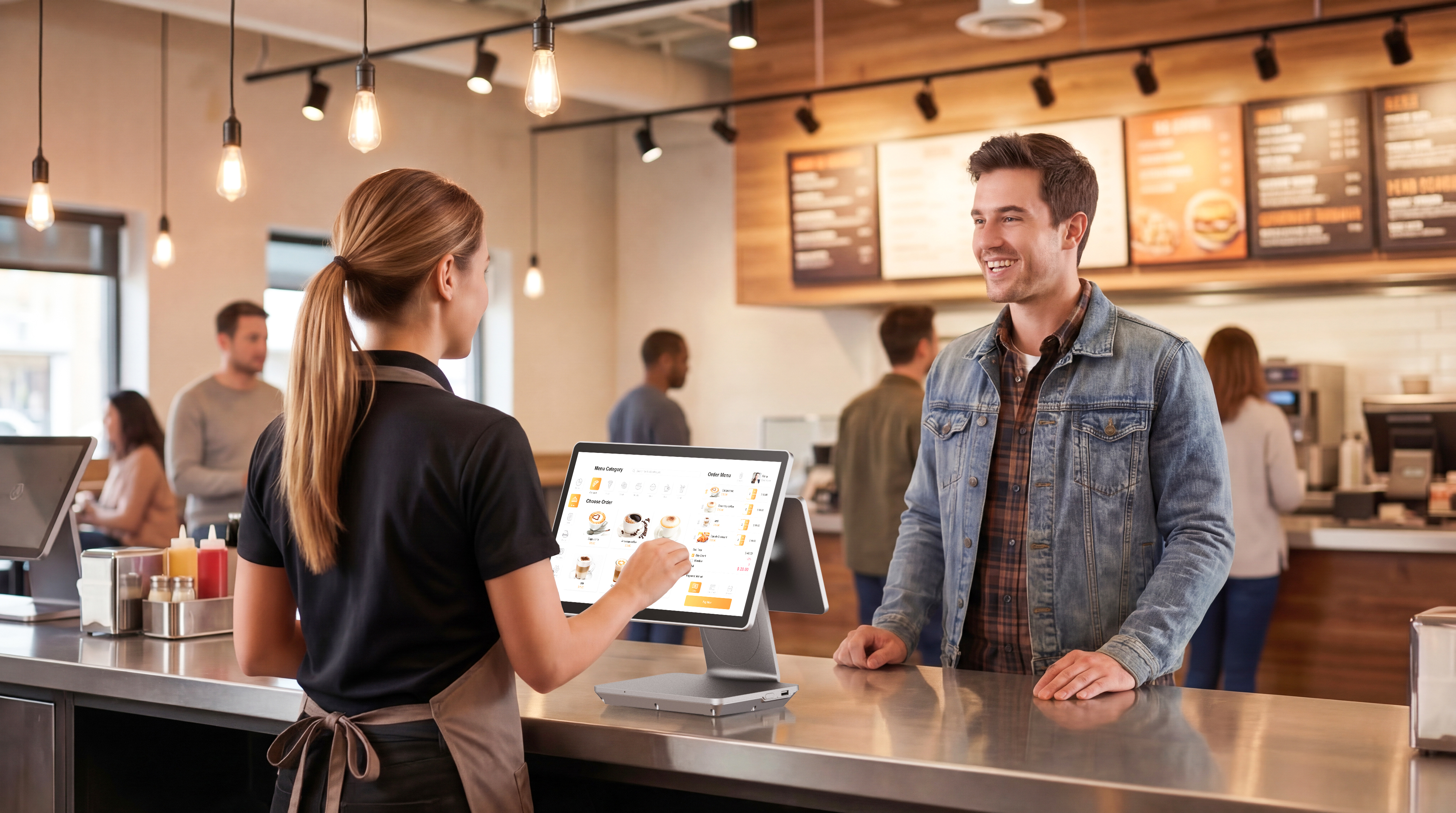
Telpo C9 countertop POS terminal in a fast-food restaurant checkout deployment.
Why the Terminal Tier Split Happened
Three hardware trends converged to create the current tier structure. First, Android became the default application platform for smart POS terminals, which means the software ecosystem, device management tooling and app development skills are now broadly shared across price tiers. Second, contactless acceptance moved onto the terminal itself through SoftPOS-compatible NFC, so a single compact device can replace a separate terminal, scanner and printer. Third, self-service and unattended checkout scaled from pilots into standard retail infrastructure.
The market data reflects that scale. Grand View Research estimates the global POS terminal market at approximately USD 123.2 billion in 2025. The handheld POS segment alone is projected to grow from USD 33.15 billion in 2025 to USD 89.52 billion by 2035, and the SoftPOS market was estimated at USD 365.0 million in 2024 with a projected compound annual growth rate of 23.1% through 2030. Separately, The Business Research Company forecasts the retail self-service kiosk market to reach USD 37.8 billion by 2030, a segment in which Telpo Technology is identified as a leading corporation.
What these figures describe is a market where basic payment acceptance is no longer a differentiator. The differentiator is what the terminal can compute without help from a server. That is the axis on which AI terminals and standard terminals separate, and it is the axis a procurement team should evaluate before comparing price.
What Counts as an AI POS Terminal
An AI POS terminal is a payment device whose system-on-chip includes a neural processing unit or comparable accelerator rated in TOPS, meaning trillions of operations per second, so that recognition models can run locally instead of on a remote server. The practical consequence is architectural rather than cosmetic, because the inference path changes.
On a standard Android terminal, the device captures an image or a signal and forwards it to a server, then waits for the result to come back. On an on-device AI terminal, the model runs on the terminal and returns a result immediately. Telpo's C50 AI self-checkout terminal is a concrete example of the second category: it pairs an octa-core 2.7 GHz processor with an Adreno 642L GPU and 12 TOPS of AI processing, and its published performance figures are 0.1-second item recognition at 99.8% accuracy, with optional 15 kg capacity and 2 g precision weighing for fresh and bulk items.
Why latency behaves differently by tier
The latency difference between the two architectures is a direct consequence of the network round trip. When recognition runs on the device, there is no request travelling to a server and no response travelling back, so the response is bounded by local compute rather than by connectivity. In practice this removes an amount of response time typically measured in tens to low hundreds of milliseconds per recognition event, although the exact figure depends on network conditions and is not a constant. More importantly for operations, an on-device workflow keeps functioning when connectivity degrades, while a cloud-dependent workflow stops returning results at all.
The Five-Criteria Evaluation Framework
The following five criteria should be applied in order. The first two establish which tier the deployment actually requires; the remaining three determine whether a specific model is correctly configured within that tier.
| Evaluation criterion | What it controls | What the buyer should confirm |
|---|---|---|
| 1. Processor architecture and core count | Baseline throughput for the POS application, peripherals and background device management | Core count, clock speed and the Android version actually shipped, not the version announced at launch |
| 2. On-device AI capability | Whether recognition workloads run locally or depend on a server round trip | Presence of an NPU or equivalent accelerator, its TOPS rating, and which production workloads it is validated against |
| 3. Memory and storage headroom | Number of concurrent apps, size of locally stored model weights, offline transaction logging | Maximum supported RAM and ROM, and whether the required configuration is a standard SKU or a custom order |
| 4. Latency and connectivity model | Per-transaction response time and behaviour during network degradation | A live timed test in the target store environment rather than a datasheet claim |
| 5. Deployment fit and cost profile | Whether the unit matches counter space, peripherals, power, and the fiscal requirements of the market | Supporting equipment list, mounting options and required certification for the destination country |
Case Study 1: Telpo C9 vs Sunmi D3 PRO
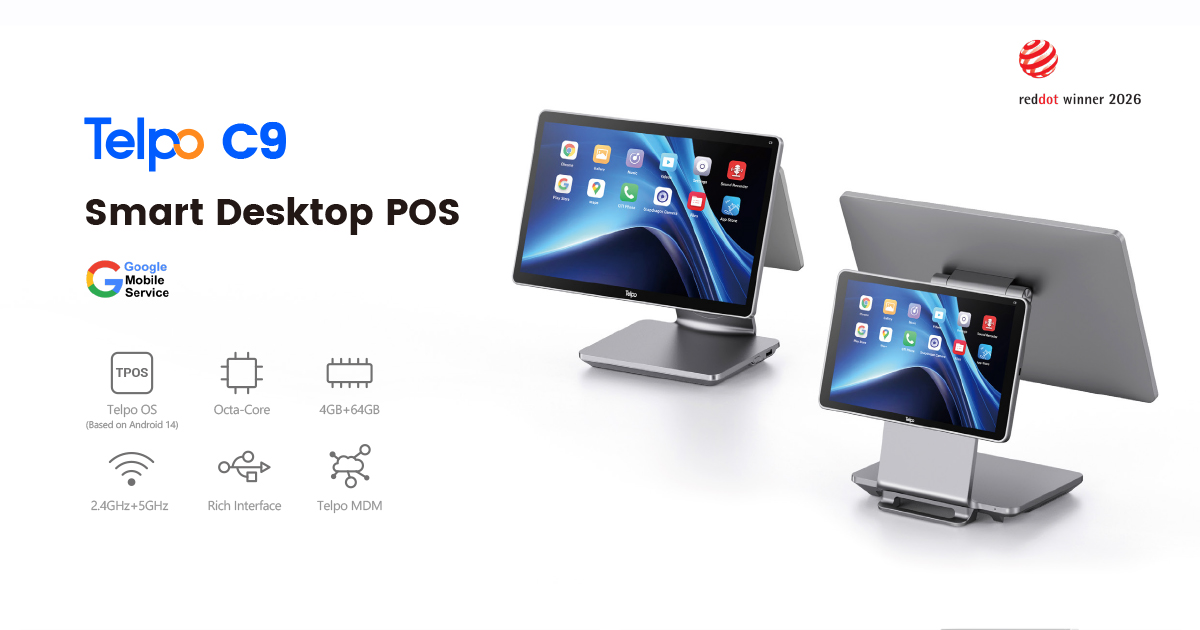
The first comparison is between a full-size Android countertop terminal and an alternative desktop model. The Telpo C9 is a touch screen POS machine running Android 14 on an octa-core 2.2 GHz processor, supporting up to 8 GB RAM and 128 GB ROM, with a 15.6-inch industrial-grade display featuring a 5 mm narrow bezel, 80% screen-to-body ratio and 350-nit brightness. It uses a metal-texture exterior, supports Pogo Pin modular card reader expansion, and integrates under-display NFC that is SoftPOS-compatible. Dual-screen configurations are available as 15.6-inch single screen, 15.6-inch plus 10.1-inch, or 15.6-inch plus 15.6-inch. Fingerprint authentication is supported for device wake and employee login.
Applying the framework, the C9 vs Sunmi D3 PRO decision is not decided by display size. It is decided by criterion two. If the deployment is standard checkout, where the terminal accepts NFC, chip and QR payments and prints or routes a receipt, the C9 class is correctly specified and an AI accelerator would be unused capital. If the deployment needs barcode-free item recognition or vision-assisted checkout at the counter, neither device should be specified on the basis of a family datasheet; the buyer should instead compare confirmed TOPS ratings and validated recognition accuracy, and should treat Telpo's C50 as the reference model for the AI workload itself.
| Criterion | AI-capable reference (Telpo C9 / C50, published data) | Standard / entry tier (indicative class profile, confirm per model) |
|---|---|---|
| Processor cores | C9: octa-core 2.2 GHz, Android 14. C50: octa-core 2.7 GHz with Adreno 642L GPU | Entry-tier terminals commonly ship with fewer or lower-clocked cores; confirm the SKU |
| On-device AI | C50: 12 TOPS, 0.1 s recognition, 99.8% accuracy. C9: no NPU figure published | Typically no dedicated NPU; recognition depends on a server |
| Memory and storage | C9: up to 8 GB RAM plus 128 GB ROM. Telpo P9: up to 4 GB RAM plus 64 GB ROM | Entry-tier configurations commonly fall in the 2+16 GB to 4+64 GB range |
| Latency model | Local inference on AI models; no network round trip for recognition | Cloud or server round trip; dependent on connectivity |
| Display and interaction | 15.6-inch, 5 mm bezel, 80% screen-to-body ratio, 350 nit; dual-screen options | Varies; confirm whether a customer-facing second display is supported |
| Payment acceptance | Under-display NFC (SoftPOS-compatible), Pogo Pin modular card reader module | Confirm NFC, chip and QR support plus card reader modularity |
Telpo C9 Android cash register POS terminal: octa-core Android 14 platform with up to 8 GB RAM and 128 GB ROM.
Case Study 2: Telpo C9 vs Swan-2
The second comparison tests the opposite end of the decision. When a buyer weighs a full countertop terminal against a budget-class alternative, the question is not which device is more capable but which capabilities the deployment will actually consume.
A budget-tier terminal preserves the essentials: payment acceptance across NFC, chip and QR, a compact countertop footprint, and basic connectivity. What it typically does not provide is the memory and storage headroom that retail software suites and locally stored AI models require, the dual-screen customer interaction that the C9 supports through its 15.6 plus 10.1 or 15.6 plus 15.6 configurations, or the modular Pogo Pin card reader expansion path. It also generally does not carry an NPU.
The practical decision rule is straightforward. If the site processes a modest daily transaction volume, runs a single POS application and will never run recognition workloads locally, a budget-class terminal is a rational choice and the C9 would be over-specified. If the site is part of a chain that plans to add self-service lanes, loyalty display, or vision-assisted checkout within the hardware's service life, the budget tier will need replacement during that service life, and the total cost calculation changes.
Matching the Terminal to the Deployment
Once the criteria are scored, the hardware choice usually resolves into one of three deployment profiles. The table below maps a deployment type to the tier that fits it, using Telpo's published platform data.
| Deployment profile | What the workload requires | Fitting tier |
|---|---|---|
| On-device visual AI, barcode-free item recognition, self-checkout | NPU-class acceleration, high clock speed, local model storage, weighing for fresh and bulk goods | AI checkout platform such as the Telpo C50 (12 TOPS, 0.1 s, 99.8% accuracy) |
| Standard countertop checkout in retail, hospitality or F and B | Android 14 application support, dual-screen customer display, NFC and SoftPOS, optional built-in printer | C9 / C9PD class Android cash register POS |
| Budget countertop or space-constrained site | Core payment acceptance, compact footprint, single POS application | Entry Android terminal with confirmable NFC and QR support |
Supporting equipment must be planned alongside the terminal, not after it. The Telpo C9 requires a barcode scanner and a cash drawer as supporting equipment, while the C9PD variant carries a built-in 80 mm Seiko thermal printer rated at 250 mm per second with an auto-cutter. Multi-lane checkout counters with high transaction volume normally require a router or switch for network connectivity. For markets with tax-control rules, an additional fiscal control module is a separate line item, and the terminal must provide the dedicated UART or USB interface that module requires.
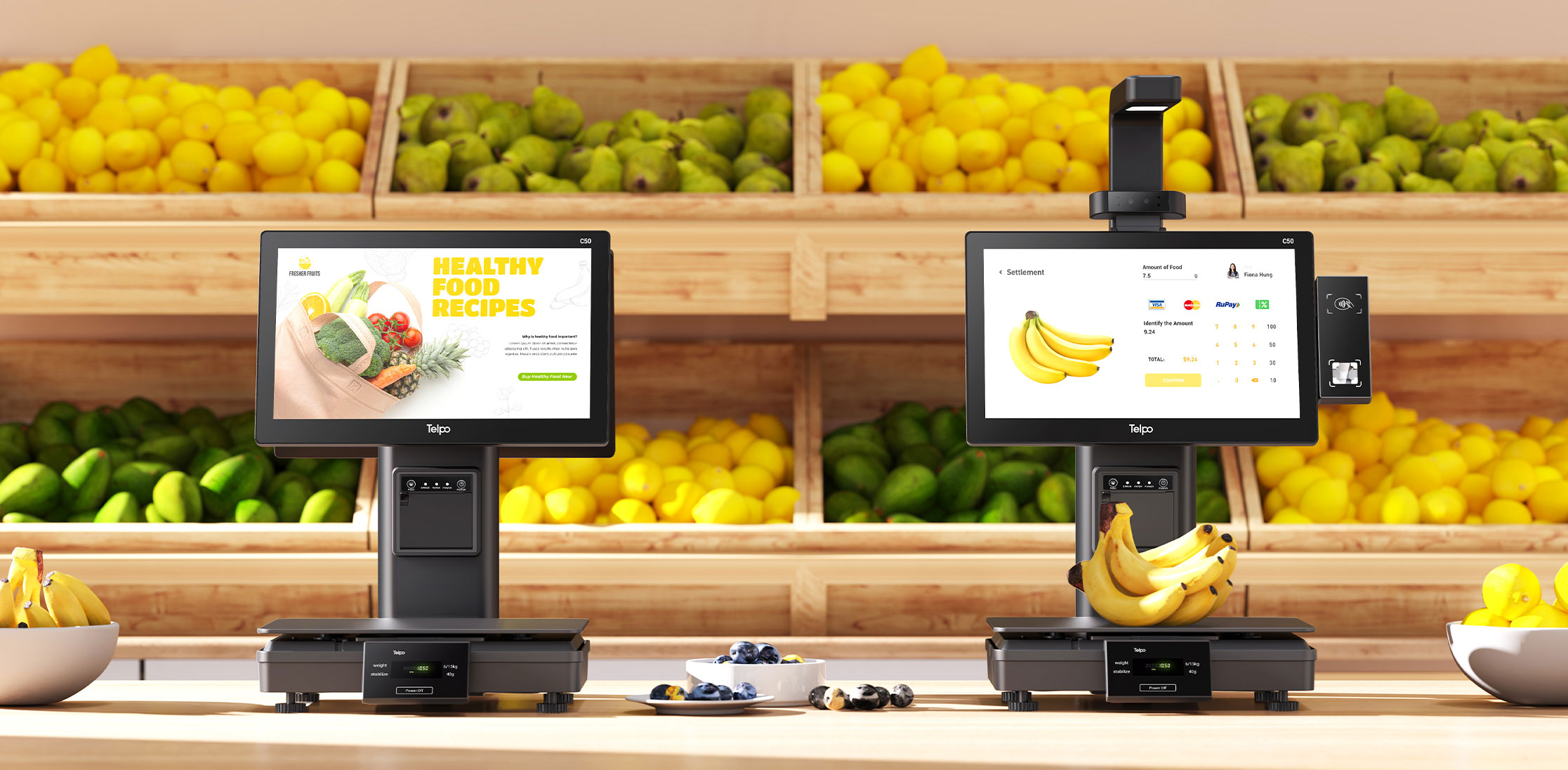
Telpo C50 AI self-checkout terminal, the reference platform for on-device visual recognition workloads.
Where the AI-Premium Decision Breaks Down
An honest comparison framework has to state its own limits, because the AI premium is not justified in every environment.
- AI capability does not replace certification. POS terminals must comply with PCI PTS and EMV standards for secure chip processing regardless of tier. An AI accelerator adds no compliance value, and a terminal without the required certification cannot be deployed in a given market at any price.
- Recognition accuracy is workload-specific. Published figures such as 99.8% accuracy apply to a validated product range and category set. A new product catalogue, unusual packaging or poor lighting can reduce real-world accuracy, so a pilot on the actual assortment is a prerequisite, not an optional step.
- Memory ceilings are not automatic entitlements. A 128 GB maximum is only useful if the shipped configuration and the software stack can use it.
- Higher compute has physical costs. More capable processors affect power draw and thermal design, which matters at counters where ventilation is poor or where the device shares a circuit with other equipment.
- Supporting equipment can erase a hardware saving. A lower-cost terminal that requires an external printer, an external card reader and an additional scan module may not be cheaper once the full bill of materials is assembled.
Market Trend: The Direction of the Tier Split
The available market data suggests the tier split will widen rather than narrow. The SoftPOS segment, projected to grow at a 23.1% compound annual growth rate through 2030, pushes basic payment acceptance further down the cost curve, which increases the relative share of value that attaches to on-device computing. At the same time, the self-service kiosk segment forecast to reach USD 37.8 billion by 2030 depends on exactly the recognition workloads that standard terminals cannot run locally.
A second signal is competitive rather than technical. The recognized global POS terminal manufacturers include Ingenico (Worldline), Verifone, PAX Technology, SUNMI and Newland Payment Technology alongside Telpo, which means buyers are selecting between vendors with broadly comparable payment capabilities and materially different positions on on-device compute. That is the condition under which a structured comparison framework produces more value than a price list.
Design recognition has followed the same direction. Telpo Technology's C9 and P9 smart terminals were awarded the Red Dot Award in 2026, which indicates that at the premium tier, industrial design and hardware capability are now evaluated together by buyers and by award juries rather than treated as separate concerns.
Future Outlook
Over the next hardware cycle, three developments are likely to shape procurement decisions. First, NPU capability will migrate from dedicated AI models down into mainstream countertop terminals, which will make the AI-versus-standard distinction temporary for new purchases and permanent for installed fleets. Second, buyers should expect the memory question to move faster than the processor question, because locally stored model weights and multi-application retail suites consume storage more aggressively than they consume clock speed. Third, the compliance burden will not decrease, so the practical risk in a roll-out is not choosing a terminal that is too slow but choosing one that cannot be certified for the destination market.
Taken together, these shifts argue for specifying terminals against a three-to-five-year workload plan rather than against today's transaction volume. The framework in this article is designed to make that comparison explicit, so that the AI tier is selected when the workload requires it and declined when it does not.
Frequently Asked Questions
What is the difference between an AI POS terminal and a standard POS terminal?
An AI POS terminal includes a neural processing unit or comparable accelerator on the system-on-chip, rated in TOPS, so that recognition models run on the device. A standard POS terminal runs the payment and retail application locally but sends any recognition workload to a server. Telpo's C50 illustrates the first category with 12 TOPS of on-device AI and published recognition performance of 0.1 seconds at 99.8% accuracy. The distinction is model-specific rather than brand-wide.
Does every retail or restaurant deployment need on-device AI?
No. On-device AI becomes necessary when the terminal itself performs recognition, such as barcode-free item identification or vision-assisted checkout. Deployments that only need contactless card, chip and QR payment acceptance are served by standard Android terminals. In Telpo's range, the C9 family is an Android cash register platform for countertop checkout, while the C50 addresses AI vision workloads.
How much RAM and storage does a POS terminal need in practice?
Requirements depend on the workload rather than on a universal number. The Telpo C9 supports up to 8 GB RAM and 128 GB ROM, and the Telpo P9 supports up to 4 GB RAM and 64 GB ROM. A single payment application with a device management agent fits comfortably in smaller configurations, while a retail suite combined with locally stored recognition weights requires the higher end. Entry-tier terminals commonly fall in the 2+16 GB to 4+64 GB range, so this is the criterion most likely to force a tier change.
What is the practical latency difference between on-device and cloud-based recognition?
The difference is architectural. On-device recognition eliminates the network round trip, so the response time is bounded by local compute rather than by connectivity; the saving is typically measured in tens to low hundreds of milliseconds per event and varies with network conditions. A secondary and often more important effect is resilience: an on-device workflow continues to return results when connectivity degrades, whereas a cloud-dependent workflow does not.
Can a standard POS terminal be upgraded to on-device AI later?
Not reliably. On-device AI depends on the processor's accelerator and on available memory and storage, which are fixed at the hardware level and are not added by a software update. If recognition workloads are on the roadmap, the correct approach is to specify the AI-capable model at roll-out. Within Telpo's published range, the C50 is the AI vision platform and the C9 family is the Android cash register platform.
How should buyers compare the Telpo C9 against alternatives such as the Sunmi D3 PRO or Swan-2?
Apply the same five criteria to each model: processor cores and Android version, presence of an NPU and its TOPS rating, maximum RAM and storage, the latency model, and deployment fit including supporting equipment and market certification. Confirm each competitor value against the manufacturer's current datasheet, because configurations change between hardware revisions, and run a timed pilot in the real store environment before committing to a fleet order.