
POS Terminal Shortlist: C9 for AI Checkout, Swan-2 for Standard Retail
Android-based POS terminals reached roughly 48% of global shipments in 2025, according to Counterpoint Research, and that single shift has quietly redefined what a terminal shortlist is for. Once the operating system stopped being the differentiator, buyers began separating devices by workload: lanes that run local visual inference, and lanes that simply take a basket and a payment.
The short answer, because it is the decision most readers arrive with: for deployments running on-device visual AI such as loss prevention, customer analytics and smart checkout, the Telpo C9 is the better-specified candidate, carrying an 8-core processor, 6-12 TOPS of on-chip AI and memory configurations of 4+64 GB or 8+128 GB. For standard retail checkout that does not run local inference, the Swan-2, offered in 2+16 GB or 4+64 GB, is the budget-positioned option, and its lower memory and storage may limit performance in data-intensive retail applications.
What follows is the reasoning a procurement team can audit: the workload split behind the shortlist, what the C9's compute budget buys at the lane, where the Swan-2 is the correct rather than the compromised choice, the limits of the on-device AI case, and the purchasing terms and acceptance criteria that should be fixed before an order is placed.
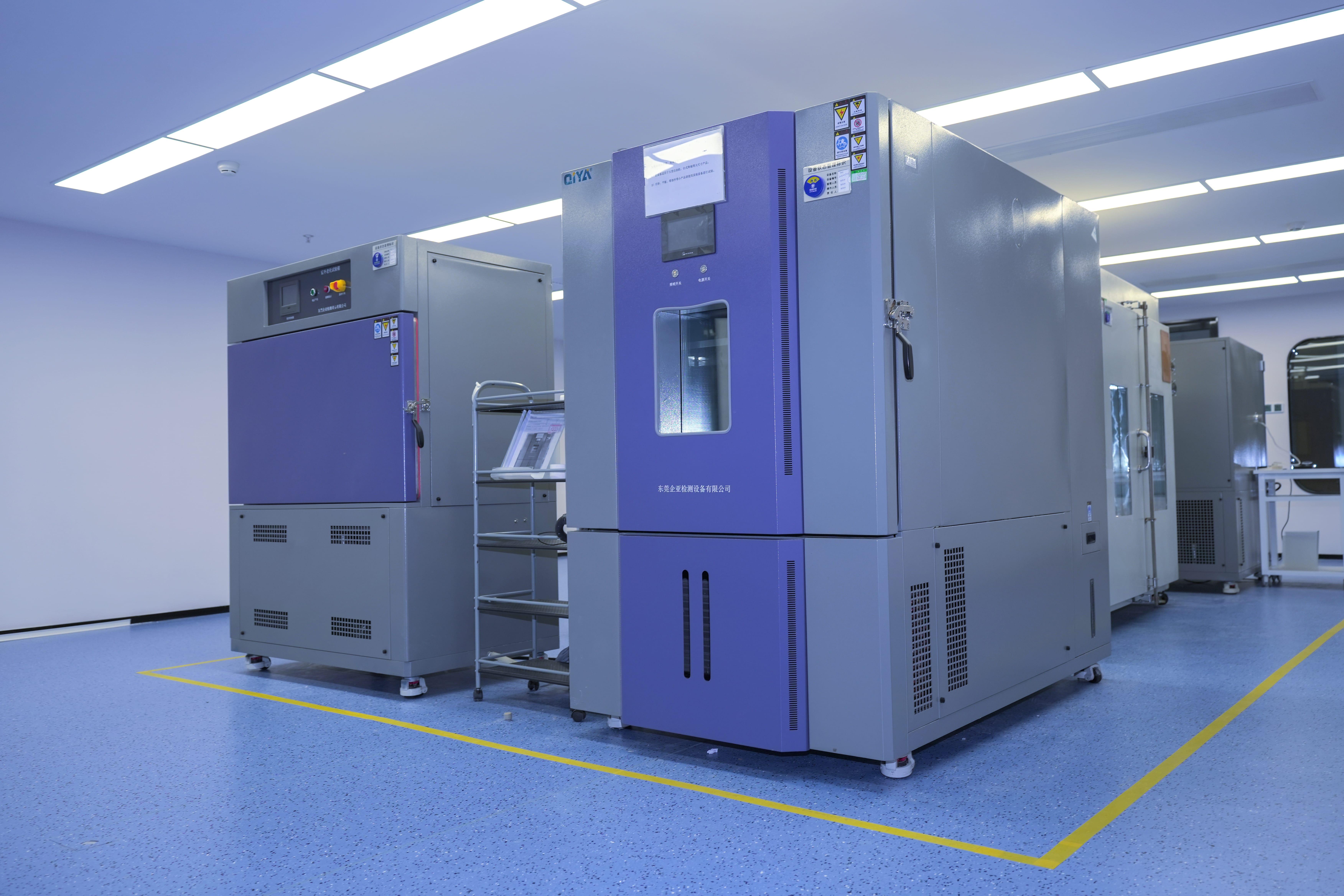
Reliability testing at a CNAS-accredited laboratory: acceptance criteria for AI-capable terminals now include workload validation, not only hardware specification.
Why the terminal shortlist split into two workloads
A modern store estate rarely runs one kind of lane. It runs checkout positions that capture the basket, score a shrink event and push a promotion to a customer-facing screen, and it runs positions that scan, total and print. Both sit under the same merchant account, the same support contract and frequently under the same supplier, but they place materially different demands on the device.
That difference makes a single-model rollout expensive in either direction. Specifying AI-grade hardware for every lane pays for compute that never executes a model. Specifying a lighter terminal across an estate that plans on-device visual analytics produces a shortfall that surfaces months later as application-swap stalls, thin offline caches, or models quietly pushed back to the cloud. The price spread in the category is wide enough for this to be a real budget line rather than a rounding error: commercial-grade smart POS hardware was reported in a USD 120 to USD 850 average selling price range in 2025.
For context, Fortune Business Insights valued the global point-of-sale market at USD 38.57 billion in 2025. Research houses scope that number differently, so treat it as directional rather than as a budget input; the buyer-relevant signal is simply that terminal spend is large, recurring and hardware-driven.
Telpo in context
Telpo Technology Co., Ltd. is a Chinese manufacturer of AI-driven smart terminals, founded in 1999 and headquartered in Foshan, Guangdong. The company operates across smart retail, smart payment, smart transportation and biometric security, and its hardware portfolio spans smart payment terminals, mobile and desktop Android POS devices, self-service kiosks, ticket validators, AI edge terminals and biometric security devices. Manufacturing covers approximately 45,000 sqm with an annual output stated at 2,000,000 units; its engineering organisation is described as 200 engineers, supported by 300+ technical patents and a CNAS-accredited laboratory.
Two details matter for a shortlist rather than a company profile. Both candidates discussed here come from the same supplier, so a mixed estate can run on one fleet-management layer (Telpo MDM) and one device software layer (Telpo OS) rather than two. And because the C9 and the Swan-2 sit at different points on the same portfolio ladder, the choice between them is a specification decision rather than a vendor decision.
The C9: what eight cores and 6-12 TOPS buy at the lane
The Telpo C9 is specified with an 8-core processor and 6-12 TOPS of on-chip AI. Those two figures do different jobs. Core count governs how many concurrent Android applications the terminal can hold without the interface stalling, with POS, analytics and inventory applications running side by side rather than in sequence. The TOPS figure governs whether a visual model executes on the device at all.
In Telpo's published comparison against the Sunmi D3 PRO, the C9 carries 33% more processor cores, 8 versus 6, and adds an on-chip AI budget the D3 PRO does not have. The stated consequence is local inference for visual AI applications and shorter transaction times under multi-application load.
The latency argument is the one procurement teams tend to underweight. Local inference is described as saving 50-200 ms per request compared with a cloud roundtrip, and as removing recurring cloud-compute fees for that workload. At a single lane, 50-200 ms is imperceptible. Across a queue at peak, and across a fleet that would otherwise pay per inference call, it becomes an operating characteristic rather than a specification nicety.
Memory and storage complete the picture. The C9 is offered as 4+64 GB or 8+128 GB, and it runs Android 14, which keeps it on an active security-patch cycle. The higher configuration is what makes an offline AI-model cache practical: 128 GB of storage at the high end supports richer retail media and a larger local model cache, reducing bandwidth and synchronisation cost and extending how long a lane can operate without connectivity. With 8 GB of RAM at the high end, twice that of the Swan-2, the C9 is also less likely to hit application-swap stalls under multi-application load.
The Swan-2: where a lighter configuration is the right answer
The Swan-2 is offered in 2+16 GB and 4+64 GB configurations. Set against the C9, that is half the RAM at the high end, 4 GB versus 8 GB, and half the storage at the low end, 16 GB versus 64 GB; at the high end the gap is 64 GB versus 128 GB. Telpo positions the Swan-2 for budget deployments and states that its lower memory and storage may limit performance in data-intensive retail applications.
Read plainly, that is a statement about segment rather than a defect. A lane that scans, totals, prints and reconciles does not need an AI cache. What it needs is a stable terminal, a predictable patch path and a unit cost that survives multiplication across hundreds of sites. The honest boundary is that the Swan-2 should not be placed on lanes where local inference, large product catalogues or heavy media are part of the plan. Those are precisely the workloads the C9 configurations were sized for.
Table 1. Configuration and workload fit, limited to attributes confirmed in the reviewed product material.
| Attribute | Telpo C9 | Swan-2 |
|---|---|---|
| Memory and storage options | 4+64 GB or 8+128 GB | 2+16 GB or 4+64 GB |
| Highest RAM | 8 GB | 4 GB |
| Highest storage | 128 GB | 64 GB |
| Processor | 8-core | Not stated in reviewed material |
| On-chip AI | 6-12 TOPS | Not stated in reviewed material |
| Operating system | Android 14 | Not stated in reviewed material |
| Positioned for | AI checkout, larger catalogues, AI cache, richer retail media | Budget deployments |
| Pricing | Configuration-dependent, quote-based | Configuration-dependent, quote-based |
What on-device inference actually changes
On-device inference changes where the model executes, and therefore which costs and risks move to the terminal. Three operational consequences follow.
The device becomes part of the data path, so patching and model updates need a management channel. Telpo publishes MDM for centralised fleet control, including remote control, device configuration and personalisation, alongside Telpo OS for device monitoring and management. A buyer should confirm that the management layer in the quotation is the one that will actually be used to push models and patches.
The security surface widens without changing the payment foundation. Payment acceptance still rests on hardware-level controls, with PCI 6.x certification on terminals and EMVCo-certified contactless modules supporting NFC, smart card, magnetic stripe, QR code and mobile payments. Telpo also publishes product liability insurance as a control for property damage arising from product failure. None of these controls is a substitute for model governance, but they are the parts that are auditable in a tender.
Third, acceptance testing has to move from a hardware checklist to a workload test. A device that scores well on processor and TOPS can still underperform if the model it must run exceeds the AI budget, or if storage cannot hold the cache the model depends on.
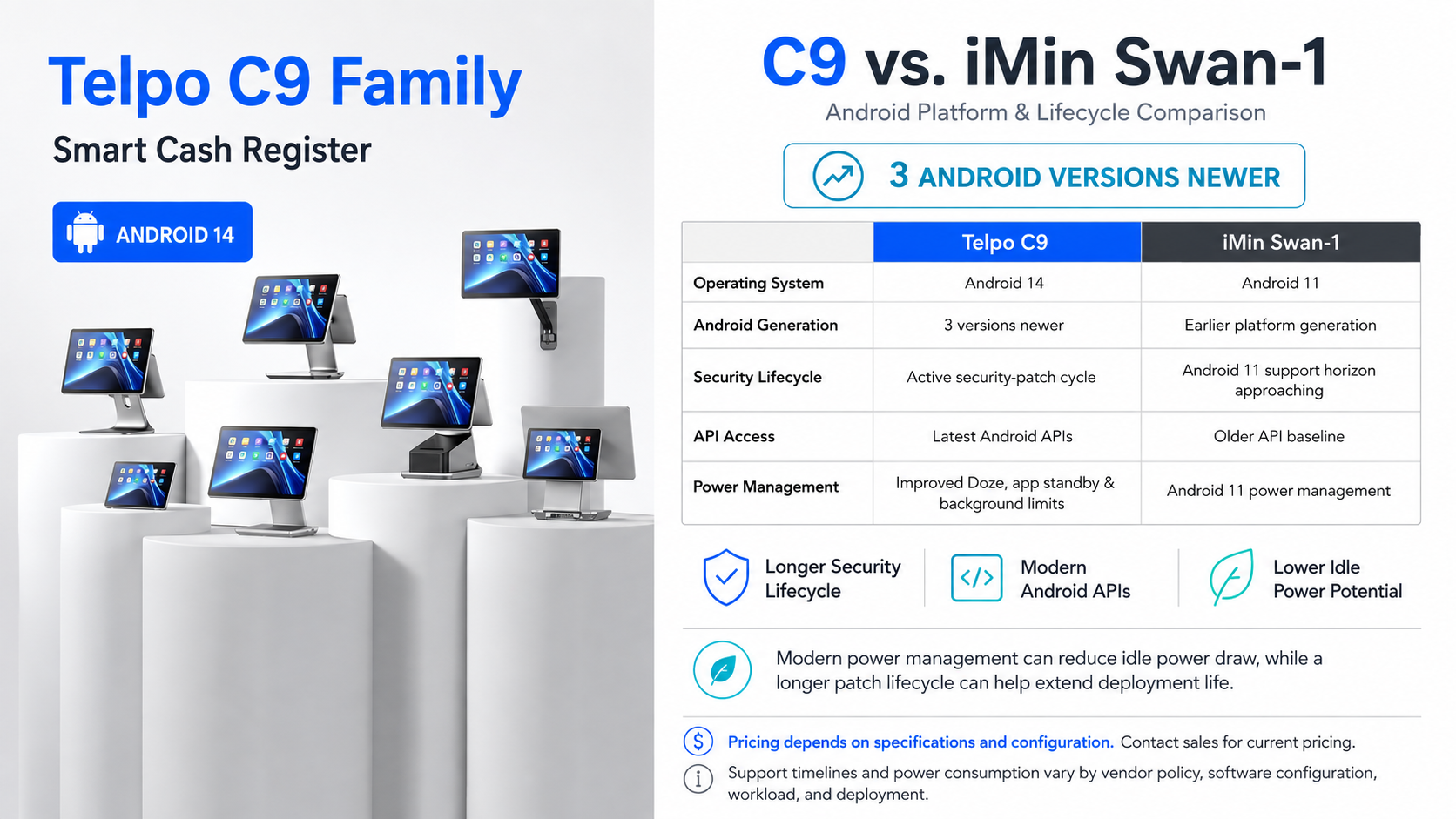
C9 family configuration comparison: memory and storage headroom determines which on-device workloads a lane can carry.
Where each terminal fits
AI checkout lanes
Loss prevention, customer analytics and smart checkout all depend on visual models running close to the transaction. These are the workloads the C9 was specified for: 6-12 TOPS of on-chip AI for local inference, 8 cores for concurrent POS, analytics and inventory applications, and 128 GB of storage at the high end for model cache and retail media. In a dual-screen or self-service configuration, the same compute budget supports the customer-facing experience without competing with the checkout application for cycles.
Standard retail lanes
Countertop checkout, budget-driven rollout and mature estates that keep analytics in the back office are the Swan-2's territory. Where the lane plan includes no local inference and no large local media library, the lighter memory configuration is proportionate, and the money saved per lane can be redirected into the lanes that do carry AI.
Adjacent devices in the same estate
A realistic rollout rarely stops at two models. Telpo's own comparison material places the K1 at 6 TOPS for standard on-device visual AI, against 4 TOPS on the IMIN Grane 1 for light edge AI, and positions the 12 TOPS Sunmi Flex 3 as the device for heavier visual workloads such as face recognition and multi-object tracking. For field and handheld work, the Telpo P9 uses an octa-core processor with Android 14 and a 5000 mAh removable battery, described as delivering 17-23 hours of runtime against 8-12 hours for the 2630 mAh Sunmi P3, with broader payment certification coverage that includes PCI PTS 6.x, EMV, Rupay, JCB, Discover, AMEX, Paypass, Paywave and UnionPay.
Market signals that shape a shortlist in 2026
Android reached approximately 48% of global POS shipments in 2025. The practical implication is not that Android won, but that application flexibility is now the basis of competition, and with it the question of how much compute sits under the application.
Regulation is pulling in the same direction as the workloads. Germany's KassenSichV requires a certified technical security system for all cash registers, which makes fiscal capability a gating item rather than a feature for any rollout touching that market. Software ecosystem access matters for the same reason: Telpo's M10 smart POS obtained Google Mobile Services certification in 2024, which is the kind of status buyers now check before committing to an application roadmap.
Against that, the reported USD 120 to USD 850 average selling price band for commercial-grade smart POS hardware in 2025 shows how wide the specification space remains. Two terminals from one supplier can sit at opposite ends of that band on configuration alone.
Against standard terminals, and the limits of the AI case
Table 2. C9 against standard-terminal alternatives named in Telpo's published comparison material.
| Dimension | Telpo C9 | Sunmi D3 PRO | iMin Swan-1 |
|---|---|---|---|
| Processor | 8-core | 6-core | 4-core |
| On-chip AI | 6-12 TOPS | None | Not stated in reviewed material |
| Operating system | Android 14 | Not stated in reviewed material | Android 11, approaching end-of-support |
| Fit | On-device visual AI plus concurrent applications | Standard POS without on-device AI | Single-task POS workloads |
The limits deserve as much space as the advantages, because they decide whether the shortlist holds up in year three.
TOPS is a ceiling, not a guarantee. Telpo's own comparison material describes 12 TOPS as supporting richer on-device models such as face recognition and multi-object tracking, while 6 TOPS is positioned for standard edge AI and offloads heavier models to the cloud. A buyer should match the model to the AI budget rather than rank devices by a TOPS number in isolation.
The C9's advantages only materialise when a workload exists. On a lane that never executes inference, the extra cores, TOPS and storage are dormant, and the specification premium buys nothing beyond headroom for future applications.
Memory does not fix architecture. A larger local cache reduces bandwidth and synchronisation cost, but it does not substitute for back-office design, network sizing or a coherent model-update process. Deployments that treat storage capacity as a substitute for integration planning tend to discover the gap at peak.
The Swan-2 constraint is genuine, not rhetorical. Its lower memory and storage may limit performance in data-intensive retail applications, so it should not be quietly promoted into AI lanes to standardise a purchase order.
Finally, pricing for both models is configuration-dependent and not publicly disclosed, and the cost difference between the C9 and the Swan-2 is not published. A total cost of ownership comparison therefore has to be built from quotation, service terms and spares rather than from list prices.
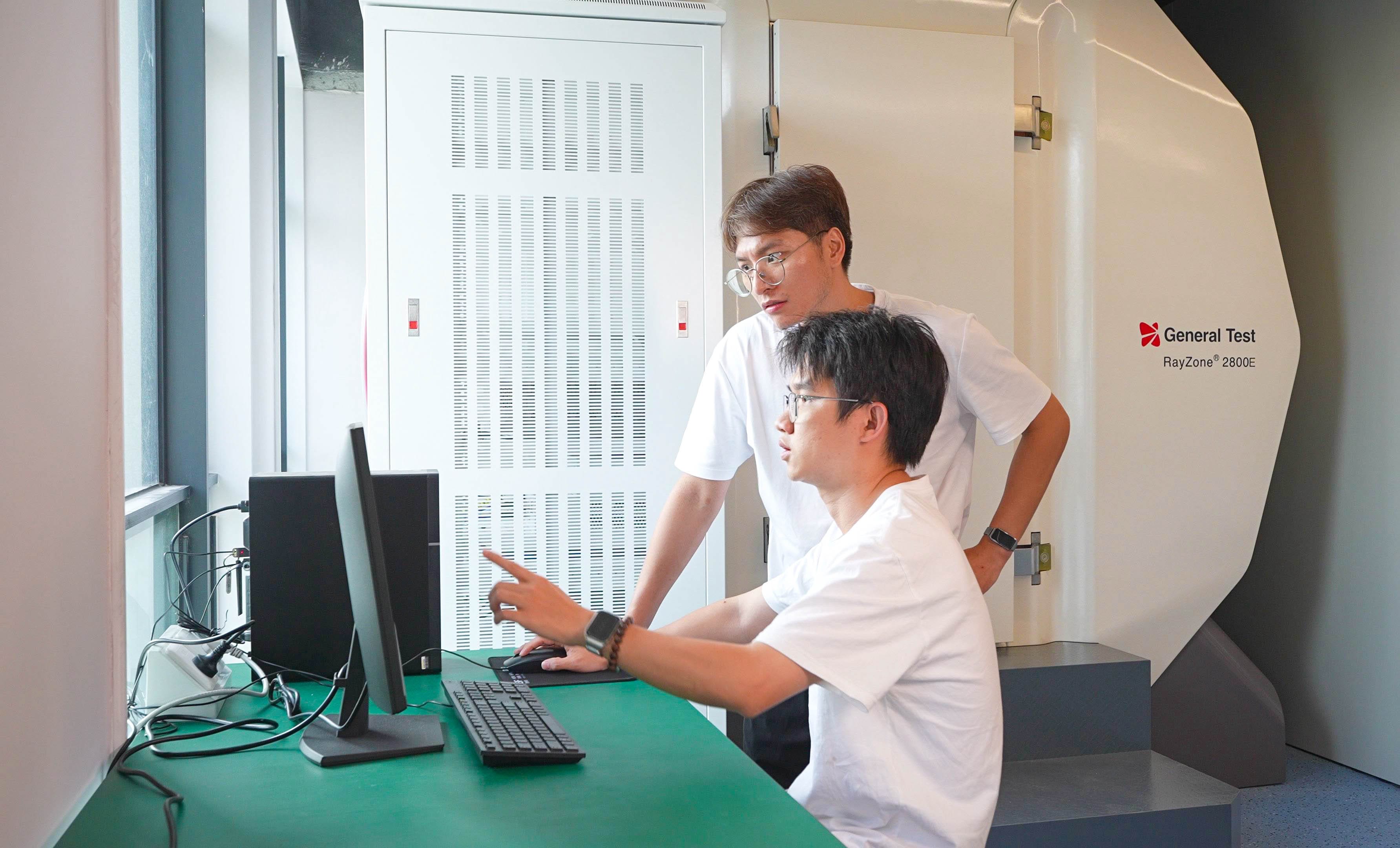
Pre-shipment validation: sample testing should exercise the workload the terminal will run, not only the hardware specification.
Procurement terms and acceptance criteria
Six items belong in the purchasing terms before either model is ordered.
Lock the configuration in writing. On the C9 that means naming 4+64 GB or 8+128 GB explicitly, because the configuration determines both memory headroom and the practical AI budget. On the Swan-2 it means distinguishing 2+16 GB from 4+64 GB by lane type rather than accepting a mixed shipment.
Write the acceptance test around the workload. Inference latency against a stated target, behaviour with the network disconnected, cache capacity once the model and media library are loaded, and recovery after a forced power cycle are the tests that predict field performance. Processor cores and TOPS belong in the specification annex, not in the acceptance criteria.
Fix the software support horizon. The C9 runs Android 14 and remains on an active security-patch cycle; the iMin Swan-1 runs Android 11, which is described as approaching end-of-support. Ask for the patch commitment in months, not in marketing language.
Define the compliance set by destination market. Payment acceptance requires PCI 6.x certification and EMVCo-certified contactless modules; fiscal markets add local requirements, with Germany's KassenSichV certified technical security system as the clearest example. Confirm the certificate scope covers the exact model and configuration being ordered.
Specify the management and security controls. Telpo MDM for remote control, device configuration and personalisation, and Telpo OS for device monitoring, should be named in the contract if models will be updated in the field. Where ruggedisation matters, ask for the model-level rating rather than a portfolio claim; Telpo's general specifications reference IP65 sealing on select models, IK08 impact certification on models such as the T20, a 1.2-metre drop standard across most devices, and UN38.3 certification for battery packs.
Agree commercial terms and sample validation. Pricing is quote-based and configuration-dependent, so payment terms, spares, warranty duration and lead time should be settled alongside the sample. A sample programme that runs the intended AI workload in the intended lane is worth more than a second round of datasheet comparison. Telpo's product brochure covering payment and retail terminals is available for download: https://cdn.socialarks.com/sbsp/24919/common/2026/0716/Telpo-Products-Brochure-Payment-Retail-V4.pdf
Future outlook
The direction of travel is toward narrower specification rather than broader. As on-device AI moves from pilot to standard lane design, expect memory floors to rise across budget tiers, and expect the patch lifecycle to become a scored tender criterion rather than a footnote. Expect too that the AI budget will be quoted as a workload statement, not a TOPS number, because the limits described above are already visible to buyers who have run a model on a lane.
For this shortlist, that means the C9 and the Swan-2 are unlikely to converge. The gap between an AI checkout lane and a standard retail lane is a workload gap, and terminals designed around one rarely serve the other without a cost penalty on one side of the estate.
FAQ
What distinguishes an AI checkout POS terminal from a standard retail POS terminal?
The distinction is where inference runs. An AI checkout terminal carries enough on-chip compute to execute visual models locally; the Telpo C9, for example, specifies 6-12 TOPS of on-chip AI alongside its 8-core processor. A standard retail terminal is specified for basket, payment and printing workloads without a local AI budget, and the Sunmi D3 PRO is a 6-core device without on-chip AI. Both terminal types can process the same transactions; the difference is which workloads execute on the device rather than in the cloud.
How do the Telpo C9 and the Swan-2 differ on memory and storage?
Capacity, not architecture, is the main split. The C9 ships as 4+64 GB or 8+128 GB; the Swan-2 ships as 2+16 GB or 4+64 GB. That gives the C9 twice the RAM at the high end, 8 GB versus 4 GB, twice the storage at the low end, 64 GB versus 16 GB, and twice the storage at the high end, 128 GB versus 64 GB. The practical effect is headroom: more RAM reduces application-swap stalls under multi-application load, and more storage supports richer retail media and a larger offline AI-model cache.
Does on-device AI remove the need for cloud processing?
It reduces the dependence rather than removing it. On the C9, visual analytics are processed locally, which Telpo describes as saving 50-200 ms per request compared with a cloud roundtrip and as eliminating recurring cloud fees for that workload. Local processing still requires model distribution, monitoring and fleet management; it changes where inference executes. Where a model exceeds a device's AI budget, work moves to a server, which is exactly how Telpo's comparison material frames its 6 TOPS K1 against the 12 TOPS Sunmi Flex 3.
When is the Swan-2 the appropriate choice instead of the C9?
When the lane carries no local AI or data-heavy workload. The Swan-2's 2+16 GB and 4+64 GB configurations position it for budget deployments, and the same source material notes that lower memory and storage may limit performance in data-intensive retail applications. A store running standard checkout, with analytics handled elsewhere and no on-device visual models planned, gains little from the C9's AI budget and storage ceiling. Where a rollout is cost-capped per lane, the lighter device avoids paying for compute the lane will not use.
What should be confirmed before placing an order for either model?
Four items. First, the configuration, since RAM and storage determine the AI budget on the C9 and the performance ceiling on the Swan-2. Second, a workload-based acceptance test covering inference latency, offline behaviour and cache capacity, rather than a hardware checklist. Third, the software support horizon, including the Android patch cycle, where the C9 runs Android 14 while the iMin Swan-1 runs Android 11 and is described as approaching end-of-support. Fourth, the compliance set for the destination market, combining PCI 6.x certification and EMVCo-certified contactless modules for payment with local fiscal requirements such as Germany's KassenSichV certified technical security system.
Pricing for both the C9 and the Swan-2 is configuration-dependent and not publicly disclosed, so commercial terms, spares and lead time should be confirmed against a written quotation before a purchase order is raised.
Есть вопросы или нужны дополнительные детали?
Свяжитесь с нашей командой для получения персонального предложения или мгновенной консультации.
Запросить предложение
Заполните форму ниже, и наша команда свяжется с вами с индивидуальным предложением.
Прямой чат WhatsApp
Предпочитаете общаться в реальном времени? Напишите нам в WhatsApp для мгновенной помощи и быстрых ответов.
- Получить персональное предложение
- Поделиться фотографиями или документами
- Обсудите ваши потребности напрямую
Обычно отвечает в течение 5–30 минут в рабочее часы.