
PSA Nitrogen Generator vs BMN Membrane System: Independent Buyer Comparison
PSA Nitrogen Generator vs BMN Membrane System: Independent Buyer Comparison
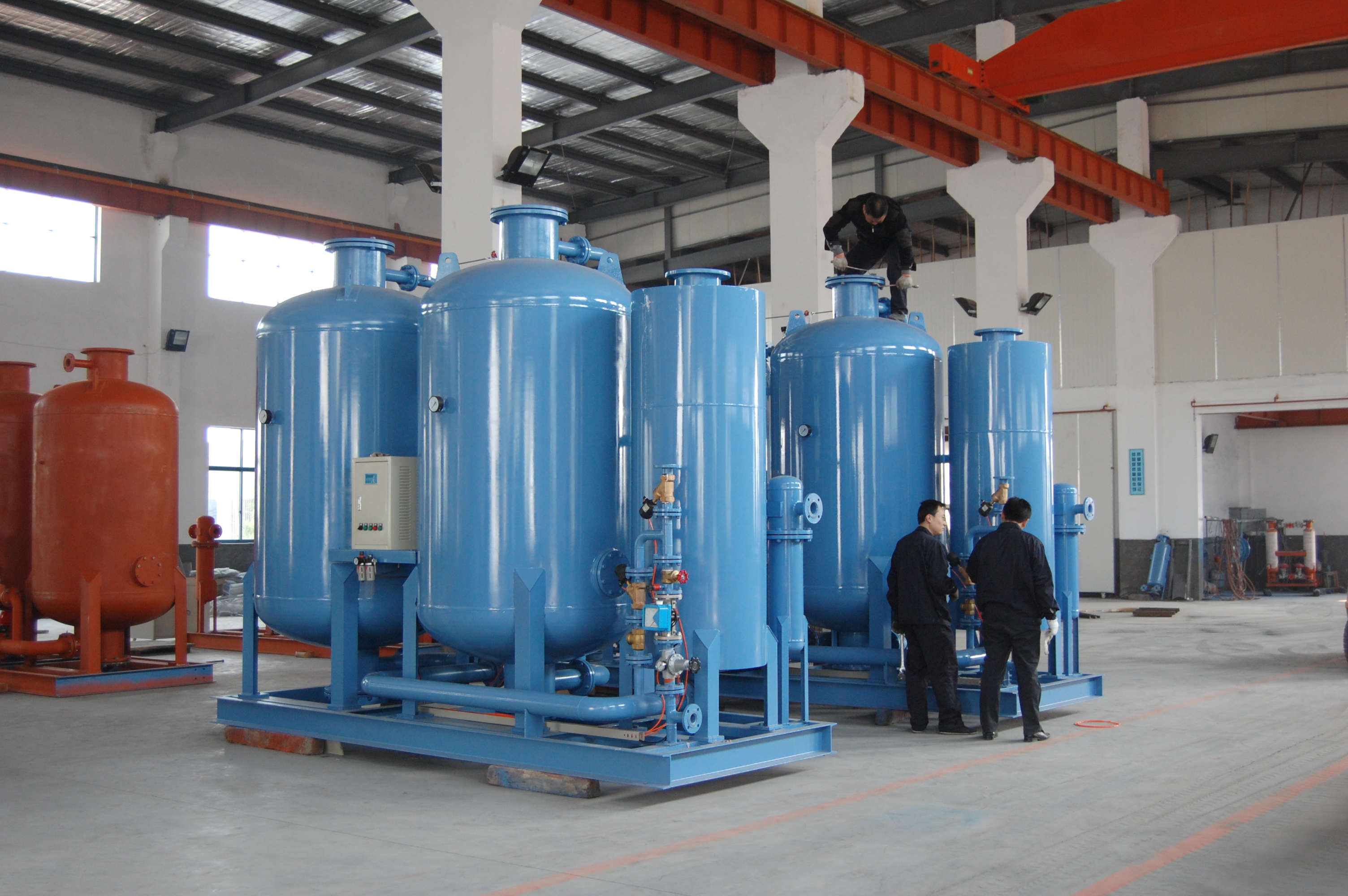
For an independent buyer, the PSA nitrogen generator versus BMN membrane system decision is a fit decision, not a technology popularity contest. PSA stations are generally the more appropriate route when the process requires very high purity, documented adsorption performance and an integrated on-site station. The BMN Series membrane separation nitrogen generator is generally the more compact, quiet, floor-mounted route for duties where the required purity sits within a membrane package range and installation space is tight. The correct choice depends on the guaranteed flow, purity, pressure, utilities and acceptance terms, not on the label on the skid.
Buyer's short answer. Compare PSA and BMN against one duty point: required Nm³/h, purity, pressure, dew point, ambient conditions and annual operating hours.
- Choose a PSA nitrogen generator when purity above 99.9% is required, when the process needs a fully documented adsorption station, or when the buyer needs a clear maintenance schedule for CMS, valves, filters and dryers.
- Choose a BMN membrane system when the required purity is inside the model-specific membrane range, when floor space and noise are major constraints, and when compact continuous operation matters more than the widest possible purity envelope.
- In both cases, make the supplier state what is included, what is excluded, how performance will be tested and how the guarantee will be measured.
What each system actually does
A PSA nitrogen generator uses two adsorption towers filled with carbon molecular sieve. Clean, dry compressed air enters one tower under pressure; the sieve adsorbs oxygen, carbon dioxide and moisture, while nitrogen passes through as product gas. The online tower saturates, the system equalizes pressure and switches to the standby tower, then regenerates the saturated bed by depressurization. This alternating cycle is what produces continuous nitrogen from compressed air.
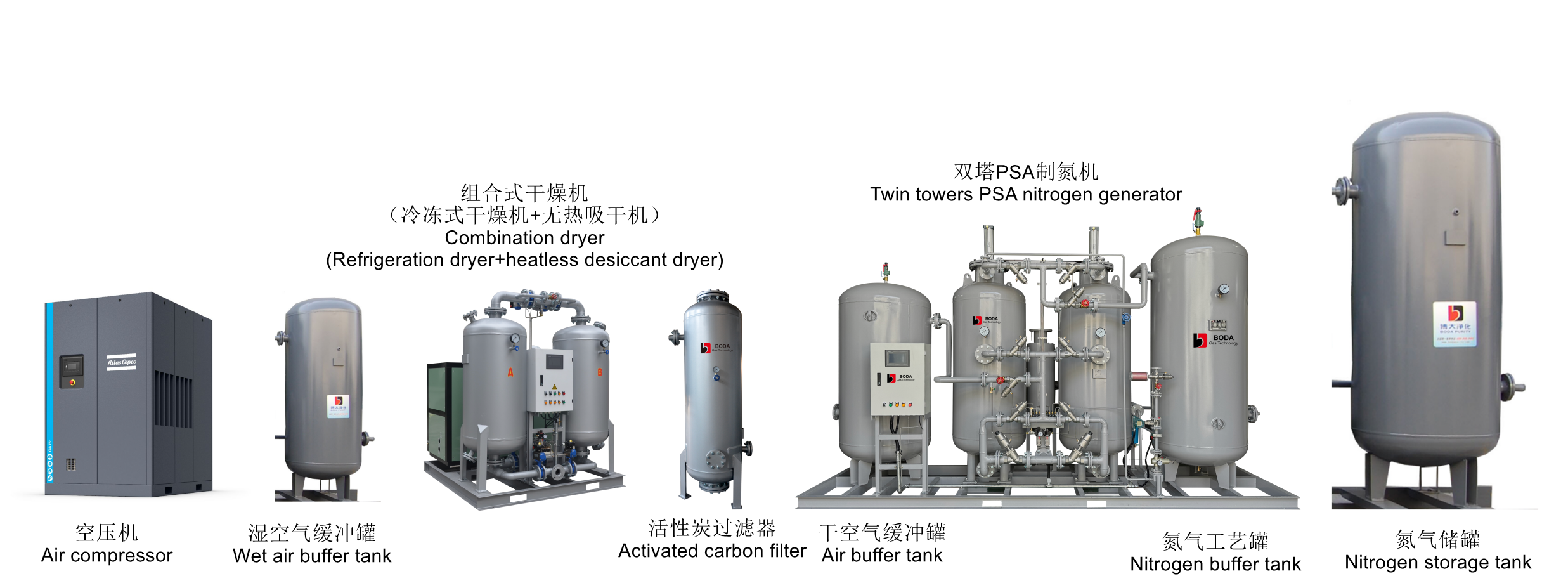
A PSA nitrogen generator is not a standalone box. A complete station normally includes an air compressor, air receiver tanks, dryers, multiple filters, an activated carbon filter, the PSA generator unit, a nitrogen buffer tank, an oxygen analyzer or purity sensor, and a control system. This scope matters because the compressor, dryer and filtration train can dominate maintenance and energy use. A low-maintenance PSA nitrogen generator is therefore defined by accessible components, realistic service intervals and spare-parts support, not by a marketing label.
A BMN Series membrane separation nitrogen generator uses hollow-fiber membrane bundles to separate gases by permeation speed. The package is described for this comparison as covering 5 to 3,000 Nm³/h, 95% to 99.9% purity, adjustable pressure, compact and quiet continuous operation, and floor installation. Those figures are useful for preliminary screening, but they are not a substitute for a model-specific guarantee at the buyer's temperature, pressure and flow conditions.
There is an important purity qualification. General membrane references in the supplied technical material describe membrane systems at 95% to 99.5% purity, while the BMN Series range quoted for this comparison extends to 99.9%. A buyer should not treat those as interchangeable. Ask for the guaranteed purity at the specified flow, pressure and temperature, and ask whether the 99.9% figure applies to the exact model being quoted. If the process needs 99.999% or ultra-high purity, a PSA system is generally the more suitable starting point.
Side-by-side comparison for procurement
| Decision area | PSA nitrogen generator | BMN membrane system | What the buyer should verify |
|---|---|---|---|
| Separation principle | Carbon molecular sieve adsorbs oxygen under pressure in alternating towers. | Hollow-fiber membranes separate gases by permeation speed. | Confirm the actual technology, model and process diagram in the offer. |
| Purity position | PSA can reach up to 99.999% with CMS; it is generally favored for requirements above 99.9%. | Membrane systems are generally cited at 95% to 99.5%; the BMN Series is quoted for this comparison at 95% to 99.9%. | Require a guaranteed purity point at the specified flow and conditions, not only a headline range. |
| Flow and scale | PSA packages are configured across industrial capacities and can be integrated with dryers, filters, buffer tanks and analyzers. | BMN Series range quoted at 5 to 3,000 Nm³/h. | Check the quoted flow at the required purity and pressure; confirm turndown and part-load behavior. |
| Footprint and installation | Station footprint includes compressor, dryers, filters, tanks and generator; skid-mounted and containerized formats are available. | Compact, quiet and floor-mounted package; suitable where civil works and acoustic treatment are constrained. | Compare actual GA drawings, maintenance access, lifting requirements and utility connections. |
| Operating profile | Cyclic adsorption and regeneration; automatic valve switching and control are central to stable performance. | Continuous membrane operation with adjustable pressure, as described for the BMN Series. | Check startup, turndown, shutdown and restart procedures in the operating manual. |
| Maintenance profile | Filters, compressor service, dryer desiccant and CMS replacement create a defined maintenance schedule. | Different maintenance profile; pre-treatment, analyzer calibration and membrane module care should be stated by the supplier. | Ask for a two-year spare-parts and service plan, not only a warranty statement. |
| Energy and utilities | Compressed-air demand, purge loss, valve performance and control strategy affect kWh per Nm³. | Feed-air quality, pressure and module performance affect output and energy use. | Compare kWh/Nm³ at the same purity and flow, including compressor and dryer consumption. |
| Typical fit | High-purity industrial gas, chemical blanketing, pharmaceutical, food packaging with analyzer control, oil and gas, electronics and laser cutting. | Space-constrained plants and lower-to-mid purity duties where compact, quiet and floor-mounted operation is valued. | Match the technology to the application, not to a generic preference. |
| Cost structure | Cost is driven by compressor, dryer, filtration, CMS, valves, controls, certification and skid format. | Cost is driven by membrane modules, pre-treatment, controls, packaging and required documentation. | Normalize the scope before comparing price; a lower skid price may exclude major station items. |
| Acceptance risk | Higher if purity, dew point, analyzer response and valve performance are not tested and documented. | Higher if purity is guaranteed only as a range or if feed-air conditions are not defined. | Write measurable acceptance criteria into the purchase order. |
Where PSA stations fit
PSA is the natural starting point when the nitrogen specification is demanding. The supplied technical material states that PSA nitrogen generators can produce nitrogen with a purity rating up to 99.999% using carbon molecular sieve. Atlas Copco's comparison also notes that PSA systems are favored over membrane systems for high-purity requirements above 99.9%, because membrane purity is typically capped at lower levels. That does not make PSA universally better; it means the buyer should start with the required purity and work backward.
A practical purity map helps the evaluation:
- 95% to 98% purity: fire protection, marine tank blanketing, oil-field pipeline purging and general tire inflation.
- 99% to 99.9% purity: food and beverage modified atmosphere packaging, winemaking and conventional plastic molding.
- 99.95% to 99.99% purity: mild-steel laser cutting, electronics manufacturing, cable production and pharmaceutical tank blanketing.
- 99.999% and above: special-metal cutting such as titanium alloy, high-end electronics and specialized laboratory work.
PSA nitrogen generators for the chemical industry are often selected for blanketing and reactor purging, where purity and continuous supply need to be tied to the process risk. PSA nitrogen generators for food and beverage packaging need an online residual oxygen analyzer and a clear sanitation and verification routine. PSA nitrogen generators for the pharmaceutical industry need documentation, alarm response and change control. PSA nitrogen generators in oil and gas applications may need marine-classification approvals, hazardous-area planning or remote-site service access. These are different acceptance problems, even when the same adsorption principle applies.
An industrial PSA nitrogen generator also brings a broader station scope. The buyer is not only purchasing two towers; the buyer is accepting a compressed-air system, a dryer train, filtration, buffering and controls. A skid-mounted PSA nitrogen generation package can reduce site work, but the battery limits must be written down. A movable containerized PSA nitrogen generator is another packaging option for remote or temporary demand, but containerization does not remove the need for feed-air quality, power, drainage and maintenance access.
Where BMN membrane systems fit
The BMN Series membrane separation nitrogen generator is most relevant when the project needs a compact, quiet, floor-mounted package and the required purity is within the membrane range. Its quoted 5 to 3,000 Nm³/h output range and adjustable pressure make it a credible option for lower-to-mid purity duties where the buyer wants to avoid a large adsorption station footprint. Continuous operation and floor installation can simplify civil works, especially in existing plants where crane access and new foundations are difficult.
The fit boundary is purity. If the process needs 99.99% or 99.999% with a tight dew point and a documented adsorption station, a PSA system is usually the more defensible choice. If the process needs 95% to 99.5% for blanketing, purging, packaging or general inerting, the BMN Series should be evaluated on its guaranteed model performance. If the buyer is quoted 99.9% from a membrane package, the purchase order should state the exact flow, pressure, temperature and analyzer basis for that purity. A membrane system can be the right answer, but only when the specification is written around the membrane's actual guarantee.
A BMN buyer should also request a scope split. Ask whether the offer includes feed-air filtration, coalescing filters, carbon filtration, buffer tank, oxygen analyzer, PLC, pressure control, noise enclosure, installation and commissioning. Ask what is excluded. The compact footprint of a membrane package can be lost if the buyer later has to add a large dryer, receiver and filtration train that were not in the original scope.
The real cost comparison: capex is only the first line
PSA and BMN projects are difficult to compare on equipment price alone because the battery limits are different. A PSA quotation may include a compressor, refrigerated or desiccant dryer, filters, activated carbon filter, buffer tank, analyzer and control system. A membrane quotation may include the membrane skid, pre-treatment and controls, but may exclude compressed-air supply or installation. The buyer should normalize both offers to the same inlet air quality, outlet purity, flow, pressure, dew point, power supply and documentation package.
Within PSA offers, configuration choices can move both capital cost and operating cost. Optional product standards such as ASME, CE, TR-CU and marine-classification approvals can change cost by a range of 10% to 300% depending on the certification requirement. Skid format differences can change cost by 5% to 10% depending on whether the buyer selects a split-type skid assembly, an integrated skid-mounted unit or a container-integrated package. An intelligent energy-saving PLC control system may add about 5% to initial investment while targeting 20% to 40% energy savings by adjusting the operating cycle to actual nitrogen demand. A customized CMS-330 molecular sieve may save about 10% energy in a 100 Nm³/h, 99.99% example, with roughly 15% higher material cost. Stainless-steel pneumatic valves can reduce valve-leakage failure rates by 60%, with about 20% higher valve cost. A 304 stainless-steel regeneration-gas pipeline can extend service life by 20%, with a 150% material-cost premium. These are not automatic benefits; they are options to justify against the buyer's operating hours and maintenance plan.
For the BMN route, the cost drivers should be requested in the same way: membrane module cost, expected module life, pre-treatment schedule, analyzer calibration, control-system support, spare-parts lead time and replacement cost. Do not accept a lower headline price if it moves compressor, dryer or buffer-tank scope into the buyer's own project without disclosure.
PSA station operation and maintenance: what the quote should expose
A PSA nitrogen station has a definable maintenance rhythm, and that rhythm should appear in the commercial offer. The supplied maintenance guidance lists precision filter element replacement every 8,000 hours, standard air-compressor service every 3,000 to 4,000 runtime hours, air-dryer desiccant replacement generally every 16,000 to 24,000 hours, and carbon molecular sieve replacement at roughly 6 to 10 years. Actual intervals depend on duty, ambient conditions, feed-air quality and the supplier's instructions, but the buyer should still ask for a scheduled maintenance table with parts, labor and downtime assumptions.
The PSA design also affects long-term reliability. Automatic cylinder compression in larger adsorption towers is claimed to reduce molecular-sieve pulverization and extend sieve service life by 40% to 60% over conventional tower-head structures, with a tower-head cost about 60% higher than a conventional structure. Siemens PLC and SMC thermal mass flowmeter configurations are claimed to deliver a 30% to 50% lower failure rate than ordinary domestic control-instrument solutions, at about 60% higher initial procurement cost. These claims should be tested through references, spare-parts lists and acceptance tests, not accepted as automatic outcomes.
For the buyer, the practical question is not whether a PSA station needs maintenance. It will. The question is whether the maintenance can be planned, whether parts are available and whether the supplier has documented the effect of deferred service on purity. A good-quality PSA nitrogen generator should come with a maintenance manual, alarm list, recommended spare-parts list and a clear statement of which consumables are excluded from warranty.
BMN operation and performance verification
The BMN membrane system should be evaluated on its own operating logic. Because the package is described as compact, quiet and floor-mounted, the buyer should ask for the sound-pressure data, the required clearance for module replacement and the actual utility connection points. A compact package can still require significant feed-air treatment and buffer volume, so the layout should be checked against the real installation, not only the skid outline.
The most important BMN verification is the purity guarantee. Ask for a model-specific performance curve or table that states nitrogen flow, purity, pressure, temperature and measured dew point. Ask whether the analyzer is included, how it is calibrated and what happens when purity drifts out of specification. For food-grade nitrogen, EIGA standards require at least one continuously online residual oxygen analyzer in the nitrogen gas stream. That is a design expectation the buyer should confirm in the BMN offer if the application is food contact or modified atmosphere packaging.
Also ask for the membrane module life assumption and the replacement cost. A membrane system may have a different maintenance profile from a PSA station, but it is not maintenance-free. Pre-treatment filters, controls and analyzers still need attention. The buyer should compare the total service plan, not only the number of moving parts.
Application fit: chemical, food, pharmaceutical and oil and gas
In the chemical industry, nitrogen is used for blanketing, purging and inerting. The buyer should define whether the risk is product oxidation, fire or explosion prevention, or process stability. A PSA system is often preferred when high purity and a documented adsorption station are required; a BMN membrane system may fit lower-purity blanketing where space and installation are constrained. The deciding evidence is the required purity at the reactor or tank, not the purity at the generator outlet alone.
In food and beverage packaging, modified atmosphere packaging depends on consistent oxygen exclusion. A PSA nitrogen generator with an online oxygen analyzer and a validated startup routine is a common choice. A BMN membrane system can be considered where the packaging line's purity requirement sits within the membrane guarantee and the plant values a compact floor-mounted package. In both cases, the buyer should verify analyzer response time, alarm logic and the procedure for rejecting out-of-spec gas.
In the pharmaceutical industry, documentation and change control matter as much as purity. The buyer should ask for material certificates, calibration records, alarm-history capability and a clear deviation procedure. In oil and gas applications, the buyer may need marine-classification approvals, hazardous-area assessment and remote-site service support. The technology choice follows the application risk, not the other way around.
Acceptance criteria before purchase
An independent buyer should convert the technical comparison into purchase-order language. The following checklist applies to either technology and helps prevent a low-price offer from becoming a high-risk project.
- Guaranteed duty point: flow in Nm³/h, purity in percent, outlet pressure, dew point and allowable turndown, all at stated ambient and feed-air conditions.
- Analyzer and instrumentation: continuous online oxygen analyzer where required, calibration method, alarm setpoints and automatic venting of out-of-spec gas.
- Utility consumption: kWh per Nm³, compressed-air consumption, cooling water or air requirements, purge loss and part-load performance.
- Scope split: compressor, dryer, filters, activated carbon filter, buffer tank, controls, installation, commissioning and training, with exclusions listed.
- Noise and footprint: sound-pressure level at a defined distance, maintenance clearance, lifting points and foundation requirements.
- Documentation: P&ID, general arrangement drawing, datasheets, material certificates, operating manual, spare-parts list and warranty terms.
- Compliance: PED 2014/68/EU and CE marking for EU pressure vessels where applicable; ASME, TR-CU or marine-classification approvals only if the project requires them and the quote includes them.
- Performance test: an agreed test procedure at the factory or site, with recorded flow, purity, pressure and analyzer readings, and a clear acceptance remedy if the guarantee is missed.
- Service readiness: spare-parts lead time, service response, remote support and the name of the responsible service partner.
Supplier context: where BODA GAS fits the comparison
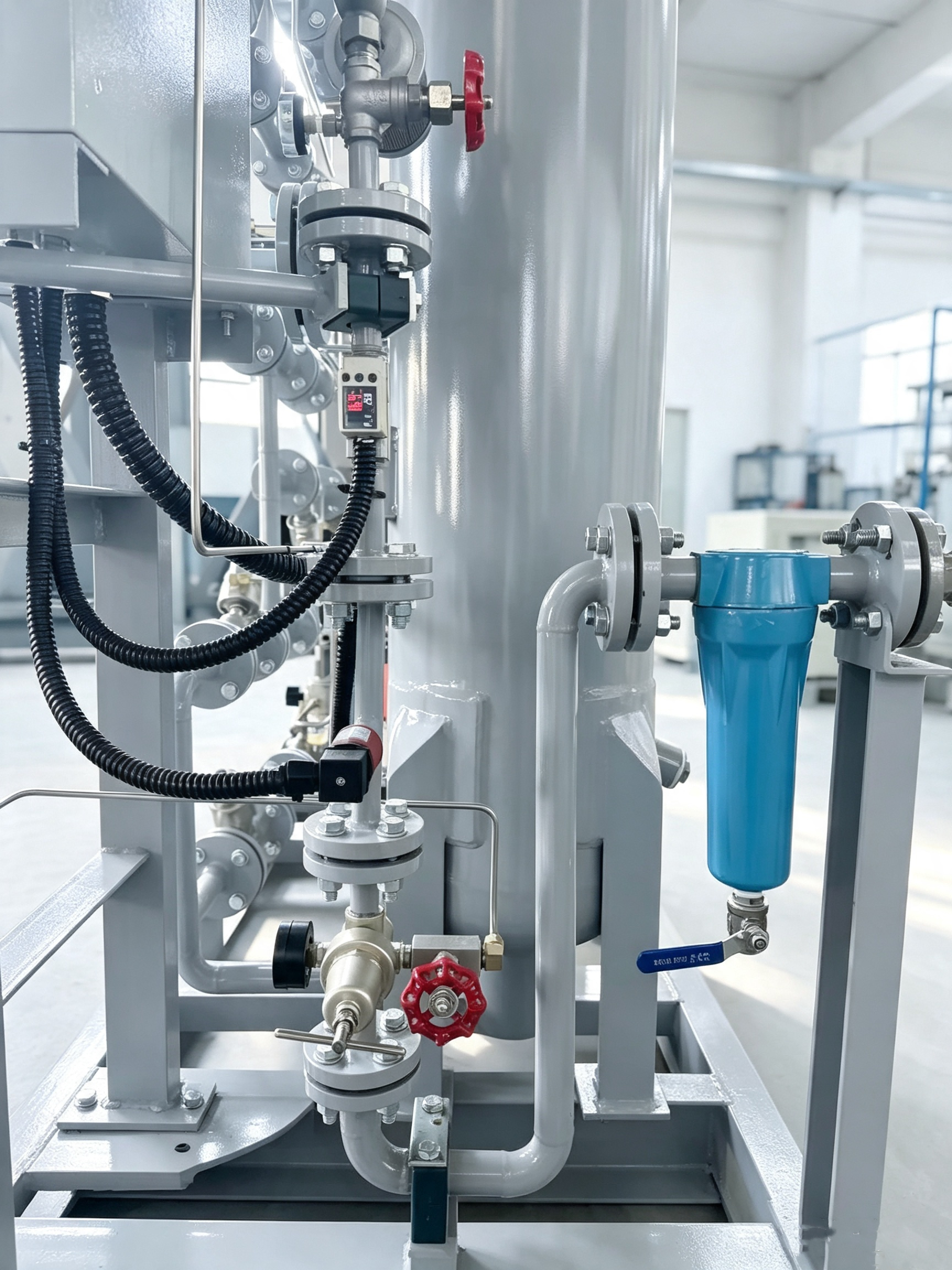
BODA GAS is the trading name used here for Hangzhou Boda Purity Equipment Co., Ltd., a manufacturer established in 2002 and based in Hangzhou, Zhejiang Province. The company operates a production base of more than 30,000 m², employs 58 people, reports annual output of 480 units and maintains a 15-engineer R&D team. Its portfolio includes PSA nitrogen generators, PSA oxygen generators, refrigeration dryers, heatless and heated desiccant dryers, combination low-dew-point compressed air dryers, filters and membrane separation nitrogen generators.
That portfolio is relevant because a buyer comparing PSA and BMN can ask one supplier to quote both routes against the same duty point. It also creates a discipline requirement: the buyer should not accept a technology recommendation without model-specific datasheets, scope boundaries and acceptance terms. BODA GAS holds ISO 9001, ISO 13485, ISO 14001 and ISO 45001 certifications, and its export share is stated at 30%. Those facts support supplier screening, but they do not replace a project-specific guarantee. The comparison should still be decided on the delivered package, the documented performance and the service plan.
Market context: why both technologies remain relevant
Market data supports a mixed buyer landscape rather than a single-technology outcome. Fortune Business Insights estimates that pressure swing adsorption technology accounts for approximately 48% of the global nitrogen generator market, making it the largest technology segment. Grand View Research reports that the food and beverage segment held approximately 49.8% of nitrogen generator revenue share in 2023, driven by modified atmosphere packaging. Verified Market Research projects Asia-Pacific to hold a 35% share of the PSA nitrogen generator market by 2032. These are market-level signals, not proof that either technology fits a specific plant.
For procurement, the implication is practical. PSA remains the reference route for high-purity and integrated station requirements, while compact membrane packages remain relevant where space, noise and installation simplicity are decisive. A buyer should expect more skid-mounted and containerized packaging, more controls-led energy reporting and more scrutiny of acceptance testing. The technology label will matter less than the guaranteed duty point, the utility profile and the service model behind it.
FAQ: independent buyer questions
Is PSA always better than a BMN membrane system for high purity?
No. PSA is generally favored when the requirement is above 99.9% because PSA can reach up to 99.999% with carbon molecular sieve. Membrane systems are generally cited at 95% to 99.5%, while the BMN Series range quoted for this comparison extends to 99.9%. The buyer should require a model-specific guaranteed purity at the actual flow, pressure and temperature. If the process needs 99.999% or ultra-high purity, PSA is usually the more suitable starting point.
What flow range does the BMN Series cover?
The BMN Series is quoted for this comparison at 5 to 3,000 Nm³/h. That range should be read as a preliminary screening envelope, not a guarantee for every model. The buyer should ask for the exact model's flow at the required purity and pressure, and should confirm turndown, minimum load and part-load performance.
What maintenance should a PSA nitrogen station include?
A PSA station maintenance plan should include precision filter element replacement at around 8,000 hours, air-compressor service at around 3,000 to 4,000 runtime hours, air-dryer desiccant replacement generally at 16,000 to 24,000 hours, and carbon molecular sieve replacement at roughly 6 to 10 years. Actual intervals depend on feed-air quality, ambient conditions, operating hours and the supplier's instructions. The purchase order should identify which consumables are included in warranty and which are excluded.
What should be in a BMN membrane system quotation?
A BMN quotation should state the guaranteed flow, purity, pressure and dew point at defined conditions; the feed-air quality requirement; the pre-treatment and filtration scope; the buffer tank and analyzer scope; the control system; installation and commissioning responsibilities; noise data; maintenance intervals; and spare-parts costs. It should also list exclusions, because a compact membrane skid can still depend on compressor, dryer and filtration equipment outside its battery limits.
How should buyers compare energy use between PSA and BMN?
Compare kWh per Nm³ at the same outlet purity, flow and pressure, and include the compressor, dryer, purge loss and control system. For PSA, configuration choices can affect energy use: an intelligent energy-saving PLC control system may target 20% to 40% savings by adjusting the operating cycle to actual demand, and a customized CMS-330 molecular sieve may provide about 10% energy savings in a stated 100 Nm³/h, 99.99% example. For BMN, the feed-air pressure and module performance should be stated by the supplier. These figures are configuration-dependent and should be verified in the offer.
Which certifications matter in the comparison?
For EU pressure vessels, PED 2014/68/EU and CE marking apply where the directive is relevant. ASME, TR-CU and marine-classification approvals are optional product standards unless the project or market requires them. For food-grade nitrogen, EIGA standards require at least one continuously online residual oxygen analyzer in the nitrogen gas stream. The buyer should confirm that the certification scope covers the actual pressure vessels and the destination market, not only the company management system.
Technical resources
For component and scope reference, the public BODA GAS product manual is available here: BODA GAS Product Manual. Use it as a starting point for scope discussion, then require a project-specific datasheet and acceptance protocol for the selected PSA or BMN configuration.
Есть вопросы или нужны дополнительные детали?
Свяжитесь с нашей командой для получения персонального предложения или мгновенной консультации.
Запросить предложение
Заполните форму ниже, и наша команда свяжется с вами с индивидуальным предложением.
Прямой чат WhatsApp
Предпочитаете общаться в реальном времени? Напишите нам в WhatsApp для мгновенной помощи и быстрых ответов.
- Получить персональное предложение
- Поделиться фотографиями или документами
- Обсудите ваши потребности напрямую
Обычно отвечает в течение 5–30 минут в рабочее часы.