
PTFE-Lined Control Valve vs Butterfly vs O-Port Ball Valve
PTFE-Lined Control Valve vs Butterfly Valve vs O-Port Ball Valve: A Neutral Buyer Comparison
When a corrosive or high-purity duty enters an industrial control valve package, the shortlist often collapses to three PTFE-lined architectures: a bellows-sealed control valve, a lined butterfly valve and a lined O-port ball valve. They arrive on the same quotation, in the same pressure class, described with broadly similar wording - and they are not interchangeable.
This comparison is deliberately narrow. It covers three catalogue products from Wuzhong Instrument Co., Ltd. - the PTFE-Lined (Bellows-Sealed) Control Valve (model APF), the PTFE-Lined Butterfly Valve (model WB410) and the PTFE-Lined O-Port Ball Valve (model G4100) - using only the published specification data for those three products. The goal is not to rank them, but to help a buyer build a like-for-like evaluation checklist before quotations are requested, so that the comparison is made on duty, sealing approach and maintainability rather than on the price column alone.
Short answer. For continuous modulating duty on aggressive media in smaller line sizes, the bellows-sealed lined control valve (APF, DN20 to DN150) is the architecture designed for throttling. For high-flow isolation on larger lines at low pressure drop, the centerline lined butterfly valve (WB410, DN40 to DN600) is normally the more economical selection. For full-bore, tight shutoff on smaller lines (G4100, DN15 to DN300), the lined O-port ball valve is the usual isolation choice. All three are listed in the same pressure envelope - Class150 or PN16.
Why Lined Valves Sit in the Middle of the Corrosion Decision
Corrosion control in process piping generally follows three routes: upgrade the wetted metallurgy, accept a shorter service life, or isolate the pressure boundary from the medium with a non-metallic lining. The third route is the reason a lined valve exists. PTFE is chemically inert across a wide range of aggressive media and presents a low-friction, non-stick wetted surface, which is why lining is commonly specified for chemical dosing, water treatment, desalination, dehydration and acid gas removal duties - and for services where metallic contamination of the process is undesirable.
The trade-off is that a lining adds an architecture question rather than removing one. Not every valve type carries a lining equally well, holds the shutoff a project requires at the same pressure rating, or can be maintained on site with the same effort. That is where a buyer comparison should start.
The Three PTFE-Lined Products in This Comparison
Wuzhong Instrument Co., Ltd. (WZI) is a control valve manufacturer founded in 1959, based in the China Automation Industrial Zone, Wuzhong City, Ningxia, China. The company states that it designs and manufactures control valves, severe-service valves, actuators and valve accessories for process industries including petrochemical, power generation, nuclear energy, LNG, and oil and gas, and reports a 120,000 square metre factory, 1,134 employees, 86 R&D engineers and an annual output of 200,000 units.
Within that portfolio, three PTFE-lined products cover the corrosive and high-purity duties discussed here. Their published data is summarised below; this table is the baseline for every later comparison in this article.
| Product | Model | Structure type | Nominal size | Pressure rating |
|---|---|---|---|---|
| PTFE-Lined (Bellows-Sealed) Control Valve | APF | Contoured plug | DN20 to DN150 (3/4 in to 6 in) | Class150, PN16 |
| PTFE-Lined Butterfly Valve | WB410 | Centerline sealing type | DN40 to DN600 (1-1/2 in to 24 in) | Class150, PN16 |
| PTFE-Lined O-Port Ball Valve | G4100 | Floating ball or trunnion-mounted ball | DN15 to DN300 (1/2 in to 12 in) | Class150, PN16 |
All three are listed with identical application coverage - water supply and drainage, fire protection, water treatment systems, dehydration, desalination, and acid gas removal systems - and are catalogued under offshore oil and gas service. All three also carry the same material statement: material is customised to customer specifications. That last point matters more than it appears, and it is dealt with in the media-contact section below.
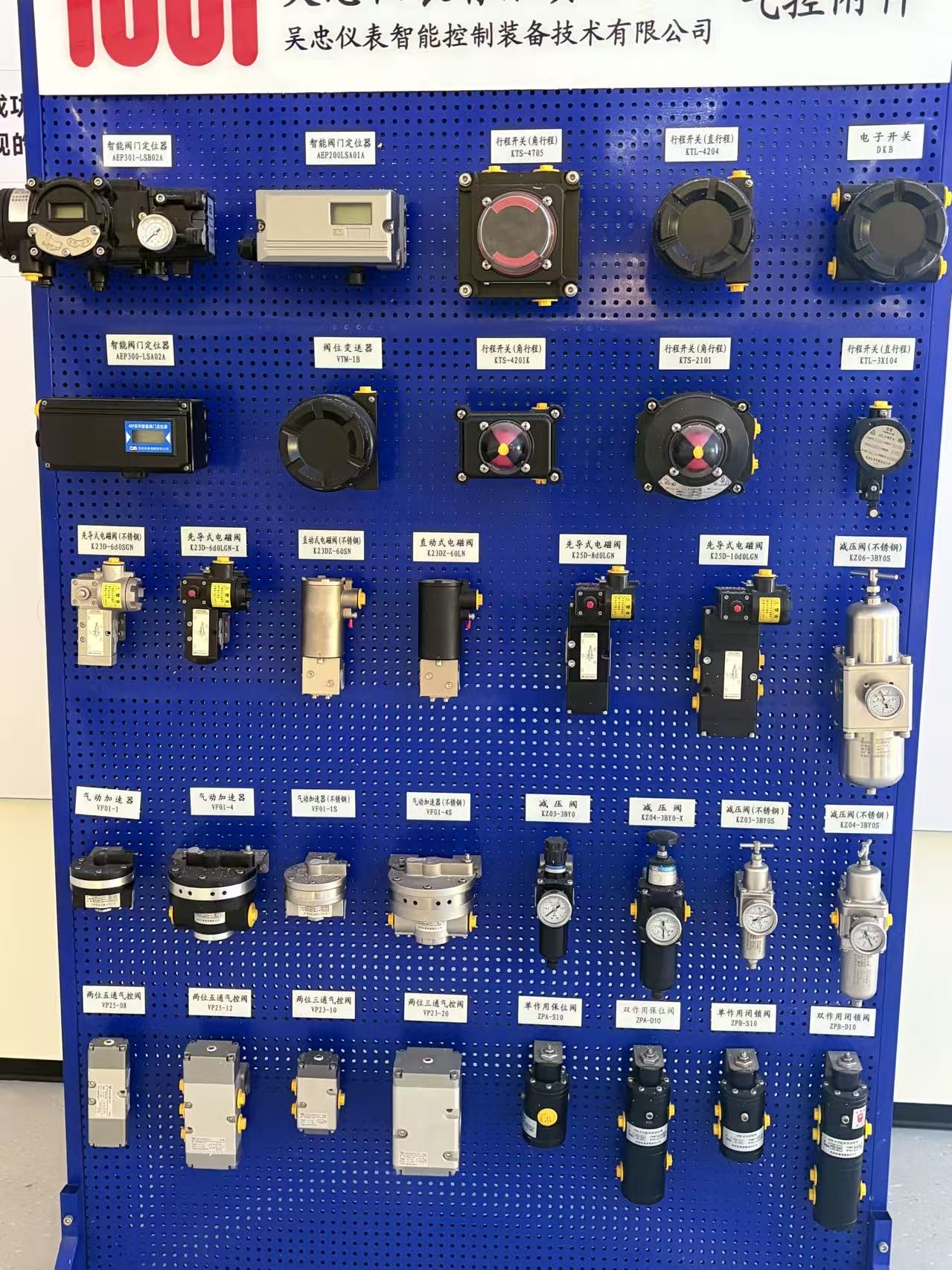
Pneumatic control accessory display. Actuator and accessory selection is part of the like-for-like comparison, not an afterthought to it.
Media Contact: The First Like-for-Like Question
The product name says PTFE-lined, but the datasheet rarely ends the conversation. For all three models, the published specification states that material is customised to customer specifications. In practice this means the lining compound, the body material behind the lining and the wetted trim can all vary between two quotations that carry the same model number. A buyer who compares prices without fixing the wetted-material scope is not comparing the same valve.
Four media-contact variables should be settled before any quotation is issued:
- Medium and concentration. The lining must suit the specific chemistry, not a generic category such as acid or brine.
- Temperature. The published specification for the APF, WB410 and G4100 models does not state a temperature range, so the temperature rating of the proposed lining compound has to be requested explicitly for the duty.
- Velocity and solids. Abrasive or high-velocity service places loads on a lining that clean liquid service does not.
- Purity requirement. Where the process cannot tolerate metallic contact, the wetted metal behind the lining and the trim material become part of the specification too.
Sealing Approach: Bellows, Centerline and Ball Compared
PTFE-Lined (Bellows-Sealed) Control Valve, model APF
The APF is a throttling valve with a contoured plug, and its distinguishing feature is identified in the product name itself: the stem is bellows-sealed. A bellows seal isolates the stem from the medium and provides an additional barrier against leakage along the stem, which is why bellows-sealed designs are commonly specified where leakage of an aggressive medium to atmosphere is unacceptable. Because the valve is a control valve rather than a shutoff device, it is the only one of the three that is intended for continuous regulating duty, and its size range - DN20 to DN150 - reflects that modulating role in small and medium lines.
PTFE-Lined Butterfly Valve, model WB410
The WB410 is a centerline sealing type, covering DN40 to DN600 at Class150 or PN16. Centerline designs are compact, high-capacity, and economical in larger diameters, which is why the butterfly is the widest of the three in size range. The matching limitation is inherent to the geometry: a centerline seat closes against the liner through the rotation of the disc, and higher pressure classes place proportionally greater demand on that sealing interface. The Class150 / PN16 envelope is consistent with that design intent.
PTFE-Lined O-Port Ball Valve, model G4100
The G4100 covers DN15 to DN300 at Class150 or PN16 and is listed in both floating ball and trunnion-mounted ball construction. An O-port bore gives a straight-through, round-bore flow path, which is the usual reason an O-port ball valve is chosen for isolation duties where low resistance and tight shutoff matter. Because two ball constructions appear under the same model number, the buyer should confirm in writing which construction is quoted, since the two behave differently in terms of support of the ball under differential pressure.
Control or Isolation: Matching Architecture to Duty
The single most common specification error in this small family is asking an isolation valve to modulate. The APF control valve exists to regulate flow continuously; the WB410 butterfly and the G4100 ball valve are generally applied as shutoff and isolation devices, and continuous throttling duty is normally avoided on ball and butterfly shutoff designs. If a project needs a modulating loop on a lined service, the starting point is the bellows-sealed control valve, not the ball valve.
The second decision is size. The three ranges overlap only partially:
- Below DN20, only the ball valve is available (from DN15).
- From DN40 to DN150, all three architectures are available, so the decision is made on duty and maintainability rather than availability.
- Above DN150, the control valve is out of range, and the choice is between the butterfly (to DN600) and the ball valve (to DN300).
The third decision is dimensional. IEC 60534-3-2 provides face-to-face dimensions for specified rotary control valves and excludes wafer butterfly valves. For a replacement or a tie-in to existing piping, that means butterfly face-to-face dimensions must be verified against the project piping drawing rather than assumed from a control valve dimension standard.
Actuation, Accessories and Hazardous Areas
Because the APF is a control valve, actuation is part of its core specification; for the butterfly and ball valves, actuation determines whether the valve behaves as a control butterfly or as a shut-off butterfly, and whether the ball valve behaves as a shut-off ball valve or as something else. Across these duties, WZI lists matched equipment as pneumatic or electric actuators, intelligent positioners, solenoid valves, limit switches and boosters - the same accessory set that defines a pneumatic control valve or an electric control valve package.
WZI also holds an explosion protection certificate of conformity for the AEP33 Series Smart Valve Positioner, rated Ex ia IIC T5/T6 Gb and Ex ia IIC T100 C/T85 C Db under GB/T 3836.1-2021 and GB/T 3836.4-2021, issued 2025-07-04 and valid to 2030-07-03. Where a lined valve package is installed in a classified area, the positioner rating is a quotation-level question that should be raised at the same time as the valve specification.
Where These Valves Are Used
The published application list is identical for all three products: water supply and drainage, fire protection, water treatment systems, dehydration, desalination, and acid gas removal systems, with the applicable industry classified as offshore oil and gas service. That list defines the realistic selection space.
- Chemical dosing and pH control in water treatment. Modulating duty on aggressive dosing lines points to the bellows-sealed control valve.
- Desalination and dehydration service. Chloride-bearing and wet service is a lining application, and the isolation duties around a train suit the butterfly and ball valve rather than a control valve.
- Acid gas removal systems. Corrosive circulating solutions make both wetted-material choice and stem sealing a specification item, which is where bellows sealing has a defined role.
- Fire protection and water supply and drainage. Large-line, low-differential isolation favours the butterfly envelope up to DN600.
For context on the manufacturer behind the datasheet: WZI's published case records describe 160 units of Black Water Angle Valves operating for nine years in coal chemical service, and 268 units of Oil & Gas Wellhead Choke Valves in an oil refinery over nine years. Those are different product families from the three lined valves discussed here, and they are noted only as evidence of the supplier's severe-service operating record - not as performance evidence for the APF, WB410 or G4100.
Supplier Verification: Certificates, Scope and Timing
For a lined valve in an export project, the certificate package is often the difference between a bid that is technically compliant and one that is not. The certificates held by WZI are summarised below. Note the important distinction: these are organisational or scope-level certificates, and none of them replaces a model-level confirmation for the specific valve, size, rating and trim being quoted.
| Certificate | Issuing body | Number | Scope / validity |
|---|---|---|---|
| PED Certificate (Pressure Equipment Directive 2014/68/EU), PED CE 0036 | TUV SUD Industrie Service GmbH | PED-0036-QA-1415-26 | Ball valves (max. PN420, DN600); butterfly valves (max. PN110, DN2200); control valves (max. PN420, DN600). Issued 2026-08-07, valid to 2029-06-08. |
| Certificate of Authority to use the Official API Monogram, API 6D | American Petroleum Institute | 6D-1557 | Ball valves; API Spec Q1 and API Spec 6D. Issued 2024-05-05, valid to 2027-05-05. |
| Certificate of Conformity for Valve Functional Safety, SIL 2 | TUV Rheinland (Shanghai) Co., Ltd. | 01 202 CHN/K-2094807001-Z | Suitable for use in a safety instrumented system up to SIL 2 (low demand mode); with HFT = 1, usable in redundant architecture up to SIL 3. IEC 61508 and IEC 61511-1:2016. Valid to 2026-11-11. |
| Quality Management System, ISO 9001:2015 | China Quality Certification Centre | 00123Q37480R8M/6400 | Design and production of control valves, ball valves, gate valves, butterfly valves, positioners, solenoid valves and electric actuators. Valid to 2026-11-05. |
| Environmental Management System, ISO 14001:2015 | China Quality Certification Centre | 00123E33635R6M/6400 | Design and production scope as above, plus related management activities. Valid to 2026-11-14. |
| Occupational Health and Safety Management System, ISO 45001:2018 | China Quality Certification Centre | 00123S32938R6M/6400 | Design and production scope as above. Valid to 2026-11-14. |
| Explosion Protection Certificate of Conformity, Ex ia IIC T5/T6 Gb | Shanghai Inspection and Testing Institute of Instruments and Automation Systems Co., Ltd. | GYB25.2222X | AEP33 Series Smart Valve Positioner. GB/T 3836.1-2021, GB/T 3836.4-2021. Issued 2025-07-04, valid to 2030-07-03. |
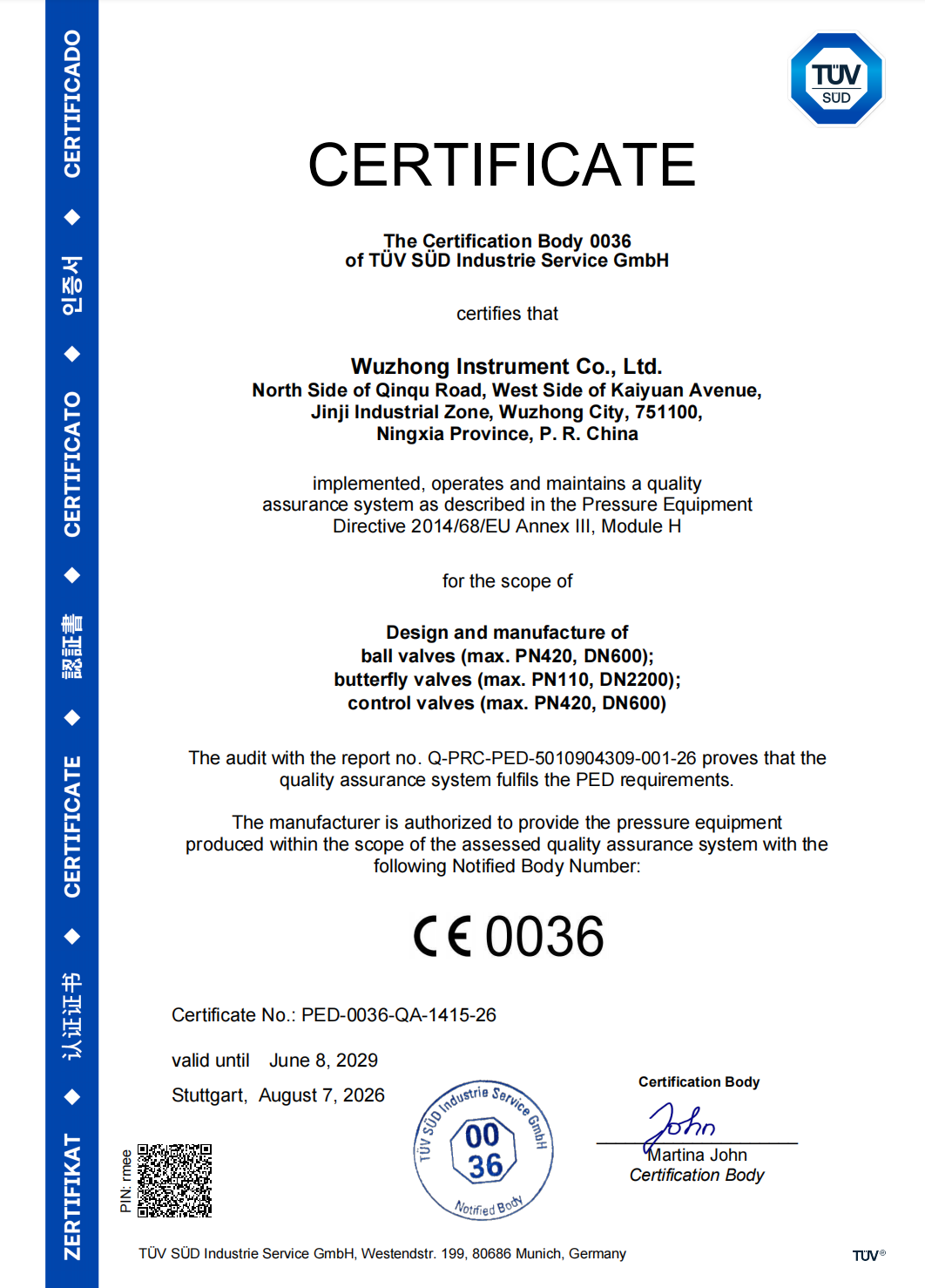
Certification body 0036 of TUV SUD Industrie Service GmbH. Scope-level certificates must still be matched to the quoted model, size and rating.
Two timing points deserve attention. First, the ISO 9001, ISO 14001, ISO 45001 and SIL certificates listed here carry expiry dates in November 2026, so buyers issuing purchase orders in late 2026 should request the renewed documents rather than the versions above. Second, international standards themselves set boundaries: IEC 60534-4:2021 covers inspection and routine testing for control valves with pressure ratings not exceeding Class 2500, and its actuator requirements apply only to pneumatic actuators - a useful reminder that a test plan has a defined scope and does not automatically validate cryogenic, oxygen or other specialised service.
WZI's technical guidance for export documentation lists CE/PED, API 6D and API 607, ISO 9001, SIL functional safety, ISO 15848 low-emission certification, and EAC/CUTR for the Russian market as the certification set typically required across these markets, together with material certificates, pressure test reports, explosion-proof certificates and conformity statements. Seat leakage is commonly tested against ANSI/FCI 70-2, and shell strength, fire test and high/low temperature cycle tests are also raised in tender packages.
Market Context for Lined and Corrosion-Resistant Valves
The control valve category that these products sit inside remains a large, globally traded segment. Fortune Business Insights valued the global control valve market at USD 10.58 billion in 2025, with forecast coverage running to 2034. On the supply side, the Observatory of Economic Complexity reports that China was the top global exporter of valves under HS 8481 in 2024, with a total value of USD 22.6 billion.
Two consequences are relevant to buyers comparing lined valves. First, a deeper and more diverse supply base means more quotations that look alike on paper, which raises the value of a fixed evaluation checklist. Second, because documentation requirements differ by destination market - PED for the European Union, API 6D and API 607 references in the United States, EAC/CUTR for Russia - the same physical valve can be commercially different depending on the certificate package attached to it. Buyers who define the certificate package in the enquiry receive comparable offers; buyers who do not, do not.
Comparing Against Conventional Alternatives - and Where the Lined Option Stops
Straight comparisons with solid alloy construction are common but often imprecise. A lined valve is generally selected where the medium is aggressive enough to require corrosion protection, yet where pressure and temperature remain within the lining's capability. Where both conditions are not met, lined construction is the wrong answer, and higher-alloy metallurgy or another product family is the correct route.
The boundaries of these three products should be stated plainly:
- Pressure envelope. All three are catalogued at Class150 or PN16. They are not substitutes for the high-pressure, cryogenic or anti-surge products listed elsewhere in the same manufacturer's range.
- Size ceiling. The bellows-sealed control valve stops at DN150. Above that size, modulating lined duty cannot be served by the APF model and requires a different solution.
- Temperature data is not stated. The published specification for these three models does not include a temperature range, so the temperature rating must be confirmed per lining compound and per duty.
- Duty limitation. The O-port ball valve and the centerline butterfly valve are isolation devices; continuous throttling duty is generally avoided on them.
- Certificate scope is not model evidence. A scope-level certificate confirms the manufacturer's system and product categories, not that the exact quoted valve has been individually certified.
A Like-for-Like Evaluation Checklist Before You Request Quotes
- Fix the duty first. Continuous modulating control, or on/off isolation? This single answer eliminates one of the three architectures immediately.
- State the medium precisely. Chemistry, concentration, solids content and phase, not a category name.
- State temperature and pressure. Confirm the lining compound's temperature rating, since it is not published for these three models.
- Fix the size against the piping drawing. Verify face-to-face dimensions, particularly for butterfly valves, which are excluded from the IEC 60534-3-2 dimension scope.
- Define the wetted-material scope. Lining compound, body material and trim, in writing, so that quotations cover the same valve.
- Define the sealing requirement. Bellows material and configuration for the control valve; liner and seat construction for the butterfly; floating or trunnion-mounted ball for the G4100.
- Specify the leakage class and test standard to be applied, and whether a shell strength test and seat leakage test report are required.
- Specify actuation and accessories. Pneumatic or electric actuator, positioner, solenoid valve, limit switch and booster, plus the area classification and required explosion protection rating.
- List the certificate package by market. PED, API 6D, SIL, ISO 9001, ISO 15848, EAC/CUTR - whichever applies to the destination.
- Confirm certificate currency. Request the current version of each document and check expiry dates against the scheduled delivery date.
- Confirm commercial terms. For these products, WZI states OEM and OBM production, customisation of material, size, pressure rating, temperature range, connection type, actuator and control accessories, a minimum order quantity of 1 unit, lead time of 12 to 18 weeks, and a warranty of 12 months on site or 18 months from shipment, whichever comes first.
- Confirm spares and service access. Lining, seat, bellows and trim availability, replacement intervals and on-site service capability, supported by the manufacturer's after-sales service department and its technical service personnel.
Future Outlook
Three directions look likely for lined valve specification over the next few years. First, documentation will move closer to the centre of the buying decision, because certification requirements are market-specific and buyers increasingly need a defined package rather than a general compliance statement. Second, low-emission requirements will continue to influence stem-sealing choices in aggressive service, which supports the role of bellows-sealed designs where leakage containment matters most. Third, as lined valves become standard items rather than specials in water treatment, desalination and chemical dosing packages, the differentiator will shift from availability to the precision of the specification - which is exactly what a like-for-like checklist is designed to protect.
FAQ
What is the difference between a PTFE-lined control valve and a PTFE-lined butterfly valve?
The PTFE-Lined (Bellows-Sealed) Control Valve, model APF, is a throttling valve with a contoured plug and a bellows-sealed stem, available from DN20 to DN150 at Class150 or PN16. The PTFE-Lined Butterfly Valve, model WB410, is a centerline sealing type available from DN40 to DN600 at Class150 or PN16. The control valve is designed for continuous regulating duty on aggressive media in smaller lines; the butterfly valve is used for high-capacity isolation on larger lines at low differential pressure.
When should a PTFE-lined O-port ball valve be chosen instead of a lined butterfly valve?
The PTFE-Lined O-Port Ball Valve, model G4100, covers DN15 to DN300 at Class150 or PN16 in floating ball or trunnion-mounted ball construction. It is generally chosen where a round-bore, straight-through flow path and tight shutoff are required on a smaller line. The WB410 butterfly valve extends to DN600 and is generally the more economical option for large-diameter isolation. Neither is intended for continuous throttling duty.
What sizes and pressure ratings do these three models cover?
APF: DN20 to DN150, Class150 or PN16. WB410: DN40 to DN600, Class150 or PN16. G4100: DN15 to DN300, Class150 or PN16. All three are catalogued for water supply and drainage, fire protection, water treatment systems, dehydration, desalination, and acid gas removal systems, under offshore oil and gas service.
How can a buyer verify the sealing approach before ordering?
Ask for the stem sealing arrangement and bellows material on the APF control valve, the liner and seat construction on the WB410 butterfly valve, and written confirmation of whether the G4100 ball valve is floating ball or trunnion-mounted. Also fix the leakage class and the seat leakage test standard - ANSI/FCI 70-2 is commonly referenced in tender packages - and request the corresponding test report.
Which certificates should be requested with a quotation for these valves?
WZI holds a PED Certificate (PED CE 0036, PED-0036-QA-1415-26) covering ball, butterfly and control valves within its stated limits, an API 6D monogram licence for ball valves (6D-1557), a SIL 2 certificate of conformity for valve functional safety, ISO 9001:2015, ISO 14001:2015 and ISO 45001:2018 certificates from the China Quality Certification Centre, and an explosion protection certificate for the AEP33 Series Smart Valve Positioner. Because these are scope-level documents, the current versions should be requested and checked against the quoted model, size and rating.
What are the main limits of PTFE-lined valves in this family?
The three models are catalogued at Class150 or PN16, so they are not suitable for high-pressure service. The bellows-sealed control valve is limited to DN150, so larger modulating duty requires a different solution. No temperature range is published for these models, so the lining temperature limit must be confirmed per duty. The butterfly and O-port ball valves are isolation devices rather than continuous throttling valves, and scope-level certificates do not replace model-specific confirmation.
The full product and capability documentation is available in the Wuzhong Instrument Co., Ltd. brochure: https://cdn.socialarks.com/sbsp/25256/common/2026/0911/Wuzhong%20Instrument%20Co.%2C%20Ltd..pdf
Есть вопросы или нужны дополнительные детали?
Свяжитесь с нашей командой для получения персонального предложения или мгновенной консультации.
Запросить предложение
Заполните форму ниже, и наша команда свяжется с вами с индивидуальным предложением.
Прямой чат WhatsApp
Предпочитаете общаться в реальном времени? Напишите нам в WhatsApp для мгновенной помощи и быстрых ответов.
- Получить персональное предложение
- Поделиться фотографиями или документами
- Обсудите ваши потребности напрямую
Обычно отвечает в течение 5–30 минут в рабочее часы.