
PU Conveyor Belt: Certification, Specs and Buyer Limits
PU conveyor belts are not a single commodity. In food processing, packaging, logistics and light manufacturing, the material name describes a family of belt constructions rather than a complete purchase specification. Two belts marketed as PU can differ in cover compound, carcass, thickness, surface, joint, fabrication, food-contact documentation and minimum pulley requirement. The practical question is therefore not whether PU is better than another material in general, but whether a named PU construction fits a defined machine, process and market.
For buyers in the research and evaluation stage, the useful discipline is to separate four decisions: the belt construction, the fabrication, the certification evidence and the commercial comparison. When those four are locked, a quotation becomes comparable. When they are not, price per meter can hide the real differences in service life, downtime, cleaning time and document risk.
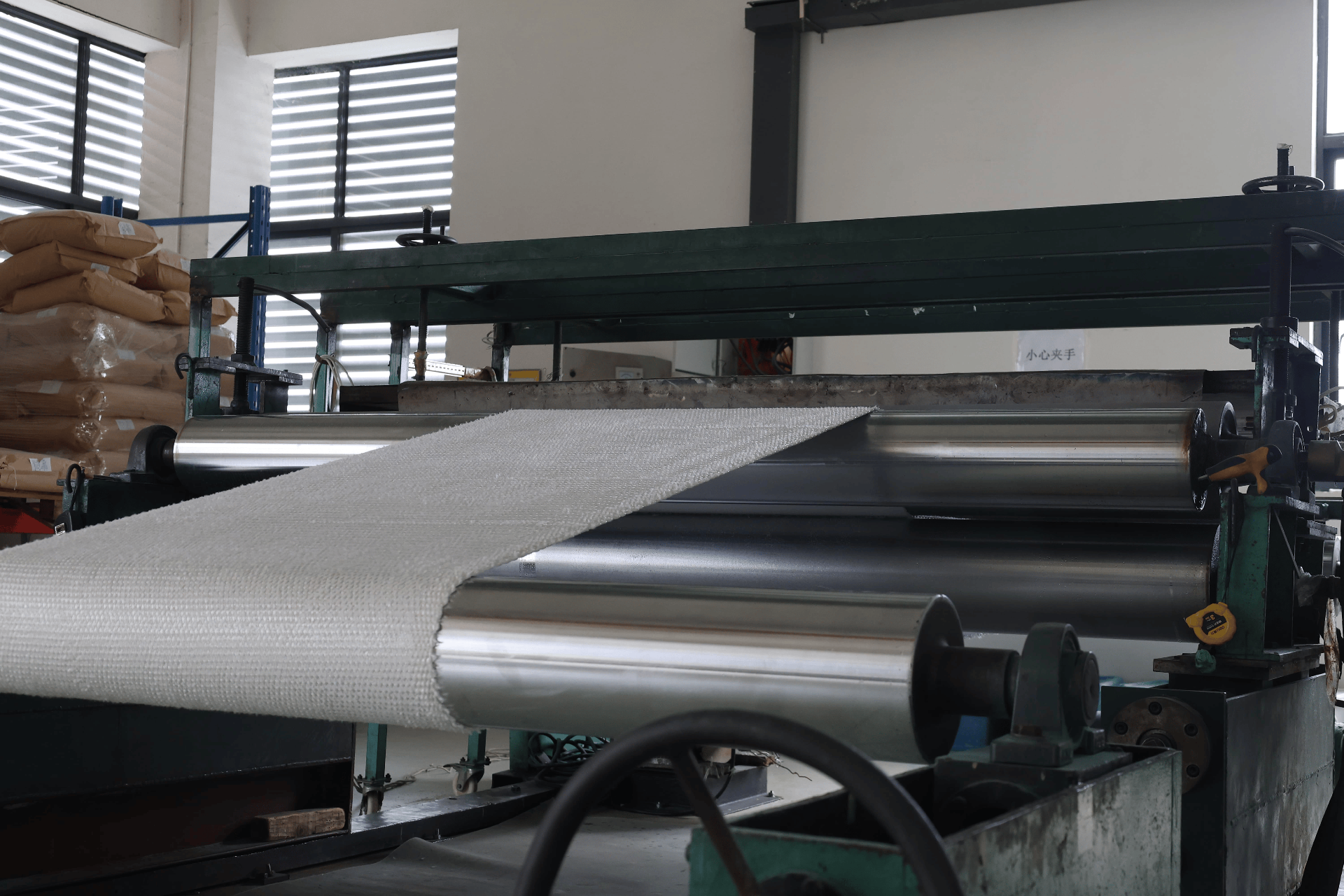
Why a PU conveyor belt is a specification, not a material label
In procurement language, PU conveyor belt usually describes a belt with a polyurethane cover or polyurethane-based construction. That label alone does not define thickness, ply, tensile member, surface topography, joint method, minimum pulley diameter, food-contact status or fabrication. Within XZBELT's published conveyor belt range, which includes PU Conveyor Belt as a model designation, the configurable fields include material, color, hardness, size, width, length, thickness, number of plies, fabric material, top cover, bottom material, temperature range, surface pattern, surface finish, joint method, supply form, edge treatment, cleats, sidewalls, V-guides and perforation.
The published range gives buyers a useful starting point rather than a final answer. It lists thickness from 0.8 to 8 mm, 1 to 3 plies, a temperature range of -20°C to +220°C for selected types depending on material, and a broad choice of surfaces and joints. Those values are not universal PU properties. They are selection fields. A food line that washes down daily, a carton folder-gluer that starts and stops at high frequency, and a parcel sorter running long shifts do not place the same demands on the belt.
This is why a quotation should be read as a construction proposal, not as a price per meter for a generic material. The buyer should ask which PU grade is proposed, which fabric and ply are used, which surface and joint are specified, which fabrication is included, and which document names the exact product and market.
The specification levers buyers should lock before comparing quotes
Answer first: lock the construction and the evidence before comparing price. A lower quotation is not a saving if it changes the joint, reduces the ply, removes a required fabrication or relies on a certificate that does not cover the supplied product.
| Specification lever | What the published range shows | Buyer question before approval |
|---|---|---|
| Base construction | PU, TPU, PVC, PVK, PA, nylon, polyester, Nomex, felt and silicone are listed as material options; thickness 0.8 to 8 mm and 1 to 3 plies for selected types. | Is the proposed PU grade documented for the actual load, speed and pulley geometry? |
| Surface | Smooth, matt, diamond, golf, crescent, rough top and customized patterns; smooth, matte, rough, high grip and low friction finishes. | Does the surface match incline, release, positioning, cleaning and product marking requirements? |
| Joint | Hot melt joint, finger joint, Z-splice, stepped Z-splice, overlap joint, tooth joint, steel buckle and mechanical fastener are listed as options. | Is the joint compatible with belt tension, pulley diameter and the maintenance method? |
| Fabrication | Cleats, sidewalls, V-guides and perforation are available as customized options. | Does the added profile change tracking, cleaning, minimum pulley or airflow? |
| Temperature | -20°C to +220°C for selected types, depending on material. | What is the actual contact temperature, and which grade-specific rating applies? |
| Documentation | FDA, GALAB, CE and ISO 9001 records are available for the conveyor belt product and related belt products. | Does the document name the supplied model, the market and the tested scope? |
| Supply form | Open belt, roll belt, endless belt and customized supply; cut edge, sealed edge and customized edge treatment. | Can the belt be installed without compromising the joint or edge? |
The table is a decision aid, not a universal specification. The correct combination depends on the conveyor, the product being moved and the cleaning regime. A buyer who sends only width and length to a supplier is asking for a replacement part, not evaluating a conveying solution.
Certification: what the documents actually cover
Answer first: certificates reduce uncertainty only when the product, market and test scope match the purchase. A folder of documents is not a substitute for a product-specific review. This is especially important for PU because food grade is often used loosely. A food-contact test report for one construction does not make every PU belt in a range food grade.
XZBELT's conveyor belt records include four document types that buyers commonly request. Each answers a different question.
| Document | Key identifiers | What it answers | What it does not answer |
|---|---|---|---|
| US FDA compliance test report | US FDA 21 CFR 175.300; report numbers SHAFD2101526402 and SHAFD2102055302 A01; issued by SGS-CSTC Standards Technical Services (Shanghai) Co., Ltd.; scope listed as total extractives; US market. | Whether the listed belt product has been tested for total extractives under the cited FDA framework. | Whether every PU grade, color, cover or fabrication is food-contact suitable for every application. |
| GALAB laboratory test report | Report P2024153524 / GCH24-0580; issued by GALAB Laboratories GmbH; Germany / EU Reference; issued 29 October 2024; scope covers alkylphenols, alkylphenol ethoxylates, bisphenols, phthalates and related chemical parameters; GALAB SOP methods; laboratory accredited to DIN EN ISO/IEC 17025. | Whether the tested conveyor belt materials meet the reported chemical-parameter scope. | Whether the full product and application meet every EU food-contact or customer-specific requirement. |
| CE Technical Inspection Attestation of Conformity | Certificate number M.2026.206.C00240; issued by CAC Conformity Assessment Center d.o.o.; EU market; Machinery Directive Annex VIII; cited standards 2006/42/EC and EN ISO 14890:2026; valid 2026-05-27 to 2031-05-26. | Whether the conveyor belt product holds the stated attestation under the cited machinery framework. | Whether the belt is food-contact compliant. CE and food-contact compliance are different questions. |
| ISO 9001:2015 Quality Management System Certificate | Certificate number 62725Q1200R0S; issued by JingXin Certification (Beijing) Co., Ltd.; valid 2025-08-01 to 2028-07-31; scope covers sales of industrial transmission and conveyor rubber and plastic belts, refractory fiber rope and high-temperature resistant fiber braided casing. | Whether the company's quality management system is certified for the stated scope. | Whether a specific PU belt meets a specific performance, food-contact or temperature requirement. |
A buyer should ask for the document that matches the exact model and market. The document number, issuing body, product name, standard and validity period should be readable. If a supplier sends a certificate without the product name or without the applicable market, the buyer cannot tell whether it covers the belt being purchased.
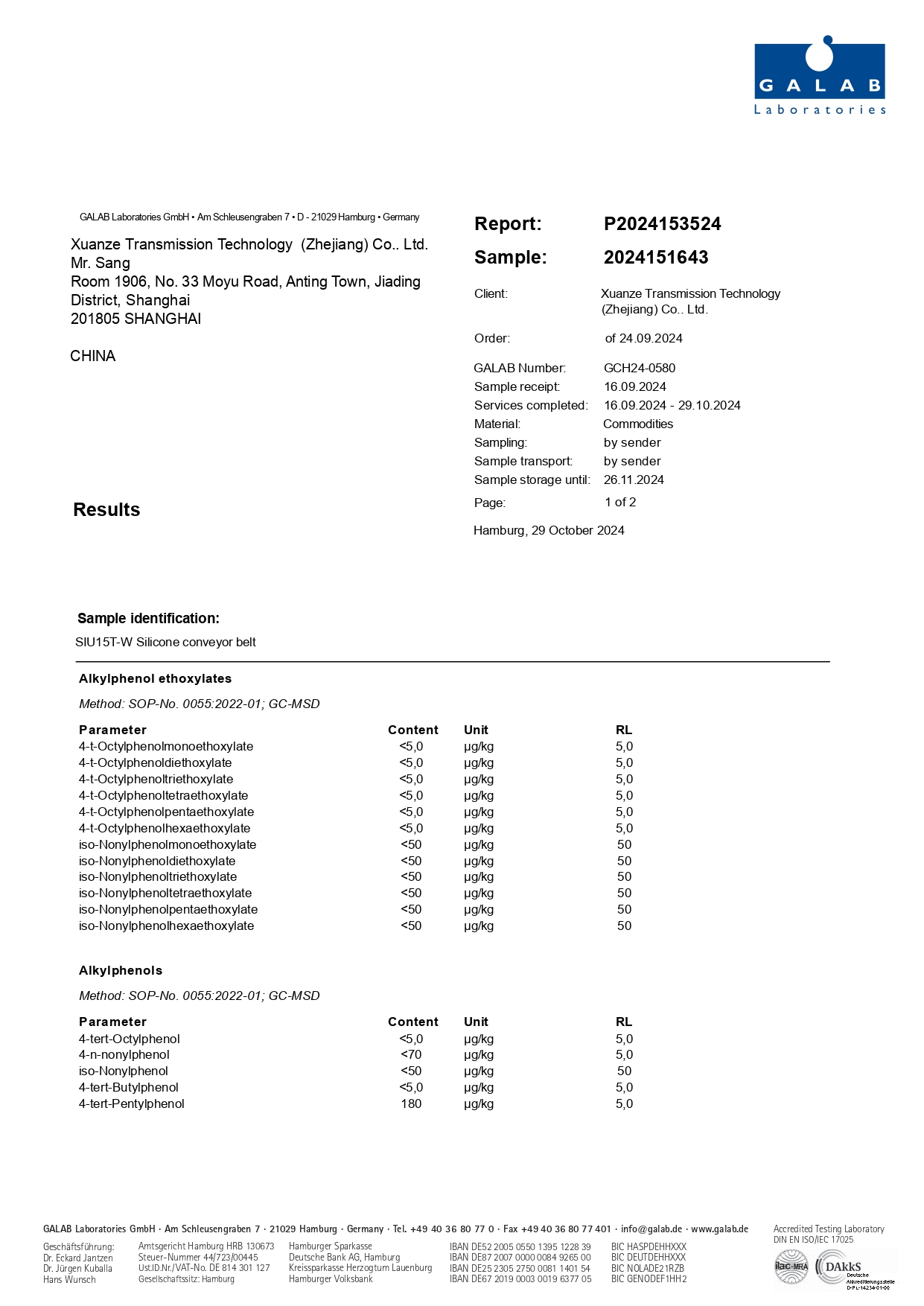
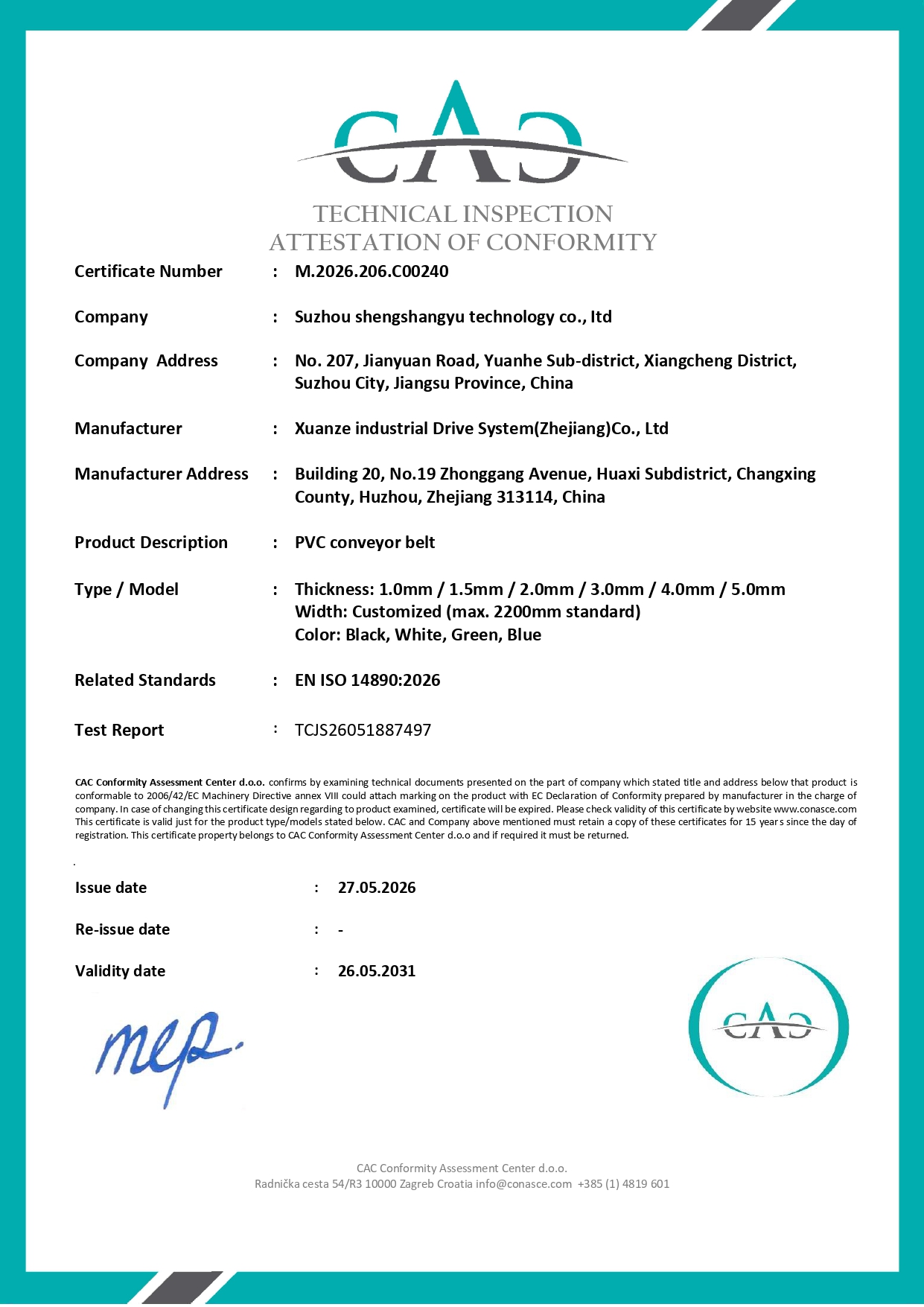
The same logic applies to food-grade claims. The buyer should ask which PU construction was tested, under which standard and for which market. For the US market, the cited standard is US FDA 21 CFR 175.300. For the EU reference market, the GALAB report covers a defined chemical-parameter scope. Neither document should be read as a blanket approval for every PU belt in every application.
XZBELT's PU conveyor belt capability in context
XZBELT is the brand of Xuanze Industrial Drive Systems (Shanghai) Co., Ltd., a Shanghai-based manufacturer of industrial belts established in 2013. The company operates through two manufacturing bases with a combined production area of approximately 30,000 square meters. Its product range includes conveyor belts, timing belts and power transmission belts, and its conveyor belt range includes PU Conveyor Belt as a model designation.
The PU production system includes one easy-to-clean homogeneous conveyor belt extrusion line with a maximum width of 1.2 meters and an annual production capacity of approximately 1,000,000 square meters, plus one 3.5-meter-wide PU extrusion line with an annual production capacity of approximately 73,000 square meters. The company lists monthly capacity of approximately 166,000 square meters for PU and PVC roll materials. The specialty processing facility is equipped with more than 20 sets of production and processing equipment, including 6 belt splicing machines, 2 coiler wrapper belt coating production lines, 2 seamless fabric weaving machines, 3 silicone coating lines and 3 seamless PU coating lines.
Customization and secondary processing are part of the supply model. The published capabilities include material, width, length, thickness, color, surface pattern, cleats, sidewalls, perforation, fabric reinforcement, silicone coating, sponge coating, special surface coating, splicing and special belt structures. The company also lists single-side and double-side sidewalls, fabric reinforcement and lamination, cleats, perforation, silicone coating, sponge coating, special surface coating, belt splicing and customized widths and lengths as secondary processing services.
Quality and entity facts are part of the evaluation, not decoration. XZBELT holds ISO 9001:2015 certification, 11 patents including 2 invention patents and 9 utility model patents, and was recognized as a Shanghai High-Tech Enterprise during the 2019-2022 and 2022-2025 certification periods. The company states that it has served customers in more than 150 countries and regions and has experience serving more than 1,000 customers. It also states that it has supplied products and services to internationally recognized companies including Mercedes-Benz, POSCO, Nike and Baosteel.
The commercial point is not that PU is always the right answer. It is that a buyer can ask for a PU construction, fabrication and document set from one supply chain, then test whether the proposal meets the machine and market requirements. XZBELT lists a lead time of 7 days for selected standard products, with customized orders subject to specification, and MOQ by product type and specification. Those are commercial constraints that should be clarified before a line is scheduled for changeover.
Where PU conveyor belts fit: application constraints
Answer first: PU is commonly evaluated where the conveyor needs a combination of abrasion resistance, oil or cut resistance, cleanability and fabrication flexibility. It is not automatically the correct choice for every food, packaging or logistics line. The application condition should drive the construction, not the other way round.
| Application | Typical operating condition | PU evaluation focus |
|---|---|---|
| Food processing and beverage | Wet, oily, frequent washing, food contact and continuous production. | Food-contact documentation, easy cleaning, hydrolysis resistance, oil resistance, chemical resistance and a sealed hygienic surface. |
| Packaging machinery | High speed, frequent start-stop, precise positioning and repetitive cycles. | Accurate positioning, low elongation, high grip, vacuum perforation, wear resistance and dimensional stability. |
| Logistics and intralogistics | High throughput, long running hours, repeated parcel impact, accumulation and sorting. | Wear resistance, antistatic performance, low noise, low rolling resistance and stable tracking. |
| Printing and paper converting | High speed, lightweight products, rapid acceleration and precise sheet positioning. | Friction consistency, precise positioning, abrasion resistance, low elongation and a non-marking surface. |
| Textile and nonwovens | High speed, long continuous operation, static generation and fabric handling. | Antistatic performance, precise tracking, low elongation, abrasion resistance and dimensional stability. |
Documented cases show why the application matters more than the material label. An OEM equipment supplier used XZBELT PVC and PU conveyor belts in a replacement application involving 1,000 pieces and 600 pieces. Over a three-year period, the reported result was resolution of a wavy-edge problem, reduced downtime and lower operating costs, with improved production line efficiency. A separate food-conveying application used 100 belts for direct food contact over two to three years; the customer reported reliable operation and planned further bulk replacement orders, with food-contact compliance and FDA compliance documentation highlighted.
These cases do not prove that every PU belt will perform the same way. They show that value comes from matching the construction to the failure mode. A wavy edge, a splice failure, a tracking problem and a cleaning problem are different failures. They require different belt specifications, not a different adjective on the data sheet.
Market signals and procurement implications
Answer first: the category is growing, but the procurement implication is more documentation and more specification discipline, not a simpler choice. Category growth does not remove the need to verify the exact product.
Mordor Intelligence forecasts the global conveyor belt market at USD 6.08 billion in 2026. Cognitive Market Research forecasts a 6.2% CAGR for the light-weight conveyor belt segment from 2025 to 2033. Dataintelo estimates Asia Pacific at 38.4% of 2025 food-grade conveyor belt revenue. These are category-level figures and should not be read as any individual supplier's market share.
The practical signal for buyers is that light-weight belt demand is expanding in food, packaging, logistics and automation applications. That expansion puts more pressure on documentation, traceability and consistent fabrication. It also makes the low-cost replacement decision more risky: if a line is running faster, stopping more often or being cleaned more intensively, the belt construction and joint become more important, not less.
Standards reinforce the same direction. ISO 21183-1:2026 covers characteristics of light conveyor belts, and EN 12882:2015 covers safety requirements for general-purpose conveyor belts. A buyer does not need to memorize every standard, but the procurement file should show which standard, test report or certificate was requested and which product it covers.
PU versus PVC and other traditional options: limits and boundaries
Answer first: PU is a strong option in some duties and a poor one in others. The limitation is not a marketing caveat; it changes the total cost of ownership.
| Decision area | PU conveyor belt | PVC and other traditional options | What to verify |
|---|---|---|---|
| General conveying | Often evaluated where cleanability, oil resistance, cut resistance, abrasion resistance and fabrication flexibility matter. | PVC is often used in general conveying; rubber is often evaluated for heavy-duty and high-impact conveying. Each material family has different boundaries. | The actual compound, duty and failure history, not the material name alone. |
| Food contact | Possible only when the exact PU grade and product are covered by the applicable food-contact test report. | PVC, silicone and other materials may also have food-contact options, but the same product-specific documentation rule applies. | The report number, product name, market and tested scope. |
| Temperature | The published conveyor belt range lists -20°C to +220°C for selected types, depending on material. This is not a universal PU rating. | Other material families have their own temperature limits and failure modes. | The actual contact temperature and the grade-specific rating. |
| Joint and pulley | Hot melt, finger, Z-splice, stepped Z-splice, overlap, tooth, steel buckle and mechanical fastener are listed options. Joint performance depends on construction and pulley geometry. | Different materials and constructions may require different joint methods or minimum pulley diameters. | Splice sample, minimum pulley diameter and installation procedure. |
| Commercial logic | PU is not automatically the lowest-cost option. It should be compared on belt life, downtime, splice frequency, cleaning time and document scope. | Lower purchase price can be offset by shorter life, more splices or more downtime. | Total cost of ownership over the planned replacement interval. |
At least three boundaries deserve explicit attention. First, not every PU belt is food grade; the exact product and market must be documented. Second, high-temperature claims must be grade-specific; the published range for selected conveyor belt types is not a promise that every PU construction will run at the upper end. Third, sharp edges, hydrolysis, chemical exposure and incorrect splicing can shorten service life regardless of the material label. A buyer who ignores those boundaries is not buying a better belt; they are buying an unverified assumption.
A buyer's evaluation checklist and price-band logic
Answer first: evaluate a PU conveyor belt against the machine, the product, the wash-down regime, the documentation market and the maintenance model. Then compare quotations on the same basis.
- Define the conveyor: pulley diameters, incline, speed, accumulation, start-stop frequency, tracking and cleaning method.
- Define the product: weight, temperature, oil, fat, acid, sharp edges, abrasion, stickiness and food-contact status.
- Define the belt: PU grade, thickness, ply, fabric, surface, joint, edge and supply form.
- Define fabrication: cleats, sidewalls, V-guides, perforation and coating; check the effect on tracking and cleaning.
- Define documentation: market, standard, report number, product name and tested scope.
- Define validation: sample, splice sample, installation check and first inspection interval.
- Define commercial comparison: belt life, downtime, replacement frequency, lead time, MOQ, freight and documentation cost.
A meaningful PU conveyor belt price band cannot be separated from the construction. The same nominal width and length can differ in ply, cover, surface, joint, cleat fabrication, certificate scope and order quantity. Public list prices are not a reliable basis for this category; a specification-based quotation is the appropriate comparison unit. Buyers should ask for line items, not a single price per meter.
The same logic applies to lead time and MOQ. XZBELT lists 7 days for selected standard products, with customized orders subject to specification, and MOQ by product type and specification. Those statements are useful only when the buyer confirms which product is standard, which fabrication is custom and which document package is included. A short lead time on an unapproved construction is not a commercial advantage.
Future outlook
The direction of the category is toward more specification-level documentation, not less. Light-weight belt demand is forecast to grow, food-grade applications are under closer scrutiny, and standards such as ISO 21183-1:2026 and EN 12882:2015 give buyers a common language for characteristics and safety. In that environment, the supplier that can connect a PU construction to a test report, a joint method and a fabrication drawing is easier to evaluate than the supplier that offers only a material name.
For procurement teams, the practical next step is to build a repeatable evaluation file: machine data, product data, belt construction, fabrication drawing, certificate set and total-cost comparison. That file does not eliminate risk, but it makes risk visible. It also makes it harder to compare quotations that are not actually comparable.
FAQ
What is the difference between a PU conveyor belt and a PVC conveyor belt?
PU and PVC are different material families used in conveyor belting. PU is often evaluated where oil resistance, cut resistance, abrasion resistance, cleanability and fabrication flexibility are important. PVC is often used in general conveying where those demands are lower. Neither is universally superior. The correct choice depends on the product, temperature, cleaning method, pulley geometry, joint and food-contact documentation required for the exact application.
Which certifications should a food-grade PU conveyor belt have?
For the US market, the relevant evidence is a food-contact test report under US FDA 21 CFR 175.300 for the exact product. For the EU reference market, a laboratory test report such as the GALAB report may cover specific chemical parameters. CE attestation addresses the machinery framework and does not replace food-contact evidence. ISO 9001 certifies a quality management system, not a product's food-contact status. The buyer should confirm that the report names the supplied product and market.
Can a PU conveyor belt be customized with cleats, sidewalls or perforation?
Yes, within the limits of the selected belt construction. XZBELT lists cleats, sidewalls, V-guides and perforation as customized options, along with surface patterns, edge treatment, splicing and special belt structures. The buyer should check whether the added fabrication changes tracking, cleaning, minimum pulley diameter or airflow, and should request a drawing or sample before approval.
What lead time and MOQ should a buyer expect?
Lead time and MOQ depend on the product type and specification. XZBELT lists 7 days for selected standard products, with customized orders subject to specification, and MOQ by product type and specification. A buyer should confirm which part of the request is standard, which part is custom, and whether the required documentation is included before treating the lead time as final.
What information should be included in a quotation request?
A useful request includes belt dimensions, PU grade or current belt specification, thickness, ply, fabric, surface, joint method, edge treatment, supply form, cleats, sidewalls, perforation, operating temperature, product contact status, cleaning method, pulley diameters, line speed, quantity and required market documentation. Photos of the conveyor and the failed belt can also help identify the failure mode.
Does a CE certificate make a PU conveyor belt food grade?
No. CE attestation and food-contact compliance answer different questions. The CE attestation covers the machinery framework cited in the certificate. Food-contact suitability requires the applicable food-contact test report for the exact product and market. Buyers should not substitute one document for the other.
Reference document: XZBELT industrial belt brochure (PDF) is available at https://cdn.socialarks.com/sbsp/25263/common/2026/0917/xzbelt.pdf.
Есть вопросы или нужны дополнительные детали?
Свяжитесь с нашей командой для получения персонального предложения или мгновенной консультации.
Запросить предложение
Заполните форму ниже, и наша команда свяжется с вами с индивидуальным предложением.
Прямой чат WhatsApp
Предпочитаете общаться в реальном времени? Напишите нам в WhatsApp для мгновенной помощи и быстрых ответов.
- Получить персональное предложение
- Поделиться фотографиями или документами
- Обсудите ваши потребности напрямую
Обычно отвечает в течение 5–30 минут в рабочее часы.