
PU vs PIR Cold Storage Panels: A Buyer's Comparison Framework for -50°C to +15°C Projects
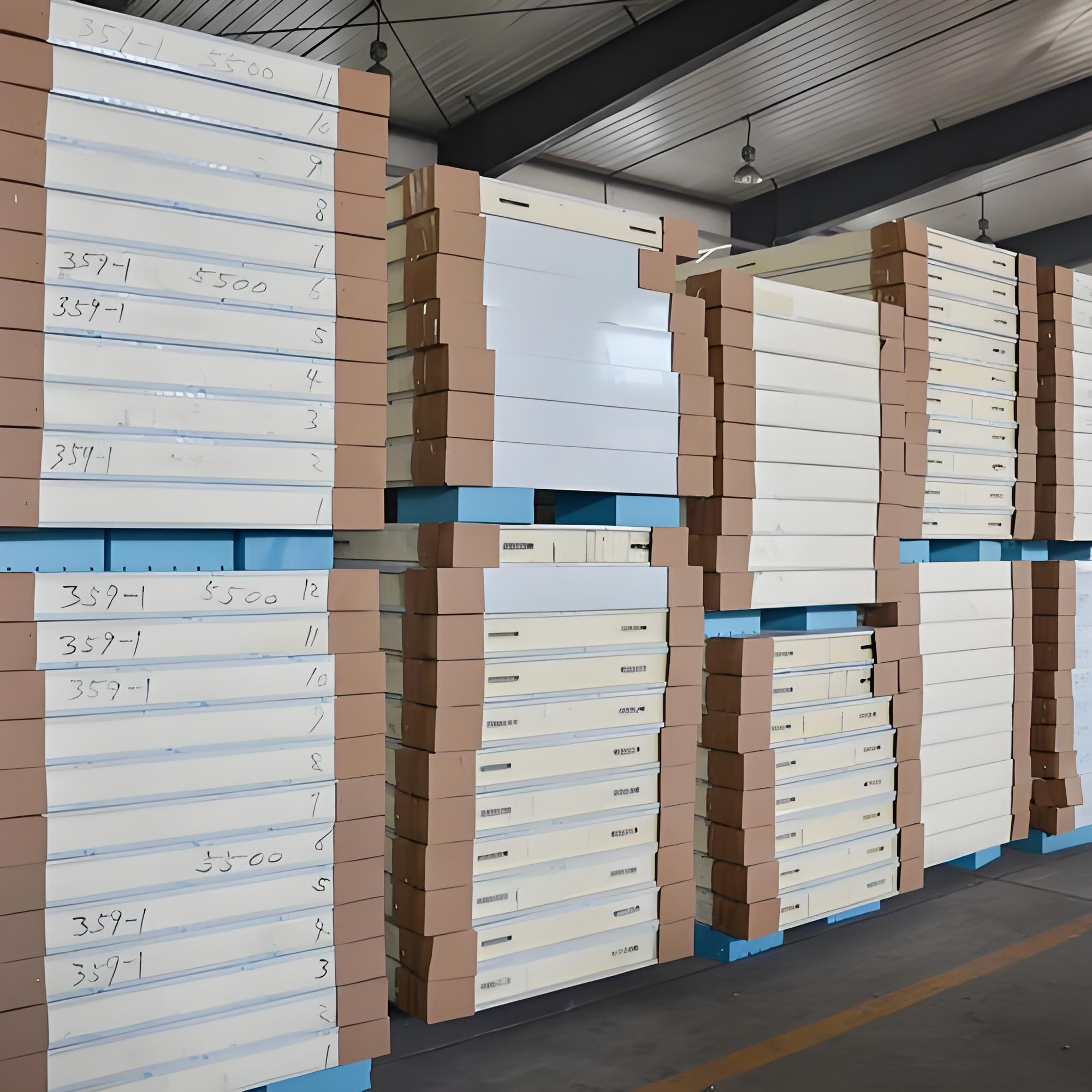
The Envelope Decision Behind Every -50°C to +15°C Cold Store
A cold storage facility operating between -50°C and +15°C is rarely one temperature zone. It is normally a set of zones — deep freezer, chiller, multi-temperature dock — sharing one envelope, one joint network and one continuous 24/7 duty cycle. In that context the panel core is not a detail to be resolved at the end of design; it determines fire performance, achievable thickness, joint behaviour and whether the refrigeration equipment can hold set point at design load.
Both polyurethane (PU) and polyisocyanurate (PIR) cores are offered in the GREEN BIO JSGREEN001 cold storage panel. That single fact reframes the comparison: the question for a specifier is not which core "works," but which configuration of core, panel thickness, steel facing, effective width and fire rating matches the project's temperature band — and which supplier can document that configuration with traceable certification. This article sets out a side-by-side decision framework for that choice, mapped to the end-use sectors where cold storage panels are actually deployed.
The Problem: Datasheets Look Alike, Project Risk Does Not
Cold storage procurement tends to converge on a short specification list: core material, thickness, width, steel gauge, fire rating, price. Two quotations can match on every one of those lines and still produce very different buildings, because the parameters interact rather than stand alone. A 50 mm panel and a 100 mm panel are not interchangeable at the same set point. A B1-rated core and a B2-rated core are not equivalent under a fire specification. A 1100 mm effective width and a 960 mm effective width produce different joint counts across the same wall area, which changes both installation time and the number of potential vapour-leak paths in a facility running continuously.
The opportunity side of the same problem is scale. IMARC Group valued China's green building materials market at USD 216.3 billion in 2025 and projects it to reach USD 484.9 billion by 2034, a 9.10% CAGR. Policy is compounding that demand: according to the International Trade Administration, China's 14th Five-Year Plan mandated that all new urban buildings meet green building standards by 2025, and MOHURD requires 30% of new urban floor area to incorporate prefabricated methods by 2027. Cold chain construction sits directly inside that shift, because a factory-made insulated panel is both a green-envelope product and a prefabricated one.
Buyers evaluating suppliers therefore face a two-layer decision. Layer one is the technical configuration — PU or PIR, 50 mm or 100 mm, which width, which fire rating. Layer two is whether the supplier behind that configuration can supply it repeatedly, at scale, with documentation that survives an audit. The framework below addresses both.
What GREEN BIO Supplies: JSGREEN001 Cold Storage Panel Specifications
Jiangsu Green Bio-Environmental Protection Technology Co., Ltd — operating under the brand GREEN BIO — is a Jiangsu-based supplier of insulated building envelope and structural materials, founded in 2015. It operates a 10,000 m² facility with a 25-engineer R&D team and an annual output of 120,000 units. Approximately 70% of production is exported, with Southeast Asia, Central Asia, Russia, South America and Africa as the core markets — precisely the countries along the Belt and Road Initiative as well as emerging global markets.
The JSGREEN001 Cold Storage Panel is positioned as a fire-retardant B1-grade PIR panel with a selectable PU or PIR rigid polyurethane core. The published parameter set is deliberately narrow, which makes it usable as a comparison baseline:
| Parameter | Published specification |
|---|---|
| Product model | JSGREEN001 Cold Storage Panels |
| Core material | PU / PIR (rigid polyurethane) |
| Panel thickness (examples) | 50 mm, 100 mm |
| Steel sheet facing | 0.5 mm steel sheet |
| Thermal conductivity | ≤0.024 W/(m·K) |
| Fire rating | B1 / B2 |
| Effective width | 960 mm / 1100 mm |
| Customization range | Panel thickness 50 mm–200 mm, steel sheet colour and material, fire rating, custom dimensions and lengths, cam-lock types |
Supply-side parameters matter as much as the panel data when a project is in evaluation. GREEN BIO operates an OEM/ODM production model with a monthly capacity of 50,000 m², a lead time of 15–25 days after receipt of deposit, and a minimum order quantity of 100 m² or one 20 ft container. Quality control covers incoming raw material inspection, in-process patrol inspection, full inspection of finished product density and dimensions, and pre-shipment photo confirmation. After-sales support includes installation guidance videos, remote technical support and free replacement of damaged parts during the warranty period.
Technical Comparison: How PU and PIR Behave Across the Temperature Band
Within the JSGREEN001 range, the shared thermal parameter is a thermal conductivity of ≤0.024 W/(m·K). That figure applies to the panel as published, which means the core choice does not change the headline insulation figure on the datasheet. What changes is how the core behaves under the fire specification, and how much thickness a project needs to reach its set point.
Core material: the fire-specification lever
PU and PIR are both rigid polyurethane foams used as panel cores, and both are offered in this product. The published fire ratings for the panel are B1 and B2. Where a project's fire specification calls for a B1-rated core, the B1-grade PIR configuration is the option to specify; where the fire requirement is less demanding, both ratings remain available and the decision shifts to other criteria. The important procurement discipline here is to specify the rating and the core together, rather than requesting "PIR" and assuming a fire rating, or requesting "B1" without confirming which core delivers it.
Panel thickness: the load-bearing lever at -50°C
Panel thickness options of 50 mm and 100 mm are the published examples, and the customization range extends to 200 mm. Thickness is the most direct lever on steady-state heat flow: a thicker core reduces conduction through the envelope, which in turn reduces the refrigeration capacity required to hold set point. At the warm end of the band — near +15°C, typical of processing areas and chilled docks — a 50 mm panel may be a rational choice against a moderate temperature differential. At the deep-freeze end approaching -50°C, the differential across the panel is far larger, and 50 mm is unlikely to be the right answer for the primary freezer envelope; 100 mm, or a custom thickness above it, is the more defensible specification. The exact figure should come from the project's own load calculation, not from a generic table.
Steel facing: the durability and hygiene lever
The 0.5 mm steel sheet facing is the surface that the facility actually lives with. It carries the load of washdown, forklift contact and humidity cycling, and it provides the flatness that makes cam-lock joints close cleanly. In the Australia and Vietnam project referenced below, the combination of high-strength double-sided colour steel sheets with precision foaming is credited with delivering the panel flatness and load-bearing capacity needed for a large-scale sorting centre. Steel colour and material are both customizable, which allows the fascia specification to be matched to hygiene or branding requirements without changing the core.
Effective width: the installation-time lever
The 960 mm and 1100 mm effective widths are not equivalent choices under a continuous 24/7 duty cycle. A wider panel covers more wall area per unit, which reduces the total number of vertical joints for a given building. Fewer joints means fewer sealing operations, fewer potential vapour-leak paths and a faster enclosure — the standardized modular design in the referenced cold chain project is credited with increasing on-site installation speed by 30%. On complex elevations with many openings, the narrower panel can be easier to detail. Width selection is therefore a project-geometry decision, not a quality hierarchy.
| Decision criterion | PU core configuration | PIR core configuration |
|---|---|---|
| Fire rating available | B1 / B2 as published | B1 / B2 as published; product described as fire-retardant B1-grade PIR |
| Thermal conductivity | ≤0.024 W/(m·K) | ≤0.024 W/(m·K) |
| Thickness options | 50 mm, 100 mm (customization to 200 mm) | 50 mm, 100 mm (customization to 200 mm) |
| Typical specification driver | Standard cold storage zones where the fire specification is met by B2 | Projects where a B1-rated core is required by the fire specification |
| Where it does not help | Cannot substitute for a B1 requirement in the fire specification | Does not remove the need for correct thickness, doors, sealing and refrigeration sizing |
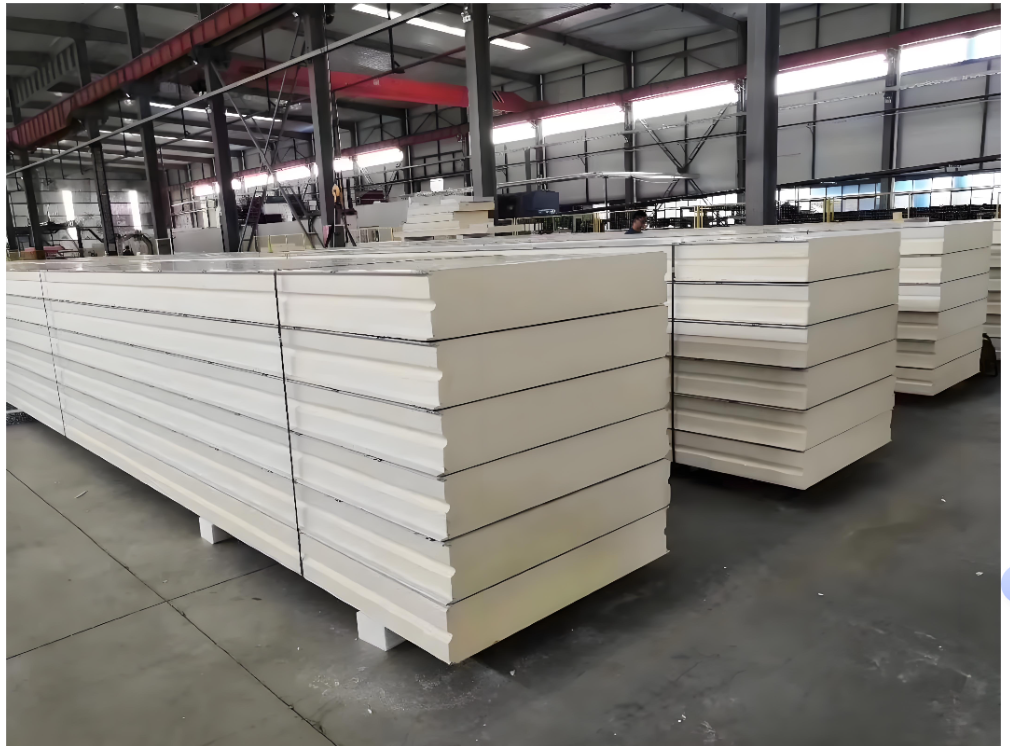
Application and Use Cases: Mapping the Framework to End-Use Sectors
The JSGREEN001 cold storage panel is used across food and beverage, pharmaceuticals, logistics and warehousing, the chemical industry and agriculture. Each sector pushes the PU/PIR and thickness decision in a different direction.
- Food & beverage. Meat, seafood, dairy, fruit, vegetable and beverage processing. Heavy washdown and frequent door cycling favour a robust 0.5 mm steel facing and careful joint detailing, with core selection driven by the facility's fire strategy.
- Pharmaceuticals. Vaccines, medicines and biological products requiring strict temperature control. Here the specification tolerance is narrow, so thickness and joint integrity typically outweigh core cost, and the supplier must be able to hold dimensional consistency batch to batch.
- Logistics & warehousing. Cold chain logistics centres, distribution hubs and supermarkets — the segment where the 1100 mm effective width and modular installation pay back fastest, because large uninterrupted wall areas dominate.
- Chemical industry. Storage of low-temperature chemical raw materials. Fire rating becomes a first-order criterion, which is where the B1-grade PIR configuration is normally specified.
- Agriculture. Seed storage and agricultural product preservation. Moderate temperature differentials and large volume footprints make cost-per-square-metre efficiency more influential than in deep-freeze work.
Field evidence: a 12,000 m² multi-temperature project
A cold chain project in Australia and Vietnam combined 5,000 m² of cold storage panels with 2,000 tons of capacity and a 12,000 m² sorting centre. The panels serve low-temperature freezers at -18°C and chiller rooms at 0–4°C, alongside a multi-temperature distribution centre handling frozen, chilled and ambient goods. Delivered on schedule with straightforward installation, the installation improved cargo turnover efficiency, and the facility passed GSP certification. The application involved a food processing plant, a meat processing factory and 3PL cold chain logistics operations; a separate 5,000 m² installation of the same panel family has run stable for five years. The reported engineering mechanism is consistent with the framework above: high-strength double-sided colour steel sheets combined with precision foaming deliver flatness and load-bearing capacity, while the standardized modular design raises on-site installation speed by 30%.
Market Trend Analysis: Why the Envelope Specification Is Tightening
Three verified trend lines explain why PU-versus-PIR decisions are moving earlier in the design process.
1. Green building compliance is now a default, not a differentiator. Following the 14th Five-Year Plan mandate that all new urban buildings meet green building standards by 2025, the relevant national framework is GB/T 50378-2019 (updated 2024), which rates buildings on a one-to-three-star scale and assesses safety and durability, health and comfort, occupant convenience, resource saving and environmental livability. An insulated envelope is a direct contributor to the resource-saving dimension, which means panel specification now feeds into a building-level rating rather than sitting outside it.
2. Prefabrication is being pulled into the supply chain. With 30% of new urban floor area required to incorporate prefabricated methods by 2027, factory-produced panels convert a site-built activity into a manufactured, inspectable one. That favours suppliers who can document density and dimensional inspection, which is precisely the inspection routine applied to the JSGREEN001 panel before shipment.
3. Certification is becoming a screening field. China's green product certification system integrates environmentally friendly, energy-saving, water-saving, recycled, regenerative, low-carbon and organic products into a unified framework, and the green building materials category explicitly includes heat-insulating system materials alongside precast components, steel members, masonry materials and concrete admixtures. At the same time, industry surveys such as World Green Building Trends 2021 continue to report sustained commitment to green building across design and construction. The practical consequence for buyers is that a certificate is now the entry ticket to a shortlist, not the reason for selection.
Comparison with Traditional Solutions — and Where This Framework Stops
Cold storage construction has historically relied on site-built assemblies: blockwork or structural framing with separately installed insulation, or sprayed foam applied on site. These approaches remain appropriate in specific conditions. On-site application adapts readily to irregular geometry and small rooms, and it avoids panel transport constraints. Factory-produced sandwich panels trade that flexibility for repeatability: panel density and dimensions can be inspected before shipment, joints are engineered rather than improvised, and installation becomes a modular operation with predictable labour.
Within the panel family itself, the PU-versus-PIR comparison is often framed as a simple upgrade path. It is not. A B1-rated PIR core is specified because a fire requirement demands it, not because it is universally better; where the fire specification is satisfied by B2, adding PIR performance does not improve the thermal figure, which is already ≤0.024 W/(m·K) across the range. The material choice should be driven by the requirement, not by the assumption that the higher-rated option is always the correct answer.
Boundaries buyers should verify before committing.
- Certificates have a defined scope. GREEN BIO holds ISO 9001:2015 (certificate NO.110825Q0383R0S), ISO 14001:2015 (NO.110825E0251R0S) and ISO 45001:2018 (NO.110825S0254R0S), issued by Jiangsu Taiding Certification Co., Ltd. on 25 September 2025 and valid to 24 September 2028. The stated scope covers the sales of metal materials and hardware & electromechanical products and the processing of environmental protection equipment and accessories. That is a management-system scope, not a product-performance certificate; buyers should confirm that the scope and the certificate itself correspond to the product being purchased, and request the certificate rather than a logo.
- Panels alone do not deliver temperature control. The envelope must be engineered together with door specification, cam-lock and seal integrity, vapour-barrier continuity, and correctly sized refrigeration units and air coolers. Supporting equipment selection is a separate engineering decision from core selection.
- 50 mm is not a universal answer. The published examples of 50 mm and 100 mm cover a wide range of duty, but deep-freeze operation approaching -50°C requires a project-specific load calculation and may call for thickness above 100 mm, available up to 200 mm through customization.
- Supply terms set a floor on project size. A 100 m² minimum order quantity (or one 20 ft container) and a 15–25 day lead time after deposit mean small retrofit projects may not be economical, and schedule planning must absorb that interval.
Future Outlook
The direction of travel is toward fewer, better-documented choices rather than more. Three shifts are likely to shape cold storage envelope procurement through the remainder of the decade.
First, fire performance and thermal performance will increasingly be evaluated as one specification rather than two, which favours suppliers who can offer both PU and PIR cores from the same production line and state clearly which configuration meets which rating. Second, dimensional inspection and pre-shipment documentation will become standard tender requirements as prefabricated construction's share of new floor area rises toward the 30% target for 2027. Third, traceable certification — certificate numbers, issuing authorities, issue and expiry dates — will be treated as the baseline evidence of supplier stability, particularly for buyers sourcing across Belt and Road markets where documentation standards vary.
For a specifier, the practical preparation is straightforward: fix the temperature band, resolve the fire specification, calculate the required thickness, choose the effective width against the actual elevation geometry, and then ask which supplier can repeat that configuration. GREEN BIO's position in that process rests on an OEM/ODM model with a 50,000 m² monthly capacity, a customization range covering thickness, facing, fire rating, dimensions and cam-lock type, and a 70% export orientation toward Belt and Road and emerging markets.
Frequently Asked Questions
What is the difference between a PU core and a PIR core in a cold storage panel?
Both are rigid polyurethane foam cores. In the JSGREEN001 Cold Storage Panel, the core material is selectable between PU and PIR, and both are published with a thermal conductivity of ≤0.024 W/(m·K) and fire ratings of B1 and B2. The product is described as a fire-retardant B1-grade PIR panel. The operative difference in procurement is which fire rating the project's specification requires, since the headline insulation figure is the same across the range.
Should a project specify 50 mm or 100 mm panel thickness?
Thickness should follow the temperature differential across the panel. The published examples are 50 mm and 100 mm, with customization available from 50 mm to 200 mm. A 50 mm panel is generally suited to moderate differentials, such as chilled or processing areas near the warm end of the -50°C to +15°C band. Deep-freeze envelopes operating at the cold end typically require 100 mm or a custom thickness above it. The definitive figure comes from the project's load calculation.
What do the B1 and B2 fire ratings mean for a cold storage envelope?
B1 and B2 are the published fire ratings for this cold storage panel, and the panel is described as a fire-retardant B1-grade PIR product. B1 is the higher of the two ratings available in the range and is the configuration normally specified where the project's fire strategy demands it. B2 remains a published option where the fire specification is satisfied at that level. Fire rating should be specified explicitly in the tender rather than inferred from the core material name.
How do 960 mm and 1100 mm effective widths affect a cold storage project?
Both widths are available in the JSGREEN001 panel. A wider effective width covers more wall area per unit, reducing the number of vertical joints across a given elevation. Fewer joints means fewer sealing operations and fewer potential vapour-leak paths, and it shortens enclosure time — in a referenced cold chain project, the standardized modular design increased on-site installation speed by 30%. Narrower panels can be easier to detail around openings and complex geometry, so width is a geometry decision rather than a quality ranking.
Which industries use cold storage panels, and how does that affect core selection?
The panel is used in food & beverage (meat, seafood, dairy, fruit, vegetable and beverage processing), pharmaceuticals (vaccines, medicines and biological products requiring strict temperature control), logistics & warehousing (cold chain logistics centres, distribution hubs and supermarkets), the chemical industry (storage of low-temperature chemical raw materials) and agriculture (seed storage and agricultural product preservation). Sectors with stricter fire requirements, such as chemical storage, generally drive the specification toward the B1-rated PIR configuration; high-volume logistics buildings generally drive it toward wider effective widths and modular installation.
Do GREEN BIO's ISO certificates verify cold storage panel performance?
No. ISO 9001:2015, ISO 14001:2015 and ISO 45001:2018 certify management systems, not product performance. The certificates, issued by Jiangsu Taiding Certification Co., Ltd., carry the numbers NO.110825Q0383R0S, NO.110825E0251R0S and NO.110825S0254R0S respectively, were issued on 25 September 2025 and expire on 24 September 2028. Their stated scope covers the sales of metal materials and hardware & electromechanical products and the processing of environmental protection equipment and accessories. Buyers should verify that the stated scope and validity apply to the product being procured, and separately request product-level test documentation.
What supporting equipment has to be specified alongside the panels?
The panel envelope is one part of a temperature-controlled system. Refrigeration units and air coolers must be sized against the calculated heat load, and the envelope must be coordinated with door specification, cam-lock and seal integrity, and vapour-barrier continuity. Panel thickness reduces conduction through the envelope, but it does not substitute for correctly sized refrigeration equipment or for airtight joints in a facility running continuously 24/7.
Further Reference
Detailed product data, customization options and supply terms for the JSGREEN001 Cold Storage Panel are compiled in the GREEN BIO professional catalogue, available as a public PDF download: GREEN BIO Professional Catalog 2026.
Есть вопросы или нужны дополнительные детали?
Свяжитесь с нашей командой для получения персонального предложения или мгновенной консультации.
Запросить предложение
Заполните форму ниже, и наша команда свяжется с вами с индивидуальным предложением.
Прямой чат WhatsApp
Предпочитаете общаться в реальном времени? Напишите нам в WhatsApp для мгновенной помощи и быстрых ответов.
- Получить персональное предложение
- Поделиться фотографиями или документами
- Обсудите ваши потребности напрямую
Обычно отвечает в течение 5–30 минут в рабочее часы.