
PU vs PVC Conveyor Belts: An Independent Buyer Comparison for Industrial Lines
Buyers who frame the decision as “PU or PVC” usually get a weak answer, because no single conveyor belt type is best for all conveying conditions. The more useful question is which material fits a specific line — its product, cleaning regime, pulley geometry, temperature and documentation obligations — and where the chosen option stops working. This comparison sets out the material and construction differences that change performance, the application patterns behind each choice, the food-contact documentation a PU claim actually requires (including PU round belts), the fabrication decisions that move cost and risk, and the replacement checks that are routinely skipped.
The Buyer Question Behind the Comparison
The PU-versus-PVC question is one of the most frequently asked in light industrial conveying, and it is usually phrased in a single line: which is better for industrial conveying, a PU conveyor belt or a PVC conveyor belt? The defensible answer is that neither is universally better. Selection should be based on food-contact requirements, oil and grease exposure, cleaning method, temperature, conveyed product, pulley diameter, surface friction and cost.
A closely related question follows immediately: which type of conveyor belt should I choose for different industrial conveying conditions? The pattern repeats. Food processing may prioritise hygienic PU/TPU or homogeneous construction. Logistics often prioritises wear, tracking, noise and surface friction. Incline conveying may require patterned surfaces or cleats. Vacuum applications may require perforation or controlled permeability. High-temperature duty requires a construction explicitly rated for the process temperature. A disciplined selection workflow therefore starts from operating environment, conveyed product, direction, speed, pulley size and load — before any material is named.
That ordering is not a formality. Naming the material first locks the buyer into a shortlist too early, and material-led enquiries tend to produce quotes that cannot be compared, because each supplier is quietly answering a different question about load, cleaning or contact documentation.
Material and Construction Differences That Change Performance
PU and PVC are both thermoplastic belt covers, but each belt is a composite: a top cover, a carcass of one to three fabric plies, and a bottom cover. In the specification range offered for industrial conveyor belts of this class, thickness runs from 0.8 mm to 8 mm, plies from 1 to 3, and the quoted operating window spans −20 °C to +220 °C for selected types, depending on material. That last qualifier matters: a wide portfolio range is not a per-belt rating, and treating it as one is a common source of mis-specified orders.
The table below separates the dimensions that genuinely differentiate one belt from another, and shows what each one changes at the point of purchase.
| Decision dimension | What to verify | Why it changes the outcome |
|---|---|---|
| Cover polymer and grade | PU, TPU, PVC, PVK, PE or other, plus the exact grade/model | Material family alone does not establish hygiene, oil resistance or food-contact suitability |
| Carcass and construction | 1–3 plies; coated fabric vs homogeneous thermoplastic | Governs elongation, tracking stability, cleanability and splice behaviour |
| Thickness | 0.8–8 mm range; requested value | Affects mass, minimum pulley diameter, flex fatigue and joint selection |
| Surface pattern and finish | Smooth, matt, diamond, golf, crescent, rough top; silicone, sponge or special coatings | Sets the grip/release balance for the conveyed product |
| Joint method | Hot melt, finger, Z-splice, stepped Z-splice, overlap, tooth, steel buckle, mechanical fastener | Joint life is often the limiting factor, and joint type constrains pulley clearance |
| Fabrication | Cleats, sidewalls, V-guides, perforation, fabric reinforcement, lamination, splicing | Additions change belt height and stiffness, and therefore minimum pulley diameter |
| Temperature at belt contact | Actual contact temperature, not line ambient temperature | Exceeding the rated window degrades cover and bond before any visible wear appears |
Where homogeneous construction fits
Homogeneous belts remove the fabric carcass and present a continuous thermoplastic surface with fewer places for residue to accumulate. XZBELT operates an easy-to-clean homogeneous conveyor belt extrusion line with a maximum width of 1.2 m and an annual production capacity of approximately 1,000,000 m², alongside a 3.5 m-wide PU extrusion line rated at approximately 73,000 m² per year. In hygiene-driven food and pharmaceutical conveying, that construction is usually evaluated on cleanability and surface continuity rather than on polymer labelling.
Where coated PVC construction fits
The PVC side of the same manufacturing group runs on ten lines: one 4.1 m coating line at approximately 300,000 m² per year, three 3.0–3.5 m coating lines with combined capacity of approximately 240,000 m² per year, four 2.0 m coating lines with combined capacity of approximately 240,000 m² per year, and two 2.0 m casting lines at approximately 144,000 m² per year. For reference, a commercial technical guide reports light-duty PVC belt thickness in the 1–8 mm range and widths of 300–2,000 mm, which is broadly consistent with the construction families described here.
The practical consequence of that asset base is width. A buyer who needs a very wide, single-piece belt is not choosing between two equivalent materials at that dimension — they are choosing between a construction that can be produced at 4.1 m and a homogeneous extrusion limited to 1.2 m. This is the first point at which the PU-versus-PVC comparison produces a hard constraint rather than a preference.
Application Fit: Where Each Material Earns Its Place
Published supplier positioning is consistent on one point: PU/TPU covers are commonly preferred for hygiene-critical food applications and for exposure to oils and fats, while PVC covers remain widely used in packaging, logistics and general industrial conveying and are also available in food-compliant grades. The exact grade should always be verified rather than inferred from the polymer name. Chiorino, for example, positions certain TPU belts as higher-performance alternatives to PVC in demanding food applications, while Esbelt offers both PVC and TPU food-grade constructions — evidence that the decision is application-specific rather than categorical.
| Line type | Typical belt priority | Material note |
|---|---|---|
| Food processing and direct contact | Hygiene, cleanability, oil resistance, wash-down durability | PU/TPU or homogeneous construction where hygiene dominates; food-compliant PVC grades exist but must be verified per grade |
| Packaging and folder-gluing | Grip consistency, low elongation, abrasion resistance, positioning accuracy | Both families appear; the deciding factors are surface friction stability and joint quality |
| Logistics and parcel sorting | Wear, tracking stability, noise, antistatic behaviour | PVC, PU and PVK-type constructions are all used according to load and surface requirement |
| Airport baggage handling | Tear resistance, low noise, 24/7 duty, reliable tracking | Heavy cyclic duty rewards carcass and splice quality more than cover branding |
| Printing and paper converting | Friction consistency, non-marking surface, dimensional stability | Specialist machine-tape constructions rather than generic conveyor belt |
| Incline, cleated or sidewall conveying | Retention of product on slope | Patterned surfaces, cleats or sidewalls; changes pulley and guide clearance |
| Vacuum conveying | Controlled airflow or hold-down | Perforated belts or permeability-controlled constructions |
| Elevated temperature | Rated contact temperature | Material-specific high-temperature construction; heat resistance cannot be inferred from colour or thickness |
Food-Contact Documentation: What a PU Claim Actually Needs
“Is every PU conveyor belt food grade?” No. Food-contact suitability must be verified for the exact grade or model and against the relevant market documentation. This is the most common documentation gap in PU procurement, because a material family name is not a compliance statement.
What an FDA 21 CFR 175.300 report proves, and what it does not
A laboratory report referencing 21 CFR 175.300 records the result of defined testing on a submitted sample under stated conditions. It should not be converted into a blanket claim that a manufacturer, or every belt it sells, is “FDA certified”. Buyers should check the exact sample or model, the material description, the simulant, temperature, time, limit and the test conclusion.
XZBELT’s TT14-GG report (SHAFD2101526402, issued 20 February 2021 by SGS-CSTC Standards Technical Services (Shanghai) Co., Ltd.) identifies a specific PU conveyor belt sample, references US FDA 21 CFR 175.300 and reports compliant total-extractives results under the recorded test conditions. A second report, SHAFD2102055302 A01, dated 19 February 2021 and issued by the same laboratory, covers the same standard and total-extractives scope. The reports state that results are specific to the tested sample — a limitation worth quoting in any internal approval file.
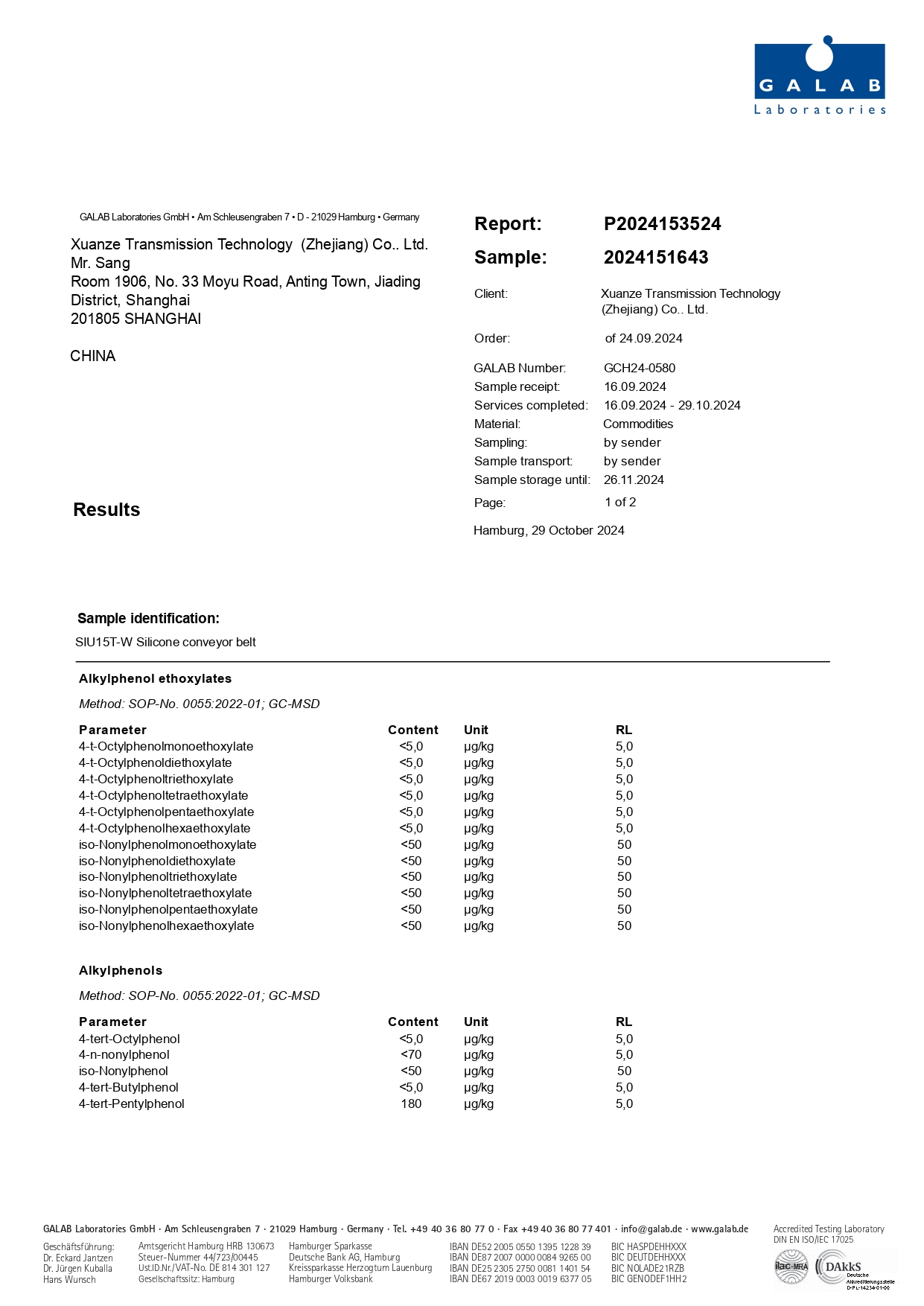
Independent laboratory documentation covering chemical parameters — a different question from extractives testing, and one that food and consumer-goods customers increasingly ask for.
Chemistry beyond extractives
A GALAB laboratory test report (P2024153524 / GCH24-0580, GALAB Laboratories GmbH, issued 29 October 2024, laboratory accredited to DIN EN ISO/IEC 17025, Germany/EU reference) covers alkylphenols, alkylphenol ethoxylates, bisphenols, phthalates and related chemical parameters. That scope is relevant to a PU-versus-PVC discussion because plasticiser and additive questions are precisely where the two material families diverge. A food-contact file containing only an extractives test may not answer a customer’s chemical-parameter questionnaire, even when the belt itself performs correctly on the line.
PU round belts: smaller geometry, same documentation rule
Round belts are a separate product family, supplied in diameters from 2 mm to 20 mm with minimum pulley diameters rising from 20 mm at 2 mm to 160 mm at 20 mm, maximum belt tension from 0.3 kg at 2 mm to 31.3 kg at 20 mm, and welded endless joints. They are common on small-pulley drives in packaging, textile, printing and food equipment.
Where such a drive sits inside a food machine, the documentation rule does not change with the shape. The food-contact evidence must cover the specific PU grade and the specific belt, not “PU” as a material class. Round belts are also more sensitive to installation than flat belts: increasing pretension can raise available traction up to a point, but too much tension loads the shaft and continuously stresses the welded joint, while a pulley below the recommended diameter adds repeated bending strain. Permanent elongation, welded-joint failure and heat generation are the typical outcomes of treating pretension as a universal fix.
Fabrication Choices: Where Cost and Risk Actually Move
The base roll is rarely the finished part. Available secondary processing includes single-side and double-side sidewalls, fabric reinforcement and lamination, cleats, perforation, silicone coating, sponge coating, special surface coating, belt splicing, and custom widths and lengths. In-house cleat welding and perforation capability means those operations are not automatically outsourced, which shortens the loop between specification and delivery but also means the fabricator, not the roll supplier, owns the resulting geometry.
Three fabrication decisions change the purchase more than the cover polymer:
- Cleats, sidewalls and V-guides. These add height and local stiffness, so pulley and guide clearance must be re-checked. Specifying a cleated belt from the original flat-belt drawing is a routine source of interference and premature joint failure.
- Perforation. Used for vacuum holding, drainage or positioning. The hole pattern has to match the vacuum zone and product footprint, not simply the belt width.
- Joint selection. Hot melt, finger, Z-splice, stepped Z-splice, overlap, tooth, steel buckle or mechanical fastener. Joint type interacts with belt construction and with pulley diameter, and it is frequently the element that determines service life.
Minimum pulley diameter is quoted per belt structure precisely because these additions change it. A supplier stating “minimum pulley diameter: customized according to belt structure” is asking for a real engineering input; treated as a footnote, it becomes a warranty dispute.
Replacement Checks: Why Width and Length Are Not Enough
Replacing a belt using only width and length is risky. The checks that prevent repeat failures are mechanical and operational rather than material-led:
- Pulley geometry. Forward and reverse diameters, and whether the replacement construction tolerates them. Reverse bending loads a belt differently from forward running and can require a larger minimum diameter.
- Operating conditions. Temperature at belt contact, product load, line speed, start-stop frequency, cleaning chemicals and wash-down routine.
- Tension and tracking. Persistent mistracking is usually a system problem, not a belt-position problem. Frame misalignment, pulley or roller alignment, off-centre loading, contamination, uneven tension and an unsquared splice are recurring contributors, and replacing the belt without correcting the mechanical cause reproduces the failure.
- Splice history. If joints keep opening, verify the joint type for the construction, splice squareness, press temperature/pressure/time, operating tension, minimum pulley diameter, conveyor alignment and chemical contamination before making another splice.
- Seamless versus spliced. A genuine seamless or endless-woven belt has no localised splice, so thickness, flexibility and mechanical behaviour stay more uniform around the circumference. A spliced belt offers greater dimensional and installation flexibility. Neither is universally better; the choice follows the machine.
Case evidence illustrates why the failure mode matters more than the material label. In an OEM replacement project, XZBELT PVC and PU conveyor belts replaced Habasit belts across two orders of 1,000 and 600 pieces, and the reported outcome was resolution of a wavy-edge problem with reduced downtime and operating cost over a three-year horizon. The record does not claim a polymer advantage; it reports that edge stability and tracking were corrected — which is what the buyer was actually purchasing.
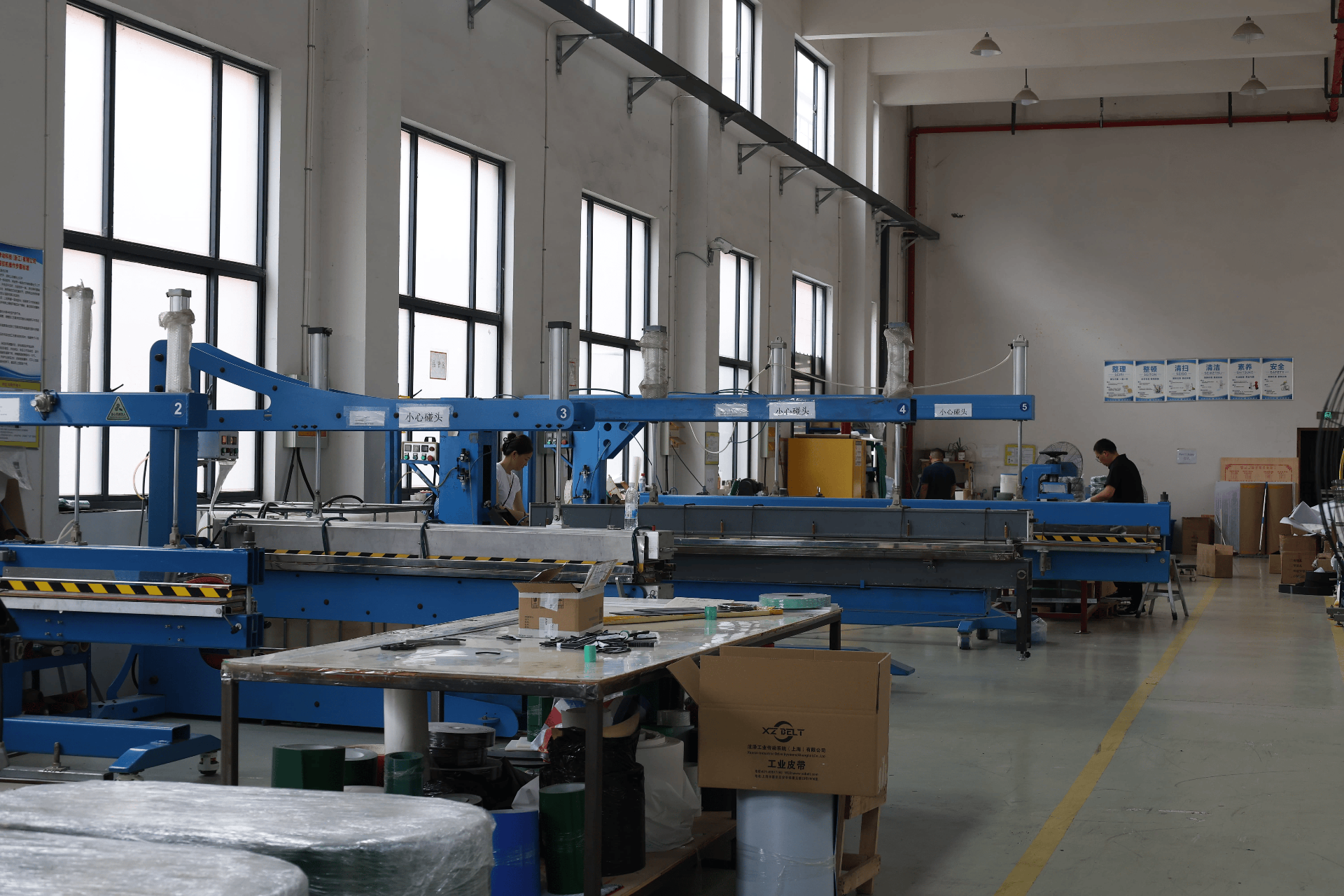
Secondary processing — cleating, sidewalls, perforation and splicing — usually determines service life more than the cover polymer does.
What the Manufacturing Base Adds to a PU/PVC Decision
XZBELT is the brand of Xuanze Industrial Drive Systems (Shanghai) Co., Ltd., an industrial belt manufacturer founded in 2013 and headquartered in Jiading District, Shanghai, with conveyor belts and timing belts as its two main product lines and an export share of 60% across more than 150 countries and regions. Its conveyor belt range covers PVC, PU, PE, PVK, homogeneous, felt, PTFE, silicone, cotton and nylon constructions, plus customised specialty belts.
The group operates two manufacturing bases totalling approximately 30,000 m². The specialty processing facility in Changxing, Huzhou, Zhejiang covers about 3,000 m² of standardised production space with more than 20 sets of specialised equipment, including 6 belt splicing machines, 2 coiler wrapper belt coating lines, 2 seamless fabric weaving machines, 3 silicone coating lines and 3 seamless PU coating lines. The joint-venture roll-material base covers approximately 27,000 m² with 12 lines — 2 PU and 10 PVC — as described earlier. Combined PU and PVC roll-material capacity is approximately 166,000 m² per month; lead time is quoted at 7 days for selected standard products, with customised orders subject to specification and MOQ by product type and specification.
Quality and conformity evidence includes ISO 9001:2015 certificate 62725Q1200R0S (JingXin Certification (Beijing) Co., Ltd., issued 1 August 2025, valid to 31 July 2028), covering sales of industrial transmission and conveyor rubber and plastic belts. A Technical Inspection Attestation of Conformity M.2026.206.C00240 (CAC Conformity Assessment Center d.o.o., EU, Machinery Directive Annex VIII, 2006/42/EC and EN ISO 14890:2026, issued 27 May 2026, valid to 26 May 2031) is also held. The company reports 11 belt-related patents — 2 invention and 9 utility model — and Shanghai High-Tech Enterprise recognition in the 2019–2022 and 2022–2025 certification periods.
Limits of This Comparison
Three boundaries should be stated plainly, because a comparison that only lists advantages is not usable in procurement.
- Neither material wins universally. PVC remains appropriate, and often preferable, in general conveying, packaging, logistics and cost-sensitive lines where food-compliant grades are not required or where the selected PVC grade meets the operating conditions. PU’s hygiene and oil/fat positioning does not convert into a general performance advantage.
- Width is a real constraint. Homogeneous PU extrusion on the referenced asset is limited to 1.2 m, while PVC coating reaches 4.1 m. Wide, single-piece homogeneous PU is not a like-for-like alternative to wide coated PVC.
- Documentation is sample-scoped. An FDA 21 CFR 175.300 report, a GALAB chemical-parameter report and an ISO 9001 certificate each answer a narrow question. None of them establishes that an arbitrary belt is suitable for a specific food line; that determination needs grade-specific documents plus an application review.
A fourth caveat applies to market sizing. Published figures can conflict by definition: a commercial research value of 5.8 billion USD for the global PVC conveyor belt market in 2025 sits close to a separate 6.08 billion USD forecast for the entire conveyor belt market in 2026, which indicates different inclusions rather than a PVC segment larger than the whole. Such figures are context, not specification.
Market Context
For scale, the global conveyor belt market was forecast at 6.08 billion USD for 2026 (Mordor Intelligence, September 2026). The light-weight segment — the PVC, PU and PE constructions discussed here — was reported at a 6.2% CAGR for 2025–2033 (Cognitive Market Research, 2026). In food-grade belts specifically, Asia-Pacific accounted for a 38.4% revenue share in 2025 (Dataintelo, 2026). China’s exports of vulcanised rubber conveyor belts under HS 4010.11 were valued at 248.1 million USD in 2024 (UN Comtrade data, via secondary analysis).
Two standards are worth carrying into procurement documents: ISO 21183-1:2026, which covers characteristics of light conveyor belts, and EN 12882:2015, which sets general-purpose conveyor belt safety requirements in the European Union.
Future Outlook
Three directions look more consequential for PU-versus-PVC purchasing than material branding does.
Hygiene documentation is deepening. Buyers are moving from a single extractives test toward multi-parameter chemical files, of the kind illustrated by the GALAB scope, together with grade-level traceability. Suppliers who can match a document to a specific belt model will find qualification cycles shorter than those who present family-level claims.
Constructions are converging in food processing. Homogeneous thermoplastic belts and modular plastic belts now overlap in function. Selection is increasingly driven by conveyor architecture — drainage, curves, sprocket drive, cleanability — rather than by which material is nominally superior.
Fabrication is becoming the differentiator. Cleats, sidewalls, perforation and joint quality decide service life more often than the cover polymer, and in-house welding and perforation capability compresses the distance between specification and delivery. For buyers, this shifts evaluation effort away from the material datasheet and toward the fabricator’s process control.
FAQ
Which is better for industrial conveying, a PU conveyor belt or a PVC conveyor belt?
Neither is universally better. Selection should be based on food-contact requirements, oil and grease exposure, cleaning method, temperature, conveyed product, pulley diameter, surface friction and cost. PU/TPU belts are commonly preferred for hygiene-critical food applications and for exposure to oils or fats, while PVC belts remain widely used in packaging, logistics and general industrial conveying and are also available in food-compliant grades. The exact grade should always be verified.
How should belt selection change with the conveying condition?
Food processing may prioritise hygienic PU/TPU or homogeneous construction; logistics often prioritises wear, tracking, noise and surface friction; incline conveying may require patterned surfaces or cleats; vacuum conveying may require perforation or controlled permeability; high-temperature duty requires a belt explicitly rated for the process temperature. A practical workflow identifies operating environment, conveyed product, direction, speed, pulley size and load before selecting a belt family.
Is every PU conveyor belt food grade?
No. Food-contact suitability must be verified for the exact grade or model and against the relevant market documentation. A material family name is not a compliance statement.
What does an FDA 21 CFR 175.300 test report prove?
It shows the result of defined testing on a submitted sample under stated conditions, referencing that standard. Buyers should check the exact sample or model, material description, simulant, temperature, time, limit and test conclusion, and should not extend the result to other belts or to the manufacturer as a whole. In XZBELT’s case, report SHAFD2101526402 from SGS-CSTC identifies a specific PU conveyor belt sample and reports compliant total-extractives results.
What documentation should be requested with a food-contact PU belt?
A practical package separates supplier-level and product-level evidence: ISO 9001 for the quality-management system; a technical datasheet defining construction and rated temperature; grade-specific food-contact test reports; and, where the market or material requires it, chemical-parameter or safety documentation. Each document must match the belt actually supplied.
Why does a conveyor belt splice keep failing?
Repeated splice failure usually indicates a system problem rather than a defective belt. The joint may be unsuitable for the construction, prepared incorrectly, pressed under incorrect temperature, pressure or time, over-tensioned, bent around too small a pulley, or exposed to misalignment or chemical contamination. The root cause should be corrected before another splice is made.
When is a seamless belt a better choice than a spliced belt?
A genuine seamless or endless-woven belt has no localised splice, so thickness, flexibility and mechanical behaviour remain more uniform around the circumference. That is valuable where vibration, repeated flexing, precise product movement or splice failure is the main concern. A spliced belt remains more practical where dimensional flexibility and simpler replacement matter more.
Есть вопросы или нужны дополнительные детали?
Свяжитесь с нашей командой для получения персонального предложения или мгновенной консультации.
Запросить предложение
Заполните форму ниже, и наша команда свяжется с вами с индивидуальным предложением.
Прямой чат WhatsApp
Предпочитаете общаться в реальном времени? Напишите нам в WhatsApp для мгновенной помощи и быстрых ответов.
- Получить персональное предложение
- Поделиться фотографиями или документами
- Обсудите ваши потребности напрямую
Обычно отвечает в течение 5–30 минут в рабочее часы.