
PUR & Hot Melt Laminating Machines: A Compliance Review Path
PUR & Hot Melt Laminating Machines: A Compliance Review Path
Qualifying a PUR or hot-melt laminating machine is a documentary exercise before it becomes an engineering argument. Before a buyer debates bond strength, line speed or warranty terms, the compliance claim itself has to survive four checks: the right certificate, naming the right model designation, inside its validity window, for the intended market. JIANGSU KUNTAI MACHINERY CO.,LTD — a manufacturer of laminating, impregnation and cutting machinery founded in 1983, operating a 30,000 m² facility with 210 employees and an eight-engineer R&D team — is a workable case for testing how far such a paper trail carries a buyer, and where it stops. The company's official site is JIANGSU KUNTAI MACHINERY CO.,LTD.
This review uses four models as working examples: the KT-PUR hot-melt glue laminating machine, the KT-PUR-1800 hot melt coating laminating machine, the KT-FT-XC lamination machine for textile and the KT-HY-H double belt press laminator. For each, it separates three things that tend to blur together in supplier conversations — what the supplied documents state, what those statements mean against a stated process requirement, and what still has to be requested before a purchase order is defensible.
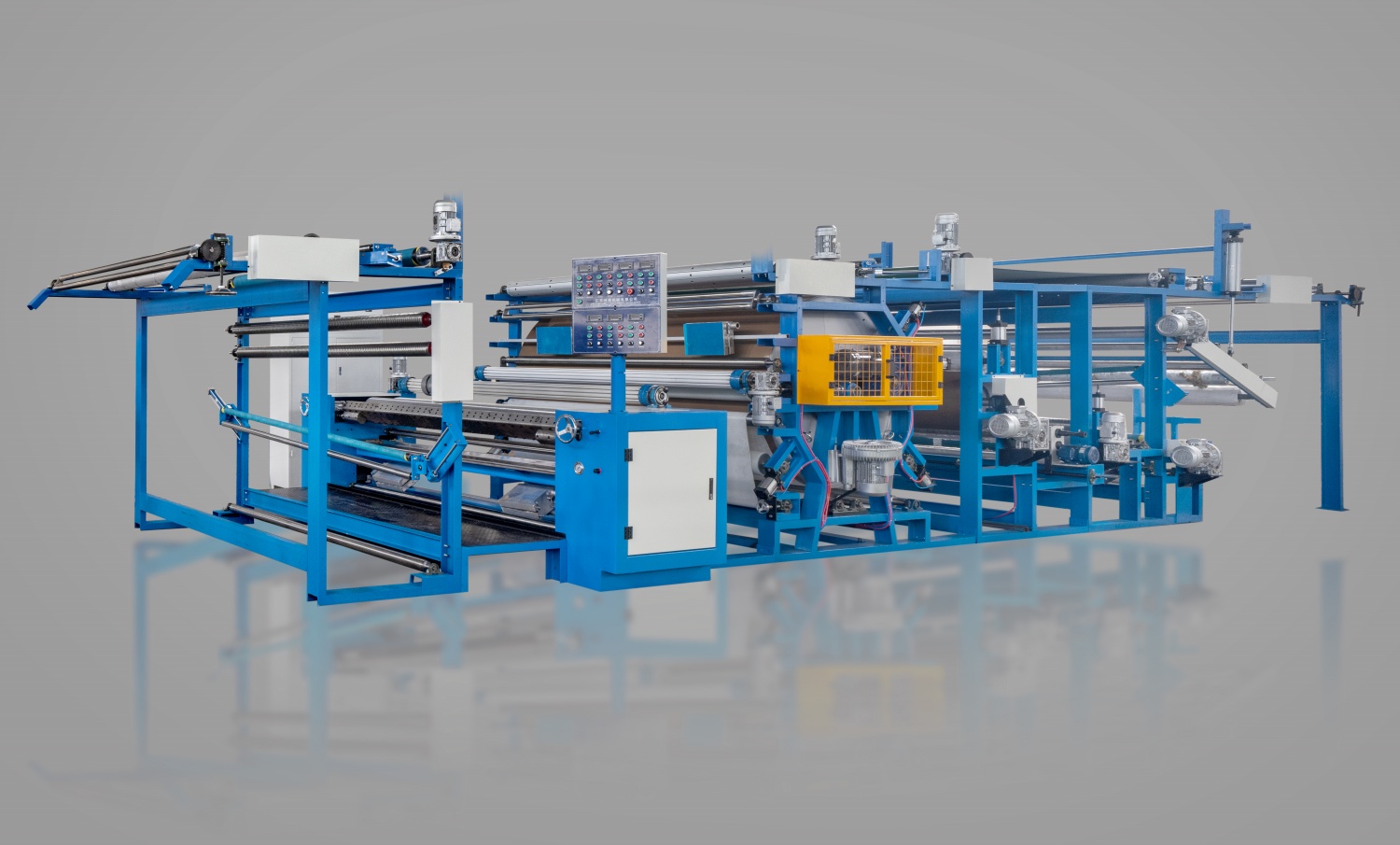
A two-function laminating configuration of the type used for textile fabric bonding, where adhesive application and consolidation are combined in one line.
Why the qualification question comes before the technical one
The compliance material that reaches a buyer's desk usually arrives in the most compressed form possible: a logo, a standard number, a certificate number and a sentence asserting conformity. That compression is where procurement risk begins, because a laminated certificate PDF and a datasheet paragraph are not the same kind of evidence.
Three specific failures recur in industrial machinery purchasing, and all three are documentary rather than technical. The first is category error — treating a management-system certificate as proof that a specific machine is safe or market-eligible. The second is designation drift — a certificate names a series or a variant, the purchase order names a different build, and no one reconciles the two. The third is range confusion — a published parameter range is read as a guaranteed performance figure, when it actually describes the span of configurations the supplier is prepared to build.
For a PUR or hot-melt line, each failure has a cost that appears late. A management-system certificate that cannot support a market-entry claim surfaces at customs or at commissioning. A designation mismatch surfaces during a factory acceptance test, when the buyer's checklist references a model string that is absent from the conformity annex. A range read as a guarantee surfaces as a shortfall against a production plan the machine was never specified to meet.
The qualification path below is therefore ordered deliberately from documents to parameters, not the reverse. Parameters are only meaningful once the buyer knows which model, which market and which validity window they attach to.
The four documents that carry a compliance claim
A qualification file for adhesive-based laminating equipment can be reduced to four documents, each answering a different question. None of them substitutes for another, and a supplier response that supplies one while implying the rest should be treated as incomplete rather than persuasive.
| Document | Question it answers | What it does not establish |
|---|---|---|
| Certificate of conformity with its model annex | Which exact model designation has been assessed against which directive or standard, for which market | Performance on the buyer's specific material, or conformity of a later configuration |
| Quality management system certificate | Whether design, manufacturing and sales sit inside a certified management system, and within what scope | Product-level conformity, safety of an individual machine, or legal market access |
| Model-specific build sheet or datasheet | The fixed values quoted for the machine being purchased: width, speed, heating, installed capacity, included components | That the supplier's published range applies unchanged to the ordered unit |
| Electrical and component schedule | Which motor, inverter and switchgear brands and origins are inside the panel | Spare-part availability, lead time or lifetime support commitments |
Two practical rules follow. First, ask for the annex page that carries the model list, not only the certificate cover. Second, ask for the build sheet that will be attached to the contract, and check that its model string matches the string on the annex character for character — including any numeric suffix. A model number is an identity, and identity conflicts cannot be resolved by assuming the larger number is the newer machine or that a suffix is decorative.
Reading the two supplied certificates correctly
KUNTAI's supplied compliance material contains two certificate records. They are different instruments with different scopes, and reading them as a single compliance statement is the most common error available in this file.
ISO 9001:2015 — system scope, not model conformity
The quality management system certificate is registered under number 07626Q00528R101 by Beijing ZhongRunXing Certification Co., Ltd., against GB/T 19001-2016 / ISO 9001:2015. It was issued on 13 April 2026 and expires on 12 April 2029. Its stated scope is the design, manufacturing and sales of lamination machines and cutting machines, and it is recorded as applicable to the global market rather than to a single jurisdiction.
For a buyer, that scope is meaningful but bounded. It indicates that design and manufacturing activity for lamination machinery sits inside a certified quality management system, which is a legitimate supplier-qualification signal and a reasonable basis for asking how drawings, revisions and test records are controlled. It does not certify any individual machine, does not establish conformity with the Machinery Directive, and does not create EU market access on its own. When a supplier presents an ISO 9001 certificate as the answer to a product-compliance question, the correct response is to ask for the product conformity record separately.
CE under 2006/42/EC — model scope and validity window
The CE record is an ECM type-approved certificate under the Machinery Directive, numbered NO.3N221214.JKMSU84, issued against standard 2006/42/EC, valid from 14 December 2022 to 13 December 2027 and applicable to the EU market. Its written scope covers lamination machines, with models including KT-PUR-1800, KT-FT-XC, KT-QLJ-X and all listed serial variants. In the same supplier dataset, the certificate record is also linked to the KT-PUR, KT-PUR-1800, KT-FT-XC and KT-HY-H product entries.
Those two statements are not identical, and the gap between them is exactly what a documentary review is for. A buyer intending to import a KT-PUR or a KT-HY-H into the EU should request the annex page that carries the model list and confirm that the designation on their build sheet appears there, rather than relying on the product-page association. This is not an accusation of anything; it is the difference between a citation and a verification.
Two further review points sit inside this certificate. First, the validity window closes on 13 December 2027, so a delivery or commissioning schedule that extends beyond that date needs an explicit statement on how the conformity position will be maintained. Second, the directive reference is 2006/42/EC as stated on the record; buyers in markets that require other regimes — North American electrical approvals, for example, or a different Eurasian regime — should treat those as open questions to be raised in the RFQ, because no such certification is asserted in the supplied material.
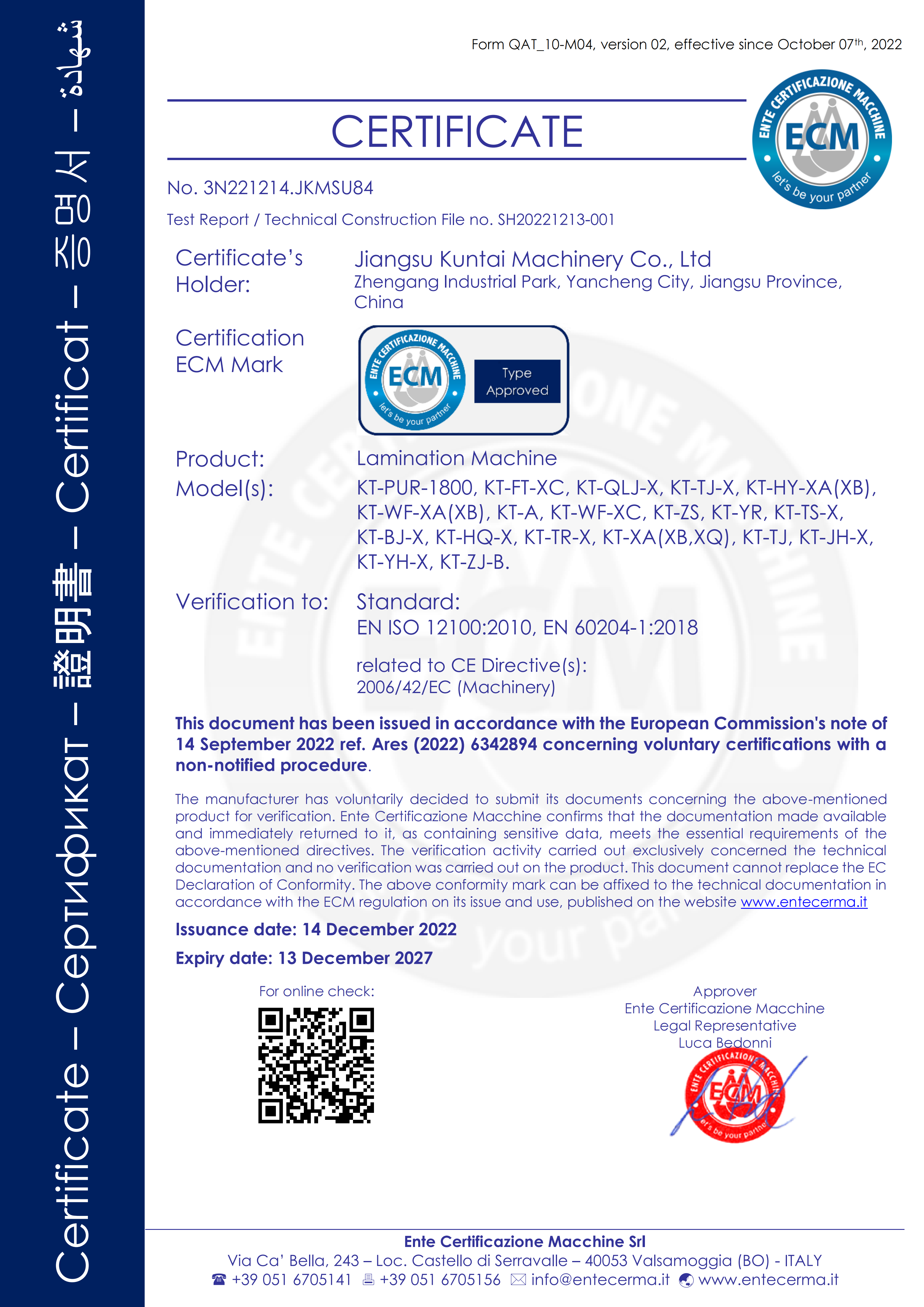
The CE record under 2006/42/EC, certificate NO.3N221214.JKMSU84, issued by ECM and valid 14 December 2022 to 13 December 2027. Buyers should sight the annex carrying the model list.
What is deliberately not claimed here
Nothing in this review asserts a certification beyond the two records described above. There is no claim of UL, CSA, EAC, UKCA or pressure-equipment approval, no claim of a third-party bond-strength test, and no claim of an audited installed base. Where a buyer's market or process requires an approval that does not appear in the file, the honest position is that it is unverified — and the qualification step is to ask, in writing, rather than to infer from adjacent documents.
Mapping four models against a process requirement
The second half of the review moves from paperwork to configuration. The table below restates only what the supplied documents state for each model, so that a buyer can see immediately where the documentary coverage is complete and where a request is still open. Where a model is published under two parameter sets, both are shown rather than averaged.
| Model | Documented role | Material width | Heating | Press / belt configuration | Named electrical components |
|---|---|---|---|---|---|
| KT-PUR (as hot-melt glue laminating machine) | Hot-melt adhesive lamination across healthcare, car trim, garment, upholstery, footwear, construction and home textile applications | 1600–3400 mm; roller surface 1800–3600 mm | Electricity and thermal oil | Single gluing roller; 200 kg glue melter; oil heater; 4 A-frames; speed 0–40 m/min; 65 kW | Siemens motor (made in China); Yaskawa inverter; Schneider electrics |
| KT-PUR (as PUR laminating machine) | Fabric bonding with a PUR glue drum melter in the line | Maximum 2400 mm; roller surface 2600 mm | Electricity and thermal oil | 1 gluing roller; 4 trolleys with air shaft; PUR glue drum melter; oil heater; humidifier; speed 0–35 m/min; 70 kW | Siemens motor (made in China); Yaskawa inverter; Schneider electrics |
| KT-PUR-1800 | Hot melt coating laminating machine | Not stated in the supplied documents | Not stated | Not stated | Not stated |
| KT-FT-XC | Lamination machine for textile manufacturing | 1600–3200 mm; roller surface 1800–3400 mm | Electricity and thermal oil | 1 gluing roller; 4 trolleys with air shaft; PUR glue drum melter; oil heater; speed 0–35 m/min; 105 kW | Siemens motor (made in China); Yaskawa inverter; Schneider electrics |
| KT-HY-H | Double belt press laminator for textile fabric bonding | Maximum 1600 mm; roller surface 1800 mm | Electricity | Double belt press; heating zone 3 m; cooling zone 1.5 m; speed 0–25 m/min; carbon steel or SS304 | Not stated in the supplied documents |
KT-PUR: one designation, two published parameter sets
The KT-PUR appears in KUNTAI's supplied product data twice, and the two entries do not describe the same build. The hot-melt glue laminating machine entry quotes 1600–3400 mm material width on an 1800–3600 mm roller surface, a 200 kg glue melter, four A-frames, 0–40 m/min and 65 kW installed capacity. The PUR laminating machine entry quotes a 2400 mm maximum material width on a 2600 mm roller surface, four trolleys with air shaft, a PUR glue drum melter, an oil heater, a humidifier, 0–35 m/min and 70 kW.
Both entries name the same electrical package — Siemens motors made in China, Yaskawa inverters and Schneider electrics — and both use electricity plus thermal oil for heating. For qualification purposes, the divergence is the finding. A buyer specifying a KT-PUR should record which of the two builds is quoted, because installed capacity, glue melter capacity, web handling hardware and top speed all change with it, and each of those changes the electrical supply, the floor space and the operator routine.
KT-PUR-1800: the model named on the certificate, thinnest on datasheet
The KT-PUR-1800 is the model designation that appears in the CE certificate's written scope, which makes it the single most important model in this review for a European buyer — and it is also the one with the least published technical detail in the supplied material. It is classified as a hot melt coating laminating machine; no material width, heating method, belt configuration or installed capacity is stated for it in the documents available here.
That combination is not a disqualification, but it does restructure the qualification sequence. The certificate question for KT-PUR-1800 is closer to answered than for its siblings; the machine question is further from answered. The correct next step is a written request for the model-specific build sheet — width, roller surface, heating source, installed capacity, glue melter capacity and included ancillary items — so that the certificate and the machine specification can be reviewed against each other rather than in isolation.
KT-FT-XC: textile bonding with thermal oil in the loop
The KT-FT-XC is listed as a lamination machine for textile manufacturing and as a fabric-to-fabric laminating machine. It quotes 1600–3200 mm maximum material width on an 1800–3400 mm roller surface, 0–35 m/min, electricity plus thermal oil heating, and roughly 105 kW installed capacity. The line includes one gluing roller, four trolleys with air shaft, a PUR glue drum melter and an oil heater, with Siemens motors made in China, Yaskawa inverters and Schneider electrics.
One documentary distinction matters if the buyer is comparing within the range: unlike the KT-FT entry, the KT-FT-XC listing does not name a humidifier among its included components. That single line item affects how a PUR adhesive is handled in the line, and it belongs in the scope comparison rather than being assumed across models.
The supplied application records place this class of machine in upholstery work — blackout fabrics, mattress protectors and sofa fabric, where the stated functions are waterproofing and sun protection — and in garment work covering protective suits, windbreakers and thermal underwear. Both records describe synchronised operation with a glue melter and oil heater as matched equipment, at middle temperature for upholstery and at fast speed for garment production. Notably, both records also list voltage stability as a special requirement of the working condition, which is a utility-side issue rather than a machine-side one and should therefore appear in the buyer's site-preparation checklist.
KT-HY-H: belt press geometry is the fit boundary
The KT-HY-H is a double belt press laminator built in carbon steel or SS304 for textile fabric bonding. It uses electric heating with a 3 m heating zone and a 1.5 m cooling zone, a roller surface of 1800 mm, a maximum material width of 1600 mm and a speed range of 0–25 m/min.
The two zone lengths are the most decision-relevant numbers in the record. In a double belt press, the heating zone determines how long the laminate is held under temperature and pressure, and the cooling zone determines how long it is held before release. A 3 m to 1.5 m ratio describes a machine architecture, not a performance guarantee: what it means for a buyer is that the achievable line speed for a given laminate depends on the residence time that material needs in each zone, and that this residence-time question has to be answered by trial on the buyer's own material rather than extrapolated from the speed range. The supplied application record for aviation sound insulation panels, for example, specifies a high-temperature working condition with a water chiller as matched equipment — a configuration detail that follows directly from the need to control the cooling side.
Two gaps also belong in the file. No installed capacity is stated for the KT-HY-H, and no electrical component brands are named for it, in contrast with the KT-PUR and KT-FT-XC entries. Both are straightforward RFQ items, and both affect the buyer's electrical supply design and spare-parts strategy.
Converting published parameters into acceptance criteria
Once the documents are read, the parameters have to be translated into criteria the buyer can actually test against. Four conversion rules apply to this equipment class.
Width is quoted in pairs, and the allowance needs a definition. In every published pair in this file — 2400 mm material on a 2600 mm roller surface, 1600–3400 mm on 1800–3600 mm, 1600–3200 mm on 1800–3400 mm, 1600 mm on 1800 mm — the roller surface runs 200 mm wider than the stated maximum material width. That consistency is an arithmetic observation from the listed values, not a stated design rule. The buyer's question is what the allowance covers: edge trim, web wandering, or a carrier film. Getting that defined prevents a dispute in which both parties are quoting the same datasheet correctly.
Speed range is machine capability, not line output. A 0–35 m/min or 0–40 m/min range describes what the drive can do. What the line actually produces depends on adhesive, substrate, cure behaviour and the residence time the process requires. For PUR systems the cure question is genuinely time-dependent: published technical commentary places full chemical cross-linking of PUR hot-melt adhesives at roughly 24 to 72 hours, which means a bond test run immediately off the line is measuring green strength, not final performance. An acceptance criterion that ignores the cure window will produce a false failure or a false pass.
Heating method determines utilities, not just temperature. The KT-PUR and KT-FT-XC configurations pair electricity with thermal oil and include an oil heater; the KT-HY-H uses electric heating. These are different site requirements — oil handling and circulation on one side, electrical load on the other — and they change commissioning work. Installed capacity across the documented models runs from 65 kW to 105 kW, with the KT-HY-H figure unstated, so the buyer's supply capacity check should be treated as an open item until confirmed in writing.
Named components belong in the contract, including their origin. The Siemens motors are specified as made in China, alongside Yaskawa inverters and Schneider electrics. That qualification is part of the stated specification and should be carried into the purchase order verbatim, because it determines spare-part sourcing and panel documentation. Where a model names no component brands at all — the KT-HY-H case — the component schedule is a required deliverable rather than an optional nicety.
What supplier scale evidence supports — and what it does not
KUNTAI's supplier profile adds a second evidentiary layer that is often conflated with product compliance. It should be read separately. The company gives its founding year as 1983, describing more than 40 years of design and construction work in coating, laminating, impregnation and cutting machinery. It reports a 30,000 m² facility, 210 employees, an eight-engineer R&D team and annual output of 650 units, with 70% of output exported to North America, South America, Europe, South Asia, Africa and the Middle East. Manufacturing support includes CNC machining centres, drilling and polishing equipment. Commercial terms are stated as OEM production, customisation of voltage, logo, colour and machine structure, a one-unit minimum order, 30–60 day lead times, a stated monthly capacity of 55 units, 100% testing and remote after-sales support.
Each of these facts supports a specific qualification question, and only that question. Design continuity over four decades is a reasonable basis for asking whether drawings and revision records for older models still exist — a real concern when a buyer is specifying a line intended to run for fifteen years. An eight-engineer R&D team is testable rather than merely reassuring: submit a written technical query specific to the model under consideration and assess whether the answer is model-specific or generic. A 30,000 m² facility and a stated monthly capacity of 55 units are relevant to whether a factory acceptance test can be staged and whether a delivery date is plausible against the order book. A 100% test claim is only useful once the buyer has seen the format of the test record that will be handed over.
The same evidence does not establish what buyers most want it to establish. It does not prove bonding performance on a specific substrate, does not constitute an independent audit, and does not verify the installed base. KUNTAI's supplied case records list, among others, textile-mill installations in Turkey at 120 units and India at 140 units with five years of reported stable operation and low maintenance, and an automotive interior plant in Germany and Mexico at 20 units over three years. These are company-supplied references and should be treated as such — useful for framing reference questions, not as third-party validation. The boundary sentence for the qualification file is simple: scale evidence supports the supplier; only model-level documents and a trial on the buyer's material support the machine.
Adhesive route or belt press: the fit boundary
Within this four-model set there are two distinct process architectures, and the choice between them is a fit decision rather than a quality ranking. The KT-PUR and KT-FT-XC are adhesive-application machines: a gluing roller, a PUR glue drum melter and an oil heater apply and cure a reactive hot-melt adhesive, with widths documented up to 3400 mm and 3200 mm respectively and speeds to 35–40 m/min. The KT-HY-H is a consolidation machine: a double belt press with a defined heating and cooling zone, a 1600 mm maximum material width and 0–25 m/min.
The boundary is therefore set by the process, not the price. Where the bond is created by an applied adhesive and the material can tolerate the cure window, the adhesive route offers the wider web and the faster drive. Where the laminate requires sustained temperature and pressure through a controlled heating and cooling profile — the sound-insulation and automotive interior applications in the supplied records both point this way — the belt press geometry is the relevant architecture, and its narrower width and lower top speed are characteristics to be planned around rather than shortcomings to be argued about. A buyer whose product needs both a 3000 mm web and a defined cooling zone has a specification conflict to resolve before any quotation is comparable.
What changes in the 2026–2027 review cycle
Two dates in the supplied file turn compliance from a one-off check into a schedule item. The CE record expires on 13 December 2027 and the ISO 9001 certificate on 12 April 2029. Buyers writing a multi-year capital plan should record both dates against the commissioning timeline and ask, in the RFQ, how renewal or re-issue will be handled for machines delivered close to either boundary.
Import classification is the other document a buyer should settle early. Machinery for coating or impregnating textile fabrics is classified under HS Code 84518080 according to the customs classification reference reviewed for this assessment, which is the kind of detail that determines duty treatment and clearance documentation. It is a classification input, not a statement about any individual machine's conformity.
The wider market context supports the same conclusion without changing it. One commercial research forecast reviewed for this assessment projects growth of 7.1% a year for the hot-melt adhesive laminating machine segment over 2026–2032 — a source forecast with its own assumptions, not an observed outcome — and a growing equipment population tends to sharpen rather than relax documentary scrutiny. For the buyer, the practical consequence is unglamorous: the qualification file becomes a standing document that is updated when certificates renew and when build sheets are revised, rather than a PDF bundle assembled once during a tender.
Frequently asked questions
Does an ISO 9001 certificate make a laminating machine CE-compliant?
No. The ISO 9001:2015 certificate registered as 07626Q00528R101 covers a quality management system for the design, manufacturing and sales of lamination machines and cutting machines, against GB/T 19001-2016 / ISO 9001:2015, valid from 13 April 2026 to 12 April 2029. It says nothing about an individual machine's conformity with the Machinery Directive. The EU position is addressed by a separate record, the ECM type-approved certificate NO.3N221214.JKMSU84 under 2006/42/EC, valid from 14 December 2022 to 13 December 2027.
Which models are named in the CE certificate scope?
The certificate's written scope covers lamination machines, with models including KT-PUR-1800, KT-FT-XC, KT-QLJ-X and all listed serial variants. In the same supplier dataset the certificate record is also linked to the KT-PUR, KT-PUR-1800, KT-FT-XC and KT-HY-H product entries. Because those two statements are not worded identically, a buyer planning EU import should obtain the annex page carrying the model list and confirm that the designation on the build sheet appears on it.
What belt press configuration does the KT-HY-H use?
The KT-HY-H is a double belt press laminator in carbon steel or SS304, using electric heating, with a 3 m heating zone and a 1.5 m cooling zone. It has an 1800 mm roller surface, a maximum material width of 1600 mm and a speed range of 0–25 m/min. No installed capacity or electrical component brand is stated for this model in the supplied documents.
How should acceptance criteria be set for a PUR hot-melt line?
Fix the build sheet first, choosing between the two published KT-PUR configurations rather than blending their figures, and confirm installed capacity, glue melter capacity and included ancillary items in writing. Specify the electrical component schedule including country of manufacture, since the Siemens motors are documented as made in China alongside Yaskawa inverters and Schneider electrics. Define bond testing against the adhesive's cure behaviour — published technical commentary places full PUR cross-linking at roughly 24 to 72 hours — and require the test record format before the factory acceptance test rather than after it.
Is a price band available for these machines?
No price band appears in the supplied documents, so no figure is quoted here. The practical substitute is scope normalisation: compare quotations on identical content — glue melter capacity, oil heater, humidifier, trolley or A-frame count, gluing rollers and installed capacity — because those items vary between the published KT-PUR configurations and materially change what is being compared.
The supplier's full brochure, including the product range and company profile, is available for download: KUNTAI company profile (PDF).
Есть вопросы или нужны дополнительные детали?
Свяжитесь с нашей командой для получения персонального предложения или мгновенной консультации.
Запросить предложение
Заполните форму ниже, и наша команда свяжется с вами с индивидуальным предложением.
Прямой чат WhatsApp
Предпочитаете общаться в реальном времени? Напишите нам в WhatsApp для мгновенной помощи и быстрых ответов.
- Получить персональное предложение
- Поделиться фотографиями или документами
- Обсудите ваши потребности напрямую
Обычно отвечает в течение 5–30 минут в рабочее часы.