
PUR vs. Hot Melt vs. Flame vs. Dot Coating: A Laminating Machine Buyer's Decision Framework
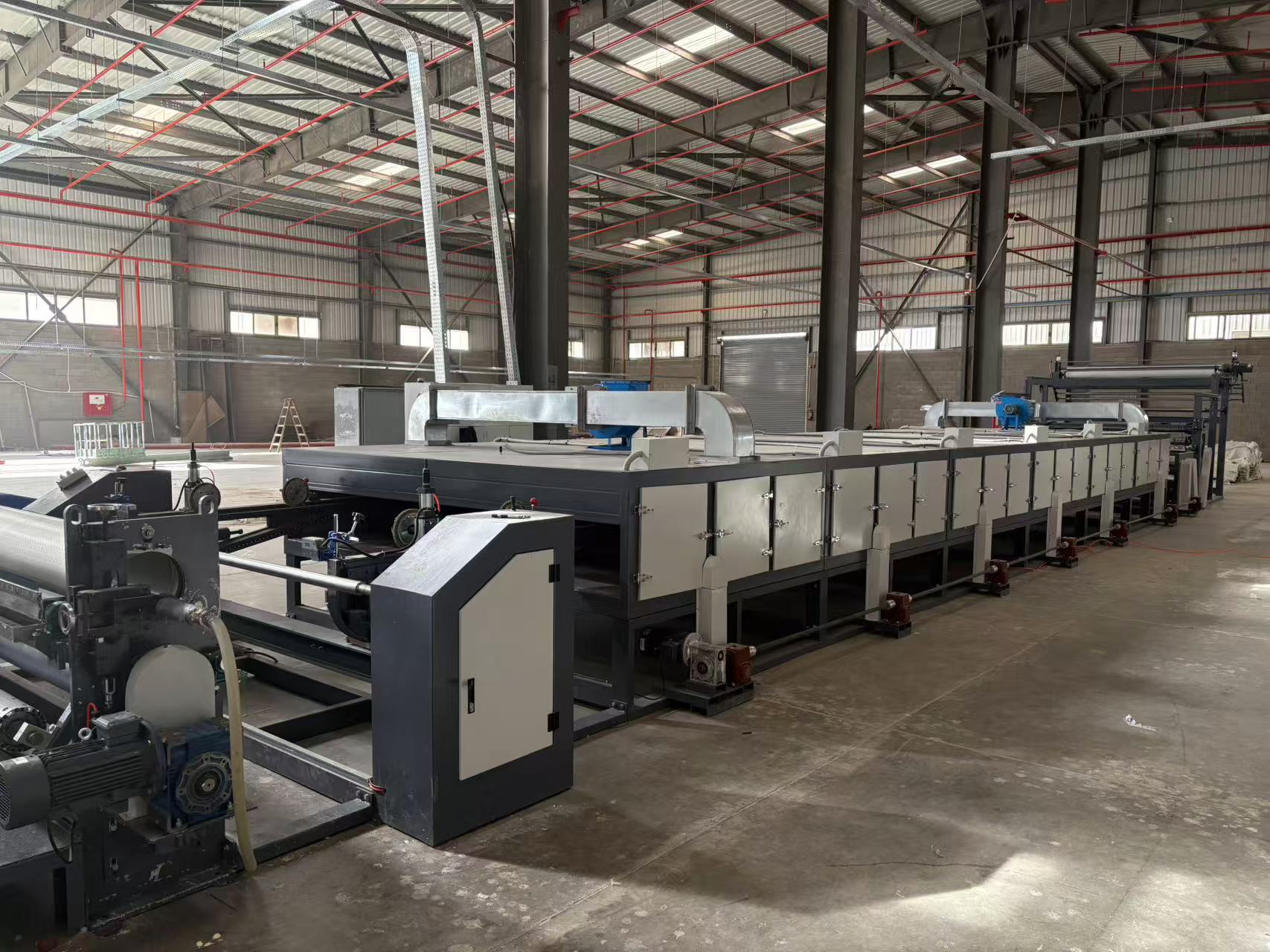
Dot coating applies adhesive as a pattern rather than a continuous film. Alongside PUR, hot melt and flame systems, it is one of the glue application methods that decides substrate fit, line speed and the factory utilities a laminating line will require. Image: KUNTAI KT-DS dot coating laminating machine.
The Glue Application Method Usually Constrains the Line More Than the Machine Frame
In industrial lamination, the adhesive application method — not the machine frame — sets the outer boundary of what a production line can make. PUR, standard hot melt, flame, dot coating and spray-and-powder systems each permit a different set of substrates, bond types, line speeds and factory utilities. Buyers who shortlist laminating machines on roll width and speed alone often meet the real constraint later: a substrate that will not bond, a gas supply the site cannot install, or a curing condition the existing line cannot hold.
This article builds a buyer's decision framework around the four methods most often compared — PUR, hot melt, flame and dot coating — and includes spray-and-powder scattering, thermal bonding and impregnation where they compete for the same production slot. Machine examples are drawn from the KOntai range, which covers all of these categories.
JIANGSU KUNTAI MACHINERY CO., LTD., established in 1983 and based at Zhengang Industrial Park, Yancheng City, Jiangsu, China, designs and builds coating, laminating, impregnation and cutting machinery for technical textiles and composites. The company operates a 30,000 m² facility with approximately 210 employees, an annual production capacity of 650 units, an eight-engineer R&D team, and an export share of about 70% across North America, South America, Europe, South Asia, Africa and the Middle East.
What Each Method Actually Does
PUR: reactive hot melt
PUR adhesive is applied to the substrate as a molten film and then cross-links with ambient moisture over the following days. Two process consequences follow immediately: the adhesive must be melted and metered at a controlled temperature, and the humidity around the bond line becomes a quality variable rather than a background condition.
Kuntai's KT-PUR PUR laminating machine for fabric bonding is documented with a maximum material width of 2400 mm, a 2600 mm roller surface, a speed range of 0–35 m/min, electricity and thermal oil as the heating method, and a 70 kW installed capacity. The line includes one gluing roller, a PUR glue drum melter, an oil heater, a humidifier, and four trolleys with air shaft. Drive and electrical components are a Siemens motor (made in China), a Yaskawa inverter and Schneider electrics; the machine is built in carbon steel or SS304.
The humidifier is the detail worth pausing on. It indicates that on a PUR line, moisture is treated as an engineered input. Buyers evaluating PUR against standard hot melt should therefore check whether the plant can hold a stable environment around the laminating head, not only whether the line can reach the required speed.
A second documented configuration, the KT-PUR-1800 hot melt coating laminating machine, is specified for safety shoes manufacturing. It runs at 0–35 m/min with an 1800 mm maximum material width and a 2000 mm roller surface, a 60 kW installed capacity, one gluing roller covering an application range of 25 to 110 g/m², a 200 kg glue melter, an oil heater, and four trolleys with air shaft. Components include a Siemens motor (made in China), an Inovance inverter and Schneider electrics.
Wider fabric bonding formats include the KT-FT fabric-to-fabric laminating machine (2400 mm maximum material width, 2600 mm roller surface, 0–35 m/min, approximately 105 kW, with PUR glue drum melter, oil heater and humidifier) and the KT-FT-XC lamination machine for textile (1600–3200 mm material width, 1800–3400 mm roller surface, 0–35 m/min, 105 kW, one gluing roller, four trolleys with air shaft, PUR glue drum melter and oil heater).
Standard hot melt: thermoplastic
Standard hot melt adhesives are applied molten and solidify as they cool. They do not cross-link, so the bond behaves differently under sustained heat than a reactive PUR bond generally does. Within Kuntai's range, the machine carrying the KT-PUR hot melt glue designation is documented from 1600 mm to 3400 mm material width and 1800 mm to 3600 mm roller surface, at 0–40 m/min with a 65 kW installed capacity. Its structure includes one gluing roller, a 200 kg glue melter, an oil heater and four sets of A-frames, and it is built from carbon steel, aluminum foil or SS304. Documented target industries are the healthcare, car trim, garment, upholstery, footwear, construction and home textile sectors.
Flame lamination
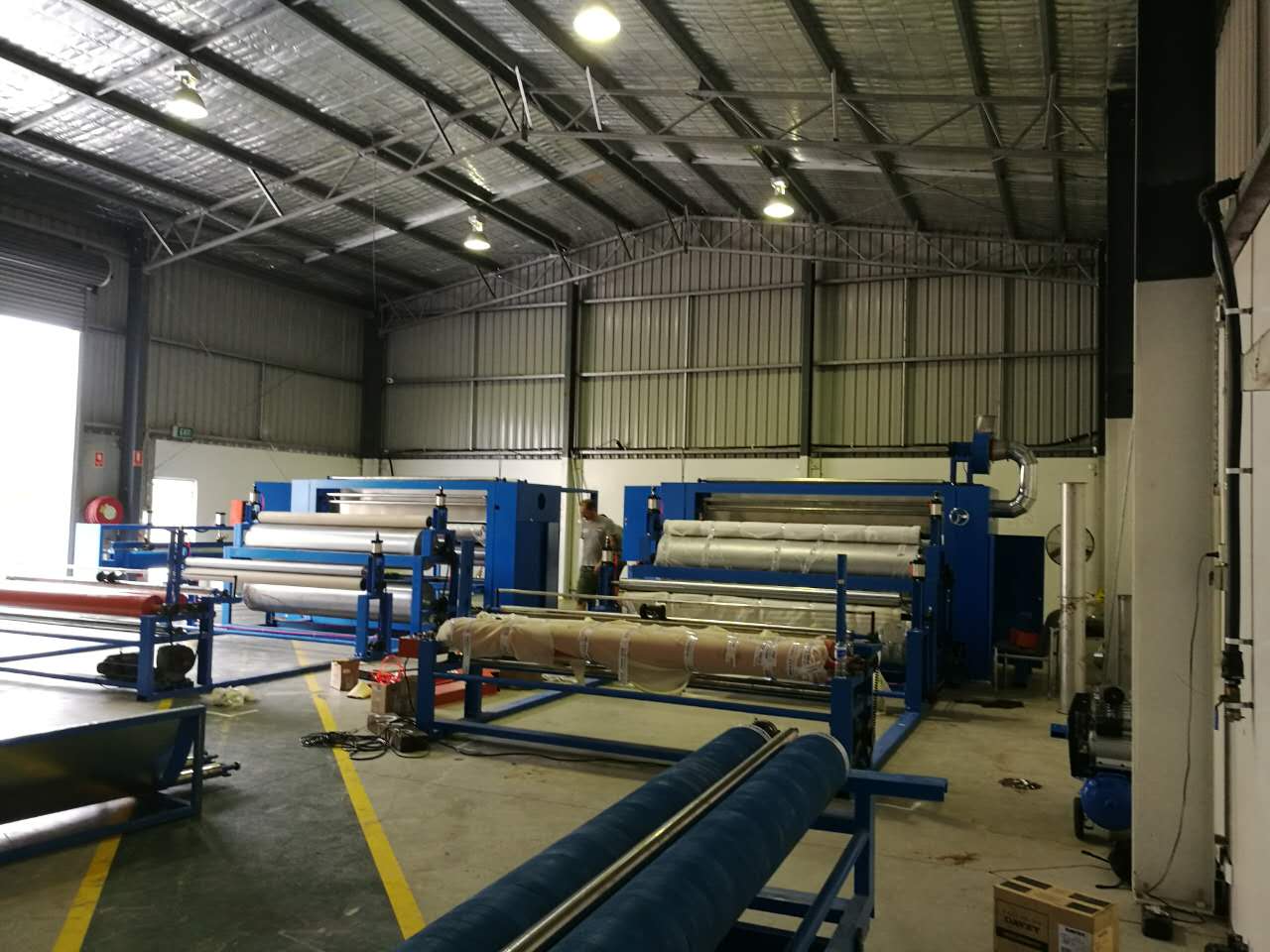
A flame lamination line replaces the adhesive with a controlled gas flame that briefly melts the substrate surface before the nip. Image: KUNTAI KT-HY flame laminating machine.
Flame lamination uses a gas flame to generate a thin molten layer on a foam or similar substrate, which is then bonded under nip pressure. The KT-HY flame laminating machine is specified for automotive seat manufacturing, with a material width range of 1600–3000 mm, a roller surface and flame burner width of 1900–3300 mm, a maximum speed of 25 m/min, and a machine drive power of 15 kW. It runs on natural gas or liquefied gas, with a Siemens motor (made in China), a Yaskawa inverter and Schneider electrics.
Dot coating
Dot coating deposits adhesive as discrete dots rather than a continuous film. The KT-DS dot coating laminating machine is specified for carpet manufacturing, with a coating width range of 1600–4500 mm and a roller surface of 1800–4700 mm. Machine speed is adjustable between 5 and 20 m/min, transmission uses chain wheel control, heating is electric, and working temperature runs at 80–100°C with a maximum of 130°C.
Spray and powder scattering
The KT-SF glue spraying and powder scattering machine is specified for filter manufacturing. It handles material widths of 1600–2600 mm on a roller surface of 1800–2800 mm, at 5–25 m/min in continuous operation. Powder size range is 20–150 microns, machine power is 155 kW, and the structure includes six glue spraying systems and four powder scattering systems with an automatic powder feeding device. The glue melting machine capacity is 200 kg, the maximum unwinder/rewinder diameter is 1000 mm, and the machine is designed for use with PUR hot melt glue and PSA hot melt glue.
Adjacent methods: thermal bonding and impregnation
Two further processes compete for the same production slot. Thermal bonding uses heat and pressure without a separate adhesive layer: the KT-PB flatbed laminating machine covers a 1600 mm maximum material width and 1800 mm roller surface at 0–25 m/min, with a 230 kW installed capacity, a maximum heating temperature of 230°C, a 3 m heating zone and a 1.5 m cooling zone, plus Siemens PLC and touch screen control, NSK bearings and Schneider electrics. The KT-HY-H double belt press laminator uses the same 1600 mm width and 0–25 m/min range with a 265 kW installed capacity and a maximum heating temperature of 250°C, and is specified for insulation material manufacturing, the filter industry and the automotive industry.
Impregnation is a separate family again. The KT-LH-1800 UD prepreg machines and the KT-YJ-1800 UHMWPE impregnation machine handle material widths up to 1650 mm on an 1800 mm roll surface, using water-based adhesive and dipping or coating application, with composite speeds of 5–11 m/min, 90 kW total power and 1080 yarn bobbins. The KT-LH-1800 UD crossply machine adds 8000 kN of hydraulic pressing tonnage on a 1700 × 1700 mm working table at approximately 95 kW. These are specified for bulletproof vest, helmet and plate manufacturing.
Method Comparison at a Glance
| Method | Documented model and key specs | Typical industry fit | Practical boundary |
|---|---|---|---|
| PUR reactive hot melt | KT-PUR (fabric bonding): 2400 mm width, 0–35 m/min, 70 kW, humidifier and PUR drum melter; KT-PUR-1800: 1800 mm, 25–110 g/m², 60 kW | Garment, upholstery, footwear, safety shoes, car trim, home textile | Moisture and temperature must be controlled; adhesive handling adds process discipline |
| Standard hot melt | KT-PUR hot melt glue laminating machine: 1600–3400 mm width, 0–40 m/min, 65 kW, 200 kg melter, four A-frames | Healthcare, construction, home textile, upholstery, garment | Thermoplastic bond re-softens under sustained heat |
| Flame | KT-HY: 1600–3000 mm width, burner 1900–3300 mm, max 25 m/min, 15 kW drive, natural gas or LPG | Automotive seats, car trim, foam-to-fabric bonding | Requires gas supply, ventilation and stable gas pressure |
| Dot coating | KT-DS: 1600–4500 mm coating width, 5–20 m/min, chain wheel transmission, 80–100°C working, 130°C max | Carpet, upholstery, technical textiles | Adhesive options limited by the 130°C ceiling; bond depends on dot pattern |
| Spray and powder scattering | KT-SF: 1600–2600 mm width, 5–25 m/min, 20–150 micron powder, 155 kW, six spray and four scattering systems | Filter media, air filtration, nonwovens | Powder handling, dust control and dosing accuracy must be managed |
| Thermal bonding | KT-PB: 1600 mm, 0–25 m/min, 230 kW, 230°C; KT-HY-H: 1600 mm, 0–25 m/min, 265 kW, 250°C | Insulation material, filter, automotive, aviation sound insulation panels | High installed capacity; 1600 mm width and 0–25 m/min are the design ceiling |
| Impregnation (UD) | KT-LH-1800 / KT-YJ-1800: 1800 mm roll surface, width ≤1650 mm, 5–11 m/min, water-based adhesive | Bulletproof vest, helmet, plate manufacturing | Narrow width and deliberately low composite speed |
A Five-Gate Decision Framework
The framework below is ordered so that each gate eliminates options before the next one is applied. Buyers who invert the order — choosing speed first — usually revisit the decision during commissioning.
Gate 1 — Substrate pair. Identify both materials being joined and whether either surface will accept a molten adhesive or needs activation. Flame lamination exists because certain foam surfaces bond more reliably after a flame pass than with an applied adhesive layer. Conversely, heat-sensitive surfaces rule out processes with high thermal exposure.
Gate 2 — Bond type required by the end product. A continuous adhesive film, a dot pattern and a scattered powder dot produce different hand, drape and peel behaviour. Carpet backing and filter media are documented on Kuntai's range as dot coating and spray/powder processes respectively, which reflects the fact that these products do not require a continuous film.
Gate 3 — Width and line speed. This is where the shortlist narrows fastest. Documented ranges within one manufacturer's catalogue already span 1600 mm to 4500 mm in coating width and 0 to 40 m/min in speed, so a mismatch here cannot be resolved by adjustment alone.
Gate 4 — Utilities, consumables and site conditions. Flame systems require natural gas or liquefied gas. PUR lines documented by Kuntai include a humidifier, an oil heater and a PUR glue drum melter. Thermal bonding machines in the KT-PB and KT-HY-H class draw 230 kW and 265 kW. Dot coating runs on electric heating at 80–100°C. Each of these translates into a site requirement: gas piping and ventilation, thermal oil circuits, humidity control, or a larger electrical supply.
Gate 5 — Compliance and documentation. Textile machinery safety is governed by the ISO 11111 series, with Parts 2 to 7 covering safety requirements for different machinery types. Buyers should confirm which part applies to the machine class under evaluation, and should verify the manufacturer's own certificates rather than relying on category claims.
Matching Methods to Industries and Materials
Kuntai's documented application records show how method and industry pair in practice. These records also include the site conditions buyers should plan for.
Automotive seats and car trim. Flame lamination is the documented process, used in new production lines running continuous operation at fast speed, with gas tanks and gas appliances as matched equipment and pressure stability as the stated special requirement. Documented project markets include South Korea, Germany and Czechia.
Carpet. Dot coating is the documented process, served by the KT-DS with coating widths from 1600 mm to 4500 mm.
Filter media. Glue spraying and powder scattering is the documented process, operated in synchronized mode at middle temperature for air filtration, with a glue melter as matched equipment and voltage stability as the stated requirement. Documented project markets include Türkiye, South Korea, India and Germany.
Garment and protective wear. PUR and hot melt lamination are the documented processes for protective suits, windbreakers and thermal underwear, where the function is warmth retention and protection from wind and rain. The lines run on electric drive at fast speed, with a glue melter and oil heater as matched equipment and voltage stability as the stated requirement. Documented project markets include India, Türkiye, Pakistan and Malaysia.
Upholstery and home textile. Blackout fabric, mattress protectors and sofa fabric are documented on PUR, hot melt and dot coating machines, running at middle temperature with a glue melter and oil heater, for waterproofing and sun protection. Documented project markets include South Korea, India and Türkiye.
Aviation sound insulation panels. The KT-PB flatbed laminating machine and KT-HY-H double belt press laminator are documented for this application working at high temperature, with a water chiller as matched equipment and voltage stability as the stated requirement. Documented project markets include South Korea, France and Germany.
Ballistic protection. UHMWPE and aramid impregnation and crossply equipment are documented for bulletproof vest, helmet and plate manufacturing, operating at low temperature and moderate humidity with a glue pump system matched to the line and voltage stability stated as the site requirement.
Where Each Method Stops Working
A credible decision framework has to state ceilings, not only capabilities.
- Flame lamination is bounded by site infrastructure. The KT-HY requires natural gas or liquefied gas and operates at a maximum of 25 m/min, so plants without a gas supply or with unstable gas pressure face a structural constraint rather than a tuning problem.
- Dot coating has the widest documented coating envelope in the range at 1600–4500 mm, but its maximum operating temperature is 130°C with a working band of 80–100°C. That ceiling narrows the adhesive chemistries available.
- PUR processes depend on moisture. The humidifier listed on the KT-PUR fabric-bonding configuration and the KT-FT makes this explicit. The KT-PUR-1800 works within an application window of 25–110 g/m², which means the coating weight has to be engineered rather than set casually.
- Spray and powder scattering introduces powder handling. The KT-SF operates across a 20–150 micron powder range with six spray and four scattering systems, so dosing consistency and dust management become production disciplines.
- Thermal bonding machines carry high installed capacity — 230 kW for the KT-PB and 265 kW for the KT-HY-H — and are documented at a maximum material width of 1600 mm and 0–25 m/min. For very wide or very fast lines, that combination is a design limit.
- UD impregnation equipment is intentionally slow and narrow: material width up to 1650 mm on an 1800 mm roll surface at 5–11 m/min. Throughput expectations have to be set accordingly.
Market Signals Behind the Method Decision
Method choice is not only a technical question; it is also a bet on where demand is moving.
- The global laminating machines market was estimated at USD 786.5 million in 2026 and is projected to reach USD 1,356.7 million by 2033, according to Coherent Market Insights.
- Scope differences matter when reading that figure. Persistence Market Research lists USD 746.4 million for 2026 and Future Market Insights lists USD 676.4 million for 2025, largely because office and pouch laminators are weighted differently against industrial and textile laminating systems.
- The PUR hot melt adhesives market, the chemistry behind reactive PUR lamination, is expected to grow at a CAGR of 7.2% through 2034 to reach USD 7.1 billion, according to Dataintelo.
- Asia-Pacific dominated the textile machinery market with a 72.70% share in 2025, primarily led by automation growth in China, according to Fortune Business Insights. This concentration matters for spare parts, service response and process knowledge.
- The global prepreg market was valued at USD 15.07 billion in 2024, with aerospace and defense demand as a driver, according to Maximize Market Research. The aerospace prepreg segment alone was USD 3.5 billion in 2024, according to MarketsandMarkets. Both figures sit behind the impregnation and crossply equipment documented for ballistic and aerospace applications.
How This Compares with Traditional Lamination Approaches
Older lamination lines commonly relied on solvent-based or water-based adhesives applied as a liquid and then dried in an oven before nipping. That approach is well understood and still widely used, but it carries inherent process costs: a drying stage, energy consumption tied to evaporation, and — for solvent systems — recovery or abatement equipment and associated handling requirements.
Hot melt, PUR and flame processes remove the drying stage. Reactive PUR then adds a curing phase that happens after the roll is wound, which changes the way production is planned and quality is released. Thermal bonding removes the adhesive entirely but adds heat and pressure equipment with a high connected load.
The honest comparison is not that newer methods replace older ones. Each shift trades one constraint for another. PUR trades a drying oven for humidity control. Flame trades adhesive cost for gas infrastructure and thermal risk. Dot coating trades a continuous film for a pattern-dependent bond at a 130°C ceiling. Thermal bonding trades adhesive for 230–265 kW of installed capacity. Buyers should select the trade their plant can actually manage, which is why the five-gate framework above puts substrate and bond type before speed.
Future Outlook
Two directions are visible in the available data. The first is continued growth in reactive PUR chemistry, with the PUR hot melt adhesives market projected to grow at a 7.2% CAGR through 2034. Because PUR lines require moisture control, this growth also implies broader adoption of humidification and temperature control as standard line equipment rather than optional additions.
The second is the widening of composite applications. With the prepreg market at USD 15.07 billion in 2024 and aerospace prepreg at USD 3.5 billion, impregnation and crossply equipment is moving from specialist defense supply chains into a broader industrial base. Equipment design has to keep pace: Kuntai's own range already spans double belt presses, flatbed laminators, PUR and hot melt coaters, flame laminators, dot coaters, spray and scattering lines, and UD impregnation and crossply machines, supported by an eight-engineer R&D team and an annual output of 650 units.
For buyers, the practical implication is that method selection will remain the first decision and the hardest one to reverse. Machine width, speed and controls can be specified with relative confidence; the adhesive method determines which of those specifications will actually be usable.
Manufacturer Reference
JIANGSU KUNTAI MACHINERY CO., LTD. is a China-based manufacturer of coating, laminating, impregnation and cutting machinery for technical textiles and composites. Founded in 1983, the company has more than 40 years of experience in this equipment category, operates a 30,000 m² facility with approximately 210 employees, and reports an annual production capacity of 650 units with an export share of about 70%. Its main product lines include laminating machines (double-belt presses, flat-bed laminators, hot-melt film laminators, UD impregnation and crossply machines), cutting machines, bronzing and printing machines, spray and scattering equipment, and inspection machines. The company states that it holds ISO 9001 and CE certification. A full company profile with machine specifications is available as a downloadable PDF: https://cdn.socialarks.com/sbsp/25071/common/2026/0709/kuntai%20profile.pdf
FAQ
How should a buyer choose between PUR and standard hot melt for a textile lamination line?
The documented distinction lies in process control and bond behaviour. Kuntai's PUR-based models, including the KT-PUR fabric-bonding configuration and the KT-FT fabric-to-fabric machine, include a humidifier alongside the PUR glue drum melter and oil heater, which reflects the moisture curing mechanism of reactive PUR. The KT-PUR hot melt glue laminating machine is documented across 1600–3400 mm material width at 0–40 m/min with a 200 kg glue melter and four A-frames. Buyers should compare the required bond permanence under heat, the availability of humidity control on site, and the adhesive supply chain for each chemistry.
What are the documented specifications of a flame laminating machine, and which industries does it serve?
The KT-HY flame laminating machine is specified for automotive seat manufacturing. It handles a material width range of 1600–3000 mm, with a roller surface and flame burner width of 1900–3300 mm, a maximum speed of 25 m/min and a machine drive power of 15 kW. It operates on natural gas or liquefied gas, with a Siemens motor (made in China), a Yaskawa inverter and Schneider electrics. Documented car trim applications run in continuous operation at fast speed with pressure stability as the stated site requirement.
Which glue application method is used for carpet lamination, and at what temperature does it run?
Carpet manufacturing is documented on the KT-DS dot coating laminating machine, which applies adhesive as dots rather than a continuous film. It has a coating width range of 1600–4500 mm and a roller surface of 1800–4700 mm, runs at 5–20 m/min with chain wheel transmission, and uses electric heating. Working temperature is 80–100°C with a maximum of 130°C.
Can one laminating machine be converted between PUR, hot melt and dot coating?
In the documented range, each method is built on a different structural configuration: a gas burner and gas supply for the KT-HY, a PUR glue drum melter and humidifier on PUR models, chain wheel-driven dot coating on the KT-DS, and six glue spraying systems with four powder scattering systems on the KT-SF. Heating methods also differ, from electric heating at 80–100°C to thermal oil and gas. Because these are configuration-level differences, the gluing method is normally fixed when the machine is specified rather than changed between production runs. Buyers with mixed product portfolios should confirm configuration at the quotation stage.
What safety and certification standards apply to laminating machinery?
Textile machinery safety is governed by the ISO 11111 series, specifically Parts 2 to 7, which cover safety requirements for different machinery types. Verification should therefore start with identifying which part applies to the machine class under evaluation. On the manufacturer side, JIANGSU KUNTAI MACHINERY CO., LTD. states that its products are produced under ISO 9001 and CE certification, alongside an internal quality control system. Beyond certificates, buyers should also confirm site-level conditions that affect safe operation, including voltage stability and, for gas-fired processes, gas pressure stability.