
PVA Acceptance Criteria for Slow-Release Medical Substrates
Qualifying polyvinyl alcohol (PVA) for a slow-release medical substrate is a documentation exercise before it is a materials exercise. Two suppliers can quote the same grade name — PVA 0599, for instance — and still deliver polymer whose dissolution temperature, solution viscosity and film behaviour differ enough to move a release profile outside specification. What protects the formulation is the acceptance criteria attached to the grade, not the grade label itself.
For biotech and medical innovation buyers at research and evaluation stage, the practical answer is to build the specification around four measurable grade parameters: degree of hydrolysis, degree of polymerization, viscosity and water solubility, and then to bind those parameters to documentary evidence that travels with every batch. This reference sets out how such criteria are constructed for PVA grades used in pharmaceutical coating and slow-release medical substrates, and how the same logic extends to PVA-stabilised VAE emulsions used as binders in medical non-woven materials.
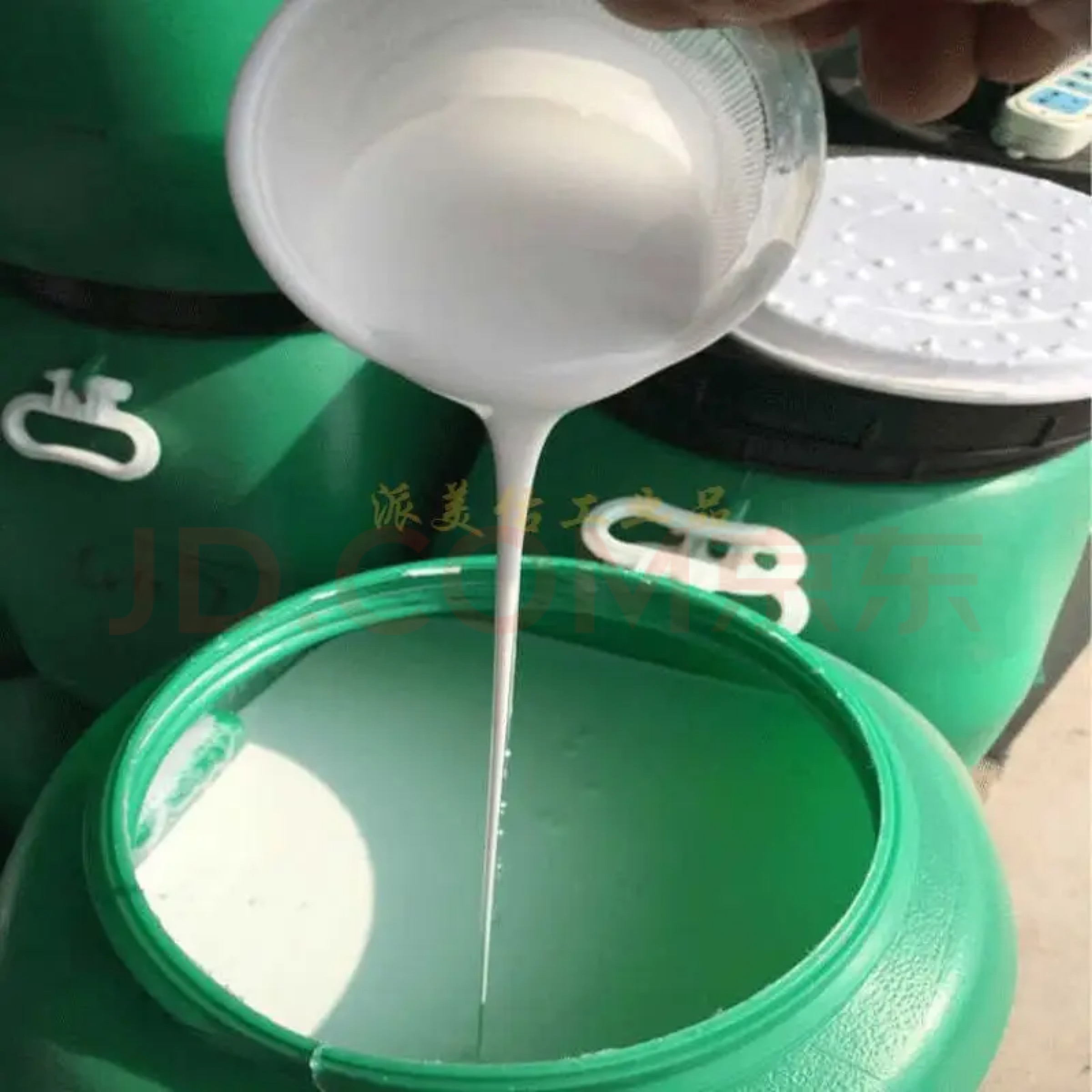
HOPEWAY CHEMICAL INDUSTRIAL CO., LIMITED is a China-based integrated manufacturer of polyvinyl alcohol (PVA), VAE emulsion, redispersible polymer powder, PVA film and PVA fibre, operating four production bases and exporting to more than 40 countries. Founded in 1998, the company reports an annual PVA production capacity of 350,000 metric tons and a workforce of 4,451, including 731 R&D personnel. Its published grade portfolio is used in this article as the reference data set because the grades discussed here — PVA 0599, PVA1799, PVA2499 and the partially hydrolysed grades alongside them — are documented with the exact parameters an acceptance clause needs.
Why slow-release substrates change the qualification question
In construction putty, carton adhesive or warp sizing, batch-to-batch variation in PVA is absorbed by the formulation and by process tolerance. A two-point shift in hydrolysis is corrected with water, plasticiser or a solids adjustment. In a slow-release substrate the polymer either forms the rate-controlling film or sits within the matrix, so the same two-point shift propagates directly into hydration behaviour, diffusion path length and release rate.
That difference changes what an acceptance criterion has to do. Instead of approving a supplier once against a certificate, the buyer approves a parameter window with a stated test method, and re-verifies it per batch. Degree of hydrolysis, degree of polymerization, viscosity and solubility are the four parameters that carry that obligation, because they are the four that HOPEWAY's own grade data uses to differentiate PVA 0599 from PVA1799, and PVA1799 from PVA2499.
Four parameters that belong in every PVA specification
Every grade in the portfolio is described on the same four axes, which is what makes the data convertible into acceptance language without interpretation by a sales contact.
| Grade | Hydrolysis type | Degree of polymerization | Degree of hydrolysis | Viscosity (mPa·s) | Solubility / stated application focus |
|---|---|---|---|---|---|
| PVA 0599 | Fully hydrolysed | ≈ 500 | 98–99% | 5–7 | Pharmaceutical coating, slow-release medical substrate, special acetal resin, fine chemical dispersant |
| PVA1799 | Fully hydrolysed | ≈ 1700 | 98–99% | 22–30 | Dissolves in water above 80 °C; warp sizing, vinylon spinning, high-temperature industrial adhesive, water-resistant paper coating |
| PVA2499 | Fully hydrolysed | ≈ 2400 | 98–99% | 45–58 | Hot-water soluble; high-count fabric sizing, high-strength PVA fibre, PVB resin and film feedstock, cement reinforcing agent |
| PVA 1788 | Partially hydrolysed | ≈ 1700 | 87–89% | 20.5–28 | Cold-water soluble; construction glue, paper surface sizing, thermal paper coating, ceramic binder |
| PVA 2488 | Partially hydrolysed | ≈ 2400 | 87–89% | 44–55 | Cold-water soluble; exterior putty, tile adhesive, wood adhesive, medium-to-high count warp sizing |
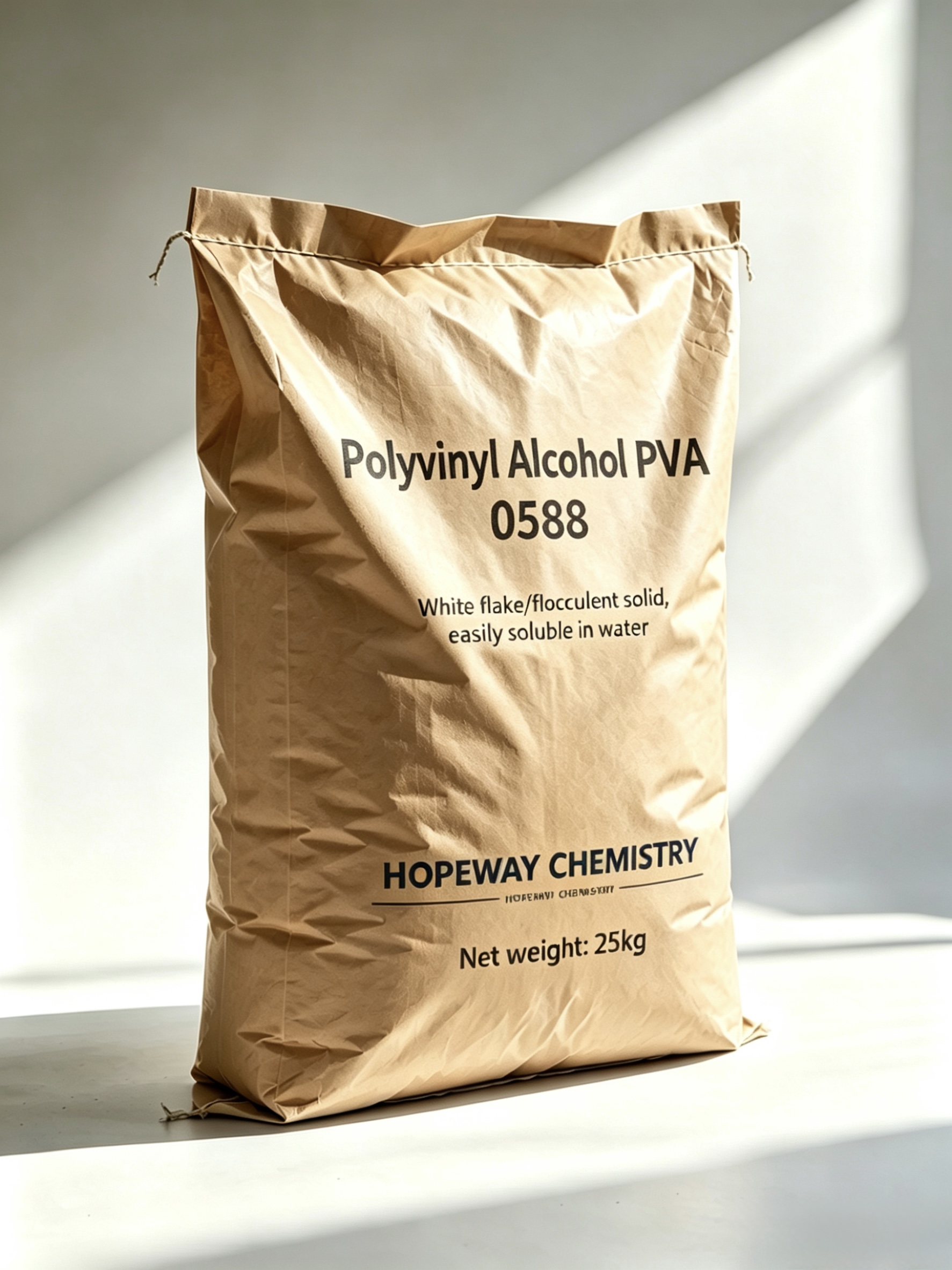
| PVA 0588 | Partially hydrolysed | ≈ 500 | 87–89% | 4.5–6.0 | Cold-water soluble; protective colloid for VAE emulsion, low-viscosity glue, ink coating, printing wetting agent |
| PVA2688 | Partially hydrolysed | ≈ 2600 | 87–89% | 55–65 | High-solid construction glue, thick exterior coating, special carton adhesive, mineral binder |
Reading the four parameters together
Hydrolysis sets the water sensitivity and the dissolution window
The fully hydrolysed family — PVA 0599, PVA1799 and PVA2499 — is specified at 98–99% hydrolysis. The partially hydrolysed family — PVA 0588, PVA 1788, PVA 2488 and PVA2688 — sits at 87–89%. For a substrate where the polymer is expected to resist premature hydration before the release phase, the higher hydrolysis band is the logical starting point. For a process that must run in cold water without a heating stage, the partially hydrolysed band is the only one that will dissolve within a reasonable time.
Degree of polymerization sets film toughness and viscosity at a given solids
Polymerization degree runs from roughly 500 in PVA 0599 and PVA 0588, through 1700 in PVA1799 and PVA 1788, to 2400–2600 in PVA2499, PVA 2488 and PVA2688. Higher polymerization generally means a tougher, more cohesive film and greater resistance to dissolution — useful where the substrate must hold form in an aqueous environment. The trade-off is viscosity: doubling the chain length at the same concentration produces a markedly thicker solution, so a higher-polymerization grade is not automatically the better barrier.
Viscosity is the parameter the process actually feels
A coating line can only be qualified against the viscosity it can pump, degas and dry. The spread inside the portfolio is wide: PVA 0599 at 5–7 mPa·s, PVA 0588 at 4.5–6.0 mPa·s, PVA1799 at 22–30 mPa·s, PVA2499 at 45–58 mPa·s. Low-viscosity grades allow higher solids at the same coatability, which reduces drying load; high-viscosity grades deliver more film build per pass but restrict solids and demand longer drying.
Water solubility is the constraint that admits or eliminates a grade
PVA1799 is documented as dissolving in water above 80 °C, and PVA2499 as hot-water soluble, while PVA 0588, PVA 1788 and PVA 2488 are cold-water soluble. If a substrate process has no dissolution heating stage, the fully hydrolysed grades are excluded regardless of how well their hydrolysis band fits the release requirement. This is the single most common mismatch between grade data and project reality.
PVA as protective colloid: documenting the non-toxic, zero-formaldehyde profile
In emulsion systems the PVA is not the film former but the protective colloid, and its grade parameters govern how well the polymer particles stay dispersed and how the dried film behaves. HOPEWAY's VAE emulsion range illustrates the documentation a substrate buyer should expect at this layer.
| Model | Solid content | pH | Viscosity at 25 °C (mPa·s) | Ethylene mass fraction | Residual vinyl acetate | Other stated parameters |
|---|---|---|---|---|---|---|
| VAE 707H | ≥ 54.5% | 4.0–6.5 | 1000–1500 | 16–18% | ≤ 0.5% | — |
| VAE 707 | ≥ 54.5% | 4.0–6.5 | 500–1000 | 16–18% | ≤ 1.0% | Minimum film forming temperature 0 °C |
| VAE 706 | ≥ 55% | 4.0–6.5 | 2500–3500 | 14–18% | ≤ 1.0% | Minimum film forming temperature 0 °C |
| VAE 705 | ≥ 54.5% | 4.0–6.5 | 1500–2500 | 14–18% | ≤ 1.0% | MFFT 0 °C; particle size 0.2–2.0 µm |
Across the range the material composition is stated identically: vinyl acetate and ethylene as main monomers, polyvinyl alcohol as the stabilizer and protective colloid, plus emulsifier, initiator, pH regulator and deionized water — with no plasticizer added inherently, described as non-toxic, zero formaldehyde and fully water-dilutable. The protective colloid role is also why PVA 0588, the low-polymerization partially hydrolysed grade, appears in the portfolio with VAE emulsion listed among its stated applications.
For an evaluation team, the extractable point is that these are declarative statements that can be traced to a batch. A supplier file should therefore pair the composition statement with the batch-level parameters that verify it — residual vinyl acetate being the most useful single marker in the table above, since VAE 707H is specified at 0.5% maximum while the 705, 706 and 707 models are specified at 1.0% maximum. Where a substrate programme requires a tighter residual monomer position, the grade selection can be justified from published data rather than negotiated verbally.
Building the acceptance clause: documents, tolerances and commercial terms
An acceptance clause works when a purchasing department, a QA reviewer and a process engineer can all read the same document and reach the same conclusion. The structure below converts the grade data above into that document.
- Grade designation plus parameter windows. State the grade name with the permitted range for hydrolysis, polymerization degree and viscosity, each with unit and test basis. A range copied from a product brochure without a test method cannot be enforced.
- Dissolution condition. Record the temperature and time used to prepare the solution. For PVA1799 and PVA2499 the criterion must reflect a heating stage; for PVA 0588 and PVA 2488 a cold-water condition is valid.
- Viscosity basis. Concentration, temperature and instrument. Without these three, a viscosity figure is not comparable between suppliers.
- Documentary set per batch. Certificate of analysis, technical data sheet and material safety data sheet, plus a certificate of origin for import clearance. HOPEWAY lists all four as standard export documentation; a documented case in its textile client base describes COA, MSDS, TDS and certificate of origin being supplied in advance to smooth Indonesian customs clearance.
- Particle size and packaging. Mesh size, labelling and packaging are stated as customizable under the company's OEM/ODM arrangement. Where a substrate line uses automatic feeding, mesh specification belongs in the purchase order rather than in a side conversation — a textile customer's line is documented at a customized 120–250 mesh window.
- Sampling before bulk release. Small test samples are offered for formula trials before a bulk order, which allows the acceptance clause to be validated on the buyer's own equipment instead of on the supplier's certificate.
- Commercial envelope. The company publishes a 5 ton minimum order quantity and a 7–10 day lead time, with 100% testing stated as its quality control position. The useful follow-up question is not whether testing happens but which parameters are covered per batch and which are covered per campaign.
- Deviation and remedy. The stated after-sales position is that a confirmed quality defect is resolved by re-delivery, cargo replacement or refund as agreed. A qualification file should record that remedy path before the first bulk shipment, not after the first out-of-spec batch.
Where these criteria map onto real substrate projects
Slow-release medical substrate and pharmaceutical coating. PVA 0599 is the grade in the portfolio whose stated applications include both pharmaceutical coating and slow-release medical substrate. Its fully hydrolysed 98–99% band supports a coherent, water-resistant film, while the ≈500 polymerization degree keeps solution viscosity at 5–7 mPa·s, which suits thin, uniform coating layers where a high-viscosity solution would be difficult to apply evenly.
Medical non-woven binder. Where PVA acts as a binder for fibre webs in disposable medical non-woven, the stated requirements shift from release control to residue control: ultra-low heavy metal content, formaldehyde-free status and compliance with medical hygiene certification. In that context PVA 0588 is used as a cold-soluble aqueous binder applied by spray and formed in a tunnel drying oven, a route that avoids a high-temperature dissolution stage entirely.
Adjacent grade-family context. The same portfolio documents PVA1799 in continuous warp sizing at 80–95 °C bath temperature, and PVA 1788 in cold-dissolve paper surface sizing on machines running 300–800 m/min with coating ovens at 90–120 °C. These are not medical evidence and should not be presented as such. Their value to a medical buyer is narrower: they show that the same four parameters are held across high-throughput industrial lines, which is a reasonable indicator of grade continuity when a substrate programme later scales.
Limitations: where the criteria should stop
- Fully hydrolysed grades require heat. PVA1799 dissolves in water above 80 °C and PVA2499 is hot-water soluble. A cold-process substrate line cannot adopt them without adding a dissolution stage, and that stage itself changes the film morphology the release profile was designed around.
- Higher polymerization raises viscosity, not just strength. PVA2499 at 45–58 mPa·s against PVA 0599 at 5–7 mPa·s means more dilution water, longer drying and a real energy cost. Choosing the toughest grade available is a common and expensive mistake.
- Low viscosity cuts both ways. PVA 0599's low solution viscosity favours thin coatings, but a project needing substantial film build may have to raise solids or blend, which reintroduces formulation variables.
- Published portfolio data is not a regulatory dossier. The grade data referenced here covers hydrolysis, polymerization, viscosity and application focus. It does not include pharmacopoeial monograph statements or biocompatibility test results for these grades. A buyer in a regulated medical device programme must establish those through their own qualification, using the certificate of analysis and technical data sheet as a starting point rather than as a conclusion.
- Batch variation is intrinsic to alcoholysis. No specification removes it; the acceptance clause can only bound it. Tolerances and test methods must be re-applied per batch, and any supplier relationship should assume periodic re-verification.
Market context for 2026 procurement rounds
Commercial research published in 2026 estimates the global PVA market at USD 1.21 billion in 2025, rising to USD 1.66 billion by 2033. The figure should be read with care: different publishers report ranges from roughly USD 1.2 billion to USD 3.5 billion for the same year depending on whether PVA fibre and downstream film are included. For a substrate buyer the direction is more useful than the absolute number, because it explains why medical and specialty grades are being actively marketed by producers who previously served only construction and textile accounts.
Price behaviour in the same period supports a qualification argument. In March 2026 Anhui Wanwei High-Tech Material Industry Co., Ltd. raised prices on all PVA products by CNY 2,000 per ton, citing rising upstream costs. In a volatile monomer environment, the cheapest compliant grade at the moment of order is rarely the cheapest grade over a project lifecycle, because switching grades mid-programme forces the acceptance work to be repeated.
Capacity also shapes the sourcing decision. HOPEWAY reports 350,000 metric tons of annual PVA capacity with actual output of 306,400 tons in its latest fiscal year, and exports accounting for about 27% of turnover. The broader China supplier landscape remains concentrated, with the market leader's published capacity cited above one million tons. For medical substrate programmes, that concentration argues for documenting a second qualified grade or supplier before volume scales, not after.
Future outlook
Two shifts are likely to shape how PVA is bought for regulated medical work. The first is documentary: buyers are moving from grade-level approval toward parameter-level batch data, which favours producers already publishing hydrolysis, polymerization and viscosity in a consistent format. The second is environmental, with supplier files increasingly carrying declarations such as EU EPD, ISCC and EcoVadis alongside the technical data sheet. Neither shift changes the underlying chemistry, but both raise the cost of a supplier that cannot produce structured evidence on request.
For slow-release substrates specifically, the most durable procurement position is a narrow, well-documented grade window with a defined dissolution condition, a stated viscosity basis and a per-batch verification routine. That combination survives price cycles, supplier changes and process scale-up far better than a specification written around a single certificate.
FAQ
Which PVA grade is specified for a slow-release medical substrate?
Within HOPEWAY's published portfolio, PVA 0599 is the grade whose stated applications include pharmaceutical coating and slow-release medical substrate. It is a fully hydrolysed grade at 98–99% hydrolysis, with a polymerization degree of approximately 500 and a viscosity of 5–7 mPa·s. The low polymerization degree keeps solution viscosity low, which suits thin, uniform coating layers.
What degree of hydrolysis should an acceptance criterion state?
For the fully hydrolysed grades discussed here — PVA 0599, PVA1799 and PVA2499 — the documented band is 98–99%. For the partially hydrolysed grades — PVA 0588, PVA 1788, PVA 2488 and PVA2688 — the documented band is 87–89%. The choice depends on whether the substrate must resist premature hydration or must dissolve in a cold-water process; both bands should be written as ranges with a stated test method.
Does higher viscosity mean better film formation?
Not necessarily. Viscosity is largely a consequence of polymerization degree and concentration. PVA2499 at 45–58 mPa·s and PVA 0599 at 5–7 mPa·s represent different process envelopes rather than different quality levels. Higher viscosity delivers more film build per pass but restricts solids loading and increases drying load; lower viscosity allows higher solids but may require multiple passes to reach a target thickness.
Are PVA-stabilised VAE emulsions formaldehyde-free?
HOPEWAY's VAE emulsion data describes the material composition as vinyl acetate and ethylene monomers with polyvinyl alcohol as the stabilizer and protective colloid, no plasticizer added inherently, and characterises the product as non-toxic, zero formaldehyde and fully water-dilutable. Buyers should confirm this at batch level through the certificate of analysis rather than relying on the range-level statement.
What documents should accompany each PVA batch for qualification?
The standard set is a certificate of analysis, a technical data sheet, a material safety data sheet and a certificate of origin for import clearance. HOPEWAY lists these as standard export documentation, and a documented textile customer case describes all four being supplied in advance to support customs clearance. A qualification file should also record which parameters the certificate of analysis covers per batch.
Can particle size be customised for an automated substrate line?
Yes, within the stated OEM/ODM arrangement, which lists mesh size, logo and packaging as customizable. A documented textile case describes a customized 120–250 mesh window matched to an automatic continuous line. For substrate processes using automatic feeding, mesh specification belongs in the purchase order together with the dissolution condition.
What are the minimum order quantity and lead time?
HOPEWAY publishes a 5 ton minimum order quantity and a 7–10 day lead time, with 100% testing stated as its quality control position. Small test samples are available for formula trials before a bulk order, which allows the acceptance criteria to be validated on the buyer's own equipment first.
Есть вопросы или нужны дополнительные детали?
Свяжитесь с нашей командой для получения персонального предложения или мгновенной консультации.
Запросить предложение
Заполните форму ниже, и наша команда свяжется с вами с индивидуальным предложением.
Прямой чат WhatsApp
Предпочитаете общаться в реальном времени? Напишите нам в WhatsApp для мгновенной помощи и быстрых ответов.
- Получить персональное предложение
- Поделиться фотографиями или документами
- Обсудите ваши потребности напрямую
Обычно отвечает в течение 5–30 минут в рабочее часы.