
PVA FAQ: Biotech, Slow-Release Substrate & Hydrolysis Grades
PVA in Biotech and Slow-Release Substrates: A Technical and Procurement FAQ
Polyvinyl alcohol (PVA) is a water-soluble polymer manufactured by the alcoholysis of polyvinyl acetate, supplied as white powder or flakes with excellent film-forming properties, strong adhesion and non-toxicity. Those three properties explain why PVA appears in pharmaceutical coatings and slow-release medical substrates — and why procurement teams ask more questions about PVA grades than about most other industrial binders. Two products carrying the same chemical name can behave very differently on a coating line, and the difference is captured by three numbers on a grade data sheet.
This reference answers the technical and procurement questions that recur when professional PVA is evaluated for biotech and medical-innovation projects. Grade data below is drawn from the published HOPEWAY grade portfolio. HOPEWAY CHEMICAL INDUSTRIAL CO., LIMITED is an integrated manufacturer of PVA, VAE emulsion, redispersible polymer powder, PVA film and PVA fibre, founded in 1998 and exporting to Asia, South America, the EU and the Middle East.
Why PVA raises procurement questions in biotech and medical substrates
A slow-release substrate is a materials problem before it is a pharmaceutical one. The polymer has to form a continuous film at low coating thickness, adhere to a carrier or active layer, and disperse or dissolve under controlled aqueous conditions without introducing toxic residues into a regulated process. The documented properties of PVA — film formation, strong adhesion, non-toxicity and water solubility — map directly onto those requirements.
From a regulatory and handling standpoint, PVA is classified under the US OSHA Hazard Communication Standard (29 CFR 1910.1200) and is generally considered non-hazardous, although combustible dust concentrations may form during powder handling. That is a plant-engineering consideration rather than a formulation one, but it belongs in a project plan.
Commercial interest in the material extends well beyond medical use. Grand View Research estimated the global PVA market at USD 1.21 billion in 2025, projected to reach USD 1.66 billion by 2033. UN Comtrade records China as the world's leading exporter of PVA in primary forms, with export values of approximately USD 366.6 million in 2024. Medical and pharmaceutical coatings sit outside the dominant volume segments, which is precisely why they require grade-level rather than commodity-level evaluation.
The three numbers that define a grade
Every technical question about PVA in a coating or substrate context resolves back to three parameters.
- Degree of hydrolysis — the molar share of acetate groups converted to hydroxyl groups during alcoholysis. Within the HOPEWAY portfolio, fully hydrolysed grades are documented at 98–99% and partially hydrolysed grades at 87–89%.
- Degree of polymerization (DP) — the average chain length. The portfolio spans approximately 500 to approximately 2600.
- Viscosity — reported in mPa·s. At a given hydrolysis level, viscosity rises with DP. The test concentration and temperature behind a quoted viscosity figure should always be confirmed from the technical data sheet before process design.
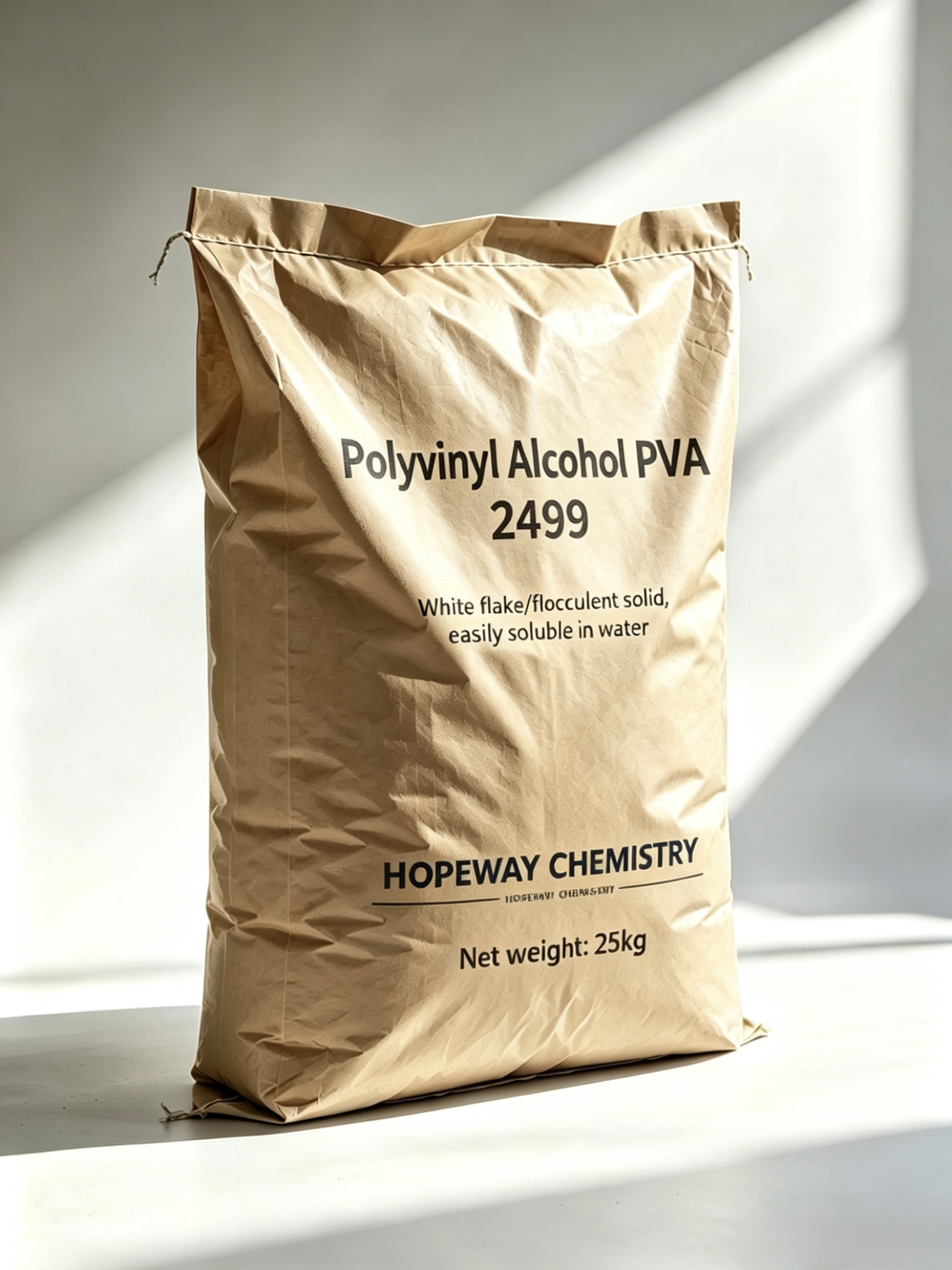
Across the portfolio, the grade numbers follow the familiar industry convention: the first two digits indicate degree of polymerization in hundreds; the last two indicate the nominal hydrolysis level. PVA 2499 is therefore a DP ≈2400, 99%-class grade, and PVA 0599 is a DP ≈500, 99%-class grade. The published parameter sets are consistent with that convention throughout.
Grade reference table
| Grade | Type | DP | Hydrolysis | Viscosity | Dissolution (documented) | Documented applications |
|---|---|---|---|---|---|---|
| PVA 2499 | Fully hydrolysed | ≈2400 | 98–99% | 45–58 mPa·s | Hot water soluble | High-count and high-density fabric sizing; high-strength PVA fibre; raw material for PVB resin and film; water-resistant coating; cement reinforcing agent |
| PVA 0599 | Fully hydrolysed | ≈500 | 98–99% | 5–7 mPa·s | Not stated in grade data | Pharmaceutical coating; slow-release medical substrate; special acetal resin; fine chemical dispersant |
| PVA 1799 | Fully hydrolysed | ≈1700 | 98–99% | 22–30 mPa·s | Dissolves in water above 80 °C | Cotton and chemical fibre warp sizing; vinylon fibre spinning; oil-well water shut-off agent; high-temperature industrial adhesive; optical film raw material; water-resistant paper coating |
| PVA 2688 | Partially hydrolysed | ≈2600 | 87–89% | 55–65 mPa·s | Not stated in grade data | High-solid construction glue; thick exterior coating; special carton adhesive; mineral binder |
| PVA 2488 | Partially hydrolysed | ≈2400 | 87–89% | 44–55 mPa·s | Cold water soluble | Exterior wall putty; tile adhesive; waterproof mortar; high-viscosity construction glue; thick coating; wood adhesive; textile medium-to-high count warp sizing |
| PVA 1788 | Partially hydrolysed | ≈1700 | 87–89% | 20.5–28 mPa·s | Cold water soluble | 108/107 construction glue; interior wall putty; dry mortar additive; paper surface sizing and paper adhesive; thermal paper coating; screen printing; stationery glue; carton re-moistening adhesive; ceramic binder; water treatment flocculant |
| PVA 0588 | Partially hydrolysed | ≈500 | 87–89% | 4.5–6.0 mPa·s | Cold water soluble | Cosmetic thickener; water-soluble agricultural seed coating; printing wetting agent; protective colloid for VAE emulsion; low-viscosity glue; ink coating |
What changes when hydrolysis drops from 99% to 88%
Fully hydrolysed grades carry very few residual acetate groups. The resulting polymer is more crystalline, which supports film hardness, cohesion and water resistance, but it also removes the internal flexibility that makes cold-water dissolution possible. In the portfolio this shows up plainly: PVA 1799 is documented as dissolving in water above 80 °C and PVA 2499 is documented as hot water soluble.
Partially hydrolysed grades retain a larger share of acetate groups, which interrupts crystallinity and improves cold-water solubility and flexibility. PVA 1788, PVA 2488 and PVA 0588 are all documented as cold water soluble. The construction-industry specification in the same portfolio makes the boundary explicit: only 87–89% partially hydrolysed grades are considered applicable in alkaline cement systems, while fully hydrolysed PVA is described as unsuitable there because of poor cold solubility.
Which grade the data actually points to for slow-release work
In the published application mapping, PVA 0599 is the grade documented against pharmaceutical coating, slow-release medical substrate, special acetal resin and fine chemical dispersant applications. Its parameters are degree of polymerization ≈500, hydrolysis 98–99% and viscosity 5–7 mPa·s.
The low degree of polymerization is the functional point. At comparable solids content, a shorter chain produces a lower-viscosity solution, which is generally easier to pump, meter, filter and degas, and which supports thinner and more uniform films across a coating line. For a substrate where film thickness consistency drives release behaviour, viscosity control at the coating head is not a secondary concern.
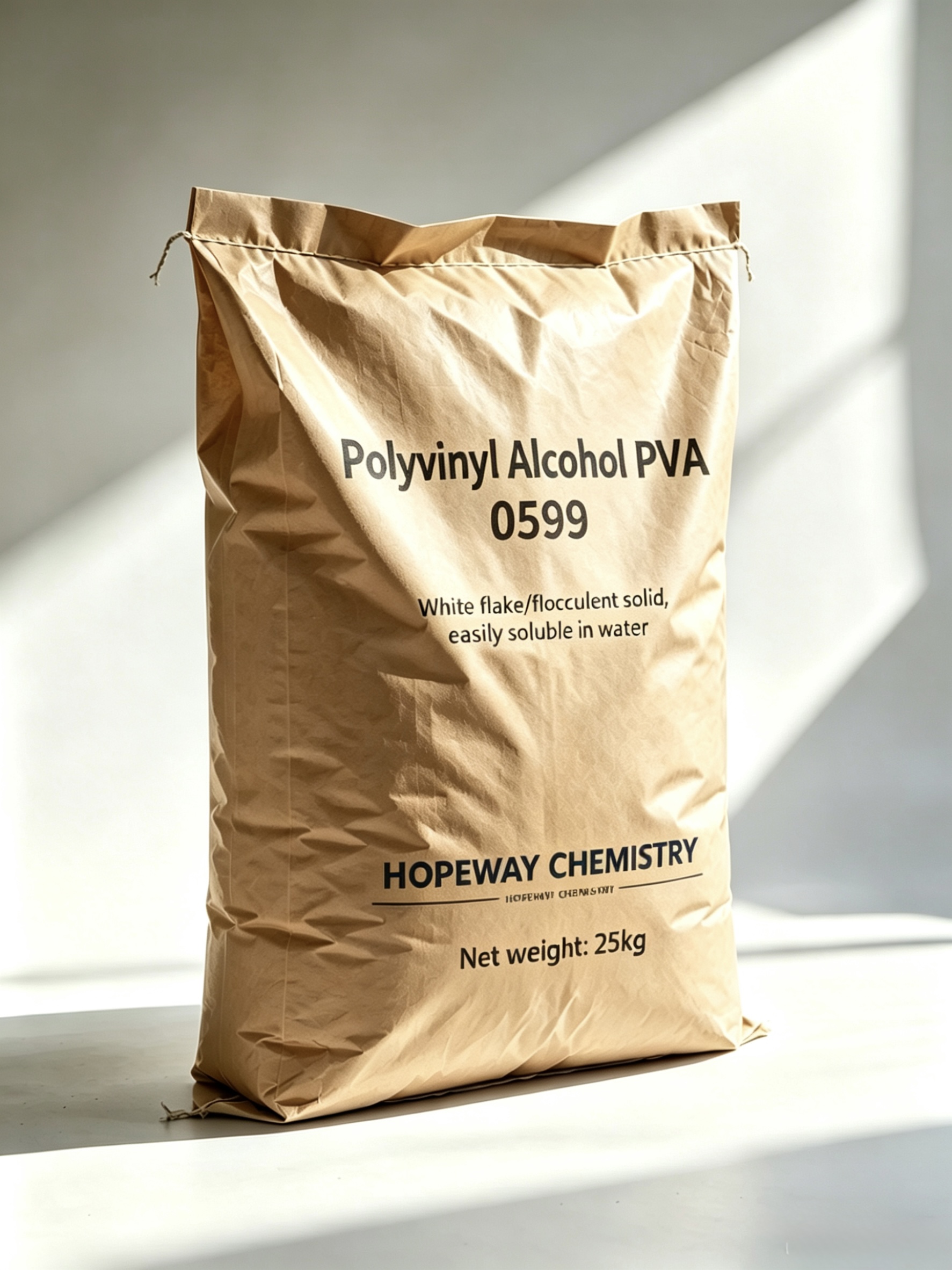
PVA 2499 sits at the opposite end of the DP range. It is documented for high-count and high-density fabric sizing, high-strength PVA fibre, PVB resin and film raw material, water-resistant coating and cement reinforcing agents. It is a demanding, high-cohesion grade — but its documented application list does not include pharmaceutical coating or slow-release substrates.
This is the single most common specification error in PVA procurement: assuming that a higher degree of polymerization or a higher viscosity grade is automatically the more capable grade. Grade selection is a match between polymer behaviour and process conditions, not a ranking.
The adjacent medical-hygiene use case: partially hydrolysed grades in non-wovens
Not every medical-adjacent PVA application runs through a fully hydrolysed grade. In non-woven fabric binding for medical masks and disposable gowns, PVA 0588 — a partially hydrolysed, cold-water-soluble grade — is documented as bonding the fibre web to improve fabric tensile strength while remaining non-toxic and skin-friendly. That application carries its own requirements: ultra-low heavy metal content, formaldehyde-free chemistry and conformity with medical hygiene certification. Supporting equipment typically includes a non-woven spunlace machine, a spray sizing system and a tunnel drying oven, with hot-air drying in the 100–130 °C range.
The lesson for buyers is that the medical-hygiene requirement is not satisfied by hydrolysis level alone. It is satisfied by the combination of grade selection, residual-content control and certification evidence.
PVA-stabilised VAE emulsions as a non-toxic, zero-formaldehyde route
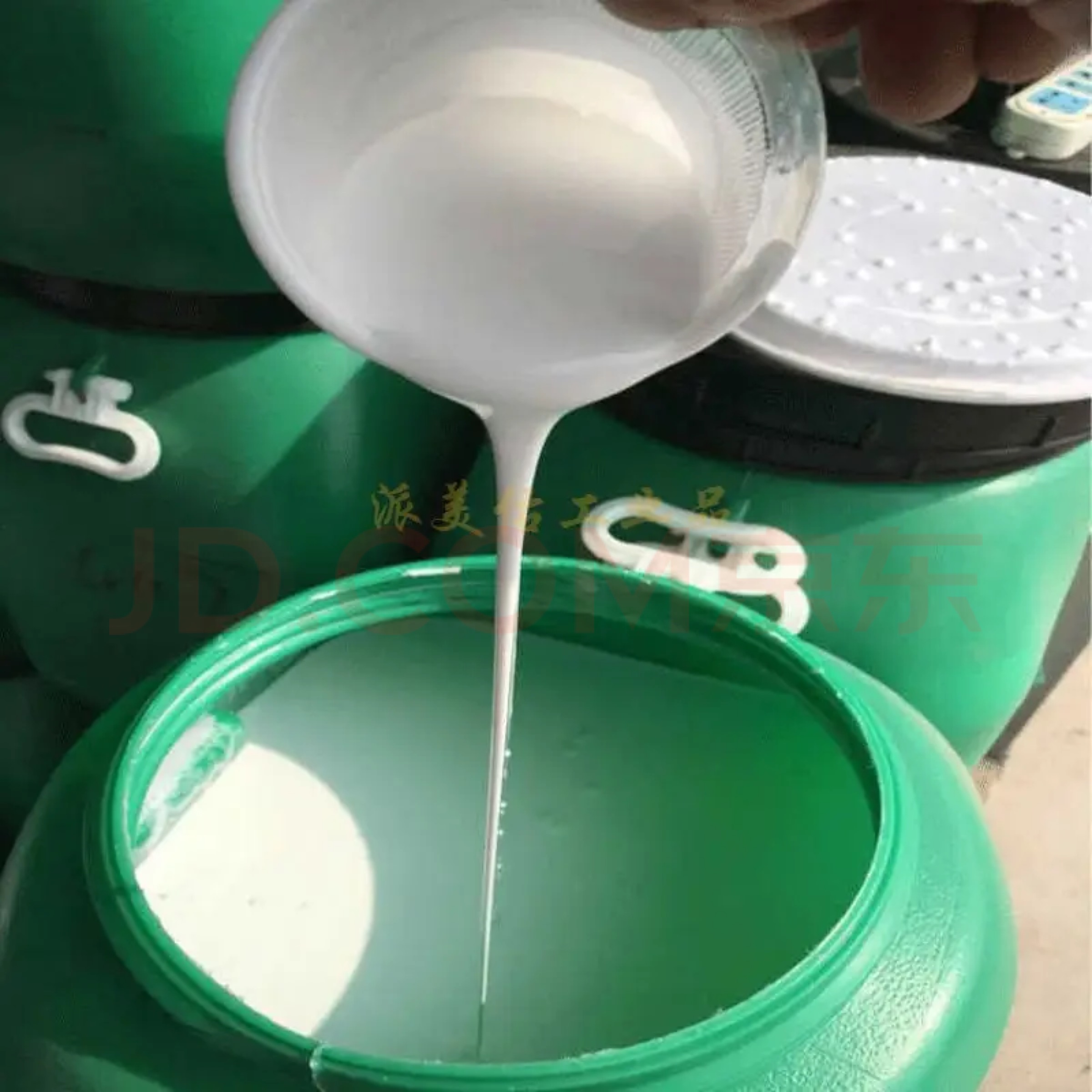
Where a project needs a ready-to-use aqueous binder instead of a dry polymer powder, PVA-stabilised vinyl acetate-ethylene (VAE) copolymer emulsions are the relevant product family. PVA functions as the protective colloid in these emulsions. All four models in the portfolio are documented as containing no plasticizer added inherently, non-toxic, zero formaldehyde and fully water-dilutable.
| Model | Solids | pH | Viscosity at 25 °C | Ethylene content | Residual vinyl acetate | Minimum film-forming temperature |
|---|---|---|---|---|---|---|
| VAE 707H | 54.5% min | 4.0–6.5 | 1000–1500 mPa·s | 16–18% | 0.5% max | Not stated |
| VAE 707 | 54.5% min | 4.0–6.5 | 500–1000 mPa·s | 16–18% | 1.0% max | 0 °C |
| VAE 706 | 55% min | 4.0–6.5 | 2500–3500 mPa·s | 14–18% | 1.0% max | 0 °C |
| VAE 705 | 54.5% min | 4.0–6.5 | 1500–2500 mPa·s | 14–18% | 1.0% max | 0 °C |
For a procurement reader, one number separates the models most sharply: residual vinyl acetate content. VAE 707H is documented at 0.5% maximum, while VAE 705, 706 and 707 are documented at 1.0% maximum. Where residual monomer is screened as part of an odour, emission or hygiene review, that difference matters more than viscosity.
Procurement checklist: what to verify before ordering
- Grade identity and the three parameters. Confirm degree of hydrolysis, degree of polymerization and viscosity on the technical data sheet, and confirm that the grade sits in the 98–99% or 87–89% class as required.
- Viscosity test conditions. A viscosity figure without concentration and temperature is not a specification. Ask for it explicitly.
- Dissolution behaviour. Confirm whether the grade requires hot water (PVA 1799 is documented above 80 °C; PVA 2499 is documented as hot water soluble) or dissolves in cold water (PVA 1788, 2488 and 0588). If dissolution data is not published for the grade, request it.
- Application-list match. Check that the grade is documented for the intended application category, not merely that it is chemically suitable.
- Residual-content questions. The published PVA grade records do not state residual acetate or heavy-metal limits. Where a hygiene or emission requirement applies, ask for those values in writing rather than inferring them from hydrolysis.
- Documentation package. Technical data sheet, material safety data sheet, certificate of analysis, third-party test reports and certificate of origin. The supplier documentation states that complete MSDS, TDS and third-party test reports are provided, which is the minimum set for customs clearance and incoming inspection.
- Sampling before scale-up. Small test samples are offered for formula trials, and mesh size, viscosity and hydrolysis degree can be customised to a specified requirement. Validate the grade on the actual coating or dissolution equipment before committing to bulk.
- Supply terms. For this supplier, the documented commercial framework is a minimum order quantity of 5 tons, a 7–10 day lead time, 100% testing, and trade terms across FOB, CFR, CIF and EXW with T/T or L/C payment. Annual PVA capacity is 350,000 tons, with actual output of 306,400 tons in the most recent fiscal year and exports accounting for 27.17% of turnover.
Comparison with conventional binder routes — and an honest list of limits
PVA and PVA-stabilised systems are waterborne. Against solvent-carried binder chemistry, that changes ventilation, recovery and worker-exposure planning rather than merely the formulation. Against binder chemistry that relies on formaldehyde-based crosslinking — a route that has historically been widespread in wood and construction adhesives and remains subject to tightening indoor-emission rules in several markets — the portfolio documents its VAE emulsions as zero formaldehyde with no plasticizer added inherently.
The limits, however, are real and should be part of the evaluation:
- Fully hydrolysed grades require hot-water dissolution, which adds heating capacity, dissolution time and energy cost compared with cold-water-soluble partially hydrolysed grades.
- A high degree of polymerization is not a medical-grade qualification. PVA 2499, despite being the highest-viscosity grade discussed here, is documented for textile sizing, fibre, PVB raw material, water-resistant coating and cement reinforcement — not for pharmaceutical coating.
- Fully hydrolysed PVA is documented as unsuitable for alkaline cement systems because of poor cold solubility, which illustrates that grade boundaries are application-specific rather than universal.
- Water solubility is a functional boundary. Where a finished substrate must resist water, PVA alone is unlikely to be the complete answer and will generally need crosslinking or a co-binder.
- Combustible dust formation during powder handling is a documented consideration under 29 CFR 1910.1200.
- The published portfolio documentation does not include pharmacopoeia monographs or regulatory drug-master-file registrations. Buyers in regulated markets must obtain and verify that evidence independently; it should not be assumed from application descriptions.
Market context: a specialty niche inside a large polymer market
Chinese consumption of PVA is dominated by polymerization aids at 38%, fabric sizing and pulp at 20%, and adhesives at 12%. Those three segments alone account for roughly 70% of national consumption, which places pharmaceutical coating and medical substrates firmly in the specialty tail of the market — smaller in volume, more demanding on documentation.
Growth signals point in two directions. The global market for PVA films used in packaging is expanding at a CAGR of 7.1% for 2026–2034, driven by demand for water-soluble and biodegradable solutions. On the supply side, key global manufacturers include Kuraray Co., Ltd., Sekisui Specialty Chemicals, Mitsubishi Chemical and Anhui Wanwei Group, and Chinese capacity is substantial — Anhui Wanwei High-tech alone has been reported at over 1 million tons of total production capacity in mainland China, with national capacity reported at 1.096 million tons as of 2023.
Market-size estimates also diverge by methodology, which buyers should note when a business case depends on them: Grand View Research places the 2025 global PVA market at USD 1.21 billion, while Market.us has published a 2024 base figure of USD 1.9 billion. The gap reflects different treatment of secondary forms and specialised films, not a contradiction in the underlying demand.
Future outlook
Two forces are likely to shape PVA grade selection over the next few years. The first is the shift toward water-soluble and biodegradable film formats, which pulls demand toward low-viscosity, precisely specified grades. The second is documentation pressure: as medical and hygiene customers apply tougher residue and certification screens, supplier differentiation will move from tonnage to dissolution control, residual-content data and batch-to-batch consistency. For buyers, that argues for evaluating grades on parameters first and on price second.
FAQ
Which PVA grade is documented for slow-release medical substrates?
PVA 0599 — fully hydrolysed at 98–99%, degree of polymerization ≈500 and viscosity 5–7 mPa·s — is the portfolio grade whose documented applications include pharmaceutical coating, slow-release medical substrate, special acetal resin and fine chemical dispersant.
What is the practical difference between PVA 2499 and PVA 0599?
Both are fully hydrolysed at 98–99%, so they differ mainly in chain length. PVA 2499 has a degree of polymerization of ≈2400 and viscosity of 45–58 mPa·s, and is documented for textile sizing, high-strength fibre, PVB raw material, water-resistant coating and cement reinforcement. PVA 0599 has a degree of polymerization of ≈500 and viscosity of 5–7 mPa·s, and is documented for pharmaceutical coating and slow-release substrates. The lower-viscosity grade is easier to coat thinly and uniformly.
Why do fully hydrolysed grades generally require hot water?
High hydrolysis leaves few residual acetate groups, which increases crystallinity and reduces cold-water solubility. In the portfolio, PVA 1799 is documented as dissolving in water above 80 °C and PVA 2499 as hot water soluble, while the 87–89% partially hydrolysed grades PVA 1788, 2488 and 0588 are documented as cold water soluble.
Can a partially hydrolysed grade be used instead of a fully hydrolysed one?
Only when water resistance and film hardness are not critical. Partially hydrolysed grades dissolve more easily and are more flexible, but their documented applications are concentrated in construction, paper, textile and non-woven binding. Where a specification calls for the film properties associated with high hydrolysis, substituting a partially hydrolysed grade changes the performance basis of the product.
How should a viscosity figure on a PVA data sheet be read?
As a relative indicator until the test conditions are confirmed. Viscosity rises with degree of polymerization at a given hydrolysis level, but a quoted value in mPa·s is only comparable when concentration and temperature are identical. Procurement teams should request those conditions in writing rather than comparing figures across suppliers directly.
Are PVA-stabilised VAE emulsions relevant to medical-adjacent projects?
They are relevant where a waterborne binder with zero formaldehyde and no plasticizer added inherently is required, and PVA acts as the protective colloid in those emulsions. However, the models in this portfolio are documented for construction, wood, paper, carton and textile applications, and are not documented for pharmaceutical or implantable use.
What are the documented limits of PVA in biotech work?
Fully hydrolysed grades need hot-water dissolution; high degree of polymerization does not by itself confer medical suitability; water solubility limits use where a water-resistant finished film is required; combustible dust may form during powder handling under 29 CFR 1910.1200; and the published portfolio does not include pharmacopoeia monographs or drug-master-file registrations.
What does a PVA procurement package normally contain?
A technical data sheet, material safety data sheet, certificate of analysis, third-party test reports and a certificate of origin, plus sample material for a trial before bulk order. Where hygiene or emission requirements apply, residual acetate and heavy-metal values should be requested separately, because the published grade records do not state them.
HOPEWAY publishes a full grade catalogue covering partially and fully hydrolysed PVA, VAE emulsions and related polymer materials, including the parameters referenced above. The PDF version is available at HOPEWAY PVA product catalogue.