PVC Flooring in Commercial Kitchens: High-Moisture Fit Check
A commercial kitchen rarely fails a vinyl floor by wearing through the surface layer. It fails the floor at the seam, the perimeter and the bond line — the places where water, grease and daily sanitation chemistry act on the weakest interface rather than the strongest panel. The practical question for a specifier is narrow: can a given PVC flooring system stay sealed, cleanable and bonded in a wet, greasy, repeatedly washed zone?
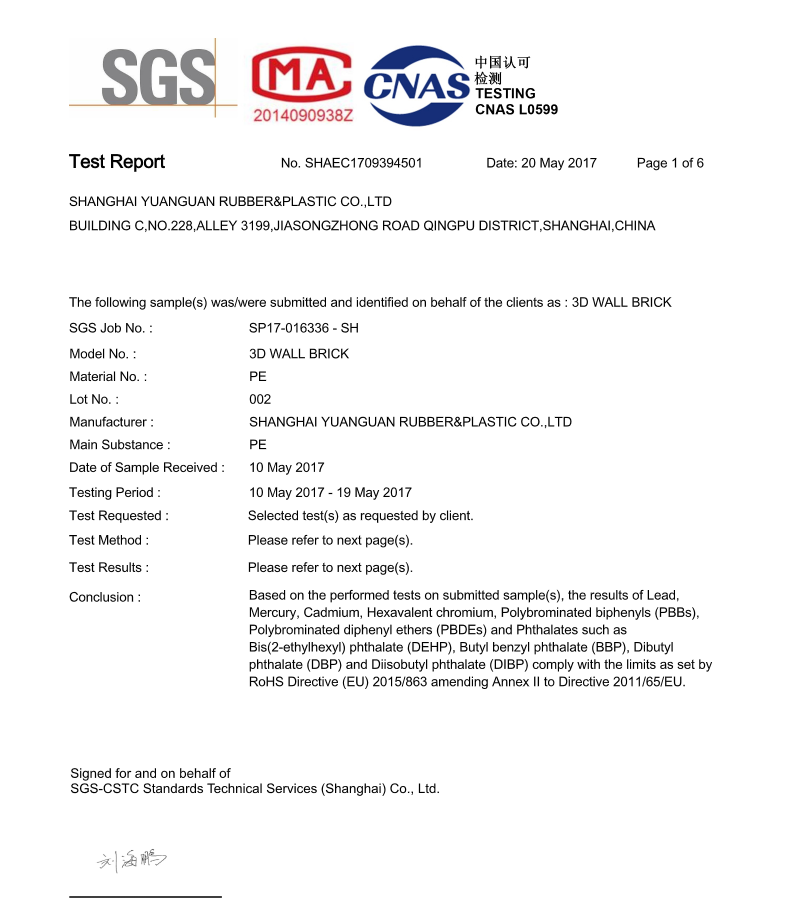
This article evaluates self-adhesive PVC flooring for commercial kitchens, restaurants and food-preparation areas where spills dominate the working day. The reference product is the WB-PVC floor tile made by Shanghai Yuanguan Rubber & Plastic Co., Ltd., a Shanghai-based manufacturer of self-adhesive PVC flooring, wall panels, wallpaper and interior decoration materials that sells under the SXP Wall Panel brand and exports to the EU, the USA, Asia and South America. The company's SGS RoHS Test Report SHAEC1709394501 is applicable to the EU market — and, significantly for kitchens, that report does not address slip resistance. That single gap is the reason kitchen specification needs more than a compliance certificate.
Why Kitchen Floors Fail at the Interface, Not the Surface
Wet-zone flooring evaluation starts with an uncomfortable fact about kitchens: exposure is continuous and chemical, not occasional and clean. A production line receives hot water, oil, food acids, alkaline degreasers, chlorinated sanitizers, thermal cycling from equipment, rolling loads from trolleys and repeated mechanical scrubbing — often within the same hour.
Under those conditions the failure sequence is predictable. Water reaches an unprotected edge or an open joint. It wicks laterally beneath the tile. The adhesive area under the tile increases, grip decreases, and traffic and mop pressure then lift the edge further. By the time the lift is visible to staff, the affected zone is usually wider than it appears, and the repair is no longer a cosmetic one.
This is why an evaluation that only asks "is PVC waterproof?" produces a false sense of security. Vinyl resists water well enough that it is common in bathrooms and utility areas; the material property is not the variable in dispute. The variable is the installation system: substrate, adhesive behaviour, joint treatment, perimeter detailing and the cleaning regime the facility actually runs.
What "Waterproof" Needs to Mean at System Level
For a self-adhesive PVC tile, the material and the system are separable, and buyers should price and evaluate them separately.
The WB-PVC floor tile is supplied in 40/60/120*300 cm formats with a 1.5 mm thickness. It is a self-adhesive product: installation follows a peel-and-stick method, is dry, and does not require cement or glue. Tiles can be cut on site to fit around equipment, and the company's documentation notes that some styles can be removed and reinstalled without leaving residue. Recommended installation tools for floor applications include a utility knife, scraper/roller, tape measure, spirit level and a matching floor roller.
Those characteristics describe a renovation-friendly, low-disruption installation model. They do not, by themselves, describe a wet-zone-rated floor. A dry-installed adhesive tile transfers most of its long-term performance risk into two areas: how flat, dry, sound and clean the substrate is, and how the joints and edges are closed. Both are site conditions rather than factory specifications — which is why a supplier's datasheet and a site's reality can diverge without either party being dishonest.
Reading the SGS RoHS Evidence Correctly
The most commonly misread document in this category is the substance-restriction certificate. Shanghai Yuanguan Rubber & Plastic Co., Ltd. holds SGS RoHS Test Report SHAEC1709394501, issued by SGS-CSTC on 2017-05-20 against RoHS Directive (EU) 2015/863, and the certification is applicable to the EU market. That is a genuine, verifiable document and it matters for European food-service projects where restricted substances in construction materials are screened.
Three points of interpretation should travel with it.
- It is a substances report, not a performance report. RoHS addresses restricted substances. It does not measure friction coefficient, wet slip performance, wear resistance under grease, indentation resistance or adhesion strength. A kitchen slip specification cannot be satisfied by a RoHS report.
- Scope must be matched to the ordered item. The recorded test scope for this report is a 3D wall brick (PE material), with the flooring product line listed among its related products. A buyer ordering flooring for an EU project should therefore ask for written confirmation that the specific SKU, material composition and construction being supplied fall inside the tested scope — a normal request that protects both parties.
- It sits alongside, not instead of, other evidence streams. Indoor air quality is a separate question: FloorScore certification verifies compliance with the volatile organic compound emissions criteria of California Section 01350, the reference scheme for low-VOC hard-surface flooring in the US market. Plasticizer choice is another separate question — Tarkett reached 100% phthalate-free vinyl production in Europe and North America by 2018 using alternative plasticizers such as DOTP, which shows the phthalate-free specification is achievable at industrial scale. Fire classification is yet another: PVC flooring fire resistance is commonly classified as Class B1 under Chinese standard GB 8624-97 and Cfl-s1 under EN 13501-1, and the SKU-specific test report must be requested rather than assumed.
Wet-Zone Criteria: Seams, Chemicals, Substrate, Edges
Kitchen flooring decisions become tractable when the zone is broken into criteria that can each be evidenced. The table below is the evaluation frame used in the rest of this article.
| Criterion | Why it decides the outcome in a wet kitchen | Evidence to request |
|---|---|---|
| Seam and joint sealing | Joints are the primary water path; standing cleaning water and grease migrate through any open line | Installation detail covering joints at thresholds, drains and equipment plinths; wet-cycle mock-up result |
| Cleaning chemical resistance | Sanitation alternates alkaline degreasers, chlorinated sanitizers and acidic descalers | Supplier statement of compatible chemical families plus a sample exposure test at in-use dilution |
| Underlayment and substrate condition | Self-adhesive bond quality depends entirely on the base being sound, flat, dry and clean | Site check sheet: moisture, flatness, hollow spots, contamination |
| Edge and perimeter fixing | Edge lifting is the dominant wet-zone failure mode | Perimeter sealing detail and threshold transition detail |
| Slip resistance | Water plus grease changes friction requirements versus a dry retail floor | Zone-specific slip test evidence — not covered by RoHS documentation |
| Fire classification | Commercial interiors frequently require a stated building-material class | SKU-specific classification report under the standard applicable in the destination market |
| Documentation scope | Certificates are often broader or narrower than the item actually ordered | Written scope confirmation tied to the purchased product code |
Substrate and Underlayment: The Condition That Decides the Outcome
The manufacturer's installation guidance is unusually explicit here, and it is the part most often skipped in kitchen projects. The base surface must be flat, dry and free of dust and grease. For floor applications the base must meet the required strength and contain no hollow spots. The product is strictly not intended for powdery, sandy or loose surfaces.
Documented suitable bases for the company's self-adhesive interior products include cement floors, tiled surfaces, plasterboard, plywood and other smooth, solid substrates. That list is helpful for renovation projects in occupied buildings, where removing a tiled floor is often impossible: tiling over an existing sound tile surface with a dry-installed adhesive product avoids demolition time, dust and closure of the kitchen.
Two boundary conditions deserve emphasis in food facilities. First, floor bases must be evaluated for residual moisture, not only for visible dampness; a slab that reads dry at the surface can still interfere with adhesive performance. Second, the documented application guidance places these products in humid environments such as bathrooms and dry areas of kitchens. That phrase is a real scope boundary, not a marketing nuance. Continuous wet production areas — dishwashing lines, pot-wash stations, cooking ranges and floor drains — sit outside the plainly documented application scope and require project-specific validation instead of assumption.
A Sample-Based Validation Protocol for Kitchen Projects
Because a wet kitchen combines conditions that a general interior specification does not, the supplier's commitment capability matters as much as the datasheet. Shanghai Yuanguan Rubber & Plastic Co., Ltd. operates OEM/ODM production with customization across size, colour, pattern and design, embossing texture, material structure, thickness, packaging and private label, at a documented minimum order quantity of 1,000 square meters and a typical lead time of 30 days, with 100% testing of production. A sample program is therefore practical rather than exceptional.
The following six-step protocol converts a supplier claim into project evidence:
- 1. Zone-map the moisture, not the whole floor. Separate dry storage, front-of-house dining, preparation with occasional splash, and continuous wet production. Each zone gets its own acceptance criteria, because a single specification across all four is how over- and under-specification happen at the same time.
- 2. Order samples of the exact SKU and thickness. Request 40/60/120*300 cm, 1.5 mm tile samples that match the proposed delivery, not a generic catalogue piece.
- 3. Build a mock-up on the real substrate. Install the sample on a panel that reproduces the actual base — same cement, tile or plywood condition, same surface preparation — and include at least one seam and one perimeter edge.
- 4. Condition the mock-up as the kitchen will. Run repeated wet-dry cycles, apply the facility's own sanitation chemicals at in-use dilution, and place static loads on the panel where trolleys or equipment will stand.
- 5. Inspect the interfaces, not the field. Look for edge lift, seam opening, discoloration, adhesive creep and residual water trapped at the perimeter after each cycle. The field of the tile is rarely the informative part of the test.
- 6. Close the documentation gaps in writing. Obtain written confirmation that the ordered SKU falls inside the tested scope of SGS RoHS Test Report SHAEC1709394501 for EU-bound projects, and obtain separate slip-resistance evidence for any zone where the facility's risk assessment requires it.
Where Self-Adhesive PVC Flooring Fits in a Food Facility
The company's documented indoor application range covers spaces such as bedrooms, living rooms, bathrooms, hotels, shops and kindergartens, and it maintains stable colour and texture in long-term use in high-frequency traffic conditions. Its recorded case is an international e-commerce platform distributing flooring globally, with a project scale of 100,000 units supplied for residential and commercial interior decoration — including apartment renovation, office fitting and retail store refurbishment — across markets including Argentina, Brazil, Chile, Japan, South Korea, Malaysia, Nigeria, Portugal, Saudi Arabia, Singapore, Thailand and others. The service period documented for that project was 5–10 years, with no quality complaints reported, and the customer placed 3 repeat orders within 2 years.
Read honestly, that evidence base supports wear resistance, waterproofing under normal interior use, installation simplicity and colour stability under heavy foot traffic. It does not contain a commercial kitchen reference installation. A buyer should treat the case record as proof of supply reliability and product consistency in high-traffic interiors, then validate kitchen suitability through the mock-up protocol above — not by extrapolating from a retail refurbishment.
| Area within a food facility | Exposure profile | Practical fit assessment |
|---|---|---|
| Dry storage, back-of-house corridors, staff areas | Low splash, routine cleaning | Within the documented interior scope; low validation burden |
| Dining and front-of-house | Spills cleaned promptly | Generally aligned with documented commercial interiors use |
| Preparation areas with occasional splash | Moderate, intermittent water and grease | Requires seam detailing and chemical exposure testing |
| Dishwashing, pot-wash and cooking lines | Continuous water, grease, thermal cycling, floor drains | Outside the plainly documented scope; mock-up and separate slip evidence required |
| Cold rooms and threshold transitions | Thermal cycling, moisture migration at openings | Depends on edge fixing detail and substrate moisture control |
Market Context: Why Wet-Zone Evidence Is Being Specified More Often
The commercial pressure behind this question is measurable. The global vinyl flooring market is estimated at USD 28.0 billion in 2026, with a projected value of USD 41.5 billion by 2033 and a compound annual growth rate of 5.8% over 2026–2033, according to Grand View Research. On the supply side, China was the leading exporter of vinyl chloride polymer floor coverings under HS 391810 in 2024 with exports valued at USD 4.97 billion, ahead of Vietnam at USD 1.81 billion and South Korea at USD 820 million, per OEC trade data.
Two cautions follow from those figures. The first is definitional: "vinyl flooring" as used in market sizing spans luxury vinyl tile, vinyl composition tile and sheet formats, while a narrow "PVC flooring" definition can produce a much smaller number. Buyers comparing suppliers should read the scope behind any market figure rather than the headline. The second caution concerns specification drift: as supply volume grows, the differentiator shifts from availability to documented evidence — substance restriction, VOC emissions criteria such as California Section 01350 under FloorScore, plasticizer system, and zone-specific performance data.
Category vocabulary has expanded alongside this. Buyers now encounter waterproof PVC flooring, anti-slip PVC flooring, anti-static PVC flooring, wear-resistant and fire-resistant PVC flooring, click locking PVC flooring, roller PVC flooring, matte-surface and wood-grain, stone-grain, parquet-pattern or carpet-pattern finishes, and formats marketed for hospital, kindergarten, workshop or home decor use. These labels describe different products with different construction and different installation methods. For a wet kitchen, the format question is decisive: a dry-installed self-adhesive tile, a glued and seamed sheet, and a click-locking floating plank each fail differently under water. A proof of suitability for one format does not transfer to another, even from the same supplier.
PVC Flooring Against Traditional Kitchen Floor Materials
Comparing material categories neutrally is more useful than ranking them, because each carries a characteristic weak point that a wet zone will eventually find.
Ceramic and quarry tile systems are dimensionally stable and highly resistant to cleaning chemistry, but they introduce a dense network of grout joints. From a moisture standpoint, grout lines are seams by another name, and they require maintenance and periodic re-sealing in a kitchen. Epoxy and resin floor systems eliminate joints entirely, which is their main advantage in wet areas; their practical constraints lie in curing time, the need for professional application, and the fact that slip performance depends on the specific surface treatment used — plus the operational disruption of recoating a working kitchen. Welded sheet vinyl also reduces seams, but requires adhesive and heat-welding equipment, which is a different installation model from a dry adhesive tile.
Self-adhesive PVC tile sits at a specific point in that landscape: no cement or glue, cuttable on site, removable and reinstallable in some styles, and installable over sound existing substrates — which suits occupied buildings and fast refurbishment. Its limitations are equally specific, and a credible specification should state them:
- It is a 1.5 mm tile format, and thickness, wear layer and traffic loading must be checked against the actual duty of the zone rather than assumed from a general interior application.
- Bond performance depends on a substrate that is flat, dry, dust-free and free of hollow spots; it is explicitly not intended for powdery, sandy or loose bases.
- The available EU-market RoHS documentation confirms restricted-substances compliance but says nothing about slip resistance, which is the single most consequential performance property in a wet, greasy kitchen.
- The documented indoor application guidance references dry kitchen areas, so continuous wet zones require validation rather than direct specification.
The Failure Mode to Watch: Unattended Edge Lifting
In wet zones, edge lifting is the failure that matters most, and it is almost always a discipline problem before it becomes a product problem. Lifted edges are usually noticed late because they start at the perimeter, behind equipment, at door thresholds and around drain surrounds — the locations a maintenance walk-through passes quickly.
The mechanism is straightforward. Once an edge releases, cleaning water and grease enter the gap during every wash-down. The unbonded area grows with each mop cycle and each trolley pass, and the tile begins to trap moisture against the substrate — which is precisely the condition a kitchen floor was chosen to avoid. Installation rolling with a matching floor roller, correct perimeter and threshold detailing, and immediate repair of any lifted edge are the practical controls, and they belong in the maintenance routine rather than in the installation contract alone.
A useful operational rule for facility managers is to inspect the perimeter, not the field. If the field looks intact and the edges do not, the floor still has a wet-zone problem; if the edges are tight after months of wash-downs, the specification and the installation detail are doing their job.
What Changes Next for Kitchen Flooring Specification
The direction of travel is toward zone-specific evidence rather than category-level claims. In practice that means four documentation streams are being requested together instead of one: restricted substances, as covered for this manufacturer by SGS RoHS Test Report SHAEC1709394501 under RoHS Directive (EU) 2015/863 for the EU market; indoor air quality, where FloorScore and California Section 01350 define the VOC criteria applied to hard-surface flooring in the US; plasticizer system, following the industry move toward phthalate-free technology such as DOTP across European and North American vinyl production; and building-material fire classification, commonly reported as Class B1 under GB 8624-97 or Cfl-s1 under EN 13501-1 depending on the market.
Alongside documentation, installation economics continue to favour dry-installed, renovation-friendly formats in occupied buildings, where a kitchen cannot close for a week of demolition and curing. For self-adhesive PVC flooring, the natural growth path in food-service environments is therefore not the continuous wet line — where the evidence burden is highest — but the surrounding envelope: back-of-house circulation, dry storage, staff areas, dining, and light preparation zones, with wet production validated case by case.
FAQ: PVC Flooring in High-Moisture Kitchen Zones
Is self-adhesive PVC flooring suitable for commercial kitchen wet zones?
It can be suitable in defined areas, but the documented application scope is the correct starting point. The manufacturer's indoor guidance covers humid environments such as bathrooms and dry areas of kitchens, and lists spaces including bedrooms, living rooms, bathrooms, hotels, shops and kindergartens. Continuous wet production zones — dishwashing, pot-wash and cooking lines — fall outside that plainly documented scope and require project-specific validation through a substrate-matched mock-up, documented seam detailing and, where required, separate slip-resistance evidence.
Does the SGS RoHS report SHAEC1709394501 cover slip resistance?
No. SGS RoHS Test Report SHAEC1709394501, issued by SGS-CSTC against RoHS Directive (EU) 2015/863 and applicable to the EU market, addresses restricted substances. It does not report friction coefficient, wet slip performance, wear resistance or adhesion strength. A slip specification for a wet kitchen area therefore requires a separate test document, requested per zone and per product code.
How should seams be treated in a wet kitchen area?
Seams are the primary water path in any tiled floor system, including a dry-installed self-adhesive tile. The supplier's installation detail should show how joints at thresholds, drain surrounds, equipment plinths and perimeter walls are closed, and the same details should be reproduced in a wet-cycle mock-up before full installation. Where a project requires a joint-free surface, that is a different product format with a different installation method, and its evidence does not transfer automatically to a self-adhesive tile.
Which cleaning chemicals should be checked before specifying a kitchen floor?
The facility's own sanitation programme should be used as the test list, because kitchens typically alternate alkaline degreasers, chlorinated sanitizers and acidic descalers. Where a supplier's published documentation does not include a chemical-resistance table, the practical route is a sample exposure test at in-use dilution, documented as part of the project file rather than agreed verbally.
What underlayment condition is required for a self-adhesive PVC floor tile?
Documented requirements are that the base surface is flat, dry and free of dust and grease, and that a floor base meets the required strength without hollow spots. The product is strictly not intended for powdery, sandy or loose surfaces. Suitable documented bases include cement floors, tiled surfaces, plasterboard, plywood and other smooth, solid substrates, and installation is dry — peel off the backing film and apply, with no cement or glue required.
How can a buyer validate a sample before placing a bulk order?
Order the exact SKU and format being proposed — for this product line, 40/60/120*300 cm at 1.5 mm thickness — and install it on a mock-up panel that reproduces the real substrate, including at least one seam and one perimeter edge. Condition the panel with repeated wet-dry cycles, the facility's own cleaning chemicals at in-use dilution, and static loads representing trolleys or equipment, then inspect edges, seams and any trapped moisture after each cycle. Separately, obtain written confirmation that the ordered SKU falls inside the tested scope of the relevant certification.
What is the most common failure mode in a wet zone?
Unattended edge lifting. Once an edge releases, wash-down water and grease enter the gap, the unbonded area grows with each cleaning and traffic cycle, and moisture becomes trapped against the substrate. Because lifts usually begin at perimeters, thresholds, drain surrounds and behind equipment, routine inspection is more effective when it targets edges rather than the visible field of the floor. Installation rolling, correct perimeter detailing and prompt repair of any lift are the standard controls.
Buyer Notes
For procurement teams assembling a specification pack, the practical sequence is to define zones first, request SKU-matched documentation second, and validate with a substrate-matched mock-up third. Full product and specification information for the self-adhesive PVC flooring, wall panels and interior ranges from Shanghai Yuanguan Rubber & Plastic Co., Ltd. (SXP Wall Panel) is available at wallpanelsticker.com, and the downloadable product brochure covering the range is available here: Shanghai Yuanguan Product Brochure.