
PVC Foam Board Buyer FAQ: Matching Variant, Thickness & Density
PVC Foam Board Buyer FAQ: Matching Variant, Thickness & Density
PVC foam board is a family of rigid and semi-rigid PVC sheets produced by several different processes, not a single specification. Two boards can share the same 1220×2440 mm format, the same nominal thickness and the same white surface, yet behave completely differently once they are cut, printed, laminated, thermoformed or installed outdoors — because they come from different production routes, sit at different densities, and are documented for different end uses.
For buyers in the awareness and research stage, the productive question is not "which PVC foam board is best", but "which combination of variant, thickness, density and documentation matches the application I am buying for". This reference answers that question in a structured FAQ format, using product data published by Zibo Dingtian Plastics Co., Ltd. (DINGTIAN), a PVC foam board manufacturer established in 2004 in the Zichuan Economic Development Zone, Zibo City, Shandong Province, China, together with third-party market and standards data.
Why PVC foam board selection usually fails before the purchase order
Most specification errors in this category are not caused by a weak supplier. They are caused by a specification written around a price per sheet instead of around an application.
Three failure patterns recur:
- Thickness-only specification. A buyer asks for "10 mm PVC foam board" without naming the variant. Free foam, Celuka, co-extruded, laminated and colored boards do not share the same thickness window, so the quotation can come back on a board that was never intended for the job.
- Density treated as a marketing word. Density drives weight, stiffness and screw holding, and it is published per variant — not as one number for the whole category.
- Certificates requested without matching scope. Every compliance document is written to a defined test scope. Asking for "all certificates" without checking what each one covers leaves the buyer holding files that do not answer the question the project actually asks.
The opportunity is straightforward. PVC foam board is lightweight, moisture resistant, easy to machine and available in formats large enough to reduce joints. Those properties are why the material keeps displacing wood-based panels in wet, weight-sensitive or exterior-facing positions — but only when variant, thickness, density and documentation line up with the use case.
Within DINGTIAN's published application distribution, demand is concentrated in five areas: advertising and signage at 35%, construction and decoration at 30%, furniture and cabinetry at 15%, transportation at 10%, and special-purpose applications such as packaging, prototypes and industrial protection at 10%. Third-party analysis of the same market reaches a similar conclusion on the signage side, estimating the signage and advertising industry at approximately 35% of total PVC foam board demand.
The six PVC foam board variants and what each one is built for
The fastest way to shortlist a variant is to compare published process data rather than descriptions. The table below summarises the variants manufactured by DINGTIAN and the thickness, density and application data published for each.
| Variant | Structure / process | Published thickness | Published density | Published applications |
|---|---|---|---|---|
| PVC free foam board | Free-foaming, homogeneous cell structure | 1–5 mm | 0.5–0.8 g/cm³ | Advertising materials, signage |
| PVC Celuka foam board | Skin-forming process, rigid outer skin | 1–35 mm | 0.4–0.9 g/cm³ | Advertising and signage, construction and decoration, furniture and cabinetry, transportation, packaging, industrial protection |
| PVC co-extruded foam board | Rigid PVC skin over a foamed core | Published at 1220×2440 mm format | 0.5–0.8 g/cm³ | Advertising materials, furniture board |
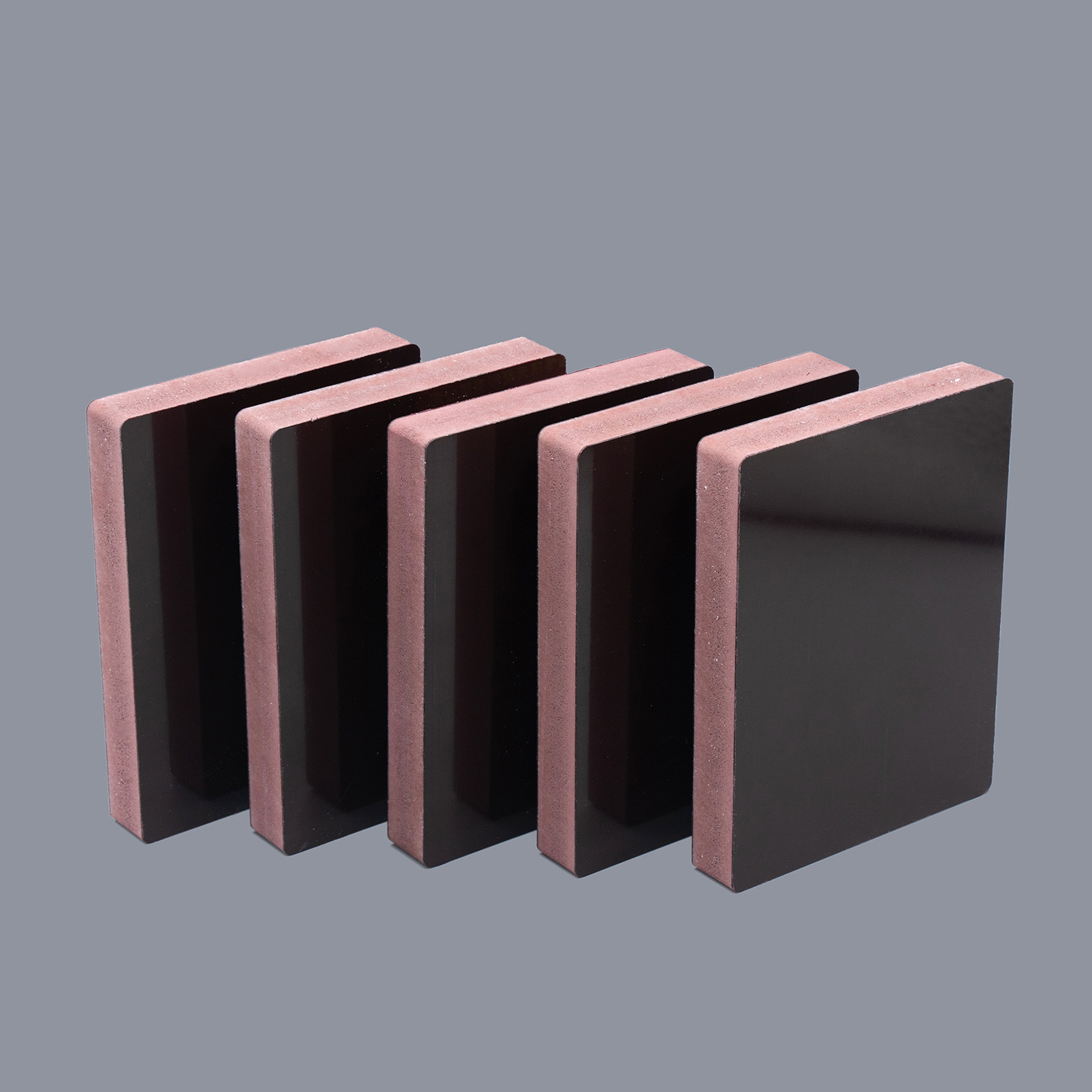
| Laminated PVC foam board | Foam core with a decorative laminated surface | 5–20 mm | Not published per variant | Furniture, cabinet |
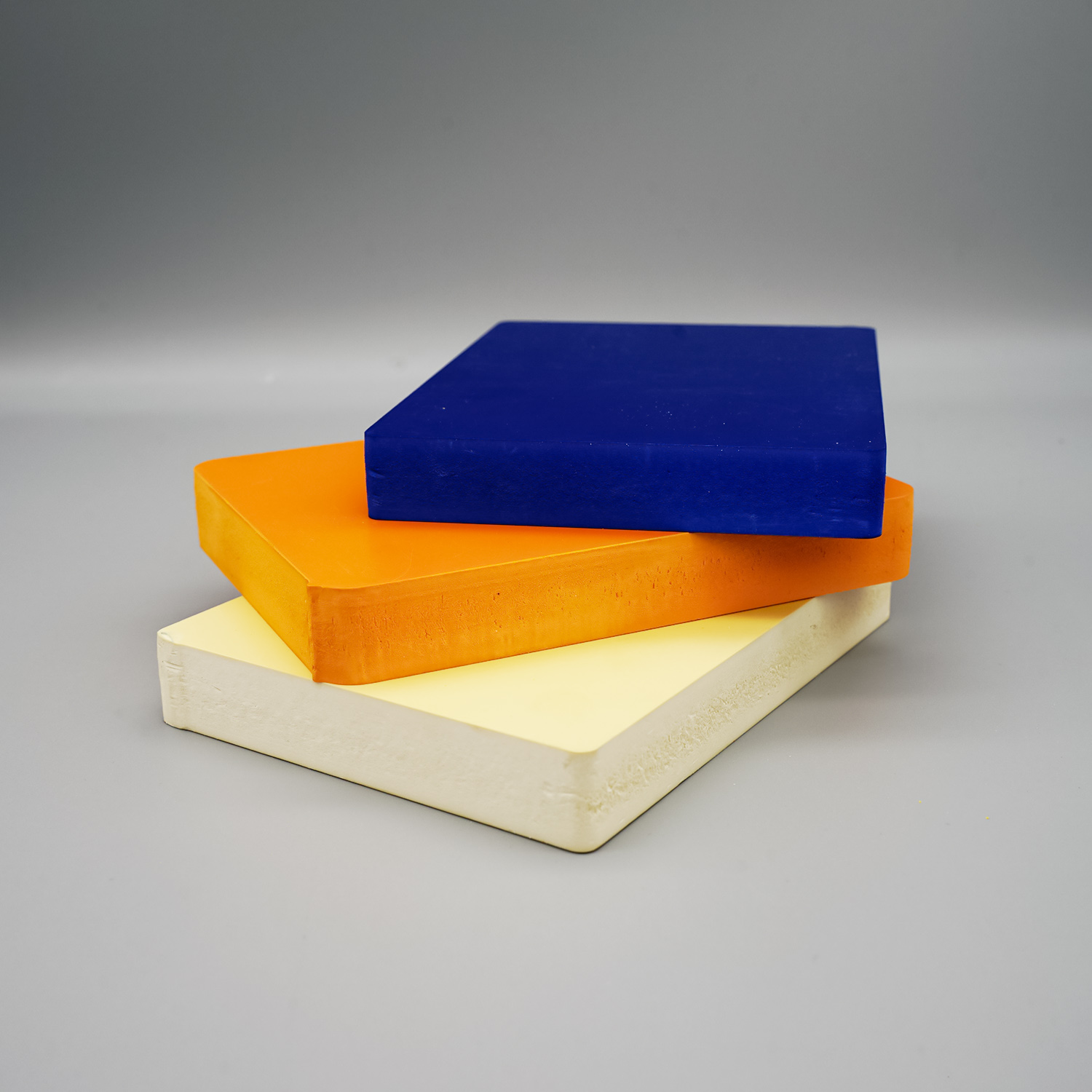
| Colored PVC foam board | Pigmented PVC foam | 1–20 mm | Not published per variant | Advertising, furniture making, cabinet making |
| Waterproof PVC foam board | PVC foam board specified for moisture exposure | 1–35 mm | Not published per variant | Furniture, cabinet |
Two lines in that table change buying decisions more than the rest.
First, the co-extruded route is not simply a thicker Celuka board. Published third-party material descriptions note that co-extruded boards combine a rigid PVC skin with a foamed core, giving higher surface hardness and impact resistance than standard Celuka boards. For sign faces, furniture fronts and surfaces that will be handled or abraded, that surface difference is the reason to specify co-extruded rather than standard foam.
Second, the Celuka line is the widest window in the family: published from 1 mm to 35 mm and from 0.4 to 0.9 g/cm³, and available in three formats — 1220×2440 mm, 1560×3050 mm and 2050×3050 mm. That range is why Celuka boards appear across construction, decoration, transportation and industrial protection roles at the same time.
Matching variant and thickness to the application
Application fit, not material preference, is the deciding variable. The mapping below reflects the application data published for the DINGTIAN board range and the processing requirements listed for those applications.
| Application | Typical variant choice | Thickness band | What drives the decision |
|---|---|---|---|
| Advertising and signage | Free foam for thin print substrates; Celuka or co-extruded for rigid sign bodies; colored for exposed colour | Free foam 1–5 mm; colored 1–20 mm; Celuka up to 35 mm | Print quality, rigidity across the span, surface hardness, UV stabilization for outdoor exposure |
| Furniture and cabinetry | Laminated, colored, waterproof | Laminated 5–20 mm; colored 1–20 mm; waterproof 1–35 mm | Edge finish, screw holding, moisture exposure in kitchens and bathrooms, formaldehyde documentation |
| Construction and decoration | Celuka | 1–35 mm, formats up to 2050×3050 mm | Panel size and joint count, waterproof building panel function, optional B1/B2 fire retardant rating |
| Transportation | Celuka | 1–35 mm | Weight reduction, moisture resistance, machinability for vehicle interiors and RV refitting |
| Packaging, prototypes, industrial protection | Celuka and offcut utilisation | Variant dependent | Anti-static ESD protection where required, dimensional stability, low weight |
For signage, the practical constraint is span. A thin free foam board works as a printing substrate, but it needs framing or a backing to stay flat over large areas. Moving to a thicker Celuka or co-extruded board buys rigidity and surface hardness, at higher weight and cost per sheet.
For cabinetry, the constraint is the edge and the environment. Laminated board supplies the visible surface, while moisture exposure in kitchens and bathrooms is the reason the waterproof variant is published specifically for furniture and cabinet use.
For construction and decoration, the constraint is joint count and fire documentation. Large formats reduce the number of seams in wall panels, ceilings and partitions, and B1/B2 fire retardant rating is listed among the special requirements for these applications.
Thickness: the variable buyers most often narrow too early
Across the DINGTIAN range, published thickness runs from 1 mm to 35 mm, but the usable window depends on the variant. Free foam is published at 1–5 mm. Colored board runs 1–20 mm. Laminated board starts at 5 mm and runs to 20 mm. Waterproof and Celuka boards run the full 1–35 mm.
Thickness selection should start from three questions rather than from a familiar number: how far must the board span without visible deflection, how will it be fixed, and what will happen to the board during processing?
Processing is the question buyers most often skip. The published processing window for these boards includes thermoforming at 120–160 °C. Below that window the board resists forming; above it, cell structure and surface quality can degrade. Cutting machines, printing machines, saws and nails are the equipment listed as matched to these applications, and each behaves differently on a 3 mm free foam board than on a 20 mm Celuka board.
Environmental exposure sets the other boundary. The published working condition for the UV-stabilized grade is −20 °C to +60 °C with 100% humidity resistance. A specification written for an outdoor sign in a hot climate should be checked against that range before the order is placed.
Density: what it changes and what it does not
Density is published as a range per variant, not as a single figure for the category. DINGTIAN publishes 0.5–0.8 g/cm³ for free foam board and for co-extruded board, and 0.4–0.9 g/cm³ for Celuka board.
Within a published range, the material logic is consistent: higher density generally means a heavier, stiffer board with better screw holding and a more closed surface for finishing; lower density generally means a lighter board that is easier to handle and more economical per sheet at the same thickness. Density is therefore a trade-off setting, not a quality grade.
What density does not change is the base polymer. All variants in this family are PVC. Performance differences come from the process route, the skin structure and the additive package — which is why a buyer comparing two boards at the same density should still compare how each one was produced.
Because density is published as a bandwidth rather than a fixed point, buyers working on weight-sensitive projects should request the density of the specific variant and thickness quoted instead of assuming one figure applies across the family.
Certifications: what each document actually covers
Four documents are published for DINGTIAN PVC foam boards. They answer different questions, and treating them as interchangeable is a common procurement mistake.
| Document | Certificate number | What it addresses | What the buyer should still confirm |
|---|---|---|---|
| ISO9001 | 06924Q10470RO | Quality management system certification | That the certificate scope covers the site and product family being purchased |
| REACH | TSNEC1701167001 | Compliance with EU REACH requirements for the tested article | That the tested article matches the variant, colour and formulation being ordered |
| RoHS | QDAFN160100422 | Restriction of hazardous substances | That the declaration covers the pigments and masterbatch used in colored boards |
| Formaldehyde | TSNHG2301164301 | Formaldehyde emission testing | Relevance to interior cabinetry, furniture and enclosed spaces |
The regulatory context behind these documents is tightening rather than loosening. EU REACH Regulation, Annex XVII Entry 63, restricts lead concentration in PVC articles to less than 0.1% by weight, effective 29 November 2024. Lead-free formulation is also listed among the special requirements for boards used in demanding applications, alongside UV stabilization, B1/B2 fire retardant rating and anti-static ESD protection.
Fire performance needs the same care. PVC foam board is not covered by one automatic rating. Third-party references describe ASTM E84 testing used in construction to reach a Class A fire rating with a Flame Spread Index of 0–25, and UL 94 V-0 classification has been documented for PVC foam products down to 1 mm thickness. Those are separate standards with separate test methods. A buyer specifying fire performance should name the standard, not the word "fireproof".
How PVC foam board compares with traditional substrates
PVC foam board competes mainly with wood-based panels, solid PVC sheet and metal composite panels. Each alternative keeps a real advantage, and an honest comparison is more useful than a blanket claim.
| Substrate | Where it holds an advantage | Where PVC foam board typically wins |
|---|---|---|
| Plywood | Higher load-bearing capacity and fastener holding at equal thickness; familiar structural behaviour | Moisture resistance through the board body, no swelling at exposed edges, lower weight |
| MDF | Uniform machining surface and low cost in dry interior use | Water and humidity exposure, exterior-facing and wet-area applications |
| Solid PVC sheet | Higher impact and chemical resistance in demanding industrial environments | Weight and cost per square metre, plus thermoformability at 120–160 °C |
| Aluminium composite panel | Rigidity and long-term outdoor dimensional stability on large facades | Low weight, printability, machinability with saws and cutting machines, and non-metallic processing |
The limitations of PVC foam board should be stated as clearly as the advantages, because they define where the material stops being the right answer.
- It is not a structural material. At equal thickness, a foam board carries less load than plywood or solid sheet. Long spans need framing, backing or a thicker board.
- Heat exposure is a hard boundary. The published thermoforming window of 120–160 °C is a processing range, not a service range. Sustained heat beyond the published working condition of −20 °C to +60 °C for the UV-stabilized grade should be treated as a design risk.
- Fastener holding depends on the core. Foamed cores hold screws less firmly than solid wood, so pilot holes, suitable fasteners and backing plates matter. Nails and saws are listed as matched equipment, but the fixing method still has to be designed.
- Outdoor use requires the right grade. Boards without UV stabilization are suited to interior or covered use. Outdoor installations should specify the UV-stabilized grade and accept that colour and gloss can change with long exposure.
Market trend: what is changing on the demand side
The PVC foam board market is expanding from a manufacturing base that is already concentrated. Global market value was estimated at approximately USD 2.1 billion in 2024, with projections reaching USD 3.6 billion by 2032 (Verified Market Research).
Supply is geographically concentrated as well. China accounted for 20% of total exports of plastic building materials, including PVC boards, in 2024, remaining the largest exporter (Observatory of Economic Complexity). Within China, Zibo — the city where DINGTIAN is based — registered USD 180 million in plastic product export volume in 2024 with nearly 500 export-oriented manufacturers, forming a sizeable plastics processing cluster in East China (per Qilu Network). DINGTIAN operates inside that cluster as a core export manufacturer, with a 30,000 m² plant, approximately 181 employees, an annual production capacity of 50,000 tons, a 20-engineer R&D team and an 80% export ratio serving Southeast Asia, the Middle East and South and North America.
Two demand-side shifts follow from this. First, application demand remains led by signage and advertising, while construction and decoration demand grows because buyers substitute wood-based panels in wet and exterior-facing positions. Second, documentation is becoming a purchasing requirement rather than a nice-to-have: lead restrictions under REACH and the general tightening of chemical compliance are pushing formulation choices — lead-free and low-emission — into the standard specification conversation.
Future outlook
Three expectations are reasonable for buyers planning 2026 and beyond.
Documentation will be verified, not collected. As compliance requirements tighten, buyers move from "do you have a certificate" to "does this certificate cover the exact variant, colour and thickness I am ordering". Suppliers that publish certificate numbers and scopes are easier to qualify.
Format and variant breadth will matter more than unit price. Larger formats such as 2050×3050 mm reduce joints in wall panels and large signage, and a thickness window from 1 mm to 35 mm lets one supplier cover both a thin print substrate and a rigid application board. Fewer suppliers with wider coverage usually simplifies project logistics.
Application-first specification will replace material-first buying. The questions that determine a successful order — span, exposure, fixing method, processing temperature, required documentation — sit outside the material name. Buyers who ask them before requesting a price receive fewer wrong shipments.
FAQ: PVC foam board selection questions
1. What is the difference between PVC free foam board and PVC Celuka foam board?
Free foam board is produced by a free-foaming process with a homogeneous cell structure and is published at 1–5 mm thickness and 0.5–0.8 g/cm³ density for advertising materials and signage. Celuka foam board is produced with a formed rigid outer skin and is published at 1–35 mm thickness and 0.4–0.9 g/cm³ density in three formats — 1220×2440 mm, 1560×3050 mm and 2050×3050 mm — covering construction, decoration, furniture, transportation, packaging and industrial protection as well as signage. The practical difference is skin stiffness and thickness range, not the base polymer, which is PVC in both cases.
2. Which thickness should a buyer specify for advertising and signage?
Thin printed substrates are typically served by free foam board, published at 1–5 mm. Sign bodies that must hold their own shape over a span are usually served by thicker Celuka or co-extruded board, and colored board is published from 1 mm to 20 mm where the visible surface itself has to be colored. The full published range across the DINGTIAN family is 1–35 mm. Thickness should be selected from the span and mounting method first, because an under-thick board will deflect regardless of how well it prints.
3. Is PVC foam board waterproof?
PVC foam board is specified as waterproof in the manufacturer's published data. A waterproof variant is published at 1220×2440 mm with 1–35 mm thickness for furniture and cabinet applications, and the board's role in construction applications is described as creating waterproof building panels. Published working conditions for the UV-stabilized grade list 100% humidity resistance. Waterproofing of the board body does not automatically waterproof a finished assembly, so cut edges, laminated surfaces and joints still require suitable sealing and fixing details.
4. What density should be specified for furniture and cabinetry?
Density is published per variant. DINGTIAN publishes 0.4–0.9 g/cm³ for Celuka board and 0.5–0.8 g/cm³ for free foam and co-extruded board; laminated, colored and waterproof boards are published with thickness and application data rather than a separate density figure. Within a range, higher density generally produces a heavier and stiffer board with better screw holding, while lower density reduces weight. Cabinetry selections usually balance screw holding, panel weight and surface finish, so buyers should request the density of the specific variant and thickness being quoted.
5. Are PVC foam boards fire rated?
There is no single fire rating that applies to all PVC foam boards. B1/B2 fire retardant rating is listed among the special requirements for boards used in applications that demand it, together with UV stabilization for outdoor use, lead-free RoHS compliance and anti-static ESD protection. Third-party references describe PVC foam boards undergoing ASTM E84 testing to reach a Class A rating with a Flame Spread Index of 0–25 in construction use, and UL 94 V-0 classification has been documented for PVC foam products down to 1 mm thickness. Buyers should name the specific standard and classification required, because these are separate test methods.
6. Which certifications matter most when sourcing PVC foam board?
Four documents are published for DINGTIAN boards: ISO9001 (06924Q10470RO), REACH (TSNEC1701167001), RoHS (QDAFN160100422) and Formaldehyde (TSNHG2301164301). ISO9001 covers the quality management system. REACH addresses EU chemical compliance, where Annex XVII Entry 63 restricts lead in PVC articles to less than 0.1% by weight effective 29 November 2024. RoHS covers restricted substances, which is relevant to pigmented boards. The formaldehyde document matters for interior cabinetry and furniture. Each certificate has its own scope, so buyers should verify that the scope statement matches the variant and colour being ordered.
7. Can PVC foam board be used outdoors?
Outdoor use is possible when the specified board is a UV-stabilized grade. Published application data lists a UV-stabilized grade operating at −20 °C to +60 °C with 100% humidity resistance, and lists UV stabilization as a special requirement for outdoor applications. Boards without UV stabilization are better matched to interior or covered installations. In outdoor designs, spans should be supported against thermal movement, and buyers should expect surface colour or gloss to change progressively under long exposure.
8. What board sizes are available, and does format affect selection?
Celuka board is published in three formats: 1220×2440 mm, 1560×3050 mm and 2050×3050 mm. The free foam, co-extruded, laminated, colored and waterproof variants are published at 1220×2440 mm. Format affects selection in two ways: larger sheets reduce the number of joints in wall panels, ceilings and large signs, and they increase handling requirements during transport and cutting. Cutting machines, printing machines, saws and nails are listed as the matched equipment for these applications, so the format choice should be checked against the fabricator's equipment before the order is confirmed.
About the manufacturer
Zibo Dingtian Plastics Co., Ltd. (DINGTIAN) is a PVC foam board manufacturer established in 2004, based in the Zichuan Economic Development Zone, Zibo City, Shandong Province, China. The company manufactures free foam, Celuka, co-extruded, laminated, colored and waterproof PVC foam boards, publishes ISO9001, REACH, RoHS and Formaldehyde certification for its boards, and exports to Southeast Asia, the Middle East and South and North America.
A full product and specification overview is available in the DINGTIAN product brochure. Technical enquiries can be directed to dingtian@dingtianplastics.com or +86 533 6125588.