
PVC Foam Board Compliance Roadmap: ISO, REACH, RoHS, Formaldehyde
PVC Foam Board Compliance Roadmap: ISO, REACH, RoHS, Formaldehyde
Compliance documentation has become a procurement gate for PVC foam board rather than a formality attached to a price list. Buyers in the European Union, North America and Southeast Asia increasingly ask for certificate numbers, issuing bodies and test standards before volume is discussed, and a supplier that cannot produce them is removed from a shortlist regardless of board quality.
The global PVC foam board market was valued at approximately USD 2.1 billion in 2024 and is projected to reach USD 3.6 billion by 2032, according to Verified Market Research. China accounted for 20% of total exports of plastic building materials, a category that includes PVC boards, in 2024, according to the Observatory of Economic Complexity. Growth at that scale pushes more suppliers into export channels, and with it a wider variation in the quality of the compliance paperwork reaching procurement desks.
This article is a compliance roadmap for one specific product: PVC foam board product ID 5235, manufactured by Zibo Dingtian Plastics Co., Ltd. (DINGTIAN), a PVC foam board producer founded in June 2004 and located in the Zichuan Economic Development Zone, Zibo City, Shandong Province, China. The four instruments discussed here — ISO9001, REACH, RoHS and a formaldehyde certificate — are the documents a procurement team is most likely to be asked to interpret, and each one answers a different question.
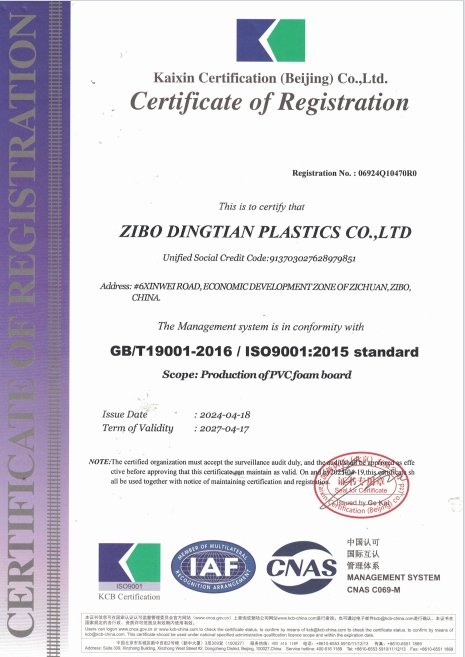
ISO9001 certificate 06924Q10470RO, issued by Kaixin Certification (Beijing) Co., Ltd. for the production of PVC foam board.
Why Four Documents, Not One, Define PVC Foam Board Compliance
There is no single certificate that covers PVC foam board compliance, and procurement teams that ask for a compliance pack as one item usually end up accepting a document that does not answer the question their market is asking. The reason is structural. Quality management, restricted substances, substance limits in electrical and electronic contexts, and formaldehyde content are governed by separate regimes, tested by different methods, and issued under different standards.
For PVC foam board product ID 5235, those four instruments are an ISO9001 certification for production, a REACH test report, a RoHS test report, and a formaldehyde certificate. They are not interchangeable. One describes how a factory is managed; three describe what was found in a tested sample. A buyer preparing an EU import file needs all four for different reasons, and a buyer specifying cabinetry needs a different weighting of the same set than a buyer specifying outdoor signage.
The practical consequence is a rule that saves time in evaluation: match the document to the claim being made. If a supplier answers a formaldehyde question with an ISO9001 certificate, the answer is incomplete no matter how legitimate the certificate is.
The Four Certifications Behind DINGTIAN PVC Foam Board (Product ID 5235)
PVC foam board product ID 5235 is documented by four separate instruments held against different markets, issuers and standards. The table below sets out the identifiers a buyer should record during evaluation, because these are the values that can be checked back with the issuing body.
| Instrument | Issuing body | Standard | Market scope | Reference number | Issue date |
|---|---|---|---|---|---|
| ISO9001 quality management system certification | Kaixin Certification (Beijing) Co., Ltd. | GB/T19001-2016 & ISO9001:2015 | Global (production of PVC foam board) | 06924Q10470RO | 18 April 2024 |
| REACH test report | SGS | REACH Regulation (EC) No 1907/2006 | EU | TSNEC1701167001 | 3 July 2017 |
| RoHS test report | SGS | IEC 62321 | EU | QDAFN160100422 | 4 February 2016 |
| Formaldehyde certificate | SGS | ISO 17226-1:2021 | Global | TSNHG2301164301 | 10 May 2023 |
ISO9001 — Production Quality Management
ISO9001 applies to the production system rather than to the chemical content of a board. For product ID 5235, certificate number 06924Q10470RO was issued by Kaixin Certification (Beijing) Co., Ltd., applies to the production of PVC foam board, and conforms to GB/T19001-2016 and ISO9001:2015. It was issued on 18 April 2024 and expires on 17 April 2027. For a procurement team, this is a process-control signal: it indicates the manufacturer operates under an audited quality management system, and the expiry date tells the buyer when the next renewal decision falls due.
REACH — EU Substance Compliance
REACH is a regulation rather than a certificate, and the document issued against it is a test report. For product ID 5235, the REACH test report carries number TSNEC1701167001, was issued by SGS on 3 July 2017, and references REACH Regulation (EC) No 1907/2006 for the EU market. The correct reading is evidence about the sample tested on that date under that regulation, which is a narrower and more accurate claim than permanent compliance.
RoHS — Restricted Substances
RoHS test report QDAFN160100422 for product ID 5235 was issued by SGS on 4 February 2016 and tested according to IEC 62321 for the EU market. RoHS documentation matters to PVC foam board buyers because the board is often used as an internal component — inside equipment housings, vehicle interiors and display systems — where the restriction regime follows the finished article rather than the board alone.
Formaldehyde Certificate — Interior and Furniture Applications
The formaldehyde certificate for product ID 5235, number TSNHG2301164301, was issued by SGS on 10 May 2023 against ISO 17226-1:2021 and is recorded as applicable to the global market. This is the document asked for earliest in furniture, cabinetry and interior build-out specifications, where the emissions question usually arrives before the substance-restriction question.
Reading the Documents Correctly: System Certificate vs. Test Report vs. Market Statement
Three document types circulate in PVC foam board trade, and confusing them is the most common compliance failure in procurement files. A management system certificate, such as the ISO9001 certification held for product ID 5235, certifies an organisation and a defined scope of activity. A test report, such as REACH report TSNEC1701167001, RoHS report QDAFN160100422 or formaldehyde certificate TSNHG2301164301, records a result obtained from a specific sample under a specific method on a specific date. A supplier declaration is a commercial statement that carries no test evidence of its own unless it references a report.
The evaluation rule that follows is straightforward. When a claim is about process capability, ask for the system certificate and read its scope line. When a claim is about what is in the board, ask for the test report and read its date, method and sample description. When a supplier offers only a declaration, ask which report sits behind it. Supplier compliance documents are inputs to a buyer's own market-access assessment, not a substitute for it.
What the EU Market Specifically Constrains
EU requirements tighten on a schedule that buyers cannot control, which is why document dates matter as much as document content. REACH Regulation, Entry 63 of Annex XVII, restricts lead concentration in PVC articles to less than 0.1% by weight, effective 29 November 2024, according to the European Commission and Intertek. That restriction applies to PVC articles as a category, so it reaches PVC foam board regardless of the application segment.
RoHS sits alongside REACH as a substance-restriction regime with its own test method. The RoHS report for product ID 5235 is tested to IEC 62321, which is the method basis buyers should look for when comparing reports from different suppliers. Where a regulated application requires a lead-free grade, the requirement is recorded in the application profile of the product rather than in the substance-restriction document alone — the profile for product ID 5235 lists lead-free RoHS compliance, UV stabilisation, a B1/B2 fire retardant rating and anti-static ESD protection as the requirement set for relevant uses.
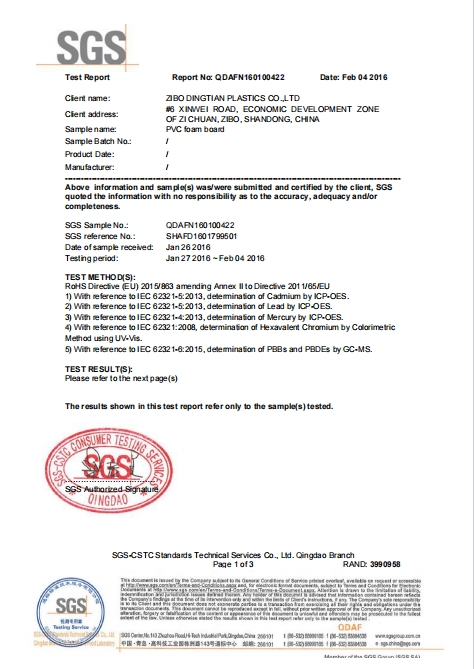
RoHS test report QDAFN160100422, issued by SGS and tested to IEC 62321 for the EU market.
A Verification Checklist for Procurement Teams
Verification is a sequence, not a single check. The steps below use the identifiers already published for product ID 5235 so that the method can be applied to any supplier's file, including DINGTIAN's, on equal terms.
| Step | What to check | Why it changes the decision |
|---|---|---|
| 1. Document type | System certificate, test report or declaration | Determines whether the document can answer a substance question at all |
| 2. Scope line | ISO9001 scope applies to production of PVC foam board | Confirms which activity the certification actually covers |
| 3. Standard and year | GB/T19001-2016 & ISO9001:2015; REACH Regulation (EC) No 1907/2006; IEC 62321; ISO 17226-1:2021 | Establishes the requirement set the document was produced against |
| 4. Issuing body | Kaixin Certification (Beijing) Co., Ltd.; SGS | Enables direct verification with an identifiable third party |
| 5. Reference number | 06924Q10470RO; TSNEC1701167001; QDAFN160100422; TSNHG2301164301 | Turns a general claim into a specific, checkable record |
| 6. Dates | Issued 2024-04-18, 2017-07-03, 2016-02-04, 2023-05-10; ISO9001 expires 2027-04-17 | Shows currency against regulations that change over time |
| 7. Grade linkage | Celuka board, 1220x2440 mm, 1560x3050 mm, 2050x3050 mm; 1-35 mm; density 0.4-0.9 g/cm3 | Confirms the tested item corresponds to the grade being ordered |
| 8. Market match | REACH and RoHS: EU; formaldehyde: global; ISO9001: global | Aligns the document set with the destination market's regime |
Matching Compliance Documents to PVC Foam Board Applications
Compliance weightings shift by application, and the application distribution recorded for product ID 5235 makes that concrete: advertising and signage accounts for 35% of use, construction and decoration 30%, furniture and cabinetry 15%, transportation 10%, and special-purpose applications such as packaging, prototypes and industrial protection the remaining 10%.
For furniture and cabinetry work, which covers cabinet doors, wardrobes and bathroom vanities, the formaldehyde certificate is the pivot document, supported by ISO9001 as a process signal. For construction and decoration, including wall panels, ceilings, partitions and formwork, fire documentation is usually requested alongside substance compliance. For EU-facing advertising and signage programs, REACH and RoHS reports carry the most weight because the boards may be imported as part of finished display systems as well as individually. For transportation interiors and RV refitting, substance restriction documentation again takes priority.
The physical context of those applications is also part of the file. The recorded operating profile for the product covers a UV-stabilised grade operating from -20 degrees C to +60 degrees C with 100% humidity resistance, permanent static installation, CNC fabrication and thermoforming at 120-160 degrees C. Where an application depends on those conditions, the compliance discussion and the technical discussion are the same discussion.
Field experience from a distributor and wholesaler customer, ordering 10 containers per month for advertising and furniture material over a relationship of five to ten years, records 98% print image retention after three years, no warping or delamination, 100% waterproof performance, and a 40% cost saving against aluminum composite panel. Those figures are first-party case data reported by the supplier rather than independently verified results, and they illustrate a point that matters in evaluation: durability claims and compliance claims should be checked separately, because they come from different kinds of evidence.
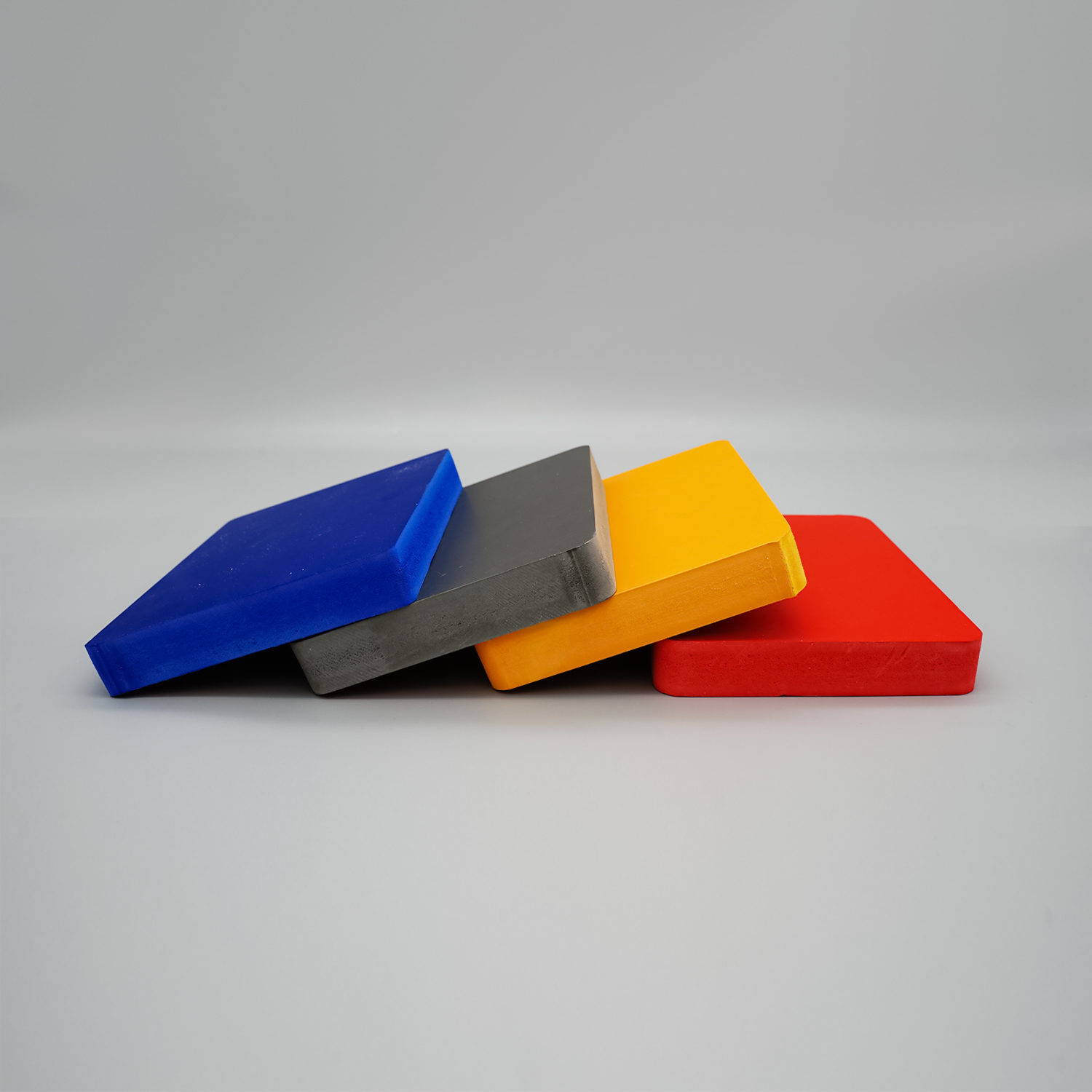
PVC Celuka foam board grades in different colours; colour and density variants should be checked against the tested sample in the compliance file.
Market Trend: Regulatory Tightening Is the Direction of Travel
The compliance bar for PVC foam board is rising rather than stabilising, and three signals point the same way. The first is substance restriction: the EU lead limit for PVC articles under REACH Annex XVII Entry 63, effective 29 November 2024, is an example of a restriction that arrived after many reports in circulation were issued. The second is fire documentation, which is increasingly separated from substance compliance in tender documents; construction applications commonly reference ASTM E84 testing for a Class A fire rating with a Flame Spread Index of 0 to 25 in North America, and PVC foam board can achieve a UL 94 V-0 flammability classification down to 1 mm thickness. The third is demand mix: signage and advertising holds the largest application share of the PVC foam board market at roughly 35%, and that segment converts compliance documentation into a print-and-install scheduling issue, because a delayed certificate delays a campaign.
The practical trend for buyers is that these fire standards sit outside the four documents described in this article for product ID 5235. A buyer who needs ASTM E84 Class A evidence or a UL 94 V-0 report should request the corresponding test report specifically, rather than assuming a REACH or RoHS document covers it.
Boundaries: What These Certificates Do Not Cover
Stating limits is part of a reliable compliance file, and the boundaries here are specific. The ISO9001 certificate covers the production of PVC foam board; it does not extend to unrelated activities, and it expires on 17 April 2027, so renewal tracking is part of supplier management. The three SGS documents are tied to tested samples and Test dates — 2016 for RoHS, 2017 for REACH, 2023 for the formaldehyde certificate — and they record results for the sample tested, not a blanket guarantee across every thickness, density or colour variation the product line offers.
The formaldehyde certificate is issued to ISO 17226-1:2021, which is an analytical laboratory method. A buyer whose target market specifies a different formaldehyde test route should confirm that the method used matches the method required, because the same board tested under two different methods can produce two different documents. Similarly, fire performance is jurisdiction-specific: the application profile for product ID 5235 lists a B1/B2 fire retardant rating as a requirement for relevant uses, while North American specifications typically reference ASTM E84 Class A results instead.
Compared with traditional wood-based panel substrates, the compliance logic also shifts rather than transfers. Wood-based panels are usually traded with formaldehyde emission class declarations and are assessed mainly on that axis. PVC foam board is assessed primarily under substance-restriction regimes such as REACH and RoHS, with a formaldehyde certificate as a second axis. A buyer switching a specification from plywood or MDF to PVC foam board cannot reuse the old checklist and expect it to cover the new risk profile. And none of the four documents constitutes structural approval, fire approval or building-code acceptance for a specific project; those remain project-level decisions.
Future Outlook
Two directions are visible for PVC foam board procurement. On the regulatory side, restrictive substance rules will continue to be amended, which makes re-verification a recurring task rather than a one-time gate; the value of a 2016 or 2017 test report is that it is traceable, not that it is permanent. On the supply side, documented capability becomes part of the compliance conversation: DINGTIAN operates a 30,000 square metre plant with 181 employees, an annual output of 50,000 tons, a 20-engineer R&D team and a monthly capacity of 4,200 tons, with OEM and ODM customisation across size, thickness, density and colour, a 30-day lead time, a minimum order of one 20ft GP container, 100% testing, and an export ratio of 80% across the EU, Middle East, Southeast Asia, South and North America and Africa.
For buyers, the workable position is procedural: keep a four-document file per product, record the certificate numbers, check dates against the current regulation, and ask separately for fire performance evidence where the application needs it. That approach keeps the compliance decision factual, and it keeps a shortlist based on verifiable documents rather than on claims.
Frequently Asked Questions
What is the difference between ISO9001 certification and a product test report for PVC foam board?
ISO9001 certifies a management system. For product ID 5235, certificate 06924Q10470RO issued by Kaixin Certification (Beijing) Co., Ltd. applies to the production of PVC foam board and conforms to GB/T19001-2016 and ISO9001:2015. A product test report records the result of a specific test on a specific sample, for example SGS report TSNEC1701167001 under REACH Regulation (EC) No 1907/2006, or report QDAFN160100422 tested to IEC 62321. The system certificate addresses process control; the test report addresses substance content.
Which certifications does DINGTIAN PVC foam board (product ID 5235) hold?
Four instruments are recorded for product ID 5235: ISO9001 certificate 06924Q10470RO, issued by Kaixin Certification (Beijing) Co., Ltd. under GB/T19001-2016 and ISO9001:2015 on 18 April 2024 and expiring 17 April 2027; REACH test report TSNEC1701167001, issued by SGS on 3 July 2017 under REACH Regulation (EC) No 1907/2006 for the EU market; RoHS test report QDAFN160100422, issued by SGS on 4 February 2016 to IEC 62321 for the EU market; and formaldehyde certificate TSNHG2301164301, issued by SGS on 10 May 2023 to ISO 17226-1:2021 for the global market.
Do REACH and RoHS documents for PVC foam board expire?
The records for product ID 5235 list an expiry date of 2099-01-01 for the REACH report, the RoHS report and the formaldehyde certificate, and an expiry date of 17 April 2027 for ISO9001 certificate 06924Q10470RO. A recorded date is not the same as continuing regulatory coverage: restricted-substance lists are amended over time, so a report issued before a restriction took effect may not address that restriction. Re-verification against the current requirements of the destination market is a routine procurement step.
What does the formaldehyde certificate for PVC foam board cover?
The formaldehyde certificate for product ID 5235, number TSNHG2301164301, was issued by SGS to ISO 17226-1:2021 and is recorded as applicable to the global market. It documents the formaldehyde result for the tested board under that method. The scope covers the tested product; it does not automatically extend to other boards, laminates or adhesives that may be combined with it in a finished assembly.
Do REACH or RoHS reports cover fire performance?
No. REACH and RoHS address substance restrictions, and the reports for product ID 5235 are issued against REACH Regulation (EC) No 1907/2006 and IEC 62321 respectively. Fire performance is documented separately. Construction applications commonly reference ASTM E84 testing for a Class A rating with a Flame Spread Index of 0 to 25 in North America, and PVC foam board can achieve a UL 94 V-0 classification down to 1 mm thickness. The application profile recorded for product ID 5235 lists a B1/B2 fire retardant rating as a requirement for relevant uses. Buyers specifying fire performance should request the corresponding fire test report rather than relying on substance-compliance documents.
How should a procurement team verify a PVC foam board compliance claim?
Check the document type (system certificate, test report or declaration), the scope line, the standard and year, the issuing body, the reference number, the issue and expiry dates, and whether the report covers the specific grade being purchased. For product ID 5235, the identifiers to verify are 06924Q10470RO issued by Kaixin Certification (Beijing) Co., Ltd., and TSNEC1701167001, QDAFN160100422 and TSNHG2301164301 issued by SGS. Reference numbers can be checked directly with the issuing body.
Compliance and specification reference: DINGTIAN's PVC foam board product brochure is available for download at https://cdn.socialarks.com/sbsp/24958/common/2026/0805/%E9%A1%B6%E5%A4%A9%E5%AE%A3%E4%BC%A0%E5%86%8C.pdf