
PVC Foam Board Fit Analysis: Furniture, Signage, Construction
PVC Foam Board Fit Analysis: Furniture, Signage, Construction
A 3 mm sheet formulated as a printing substrate behaves very differently from a 20 mm laminated panel used on a cabinet door. Selecting PVC foam board is a matching exercise between application conditions and confirmed board parameters — not a comparison of price per sheet.
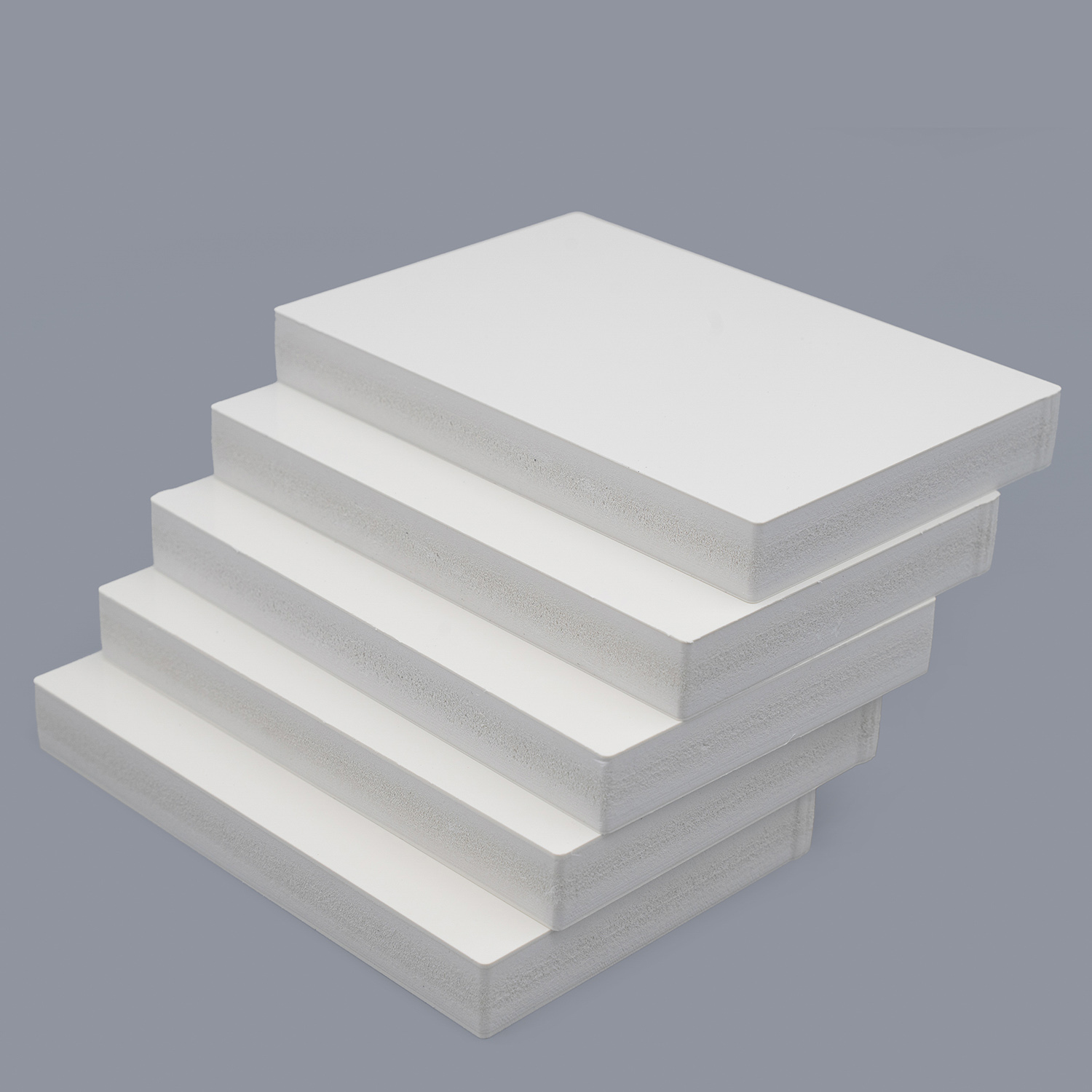
PVC foam board sheets: variant and thickness selection, not price per sheet, determines whether a board fits its application.
PVC foam board is rarely one product. Under a single generic name, suppliers ship free foam, Celuka, co-extruded and laminated variants that differ in thickness range, density and surface structure — differences that decide whether a board works as an outdoor sign face, a cabinet panel or an interior wall lining. Buyers who compare suppliers on unit price alone frequently end up comparing boards that were never interchangeable in the first place.
The global PVC foam board market was valued at approximately USD 2.1 billion in 2024 and is projected to reach USD 3.6 billion by 2032, according to Verified Market Research. Growth of that scale tends to flatten product distinctions in marketing language, which is precisely why a scenario-based fit analysis is more useful to a buyer than a product catalogue.
The Three Demand Centers in Numbers
Demand for PVC foam board is concentrated in three application clusters, and each cluster pushes the board in a different direction. Signage and advertising accounts for roughly 35% of application demand, according to Laird Plastics, making it the single largest consumption segment. Within the application profile published for the PVC Celuka foam board range, construction and decoration represents about 30%, furniture and cabinetry about 15%, transportation about 10%, and special-purpose uses such as packaging, prototyping and industrial protection the remaining 10%.
Those proportions matter at the purchasing stage. A buyer sourcing for a signage convertor and a buyer sourcing for a cabinet workshop are both buying PVC foam board, but they are optimising for different failure modes: print surface and flatness in the first case, dimensional stability and moisture performance in the second, and declared fire behaviour in the third.
Scenario Fit 1: Advertising and Signage
Signage fabrication is the segment where thin gauges and consistent surfaces matter most, and where the free foam variant enters. The PVC free foam board in the DINGTIAN range is produced in thicknesses from 1 mm to 5 mm and is positioned for advertising materials. Its role in the application profile is specific: it provides a lightweight rigid substrate for printing, which is why it is normally specified for printed panels rather than for load-bearing display structures.
For outdoor signage fabrication, the operating envelope is equally specific. The board operates under UV-stabilised conditions across a temperature range of −20°C to +60°C with 100% humidity resistance. Fabrication typically involves a cutting machine, a printing machine, nails and saws, and the sheet is thermoformed at 120–160°C where shaping is required.
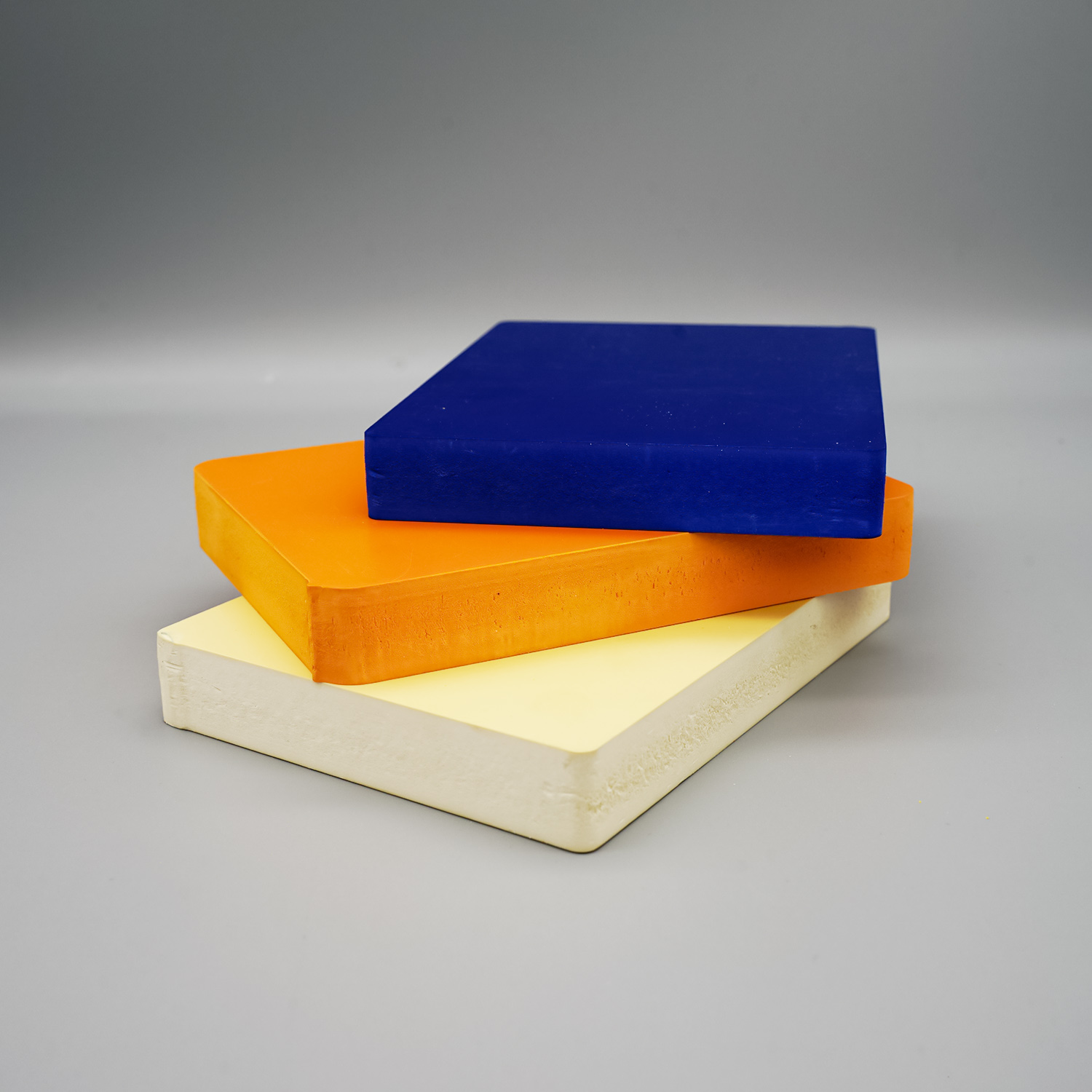
Colored PVC foam board: produced in 1–20 mm thickness for advertising and furniture and cabinet making applications.
Two further variants extend the signage range upward in rigidity. Colored PVC foam board is supplied in 1–20 mm thickness and is listed for advertising as well as furniture and cabinet making, which means a single board family can cover both a printed sign face and a coloured interior panel. Co-extruded PVC foam board, with a density of 0.5–0.8 g/cm³, is listed for advertising materials and furniture board and is the variant associated with a rigid PVC skin over a foamed core — a construction that provides higher surface hardness and impact resistance than standard Celuka board, according to Skyline Composites.
At the top of the thickness range sits the PVC Celuka foam board, available in 1–35 mm with densities of 0.4–0.9 g/cm³ and in sheet sizes of 1220×2440 mm, 1560×3050 mm and 2050×3050 mm. For large-format outdoor billboards, display panels and UV-printing substrates, that combination of thickness and format is what allows a single rigid panel to replace a multi-part assembly.
Scenario Fit 2: Furniture and Cabinetry
Furniture and cabinetry accounts for a smaller share of total demand but a disproportionate share of specification complexity, because the board is often visible and always handled. Three variants are confirmed for this segment. Laminated PVC foam board is produced in 5–20 mm and is listed for furniture and cabinet applications, including a wood-laminated finish. Waterproof PVC foam board covers 1–35 mm and is listed for furniture and cabinet use. Colored PVC foam board, again at 1–20 mm, is listed for furniture and cabinet making alongside its advertising role.
Within the Celuka range, the declared furniture applications are more granular: cabinet doors, wardrobes and bathroom vanities. That last item is the useful signal for buyers. A bathroom vanity is a wet-area application, and the board's rated performance is 100% humidity resistance with a waterproof function. Cabinetry buyers rarely need the full 35 mm range; they need the assurance that the grade they receive holds its geometry in a humid interior over years of use rather than months.
The practical boundary to respect here is thickness availability. Laminated PVC foam board starts at 5 mm — it is not offered in the thin gauges that define the free foam range. A specification written around a 3 mm decorative panel cannot be satisfied by the laminated variant, no matter how the supplier is selected.
Scenario Fit 3: Construction and Decoration
Construction and decoration is the segment where compliance requirements, not aesthetics, drive the purchase order. The confirmed role of the board in this scenario is to create waterproof building panels for commercial building interior renovation projects, operating in permanent static installation mode. That is a fundamentally different duty cycle from a sign face: the panel is fixed, it is not re-printed, and it has to satisfy a reviewer as well as a buyer.
The special requirements listed for this scenario are therefore explicit rather than optional: UV stabilisation for outdoor use, B1/B2 fire retardant rating, lead-free RoHS compliance, and anti-static ESD protection. A supplier can produce a board that performs well in the signage segment and still fail a construction specification if the fire rating is not declared and documented. In North America, PVC foam boards used in construction commonly undergo ASTM E84 testing to achieve a Class A fire rating, defined by a Flame Spread Index of 0 to 25, according to Laird Plastics. At product level, PVC foam board typically achieves a V-0 flammability classification under UL 94 standards for thicknesses down to 1 mm, per the Vinyl Institute.
Regulatory pressure on formulation is now part of the construction specification as well. EU REACH Regulation Annex XVII, Entry 63, restricts lead concentration in PVC articles to less than 0.1% by weight, effective 29 November 2024, as published by the European Commission and summarised by Intertek. For projects shipping into the EU, the lead-free requirement is a compliance condition rather than a marketing preference.
Technical Variables That Change Fit: Density, Thickness, Forming Window
Among the confirmed parameters, density is the variable most often ignored and most likely to change project outcomes. The Celuka range spans 0.4–0.9 g/cm³ within a single variant name, and the co-extruded range spans 0.5–0.8 g/cm³. A quotation that names the variant but not the density leaves the most important engineering choice open. Two boards with the same type label can differ by more than a factor of two in density, which affects weight, rigidity and how the finished part handles handling and installation loads.
Thickness interacts with density rather than replacing it. Free foam tops out at 5 mm; laminated starts at 5 mm; colored board spans 1–20 mm; the Celuka range spans 1–35 mm. The thermoforming window of 120–160°C applies where sheets are shaped, and it constrains both the tooling and the cycle time a fabricator can plan for. Because the finished installation is normally permanent and static, the value of getting density and thickness right at the ordering stage is high — corrections after installation are not economical.
Variant Fit Matrix
| Variant | Confirmed specification | Primary scenario fit | Boundary to respect |
|---|---|---|---|
| PVC free foam board | Thickness 1–5 mm | Advertising materials, printed panels | Thin-gauge only; not a structural or thick-panel option |
| PVC Celuka foam board | Thickness 1–35 mm; density 0.4–0.9 g/cm³; sizes 1220×2440, 1560×3050, 2050×3050 mm | Outdoor billboard, display panel, UV printing substrate; wall panel, ceiling, partition, formwork; cabinet door, wardrobe, bathroom vanity | Density must be specified per load; thermoforming window 120–160°C |
| PVC co-extruded foam board | Density 0.5–0.8 g/cm³ | Advertising materials, furniture board | Narrower density band than Celuka; select for surface hardness rather than for range |
| Laminated PVC foam board | Thickness 5–20 mm | Furniture and cabinet panels, including wood-laminated finishes | Not offered below 5 mm |
| Colored PVC foam board | Thickness 1–20 mm | Advertising, furniture and cabinet making | Colour choice should be fixed before ordering, since it is a production input |
| Waterproof PVC foam board | Thickness 1–35 mm | Furniture and cabinet use in humid interiors | Specify the grade where fire or UV performance is also required |
Where PVC Foam Board Replaces Conventional Substrates — and Where It Does Not
The clearest documented substitution effect comes from a distributor and wholesaler relationship covering advertising material and furniture material, running at 10 containers per month over a duration of 5–10 years. The reported outcomes in that programme include 98% print image retention after three years, zero warping or delamination, 100% waterproof performance, and a 40% cost saving compared with aluminium composite panel. The stated advantages behind those results are UV stabilisation for long-term outdoor exposure, lower installation cost through reduced weight, and straightforward fabrication and installation.
That is a strong result set, and it comes with boundaries that a careful buyer should read alongside it. First, the outcome is tied to a UV-stabilised grade; an unstabilised board is not the same product and should not be expected to deliver multi-year outdoor image retention. Second, the comparison baseline was aluminium composite panel in a specific signage and furniture material mix, so the 40% figure should not be transferred to a construction project with different compliance overheads. Third, the 120–160°C thermoforming window is a real processing constraint: fabricators without temperature-controlled forming equipment will not capture the same yields. Fourth, on the commercial side, the minimum order quantity is one 20 ft GP full container and the stated lead time is 30 days — parameters that suit container-scale buyers better than small trial purchasers.
Manufacturing Parameters Behind the Specification
Zibo Dingtian Plastics Co., Ltd. (DINGTIAN) is a PVC foam board manufacturer founded in June 2004 and based in the Zichuan Economic Development Zone, Zibo City, Shandong Province, China. The company operates a 30,000 m² plant with 181 employees, a 20-engineer R&D team and an annual output of 50,000 tons, with roughly 80% of production exported to markets including Southeast Asia, the Middle East, and South and North America.
For buyers whose specification depends on density or colour rather than a catalogue item, the relevant capability set is OEM and ODM production with customisation across size, thickness, density and colour. Monthly capacity is 4,200 tons, lead time is 30 days, quality control is described as 100% testing, and after-sales support is provided remotely. Those four parameters — customisation scope, capacity, lead time and inspection regime — are what convert a board variant into a repeatable supply programme rather than a one-off purchase.
Market and Regulatory Signals Buyers Should Track
Two structural signals sit behind present demand. China concentrated 20% of total exports of plastic building materials, including PVC boards, in 2024, maintaining its position as the largest exporter, according to the Observatory of Economic Complexity. On the regulatory side, the EU lead restriction on PVC articles that took effect on 29 November 2024 has moved lead-free formulation from a differentiator to a baseline expectation for European-facing projects. Both signals point in the same direction: documentation and formulation transparency increasingly determine whether a supplier qualifies, independently of price.
Future Outlook
If signage keeps its position as the largest application segment and construction holds roughly a third of demand, the boards that gain share are likely to be those with the narrowest, best-documented performance claims rather than the widest catalogue. Density-specific grades, declared fire classifications such as B1/B2 and ASTM E84 Class A, and lead-free compliance statements are becoming part of the purchasing specification rather than attachments to it. For buyers, the practical consequence is a shift in evaluation work: less time spent comparing variant names across suppliers, more time verifying the parameters printed behind those names — density, thickness, forming window, fire rating and formulation.
FAQ
What is the practical difference between PVC free foam board, Celuka foam board, co-extruded foam board and laminated PVC foam board?
The four variants differ mainly in thickness range, density and surface construction. PVC free foam board is produced in 1–5 mm and is used for advertising materials. PVC Celuka foam board spans 1–35 mm with densities of 0.4–0.9 g/cm³ and is used across signage, construction, furniture and transportation. PVC co-extruded foam board has a density of 0.5–0.8 g/cm³ and combines a rigid PVC skin with a foamed core, which provides higher surface hardness and impact resistance than standard Celuka board. Laminated PVC foam board is produced in 5–20 mm and is used for furniture and cabinet panels.
Which PVC foam board variant suits outdoor signage?
Outdoor signage fabrication uses board supplied in a UV-stabilised grade operating between −20°C and +60°C with 100% humidity resistance. Thin printed panels are typically produced from free foam board at 1–5 mm. Rigid outdoor display structures and large-format billboards use Celuka board in higher thicknesses, with sheet formats of 1220×2440 mm, 1560×3050 mm and 2050×3050 mm available. Where higher surface hardness is required, co-extruded board is the relevant option.
What sheet thicknesses are confirmed for each PVC foam board variant?
Confirmed thickness ranges are: PVC free foam board 1–5 mm; PVC Celuka foam board 1–35 mm; colored PVC foam board 1–20 mm; laminated PVC foam board 5–20 mm; waterproof PVC foam board 1–35 mm. The standard model size across the range is 1220×2440 mm, with the Celuka range additionally offered in 1560×3050 mm and 2050×3050 mm.
Can PVC foam board be used in wet areas such as bathroom vanities?
Yes. The declared furniture and cabinetry applications of the PVC Celuka foam board range include cabinet doors, wardrobes and bathroom vanities, and the board is rated for 100% humidity resistance. In construction and decoration, the confirmed role of the board is to create waterproof building panels for commercial building interior renovation. For wet-area use, the waterproof variant covering 1–35 mm is the appropriate grade to specify.
Which fire and compliance documents should a construction buyer verify?
The special requirements listed for construction and decoration applications are UV stabilisation for outdoor use, a B1/B2 fire retardant rating, lead-free RoHS compliance and anti-static ESD protection. Where ASTM E84 testing applies, boards used in construction commonly achieve a Class A fire rating defined by a Flame Spread Index of 0 to 25. PVC foam board typically achieves a V-0 flammability classification under UL 94 for thicknesses down to 1 mm. For the EU market, REACH Annex XVII Entry 63 restricts lead in PVC articles to less than 0.1% by weight with effect from 29 November 2024.
Can PVC foam board be thermoformed, and within what temperature window?
PVC foam board is thermoformed at 120–160°C. The finished panel is normally installed in permanent static mode, so the forming step is the main thermal process the board undergoes. Fabrication equipment typically includes cutting machines, printing machines, nails and saws. The 120–160°C window is a processing constraint, so fabricators without temperature-controlled forming capability may achieve different results.
What are the order and lead-time parameters for customized PVC foam board?
DINGTIAN produces on an OEM and ODM basis with customisation available across size, thickness, density and colour. Monthly capacity is 4,200 tons, lead time is 30 days, and the minimum order quantity is one 20 ft GP full container. Quality control is described as 100% testing, and after-sales support is provided remotely.
Reference material: the DINGTIAN company brochure can be downloaded here. Product data referenced in this analysis reflects confirmed specifications for the PVC Celuka foam board range and related variants; buyers should confirm density, thickness and compliance documents against the specific grade ordered.