
PVC Lamination Film: Reading Specs and SGS Test Reports
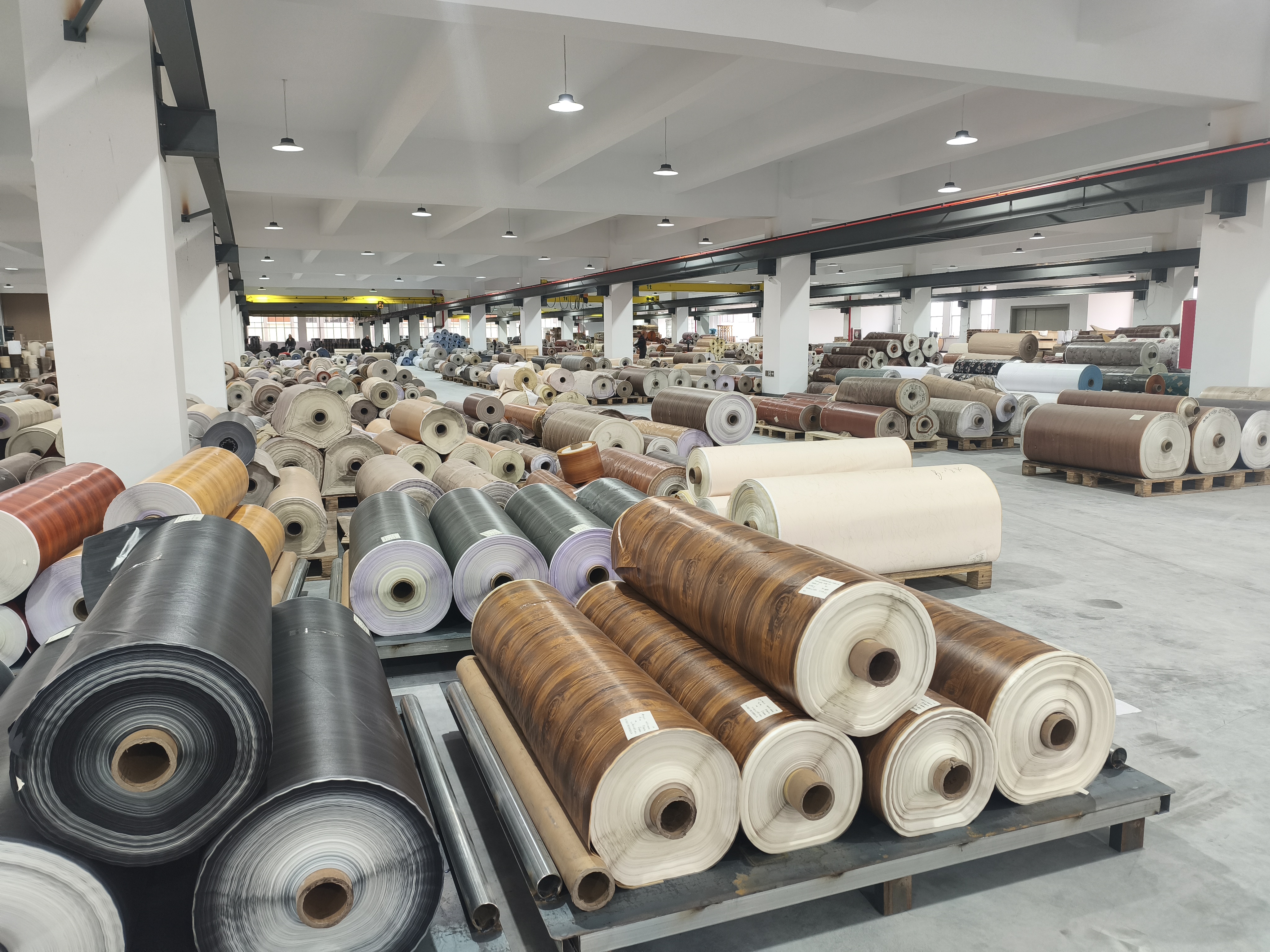
PVC lamination film is supplied by the roll and specified by thickness, width, surface finish and adhesive system.
PVC lamination film is a thin decorative surfacing material made from polyvinyl chloride and applied to panels, profiles and sheet substrates so that they present a wood, marble or metallic face without solid timber or stone. It is traded by the roll, specified by thickness, width, surface finish and adhesive system, and judged in the end by how it behaves on the buyer's own substrate and production line.
For buyers in the research and evaluation stage, the material itself is rarely the obstacle. The obstacle is specification. Two suppliers can both quote “PVC film” while offering constructions that are not interchangeable — one built for flat lamination, one for profile wrapping, one self-adhesive, one intended for vacuum forming. The useful question is therefore not which film is “best”, but which construction, supported by which documentation, fits a defined substrate and a defined destination market.
This industry reference approaches PVC lamination film as a constraint problem. It sets out the specification fields that should be closed before an order is placed, the third-party test documentation that supports a performance claim, the applications where the material fits comfortably, and the limits that remain even when the price looks attractive. XHDeco — the trade name of Haining Xihe Decoration Material Co., Ltd. — is used as a documented reference case, alongside published market and supplier data.
Why a generic PVC film enquiry creates rework
Most sourcing problems in this category begin with an incomplete enquiry. A buyer asks for “PVC lamination film, wood grain, best price” and receives quotations that look comparable on a spreadsheet but describe different products. Thickness, substrate compatibility, adhesive route and surface finish are treated as variables by suppliers, and those variables are not independent of each other.
Published supplier specifications show how wide the field is. One supplier lists decorative PVC lamination film at 0.12 mm to 0.45 mm in thickness, at widths of 1220 mm and 1260 mm, with roll lengths from 100 m to 400 m and finishes described as high gloss, matte, super matte and soft-touch. The same source publishes an 80 µm super-gloss UV-cut lamination film with acrylic adhesive, a cold-lamination floor-graphic film at 0.18 mm to 0.22 mm, and, on a separate page, clear rigid PVC film from 0.08 mm to 0.80 mm. These are different products serving different processes, and they should not be averaged into a single “industry thickness”. Thickness becomes comparable only within the same application, construction, adhesive system and test method.
Adhesive selection is part of the specification rather than an afterthought. Supplier technical pages list PVA glue for cold lamination, PUR glue for hot lamination, and pressure-sensitive adhesives, and note that the choice depends on the substrate, the lamination process and the application requirement. A film qualified for one route is not automatically qualified for another, which is why a bonding trial belongs in the qualification plan rather than after the container ships.
For procurement purposes, a complete PVC lamination film enquiry should close at least the following fields:
- Substrate — PVC panel, SPC, plywood, MDF, WPC, aluminium or another sheet material.
- Lamination route — flat lamination, profile wrapping, vacuum forming or self-adhesive application.
- Thickness — stated and compared only within the same application and construction.
- Surface finish — gloss level, texture and colour series.
- Roll dimensions — width, length and core specification.
- Documentation — the test evidence required by the destination market.
When these fields are left open, a sample can pass a visual check and still fail in production. Closing them early is cheaper than discovering the mismatch at the lamination line.
What XHDeco supplies, and how the film is specified
XHDeco is the trading name of Haining Xihe Decoration Material Co., Ltd., a decorative materials manufacturer based in Haining, Zhejiang, China — a well-established base for decorative building materials — founded in 2016. The company operates a 6,000 m² factory with around 50 employees and an eight-engineer research and development team, and exports approximately 70% of its output, mainly to Southeast Asia (Indonesia, Philippines and Malaysia), as well as the Middle East and South America. Its product range covers PVC interior wall and ceiling panels, ASA co-extruded exterior cladding, PVC decorative lamination film, WPC panels and decorative mouldings.
Within that range, the PVC lamination film is the item most relevant to buyers who surface panels rather than install them. The stated specification is compact and explicit:
| Specification field | Stated detail |
|---|---|
| Product name | PVC film |
| Model | LD-60139-9 |
| Type | Lamination film, PVC foil |
| Primary material | PVC |
| Thickness | 0.1 mm |
| Roll length | 700 m |
| Colour series | Wooden, marble and golden series |
The film is offered across wooden, marble and golden series rather than as a single pattern, which matters to buyers who need one supplier to cover several catalogue SKUs. Alongside the product specification, the stated production and commercial terms define the operating envelope of the offer:
| Capability | Stated position |
|---|---|
| Production mode | ODM |
| Customisation | Customer-owned designs supported with intellectual property claims; custom finishes and dimensions subject to confirmation |
| Monthly capacity | Around 50 × 40HQ containers |
| Lead time | 15–20 days |
| Minimum order | One container (stated as 1×20GP); mixed colours and profiles accepted in one container; trial orders negotiable |
| Quality control | Internal control, supported by SGS test reports as third-party evidence |
| After-sales | Remote technical support |
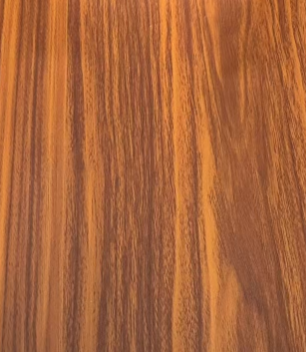
Wooden-series decorative PVC film from the supplier's surface range.
Read together, these terms describe a supplier built for container-scale volume rather than single-roll retail supply. That is a constraint as much as a capability: distributors, wholesalers and OEM buyers fit the model well, while a project that needs a few hundred metres for a pilot line has to negotiate rather than order off the shelf.
What the SGS documentation actually states
The evidentiary backbone of the offer is a third-party test report issued by SGS, not a self-declared technical statement. Its identifying details are specific enough to be checked against the issuing laboratory.
| Document element | Detail |
|---|---|
| Issuing authority | SGS |
| Document type | Third-party test report |
| Report number | GZIN2512002264CM01_EN |
| Issue date | 2025-12-17 |
| Scope | Adhesive sheet and PVC lamination decorative film |
| Applies to | The PVC film product and model LD-60139-9 |
| Standards referenced | EN 13329-2023, ISO 24338:2022, ASTM D870-15, EN 12149:1997 |
| Markets covered | EU, North America, Latin America, Middle East, Southeast Asia, Australia, Japan and Korea |
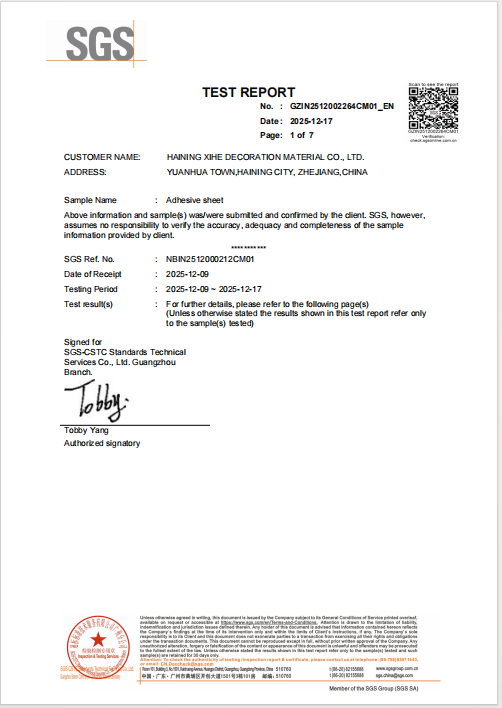
SGS test report documentation covering adhesive sheet and PVC lamination decorative film (report number GZIN2512002264CM01_EN).
The four references are not decorative. ISO 24338:2022 is identified as the reference standard for abrasion testing of this film; ASTM D870-15 as the reference standard for water immersion testing; and EN 12149:1997 as the reference standard for migration testing, with EN 13329-2023 listed as the applicable standard. In other words, the report addresses three questions buyers ask most often — how the surface resists wear, how it behaves under water immersion, and whether substances migrate from the material — under defined test methods rather than under a supplier's description.
Two further points are documented rather than implied. PVC is stated as the primary material of the film, and formaldehyde-related and fire-related testing documentation is stated as available for the product. Both matter in specification review where indoor air quality and reaction-to-fire performance are raised at tender stage.
The boundary of the documentation is equally important. A test report that references a standard is evidence of testing within a described scope; it is not a blanket approval of every film construction, substrate or installation condition. The company states that fire resistance and formaldehyde safety should be checked against the SGS test reports, and that exact grades and suitable environments need to be confirmed with the customer. A buyer on a regulated project should map the report scope to the project specification — substrate, lamination route and destination market included — before treating the document as a pass.
Where PVC lamination film fits in practice
The application profile for this material is broad but not unlimited. It is used in building decoration and interior finishing, and in some exterior wall decoration, across residential interiors, commercial spaces, hotels, retail fit-outs and renovation projects. Functionally, it acts as a decorative wall and ceiling covering, providing surface decoration and protection at the same time.
Installation is fixed rather than loose-laid: either adhesive bonding or fastening with stainless steel buckles and screws. That makes the matching accessory set — buckles, screws and adhesive sheets — part of the purchase rather than a separate afterthought. The material is positioned as suitable for normal indoor conditions, with some exterior wall use, and fire resistance and formaldehyde safety are flagged as items to be verified against the SGS test reports before a specification is locked.
Substrate range is where buyers should be most careful. Published supplier application lists for PVC lamination film include PVC laminate sheet, SPC, bamboo charcoal fibre panel, carbon crystal panel, acrylic sheet, aluminium or GI sheet, plywood, MDF and WPC. Those substrates differ in surface energy, porosity and heat sensitivity, and they do not all accept the same adhesive system or the same film thickness. A supplier's application list is a starting point for sampling, not a guarantee of adhesion on every board a buyer might run.
The practical rule is narrow and useful: select the film construction for the substrate and the process first, then confirm the finish and colour series second. Reversing that order is how a project ends up with an attractive pattern that will not wrap a profile.
Market context: growth in Asia-Pacific, scrutiny on documents
Published research places the global lamination films market — covering PVC, PET and BOPP films — at USD 6,842.11 million in 2024, with a projected value of USD 11,630.04 million by 2032 (DataM Intelligence, 2025). Asia-Pacific accounted for 36.87% of lamination film revenue in 2024, the largest regional share. On the demand side, one industry source estimates that PVC wall panels reached 1.35 billion square feet installed globally in 2023, a figure describing the downstream surface area into which decorative films feed.
Price references in this category need careful handling. One published figure puts the average selling price of PVC film laminated metal sheets at approximately USD 1,312 per tonne in 2025 — a different product segment from decorative panel film, and therefore useful only as directional context, not as a benchmark for a decorative film quotation. Comparable pricing requires the same construction, the same Incoterms and the same order scale.
The structural trend that matters to buyers is not the headline growth rate but the shift in what procurement teams ask for. Because decorative film is a thin, specification-dependent input, the qualifying conversation increasingly moves to documentation: which standard was referenced, which laboratory issued the report, which product model and scope it covers, and which markets it is intended for. Suppliers who can answer those questions in writing shorten the evaluation cycle; those who cannot push buyers back into sample rounds.
PVC lamination film compared with traditional finishing routes
Decorative film is one of several ways to give a panel a finished surface, and the comparison is a matter of process fit rather than a ranking.
| Finishing route | Typical strengths | Typical constraints |
|---|---|---|
| PVC lamination film (roll) | Continuous roll supply; wide pattern and colour range; suits flat lamination, profile wrapping and vacuum forming; light material handling | Requires a compatible substrate and adhesive system; performance depends on the specified construction; documentation must match the destination market |
| Liquid coating or paint | Covers complex geometry and edges without a film seam; single-step surface treatment | Requires curing or drying time; solvent handling and ventilation; finish uniformity depends on application |
| Timber veneer | Natural grain appearance with material depth | Natural variation between sheets; moisture sensitivity; higher material cost |
| Decorative laminate sheet | Hard, flat surface with established wear performance | Rigid sheet form is less suited to curved profiles; separate edge treatment needed |
The comparison is not settled by appearance. Roll film wins where continuous coverage, pattern consistency across large areas and profile wrapping matter; paint wins where geometry is complex and seams are unacceptable; veneer wins where natural material character is the specification.
Limits that do not disappear at a good price
At least three boundaries apply to PVC lamination film regardless of supplier. First, thickness is not a cross-application benchmark. A 0.1 mm decorative film, a 0.12–0.45 mm decorative range published by another supplier, and a 0.08–0.80 mm clear rigid film belong to different constructions, and comparing them without matching application, adhesive system and test method produces a meaningless number. The stated 0.1 mm thickness of this film should be evaluated against the buyer's own substrate and process, not against an unrelated product's data sheet.
Second, fire and formaldehyde performance is project-specific. The documentation states that formaldehyde-related and fire-related testing material is available and directs buyers to the SGS test reports, with exact grades and suitable environments to be confirmed — which means the responsibility to match a grade to a building code, a ceiling void or an exterior elevation stays with the buyer.
Third, order scale is a real constraint. A one-container minimum, even with mixed colours and profiles accepted inside that container and trial orders described as negotiable, is a different commercial model from buying a single roll. Buyers running small or highly customised programmes should treat this as a fit question rather than a defect.
What to expect next
Three directions look reasonable on the current evidence. Documentation-first procurement is likely to keep spreading, because decorative film is difficult to judge visually and comparatively easy to compare on paper once report numbers, scopes and standards are stated up front. Substrate-specific film portfolios are likely to deepen, since the substrate list for lamination film already spans PVC, SPC, plywood, MDF, WPC and metal sheet, and each substrate pushes film construction in a different direction. Supply concentration in Asia-Pacific is likely to persist while the region holds the largest share of lamination film revenue.
For buyers, the implication is unglamorous but durable: the specification sheet, the test report and the sample line up or they do not. A supplier that treats all three as one package is easier to qualify — and easier to keep — than one that treats them as separate negotiations.
FAQ
What does the SGS test report for this PVC film cover?
The document is a third-party test report issued by SGS under report number GZIN2512002264CM01_EN, dated 2025-12-17. Its stated scope covers adhesive sheet and PVC lamination decorative film, and it applies to the PVC film product and to model LD-60139-9. The report number is stated as traceable to SGS.
Which standards does the report reference, and what does each one address?
Four standards are referenced: EN 13329-2023 as the applicable standard; ISO 24338:2022 as the reference standard for abrasion testing of this film; ASTM D870-15 as the reference standard for water immersion testing; and EN 12149:1997 as the reference standard for migration testing.
Which markets is the certification intended for?
The documentation states application to the EU market, the North America market, the Latin America market, the Middle East market, the Southeast Asia market, the Australia market, and the Japan and Korea market.
What should a buyer confirm before ordering PVC lamination film?
At minimum: the substrate, the lamination route, the film thickness, the surface finish and colour series, the roll dimensions, and the documentation required by the destination market. For this product the stated specification is a 0.1 mm PVC film in 700 m rolls across wooden, marble and golden series. Thickness should only be compared within the same application, construction, adhesive system and test method, because published thickness ranges across decorative, UV-cut, floor-graphic and clear rigid films are not interchangeable.
What are the stated minimum order quantity and lead time?
The minimum order is stated as one container, given as 1×20GP, with mixed colours and profiles accepted within a single container and trial orders described as negotiable. Lead time is stated as 15–20 days against a monthly capacity of around 50 × 40HQ containers.
Can the film be used in humid interior areas or on exterior walls?
The material is described as lightweight and waterproof, with moisture-proof and wear-resistant performance, suited to normal indoor conditions and to some exterior wall use. Installation is fixed by adhesive bonding or by stainless steel buckles and screws, with adhesive sheets and other accessories matched to the installation method. Fire resistance and formaldehyde safety should be checked against the SGS test reports before specification, and exact grades and suitable environments need to be confirmed with the manufacturer.
Company profile and full product documentation: Xihe Company Profile (PDF).
Есть вопросы или нужны дополнительные детали?
Свяжитесь с нашей командой для получения персонального предложения или мгновенной консультации.
Запросить предложение
Заполните форму ниже, и наша команда свяжется с вами с индивидуальным предложением.
Прямой чат WhatsApp
Предпочитаете общаться в реальном времени? Напишите нам в WhatsApp для мгновенной помощи и быстрых ответов.
- Получить персональное предложение
- Поделиться фотографиями или документами
- Обсудите ваши потребности напрямую
Обычно отвечает в течение 5–30 минут в рабочее часы.