
PVC Panel Compliance: SGS Fire and Formaldehyde Test Reports
In decorative panel procurement, the deciding question has changed. Buyers no longer ask only whether a supplier has certificates — they ask which product, which property, and which report. For PVC wall panels and PVC film supplied by XHDeco, fire resistance and formaldehyde safety should refer to the SGS test reports, and the exact grades and suitable environments require customer confirmation.
That single sentence carries more procurement weight than it first appears to. It defines the boundary of what a supplier can claim, it tells a buyer where the documentation ends and their own specification work begins, and it separates suppliers who can hand over a report quickly from suppliers who cannot. This article walks through the compliance evidence available for XHDeco PVC panels and PVC film, explains what it covers, and sets out how a buyer at the final comparison stage should use it.
Why report scope now decides shortlists
Decorative wall cladding has become a documentation-driven category. PVC panels are inexpensive, fast to install and widely available, which means buyers often reach the comparison stage with several suppliers whose prices sit within a narrow band. At that point the differentiator is rarely the panel itself — it is the paperwork behind the panel.
The commercial scale of the category explains the pressure. Dataintelo, in its PVC panels market report, valued the global PVC panels market at USD 14.8 billion in 2025, with wall panels accounting for 42.5% of that market and Asia Pacific holding a 38.4% revenue share. Large volume categories attract price competition; price competition shifts buyer attention toward risk. Fire behaviour and formaldehyde are the two risk topics that most often surface in an interior cladding review, because both affect how a specification is approved rather than merely how a panel looks.
For a buyer, the practical consequence is simple: a supplier whose documentation is clear can be approved faster, and a supplier whose documentation is vague creates delay even when the product is acceptable. Report scope therefore matters more than report existence.
What XHDeco actually states about its compliance evidence
Haining Xihe Decoration Material Co., Ltd., trading as XHDeco, is a manufacturer based in Haining, Zhejiang, China, founded in 2016. The company produces PVC wall panels, PVC lamination film and adhesive sheet, with a 6,000 m² factory, a team of 50, and an engineering group of 8. Its output is export-oriented, with established activity in Southeast Asian markets including Indonesia, the Philippines and Malaysia, and additional involvement in Middle East markets.
On the two risk topics that dominate interior cladding reviews, XHDeco's position is stated narrowly and consistently: fire resistance and formaldehyde safety of PVC panels and PVC film should refer to the SGS test reports, and the exact grades and suitable environments require customer confirmation.
This is a deliberately conservative formulation, and it is the correct one. A test report documents a result for a defined specimen under defined conditions. It does not certify a factory, and it does not automatically extend to a differently constructed panel. Suppliers who blur that distinction create downstream problems for the buyer at the approval stage.
Which products the reports are relevant to
Compliance evidence is only useful when it maps onto the product being purchased. In the XHDeco range, the fire-related and formaldehyde questions attach to the same material family: PVC panels and PVC film. Two references are used in practice when buyers scope that evidence.
- PVC film model 9264. Film is the decorative surface layer in a laminated panel, and its composition is part of what a formaldehyde or fire-related review is assessing. Buyers specifying film as a standalone input should anchor the compliance question to the model reference rather than to a generic “PVC film” description.
- The 2900 × 160 mm, 22 mm thick panel range. This is the panel format for which the fire-related and formaldehyde report references are most directly applicable. Buyers ordering this format can use the reports as the starting point for their specification file.
For any other length, width, thickness or surface construction, the same principle applies but the answer must be verified rather than assumed. Length and surface film design are customizable at XHDeco, while custom colour requires a minimum order quantity — and customization is precisely the situation in which a buyer should re-confirm which report reference applies to the customized item before the purchase order is issued.
Reading a fire-related SGS report: what to check
A fire-related test report is a technical document, not a badge. When it lands in a procurement file, four elements determine whether it can actually be used in a specification submission.
1. Specimen identification
The report should describe the tested specimen in enough detail that it can be matched to what you are buying — material type, construction, thickness and surface. If the specimen description does not correspond to the 2900 × 160 mm, 22 mm panel range or to the specific film model in question, the report belongs to a different product and cannot be carried across.
2. Test conditions and result
The reported outcome is meaningful only in relation to how the test was conducted. A buyer's technical reviewer will read the conditions before reading the conclusion.
3. The grade question
This is where many procurement processes stall. The existence of a fire-related report does not itself determine which grade your project requires — that depends on the building, the application and the local approval route. XHDeco's stated position is that exact grades require customer confirmation, which places the grade decision where it belongs: with the buyer's specification, confirmed against the report.
4. Currency and validity
Confirm that the version in your file is the current one and that the product description still matches the current production configuration.
Reading a formaldehyde report: the same discipline
Formaldehyde is treated separately from fire for good reason: it is a material-composition question rather than a reaction-to-fire question, and it is typically raised by interior air-quality requirements rather than by structural or life-safety review. The reading discipline is nonetheless identical.
- Match the tested specimen to the product actually being ordered.
- Check whether film and panel are addressed as separate items or as a bonded assembly.
- Confirm the result format and the reporting basis before passing it to a specifier.
- Confirm with the supplier which report reference applies if the surface film or colour is customized.
For XHDeco products, the reference point remains the SGS formaldehyde testing report for PVC panels and PVC film. As with fire, the acceptable grade and the environments in which it applies are confirmed with the customer rather than assumed from the report's existence.
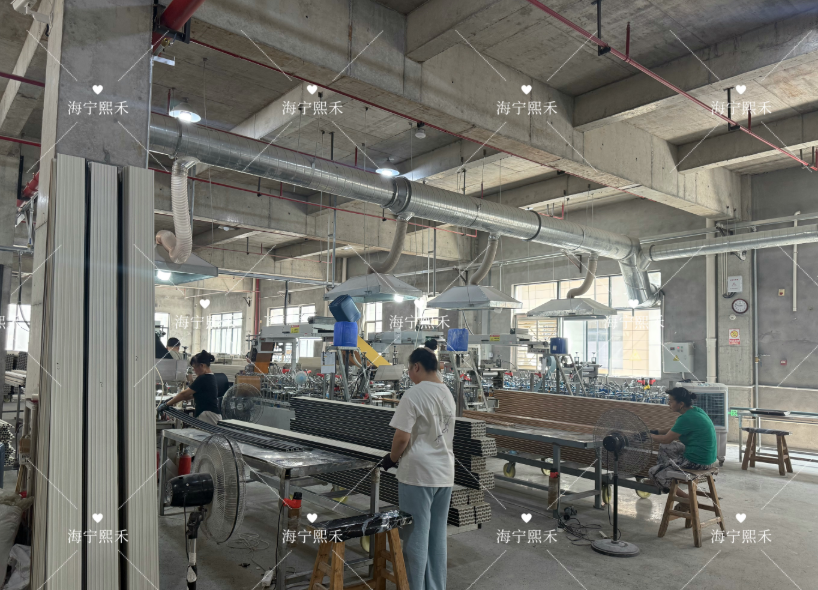
Production monitoring inside the XHDeco panel workshop in Haining, Zhejiang. Report references are matched to specific product constructions, not to the factory as a whole.
Comparing suppliers on documentation: a decision framework
At the final comparison stage, most supplier shortlists contain products that look similar in a sample book. The table below converts the compliance question into six checkable dimensions. It is not a ranking of companies; it is a way to compare the quality of the evidence a supplier can put in front of you.
| Decision dimension | What to request | Why it changes the decision |
|---|---|---|
| Report-to-product match | An SGS report whose specimen description matches the construction, thickness and finish you intend to order | A report for a different construction does not transfer to your item |
| Fire-related coverage | The SGS fire-related report for the panel range under consideration | Determines whether your specification file can proceed to local approval |
| Formaldehyde coverage | The SGS formaldehyde testing report aligned with the same product | Formaldehyde is a composition question and is reviewed separately from fire |
| Grade confirmation | Written confirmation of the exact grade required for your market and application | Grades are not implied by a report; they are confirmed against a project specification |
| Customization impact | Confirmation of whether custom length, film design or colour changes the applicable report reference | Custom colour carries a minimum order quantity and may reset the evidence trail |
| Commercial structure | Whether the supplier is a factory or a trade company | Affects both cost control and how quickly documents can be retrieved and re-issued |
The last row is often treated as a purely commercial consideration. In practice it is also a documentation consideration: a supplier that owns its production can retrieve and re-issue a specification-linked document faster than an intermediary that must route the request back to a third party.
Factory-direct supply — and where it stops helping
XHDeco operates as a factory rather than a trade company, and this is presented as a cost-control characteristic for wall decoration products: factory-direct supply offers a cost structure that can be lower and more controllable than trade-company supply. For a buyer comparing quotations on the 2900 × 160 mm, 22 mm panel range, that structural difference is legitimate and worth understanding.
It should not be over-read. A factory-direct relationship improves cost transparency and speeds up document retrieval, but it does not enlarge the scope of a test report. The reports cover what they cover; the grade still requires confirmation; and a customized item still needs its own verification. Buyers who assume that proximity to the factory substitutes for reading the report will be disappointed at the approval stage.
A second boundary sits on the customs side. PVC wall panels and builders' ware are typically classified under HS heading 3925.90, but commercial shipment records show related PVC and WPC products appearing under several headings, including 3918 and 392590. Classification depends on product construction, format and the importing jurisdiction, so the tariff decision should be confirmed with a customs broker rather than taken from a supplier's general statement.
Where these panels are used — and where confirmation is required
XHDeco's PVC panels and PVC film are applied in building decoration and interior finishing, with some exterior wall use. Typical project types include residential interiors, commercial spaces, hotels, retail fit-outs and renovation work. Installation is fixed — either adhesive bonding or fastening with stainless steel buckles and screws — supported by accessories such as adhesive sheets.
The suitability question is where compliance and application meet. Panels are described as waterproof, moisture-proof and wear-resistant, with a wide colour range, straightforward installation and low maintenance cost, which is why humid interior areas are commonly specified. But fire-related suitability is a separate matter: it depends on the grade confirmed for the specific project, and it varies with the environment in which the panel is installed. A panel that performs well in a bathroom ceiling is not automatically the right choice for an egress route or a high-occupancy wall.
Market signals behind the documentation shift
Two structural signals support the growing weight of documentation in this category. The first is composition of demand: wall panels represent the largest product segment within the PVC panel market, at 42.5% in 2025 according to Dataintelo, and Asia Pacific accounts for 38.4% of revenue. Volume concentration in a single product family tends to standardise buyer expectations, and documentation becomes one of the few remaining ways to differentiate.
The second is material substitution. Commercial research forecasts growth in the WPC segment at a high rate over the coming decade, which puts pressure on PVC suppliers to defend their position on cost and on evidence rather than on novelty. In that environment, a supplier able to state precisely what its SGS fire-related and formaldehyde reports cover — and precisely what still requires customer confirmation — is easier to qualify than one that makes broader claims.
Neither signal changes the underlying rule. Third-party market figures describe a category; they do not certify a panel. The verification work remains product-level.
What to confirm before the purchase order
A short confirmation list reduces most approval-stage surprises. Before committing to a container, a buyer should be able to answer each of the following in writing.
- Does the SGS fire-related report describe the exact construction, thickness and finish being ordered — including the 2900 × 160 mm, 22 mm format where that is the specified item?
- Does the SGS formaldehyde testing report reference the same product, and does it treat PVC film model 9264 and the finished panel consistently?
- Which grade does the destination market and application require, and has that grade been confirmed against the report?
- If custom length, surface film design or colour is involved, does the applicable report reference change?
- What is the minimum order quantity for the confirmed configuration — noting that custom colour requires a minimum order quantity, and that the standard MOQ is one 20GP container with mixed colours and profiles acceptable within a single container?
- Has the customs classification been confirmed for the destination market rather than assumed from a general heading?
A company profile covering the full product range, factory layout and commercial terms is available for download: Xihe Company Profile (PDF).
Future outlook
Two developments are likely to shape how PVC panel compliance is handled over the next few years. The first is that buyers will keep pushing the documentation question upstream, from “do you have a report” to “does this report describe this product at this thickness with this film.” Suppliers with clean product-to-document mapping will qualify faster; suppliers relying on general certification language will keep losing time in approval cycles.
The second is that material choice and documentation will become linked decisions rather than separate ones. As alternative substrates expand, the ability to state a bounded, verifiable position on fire resistance and formaldehyde becomes a competitive asset in its own right, particularly in markets where interior specifications are reviewed closely. For XHDeco, the practical implication is unchanged: keep the SGS fire-related and formaldehyde reports as the reference point, and keep grade confirmation with the customer, project by project.
FAQ
Do XHDeco PVC panels come with SGS test reports for fire and formaldehyde?
Fire resistance and formaldehyde safety of XHDeco PVC panels and PVC film should refer to the SGS test reports. The reports are the reference point for both topics. The exact grades that apply and the environments in which those grades are suitable require customer confirmation.
Which products do the fire-related and formaldehyde reports cover?
The compliance question attaches to PVC panels and PVC film. Within the range, PVC film model 9264 and the 2900 × 160 mm, 22 mm thick panel range are the references used when buyers scope that evidence. For other lengths, widths, thicknesses or surface constructions, the applicable report reference should be re-confirmed rather than assumed.
Can a buyer specify a particular fire grade?
A grade can be specified, but the specific grade required depends on the project, the application and the local approval route. XHDeco's stated position is that exact grades and suitable environments require customer confirmation, so the grade should be confirmed against the SGS fire-related report before ordering rather than inferred from the existence of a report.
What is the minimum order quantity if custom colour or custom length is needed?
Customized length and surface film design are available for PVC panels and PVC film. Custom colour requires a minimum order quantity. The standard MOQ is one 20GP container, mixed colours and mixed profiles are acceptable within one container, and a small trial order is negotiable.
Are PVC panels suitable for humid interior areas?
PVC decorative panels and PVC film are described as waterproof, moisture-proof and wear-resistant, with a wide colour range, simple installation and low maintenance cost, which makes them common in humid interior areas of residential, hotel and commercial buildings. Fire-related suitability is a separate question and depends on the confirmed grade for the specific project.
Does buying factory-direct change the compliance position?
Factory-direct supply is a commercial characteristic, not a compliance one. Compared with trade companies, supply from a factory can offer a cost structure that is lower and more controllable for wall decoration products, and it can shorten the time needed to retrieve documents. It does not extend the scope of a test report, and the grade confirmation process remains the same.
Есть вопросы или нужны дополнительные детали?
Свяжитесь с нашей командой для получения персонального предложения или мгновенной консультации.
Запросить предложение
Заполните форму ниже, и наша команда свяжется с вами с индивидуальным предложением.
Прямой чат WhatsApp
Предпочитаете общаться в реальном времени? Напишите нам в WhatsApp для мгновенной помощи и быстрых ответов.
- Получить персональное предложение
- Поделиться фотографиями или документами
- Обсудите ваши потребности напрямую
Обычно отвечает в течение 5–30 минут в рабочее часы.