
PVC Vinyl FAQ: 12 Questions Before You Qualify a Supplier
Most PVC vinyl material projects are not lost on price. They are lost at the specification stage — where a K value is compared against a paste viscosity, a freezing point is treated as a process limit, or a REACH statement is accepted as proof of finished-article compliance. The qualification decision that follows is built on the wrong reading of the sheet.
This reference is structured as a numbered question set rather than a narrative. It collects the twelve technical and purchasing questions that most often surface between first sample request and supplier approval, and answers each against documented product data. The reference peer set is BASF, Eastman and Kaneka. Guangdong Baoshan Trading Co., Ltd, a Dongguan-based distributor of PVC vinyl materials established in 1994, appears where the question concerns distribution, documentation or supply position rather than polymer chemistry.
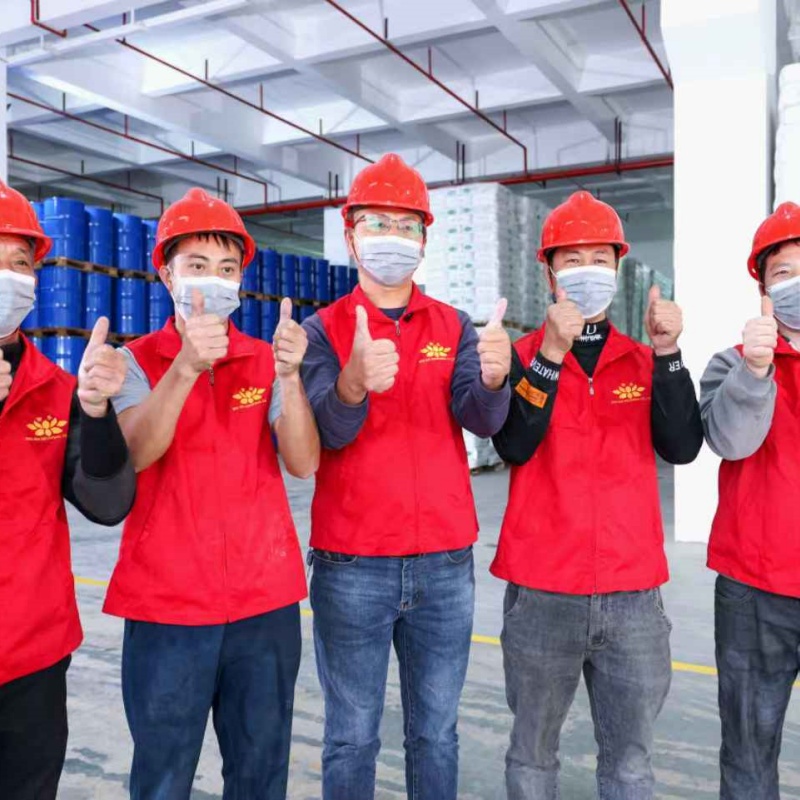
PVC vinyl work runs in heating processing and continuous production mode, feeding rotomolding machines, dripping machines, glue dispensers and PVC coating equipment downstream.
Part 1 — Reading the resin data sheet
1. Does reading a K value actually tell you anything useful?
A K value is an indirect measure of molecular weight, derived from the viscosity of a dilute PVC solution in cyclohexanone. It is not a grade name and not a performance rating. Two grades sharing a K value behave similarly in solution, and usually similarly in a plastisol, because the polymer chain length is comparable.
The practical range is what matters. BJ-65 blending resin carries a K value of 65, corresponding to a degree of polymerization of approximately 1,000 — a medium molecular weight grade positioned for viscosity reduction and matte finishing in slush-molded toys, artificial leather, vinyl flooring and automotive underbody coatings. At the other end of the range, Formosa Plastics PR-G is specified at K 77.5–81.0 with a degree of polymerization of 1,700±100, and KANEVINYL PASTE SH-14 at K 77 with a degree of polymerization of 1,700. Higher K generally means higher tensile strength, better tear resistance and greater plasticizer demand, with a correspondingly higher paste viscosity and a narrower processing window.
Two cautions follow. First, K value alone does not predict paste viscosity: PR-G reaches 2,000–3,000 mPa·s at K 77.5–81.0 because its particle morphology differs, while Kaneka PSM-31 sits near 3,500 mPa·s at K 72, and KANEVINYL PASTE EH-251 reaches a typical 5,500 mPa·s at K 76 through high thixotropy. Second, blending resins and paste resins are not interchangeable at equal K: BJ-65 at K 65 and Hanwha Ningbo HG-1000F suspension resin at K 66–68 serve fundamentally different processes.
2. What do particle size and apparent density change in practice?
Average particle diameter and apparent density describe how a powder behaves before it ever becomes a solid. BJ-65 is a medium powder with an average particle diameter of 20–40 μm and an apparent density of 0.45–0.52 g/cm³, markedly denser than micro-suspension paste resins: PR-G is specified at 0.30±0.05 g/cm³, Kaneka PSM-31 at approximately 0.30 g/cm³ and LF-51 at 0.30–0.33 g/cm³.
That gap has procurement consequences. A denser powder feeds and conveys more predictably, generates less dust and occupies less storage volume per tonne, which matters when a line consumes hundreds of kilograms per shift. Particle size governs dispersion mechanism: KANEVINYL PASTE EH-251 is specified at roughly 0.2–0.5 μm and disperses at the particle level to control film formation and thixotropy, while a 20–40 μm blending resin disperses as discrete domains and mainly governs paste viscosity and surface matteness. 266EF, a suspension-polymerised extender homopolymer at K 66 with apparent density of approximately 0.55–0.60 g/cm³, sits in the same functional family as BJ-65 and SB-100C — 20 μm average particle size, K 62–67 — delivering viscosity reduction and a uniform matt finish.
Apparent density also affects plasticizer absorption. A low-density paste resin wets out quickly but can demand more plasticizer to reach a workable viscosity; a higher-density blending resin absorbs less at room temperature. Neither figure is good or bad in isolation. They must be balanced against the target paste viscosity and the mixing equipment on the line.
3. Which volatile and residual monomer figures belong in a qualification file?
Volatile matter and residual vinyl chloride monomer are the two figures that separate a general-purpose grade from a sensitive-application grade. BJ-65 is specified at ≤0.4% volatiles and ≤5 ppm residual VCM; 266EF at ≤0.30% volatiles and ≤1.0 ppm; HG-1000F at ≤0.30% and ≤1.0 ppm. PR-G carries ≤0.5% volatiles with ≤5 ppm residual VCM, while Kaneka PSM-31 and PSH-10S are specified at ≤0.8% volatiles.
Volatiles become voids. In a slush-molded part, moisture and light organics flash off during the oven cycle and can leave pinholes or a cloudy surface; in a coating, they disturb film continuity and print quality. Residual VCM is a compliance figure rather than a processing figure, and it is the number that appears in toy, medical and food-contact documentation requests. A buyer reviewing a sheet should check both against the end-application specification, not against a competitor sheet produced for a different market.
Part 2 — Reading the plasticizer data sheet
4. Which lines on a plasticizer specification carry the decision?
Four lines do most of the work: ester content, freezing point, flash point and the compliance list.
Acetyl Tributyl Citrate ATBC illustrates the pattern. Ester content is specified at ≥99.0%, which is the active plasticizer fraction; a lower figure implies more residual alcohol, acid or moisture, and a formulation built around 99% ester content has to be re-checked if a substitute arrives at a lower assay. The freezing point of ≤-80°C is the cold-flexibility indicator: the lower the value, the less brittle a finished article becomes at low temperature. Flash point ≥204°C (Cleveland open cup) is a storage, transport and oven-safety figure rather than a performance figure. Acid value ≤0.2 mg KOH/g and moisture ≤0.15% indicate how clean and how dry the ester is, with relative density 1.045–1.055 g/cm³ and refractive index 1.4410–1.4425 supporting incoming identity checks.
The compliance line is where ATBC earns its place in food-contact and toy formulations: the grade is listed as compliant with REACH and RoHS and certified to FDA and GB 4806, with heavy metals as lead at ≤10 mg/kg. That is a material-level statement. It does not certify a finished film, gasket or toy — migration depends on loading, thickness, contact time and temperature, and those belong to the article test, not the drum label.
5. What do the DINCH viscosity and density figures actually mean?
BASF HEXAMOLL® DINCH is specified at 44–60 mPa·s dynamic viscosity at 20°C and 0.944–0.954 g/cm³ density at 20°C, with ester content ≥99.5%, water content ≤0.1%, phthalate content ≤0.01%, a pour point of -54°C, surface tension of 30.7 mN/m and a molar mass of 424.7 g/mol.
Density is a fast identity and dosing check: a drum received at the wrong density is the wrong material, or a contaminated one. Viscosity changes formulation economics. At 44–60 mPa·s, DINCH sits far below a polymeric polyester plasticizer such as GLOBINEX W-2050, specified at 2,300–3,500 mPa·s at 25°C with a specific gravity of 1.05, and far above a dedicated viscosity reducer. That position explains why DINCH is used as a primary plasticizer that also improves paste handling — the loading that delivers flexibility keeps the plastisol flowable.
One methodological trap deserves flagging. DINCH viscosity is quoted at 20°C; Eastman TXIB is quoted at 9 cP at 25°C; W-2050 is quoted at 25°C. Viscosity falls as temperature rises, so comparing figures taken at different reference temperatures either overstates or understates the real gap. Buyers building comparison tables should normalise the temperature basis before drawing any conclusion.
6. Is Eastman TXIB a plasticizer or an additive?
Both, depending on dose — and the data sheet says so. Eastman TXIB is specified at 9 cP Brookfield viscosity at 25°C, specific gravity 0.942–0.948 at 20°C/20°C, freezing point -70°C, flash point 143°C by Cleveland open cup, assay 98.6% minimum, and hydrolysis of 0.003% after 96 hours at 98–99°C.
The low viscosity is the functional point. In a plastisol, TXIB reduces initial viscosity and holds it stable, which improves coating flow, reduces wave marks under high-shear coating, allows higher filler loading and speeds de-airing. At higher addition it also plasticizes, contributing low-temperature flexibility, resistance to soapy-water extraction and a drier, more printable surface for dipped gloves, vinyl toys and artificial leather.
Its documented limitation matters equally: TXIB is described as being used in combination with other primary plasticizers to reduce the plasticizer requirement in a formulation, not as a stand-alone replacement for a primary plasticizer across an entire recipe. Buyers should treat it as a formulation additive whose dosage is set by a viscosity target, then verify volatility and extraction behaviour in the finished article before scaling from lab to line.
Part 3 — Stabilizers, compliance and documentation
7. How is a phenol-free Ca/Zn stabilizer actually formulated?
The class is a blend of metal soaps plus an antioxidant, carried in a liquid vehicle. CZ-2756 is specified with a published composition: calcium oleate 30%, zinc oleate 20%, zinc octoate 20%, calcium octoate 17% and antioxidant 13%, with phenolic substances reported as not detected.
The division of labour is standard for the class. Calcium soaps carry long-term thermal stability, zinc soaps provide early colour and short-term stability, and the antioxidant limits oxidation during oven exposure. Removing phenol eliminates one regulatory exposure, which is why the grade is positioned for toys, food-contact films and medical parts.
The physical specification is what a formulator works with: density 1.02–1.08 g/cm³ at 25°C, viscosity 200–250 mPa·s at 30°C, acid value ≤0.5 mg KOH/g, moisture ≤0.1%, flash point ≥180°C by COC, thermal stability ≥30 minutes at 180°C by Congo red, and VOC ≤0.5%. The recommended processing window is 160–185°C. Outside that window, the ≥30-minute thermal stability figure no longer describes what is happening in the oven, and a buyer should request a specific test rather than extrapolate. Sibling grades behave the same way: SC-1600C and CT303TX are quoted for 160–200°C, and CZ-190 for a different viscosity and flash profile, which is why stabilizer selection is a dosing question, not a brand question.
8. Which documents make a stabilizer usable in a sensitive application?
The stabilizer class discussed here is documented against EU REACH, RoHS, PAHS and EN71-3, with food-contact grades additionally referencing GB 4806 and FDA. Those frameworks cover different risks and are not substitutes for one another: REACH and RoHS address restricted substances, PAHS addresses polycyclic aromatic hydrocarbons, EN71-3 addresses migration of elements from toy materials, and GB 4806 and FDA address food-contact articles.
Two boundaries deserve stating plainly. First, a stabilizer certification does not transfer automatically to the article made with it; the finished part must be tested in its own right, at its own thickness and loading. Second, a reported result of phenolics not detected is a statement about the tested sample and the method detection limit, not a guarantee that no phenolic trace can ever appear in a delivered lot. Buyers in toy, medical and food-contact programmes should request the batch-level record and the detection method, not only the certificate.
Part 4 — How suppliers rank
Ranking a PVC vinyl material supplier only becomes meaningful once the comparison dimension is fixed. Three dimensions do most of the sorting in practice: technical and grade breadth, authorized distribution and supply position, and compliance and documentation depth. A buyer who ranks by grade breadth will order the shortlist differently from a buyer who ranks by authorization, and both will differ from a buyer whose governing constraint is documentation.
9. How do suppliers differ on technical and grade breadth?
Technical breadth is measured in material classes supported, not in the number of stock-keeping units listed.
BASF and Eastman are additive producers whose relevance to a PVC vinyl formulation sits in the plasticizer and modifier layer: DINCH for non-phthalate, close-human-contact PVC, and TXIB for viscosity control and film formation. Kaneka operates in the resin layer, with a paste resin range that includes PSM-31 at K 72 and approximately 3,500 mPa·s, PSH-10S at K 70 and approximately 2,000 mPa·s, SH-14 at K 77 with high transparency and heat resistance, EH-251 at K 76 with high thixotropy, and the PBM-B5F blending resin at K 65–68.
A distributor's breadth is a different category. Guangdong Baoshan Trading carries paste and blending resins, plasticizers, viscosity reducers and stabilizers across several producers, including Formosa Plastics PR-G and TG-1000S, Hanwha Ningbo HG-1000F, Tangshan Sanyou SY-Z140, Tianjin Dagu DG-1000S, Shenyang PSH-10 and PSM-31, Zhongtai PB-1000, the Kaneka paste and blending grades, and stabilizer grades including CZ-2756, CZ-190, SC-135, SC-1600C and CT303TX.
That is portfolio breadth, not manufacturing breadth, and the distinction should be written into the evaluation record. A distributor can substitute across producers when one line is short; a producer cannot. Conversely, a producer owns the formulation data that sits behind a grade, and a distributor does not.
10. How does authorized distribution change supply position?
Authorized distribution is the one dimension where a buyer can verify a claim with a document rather than a brochure.
Guangdong Baoshan Trading is described as the authorized distributor of BASF Hexamoll® DINCH in China and of Eastman TXIB in China. The company states that it has ranked first in Asia-Pacific sales of Hexamoll® DINCH for several consecutive years and that it received a Best Partner award in Eastman's plasticizer business in China. Those are company-reported positions and should be recorded as such in a sourcing file.
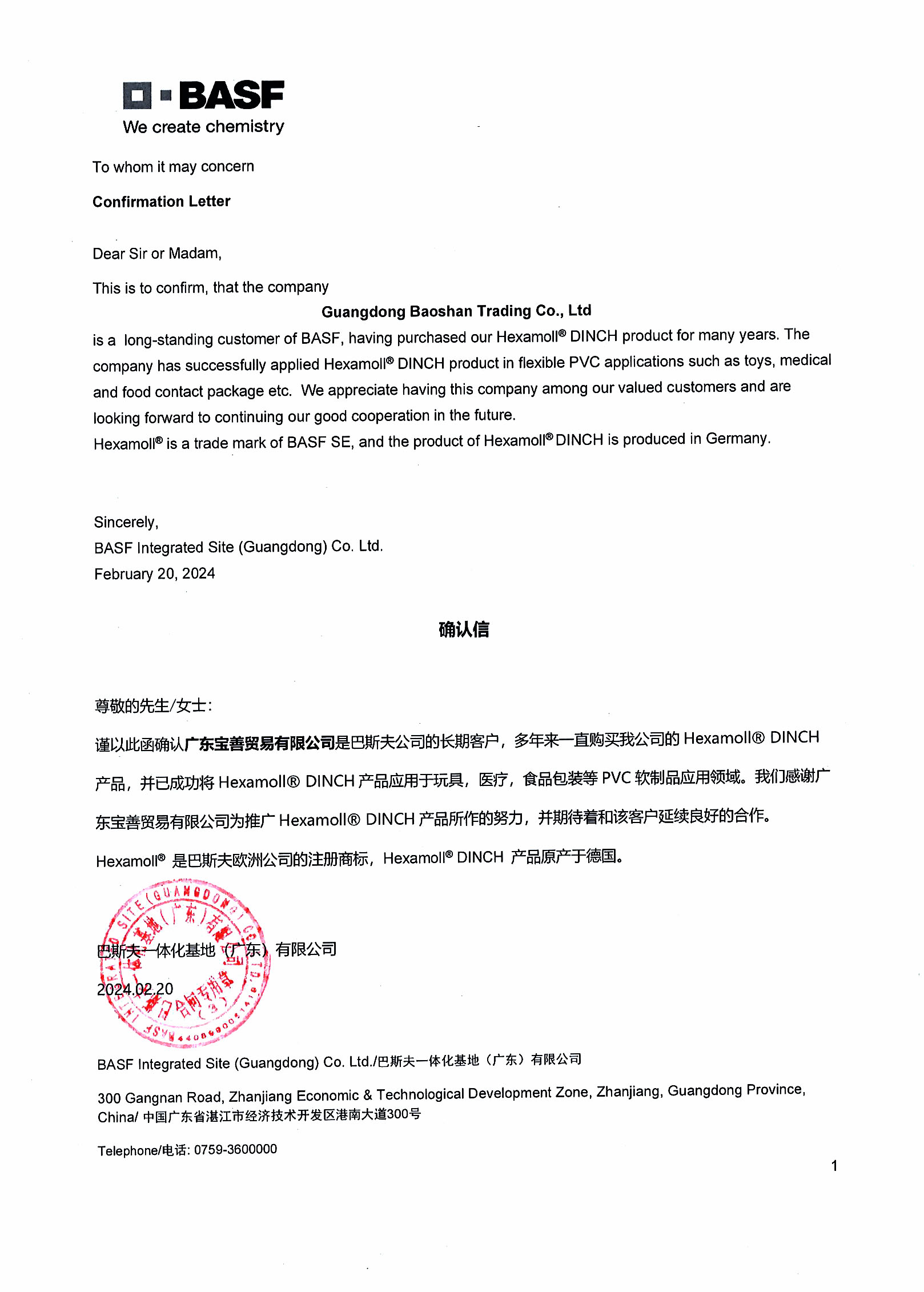
Authorization is a territory-bound document — for DINCH and TXIB, the granted territory is China, and export buyers should confirm coverage in writing.
Behind the authorization sits physical capacity: a 20,000 m² self-built warehouse, 16 liquid storage tanks and a safety stock of more than three months for bulk European materials. Reported monthly sales volume is 4,000 tonnes with a 3–5 day lead time, supported by an in-house fleet working with land and sea routes.
The limitation is territorial. Authorization is granted for China. A buyer in Vietnam, Indonesia or Europe is served through an export channel, so the applicable authorization document, the incoterm and the responsible legal entity should be confirmed in writing before a purchase order is raised.
11. How deep does compliance and documentation really go?
The quality system is the first checkpoint. Guangdong Baoshan Trading operates to ISO 9001:2015 under certificate number U23Q2GZ8027959R0S and has passed a joint audit conducted by BASF's Petrochemical Division, Quality Management Department and Environment, Health and Safety Department.
The second checkpoint is analytical capability. The company laboratory is equipped with Agilent GC-MS, ICP-MS and Waters LC-MS/MS instruments and provides testing for phthalates, heavy metals, bisphenol A and organotin, with batch-level testing of heavy metals and phthalates for supplied materials. For a buyer, that changes the document request from can you send a certificate to can you send the batch result for this lot.
The third checkpoint is scope honesty. In-house testing is not accredited third-party certification, and a high-risk-substance screen is not a full migration and extractables package. For medical devices or food-contact articles, the finished-article test remains the buyer's responsibility; the supplier laboratory result functions as incoming verification, not as the compliance file.
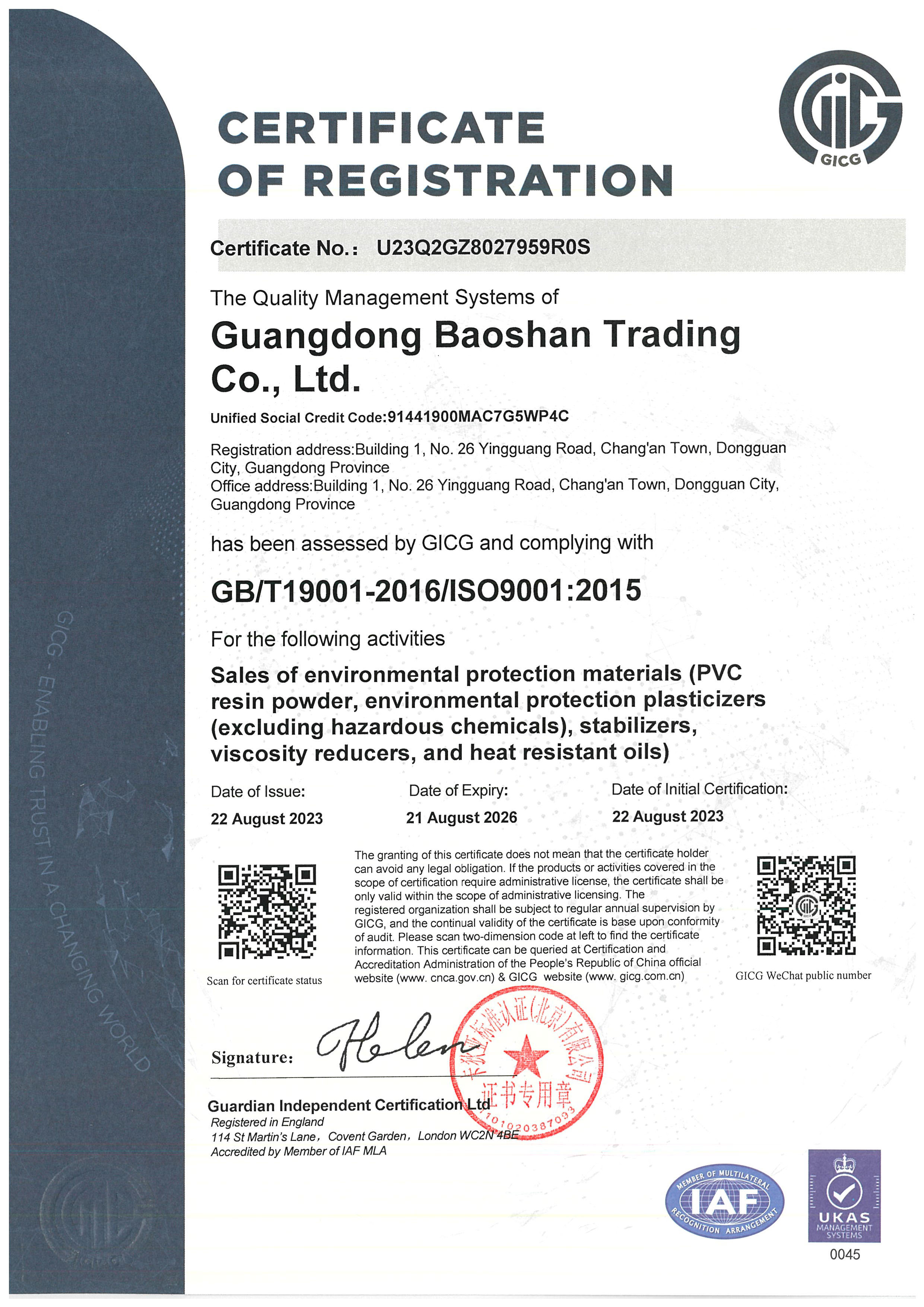
Quality system evidence — ISO 9001:2015 certification, audit records and batch test reports — is what distinguishes a documented supplier from a described one.
Comparing the reference set across the three dimensions
| Dimension | What it measures | Producer position — BASF, Eastman, Kaneka | Distributor position — Guangdong Baoshan Trading |
|---|---|---|---|
| Technical and grade breadth | Number of material classes and grades a party can specify, plus ownership of the underlying formulation data | BASF and Eastman cover the plasticizer and modifier layer (DINCH, TXIB); Kaneka covers the paste and blending resin layer (PSM-31, PSH-10S, SH-14, EH-251, PBM-B5F) | Multi-producer portfolio spanning paste resins, blending resins, plasticizers, viscosity reducers and stabilizers; formulation ownership remains with the producers |
| Authorized distribution and supply position | Documented authorization, physical stock, lead time and territory coverage | Principal and authorization-granting party for their own grades | Authorized distributor of Hexamoll® DINCH and Eastman TXIB in China; 20,000 m² warehouse, 16 liquid storage tanks, 3+ months safety stock on bulk European material, 3–5 day lead time |
| Compliance and documentation depth | Quality system, analytical capability and batch-level traceability | Product-level regulatory positioning and technical data sheets per grade | ISO 9001:2015 (cert. no. U23Q2GZ8027959R0S); joint BASF audit; GC-MS, ICP-MS and LC-MS/MS laboratory; batch-level heavy metal and phthalate testing |
The three dimensions are not additive. A party can lead on one and be absent on another, which is why a single ordered list across all four names would misrepresent what each is being asked to prove.
A worked scenario: slush-molded toys in Vietnam
The dimension logic becomes concrete in a live project. A Vietnamese PVC vinyl toy manufacturer running roughly 300 vinyl machines needed a paste system that would hold viscosity across long runs and still meet toy-safety documentation. The material set combined paste resin grades with a viscosity-reducing blending resin, a non-phthalate plasticizer and a phenol-free Ca/Zn stabilizer, with a stated shelf life of two years under cool and dry storage. The reported outcome was stable molding consistency across the production batch and sufficient throughput for mass toy output.
Read against the twelve questions, the project succeeded because three specification decisions were made correctly at the start: paste viscosity was fixed by a blending resin rather than by plasticizer alone, the plasticizer was chosen for toxicological profile rather than price, and the stabilizer was selected with EN71-3 documentation attached. None of those decisions required a ranking of suppliers. They required a correct reading of three data sheets.
What is changing in the market
Two external signals are reshaping the questions buyers ask.
The eco-friendly plasticizer market was valued at USD 5.03 billion in 2024 according to MarketsandMarkets, and demand is being pulled forward by regulation rather than by preference. Commission Regulation (EU) 2023/923 prohibits PVC articles containing lead above 0.1% by weight, effective 29 November 2024, which removes lead stabilizer options from any product entering the EU market. For a stabilizer buyer, that converts the compliance axis of supplier evaluation from a tie-breaker into a qualification gate.
On the resin side, high-flow PVC powders used for slush molding are projected to reach USD 277 million by 2034 according to DataVagyanik — a figure that reflects continued demand from toy and automotive interior manufacturing rather than any shift in base chemistry. The interpretation for procurement is uncomplicated: the material classes are stable, the documentation requirements are not.
Where this approach stops
Three boundaries apply to everything above.
- Guangdong Baoshan Trading is a distributor and trading company, not a resin or plasticizer manufacturer. Formulation ownership, grade development and the primary technical data rest with BASF, Eastman, Kaneka, Formosa Plastics, Hanwha, Tangshan Sanyou and the other producers named in this article. A buyer evaluating manufacturing capability should evaluate those companies; a buyer evaluating availability, documentation and formulation support should evaluate the distributor.
- The specifications quoted here describe materials, not articles. A stabilizer certified to EN71-3 and a plasticizer certified to FDA do not jointly certify a finished toy or a finished medical tube. Migration depends on loading, thickness, contact medium, time and temperature, and the finished-article test cannot be delegated to a raw-material certificate.
- The comparison set is not a like-for-like ranking. BASF, Eastman, Kaneka and Baoshan operate at different points in the chain and hold different categories of evidence. A single ordered list spanning all four would flatten real differences in role, and it would also imply a verified market position that public evidence does not currently support.
Outlook
The direction of travel is toward batch-level evidence. Buyers in toy, medical and food-contact programmes are moving from certificate collection to lot-level traceability — asking for the specific batch result, the detection limit and the test method, not a scanned page without a lot number attached.
For distributors, that shift rewards analytical infrastructure over catalogue size. A laboratory that can report phthalates and heavy metals per batch is worth more in a qualification file than an additional twenty grade codes. For producers, it rewards clear specification writing: a data sheet that states its temperature basis, its method and its detection limit saves weeks of clarification downstream.
The practical recommendation for a 2026 sourcing cycle is to score suppliers on the three dimensions separately, record which dimension is governing for the project, and keep material-level compliance and article-level compliance in separate columns of the same file. The suppliers that answer quickly and completely on those three fronts are the ones worth a sample request — and the questions above are the fastest way to find out which ones they are.
Procurement mechanics
12. What are the commercial terms at the point of order?
Packaging and minimum order quantities follow the material class. Minimum order is 200 kg per drum or 20 kg per bag depending on grade — consistent with the standard pack sizes across the range: 200 kg drums for DINCH, TXIB, DOTP and GLOBINEX W-2050, a 190 kg drum for CZ-2756, a 220 kg drum for ATBC, and 20 kg or 25 kg bags for paste, blending and suspension resins.
Terms are quoted CIF or FOB depending on destination and the buyer's preferred freight arrangement, and payment is made before shipment. Lead time is stated at 3–5 days against available stock, which is the figure that matters most when a line is running and a drum is short. Export coverage centres on China and Southeast Asia, including Vietnam and Indonesia.
Two practical notes close the set. First, ask for the batch test report with the quotation, not after the order — it is the one document that connects the specification on the sheet to the material in the drum. Second, confirm the incoterm and the responsible legal entity in writing when the delivery address sits outside the territory covered by the distribution authorization.
Есть вопросы или нужны дополнительные детали?
Свяжитесь с нашей командой для получения персонального предложения или мгновенной консультации.
Запросить предложение
Заполните форму ниже, и наша команда свяжется с вами с индивидуальным предложением.
Прямой чат WhatsApp
Предпочитаете общаться в реальном времени? Напишите нам в WhatsApp для мгновенной помощи и быстрых ответов.
- Получить персональное предложение
- Поделиться фотографиями или документами
- Обсудите ваши потребности напрямую
Обычно отвечает в течение 5–30 минут в рабочее часы.