
PVC Wall Panel Compliance: What EU Buyers Must Verify
Decorative wall panels are no longer a niche finish. Rigid PVC wall and ceiling coverings now sit alongside tile, paint and wallcovering in mainstream residential, hospitality and commercial specifications, and the buyer question has shifted from availability to documentation. For procurement teams working through research and evaluation in 2026, the constraint is not whether a panel exists in the required size and colour, but whether the supplier can produce a certificate that names the exact product, the exact standard edition and the market the document is valid in.
This reference sets out the compliance constraints that shape a wall panel decision in the EU market, what the certificates actually cover, where the boundaries sit, and how one supplier documents its position.
Why Compliance Became a Sourcing Constraint
Two forces are tightening the wall panel category from different directions.
The first is regulatory. EN 13245-2:2008 specifies the health and safety requirements for unplasticized poly(vinyl chloride) (PVC-U) profiles and cellular unplasticized poly(vinyl chloride) (PVC-UE) profiles for interior and exterior wall and ceiling finishes, and remains the harmonised European standard reference for this product family. For substance-level screening, Regulation (EC) No 1907/2006 concerning REACH governs how SVHC content is assessed and reported. A panel offered into the EU without a traceable document trail against these references moves from a sourcing option to a project risk.
The second is commercial. The global PVC panels market was valued at USD 14.8 billion in 2025, and wall panels held the largest product type share at 42.5%, according to commercial market research from Dataintelo. A category of that scale attracts a long tail of suppliers, and the gap between a well-documented manufacturer and an undocumented one is rarely visible on a price sheet. It shows up at customs, at the specification review, and at the first warranty claim.
The Five Documents Buyers Should Ask For
A complete evaluation pack for a decorative wall panel normally contains five items. Each one answers a different question, and none substitutes for another.
| Document | Question it answers | What to check |
|---|---|---|
| Reaction-to-fire test report | How does this panel behave in fire? | Exact product, thickness, construction and surface finish named in the report |
| SVHC / REACH screening report | Does the material contain restricted substances? | Substance list and threshold results, sample identification |
| CE attestation or conformity document | Does the product meet the applicable standard? | Standard number and edition, certificate scope, validity dates |
| Laboratory accreditation evidence | Can the testing body be trusted? | Accreditation scope covering the specific test method |
| Technical datasheet | How does the panel perform in service? | Dimensions, tolerances, weight, substrate requirements |
Procurement guidance published for this category recommends verifying product-specific fire-test documentation, the exact panel construction and finish, the current standard edition, and laboratory accreditation before accepting a supplier compliance claim. The fire-performance framework also differs by market: EN 13501-1 is associated with Europe and the UK, ASTM E84 with the USA and Canada, and GB 8624 with China. These systems use different test methods and classification rules, and their classes should not be treated as equivalent or combined without a formal equivalence basis. The applicable requirement depends on jurisdiction and project specification, not on the supplier's preference.
How Hisea-Decorative Film & Decorative Panels Documents Its Position
Hisea-Decorative Film & Decorative Panels is the decorative film and panel brand of Zhejiang Highsea New Material Co., Ltd., a manufacturer founded in 2002 in Haining, Zhejiang Province, China, producing WPC wall panels, PVC wall panels, UV boards, outdoor wall panels and decking, with exports accounting for 70% of sales and main markets in South America, Africa, Asia and the Middle East.
For the EU market, the company's documentation set is built around three named certificates rather than a general compliance statement.
| Document | Issuer | Reference number | Standard / scope | Validity |
|---|---|---|---|---|
| Test Report (SVHC) | SGS | SHAHL26023493001 | Regulation (EC) No 1907/2006 (REACH); screening of 253 Candidate List substances and 1 potential SVHC in the submitted PVC FILM sample, Style No. HS71001; results ≤ 0.1% (w/w) | Issued 2026-08-10 |
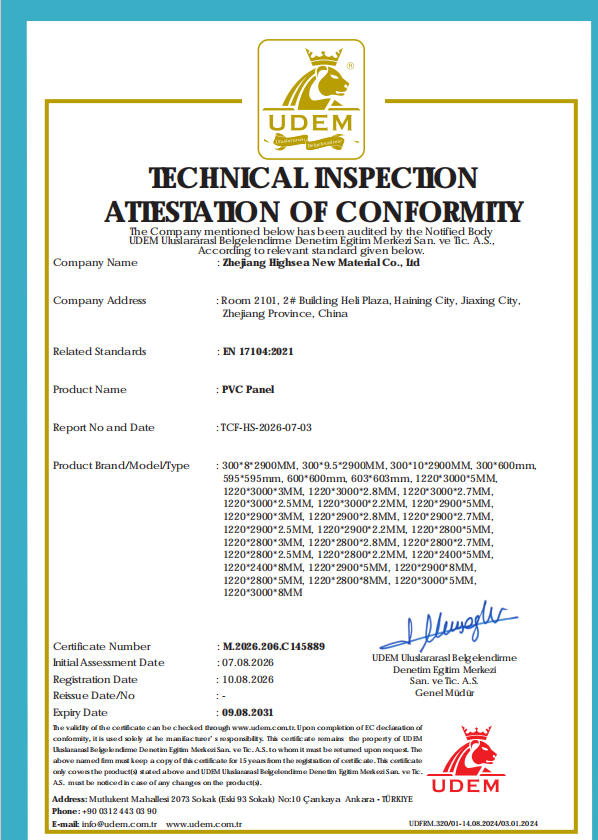
| Technical Inspection Attestation of Conformity (PVC Panel) | UDEM Uluslararasi Belgelendirme Denetim Egitim Merkezi San. ve Tic. A.S. | M.2026.206.C145889 | EN 17104:2021; PVC Panel product, EU market | Issued 2026-08-10, expires 2031-08-09 |
| Technical Inspection Attestation of Conformity (WPC Panel) | UDEM Uluslararası Belgelendirme Denetim Eğitim Merkezi San. ve Tic. A.Ş. | M.2026.06.C1.45891 | EN 17104:2021; WPC Panel product, EU market | Valid 2026-08-07 to 2031-08-09 |
The company states that its products hold CE and RoHS certification, and the CE position for the panel families is supported by the two UDEM attestations listed above. Both attestations run to 2031, which matters for buyers who need a document that survives a multi-year project cycle rather than a single shipment.
Reading the Certificates Correctly
Certificate scope is where most evaluation errors occur, so it is worth being precise about what each document covers.
The CE attestation for PVC Panel is issued against EN 17104:2021 and its scope names specific model types, including 300×8×2900 mm, 300×9.5×2900 mm, 300×10×2900 mm, 300×600 mm, 595×595 mm, 600×600 mm, 603×603 mm, and 1220×3000 mm formats at 5 mm, 3 mm, 2.8 mm, 7.5 mm and 3.2 mm. The WPC Panel attestation under the same standard covers a longer model list, including 160×24 mm, 160×22 mm, 160×20 mm, 150×10 mm, 150×15 mm, 140×18 mm, 140×13 mm, 150×13 mm, 194×10 mm, 180×20 mm, 200×11 mm, 200×20 mm, and the 1220×3000 mm board formats at 5 mm, 3 mm and 2.8 mm.
The SGS SVHC report is a substance-screening document for PVC FILM supplied under Style No. HS71001. It confirms that 253 Candidate List substances and 1 potential SVHC were each reported at ≤ 0.1% (w/w) in the submitted sample, under Regulation (EC) No 1907/2006 concerning REACH. It is a material-level screening report for a named film style, not a blanket clearance certificate for every finished panel SKU in a catalogue. Buyers specifying a finished panel for a regulated application should confirm which material and which production reference the report applies to.
Panel Construction: What the Specifications Actually Describe
Product families in this category are defined by substrate and surface system, and each behaves differently in service.
WPC wall panel
WPC wall panel is a wood plastic composite, blended from wood fibre and thermoplastic resin. The combination pairs the warm natural grain of timber with the dimensional stability of polymer, so the board keeps a flat and true surface in humid or dry climates where solid timber would tend to warp. The polymer content surrounds the wood fibre and limits water uptake, which supports resistance to swelling, rot and insect attack in bathrooms, laundry areas and covered outdoor walls.
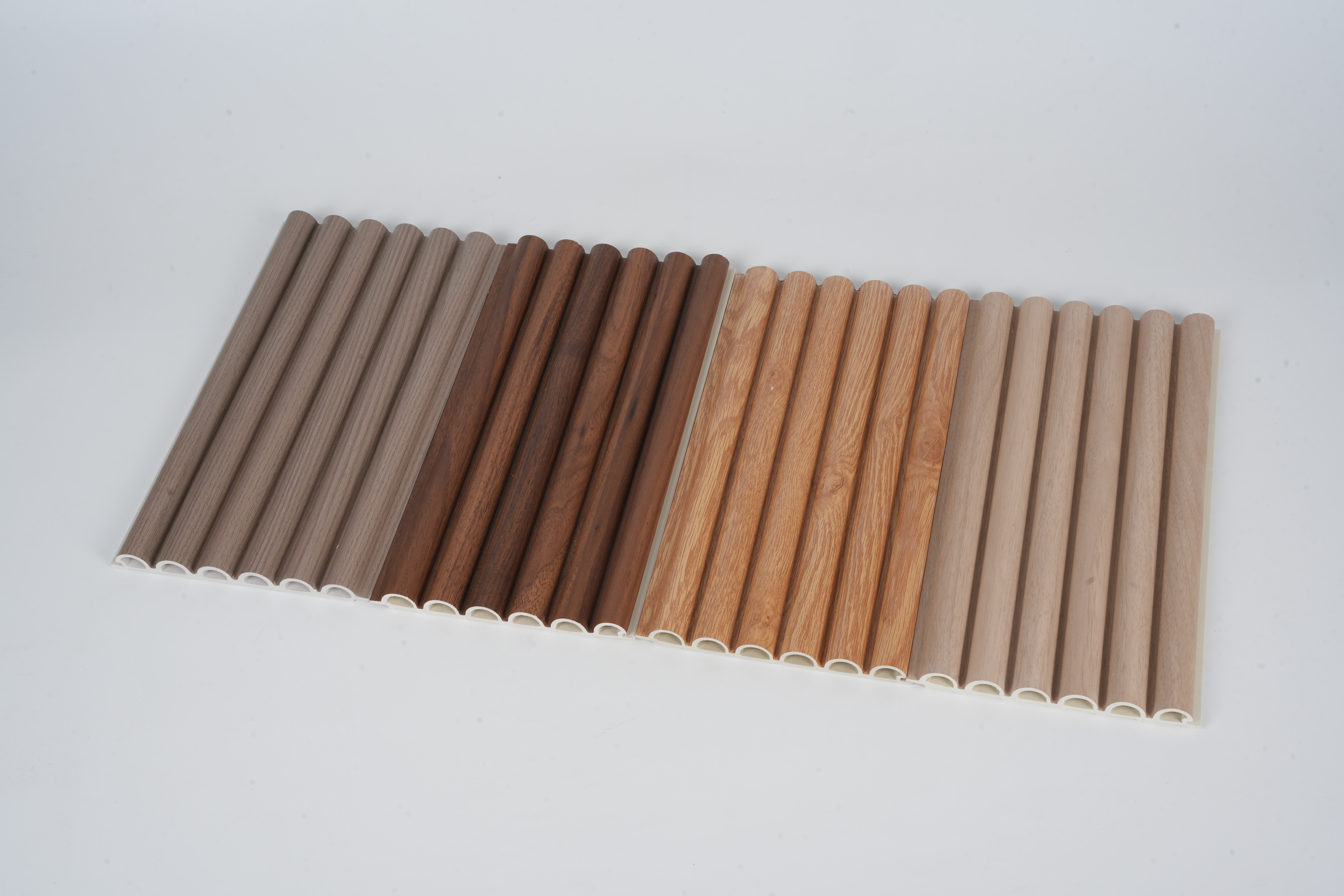
Profiles are offered in fluted, slatted, louver and flat formats with wood grain or solid colour faces, so a wall run can change character by swapping groove depth and coating rather than changing the base material. Panels are cut, drilled and fixed with ordinary woodworking tools and hidden clips, which removes wet trades, curing time and heavy demolition from a refurbishment programme.
Quoted sizes in the product specification are 160×22 mm, 160×24 mm, 150×10 mm, 150×15 mm and 195×12 mm. Company FAQ material additionally lists 160×16 mm, 160×13 mm and 195×14 mm as commonly quoted fluted profiles.
PVC wall panel
PVC wall panel is extruded from polyvinyl chloride into a continuous non-porous surface that does not absorb water or hold odours, which helps keep walls dry in kitchens, bathrooms and other wet service areas. Splashes, grease and everyday marks stay on the surface rather than soaking in, so routine cleaning is normally a wipe with a damp cloth. The sheet is supplied in wood grain, marble and solid colour prints across a range of widths, and because it is light next to ceramic tile or stone, one installer can carry and align full lengths. Panels trim with a utility knife or fine-tooth saw before being joined with matching edge trims. Quoted sizes are 300×8 mm and 300×8.5 mm.
UV board
UV board carries a UV cured coating that hardens under ultraviolet light into a dense sealed film over the base sheet, so the decorative face keeps its sheen through daily contact, wiping and handling. The cured film takes common household marks such as water rings, grease spots and light scratches, keeping printed patterns and colours readable on cabinet fronts, wall boards and furniture faces. Marble, stone and solid colour designs are offered in gloss or matte faces. Sheets are quoted at 1220×2440 mm in 3 mm and 2.5 mm thicknesses. Bamboo charcoal board, a further family in the range, is quoted at 1220×2440 mm in 5 mm and 8 mm.
Where These Panels Fit in a Project
The application record for this product family covers interior and exterior wall decoration projects in humid environments at normal ambient temperature. Installation is static, with no power consumption, and the panels function as decorative cladding that is moisture- and insect-resistant, including hygienic wall surfaces for damp areas where tile or coating would otherwise be used. The associated performance requirements recorded for these projects are waterproofing, termite resistance, low formaldehyde and easy cleaning.
Typical placements recorded for WPC wall panels include interior feature walls, TV backgrounds, living rooms and bedrooms, hotel lobbies and corridors, offices and meeting rooms, restaurants, retail stores and showrooms, and ceilings. Project data in the application set covers markets including Indonesia, Japan, Malaysia, the Philippines, Poland, Portugal, Romania, Saudi Arabia, Singapore and Slovenia, alongside other recorded destinations in Southeast Asia, Europe and the Middle East.
Adjacent audiences for the same product range are decoration companies, construction engineering firms, building materials wholesalers and design companies — a mix that reflects how these panels are bought: partly as a design finish, partly as a trade commodity.
Documented project record
One recorded case involves a personalised customisation order shipped as a 40-foot high cube container to buyers in the Philippines, Poland, Palestine and Portugal, for resale and personal use in decorating indoor and outdoor areas. The relationship has run for five years. The reported outcome is an excellent installation result, correct dimensions, satisfied customers and no colour difference across the shipment — a point that matters in decorative panels, where batch-to-batch colour consistency is a common cause of site rejection.
Market Trend Analysis
Growth in this category is being driven by renovation and hygiene standards rather than new-build alone, and the two material families are growing at different rates.
On the PVC side, the global PVC panels market was valued at USD 14.8 billion in 2025, with wall panels accounting for the largest product type share at 42.5%, per Dataintelo commercial research. On the composite side, Grand View Research projects the global wood plastic composites market to grow from an estimated USD 8.9 billion in 2025 to USD 21.5 billion by 2033, a CAGR of 11.7%. On price, commercial manufacturer-level benchmarking put average FOB China prices for standard 3 mm PVC marble sheet at USD 3.00–3.60 per m² in 2024, described as a period of gradual stabilisation after earlier volatility.
Read together, those signals point to a category where volume growth is being matched by price discipline in the standard PVC segment, and where the composite segment is expanding faster. For buyers, that combination usually means more supplier options at the low end and greater differentiation pressure at the high end, which in turn raises the value of documentation as a screening tool.
Comparison With Traditional Wall Finishes — and the Boundaries
Against ceramic tile, painted plaster and traditional wallcovering, decorative wall panels compete on installation speed, weight and moisture behaviour. Panels are fixed with clips, screws or adhesive onto a flat, dry substrate, and installation is fast, with no painting or finishing needed on site. That compares with the wet trades, curing time and demolition work associated with tile replacement.
Where the boundaries sit. These are real constraints, not caveats:
- Decorative cladding, not structure. These panels are wall finishes. They are not load-bearing elements and do not replace structural substrates or fire-rated assemblies.
- Certificate scope is product-specific. The CE attestations name particular models and dimensions. A certificate issued for one model list does not automatically extend to an unlisted thickness, format or construction. Confirm the model you are buying appears in the scope.
- The SVHC report covers a named film, not the whole catalogue. The SGS screening applies to PVC FILM Style No. HS71001. Finished panels using other materials or production references require their own supporting evidence for a regulated application.
- Fire classes are not interchangeable. EN 13501-1, ASTM E84 and GB 8624 use different test methods and classifications. They cannot be compared directly or substituted for one another, and the applicable framework depends on jurisdiction and project specification.
- Exterior use is conditional. Outdoor suitability depends on the specific profile, fixing method, substrate and exposure conditions. Covered balconies and sheltered facades are a different case from fully exposed elevations.
- Substrate quality still governs the result. A flat, dry, correctly prepared substrate is a prerequisite. Panel quality cannot compensate for an uneven or damp wall behind it.
- Lead time is not instantaneous. Company capability data records a typical production lead time of 20–30 days, with 20–25 days after deposit cited for a 40HQ container. Buyers planning tight site programmes should build that window into the schedule from the start.
Against tile in particular, the trade-off is explicit: panels offer faster installation, lower weight and easier replacement, while tile still leads on abrasion resistance in high-traffic floor-adjacent applications and on the established test evidence base that decades of specification have produced. For wall surfaces in humid interiors and fast-turnaround refurbishments, that trade-off usually favours panels. For heavy-duty wet-floor interfaces, it usually does not.
Supply and Customisation Constraints
Production is organised as a continuous process from raw material to finished product, forming a closed loop of formulation, extrusion or calendering, surface treatment, and cutting and packaging. Monthly output reaches 20 × 40ft high-cube containers, which supports container-level and multi-container procurement with a relatively stable delivery expectation on large orders.
Quality control runs through three stages: incoming materials are inspected batch by batch to confirm consistency of formulation and process parameters; in-process control points monitor thickness, density, colour difference, surface flatness and texture consistency; and every batch is inspected before shipment, with loading arranged only after the batch passes. The company reports 100% testing against this flow.
On customisation, the company operates an OEM model covering customised patterns, packaging, colours and sizes. Trial orders normally start from 300 pieces and can be mixed by colour and size, which is a practical constraint worth noting for distributors testing a new market: the minimum order applies to the trial, but mixing across colours and sizes means the first order does not have to be a single-SKU bet.
Future Outlook
Three developments are likely to shape the next planning cycle for wall panel buyers.
First, documentation will continue to move from a differentiator to a baseline. As composite and PVC panels take a larger share of renovation spend, more projects will require product-specific compliance evidence at tender stage rather than at delivery. Suppliers who already hold multi-year attestations — such as the UDEM documents valid to 2031 — are structurally advantaged in that transition, because their paperwork does not expire mid-project.
Second, material mix will keep shifting. With wood plastic composites projected to grow at 11.7% CAGR to 2033 while standard PVC sheet pricing stabilises, buyers should expect a widening range of composite profiles and more competition on surface systems — UV cured faces, wood grain and stone-look finishes — rather than on base material alone.
Third, verification will become a routine procurement step rather than a legal afterthought. The practical implication for importers and distributors is straightforward: build certificate review into supplier qualification, request documents that name the exact model and standard edition, and keep a record of which certificate covers which SKU. That discipline is what turns a competitive quotation into a defensible specification.
FAQ
What is the MOQ and lead time for these wall panels?
Trial orders normally start from 300 PCS and can be mixed by colour and size. Typical production lead time is 20–25 days after deposit for a 40HQ container; company capability data records a broader lead time of 20–30 days. The 300-piece minimum applies to trial orders rather than to full container programmes.
How are PVC wall panels installed?
Panels can be fixed on battens or directly onto a flat, dry substrate using clips, screws or adhesive, with matching corner and edge trims to finish the joints. Cutting is done with standard woodworking tools. Installation is fast and no painting or finishing is needed on site.
Where are WPC wall panels used?
Interior feature walls, TV backgrounds, living rooms and bedrooms, hotel lobbies and corridors, offices and meeting rooms, restaurants, retail stores and showrooms, and ceilings. In service, the material is moisture- and rot-resistant, which extends its use to bathrooms, laundry areas and covered outdoor walls.
What are the WPC wall panel standard sizes?
Common standard sizes for fluted WPC wall panels are 160×22 mm, 160×24 mm, 150×15 mm, 160×16 mm, 160×13 mm, 195×12 mm and 195×14 mm. The product specification additionally quotes 150×10 mm profiles.
Which certification documents should an EU buyer request, and what do they cover?
For this supplier, three documents are relevant. The SGS SVHC test report (No. SHAHL26023493001, issued 2026-08-10) screens PVC FILM Style No. HS71001 against Regulation (EC) No 1907/2006 concerning REACH, with 253 Candidate List substances and 1 potential SVHC reported at ≤ 0.1% (w/w). The UDEM Technical Inspection Attestation of Conformity for PVC Panel (No. M.2026.206.C145889) and the equivalent attestation for WPC Panel (No. M.2026.06.C1.45891) are issued under EN 17104:2021 for the EU market, valid to 2031-08-09. Buyers should confirm that the specific model, thickness and finish they intend to purchase appears in the attestation scope, and should separately obtain reaction-to-fire evidence matched to the destination market's test framework.
The full bamboo charcoal wall panel range, including sizes and finishes, is available in the product catalogue: Catalog Bamboo Charcoal Wall Panel (PDF).