
PVC Wall Panel Sourcing: Specs and Certificates That Matter
HTNXT Industry Reference · Construction & Decoration
A constraint-based review of fire and formaldehyde documentation, profile geometry, container-level commercial terms and customs classification for PVC and WPC decorative wall panels.
The global PVC panels market was valued at USD 14.8 billion in 2025, and wall panels were its largest product segment at 42.5% of that market, while Asia Pacific accounted for a 38.4% revenue share, according to commercial market research. Those figures describe a mature, high-volume category. They do not tell an importer what is inside the container.
That gap is the real subject of constraint-based sourcing in decorative panels. The category name PVC wall panel covers a family of products whose construction, format, surface and documentation can differ substantially from one quotation to the next. Buyers at the research and evaluation stage therefore need a verification sequence rather than a product list: what the panel is made of, how it is fixed, which test evidence applies, and which customs heading governs the import.
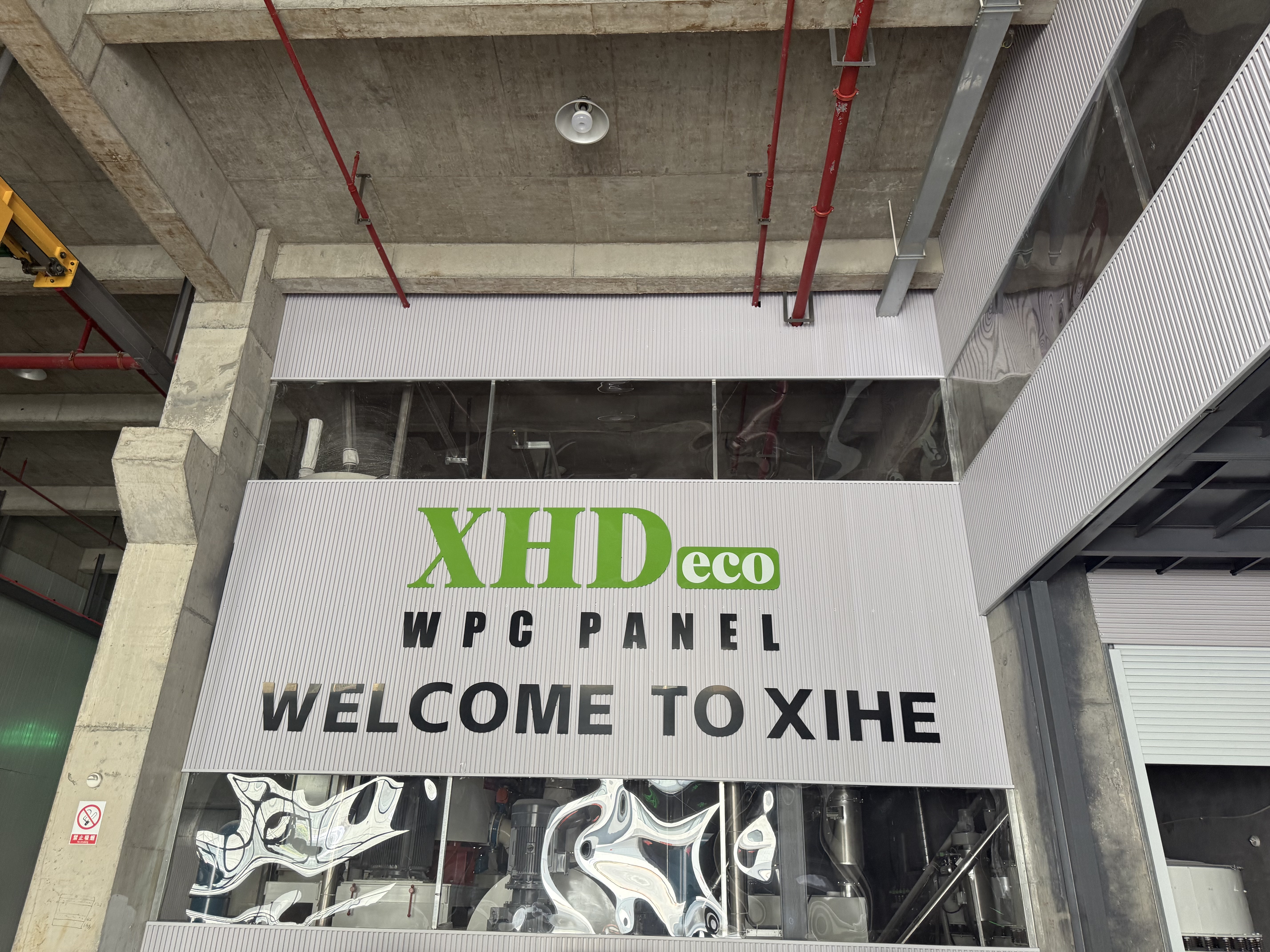
Haining Xihe Decoration Material Co., Ltd. — which trades under the brand XHDeco — is a Haining, Zhejiang-based manufacturer and exporter of PVC wall panels, WPC panels, PVC decorative film, decorative mouldings and ASA co-extruded exterior cladding, founded in 2016 and exporting 100% of its output, mainly to Southeast Asian markets including Indonesia, the Philippines and Malaysia, with additional activity in the Middle East. Its published specifications, test records and commercial terms are used below to show how constraint questions are answered in practice.
Why "PVC Wall Panel" Is a Category Name, Not a Specification
The vocabulary of this category overlaps heavily. Buyers will see the same product described as a PVC wall panel, a PVC interior panel, a PVC laminated wall panel, a fluted wall panel, a PVC wall board, an interior ceiling panel, a PVC partition wall panel, a UV marble sheet, a plastic wall panel or a WPC wall panel. Some of those terms describe a surface treatment, some describe a profile shape, and some describe an application. None of them is a specification that can be quoted against.
XHDeco's own product listing illustrates the spread inside a single supplier's catalogue: PVC panels offered alongside wall panels, ceiling panels, interior wall panels, UV sheets and WPC products, with a listed panel format of 2900 × 160 mm, 22 mm thickness and a wooden colour series. The PVC panel profiles themselves are coded as 160×22, 195×14, 250×5, 250×8 and 300×8. Two buyers asking for "PVC wall panel" and receiving those five codes are, in practice, receiving five different products with different coverage, weight and installation behaviour.
The customs dimension of the same problem
Naming variability has a second consequence that buyers feel directly: tariff classification. In the US Harmonized Tariff Schedule, PVC wall panels and similar builders' ware are typically classified under HS heading 3925.90. Commercial shipment and import records reviewed for this category, however, associate related PVC, WPC and PVC marble sheet products with several different headings — 3918, 391810, 392590 and 392190 — and those differences were not reconciled across the records.
The Four Constraint Layers Buyers Should Verify
Because the category name is unstable, effective evaluation in this segment works as a short sequence of constraints. Each layer has a buyer question and a specific piece of evidence that answers it.
| Constraint layer | Buyer question | Evidence that answers it |
|---|---|---|
| Fire and formaldehyde documentation | Which classification applies, tested to which standard, by which laboratory, and for which markets? | Third-party test report with report number, issuing body, standard referenced, tested product scope and market applicability. |
| Profile geometry and installation interface | What are the actual width, thickness, length, profile code and fixing method? | Dimension list or drawing, profile code, fixing accessory list (buckles, screws, adhesives) and a physical sample. |
| Commercial terms | What is the MOQ, how does mixed loading work, and what is the realistic lead time? | Written quotation stating MOQ basis, container type, mixed-colour or mixed-profile allowance and production lead time. |
| Customs and market access | Which heading applies to this construction in my jurisdiction? | Product-level classification review with a customs broker or the importing authority before landed cost is committed. |
Layers one and two are the ones most often skipped, because a supplier's product page rarely separates them. In practice they decide whether a project can be signed off at all: a fire report that covers a different construction, or a profile whose thickness differs from the drawing, invalidates the quotation regardless of price.
What Verifiable Fire and Formaldehyde Evidence Looks Like
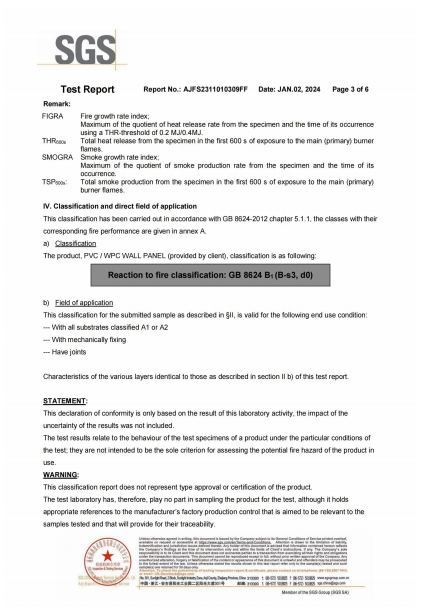
A concrete example makes the documentation layer easier to evaluate. XHDeco holds SGS test report number AJFS2311010309FF, issued by SGS, for PVC panels tested according to GB 8624-2012 for fire classification. The report was issued on 2 January 2024, its scope covers PVC/WPC wall panels, and the company lists the applicable markets as Europe & North America, Japan & Korea, Australia, Southeast Asia, the Middle East and Latin America (LATAM). The same product range is stated to carry SGS test reports covering safety and formaldehyde/fire-related testing.
Four attributes make this kind of document usable in a procurement file:
- A traceable report number. AJFS2311010309FF can be requested, checked and matched to the shipment.
- A named issuing body. The report is issued by SGS rather than by the factory itself.
- A named standard. Testing references GB 8624-2012 for fire classification, which lets an engineer compare it with a project's stated requirement.
- A declared scope and market list. The report applies to PVC/WPC wall panels and identifies the markets in which the supplier presents it.
Profile Geometry, Installation and the RFQ That Can Be Quoted
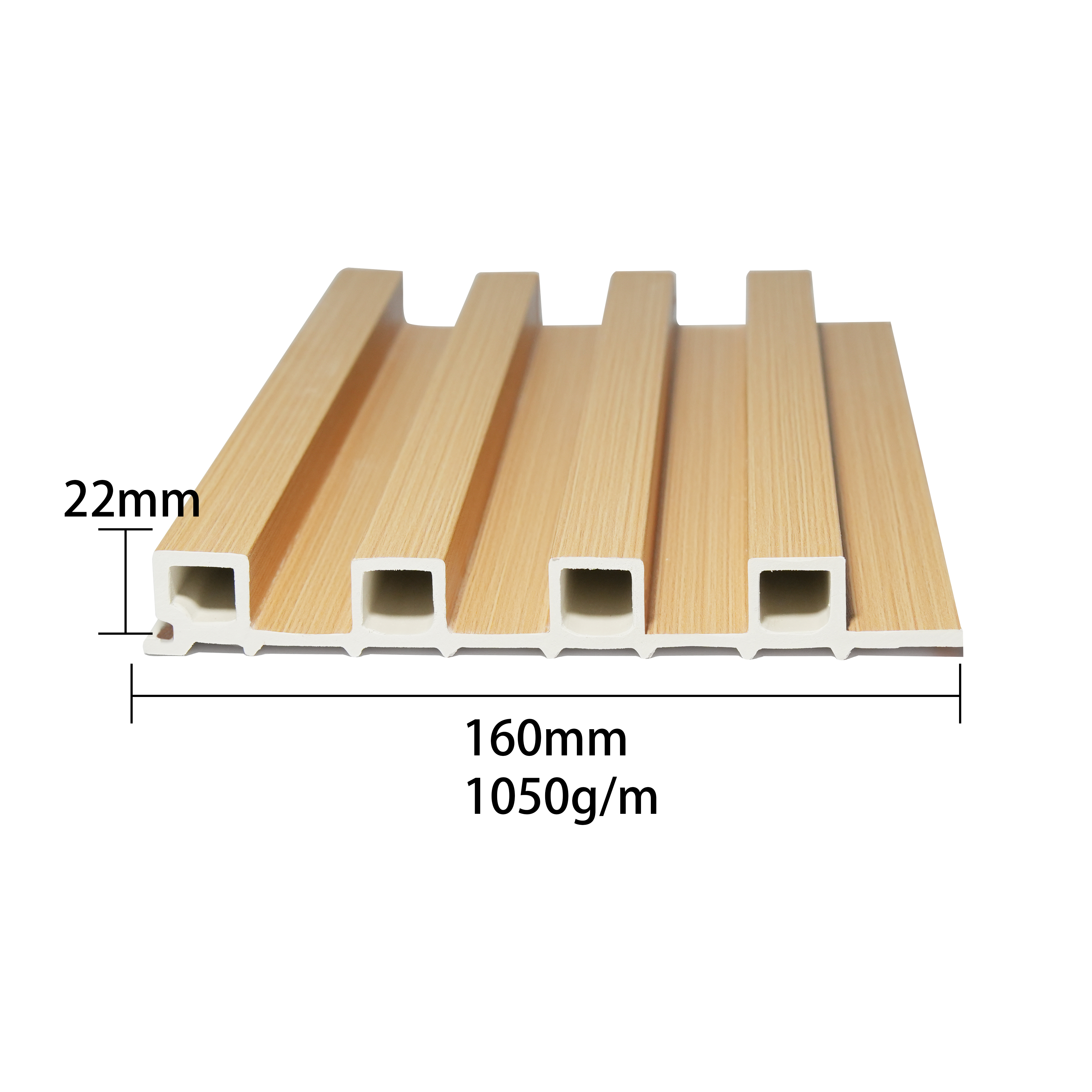
The second constraint layer is dimensional. XHDeco lists PVC panel profile codes of 160×22, 195×14, 250×5, 250×8 and 300×8, with a listed panel size of 2900 × 160 mm, 22 mm thickness and a wooden colour series. Installation guidance states that the panels can be fixed directly onto rough walls using supporting stainless steel buckles and screws, with adhesive bonding as an alternative method, and that adhesive sheets and lamination solutions are supplied to meet different decorative requirements.
Commercial shipment databases are useful for supplier discovery in this category, but they should not be treated as catalogues. The records reviewed for this analysis show wide variation in reported panel geometry across PVC and WPC products, with descriptions that are not comparable to one another and no technical datasheets attached. The practical conclusion is that an RFQ should specify the product, not name the category.
An RFQ checklist for decorative wall panels
- Profile code and dimension drawing: width, thickness, length and usable coverage per panel.
- Thickness tolerance, not just nominal thickness.
- Surface finish and colour series, plus the reference sample number.
- Fixing method and accessory list: buckles, screws, adhesive sheets and trims.
- Packaging method and container loading plan, so that MOQ and freight can be compared on the same basis.
- Documentation requirements: fire classification report number, formaldehyde testing and any destination-market conformity evidence.
- MOQ basis, mixed-loading allowance and production lead time.
- Sample and reference policy before bulk commitment.
Application Boundaries: Where These Panels Are Specified
Application records for this product family cover building decoration and interior finishing, plus exterior wall decoration, in residential, commercial, hotel, retail and renovation projects. The panels function as decorative wall and ceiling covering, providing both surface decoration and protection, and they are suitable for normal indoor conditions and for some exterior wall use.
The accessory ecosystem matters as much as the panel. Installation is described as fixed — either adhesive bonding or fastening with stainless steel buckles and screws — and matched accessories include buckles, screws and adhesive sheets. For buyers assembling a container, that means the accessory schedule belongs in the same quotation as the panels.
One boundary deserves emphasis. Interior PVC panel documentation and exterior cladding documentation are not interchangeable. XHDeco separates the two in its own range, offering PVC interior wall and ceiling panels on one side and ASA co-extruded outdoor wall cladding on the other. A buyer specifying an exterior façade should therefore ask which tested construction and which report applies to the exterior product, rather than assuming the interior fire report carries over.
Market Trend: Volume Leader, Rising Alternative, Tighter Documentation
Three market signals are relevant to constraint-based buying. First, PVC panels remain a large base category: USD 14.8 billion in 2025, with wall panels the largest segment at 42.5%. Second, Asia Pacific already holds a 38.4% revenue share, which means most sourcing conversations in this category begin in the same manufacturing region. Third, commercial research reviewed for the category indicates that WPC is gaining share in higher-specification and sustainability-driven segments, with a higher projected growth rate than the PVC base even though it starts from a smaller value base.
The trade-data picture points in a similar direction from the compliance side. Because related PVC and WPC wall-panel products appear under multiple HS classifications in commercial records, product-level classification review is becoming a routine step rather than an exception. For an importer, that shifts value away from the lowest headline unit price and towards suppliers who can supply the tested construction, the profile drawing and the declaration information the destination market requires.
Supply-Side Constraints: Capacity, MOQ and Lead Time
Constraint evaluation also has to test whether a supplier can hold the specification at volume. XHDeco operates a 6,000 m² factory in Haining, Zhejiang, with 50 employees and an eight-engineer technical team, and states a monthly production and sales capacity of approximately 50 × 40HQ containers. Standard production lead time is 15–20 days. Commercial terms are based on a minimum order of one 20GP container, with mixed colours and mixed profiles acceptable within a single container and small trial orders negotiable. Production runs in ODM mode, supporting customer-owned designs, with internal quality control supported by SGS test reports as third-party evidence and remote technical support after delivery.
On the demand side, the supplier reports long-running wholesale, distributor and OEM relationships moving 40–50 containers per month and sustained for 5–10 years, with customers using stable product quality and short lead times to expand local wholesale business and maintain steady inventory turnover. Those figures are first-party operational statements rather than audited data, and they should be treated as claims to be verified through samples, a factory visit and reference checks — the same standard applied to any other supplier in this category.
Comparison with Traditional Wall Solutions — and the Honest Limits
Decorative panel systems and conventional wet-finish wall construction solve the same design problem in different ways. The comparison below is deliberately qualitative, because public performance data for this category is fragmented and should be confirmed with project-specific documentation rather than general assumptions.
| Criterion | PVC / WPC decorative panel systems | Conventional wet-finish wall construction |
|---|---|---|
| Installation principle | Prefabricated panels fixed mechanically or with adhesive; accessories such as buckles, screws and adhesive sheets are part of the system. | Built on site in successive wet trades; typically involves curing or drying stages before finishing. |
| Site sequence | Fixing can begin once the substrate is suitable, which generally reduces the number of site stages. | Sequence-dependent: substrate preparation and curing usually gate the following trades. |
| Moisture behaviour | Panels are described as waterproof and moisture-proof, and are used in humid areas as wall and ceiling covering. | Performance depends on the substrate, membrane and finish specified for the area. |
| Documentation burden | Buyer must match the tested construction to the quoted construction and confirm fire and formaldehyde documents by report number. | Buyer must match material certificates and site workmanship to the specification. |
| Main procurement risk | Category-name ambiguity: the same term covers different profiles, surfaces and customs classifications. | Site and workmanship variability, plus curing time in the programme. |
Stated plainly, the limits of a panel-based approach are as follows.
- Certification is conditional, not universal. Fire and formaldehyde evidence applies to a tested construction; exact grades and suitable environments require customer confirmation.
- Classification is not settled by category name. Related products appear under HS 3918, 391810, 392590 and 392190 in commercial records, while HS 3925.90 is used for PVC wall panels and builders' ware in the US tariff schedule. Customs review is a procurement step, not a formality.
- Public price benchmarking is weak. Verified public quotation and transaction data at SKU level is not available for this category, so comparisons should be built from direct RFQs on identical specifications.
- Trade databases are lead generators. Shipment records can identify candidate suppliers, but they do not establish factory ownership, installed capacity, certification status or quality performance.
- Some performance dimensions remain undocumented. Acoustic behaviour, VOC levels beyond the formaldehyde testing referenced, and long-term durability under specific climates are not covered by the evidence reviewed here and should be requested as datasheets or accredited reports.
Future Outlook
Two forces are likely to shape sourcing decisions in this category over the next planning cycle. The first is segment structure. With wall panels holding 42.5% of a USD 14.8 billion PVC panel market and WPC projected to grow faster from a smaller base, buyers are increasingly maintaining dual-material specifications — PVC for volume-driven, cost-sensitive interior work and WPC where a higher-specification finish is required. Suppliers who can document both under the same quality system have an advantage in that structure.
The second force is evidentiary. As commercial records continue to show classification variance and as more markets ask for standard-referenced test evidence, the differentiator shifts from the product name on a quotation to the report number attached to it. Standards-based documentation such as an SGS report referencing GB 8624-2012 for fire classification is checkable; a general claim of a "fireproof panel" is not. Buyers preparing supplier shortlists should treat the ability to produce a traceable report number, a profile drawing and a declaration history as the practical entry requirement rather than as a tie-breaker.
FAQ
Are PVC decorative wall panels waterproof and suitable for humid areas?
PVC decorative panels and PVC film are described as lightweight, waterproof, moisture-proof and wear-resistant, with a wide range of colour options, simple installation and low maintenance cost. They are used for wall and ceiling decoration in residential, hotel and commercial buildings, including humid areas. Moisture performance for a specific project should still be confirmed against the datasheet and the intended substrate.
What is the minimum order quantity for PVC wall panels?
The stated minimum order is one 20GP container, with mixed colours and mixed profiles acceptable within a single container, and small trial orders negotiable. Because MOQ is expressed in container terms, packaging and loading efficiency affect how many panels actually ship in that minimum order.
Can colour, length and surface design be customized?
Customized length and surface film design are available. Custom colour is subject to a minimum order quantity. The supplier operates in ODM mode and supports customer-owned designs, with custom finishes and dimensions confirmed with the manufacturer before production.
What certification evidence applies to these PVC wall panels?
SGS test report number AJFS2311010309FF, issued by SGS, covers PVC panels tested according to GB 8624-2012 for fire classification, with a scope of PVC/WPC wall panels, issued on 2 January 2024 and listed for Europe & North America, Japan & Korea, Australia, Southeast Asia, the Middle East and Latin America (LATAM). The product also carries SGS test reports for safety and formaldehyde/fire-related testing. Exact grades and suitable environments require customer confirmation.
Why do customs classifications for PVC and WPC wall panels differ between records?
Classification follows product construction, format, backing and surface treatment, together with the importing jurisdiction's tariff schedule. PVC wall panels and builders' ware are typically listed under HS heading 3925.90 in the US Harmonized Tariff Schedule, while commercial records associate related PVC, WPC and PVC marble sheet products with headings including 3918, 391810, 392590 and 392190. A product-level classification review before import is the recommended approach.
What should an RFQ for PVC or WPC wall panels include?
An RFQ should specify profile code and dimensions, usable coverage, thickness tolerance, surface finish and colour series, fixing method and accessories, packaging and container loading plan, documentation requirements, MOQ basis, mixed-loading allowance, lead time and sample policy. Specifying dimensions, coverage, tolerance and packaging instead of a generic product name is what makes quotations comparable.
A downloadable company profile with the full XHDeco product range, factory information and certification summary is available here: Xihe Company Profile (PDF).
Есть вопросы или нужны дополнительные детали?
Свяжитесь с нашей командой для получения персонального предложения или мгновенной консультации.
Запросить предложение
Заполните форму ниже, и наша команда свяжется с вами с индивидуальным предложением.
Прямой чат WhatsApp
Предпочитаете общаться в реальном времени? Напишите нам в WhatsApp для мгновенной помощи и быстрых ответов.
- Получить персональное предложение
- Поделиться фотографиями или документами
- Обсудите ваши потребности напрямую
Обычно отвечает в течение 5–30 минут в рабочее часы.