
PVC vs. TPU in Custom Outdoor Production: A Technical FAQ
Choosing between PVC and TPU is not a cosmetic decision. It changes weld parameters, seam design, inspection criteria and warranty exposure — and it is one of the few specification choices a technical buyer can still influence after the drawing is frozen.
The short answer: both materials weld, but they are not interchangeable
PVC (polyvinyl chloride) and TPU (thermoplastic polyurethane) are both weldable polymer systems used in outdoor inflatables, covers, shelters and textile assemblies. Both can be cut, welded, printed and repaired in the field. The difference is not whether they work — it is what has to change on the production line when a buyer swaps one for the other.
In broad market terms, PVC is the long-established, generally lower-cost material behind tarpaulins, boat and furniture covers, banners and large promotional inflatables. TPU is generally positioned higher on flexibility, abrasion behaviour and low-temperature performance, and it generally carries a higher material cost. Those are general characterisations rather than universal rules: film grade, coating weight, thickness and construction can move a product from one behaviour to the other.
For procurement the useful question is narrower. Which material can be welded reliably at the required thickness, how the seam behaves after repeated folding and packing, how the surface accepts printing and branding, and what has to be retested if the specification changes mid-project. Those four points are where most custom outdoor programmes either hold together or come apart.
Why material selection belongs with the buyer, not only the workshop
On a custom outdoor programme, the material question usually arrives disguised as a price question. A buyer compares a PVC construction against a TPU option, sees a higher unit price and defaults to the cheaper line. The cost of that default tends to surface later — as a stiffer product in cold conditions, as a seam that behaves differently under the same weld setting, or as a printing step that has to be re-engineered because the surface energy is not what it was on the sample.
Because material chemistry directly controls the welding process, the decision is really a process decision. It determines machine settings, operator technique, the patch and repair strategy, and which tests must be repeated when the specification is finalised. A spec written as "PVC or TPU" is therefore not yet a specification: the process has to be validated for the one material that will actually be ordered.
This is also why multi-material manufacturers matter in the evaluation stage. A supplier who only runs one polymer system will naturally recommend it, whether or not it fits the load case. A supplier who runs both is in a position to say which one the project does not need.
PVC vs. TPU: the differences that reach the production line
The table below summarises the practical differences that show up during manufacturing and after delivery. Material statements are deliberately qualitative, because grade and construction — not the polymer family alone — decide the final result.
| Decision point | PVC (polyvinyl chloride) | TPU (thermoplastic polyurethane) |
|---|---|---|
| General market position | Long-established material for tarpaulins, covers, banners and large promotional inflatables; generally the lower-cost option | Generally positioned as a higher-performance, higher-cost option where flexibility and abrasion behaviour matter |
| Flexibility at low temperature | Generally stiffens as temperature falls; plasticiser content influences how much | Generally retains flexibility at lower temperatures, which is why it appears in products used outdoors year-round |
| Abrasion and tear behaviour | Adequate for most cover and banner applications; performance depends on coating weight and reinforcement | Generally higher abrasion and tear resistance for the same handling weight |
| Welding | Widely welded by high-frequency and hot-air methods; established parameter windows | Weldable by the same families of process, but typically needs different parameters; hybrid TPU / PVC layups are used in practice |
| Surface and printing | Commonly printed with established ink systems; predictable for large-format branding | Often requires specific surface preparation or primer steps to hold print and adhesive |
| Moisture and hydrolysis | Generally tolerant of humid storage and waterfront conditions; suitable for covers used near water | Hydrolysis behaviour depends strongly on the grade chosen; grade selection is part of the specification, not an afterthought |
| Field repair | Patch and weld repair is well understood by end users | Repairable with the same approach, but the repair material must match the original grade |
| End-of-life discussion | Plasticiser content makes recycling conversations more complex | Increasingly referenced in recyclability discussions because it is a thermoplastic with fewer additive questions |
| Typical outdoor use in this portfolio | Boat shelter covers, tarpaulin products, large-format inflatable structures | Inflatable sport structures and shelters where flexibility and repeated packing dominate the use cycle |
Two consequences follow. First, price comparison should be made at the level of a validated construction, not at the level of raw material per square metre — the welding, testing and printing steps differ and they carry cost. Second, any material switch after the sample approval stage should be treated as a new validation, not as a like-for-like substitution.
Where PVC and TPU meet: hybrid constructions
Hybrid TPU + PVC construction is a real production option, and it is documented in StarCanopy's reference work. The CS-01 inflatable container shelter — a removable, inflatable shelter designed to sit in the gap between two shipping containers for temporary activity and work use — is specified with a TPU + PVC material combination and anti-UV treatment. The I-FB inflatable football goal is also specified with TPU + PVC fabric.
The logic behind a hybrid layup is usually functional rather than commercial. One material is placed where flexibility, abrasion behaviour or surface finish matter most; the other where stiffness, printability or cost matter most. The consequence is procedural: the joint between the two materials becomes the critical seam, and that is where inspection effort concentrates. Air tightness and tensile behaviour at the transition are the two properties a buyer should expect to see verified.
Aluminium or steel frames: the second question buyers raise
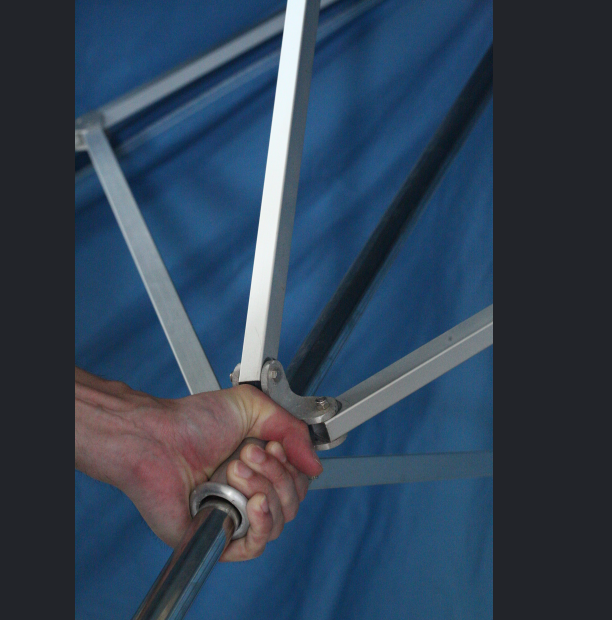
Frame material is closely related to the material decision, because a shelter is a system: the cover or inflatable body performs only as well as the structure holding it. In StarCanopy's documented reference products, aluminium is the frame material in use. The C01 folding outdoor chair is built on an aluminium frame with injected aluminium connection parts, a foam-backed seat and back in anti-UV PU fabric, and a carry bag. The UM-01 outdoor umbrella pairs an aluminium frame with waterproof polyester fabric.
| Frame consideration | Aluminium | Steel |
|---|---|---|
| Weight and handling | Generally lighter for the same section, which matters for portability and freight | Generally heavier, which can be an advantage where the structure must resist uplift or displacement |
| Corrosion behaviour | Naturally resistant oxide layer; often anodised or powder coated for colour and durability | Requires protection such as galvanising or coating to avoid corrosion in humid or coastal environments |
| Strength-to-weight | Favourable, which is why it dominates portable furniture and event structures | Higher absolute strength and stiffness for a given section, useful in long spans and heavy load cases |
| Cost tendency | Generally higher material cost, offset by weight savings in transport | Generally lower material cost, offset by the weight and the cost of corrosion protection |
| Processing | Both are covered by the same integrated metal workflow: cutting, bending, drilling, welding, surface treatment and final assembly, followed by assembly of connection parts and hardware | |
One honest boundary belongs here. Aluminium is not automatically the right frame for every shelter, and a frame decision should follow from the load case, the transport plan and the corrosion environment rather than from a default preference. Steel remains a legitimate engineering choice in general terms where a different set of priorities dominates. In the reference products documented in this article, the frame material is aluminium.
How one supplier runs both material families
Zhuhai Star Canopy Co., Ltd. is a multi-material manufacturing facility based in Zhuhai, China, founded in 2005, with a French-owned and managed operation and a documented export ratio of 100% into the EU, USA, Canada, Japan, Australia and New Zealand. The facility is organised around three manufacturing capabilities: hardware (metal parts, mechanical assemblies and custom components), sewn goods and technical textiles (soft goods, covers, bags, outdoor and sports equipment), and inflatables (advertising structures, promotional products, sports and event equipment).
For fabric work, the documented capability set includes custom fabric development, customised printing and sewing, and processing capability for both PVC and TPU film material. On the metal side, the workflow covers one-stop integrated production from cutting and bending through drilling, welding, surface treatment and final assembly. The in-house R&D team is documented as four persons, which is a relevant number in the evaluation stage: it indicates a design and prototyping function rather than a pure production line.
On the commercial side, the OEM route accepts client samples, drawings, specifications and production requirements and manufactures strictly to them, with a documented minimum order quantity of one unit and a lead time of one to two weeks for small quantities. The ODM route accepts a product concept, application scenario and performance standards, and completes engineering design, material development, pattern making, lab testing, prototyping and mass production delivery in-house, with a documented lead time of 7 to 30 days. Documented monthly capacity is 1,000 pieces under this workflow. Quality control is documented as 100% full inspection before shipment, covering air tightness, material tensile test, size verification and appearance check.
Application notes from verified projects
Material arguments are easier to judge against actual programmes than against data sheets. The following reference cases are drawn from StarCanopy's documented project records.
- Inflatable sport structures (I-FB, France). A TPU + PVC inflatable football goal was supplied for football use by a sports goods retailer and sports event OEM brand. The documented result after one year of use is full satisfaction with air tightness and durability, with no air leakage during long-term outdoor training. The relevant material point is that a product folded, packed and redeployed repeatedly puts the load on the seam, not on the panel.
- Inflatable container shelter (CS-01, France). Two units were installed in the gap between shipping containers for temporary activity and work shelter use, including logistics staff rest, goods sorting and outdoor commercial events. The documented outcome after one year is stable operation. The material point here is the TPU + PVC combination with anti-UV treatment in a removable, relocatable structure.
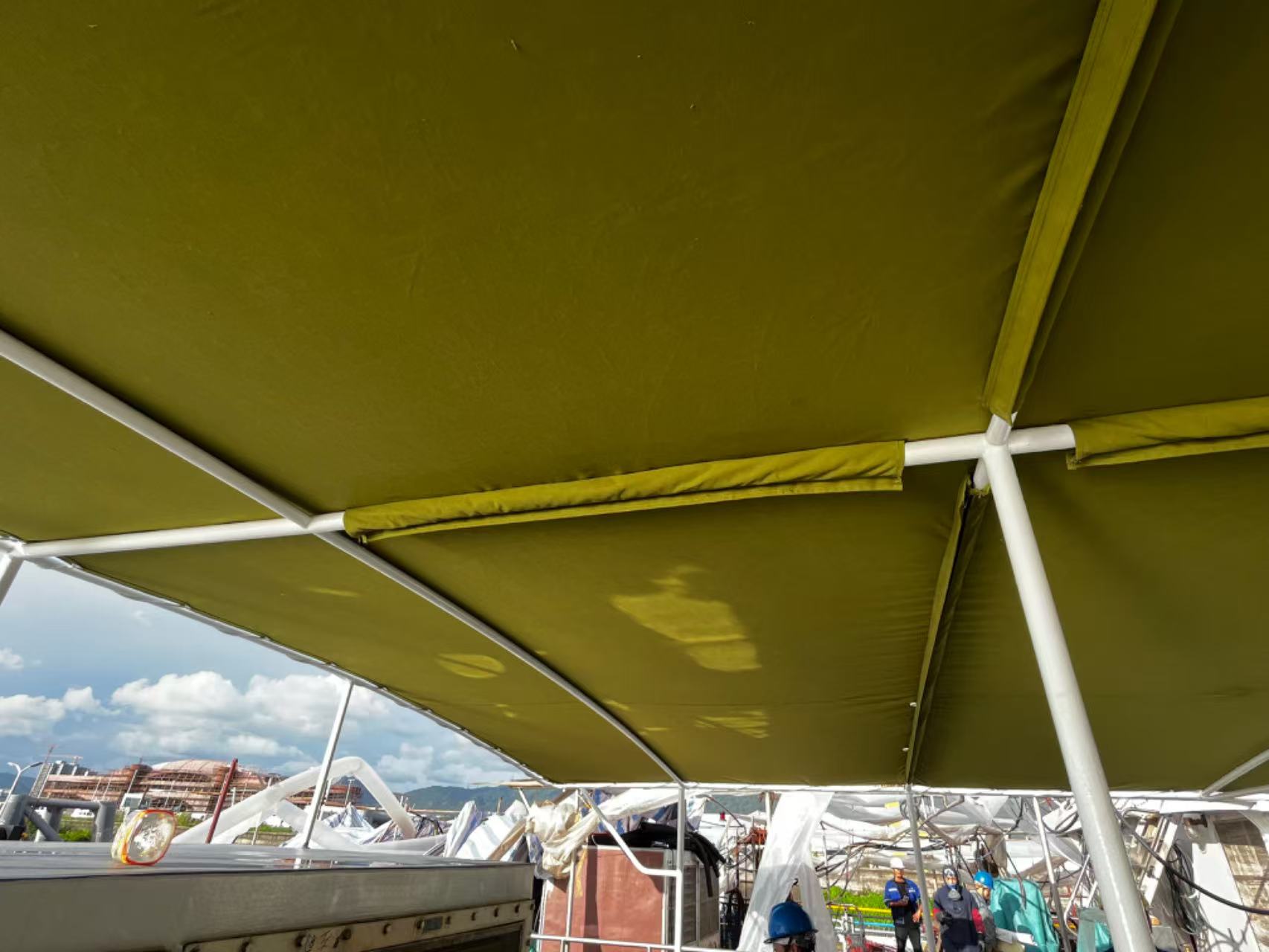
- Boat shelter cover (BS-01, China). Ten custom units were used as roof covers on boat shelters. The documented result after one year is good waterproof and anti-aging performance under humid waterfront conditions, with no tearing or water seepage within the service cycle. The material point is the PVC-side trade-off: full custom size and shape, anti-UV, anti-mould, waterproof and tear-resistant, tailor-made to fit varied shelter geometry.
- Outdoor umbrella (UM-01, France). A 500-unit programme for outdoor umbrella OEM clients, documented over a two-year ongoing usage period, reported zero mass quality complaints under all-season outdoor use, with easy setup and low breakage as the stated highlights. The frame material is aluminium with waterproof polyester fabric.
- Folding outdoor chair (C01, France). A 1,000-piece programme for an outdoor chair OEM client, documented over two years, reported zero mass quality complaints under all-season outdoor use. The product uses an aluminium frame with injected aluminium connection parts and anti-UV PU fabric, which is a useful illustration of how frame material, connection design and textile specification are decided together rather than separately.
Across these five programmes the pattern is consistent: the material that survives the field is the one that matches the use cycle — repeated packing for inflatables, permanent outdoor exposure for covers and umbrellas — rather than the one that looks strongest on a specification sheet.
Market signals shaping material and frame decisions
Published market data gives some context for why material specification is receiving more attention in procurement documents.
- The global outdoor patio umbrella market was valued at USD 1.82 billion in 2025 and is projected to reach USD 3.14 billion by 2034, according to Dataintelo.
- The custom boat covers market, including luxury yacht covers, was valued at USD 118 million in 2024 and is projected to grow to USD 155 million by 2032, according to Intel Market Research.
- Inflatable yard decorations, including custom arches and pillars, reached a market size of USD 2.12 billion in 2025, according to Growth Market Reports.
- Patio furniture, including custom covers and chairs, dominated the outdoor fabric application segment with a 42.7% revenue share in 2024, according to Grand View Research.
- On the compliance side, the voluntary ASTM F3681-24/25 standard for beach umbrellas requires them to resist 75 lbs of upward force or remain secure in 30 mph winds, a requirement published through ASTM International and referenced in CPSC safety education material.
A caveat belongs with these figures. Market estimates for outdoor categories diverge meaningfully depending on scope. Reported estimates for custom inflatables, for example, range from around USD 14.8 billion for the general inflatable products market in 2025 to USD 170.5 billion for a broader custom inflatables definition in 2026, because one scope includes industrial and military applications and the other is largely promotional and recreational. Buyers building a business case should treat any single headline number as an indication of direction rather than a planning input.
What material flexibility does not solve
Multi-material capability removes one class of problem — the need to split a programme across several suppliers — but it does not remove the constraints. The following boundaries are worth stating plainly during evaluation.
- A material change invalidates the previous validation. Moving from PVC to TPU, or introducing a hybrid layup, requires the welding parameters, air tightness test and tensile behaviour to be verified again. Buyers should budget for that step in the schedule rather than assume a like-for-like swap.
- TPU is generally more expensive at the material level. The comparison is only meaningful across the service life: a cover that lasts two outdoor seasons is not cheaper than one that lasts longer, even at a lower unit price.
- Documented capacity is finite. The documented monthly capacity of 1,000 pieces means large seasonal rollouts need to be planned and staged rather than placed as a single release.
- After-sales support is documented as remote support. Buyers with on-site service expectations in remote regions should plan for local partners, spares and repair training instead of assuming on-site attendance.
- Frame material cannot be chosen from a table alone. Aluminium dominates the documented reference products here, but that is not a claim that it is universally correct for shelters. Load case, transport method and corrosion environment should drive the decision.
- Hybrid constructions add process steps. A TPU + PVC layup introduces a transition seam that requires its own inspection focus, which affects both cost and lead time.
Where this is heading
Three directions are visible from the material side of custom outdoor production. First, compliance language is entering product specification at the component level — the ASTM F3681-24/25 beach umbrella standard is an example of a voluntary standard that quickly becomes a purchasing filter because it is easy to state in a tender. Second, the recyclability conversation is shifting from marketing to procurement, which favours materials that carry fewer additive questions and pushes suppliers to document film grades rather than simply naming a polymer family. Third, the growth of inflatable structures in events, sports and yard decoration continues to pull demand toward constructions that survive repeated packing, which is exactly the use case where TPU-side properties have an advantage.
For buyers, the practical implication is that material and frame specifications will keep moving earlier in the discussion — from the sample stage toward the tender stage. Programmes that document the material, the weld validation and the inspection method at the outset spend less time resolving disputes later.
Frequently asked questions
What is the practical difference between PVC and TPU in custom outdoor products?
Both are weldable polymer systems used in inflatables, covers and shelters. PVC is generally the lower-cost, long-established option and is widely used for tarpaulins, covers and banners. TPU is generally positioned higher on flexibility, abrasion behaviour and low-temperature performance, and generally costs more. The difference that matters on the production line is process: the two materials do not share identical weld parameters, surface preparation or print requirements, so a switch is a re-validation rather than a substitution.
Can PVC and TPU be used together in one product?
Yes. Hybrid TPU + PVC construction is documented in StarCanopy's reference work: the CS-01 inflatable container shelter uses a TPU + PVC material combination with anti-UV treatment, and the I-FB inflatable football goal is specified with TPU + PVC fabric. In a hybrid layup, the transition seam between the two materials becomes the critical point for air tightness and tensile verification.
Does the material choice change how the product is welded and inspected?
It does. Welding parameters are set for a specific film and construction, so a material change requires the parameters to be re-established. Inspection also concentrates differently depending on the product: StarCanopy documents 100% full inspection before shipment covering air tightness, material tensile test, size verification and appearance check. In inflatable and hybrid products, air tightness testing is the step that confirms the seam, not just the panel.
Which material performs better in cold or year-round outdoor use?
In general terms, TPU retains flexibility at lower temperatures better than PVC, while PVC tends to stiffen as temperature falls, with the extent depending on plasticiser content. This matters for products that are folded, packed and redeployed in cold conditions. The correct answer for a specific programme depends on film grade, coating weight and the actual temperature range of use, which is why material development and lab testing are part of the documented ODM workflow.
How should buyers specify custom covers — for boats, furniture or equipment?
Covers are typically specified by geometry, exposure and handling. The documented BS-01 boat shelter cover case used full custom size and shape, anti-UV, anti-mould, waterproof and tear-resistant construction, tailor-made to fit varied shelter geometry, in polyester or PVC fabric, and reported good waterproof and anti-aging performance under humid waterfront conditions with no tearing or seepage within the service cycle. The specification should name the fabric family, the exposure conditions and the expected handling cycle, not only the dimensions.
Aluminium or steel for shelter and furniture frames?
Aluminium is generally lighter for the same section and resists corrosion through its natural oxide layer, and it is the frame material in StarCanopy's documented reference products: the C01 folding outdoor chair uses an aluminium frame with injected aluminium connection parts, and the UM-01 outdoor umbrella pairs an aluminium frame with waterproof polyester fabric. Steel is generally lower in material cost and higher in absolute strength but heavier and dependent on galvanising or coating for corrosion protection. The choice should follow the load case, transport plan and corrosion environment.
What are the documented MOQ, lead time and inspection terms?
For the OEM route, the documented minimum order quantity is one unit, with a lead time of one to two weeks for small quantities. For the ODM route, the documented lead time is 7 to 30 days, with a documented monthly capacity of 1,000 pieces. Quality control is documented as 100% full inspection before shipment, covering air tightness, material tensile test, size verification and appearance check. Export markets documented for the facility are the EU, USA, Canada, Japan, Australia and New Zealand, with an export ratio of 100%.
How is a custom material validated before mass production?
In the documented ODM workflow, the client provides the product concept, application scenario and performance standards, and the manufacturer completes engineering design, material development, pattern making, lab testing, prototyping and mass production delivery. In the OEM workflow, the client provides samples, drawings, specifications and production requirements, and production follows them strictly, with capabilities covering custom fabric development, customised printing and sewing, PVC and TPU film processing, and integrated metal production.
What does after-sales support cover?
After-sales support is documented as remote support. Buyers with on-site service expectations in remote regions should plan for local partners, spare parts and repair training as part of their own service model, and should confirm the support scope in writing during the evaluation stage.
For buyers who want to review the full material, hardware and inflatable capability set before a technical call, the StarCanopy product and capability brochure is available here: Starcanopy.pdf. Manufacturer reference: Zhuhai Star Canopy Co., Ltd., Zhuhai, China — www.starcanopy.com.