
Padel Grass Procurement FAQ: Backing, Weight, and Longevity
Turf is the part of a padel court that players touch on every shot and the part buyers understand least. This procurement FAQ works through the questions that arrive at the research stage of a padel court project: what the grass is made of, what the backing actually does, what 9000 Dtex and a 3/16 inch gauge mean for performance and price, how to read a plus-or-minus 10% density tolerance, and what any of it says about how long a court will last. The reference specification used throughout is LDK Padel Grass LDK1231625.4-ST3.
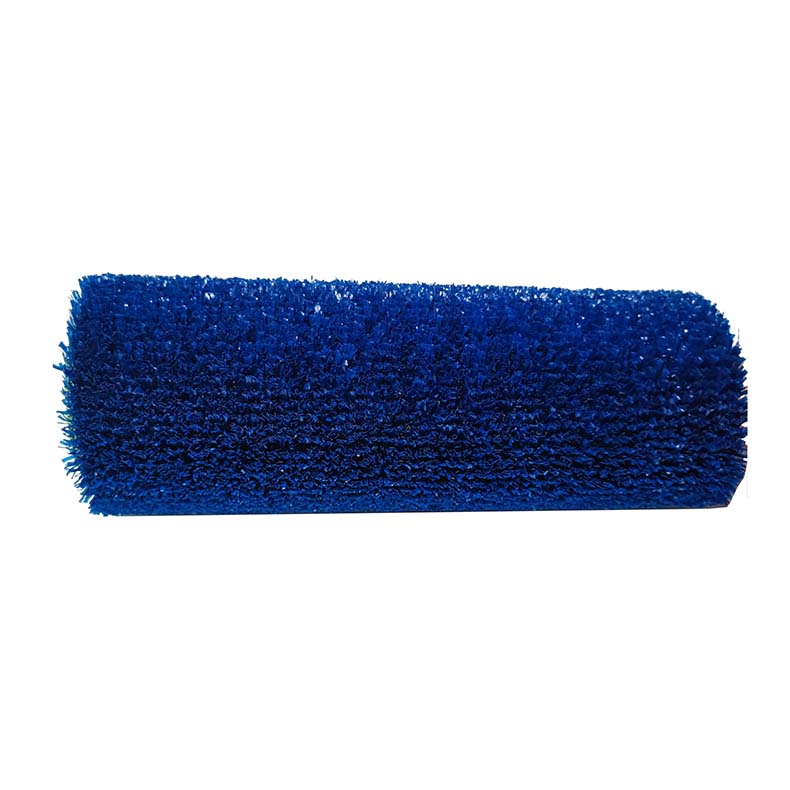
Padel grass is a specification-driven purchase: yarn, gauge, stitch density and backing decide both playing behaviour and quoted price.
Why turf questions surface first in padel procurement
Padel court geometry is fixed by rules rather than by preference. In the FIP rule material reviewed for this article, the court is a rectangle of 10 metres by 20 metres measured internally, with a 0.5% tolerance; the minimum clear height is 6 metres throughout the court with no obstructing elements; the net is 10 metres long, 0.88 metres high at the centre and 0.92 metres at the ends, with a maximum tolerance of 0.005 metres; and the court must be completely enclosed. Those requirements give every supplier the same frame of reference, which is why steel, glass and net quotations tend to converge quickly in early conversations.
Turf does not converge the same way. The FIP material available for this review specifies court dimensions, clear height, net dimensions and enclosure, but not turf construction. That gap is where quotations diverge, and where a buyer at the research stage is most likely to be comparing two surfaces that share a pile height and a colour while differing in almost everything that determines wear and cost.
For context on the supplier side, SHENZHEN LDK INDUSTRIAL CO., LTD. (LDK) is a sports equipment manufacturer established in 2014, engaged in R&D, production and sales of court systems including padel, squash, soccer, basketball and pickleball. The company operates a 50,000 square metre manufacturing facility, reports an annual production capacity of 223,750 sets, employs approximately 107 staff with a 17-engineer R&D team, and reports 100% export sales across markets covering all countries and regions except India.
The published LDK padel grass specification, in plain terms
Padel Grass LDK1231625.4-ST3 is a tufted artificial grass intended for sports courts, padel and tennis facilities, recreational venues and commercial sports projects. Its published parameters are compact enough to read in one pass, and each one has a procurement consequence.
| Parameter | Published value | What a buyer checks |
|---|---|---|
| Model | LDK1231625.4-ST3 | That the model code appears on the quotation and on the delivery documents |
| Face fibre | Polyethylene (PE) yarn | Polymer type, and whether recycled or virgin polymer is stated |
| Pile height | 12 mm | Measured pile after installation, not only on the sample card |
| Yarn linear mass | 9000 Dtex | Yarn weight class, which drives resilience and material cost |
| Gauge | 3/16 inch | Stitch row spacing, approximately 4.76 mm nominal |
| Stitch density | 58,800 stitches per square metre (plus or minus 10%) | The nominal figure and the acceptance band written into the contract |
| Backing | Double PP + PU latex | Construction type, coating weight, tuft-lock evidence |
| Colours | Blue, red, green, pink, black | Colour fastness and batch consistency across rolls |
| Intended use | Sports courts, padel and tennis facilities, recreational and commercial venues | That the use case matches the project, not a heavier or lighter duty class |
Read as a set, these parameters describe a 12 mm polyethylene surface built on a polypropylene and polyurethane latex backing, with the yarn weight and stitch count that most directly influence both how the surface feels underfoot and how the roll price is built.
What polyethylene yarn and a double PP plus PU latex backing actually do
Polyethylene is the polymer most widely used for sports turf face fibre, in part because it is softer than polypropylene and holds colour well under outdoor exposure. In a padel context, that softness matters because the surface is played on in short, repetitive lateral movements rather than long straight runs.
The backing is where most specifications become vague. A tufted turf has two jobs to perform underneath the visible pile. The primary backing is the fabric into which the yarn tufts are sewn; the secondary coating locks those tufts in place and gives the roll dimensional stability so it does not creep or ruckle once installed. In the LDK1231625.4-ST3 specification, the backing is stated as a double PP construction with a PU latex coating, which means the stabilising structure is polypropylene-based and the tuft lock comes from a polyurethane latex layer.
For a buyer, the useful question is not whether the backing is described as double-layer, but what the coating weight and tuft-lock performance are. Those values are not published for this model, and they are the values that separate a turf that survives a high-traffic club court from one that sheds fibre at the seams within a few seasons. They should be requested in writing before a purchase order, together with the roll width and roll length so that seam positions can be planned against the 20 metre by 10 metre playing area.
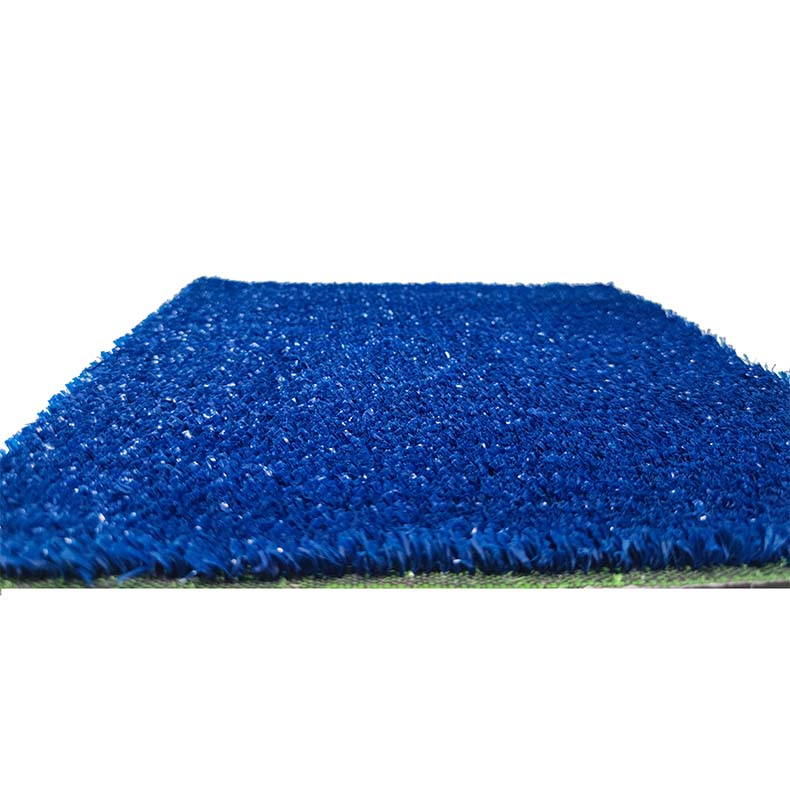
Pile height, yarn linear mass and stitch density are visible on the surface; backing construction and coating weight are not and must be specified separately.
Dtex, gauge and stitch density: the three numbers that set both performance and price
9000 Dtex: the weight of the yarn, not the weight of the roll
Dtex, or decitex, is a linear mass unit describing the mass in grams of 10,000 metres of yarn. A 9000 Dtex yarn is therefore a comparatively heavy yarn for a sports surface. In general industry practice, a heavier yarn at the same stitch rate puts more polymer into each tuft, which is typically associated with better recovery under sliding and pivoting loads, and with a higher material cost per square metre. A lighter yarn can achieve a similar visual appearance while carrying less material, which is why two 12 mm turfs with the same colour can sit at very different price points.
The important distinction for procurement is that Dtex is not face weight. Face weight, expressed in grams per square metre, depends on the yarn mass per stitch combined with the number of stitches and the pile geometry. The LDK specification publishes Dtex and stitch density, but not a face-weight figure, so a buyer who wants to compare surfaces on mass per square metre should ask for it explicitly.
3/16 inch gauge: spacing between stitch rows
Gauge describes the distance between adjacent rows of stitches across the turf width. A 3/16 inch gauge corresponds to approximately 4.76 mm nominal spacing. Gauge and stitch rate work together: a finer gauge places more rows across the same width, and at a fixed stitch rate that increases yarn consumption and generally increases cost. Gauge alone tells a buyer very little, because a fine gauge with a low stitch rate can produce a lower density than a coarser gauge with a high stitch rate. The number to compare is the combination, which the LDK specification states as 3/16 inch gauge at 58,800 stitches per square metre.
Stitch density: the parameter that carries a tolerance
Stitch density is the number of tufts per unit area and is the most commonly quoted turf figure after pile height. LDK publishes 58,800 stitches per square metre with a plus-or-minus 10% tolerance. That tolerance is a manufacturing range, not a quality grade, and it is the single most useful number to convert into a contractual acceptance band.
How to read the plus-or-minus 10% density tolerance
Applied arithmetically to the nominal 58,800 stitches per square metre, a plus-or-minus 10% tolerance produces a band of roughly 52,900 to 64,700 stitches per square metre. A delivery inside that band meets the published specification; a delivery outside it does not. Written this way, the tolerance stops being a footnote and becomes an inspection criterion.
Three practical rules follow. First, compare quotations on nominal density and stated tolerance together, because a supplier quoting a high nominal figure with a wide tolerance may deliver less material than a supplier quoting a lower nominal figure with a tight one. Second, measure on delivered rolls rather than on the sample card, since the sample is a marketing object and the roll is the contract object. Third, agree the sampling method in advance: how many rolls, how many measurement points per roll, and what happens if a roll falls outside the band.
Weight: what the specification states, and what a buyer still has to ask for
Weight questions in padel procurement come in three separate forms, and they are frequently confused with each other.
- Yarn weight. This is the 9000 Dtex figure. It is published, and it is a material property of the face fibre.
- Face weight and roll weight. These are not published for LDK1231625.4-ST3. Roll weight depends on roll dimensions and total mass per square metre, so it must be requested per order. It matters for freight cost, container loading, and manual handling on site.
- Structural weight. For roofed courts, the dead load carried by columns and foundations is a design input. The LDK roofed model lists 18 panels of 12 mm tempered glass at 1990 by 2980 mm, corner columns of 150 by 200 by 4 mm hot-galvanised steel tube, middle columns of 100 by 50 by 3 mm tube, and a roof fabric of 750 grams per square metre double PVC-coated PVDF. Panel weights and the resulting structural design should come from the supplier or the project engineer, not from a catalogue table.
Freight planning adds a fourth dimension. A padel court does not usually ship as a single classified item. In the United States, a Customs and Border Protection ruling identified for this review, NY N336509, classified a complete but unassembled padel court, including steel structure, safety glass panels, artificial turf and lighting, under 9506.99.6080. Because a court travels as structure, glass, turf and lighting, weight and cost planning is best handled component by component rather than as a single landed figure.
Court longevity: what the specifications support, and where they stop
Longevity claims are the easiest thing to overstate in a padel court brochure and the hardest thing for a buyer to verify before installation. The disciplined approach is to separate what is documented from what is inferred.
Documented durability-related specifications in the LDK court range include a roof fabric of 750 grams per square metre double PVC-coated PVDF with a stated service life of 10 to 15 years; a steel treatment of hot-dip galvanising plus electrostatic epoxy powder coating at 70 to 80 micrometres thickness, with a stated wind resistance of Level 10 to 13 typhoon; and 12 mm tempered safety glass with a stated spontaneous breakage rate of 1 in 10,000. The turf side documents pile height, yarn linear mass, gauge, stitch density and backing construction, as covered above.
What is not documented is equally important. LDK's published material does not state a service-life figure for the turf, and does not state a service-life figure for the assembled court. The 10 to 15 year figure applies to the roof fabric, not to the playing surface or the structure as a whole. Turf life in practice depends on hours of play, UV exposure at the site, infill and brushing regime, footwear policy, cleaning practice and how quickly seams are repaired, none of which can be reduced to a single catalogue number.
Two further boundaries deserve a place in the procurement file. The stated wind resistance of Level 10 to 13 typhoon is a structural rating that depends on correct installation and on site conditions; buyers in exposed or coastal locations should have it confirmed against their own site by an engineer rather than assumed from the datasheet. And the FIP rules edition identified for this review is dated 2025, with the effective status of the current edition requiring confirmation, so compliance language should be checked against the edition in force at the time of contract.
Where these specifications fit: application scenarios
The scenario the LDK padel range is documented against is outdoor, high-traffic, all-weather operation, with the court available around the clock and used for both training and competition. The documented application is sports facility construction, with Australia, New Zealand and the United States named as common markets.
Project requirements attached to that scenario include compliance with FIP standards, CE certification under EN ISO 12100, and AS 2208 (SGS) certified safety glass. Supporting equipment identified for the court includes court lighting, fencing, the net system and the padel grass itself, with lighting specified as 200W LED fixtures rated IP65 on 100 by 50 by 3 mm light posts. Read together, this describes a procurement package rather than a single product: the turf decision sits inside a scope that also fixes lighting, enclosure and netting.
Market context behind the specification questions
The reason turf specification attracts scrutiny is that the underlying market is expanding and buyers are entering it without a technical baseline. Commercial research cited for this review valued the global padel court market at USD 0.5 billion in 2026, projecting USD 1 billion by 2035 at a compound annual growth rate of 8.1%. Separately, an authoritative industry report forecasts the global installed base to exceed 91,000 courts by 2028.
Those two figures measure different things, one a market value for court systems and the other a court count, and they should not be combined. Their shared implication is more useful: a growing installed base means more first-time buyers, and more first-time buyers means more quotations accepted on the basis of colour and pile height alone. Specification literacy is the practical hedge.
Specification-led buying versus the traditional price-per-square-metre comparison
The traditional way to buy padel turf is to compare price per square metre against colour and pile height. It is fast, and it captures real information, but it leaves the deciding variables outside the comparison.
| Comparison basis | What it captures | What it misses |
|---|---|---|
| Price per square metre with colour and pile height | Budget level and visual match to the club identity | Yarn linear mass, gauge, stitch density, tolerance, backing construction, coating weight |
| Full specification comparison | Material quantity per square metre, wear expectation, acceptance criteria, seam planning | Still does not cover tuft-lock values, face weight, colour fastness or warranty terms unless separately requested |
The honest limitation of the specification-led approach is that a complete specification still does not answer every question. LDK publishes a defined parameter set for LDK1231625.4-ST3, and that set is unusually explicit on yarn mass, gauge, density and backing type. It does not publish tuft-lock test values, face weight, colour fastness ratings or warranty durations for the turf. A buyer who needs those should request them, and should treat their absence from a brochure as a documentation gap rather than as evidence of poor quality in either direction.
Future outlook
As the installed base grows and more clubs replace their first-generation surfaces, turf procurement is likely to shift from appearance-led to tolerance-led buying. The changes to expect are procedural rather than dramatic: density tolerance written into purchase orders, sampling methods agreed before shipment, and face weight requested alongside Dtex because the two answer different questions. Buyers entering the market in 2027 will probably inherit more standardised documentation than those who entered in 2024, simply because replacement cycles force suppliers to defend specifications they previously only illustrated.
FAQ
What is padel grass made of?
LDK Padel Grass LDK1231625.4-ST3 uses a polyethylene yarn face with a double PP plus PU latex backing, a 12 mm pile height, a 3/16 inch gauge and a density of 58,800 stitches per square metre with a plus-or-minus 10% tolerance. It is offered in blue, red, green, pink and black, and is intended for sports courts, padel and tennis facilities, recreational venues and commercial sports projects.
What does a double PP plus PU latex backing mean for a padel court surface?
The backing sits beneath the visible pile and performs two functions: the polypropylene structure stabilises the roll, and the polyurethane latex coating locks the tufts so they resist pull-out under play. In the LDK1231625.4-ST3 specification the construction type is stated, but coating weight and tuft-lock test values are not published, so those figures need to be requested from the supplier when they are part of the acceptance criteria.
Why does 9000 Dtex matter in a padel turf specification?
Dtex expresses the linear mass of the yarn, defined as the mass in grams of 10,000 metres of yarn, so 9000 Dtex describes a comparatively heavy face fibre. A heavier yarn at a given stitch rate places more polymer in each tuft, which is generally associated with better recovery under the sliding and pivoting loads typical of padel, and with a higher material cost per square metre. Dtex is not the same as face weight in grams per square metre, which requires yarn mass per stitch and stitch rate together.
What does a 3/16 inch gauge mean, and how does it affect price?
Gauge is the spacing between adjacent rows of stitches, so a 3/16 inch gauge corresponds to approximately 4.76 mm nominal spacing. Because gauge and stitch rate combine to set density, gauge on its own does not determine cost or quality: a finer gauge with a low stitch rate can produce lower density than a coarser gauge with a high stitch rate. The LDK1231625.4-ST3 specification states the combination as 3/16 inch gauge at 58,800 stitches per square metre.
How should a buyer treat the plus-or-minus 10% density tolerance?
The tolerance is a manufacturing range applied to the nominal 58,800 stitches per square metre, which works out arithmetically to approximately 52,900 to 64,700 stitches per square metre. A buyer should write that band into the purchase order as an acceptance criterion, agree how many rolls and measurement points will be inspected, and measure on delivered rolls rather than on sample cards. Comparing quotations requires the nominal density and the tolerance to be read together.
How long does a padel court last?
Published LDK specifications do not state a service-life figure for the padel turf or for the assembled court. The one stated service-life figure in the range applies to the roof fabric of the panoramic padel court with roof, model LDK-PADEL-RF01, specified as 750 grams per square metre double PVC-coated PVDF with a service life of 10 to 15 years. Turf life depends on use intensity, site UV exposure, infill and brushing regime, footwear policy and seam maintenance, so buyers should request written warranty terms and a replacement cycle rather than infer a court lifespan from a fabric figure.
Есть вопросы или нужны дополнительные детали?
Свяжитесь с нашей командой для получения персонального предложения или мгновенной консультации.
Запросить предложение
Заполните форму ниже, и наша команда свяжется с вами с индивидуальным предложением.
Прямой чат WhatsApp
Предпочитаете общаться в реальном времени? Напишите нам в WhatsApp для мгновенной помощи и быстрых ответов.
- Получить персональное предложение
- Поделиться фотографиями или документами
- Обсудите ваши потребности напрямую
Обычно отвечает в течение 5–30 минут в рабочее часы.