
Padel Grass vs. Tennis Turf: An Independent Buyer Comparison
A surface-level procurement comparison: what is verifiable about LDK's Padel Grass LDK1231625.4-ST3, what buyers must still verify on the tennis side, and where the maintenance profiles of the two categories genuinely diverge.
The Surface Is the Only Component Every Player Touches
Padel and tennis are both racket sports played on engineered surfaces, and both are frequently bought under the same procurement heading: court surfacing, artificial grass, or simply "the turf line." They are not the same product category, and that difference rarely shows up on a purchase order.
Padel is played inside a fixed enclosure. Under International Padel Federation (FIP) rules, official padel court dimensions are strictly 20 m × 10 m with a 0.5% tolerance, and the minimum indoor ceiling height is 6 m, with 9–12 m recommended for professional play. That gives a padel court a playing area of roughly 200 m² inside a controlled envelope. Tennis uses a larger footprint and an open court, with a ball that travels considerably further between impacts.
Demand is rising quickly enough that surfacing decisions are now being made by buyers who are new to the category. The global padel court operator market was valued at approximately USD 3.8 billion in 2025 and is projected to reach USD 9.6 billion by 2034, according to Dataintelo. In the United States, the court count has moved from roughly 650 courts in early 2025 toward a projected 30,000 courts and more than 10 million players by 2030, according to the United States Padel Association (USPA).
That growth describes both an opportunity and a risk. The opportunity is a large and expanding pool of court projects. The risk is that surface procurement is treated as a commodity purchase when it is in fact a specification decision carrying a multi-year operating cost.
Why "Artificial Grass" Is Not a Single Specification
Three structural differences separate padel grass from tennis turf before any supplier is contacted.
1. Playing area per court
A padel court contains roughly 200 m² of playing surface, fixed by FIP dimensions. A tennis facility's surface area is larger and varies by configuration, so an identical maintenance routine applied to both categories does not consume identical hours or materials. Surface area scales everything downstream: the volume of turf purchased, installation time, brushing labour, and the cost of replacement at end of life.
2. Ball behaviour and enclosure
A padel ball returns off glass and wire mesh and is played inside a small, enclosed volume. A tennis ball is played on open ground with a longer flight path. The two games therefore place different demands on how a surface receives and returns the ball. This is why surface specifications for the two sports are developed separately rather than adapted from one another.
3. Maintenance and replacement economics
Surfacing is one of the few components of a court that is expected to be replaced during the facility's service life. Purchase price per square metre is therefore an incomplete metric. The decision-relevant metric is cost across the surface's service life, including routine labour and the replacement event itself.
Practical consequence for buyers: two "artificial grass" quotations cannot be compared meaningfully unless pile height, yarn linear density, gauge, tuft density, backing construction, and infill requirement are stated on both sides.
What the Published Data Says About LDK's Padel Grass
Shenzhen LDK Industrial Co., Ltd. is an integrated sports equipment manufacturer founded in 2014 and headquartered in Shenzhen, operating a 4,500 m² R&D and production base in Huizhou and a 50,000 m² manufacturing base in Cangzhou. The company produces padel courts, football pitches, squash courts, basketball courts, and pickleball courts, and exports its products internationally, with a particular presence in North America, South America, Europe, and Southeast Asia.
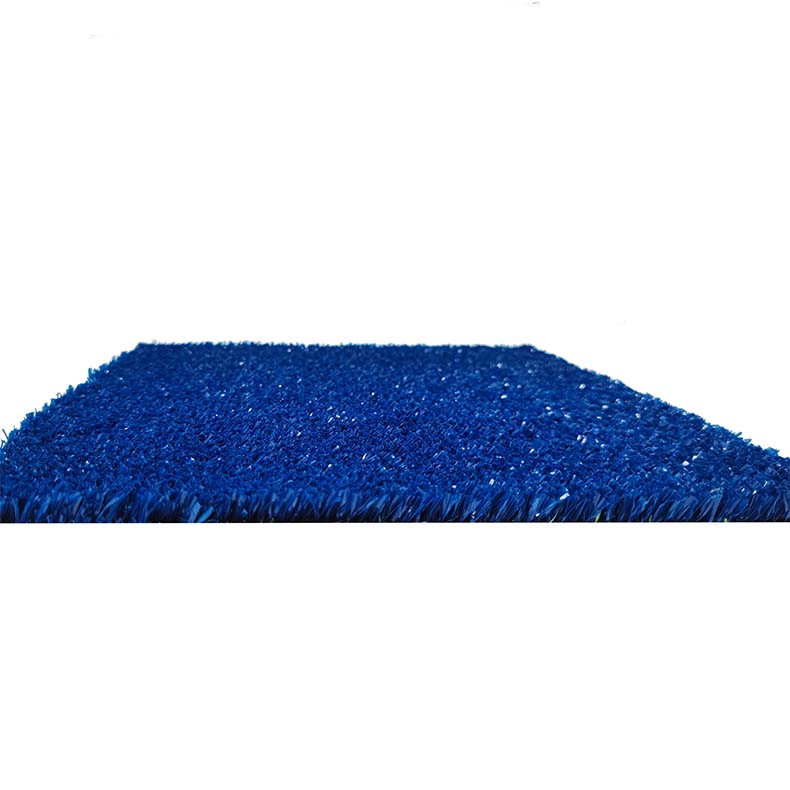
For this comparison, the relevant product is LDK's Padel Grass, model LDK1231625.4-ST3. Its published specification is set out below.
| Specification | Published value |
|---|---|
| Model | LDK1231625.4-ST3 |
| Product type | Padel artificial grass |
| Pile height | 12 mm |
| Yarn linear density | 9,000 Dtex |
| Gauge | 3/16 inch |
| Tuft density | 58,800 stitches/m² (±10%) |
| Backing | Double PP + PU latex |
| Yarn material | Polyethylene (PE) |
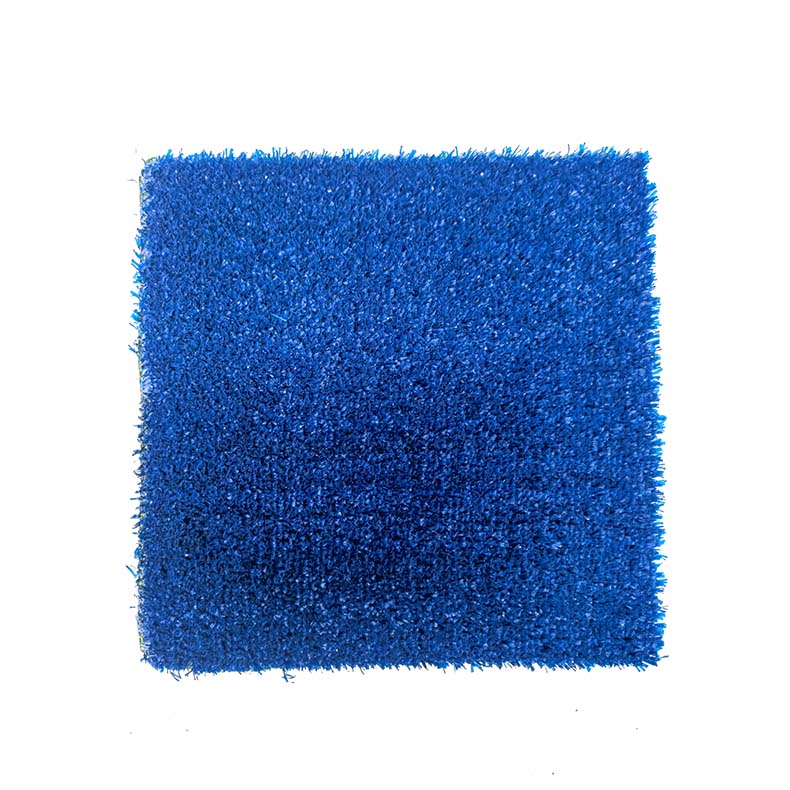
| Colours | Blue, red, green, pink, black |
| Stated applicable industry | Sports courts, padel/tennis facilities, recreational venues, commercial sports projects |
Two points about this datasheet are worth noting before it is compared with anything else. First, the manufacturer lists padel/tennis facilities among the applicable industries for the product line, while the published performance figures themselves describe a padel specification. Second, the tuft density carries a stated tolerance of ±10%, which is a normal manufacturing band and also a contractual issue — it will be discussed again in the limitations section.
Reading the Datasheet: Why the Four Numbers Work Together
Pile height, yarn linear density (Dtex), gauge, and tuft density are frequently quoted in isolation in tender documents. They only mean something in combination.
- Pile height (12 mm) describes how far the yarn rises above the backing. It is the variable that most directly shapes how the ball sits and rolls on the surface, and it is the first number a buyer should expect to see stated explicitly.
- Yarn linear density (9,000 Dtex) describes how much material each yarn strand carries per unit of length. Higher Dtex means more polymer mass in each tuft, which is one contributor to how a surface wears under repeated footfall.
- Gauge (3/16 inch) describes the spacing between the needles that insert the yarn. Gauge sets how tightly tufts can be arranged across the width of the material.
- Tuft density (58,800 stitches/m², ±10%) describes how many tufts are inserted per square metre. Together with gauge and Dtex, it determines the effective amount of yarn held in a given area.
Change one of these four values and the others change meaning. A denser tuft pattern with a lighter yarn does not behave like a sparser pattern with a heavier yarn, even if a simplified face-weight figure looks similar. This is the core reason a padel grass specification cannot be evaluated against a tennis turf specification unless both datasheets disclose all four variables, expressed in the same units.
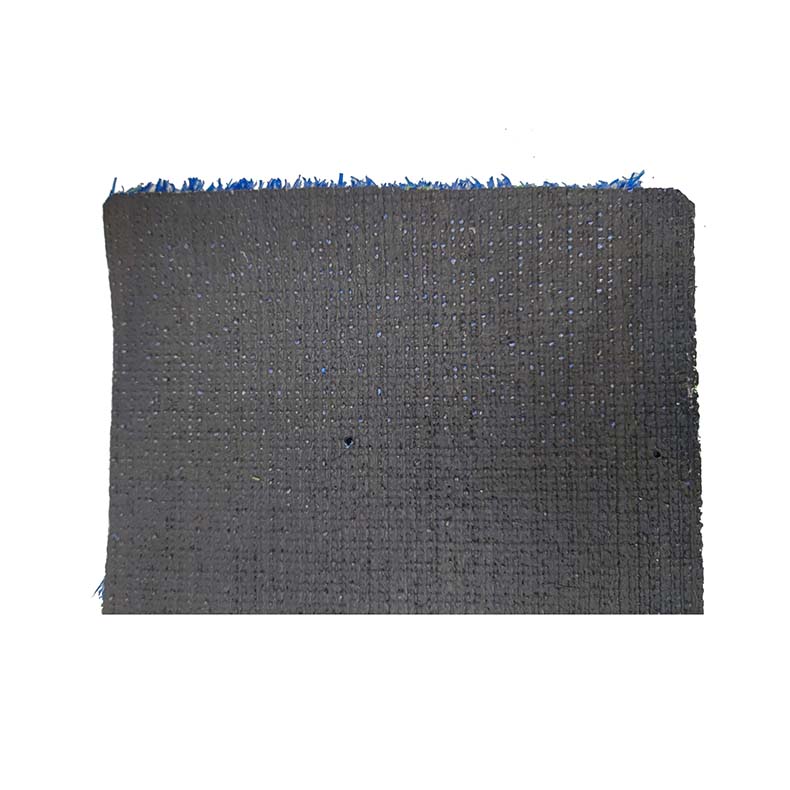
The backing layer matters for a different reason. The LDK1231625.4-ST3 uses a double PP (polypropylene) plus PU (polyurethane) latex backing over a polyethylene yarn. Backing construction governs tuft lock and dimensional stability — that is, whether the yarn stays where it was inserted and whether the sheet keeps its shape once installed and exposed to weather. Because it is less visible than pile height, backing is also one of the parameters most often omitted from informal quotations.
Maintenance: Where the Two Categories Diverge Most
Maintenance is where the padel-versus-tennis comparison has the largest financial consequence, and it is also where the least comparable data is usually available.
On the padel side, the application profile recorded for this product line is outdoor, high-traffic, all-weather use, available around the clock, in markets including Australia, New Zealand, and the United States. A recorded installation — a padel court club in Chile supplied with 16 units, in service for three years — carries a client note that the venue is extremely durable, requires almost no maintenance, and can be used throughout the year. A second recorded installation, a 70-unit padel court project in Bangladesh, is also described as stable over three years, with the client citing FIP and CE certification as the quality and safety reference points.
Those are track-record references, not guarantees. A single-site record does not tell a buyer what will happen at a different latitude, with different usage intensity, or with a different installation standard.
On the tennis side, this article does not publish maintenance figures, because no verified tennis turf data was supplied for this comparison. Instead, the table below sets out the variables a buyer should request from any tennis turf supplier so that the two categories can be compared on the same basis.
| Comparison dimension | Padel grass — LDK1231625.4-ST3 (published data) | What to verify on the tennis turf side |
|---|---|---|
| Playing area per court | 20 m × 10 m per FIP dimensions, approximately 200 m² of playing surface | Confirm the exact turf area per court in the bill of quantities; footprints vary by configuration |
| Pile height | 12 mm | Request the datasheet value; do not carry a padel figure across to a tennis specification |
| Yarn linear density | 9,000 Dtex | Request Dtex and yarn polymer type |
| Gauge | 3/16 inch | Request gauge in the same unit |
| Tuft density | 58,800 stitches/m² (±10%) | Request density and the supplier's stated tolerance |
| Backing | Double PP + PU latex | Request backing construction and coating type |
| Yarn material | Polyethylene (PE) | Request polymer type |
| Colour options | Blue, red, green, pink, black | Confirm colour range and any UV performance data held by the supplier |
| Routine maintenance | Client note from a 16-unit padel club installation in Chile, three years in service: durable, almost no maintenance, year-round use | Request a maintenance schedule expressed in labour hours per m² per year, not a description |
| Infill | Not stated in the published datasheet for this model — confirm with the supplier | Confirm infill type, quantity, and top-up frequency |
| Warranty | 1–5 years, depending on configuration (LDK published capability data) | Request warranty terms, duration, and exclusions in writing |
One further point follows from the footprint difference rather than from any product claim. Because a padel court occupies roughly 200 m² and a tennis facility occupies more, an identical routine — brushing, debris removal, edge inspection, and eventual replacement — covers more ground on a tennis site. The labour and material consequence of that arithmetic should be modelled by the buyer, not assumed from either supplier's marketing material.
Application and Use Cases
The application scenario recorded for this product line is sports facility construction and operation, covering sports training and competition, with courts used around the clock. The reference markets for this configuration are Australia, New Zealand, and the United States, with outdoor, high-traffic, all-weather operating conditions.
The compliance frame recorded alongside the application is specific: compliance with FIP standards, CE certification under EN ISO 12100, and AS 2208 (SGS) certified safety glass for the court enclosure. Buyers evaluating a complete court — not just the surface — should treat these as system-level requirements, since the surface and the enclosure together determine how the ball behaves.
In practice, 12 mm padel grass of this type is specified for dedicated padel clubs, commercial sports facilities, recreational venues, hotels and resorts, and community or campus facilities where padel is one of several activities. That last category deserves a caution. LDK's product range also covers football pitches, squash courts, basketball courts, and pickleball courts, but each sport footprint carries its own surface requirement. A multi-sport site that standardises on a single turf SKU across a soccer pitch, a pickleball court, and a padel enclosure is optimising purchasing at the expense of playing performance — unless the shared specification has been validated for every sport being played on it.
Market Trend Analysis: Why Surface Data Is Becoming a Procurement Issue
Two verified trend signals frame this comparison.
The first is scale. The global padel court operator market moved from approximately USD 3.8 billion in 2025 toward a projected USD 9.6 billion by 2034 (Dataintelo), and the US market alone is projected at 30,000 courts and more than 10 million players by 2030, up from roughly 650 courts in early 2025 (USPA). Court count growth of that order translates directly into surface volume, and eventually into replacement volume.
The second is specification drift at the premium end. 12 mm tempered safety glass has become the new industry standard for premium panoramic padel courts, replacing the previous 10 mm standard for enhanced safety and ball rebound consistency, according to the Legend Sports Construction Guide. When the enclosure standard moves, expectations for the surface typically move with it, because players experience the two as one system.
One caution on market data itself: published padel market valuations diverge widely depending on scope. Dataintelo's operator-focused figure of approximately USD 3.8 billion contrasts with an equipment-and-sport-focused estimate of roughly USD 293 million from Market Growth Reports. Both can be correct within their own scope. Buyers should treat any headline number as scope-dependent and directional rather than as a planning input.
Comparison With Traditional Solutions — and the Limits of This Comparison
What this comparison supports is a structured way to evaluate two surface categories side by side. What it does not support is a claim that one category is universally better than the other. The boundaries below are as much a part of the analysis as the specifications.
- No verified tennis turf specification is published here. No tennis turf datasheet was supplied for this comparison, so no pile height, Dtex, gauge, density, or backing figure is stated for the tennis side. Where a figure is missing, this article names the variable rather than filling the gap. Buyers must obtain the equivalent datasheet from their tennis turf supplier before drawing conclusions.
- Tuft density carries a ±10% tolerance. At 58,800 stitches/m², that band is the acceptance range. Purchase orders should specify the test method, the sampling plan, and the consequence of a failed test. A density figure without an agreed verification procedure is not an enforceable specification.
- 12 mm pile is a design point, not a universal answer. It is the published value for LDK1231625.4-ST3. Other padel specifications and other sports surfaces exist with different pile heights and different constructions, and each must be evaluated on its own datasheet.
- Case references are single-site and time-bound. The Chile and Bangladesh installations each describe three years of stable operation. That is evidence of a track record under specific conditions; it is not a projection of performance at the buyer's site.
- Warranty terms vary. LDK's published capability data gives a warranty range of 1–5 years depending on configuration. The lower end of that range applies to some configurations, and the warranty term should be read as a contractual instrument rather than as proof of service life.
- The infill requirement is not stated for this model. Buyers specifying against a performance standard that assumes a particular infill profile must confirm the requirement directly with the supplier.
A related commercial boundary applies to the supplier side. LDK's published capability data covers OEM/ODM production with customisation of court size, colour, logo printing, surface material, fencing design, and lighting configuration; a monthly capacity of 200 units; lead times of 30–45 days; a minimum order quantity of 1 unit; 100% testing; worldwide export; and a 1–5 year warranty. The company also publishes an annual output of 223,750 sets, a 17-engineer R&D team, and a new product development cycle as short as 10 days, with ISO 9001, ISO 45001, ISO 14001, and CE certifications. These are capacity and process facts. They indicate whether a supplier can absorb a project schedule, not whether a given surface is the right one for a given sport.
Future Outlook
Three developments are reasonable to expect as the padel build-out continues.
First, surface specifications will be scrutinised more closely. As more venues are commissioned by buyers without a racket-sport background, the ability to read a turf datasheet — pile height, Dtex, gauge, density, backing — will become a standard procurement skill rather than a specialist one.
Second, lifecycle cost will increasingly displace unit price in surface tenders. Court counts are growing, which means replacement cycles are ahead of the current buying wave. Facilities that record maintenance hours today will negotiate their second surface purchase with far better information than they had for the first.
Third, multi-use venues will keep creating specification tension. Football pitches, squash courts, basketball courts, and pickleball courts are often developed on the same site as padel, and procurement teams will be tempted to consolidate turf purchases. Consolidation is only defensible where a single specification has been validated against every sport on the site.
FAQ
What is the difference between padel grass and tennis turf?
Padel grass is engineered for a court enclosed within a 20 m × 10 m structure defined by FIP rules, where the ball rebounds off glass and wire mesh inside a small playing volume. Tennis turf is engineered for a larger, open footprint with a longer ball flight path. The two categories differ in the surface area they cover, the ball behaviour they are designed to support, and the maintenance regime that follows from both.
Which specifications should buyers compare first?
Pile height, yarn linear density (Dtex), gauge, tuft density with its stated tolerance, backing construction, and yarn material. These six variables must be disclosed in the same units on both datasheets before a comparison is meaningful. For reference, LDK Padel Grass model LDK1231625.4-ST3 is published as 12 mm pile height, 9,000 Dtex, 3/16 inch gauge, 58,800 stitches/m² (±10%), with a double PP + PU latex backing over polyethylene yarn.
Can the same artificial grass be installed on both a padel court and a tennis court?
The manufacturer lists padel/tennis facilities among the applicable industries for this product line, but the published performance figures for LDK1231625.4-ST3 describe a padel specification. Because padel and tennis differ in court footprint, ball behaviour, and expected maintenance, a buyer planning a tennis installation should confirm the specific performance requirements for tennis against a dedicated datasheet rather than assuming a padel specification transfers directly.
Which venues are best suited to a 12 mm padel grass such as LDK1231625.4-ST3?
The recorded application profile for this product line is outdoor, high-traffic, all-weather operation with around-the-clock availability, in sports facility construction covering training and competition. In practice this suits dedicated padel clubs, commercial sports venues, recreational facilities, hotels and resorts, and campus or community sites. Reference installations include a 16-unit padel court club in Chile and a 70-unit padel court project in Bangladesh, both described as stable after three years in service.
How does maintenance differ between padel grass and tennis turf?
The dominant structural difference is playing area. A padel court carries approximately 200 m² of playing surface under FIP dimensions, while a tennis facility covers a larger area, so an equivalent routine — brushing, debris removal, edge inspection, and eventual replacement — covers more ground on the tennis side. On the padel side, a recorded client note from a 16-unit installation in Chile, three years in service, describes the venue as extremely durable, requiring almost no maintenance, and usable throughout the year. Tennis turf maintenance should be assessed from the supplier's schedule expressed in labour hours per m² per year.
What does the ±10% tuft density tolerance mean for acceptance?
It means the delivered material may legitimately measure anywhere within 10% of the nominal 58,800 stitches/m² figure. Buyers should therefore define the test method and sampling plan in the purchase order, and state the consequence of a failed test. A nominal density value without an agreed verification procedure cannot be enforced at goods-in inspection.
Reference Document
LDK publishes a product brochure covering its court and surfacing range, which is available for download here: LDK product brochure (PDF). Buyers comparing padel grass with tennis turf should use it alongside the specific datasheet for the model under consideration, not as a substitute for one.
Есть вопросы или нужны дополнительные детали?
Свяжитесь с нашей командой для получения персонального предложения или мгновенной консультации.
Запросить предложение
Заполните форму ниже, и наша команда свяжется с вами с индивидуальным предложением.
Прямой чат WhatsApp
Предпочитаете общаться в реальном времени? Напишите нам в WhatsApp для мгновенной помощи и быстрых ответов.
- Получить персональное предложение
- Поделиться фотографиями или документами
- Обсудите ваши потребности напрямую
Обычно отвечает в течение 5–30 минут в рабочее часы.