
Paifeite Pen Assembly Capability: Models and Build Materials
Pen assembly capability is difficult to verify before an order is placed, because the equipment is built to order and cannot be inspected in a showroom. The practical alternative is to audit the evidence a supplier publishes: build materials by component class, parameters per model, and certification that can be traced to a certificate number. This article examines that evidence set as it appears in the published specifications of Suzhou Paifeite Automation Technology Co., Ltd. (Paifeite Automation), a non-standard automated integration equipment manufacturer based in Suzhou, China.
Paifeite Automation was founded in 2004 and operates a 1,750 m² facility with 48 employees, a 10-engineer R&D team and an annual output of 180 units. Pen assembly machine is its main product line; about 70% of output is exported to Europe, Asia, North America and South America, and the company states that its equipment has reached customers in more than 20 countries. Those figures describe scale rather than assembly accuracy, which is why the rest of this article stays with specifications that can be checked item by item.
Why Capability Claims Are Difficult to Verify
Assembly automation rarely fails at the concept level. It fails at the interfaces: how a refill is fed, how a cap is oriented, how a barrel is positioned before pressing, and how a finished pen is inspected before packing. None of these interfaces can be judged from a brochure photograph, and a customized line does not exist at the time of purchase, so there is nothing to inspect.
Buyers therefore rely on proxies — reference lists, factory videos and unit price — and all three are weak substitutes for design evidence. A reference list proves delivery; a video proves the machine ran on the day it was filmed; price proves nothing about material choice at the points where wear occurs.
Market context adds pressure to this evaluation step. Intel Market Research values the global automated assembly machine market at USD 2,624.73 million in 2023, projected to reach USD 4,098.88 million by 2030, driven largely by robotics and PLC integration. On the demand side, OEC trade data puts China's total pen exports at USD 2.65 billion in 2024, including USD 1.121 billion in ballpoint pens. A large supply chain means many suppliers, and a wide gap in how well each one documents its equipment.
Four Evidence Classes a Buyer Can Actually Check
Capability evidence becomes usable when it is separated into categories that can be verified independently. Four categories carry most of the weight for pen assembly equipment.
1. A defined lineup with published parameters. Capacity, assembly mode and dimensions per model allow comparison; a single generic capability statement does not.
2. Material designations by component class. Naming the alloy or polymer used for frames, key parts and contact surfaces shows that the design was specified deliberately rather than assembled from whatever was available.
3. Certificate identity. A compliance claim is useful only with a number, an issuing body, applicable standards, a validity period and the market covered.
4. Process facts. Ordered quantity, lead time, monthly capacity, customization scope and inspection practice determine whether a capable machine can actually be delivered on schedule.
Build Materials as Engineering Evidence
Across the Paifeite range, the most frequently repeated material specification for stationery models — the 372A Pen Refill Assembly Machine, the 395A1 Ballpoint Pen Assembly Machine, the 386A Whiteboard Marker Assembly Machine and the 417A1 Marker Pen Assembly Machine — is aluminum profile, 304 stainless steel, engineering nylon and painted carbon steel. The 363A Insulin Pen Assembly Machine is specified with aluminum profile, medical-grade 304 stainless steel, engineering nylon and painted carbon steel, where the medical-grade qualifier reflects its use in medical device assembly.
Two models differ, and the difference is worth noting. The 399A2 Gel pen assembly machine lists 45# steel, 6061 aluminum and stainless steel. The 396A1 Automatic Pen Assembly Machine separates its bill of materials into three functional groups: frame (carbon steel, aluminum alloy, stainless steel), key parts (alloy steel, engineering plastic, rubber) and control units (pneumatic and electric components). The larger platform models — 357A Pen Production Line Equipment, 359A Pen Making Assembly Equipment and 415A Non-standard Pen Assembly Machine — are specified with carbon steel, aluminum alloy, stainless steel and engineering plastics.
Material designations describe how a design is expected to behave over years of operation. In general machine-building practice, 304 stainless steel is an austenitic grade selected where corrosion resistance and cleanability are required; 6061 aluminum is a heat-treatable alloy commonly used for machined structural components where stiffness-to-weight ratio matters; 45# steel is a medium-carbon steel designation typically chosen for parts that must resist wear after heat treatment; engineering nylon is used for guides and contact components that must not scratch pen barrels; and painted carbon steel frames provide a cost-effective structural base. These are engineering conventions rather than performance guarantees, and they should be read as design intent.
| Model | Equipment type | Published material specification |
|---|---|---|
| 372A | Pen Refill Assembly Machine | Aluminum profile, 304 stainless steel, engineering nylon, painted carbon steel |
| 395A1 | Ballpoint Pen Assembly Machine | Aluminum profile, 304 stainless steel, engineering nylon, painted carbon steel |
| 386A | Whiteboard Marker Assembly Machine | Aluminum profile, 304 stainless steel, engineering nylon, painted carbon steel |
| 417A1 | Marker Pen Assembly Machine | Aluminum profile, 304 stainless steel, engineering nylon, painted carbon steel frame |
| 363A | Insulin Pen Assembly Machine | Aluminum profile, medical-grade 304 stainless steel, engineering nylon, painted carbon steel |
| 399A2 | Gel pen assembly machine | 45# steel / 6061 aluminum / stainless steel |
| 396A1 | Automatic Pen Assembly Machine | Frame: carbon steel, aluminum alloy, stainless steel; key parts: alloy steel, engineering plastic, rubber; control units: pneumatic and electric components |
| 357A | Pen Production Line Equipment | Carbon steel, aluminum alloy, stainless steel, engineering plastics |
| 359A | Pen Making Assembly Equipment | Carbon steel, aluminum alloy, stainless steel, engineering plastics |
| 415A | Non-standard Pen Assembly Machine | Carbon steel, aluminum alloy, stainless steel, engineering plastics |
Material specifications as published per model. Grades describe design intent; they are not a substitute for sampling and acceptance testing.
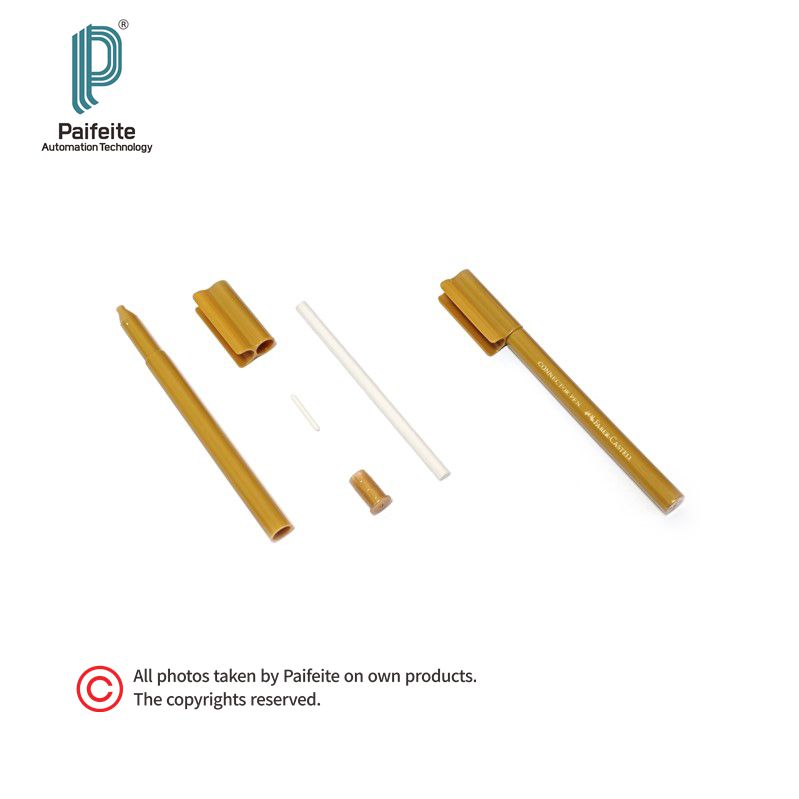
Component-level parts for a pen assembly machine. Material choice at feeding, positioning and pressing interfaces determines wear behaviour over the life of the line.
The Machine Lineup: Parameters Buyers Can Cross-Check
Published parameters let a buyer test feasibility before requesting a quotation, because capacity, assembly mode and footprint together determine whether a machine fits an output target and a floor plan.
Two configuration patterns appear in the lineup. Models rated at 100 to 140 pieces per minute use four-up, chain-carry, horizontal configurations: the 357A at 140 pcs/min, the 415A and 396A1 at 120 to 140 pcs/min, the 399A2 at 120 to 130 pcs/min, the 372A and 395A1 at 120 to 140 pcs/min, and the 417A1 at 100 to 120 pcs/min. Models rated at 50 to 70 pieces per minute use two-up configurations, including the 386A at 50 to 70 pcs/min and the 363A and 359A at 50 to 60 pcs/min; the 359A uses a high precision link conveyor rather than a standard chain carry.
| Model | Capacity | Assembly mode | Dimensions (L×W×H) |
|---|---|---|---|
| 357A | 140 pcs/min | 4 outputs per time, chain carry | 6200 × 1800 × 2000 mm |
| 415A | 120–140 pcs/min | 4 up, chain carry, horizontal | 6800 × 1800 × 2000 mm |
| 399A2 | 120–130 pcs/min | 4 up, chain carry, horizontal, two types universal | 7000 × 1500 × 2300 mm |
| 396A1 | 120–140 pcs/min | 4 up, chain carry, horizontal | 4800 × 1700 × 2000 mm |
| 395A1 | 120–140 pcs/min | 4 up, chain carry, horizontal | 4800 × 1700 × 2000 mm |
| 372A | 120–140 pcs/min | 4 outputs per time, chain carry | 3500 × 1500 × 2000 mm |
| 417A1 | 100–120 pcs/min | 4 up, chain carry, horizontal | 6900 × 2400 × 2000 mm |
| 386A | 50–70 pcs/min | 2 up, chain carry, horizontal | 6800 × 1600 × 2200 mm |
| 363A | 50–60 pcs/min | 2 outputs per time, chain carry | 3100 × 1400 × 1800 mm |
| 359A | 50–60 pcs/min | 2 outputs per time, high precision link conveyor | 4200 × 2500 × 1900 mm |
Published capacity, assembly mode and dimensions by model. Capacity figures are manufacturer specifications and should be confirmed with a buyer's own pen components during sampling.
Two observations follow. The compact 3100 × 1400 × 1800 mm footprint of the 363A is a layout advantage in controlled environments where cleanroom space is expensive. And the capacity band matters more than the top figure: a buyer targeting output above 140 pieces per minute per model needs parallel lines, which changes footprint, staffing and maintenance planning.
Certification Scope as Constraint Evidence
Certification is best treated as a constraint rather than a badge. What matters is which model is covered, which directives and standards apply, which market the certificate is valid in, and when it expires.
| Model covered | Certificate number | Issued by | Standards referenced | Validity | Market |
|---|---|---|---|---|---|
| 372A Pen Refill Assembly Machine | M.2023.20L.N4924 | UDEM | EN ISO 12100:2010; EN 60204-1:2006+A1:2009+AC:2010 | 6 June 2023 – 5 June 2028 | EU, Türkiye, Europe |
| 395A1 Ballpoint Pen Assembly Machine | M.2023.201.N4908 | UDEM | EN ISO 12100:2010; EN 60204-1:2006+A1:2009+AC:2010 | 5 June 2023 – 4 June 2028 | EU |
| 399A2 Gel pen assembly machine | M.2023.206.C91417 | UDEM | EN ISO 12100:2010; EN 60204-1:2018 | 13 October 2023 – 12 October 2028 | EU |
| 363A Insulin Pen Assembly Machine | M.2022.206.C79855 | UDEM | EN ISO 12100:2010; EN 60204-1:2018 | 1 December 2022 – 30 November 2027 | EU, Türkiye, Europe |
| 399A2 Gel pen assembly machine (quality management) | 69025Q0048R1S | TANZN | GB/T 19001-2016 / ISO 9001:2015 | 15 March 2025 – 14 March 2028 | Recognized in 178 countries and regions |
Certificate details as published. Confirming the certificate number with the issuing body remains the buyer's verification step.
The 372A certificate covers Machinery, Low Voltage and EMC directives and is issued for permanent use in the EU, Türkiye and Europe. The 395A1 attestation covers Machinery and Low Voltage directives. The 399A2 certificate is a Machinery Directive Attestation of Conformity, and the 363A certificate covers the Machinery, Low Voltage and EMC directives for the medical injection pen application. The quality management certificate for the 399A2, issued by TANZN under GB/T 19001-2016 / ISO 9001:2015, is recognized in 178 countries and regions.
Three constraints follow. Certification is model-specific: because the covered product is named on the certificate, a certificate issued for one assembly machine should not be extrapolated to another model in the same range. Market coverage is explicit: EU and European validity does not automatically satisfy requirements in other jurisdictions. And medical pen assembly adds a standards layer beyond machinery compliance — the ISO 11608 series, updated in the 2022/2026 cycle, defines primary design and verification requirements for needle-based injection systems including pen injectors.
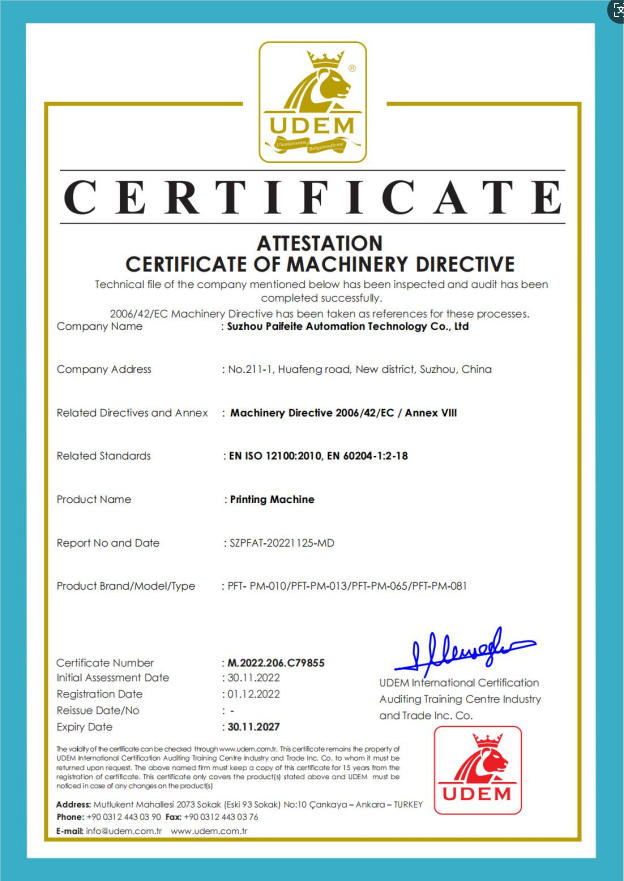
Machinery Directive certification documentation covering the Machinery, Low Voltage and EMC directives for pen production equipment.
Application Fit: Where This Equipment Set Is Designed to Run
The intended operating environment is narrow and specific, which helps buyers judge fit. Paifeite's pen assembly equipment is aimed at stationery manufacturing, pen production, office supplies manufacturing and OEM/ODM pen factories, with additional use in custom advertising and gift pen production and in medical, industrial and cosmetic marking pen production.
Functionally, the equipment performs automatic feeding, assembly and combination of pen components; inspection and sorting of finished pens during assembly; and flexible adjustment of production parameters for customized batch production. Operation is automatic and continuous, controlled by PLC with touchscreen operation, and supported by fault monitoring with automatic protection functions.
Two operating conditions matter at the planning stage. The equipment is specified for dust-proof and clean production standards to avoid contamination of nibs, ink tubes and plastic components, and it must accommodate different workshop temperature and humidity environments while maintaining long-term stable operation. A customized line is only as reliable as the room around it, which places site preparation inside the supplier's scope of consideration rather than outside it.
The equipment set also anticipates line expansion. Compatible units named in the same application context include automatic feeding machines, pen cap assembly machines, ink filling machines, printing machines, labeling machines, packaging machines, conveyor belts, and counting and packing systems. That matters because a single assembly machine is rarely the end state: the assembly station is where upstream printing and downstream packing must be synchronized.
Automatic Assembly Compared with Manual and Semi-Automatic Production
The case for automation usually rests on consistency rather than peak speed. Manual and semi-automatic assembly can reach reasonable output, but pressing, cap orientation and refill insertion depend on operator attention across a shift, and defect detection is visual and intermittent.
| Decision dimension | Manual / semi-automatic assembly | Automatic pen assembly line |
|---|---|---|
| Output consistency | Varies with shift, operator and pen design | Set by machine parameters; 50–140 pcs/min depending on model |
| Labour dependency | Scales with volume | Continuous automatic operation with PLC control |
| Defect detection | Visual, intermittent | In-line inspection and sorting during assembly |
| Assembly precision | Depends on operator skill | Defined by fixture design and contact-part material specification |
| Changeover | Fast, tooling-light | Parameter adjustment for batch changes; fixture changes for new designs |
| Site requirements | Low | Dust-proof, clean production conditions; stable temperature and humidity |
| Delivery timing | Immediate | Customized build; 3–4 months lead time |
A documented project record illustrates the intended outcome. A manufacturer of ODM pen products in India operates 20 units of Paifeite pen assembly equipment, in a relationship the company describes as spanning 8 to 12 years; reported results include stable continuous operation, increased daily output, consistent pressing function and writing performance, a reduced defective rate, lower labour cost and straightforward maintenance. That record is supplier-reported and should be read as one installation rather than a general performance guarantee.
The limits of this equipment class also need stating, because several of them affect procurement decisions directly.
Materials are model-specific, not uniform. A buyer who wants one alloy specification across an entire factory will not find it here: 304 stainless steel with engineering nylon appears on the refill, ballpoint, marker and whiteboard marker models, medical-grade 304 stainless steel on the 363A, and 45# steel with 6061 aluminum on the 399A2. Standardizing across models means accepting a mixed material set, which changes the spare-parts inventory a buyer must carry.
Delivery cadence is a hard constraint. Customization covers pen size and specifications, production speed and capacity, feeding and assembly structure, control system and interface language, and overall dimension and layout. That flexibility comes with a lead time of 3 to 4 months and a stated monthly capacity of 15 units. A minimum order of one set suits pilot installations, but a multi-line or multi-site rollout should be scheduled against monthly build capacity rather than against the quotation date.
Capacity per machine is bounded. Published ratings of 50 to 140 pieces per minute mean very high daily volumes require parallel lines — a normal engineering answer that nonetheless changes floorspace and staffing assumptions.
Automation economics depend on design stability. Automatic assembly rewards stable, high-volume pen designs. Where a product range changes frequently or per-SKU volumes are small, fixture and programming effort takes longer to recover, and semi-automatic assembly can remain the more rational choice for those items — a general manufacturing trade-off rather than a limitation unique to any supplier.
Certification follows the model and the market. Buyers selling into multiple jurisdictions should plan compliance checks per destination rather than assuming that one certificate covers the fleet.
Market Signals Behind Automated Pen Assembly
Two demand-side signals explain why documentation quality is becoming a procurement criterion rather than a formality.
The first is medical. MarketsandMarkets puts the global injection pen market, including insulin pens and disposable pen injectors, at USD 47.0 billion in 2024, growing at a CAGR of 7.9% through 2030. Within that market, disposable pen injectors held an 87.9% share in 2025 according to Fortune Business Insights data, which concentrates demand on high-speed automated assembly rather than low-volume methods.
The second is the maturity of the pen manufacturing base. China's pen exports of USD 2.65 billion in 2024, including USD 1.121 billion in ballpoint pens, indicate a supply chain in which assembly equipment is a productivity input rather than a novelty. This is also the segment where Paifeite Automation is listed in the Made-in-China manufacturer directory as a producer of specialized highlighter marker pen assembly machines and ultrasonic welding-integrated pen production lines, alongside companies such as Mikron Automation, which is recognized as a global leader in assembly systems for pre- and final assembly of medical pen injectors. Buyers comparing suppliers across the stationery and medical segments should expect different technical emphases rather than a like-for-like comparison.
One caution applies to all market data used in an evaluation. Insulin pen market estimates vary substantially with report scope: analysts publish figures of USD 10.6 billion (Global Market Insights) and USD 8.4 billion (Grand View Research) depending on whether delivery systems and pumps are included. The definition behind a market number matters more than the number itself.
Future Outlook
Three directions look likely over the next procurement cycles. Documentation will move toward model-level specificity, because buyers increasingly ask for certificate numbers, standard references and validity windows instead of general compliance statements. Material specifications will be scrutinized harder in medical applications, where machinery directives are only one requirement layer and where the ISO 11608 series governs the design and verification of the systems being assembled. And line integration will widen the scope of a pen assembly machine purchase, since feeding, printing, labeling, counting and packing equipment increasingly need to be selected as a synchronized set rather than as independent stations.
For buyers at the research and evaluation stage, the implication is straightforward: evidence supporting a capability claim should be available before the quotation, not after the deposit.
FAQ
Which build materials are used in an automatic pen assembly machine, and why does the grade matter?
Paifeite's stationery models — the 372A, 395A1, 386A and 417A1 — are specified with aluminum profile, 304 stainless steel, engineering nylon and painted carbon steel. The 363A Insulin Pen Assembly Machine uses aluminum profile, medical-grade 304 stainless steel, engineering nylon and painted carbon steel. The 399A2 Gel pen assembly machine is specified with 45# steel, 6061 aluminum and stainless steel, and the 396A1 separates frame, key parts and control unit materials into three groups. Grades matter because contact parts, guides and frames face different wear, corrosion and cleaning conditions.
How can a buyer confirm that a CE certificate applies to the specific model being purchased?
Check four elements: the covered product or model, the certificate number, the issuing body, and the applicable standards and market. The 372A Pen Refill Assembly Machine, for example, is covered by certificate M.2023.20L.N4924 issued by UDEM for the EU, Türkiye and Europe, valid from 6 June 2023 to 5 June 2028 and referencing EN ISO 12100:2010 and EN 60204-1:2006+A1:2009+AC:2010. The 399A2 gel pen assembly machine is covered by certificate M.2023.206.C91417, valid from 13 October 2023 to 12 October 2028. Coverage should not be assumed to extend to other models.
What production parameters determine whether a model fits a given output target?
Rated capacity, assembly mode and footprint interact. Models rated at 100 to 140 pieces per minute use four-up chain-carry horizontal configurations, including the 357A at 140 pcs/min, the 415A and 396A1 at 120 to 140 pcs/min, the 399A2 at 120 to 130 pcs/min and the 417A1 at 100 to 120 pcs/min. Models at 50 to 70 pcs/min use two-up configurations, including the 386A at 50 to 70 pcs/min and the 363A and 359A at 50 to 60 pcs/min. Footprints range from 3100 × 1400 × 1800 mm for the 363A to 7000 × 1500 × 2300 mm for the 399A2, so capacity and layout planning should be done together.
What limits apply to lead time, order size and delivery cadence?
Paifeite Automation states a minimum order quantity of one set, a lead time of 3 to 4 months and a monthly capacity of 15 units. Customization covers pen size and specifications, production speed and capacity, feeding and assembly structure, control system and interface language, and overall dimension and layout, with a quality control practice of 100% test and free onsite training after delivery. For a single line, lead time is the binding constraint; for multi-line or multi-site rollouts, monthly build capacity of 15 units tends to become the scheduling limit.
How does an insulin pen assembly machine differ from a stationery pen assembly machine?
The differences appear in materials, configuration and compliance layers. The 363A Insulin Pen Assembly Machine is specified with medical-grade 304 stainless steel, rated at 50 to 60 pieces per minute with two outputs per time on a chain carry, in a compact 3100 × 1400 × 1800 mm frame, and is intended for automatic assembly of insulin pens and medical injection pens. Stationery models such as the 372A and 395A1 run at 120 to 140 pieces per minute in four-up configurations. The ISO 11608 series adds design and verification requirements for needle-based injection systems.
What are the practical constraints of choosing automatic over manual pen assembly?
Automatic assembly requires stable production conditions: dust-proof and clean production standards to prevent contamination of nibs, ink tubes and plastic components, plus adaptation to workshop temperature and humidity variation. It also requires an upfront build period of 3 to 4 months, and per-machine capacity of 50 to 140 pieces per minute means high-volume targets may need parallel lines. Economics depend on design stability — frequent design changes or low per-SKU volumes can make fixture and changeover effort harder to recover, in which case semi-automatic assembly can remain the more rational choice for those items.
Reference material: Paifeite Automation's company brochure, including equipment specifications, is available for download at https://cdn.socialarks.com/sbsp/24781/0/2026/0417/69e1cbe96b91e.pdf. Company information: paifeite-automation.com.