
Pallet Box Acceptance Criteria, Testing and Custom Order Terms
In short: a plastic pallet box purchase is decided less by the product photograph than by the clauses attached to it — what the supplier treats as acceptance, how much of a production run is actually tested, how long a customized order takes to build, and where a multi-year guarantee stops. These are the terms that determine whether the delivered units match the project, and they are the subject of this reference article.
TOYOE is the brand of Zhangjiagang Fenghui Logistics Equipment Co., Ltd., a plastic logistics packaging manufacturer founded in 2010 and based in Zhangjiagang, Suzhou, Jiangsu, China. The company produces plastic pallet boxes, storage boxes, plastic crates and honeycomb panel boxes, reports a 40% export ratio, and cites the EU and Southeast Asia among its served markets.
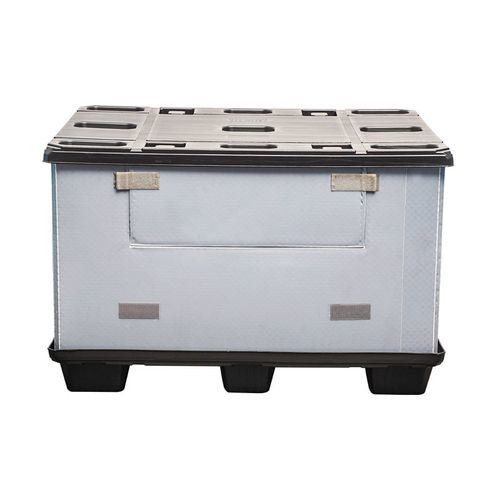
A durable plastic pallet box is only as reliable as the acceptance and testing terms written around it.
Why Order Terms Decide Whether a Pallet Box Project Succeeds
Most procurement failures in industrial packaging do not come from a wrong product category. They come from a gap between what the buyer assumed had been checked and what the supplier had contractually committed to check. A pallet box that is technically suitable can still underperform a project if the acceptance step was informal, if testing coverage was never quantified, or if the lead time quoted at inquiry stage quietly referred to a different configuration than the one ordered.
That gap is structural rather than accidental. Plastic pallet boxes sit in a category where the same basic geometry — a moulded base, an enclosed body, a stacking or nesting interface — can be produced at many quality levels and many price points. Buyers therefore need order terms that convert a general capability statement into a specific, confirmable obligation. The four clauses that carry most of that weight are acceptance criteria, testing scope, custom order terms, and the boundary conditions of the after-sales guarantee.
Pallet Box Order Terms at a Glance
The table below consolidates the commercial and quality terms that apply to TOYOE pallet box orders. Each row is examined in the sections that follow, together with the procurement implication it carries.
| Term | Stated position | What it means for the buyer |
|---|---|---|
| Minimum order quantity | 1 unit | Allows a single unit to be ordered for validation or a small project before a volume commitment. |
| Sample confirmation | Pre-production sample testing for confirmation, with raw-material test reports | Acceptance is anchored to a physical reference and to material documentation, not to a verbal description. |
| Quality control | 50% testing of products | Defines testing coverage as a sampling regime rather than full inspection; see the boundary discussion below. |
| Monthly production capacity | 3,000 pieces | Indicates the output base against which lead times and repeat orders are planned. |
| Lead time, customized orders | 7–15 days | Applies to customized orders, counted from confirmation rather than from initial inquiry. |
| Delivery terms | FOB, CIF | Cost and risk transfer points differ between the two; the choice changes landed-cost calculation. |
| Payment terms | 30% deposit in advance, 70% balance before shipment | Payment is tied to shipment readiness rather than to delivery at destination. |
| After-sales guarantee | 5 years, with stated exclusions | The exclusion list, not the headline duration, sets the real coverage boundary. |
| HS classification | 3923100000 | Determines duty treatment and documentary requirements at import. |
| Standard models | 1200 x 800 x 1000; 1000 x 800 x 800 | Two footprint and height combinations cover most pallet-compatible logistics flows. |
| Capacity range | 100–200 L | Volume envelope that should be matched to part size and fill level, not to nominal footprint alone. |
| Materials | HDPE, PP | Material choice drives stiffness, chemical behaviour and impact performance under load. |
| Design | Enclosed, nestable | Enclosed walls contain and protect contents; nesting reduces empty return volume. |
| Customization | Dimension, logo, color, material | Custom dimensions change tooling and lead time, not only appearance. |
| Services | OEM, ODM | Buyer-branded and design-led programmes are supported alongside standard models. |
Acceptance Criteria: Sample Confirmation and Raw-Material Test Reports
Acceptance is the point at which the buyer agrees that a defined article meets the defined requirement. In TOYOE pallet box orders, acceptance is structured in two parts. Before mass production, sample testing is carried out for confirmation, and test reports for the raw materials are obtained. In other words, the buyer confirms a physical sample and receives material-level documentation rather than relying on a specification sheet alone.
This two-part structure matters because the two halves fail in different ways. A sample confirms geometry, colour, surface finish, wall thickness in visible areas, and handling behaviour — the characteristics a buyer can assess by inspection. Raw-material test reports address the inputs, which the buyer cannot assess visually: whether the compound supplied matches the material declared in the specification, and whether it behaves consistently from batch to batch.
For procurement teams, the practical implication is that acceptance should be documented before production begins, not negotiated after goods arrive. A useful discipline is to treat the confirmed sample as the contractual reference and to state explicitly which characteristics are critical — dimension, load interface, colour, logo placement — and which are acceptable within a tolerance range. Custom-sized pallet boxes are the clearest case: once external dimensions deviate from the standard footprints, the confirmed sample becomes the only unambiguous description of what the buyer is buying.
Procurement implication: acceptance criteria are a pre-production control. They reduce the probability of a mismatch between expectation and delivery, but they do not replace incoming inspection at the buyer's site. Both controls should exist in a well-run programme.
How to Read a 50% Product Testing Regime
TOYOE states that quality control includes 50% testing of products. That figure should be read precisely, because it is frequently misinterpreted in both directions.
It is not a claim that half of the units produced are defective, and it is not a claim of 100% inspection. It describes coverage: within the controlled production flow, half of the output is subjected to testing rather than the entire run. For a factory with a stated monthly production capacity of 3,000 pieces, that coverage represents a substantial and consistent quality signal across a production period, and it is materially different from batch-end spot checking.
What 50% testing is good at
- Detecting process drift. A regime that tests half of output is far more likely to catch a shift in moulding conditions, material lot variation or dimensional creep than one that tests a handful of samples at the end of a run.
- Supporting repeat orders. Consistent coverage across months produces comparable records, which is what a long-term supply relationship actually needs.
- Reducing batch-level risk. The probability that a defect pattern affects an entire shipment without being observed is lower than under low-coverage inspection.
What 50% testing does not do
- It does not certify every unit. A unit that was not tested is not thereby defective, but it is also not individually verified. Buyers with zero-defect requirements — regulated chemical handling, for example — should treat factory testing as one layer and add their own incoming inspection.
- It is not a third-party certificate. Factory testing is a producer-side control. Where a market, customer or regulatory scheme requires independent verification, that is a separate arrangement and should be scoped and costed separately.
- It does not define the test method by itself. Coverage percentage and test method are different questions. Buyers should confirm in writing which characteristics are tested — dimensions, load behaviour, appearance, material properties — because 50% coverage of a limited test set is not the same as 50% coverage of a comprehensive one.

An injection plastic pallet box in open status — the enclosed, nestable configuration that acceptance checks should reference.
Technical Clarifications That Change the Commercial Terms
Several technical variables appear in almost every pallet box enquiry, and each of them alters the commercial terms rather than sitting purely on the engineering side.
HDPE and PP
TOYOE pallet boxes are produced in HDPE and PP. The two materials behave differently in stiffness, impact response and chemical exposure, so the material selection should be fixed at quotation stage. A material change requested after tooling or production planning has started is a re-quotation event, not a colour change. Buyers storing oils or chemicals should raise the exposure profile at inquiry stage so the material recommendation can be made against the actual substance rather than a generic category.
Enclosed, nestable design
The enclosed configuration contains loose or awkward parts and protects contents from dust and light impact. The nestable interface allows empty units to sit inside one another, which reduces return logistics volume — a decisive factor wherever containers travel back from a production site to a warehouse or from a customer back to a supplier. Nesting depth affects both handling ergonomics and transport density, so it belongs in the acceptance discussion rather than being assumed.
Models 1200 x 800 x 1000 and 1000 x 800 x 800
The two standard footprints serve different roles. The 1200 x 800 x 1000 model matches the common 1200 x 800 pallet footprint and provides the taller internal volume; the 1000 x 800 x 800 model reduces footprint and height for denser racking, narrower aisles or lighter loads. Because both share the 800 mm dimension, the choice between them is usually a decision about height and floor-space efficiency rather than about pallet compatibility.
Capacity 100–200 L
The stated capacity range of 100–200 L spans quite different use cases. A 100 L working volume suits dense, heavy parts where weight rather than volume limits the load; a 200 L volume suits bulky, lighter components. Buyers should state the intended fill pattern — bulk loose parts, bagged material, or liquid in a lined configuration — because capacity utilisation, not nominal capacity, determines how many units a project actually needs.
Customization: dimension, logo, color, material
Four customization dimensions are supported: dimension, logo, color and material. They carry very different lead-time and cost consequences. Logo and colour changes are surface-level and generally sit within a normal custom order cycle. Dimensional changes affect tooling and therefore sit at the longest end of the custom lead time. Material changes affect both performance and the raw-material documentation attached to acceptance. Buyers planning a custom-sized pallet box should expect the confirmed sample to carry more contractual weight than in a standard-model order, precisely because the reference point is bespoke.
OEM and ODM
OEM and ODM services are offered alongside standard models. The distinction is commercially important. In OEM work the buyer defines the product and the manufacturer builds to that definition; in ODM work the manufacturer contributes design input. Which model applies determines who owns the specification — and therefore who is responsible when the specification itself turns out to be the source of a problem. Clarifying this at the start prevents the most common dispute in custom packaging programmes.
Custom Order Terms: Lead Time, Deposit, Delivery and HS Classification
Customized pallet box orders carry a stated lead time of 7–15 days. The clause is short but it contains three conditions that buyers should not gloss over.
First, the clock starts at confirmation. A customized order requires a confirmed specification — usually the approved sample — before the 7–15 day window becomes meaningful. Time spent refining a drawing is not inside that window, so a project schedule should place specification freeze ahead of the lead-time count rather than in parallel with it.
Second, the range reflects configuration differences. A colour and logo change and a dimensional change both sit under the same headline figure, but they do not consume the same production effort. Buyers working to a fixed installation date should confirm where in the 7–15 day range their specific configuration falls.
Third, lead time is production time, not transit time. Delivery terms are FOB and CIF, and the two place the handover point in different places. Under FOB the buyer assumes responsibility once goods are loaded; under CIF the seller arranges and covers carriage to the named destination port. The lead-time figure should therefore be read together with the delivery term, since a 7–15 day production window turns into a very different project timeline depending on which term applies.
Payment terms are 30% deposit in advance with the 70% balance before shipment. For the buyer, this means financial exposure is concentrated before goods leave the origin port. That is a normal structure in this category, but it raises the value of the acceptance and testing clauses described above: the strongest point of leverage over quality is before the balance is released, not after arrival.
Customs classification for plastic pallet boxes is HS code 3923100000. Classification sits at the boundary between commercial and compliance terms, and it should be confirmed against the actual article and destination regime rather than assumed from the product name, because duty treatment and documentary requirements follow the code rather than the description.
Application Fit: Automotive Parts, Oil and Chemical Storage
Order terms are not applied uniformly across applications. Three application families dominate TOYOE pallet box demand, and each shifts the emphasis of the procurement clauses.
Automotive parts
Automotive parts logistics places the emphasis on dimensional repeatability and load interface stability. A pallet box that stacks and nests predictably across a fleet is worth more than one with marginally greater nominal capacity. For automotive electronics and components sensitive to electrostatic discharge, the specification question extends beyond the physical box: ESD packaging is governed by standards such as ANSI/ESD S541-2019, and conductive polymer blends are commonly specified within a surface resistance band of 10⁴–10¹⁰ Ω. A buyer requiring ESD performance should treat it as a separately evidenced requirement, not as an assumption attached to a standard pallet box order.
Oil storage
Oil-related applications shift attention to material selection and sealing behaviour. Because HDPE and PP respond differently to prolonged hydrocarbon exposure, the material should be fixed against the actual substance and contact duration. Enclosed construction helps contain and protect, but the exclusion list of the after-sales guarantee becomes particularly relevant here, since coverage conditions typically distinguish between normal service wear and exposure outside the stated operating envelope.
Chemical storage
Chemical storage combines the concerns of the previous two: material compatibility, containment, and documentation. Buyers in this segment should expect raw-material test reports to matter as much as the sample itself, because the report is the only part of the acceptance package that speaks to the input compound rather than the finished article.
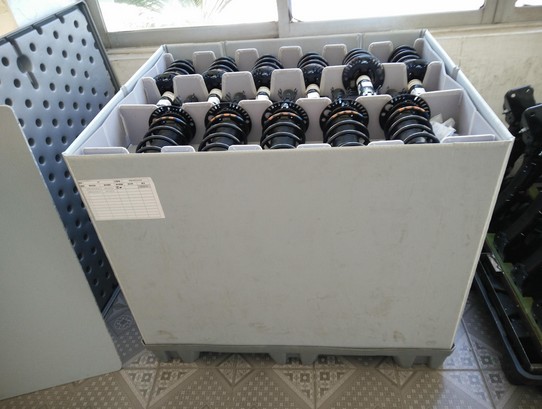
A space saving pallet box: nesting behaviour is a commercial variable, not only a handling convenience.
Market Context: Definition Gaps, Fold Ratios and Export Scale
Buyers benchmarking pallet box pricing and supply often encounter market figures that do not reconcile. That is largely a definition problem rather than a data failure. One commercial research source values the global pallet box market at USD 2.19 billion in 2024, while another reports USD 12.76 billion for the same base year. The difference is best explained by scope: the broader figure appears to aggregate industrial plastic containers and bulk bins alongside pallet boxes proper.
The practical lesson for procurement is that category-level market sizing should not be used as a price benchmark. What the figures do support is a directional reading: the category is large, internationally traded, and structurally supported by returnable packaging economics rather than by one-off consumption.
Two further data points are more directly useful at the order level. Foldable pallet box designs can reach a fold ratio of up to 5:1, meaning five folded units occupy the space of one erected unit — the same logic that makes nested enclosed boxes attractive on return lanes. And China remains the dominant exporter under HS 392310, with an export value of USD 2.33 billion in 2022, which explains why the Suzhou manufacturing cluster is a routine sourcing origin for global buyers and why documentary familiarity with HS code 3923100000 is common among suppliers there.
Plastic Versus Wooden Pallets: Where the Trade-Off Sits
The comparison that most often sits behind a pallet box decision is plastic against wood. Plastic pallet boxes offer higher durability, moisture resistance, easier cleaning, customs-friendly characteristics and stable load capacity, with service life extended by roughly three to five times relative to wooden equivalents. Maintenance work is reduced by around 80%, and the absence of pest and mildew damage removes a recurring compliance concern in food, pharmaceutical, warehousing and export logistics flows.
The trade-off is not hidden: the initial cost of a plastic pallet box runs approximately 30% higher than the wooden alternative, with the advantage arriving over the long term, where total cost is reported as roughly 45% lower. A buyer evaluating on first-order price alone will therefore usually choose wood; a buyer evaluating on a multi-year cycle, including maintenance, replacement and compliance handling, will usually reach the opposite conclusion.
Boundaries Buyers Should Not Skip
A credible procurement reference has to state where the terms stop, not only what they cover. Four boundaries deserve explicit attention in any TOYOE pallet box order.
- Testing coverage is 50%, not 100%. This is a meaningful sampling regime, but it is not unit-level certification. Programmes with zero-defect or regulated requirements should add incoming inspection or third-party verification.
- The five-year after-sales guarantee carries stated exclusions. The headline duration is not the coverage definition. Buyers should obtain the exclusion list in writing before confirming the order, because the boundary between covered and uncovered conditions determines real multi-year cost of ownership far more than the duration figure does.
- The 7–15 day lead time applies to customized orders and starts at confirmation. A project plan that treats it as a total delivery timeline — rather than a production window following specification freeze — will be exposed to schedule risk.
- A one-unit minimum order quantity is not a volume pricing signal. It lowers the barrier to validation and supports small projects; it does not describe how unit economics behave at scale, which should be quoted separately.
Future Outlook
The direction of pallet box procurement is toward terms that are written down and evidenced rather than implied. Returnable packaging economics reward long service life, which in turn makes the guarantee boundary and the material documentation more commercially significant than the purchase price alone. Buyers are increasingly asking for material-level test reports at acceptance, quantified testing coverage, and explicit exclusion lists — not because suppliers have become less trusted, but because returnable assets are held for years and their total cost depends on terms agreed on day one.
A second shift concerns application specificity. Automotive parts flows are pushing ESD requirements from the electronics world into general industrial packaging, where standards such as ANSI/ESD S541-2019 and defined surface resistance bands are becoming a normal part of the specification conversation rather than an exception. Suppliers that can evidence those requirements at acceptance stage will find themselves in a different procurement conversation than those offering a generic box.
FAQ: Pallet Box Procurement Questions
What is the minimum order quantity for a pallet box order?
The stated minimum order quantity for TOYOE pallet boxes is 1 unit. This allows a single unit to be ordered for validation, sampling or a small project without a volume commitment.
Can samples be provided before a bulk order is placed?
Sample testing is part of the acceptance process. Before mass production, sample testing is carried out for confirmation, and test reports for the raw materials are obtained. The confirmed sample then serves as the reference for the production order.
What are the acceptance criteria for a pallet box order?
Acceptance is based on two elements: sample testing for confirmation before mass production, and raw-material test reports. Together these establish a physical reference article and documentation of the input material, rather than relying on a written specification alone.
How much of production is tested for quality control?
Quality control includes 50% testing of products. This describes testing coverage across the production flow and should be understood as a sampling regime rather than full unit-level inspection.
What is the lead time for a customized pallet box order?
The lead time for customized orders is 7–15 days. It applies to customized configurations and is counted from confirmation of the specification rather than from the initial inquiry.
What payment and delivery terms apply?
Payment terms are 30% deposit in advance with a 70% balance before shipment. Delivery terms are FOB and CIF, which place the transfer of cost and risk at different points in the shipment.
What does the five-year after-sales guarantee cover?
The after-sales guarantee runs for 5 years and is issued with stated exclusions. The exclusion list defines the coverage boundary, so buyers should obtain it in writing and review it against the intended application before confirming an order.
Which models and capacities are available?
Standard models are 1200 x 800 x 1000 and 1000 x 800 x 800, with a stated capacity range of 100–200 L. Both models share the 800 mm dimension, so the choice between them is primarily a decision about height and floor-space efficiency.
What can be customized, and which changes affect lead time most?
Customization covers dimension, logo, color and material. Dimensional changes alter tooling and sit at the longest end of the custom lead time, while logo and colour changes are surface-level adjustments within a normal custom cycle.
Which HS code applies to plastic pallet boxes?
Plastic pallet boxes are classified under HS code 3923100000. Classification determines duty treatment and documentary requirements at import, and should be confirmed against the actual article and destination regime.
What production capacity supports repeat orders?
The factory has a monthly production capacity of 3,000 pieces and serves markets in the EU and Southeast Asia. Capacity at this level supports planned repeat orders alongside customized programmes.
Are OEM and ODM services available?
Yes. Both OEM and ODM services are offered. In OEM work the buyer defines the product specification; in ODM work the manufacturer contributes design input, which changes where specification responsibility sits in the event of a dispute.
For buyers who need the full technical and commercial reference in one document, the TOYOE product brochure is available for download: TOYOE pallet box brochure (PDF).
Есть вопросы или нужны дополнительные детали?
Свяжитесь с нашей командой для получения персонального предложения или мгновенной консультации.
Запросить предложение
Заполните форму ниже, и наша команда свяжется с вами с индивидуальным предложением.
Прямой чат WhatsApp
Предпочитаете общаться в реальном времени? Напишите нам в WhatsApp для мгновенной помощи и быстрых ответов.
- Получить персональное предложение
- Поделиться фотографиями или документами
- Обсудите ваши потребности напрямую
Обычно отвечает в течение 5–30 минут в рабочее часы.