
Pallet Box Technical & Procurement FAQ: Models, Materials, Customization and Lead Times
A plastic pallet box is an enclosed, reusable container built to sit on standard pallet-handling equipment and carry bulk or component loads through storage, stacking and transport. Industrial buyers rarely need a general introduction to the category. What they need is a settled answer to a narrow set of technical and commercial questions before suppliers can be compared on equal terms.
This reference gathers those questions in one place. It is built on the published specifications of the TOYOE pallet box range — manufactured by Zhangjiagang Fenghui Logistics Equipment Co., Ltd., a logistics packaging equipment manufacturer established in 2010 in Suzhou, China — together with third-party market and standards data. It is written for buyers at the awareness and research stage, when model selection, material compatibility, customization limits and import documentation still have to be defined.
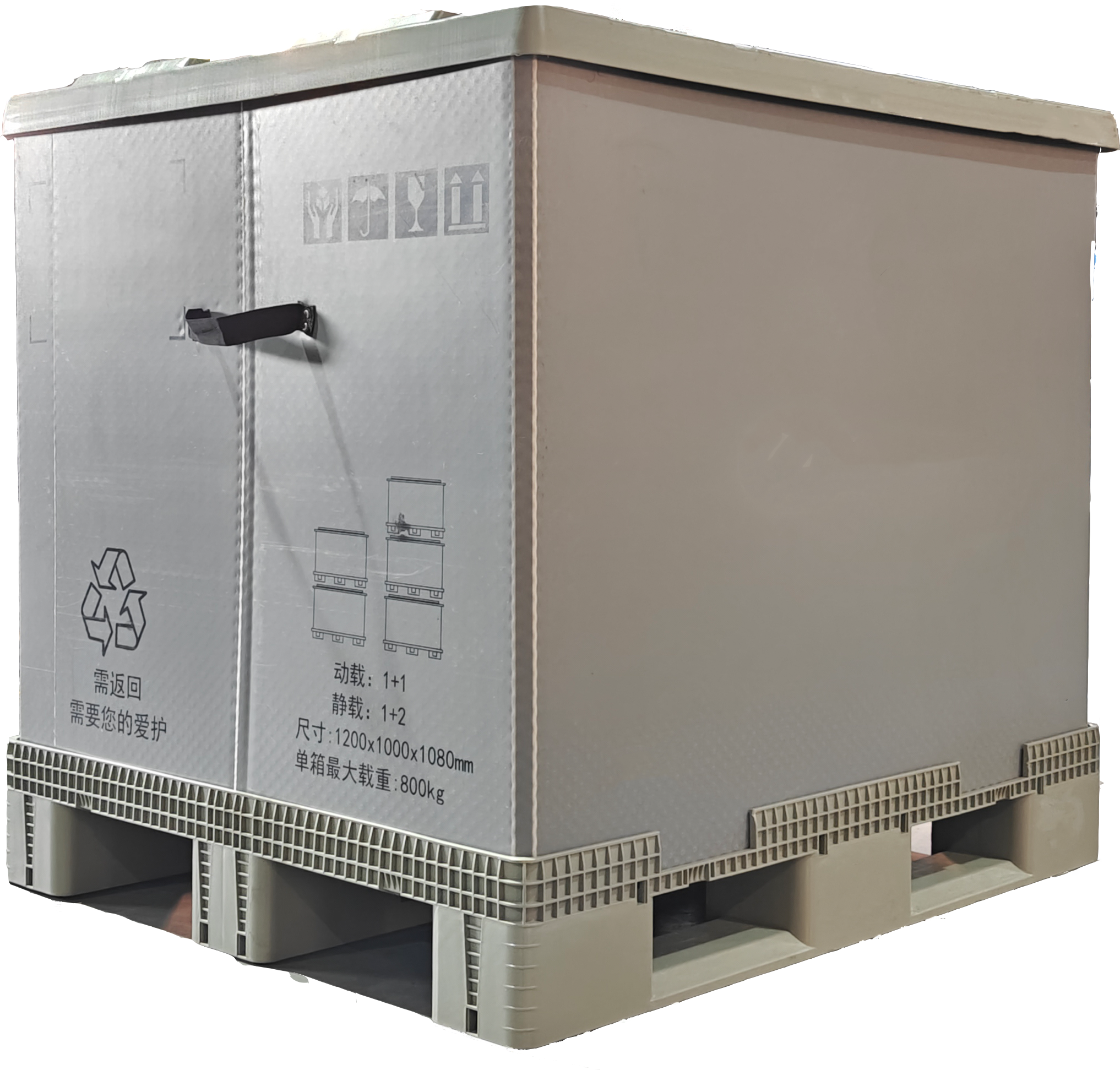
Enclosed plastic pallet boxes are designed for stacking, forklift handling and rack storage in industrial environments.
Why Pallet Box Decisions Cluster Around Four Question Areas
Industrial pallet box evaluation tends to move through four question areas in sequence, and each one constrains the next.
The first is dimensional fit: whether a standard footprint such as 1200 × 800 mm or 1000 × 800 mm matches existing racking, forklift handling and stacking patterns. The second is content compatibility: which resin and which wall construction will tolerate the substance being stored, whether that is oil, industrial alcohol, alkali, acid, industrial wastewater, water or automotive components. The third is flexibility: how far size, colour, material, logo and internal fittings can be adjusted, and whether the supplier supports OEM or ODM work. The fourth is delivery mechanics: minimum order quantity, sample availability, testing coverage, production capacity, lead time and the documentation required at import.
Buyers who resolve these four areas early avoid the most common failure in this category — discovering a dimensional, material or documentation constraint after an order commitment has already been made.
Materials and Construction: What “Enclosed HDPE/PP” Actually Delivers
Service life in this product category is largely determined by resin choice and wall construction. The TOYOE pallet box range is manufactured in HDPE (high-density polyethylene) and PP (polypropylene), with resin specifications that vary by model. The 1200*800*1000 Plastic Pallet Box is listed as HDPE and PP. The 1000*800*800 Pallet Box is listed as HDPE. The die-cast 1230*830*1000 pallet box is listed as HDPE. The Plastic Honeycomb Panel Box is listed as HDPE and PP.
Every model in the range shares three stated characteristics: recyclable, durable and nestable. Each is supplied as an enclosed type box, packed in plastic film, with a stated capacity of 100–200 L. Enclosed construction matters for two practical reasons. It contains the load so that loose components or liquids do not migrate into racking or onto the vehicle floor, and it reduces direct exposure of contents to dust and moisture during storage and transit.
That second point is not theoretical. In the documented Mexico logistics warehousing and packaging project, the pallet boxes operate in conditions described as high humidity, dust and wide temperature range, under a requirement set that includes waterproof and anti-static suitability, moisture-proofing, shock resistance and stable load bearing. In that deployment the boxes run in continuous 24/7 operation and are handled alongside forklifts, warehouse shelving and logistics handling equipment.
Nestable design has a second-order benefit that is easy to overlook at specification stage: empty boxes occupy less floor space in the return leg of a logistics loop, which affects how many units a site needs to hold in reserve.
Model Reference: Matching Dimensions to the Load
Three primary pallet box models and one honeycomb panel variant make up the documented range. All four are enclosed type, all carry a listed capacity of 100–200 L, and all are recyclable, durable and nestable.
| Model | Overall dimensions | Construction type | Material | Capacity |
|---|---|---|---|---|
| 1200*800*1000 Plastic Pallet Box | 1200 × 800 × 1000 mm | Storage Box – Plastic Pallet Box – Plastic Honeycomb Panel Box | HDPE and PP | 100–200 L |
| 1000*800*800 Pallet Box | 1000 × 800 × 800 mm | Storage Box – Plastic Pallet Box | HDPE | 100–200 L |
| Die-cast pallet box for automotive engines | 1230 × 830 × 1000 mm | Storage Box – Plastic Pallet Box – Die-cast Honeycomb Board Box | HDPE | 100–200 L |
| Plastic Honeycomb Panel Box | 1000 × 800 × 800 mm | Storage Box – Plastic Pallet Box – Blow-molded Honeycomb Board Box | HDPE and PP | 100–200 L |
Documented TOYOE pallet box models, dimensions and materials. Size, colour and logo can be customized; multiple specifications are available.
The difference between the 1200 × 800 × 1000 and 1000 × 800 × 800 formats is not only footprint. Height affects stacking stability and how the box presents to a forklift or rack beam, while the 1230 × 830 × 1000 die-cast format is specified for a different handling envelope again — it is documented in an automotive engine and gearbox logistics context. Buyers comparing formats should verify the internal envelope against the largest single component being transported, not just against the outer dimensions.
Application Fit: Oils, Acids, Alkalis, Wastewater and Car Parts
The documented application list for these pallet boxes is specific: oil, industrial alcohol, alkali, acid, industrial wastewater, water and car parts. Intended industries include automobile manufacturing, precision electronics, food cold chain, home logistics, medical and health care, and heavy industry.
Two patterns explain why the same product family appears across such different sectors. First, several of the listed contents are wet or aggressive, which favours an enclosed resin body over an open or absorbent container. Second, several of the listed industries are component-driven — automotive and precision electronics in particular — where the value of the box lies less in the volume it holds and more in whether it protects and organises a defined set of parts through a repeatable loop.
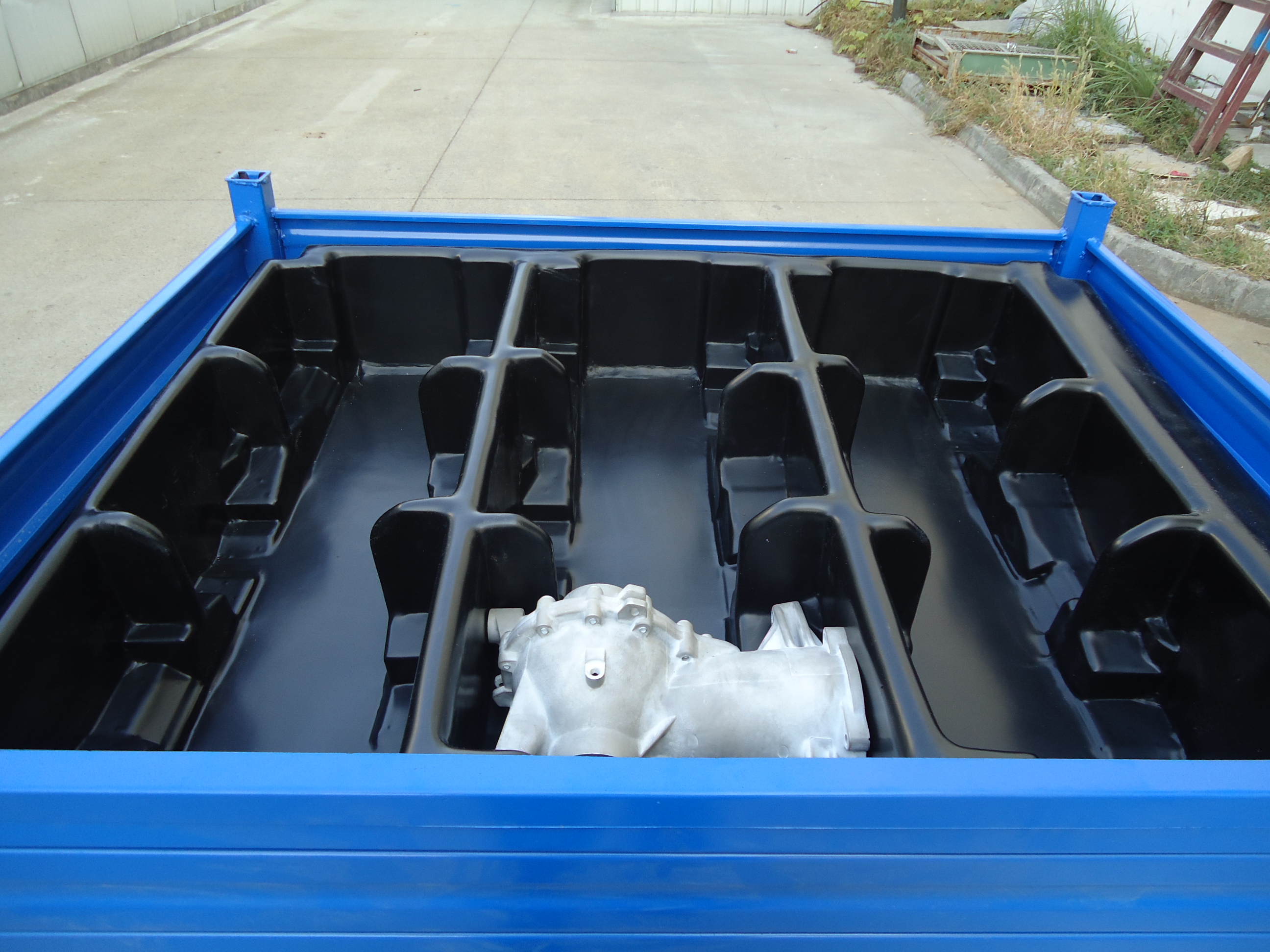
In automotive applications the pallet box functions as the outer container for vacuum-formed or blister inner trays holding individual components.
The Mexico project illustrates the application logic well. The stated function of the pallet boxes there is automotive parts storage, standardised stacking and transportation protection, with moisture-proofing, shock resistance and stable load bearing listed as requirements. That combination — a listed load-bearing requirement plus a list of non-brittle, non-absorbent contents — is the profile where enclosed plastic pallet boxes tend to make the strongest case.
Customization and OEM/ODM: Defining the Specification Boundary
Customization in this range extends across four dimensions, all of them documented: customized size, customized colour, customized material selection between HDPE and PP where the model allows, and free logo printing. Custom orders are accepted, and the specification is listed as multiple specifications or customizable.
Beyond the box itself, internal fittings are part of the documented customization envelope. Vacuum-formed inner lining trays — including heavy-duty vacuum-formed trays, transmission blister trays and anti-static blister trays — are shown as part of the range for component-specific containment. For buyers handling transmissions, boosters or other shaped parts, the inner lining is often the element that determines whether a pallet box is genuinely fit for purpose, because it fixes component orientation and prevents movement inside the outer container.
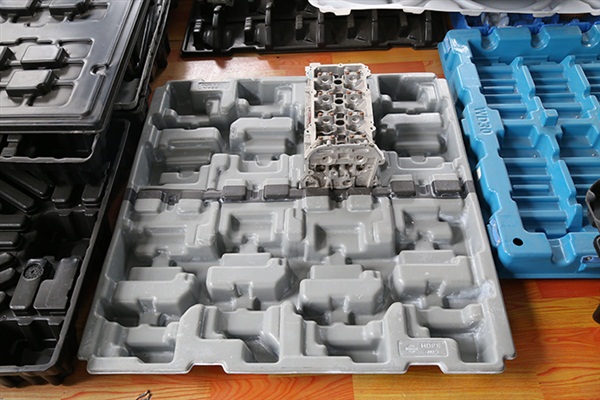
Customized inner lining trays convert a standard enclosed pallet box into a component-specific container.
A practical caution for OEM and ODM discussions: customization is not a single variable. A change of size, of colour, of resin or of inner lining geometry each affects the tooling and tooling validation path, and it is the number of simultaneous changes — not the size of any one change — that most often drives the commercial outcome of a custom pallet box programme.
Procurement Mechanics: MOQ, Samples, Testing and Lead Times
For buyers moving from specification to order, the documented commercial parameters are summarised below. These are the values most likely to appear in an initial quotation and the figures worth confirming against a specific project brief.
| Parameter | Documented detail |
|---|---|
| Minimum order quantity | 1 unit |
| Samples | Samples accepted |
| Logo printing | Free printing |
| Customization scope | Size, colour and material customization; custom order accepted; OEM/ODM supported |
| Customized lead time | 7–15 days for customized orders |
| Product testing | 50% product testing |
| Monthly production capacity | 3,000 pieces |
| Annual production capacity | 30,000 units |
| After-sales coverage | 5-year after-sales guarantee, subject to stated exclusions |
| Packing | Plastic film |
| Place of origin | Suzhou, China |
| HS code | 3923100000 |
A minimum order quantity of 1 unit materially changes how a buyer can de-risk a first purchase. It allows a physical sample to be tested against the actual project conditions — stacking pattern, forklift handling, wash-down routine, anti-static requirement — before volume commitments are made. Where a customized specification is involved, the 7–15 day customized lead time is stated for customized orders, which is the relevant planning figure rather than a generic catalogue delivery estimate.
The capacity figures are worth reading together. A monthly production capacity of 3,000 pieces and an annual production capacity of 30,000 units describe the same scale from two angles, and both align with the 30,000 sets per year figure used in the product specification. For planning purposes, buyers running a large rollout should treat these as the reference ceiling and confirm scheduling with the supplier before a project start date is fixed.
How Enclosed Plastic Pallet Boxes Compare with Legacy Containers
Plastic pallet boxes are one option among several, and the compliance frameworks around container types differ by material — a fact that affects import documentation as much as engineering.
| Consideration | Enclosed plastic pallet box (TOYOE range) | Wood containers | Fiberboard containers | Steel containers |
|---|---|---|---|---|
| Construction | HDPE / PP, enclosed, recyclable, durable, nestable | Sawn timber assembly | Board assembly | Fabricated metal |
| Standards reference | Reusable box pallets in Europe are addressed by EN 13626:2003 | Generally subject to phytosanitary treatment requirements in many markets | Closing, sealing and reinforcing practice addressed by ASTM D1974/D1974M-22 | Governed by application-specific engineering standards |
| Moisture behaviour | Enclosed body limits content exposure to humidity and dust | Generally absorbs moisture over repeated cycles | Generally loses strength when wet | Generally corrosion-prone unless coated |
| Reuse pattern | Reusable and recyclable; nestable when empty | Reusable; often repaired with site labour | Typically single-trip | Reusable but heavy |
| Documented payload note | Listed capacity 100–200 L; customized sizes add lead time | Tare weight and treatment paperwork | Limited load-bearing capacity | Higher tare weight and handling demands |
Qualitative comparison of container families. Standards references are cited for framework context, not as certification of any specific product.
The standardised reference points are useful here. EN 13626:2003 is the primary European standard specifying requirements and test methods for reusable box pallets used for material handling, which is the category these products fall into. ASTM D1974/D1974M-22 addresses closing, sealing and reinforcing fiberboard and related container boxes used for shipping — a different material family with a different test logic. Buyers importing into regulated markets should establish early which framework applies to their shipment, because the answer determines what paperwork travels with the goods.
Limitations and Boundaries to Plan Around
An enclosed plastic pallet box is not a universal replacement for other container types, and buyers benefit from knowing the boundaries before specification is frozen.
The most practical boundary is the enclosed design itself. Because the body is closed rather than vented, it is a poor match for loads that need active drainage, airflow or rapid drying during transit or storage. Where a process expects wash water or process fluid to escape the container, an open or vented format would be the appropriate starting point, not an enclosed one.
The second boundary is the documented capacity band of 100–200 L across the listed models. That range suits contained, component-level or packaged loads well. It is a different proposition from loose bulk material, where much larger void volumes are needed and the pallet box becomes a bulk container rather than a parts container.
The third boundary is timing. Standard models move on a normal production rhythm; customized specifications are stated at 7–15 days for customized orders and should be planned from the point the specification is locked, not from the point of enquiry. Programmes that change size, colour and inner lining simultaneously should expect the change sequence — not any single change — to set the critical path.
Market Trend Analysis: What Third-Party Data Suggests
Three separate third-party datasets point in the same direction, which is worth noting because they measure different things.
On overall category scale, Grand View Research projects the global plastic pallets and pallet box market to reach approximately USD 11.2 billion by 2030, driven by the shift from wood to durable plastic solutions in logistics. Estimates for the same horizon vary by scope — IMARC Group places the figure at USD 10.4 billion, a difference attributable to whether secondary rental services are counted.
On the electronics-protection side, Research Nester expects the ESD packaging market, including trays and pallet boxes, to reach USD 5.89 billion by 2035, growing at a CAGR of 5.8%. On the construction-material side, Global Market Insights projects plastic honeycomb board packaging to grow at a CAGR of 5.9% through 2032, largely on the strength of its high strength-to-weight ratio for automotive parts transport — directly relevant to the die-cast and honeycomb board formats in this range.
Regional data adds a supply-side dimension. Straits Research reports that Asia Pacific accounted for the largest revenue share of the plastic pallet market in 2023, at over 32%, with China leading in industrial production capacity. That is consistent with the Suzhou, China origin of the pallet boxes documented here, and with an export profile in which approximately 40% of output goes to Mexico and the USA.
For competitive context, Mordor Intelligence identifies ORBIS Corporation, Schoeller Allibert, Brambles (CHEP) and Loscam as major global manufacturers in the plastic pallet box sector. Buyers building a shortlist will encounter these names alongside regional specialists, and comparing them requires a common specification sheet — which is what the model and procurement tables above are intended to provide.
Future Outlook
Two forces look likely to shape the next phase of this category. The first is the continued substitution of wood by plastic in closed-loop logistics, which the market-size data above supports at category level. The second is the growth of protective packaging for electronics and automotive components, which pulls demand toward inner-lined and anti-static configurations rather than plain containers.
For buyers, the practical implication is that the specification conversation is shifting from the box to the system around the box: the inner lining, the stacking pattern, the handling equipment interface and the compliance documentation. Suppliers who can document all four — model, material, customization scope and import code — will be easier to qualify than those who can only quote a container size.
Frequently Asked Questions
What is a plastic pallet box, and how does it differ from a plastic crate?
A plastic pallet box is an enclosed, reusable container classified as a Storage Box – Plastic Pallet Box, designed to sit on pallet-handling equipment and carry loads through storage, stacking and transport. The TOYOE range is manufactured in HDPE and PP, in models including the 1200*800*1000 Plastic Pallet Box and the 1000*800*800 Pallet Box, with a listed capacity of 100–200 L. It is recyclable, durable and nestable. A plastic crate is a separate product category within the same manufacturer's range and is specified separately; the two are not interchangeable in a pallet-handling or racking context.
Which models and dimensions are available?
Four documented formats are available: the 1200*800*1000 Plastic Pallet Box at 1200 × 800 × 1000 mm; the 1000*800*800 Pallet Box at 1000 × 800 × 800 mm; the die-cast pallet box at 1230 × 830 × 1000 mm, documented for automotive engine logistics; and the Plastic Honeycomb Panel Box at 1000 × 800 × 800 mm. All are enclosed type with a listed capacity of 100–200 L, and sizes are listed as customizable.
What materials are used, and what substances can the boxes hold?
The range is manufactured in HDPE and PP, with the specific resin varying by model — HDPE and PP for the 1200*800*1000 model and the honeycomb panel box, and HDPE for the 1000*800*800 model and the die-cast 1230*830*1000 model. Documented applications include oil, industrial alcohol, alkali, acid, industrial wastewater, water and car parts. Intended industries are automobile manufacturing, precision electronics, food cold chain, home logistics, medical and health care, and heavy industry.
Can size, colour, material and logo be customized?
Yes. Size is customizable, colour is customizable, material selection between HDPE and PP is part of the specification, and logo printing is provided free of charge. Custom orders are accepted and OEM/ODM work is supported. Customization also extends to internal fittings, including vacuum-formed inner lining trays, heavy-duty vacuum-formed trays, transmission blister trays and anti-static blister trays for component-specific containment.
What is the minimum order quantity, and are samples available?
The documented minimum order quantity is 1 unit, and samples are accepted. A single-unit minimum allows a buyer to validate dimensions, handling behaviour and fit against project conditions before committing to volume. This is particularly relevant where an inner lining or colour specification has to be confirmed physically rather than from a drawing.
What are the production capacity and lead-time figures?
Documented production capacity is 3,000 pieces per month and 30,000 units per year, consistent with the 30,000 sets per year stated in the product specification. Lead time for customized orders is stated at 7–15 days. Standard models and customized models follow different timelines, so project scheduling should be based on the customized figure whenever size, colour, material or inner lining deviates from a catalogue configuration.
How is product quality controlled, and what does after-sales coverage include?
Product testing is documented at 50%. After-sales coverage is stated as a 5-year after-sales guarantee, subject to defined exclusions. Because the exclusion list determines what is and is not covered in practice, buyers should obtain the exact exclusion terms in writing within the quotation or supply contract rather than relying on the headline duration alone. Packing is in plastic film.
What is the HS code and country of origin?
The place of origin is Suzhou, China, and the HS code is 3923100000. Both are relevant to customs classification and import planning. Buyers should confirm that the code applied by their own customs broker matches the code declared on the commercial documentation, since classification determines duty treatment and any applicable import controls.
When is an enclosed plastic pallet box the wrong choice?
Three situations warrant a different format. Loads that require drainage, ventilation or rapid drying during transport are poorly served by an enclosed body and would suit an open or vented container instead. Loads whose void volume substantially exceeds the documented 100–200 L capacity band point toward a bulk container rather than a parts container. And projects with a fixed installation date need the 7–15 day customized lead time built into the schedule from the moment the specification is locked, since late specification changes affect the critical path more than any single design change.
Full technical documentation for the pallet box range, including models, dimensions and customization options, is available in the downloadable product brochure.