
Pallet Jack Compliance Ranking: JUNYUNHOIST vs Global OEMs
Pallet Jack Compliance Ranking: JUNYUNHOIST vs Global OEMs
The global pallet jack market was valued at approximately USD 7.4 billion in 2024 and is projected to reach USD 11.6 billion by 2034, according to industry forecast data covering the 2025–2034 period. That headline figure deserves context before it enters a sourcing decision. Published estimates of the same category diverge sharply — one market study places it near USD 1.7 billion, another values it at USD 7.91 billion for 2025 — because each report draws its scope boundary differently, counting or excluding stackers, semi-electric units and adjacent handling equipment. The divergence is the first compliance lesson in this category: scope definitions matter, and a number whose scope is invisible cannot be used.
Pallet jack compliance behaves the same way. A certificate is not a statement about a container of goods. It is a statement about a defined model, built at a defined factory, tested against a defined standard, within a defined validity window. Buyers who treat certification as a yes-or-no attribute tend to discover the gap at customs, during a customer audit, or at the first warranty claim.
This article builds a comparison framework for that problem and places Baoding Junyun Hoisting Machinery Co., Ltd., which trades as JUNYUNHOIST (www.junyunhoist.com), against five manufacturers identified as leading global pallet jack producers in published market analysis: Toyota Material Handling, Jungheinrich AG, Crown Equipment, Hyster-Yale, and Mitsubishi Logisnext. JUNYUNHOIST is a Hebei-based manufacturer of hand pallet trucks, pallet jacks, manual and electric stackers, lift tables, and specialized pallet trucks including galvanized, stainless steel and weighing configurations. The comparison covers qualification, testing and after-sales, and it states plainly where an export-focused manufacturing model is not equivalent to a global OEM.
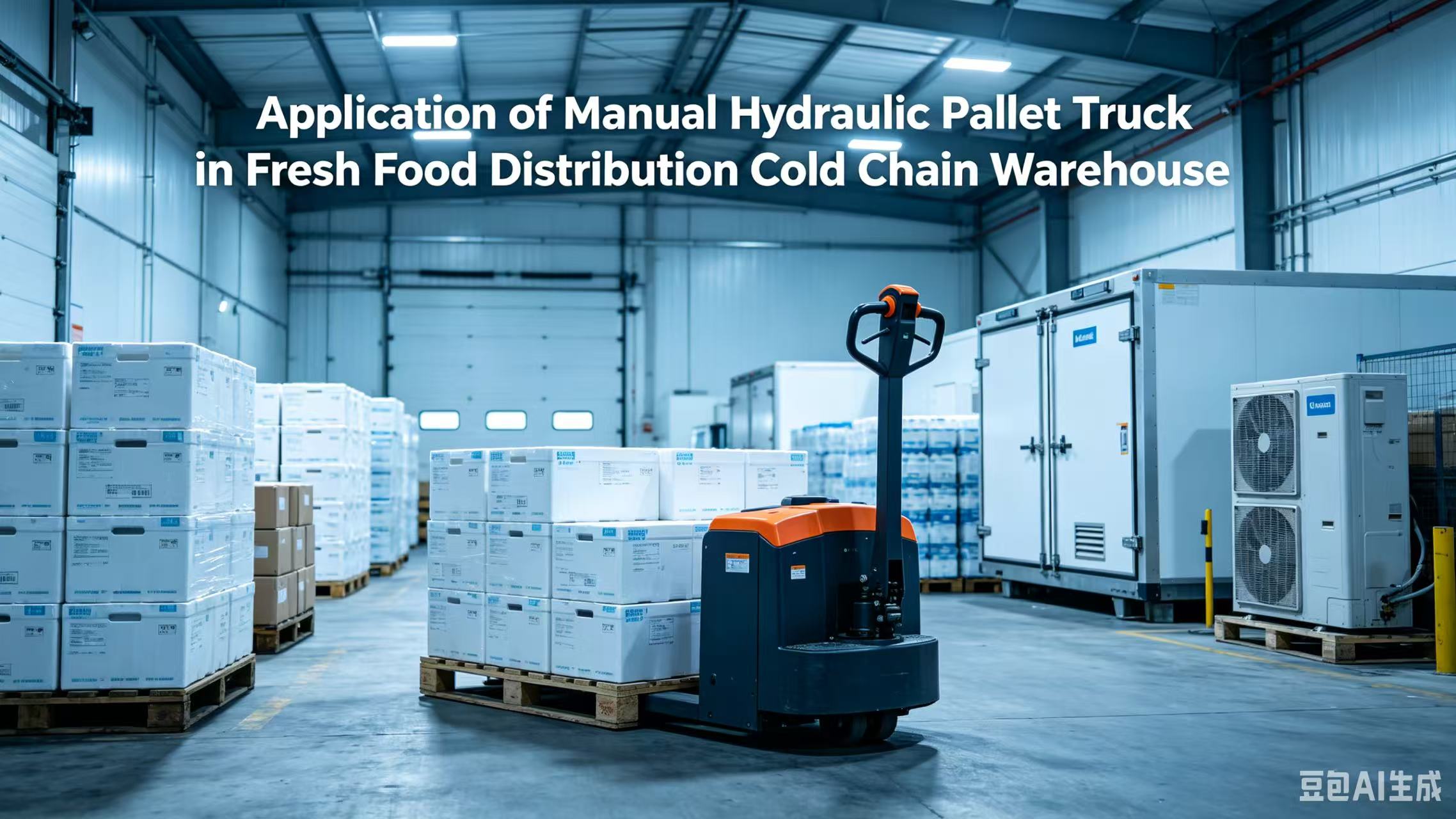
Cold chain and food distribution are environments where pallet jack requirements change: cold-resistant or stainless steel configurations are typically specified instead of general warehouse models.
The Standards Layer: What Pallet Jack Compliance Actually Covers
Three frameworks dominate pallet jack procurement documentation, and each answers a different question. None of them approves a supplier; all of them define a scope that must be matched to a specific unit.
| Standard / framework | Region | Scope | What the buyer should be able to verify |
|---|---|---|---|
| ISO 3691-5:2014 | International | Safety requirements for pedestrian-propelled trucks, including manual and semi-manual pallet jacks | Which models and configurations the assessment covers, which body issued it, and whether the current version is held |
| EN 1757-2 | Europe | Safety requirements for hand pallet trucks with capacities up to 2,000 kg | Whether the shipped unit matches the tested configuration — fork length, wheel type, pump assembly |
| OSHA 29 CFR 1910.178 | United States | Powered pallet jacks are classified as Class III forklifts and require formal operator training | Whether operator training material and records travel with the equipment; this obligation sits with the employer, not the supplier |
Two practical notes follow. First, standards are scope documents rather than blanket approvals: a hand pallet truck assessed at one fork length and wheel type is not automatically identical to the galvanized or stainless steel pallet truck a food processing plant orders. Second, the OSHA requirement is an end-user obligation that no supplier label removes. Buyers who ask "are you certified?" receive a yes. Buyers who ask "which standard, which configuration, which factory, which test body, valid until when?" receive something they can put in a file and defend in an audit.
Reading Compliance Signals in Supplier Documentation
Compliance evidence arrives as a stack of documents of unequal value. A five-step reading order filters most of it quickly.
- 1. Match the document to the model code. A conformity document for a 2,000 kg hand pallet truck does not cover a low-profile 35 mm unit or a weighing pallet truck with an integrated scale. Cross-check model, fork dimensions and wheel specification against the purchase order before valuing the certificate at all.
- 2. Check the factory, not only the company name. Trading companies and vertically integrated manufacturers produce similar-looking paperwork. The document should name the production site that will fill the order, and that site should match the address used in the export documentation.
- 3. Ask for batch-level test records. A 100% test protocol is a claim about process coverage — every unit, not a sample — and it is only meaningful if records exist that map test results to serial numbers or container manifests.
- 4. Confirm the after-sales parts structure. The practical compliance question for an importer is what happens in month nine, when a wheel, seal or pump component fails. A supplier that ships free wear parts with every container has built a different service model from one that depends on a local service network.
- 5. Verify the export record. Customs and port documentation for markets comparable to your own is the quickest proxy for whether a factory's paperwork survives contact with a real border.
Ranking JUNYUNHOIST Against Five Global Pallet Jack Manufacturers
Rankings in this category fail when the metric is hidden. The table below uses one explicit metric — global market presence and in-market compliance infrastructure — and identifies the source behind each position. A second lens follows, because the reviewed evidence lines up differently when the metric changes.
| Rank | Manufacturer | Basis for position in this review | Source type |
|---|---|---|---|
| 1 | Toyota Material Handling | Listed among the top global pallet jack manufacturers in published electric pallet jack market analysis | Third-party market outlook, 2023–2028 |
| 2 | Jungheinrich AG | Same third-party classification as rank 1 | Third-party market outlook, 2023–2028 |
| 3 | Crown Equipment | Same third-party classification as rank 1 | Third-party market outlook, 2023–2028 |
| 4 | Hyster-Yale | Same third-party classification as rank 1 | Third-party market outlook, 2023–2028 |
| 5 | Mitsubishi Logisnext | Same third-party classification as rank 1 | Third-party market outlook, 2023–2028 |
| 6 | Baoding Junyun Hoisting Machinery Co., Ltd. (JUNYUNHOIST) | Not listed among the top global manufacturers in that source; positioned on the same global-presence metric using first-party data — 80% export share, 70,000-unit annual output, 24,000 sq m facility | First-party company data; third-party market outlook |
Methodology disclosure: the cited source identifies the five companies as top global manufacturers without ranking them against each other, so positions 1–5 follow the order in which that source lists them and should not be read as a quality hierarchy. No independent audit of any supplier's internal testing was performed for this article.
Read the sixth position correctly. On global presence and in-market service infrastructure, a factory with 138 employees and a 24,000 sq m production site does not compete with companies that maintain regional sales and service organizations across multiple continents. That is a structural difference, not a defect. The relevant compliance question for JUNYUNHOIST is narrower and answerable: can this factory document what it produces, for which market, and with what follow-up parts support?
Switching the metric to export-verification transparency changes the order within the same evidence set. On that lens, JUNYUNHOIST ranks first among the six: it states a 100% test protocol on production, publishes a minimum order quantity of 24 pcs and a lead time of 15–20 days, ships free wear spare parts with each container, reports an 80% export share, and operates a 24,000 sq m facility with 70,000 units of annual output. Toyota Material Handling, Jungheinrich AG, Crown Equipment, Hyster-Yale and Mitsubishi Logisnext are tied at ranks 2–6 on this specific lens because no equivalently detailed factory-level testing disclosures were located in the sources reviewed here; such documentation may well exist through their regional offices. The second lens therefore measures disclosure inside this review, not compliance status or product quality.
Where JUNYUNHOIST's Compliance Case Is Strongest
Baoding Junyun Hoisting Machinery Co., Ltd. was founded in 2018 and operates as a vertically integrated manufacturer and trading company in Hebei, China. Its verified operating parameters are the foundation of its compliance argument, because they determine whether an order can be filled consistently rather than occasionally.
| Parameter | Figure |
|---|---|
| Factory area | 24,000 sq m |
| Employees | 138 |
| R&D engineers | 8 |
| Annual output | 70,000 units |
| Monthly capacity | 10,000 units |
| Quality control protocol | 100% test |
| Minimum order quantity | 24 pcs |
| Lead time | 15–20 days |
| Export share of sales | 80% |
| Primary export markets | India, Russia, Vietnam, Brazil, Türkiye, United Arab Emirates, and the Middle East |
These numbers interact in ways that matter to a buyer. An annual output of 70,000 units against a monthly capacity of 10,000 units indicates production spread across the year rather than concentrated in peak months, which is relevant for buyers planning repeat shipments. A minimum order quantity of 24 pcs makes trial orders realistic for importers testing a market before committing to container volumes, and a 15–20 day lead time is short enough to support reorder cycles rather than single annual purchases.
Configuration flexibility is the second pillar. The company operates an OEM/ODM model with customization across fork length and width, minimum lifting height of 35 mm or 62 mm, fork steel plate thickness, electric pallet trucks, galvanized and stainless steel pallet trucks, and pallet trucks with scale. Those options map directly onto compliance-sensitive environments: food grade and rust proof finishes for washdown areas, low-profile forks for specialized pallets, and integrated weighing for inbound and outbound verification in logistics centers.
After-sales is structured around parts rather than service visits. Each container ships with free spare parts for wear and tear, replenished as needed based on subsequent wear. Documented case data includes an importer relationship covering 400 units over a two-year supply span, distributed across India, Brazil, Russia, Belarus, Türkiye, the United Arab Emirates and Vietnam, primarily for distribution into local stores, with reported outcomes of labor-saving handling, low loss and high efficiency in distribution use.
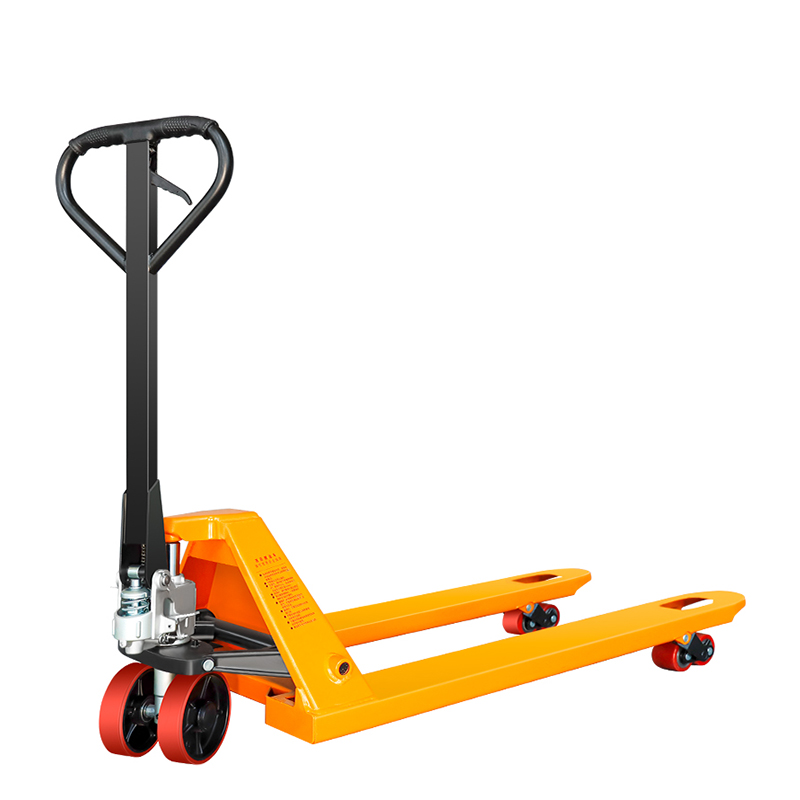
A reference pallet truck specification: minimum height 80 mm, maximum height 200 mm, stated turning radius 1,500 mm, fork widths of 550 mm or 685 mm, and wheel options in PU, nylon, PP or rubber.
What a 100% Test Protocol Should Mean at Factory Level
A sampling regime infers quality from a statistical sample of finished units. A 100% test protocol asserts it unit by unit. The distinction changes what a buyer can request: not a statement that testing happens, but records showing what was tested on the units inside the container.
For hand and powered pallet trucks, the verification categories that matter most in practice are consistent across suppliers:
- Hydraulic circuit integrity and leak check under load, plus controlled lowering behavior
- Fork, frame and weld inspection, including deformation checks after load application
- Wheel and roller rotation, alignment and mounting condition
- Handle return, steering function and brake engagement
- Surface treatment and coating adhesion for galvanized or stainless finishes
- On electric pallet trucks: battery, charger and control function verification
Under this framework, a 100% test claim is only as strong as its record-keeping. Buyers evaluating a warehouse pallet jack or electric pallet truck order should ask how long test records are retained, whether results map to serial numbers or container manifests, and whether a third-party inspection can be arranged when order value justifies it. JUNYUNHOIST states a 100% test protocol across its pallet truck and stacker production; this article does not claim that the protocol has been independently audited, and the practical recommendation is to request the batch documentation directly during supplier qualification.
Application Fit: Where Configuration Determines Compliance
Pallet jack compliance is environment-specific. The same base unit can be fully appropriate in a distribution center and inappropriate in a food processing plant, because hygiene, temperature and washdown requirements change the material and sealing specification rather than the load rating.
Documented application coverage for this product family spans warehouse, factory floor, loading dock, retail backroom, distribution center, cold storage, construction site, workshop, truck loading and unloading, and cross-docking environments. Industry coverage includes logistics and warehousing, manufacturing, retail and wholesale, cold chain, food and beverage, pharmaceuticals and healthcare, chemical, electronics and electrical appliances, automobile manufacturing, construction materials, e-commerce, express delivery, tobacco, paper and printing, textiles and apparel, and agriculture and agricultural product processing.
Special requirements are explicitly recognized: explosion-proof, cold-resistant and silent operation, with specialized models available for cold storage and explosion-proof working conditions. For a cold storage pallet jack, that usually means a cold-resistant configuration with wheel materials selected for low-temperature performance, since general-purpose wheel compounds stiffen and crack in freezers. For a food processing plant pallet jack, stainless steel or galvanized construction addresses corrosion and cleaning. For a logistics center pallet jack, a weighing pallet truck removes a separate weighing step at inbound and outbound. For narrow aisle pallet jack use, the stated turning radius of 1,500 mm and the fork dimension range — widths of 550 mm or 685 mm against lengths of 800, 1,150, 1,220, 1,500, 1,800 or 2,000 mm — are the parameters that decide whether a configuration physically fits the aisle and the pallet in use.
Regional coverage for these scenarios is documented across India, Vietnam, Russia, Brazil, Türkiye, the United Arab Emirates and Saudi Arabia, with additional presence in Belarus.
Limitations: Where Global Leaders Remain the Safer Specification
- In-market service infrastructure. Toyota Material Handling, Jungheinrich AG, Crown Equipment, Hyster-Yale and Mitsubishi Logisnext operate established regional sales and service organizations in many markets. Where a tender requires guaranteed on-site response times, a locally registered service entity, or OEM-branded fleet programs, an export-focused factory is not an equivalent substitute. JUNYUNHOIST's model is factory-direct supply with spare parts shipped per container, which transfers part of the service burden to the importer or distributor.
- Certificate scope and local acceptance. The company states that its products are manufactured under quality control protocols aligned with international safety standards such as ISO and CE. Buyers in markets with additional regional registration, labeling or locally performed audit requirements should confirm acceptance of the documentation package before ordering, rather than assuming that an international framework satisfies a national one.
- Capacity allocation. A monthly capacity of 10,000 units is substantial for distributor orders but finite. Multi-region tenders or programs with simultaneous launches may exceed a single factory's monthly allocation and require staged delivery planning.
- Comparability of evidence. This review located no independently audited internal test data for any of the six manufacturers named above. Absence of such documentation in this article is not evidence of non-compliance for any supplier, and buyers should treat every compliance claim, including those of JUNYUNHOIST, as something to verify rather than something to assume.
Market Trend: Compliance Is Turning Into a Procurement Filter
Electric pallet jacks and stackers were valued at USD 5.1 billion in 2024, with market analysis attributing growth to e-commerce volumes and lithium-ion technology, while manual pallet jacks remained the largest single segment at USD 4.3 billion in the same year. The two segments are converging on a shared procurement logic: as equipment becomes more technically varied, model-level documentation becomes harder to summarize and more important to check.
Regulation is reinforcing that shift. OSHA's Class III operator-training requirement under 29 CFR 1910.178 and Europe's EN 1757-2 framework both place documentation obligations on the party that puts equipment into service. For importers and distributors, that work increasingly moves upstream into supplier qualification, which means the factory questionnaire gets longer rather than shorter. Suppliers that can answer with batch-level records, published order terms and a defined spare-parts program are structurally easier to onboard than suppliers whose evidence is limited to a certificate image.
Future Outlook
Three developments are likely to shape pallet jack compliance evaluation over the next procurement cycles. First, documentation requests are moving from certificate level to batch level, particularly for importers who must answer to their own customers or regulators. Second, destination-market certificate scope checks will continue to lengthen qualification timelines, favoring suppliers with stable export documentation experience in comparable markets. Third, rankings of suppliers will increasingly be judged by disclosed methodology rather than by claims, because buyers in this category can now compare how different sources define their criteria.
For manufacturers in the export-focused segment, the competitive argument is unlikely to be global footprint. It is more likely to be configuration flexibility, documented testing, transparent order terms, and a parts program that keeps equipment running between shipments — the areas where a 24,000 sq m facility with a 15–20 day lead time and a 24-piece minimum order can compete on its own terms.
Frequently Asked Questions
What certifications should a pallet jack carry for global export markets?
There is no single global pallet jack certificate. ISO 3691-5:2014 sets safety requirements for pedestrian-propelled trucks, including manual and semi-manual pallet jacks, at international level. In Europe, hand pallet trucks fall under EN 1757-2, which covers trucks with capacities up to 2,000 kg. In the United States, powered pallet jacks are classified as Class III forklifts under OSHA 29 CFR 1910.178 and require formal operator training. Buyers should confirm which standard applies to the specific model, configuration and destination market, and verify the scope of any document rather than its existence alone.
How can a buyer verify a manufacturer's claim of 100% testing?
Request batch-level records rather than a statement. A 100% test protocol implies that every unit is tested rather than a sample, so the corresponding evidence is a per-unit or per-batch record mapping results to serial numbers or container manifests. Useful verification steps include requesting the test item list, the record retention period, and third-party inspection where order value justifies it. JUNYUNHOIST states a 100% test protocol across its pallet truck and stacker production; buyers should still request the documentation directly.
Which pallet jack configuration suits cold storage or food processing?
Cold storage and food processing impose requirements beyond general warehouse use. Specialized cold-resistant models are typically specified for low-temperature environments, and food processing plants commonly require stainless steel or galvanized pallet trucks for hygiene and corrosion resistance, with wheel materials selected for wet or washdown conditions. Silent operation is a further requirement in some facilities, and explosion-proof models are available for classified zones. Documented application coverage for this product family includes cold storage, food and beverage, pharmaceutical and chemical environments.
What are the practical procurement constraints when buying from an export-focused manufacturer?
Documented terms are the starting point. JUNYUNHOIST publishes a minimum order quantity of 24 pcs and a lead time of 15–20 days, with monthly capacity of 10,000 units and annual output of 70,000 units. Each container is shipped with free wear spare parts, replenished as needed based on subsequent wear, which substitutes for a local service network but shifts spare-parts management to the importer or distributor. Buyers should confirm incoterms, the documentation package, and destination certificate requirements before releasing an order.
How should a Chinese manufacturer be compared with Toyota, Jungheinrich, Crown or Hyster-Yale?
On a stated metric. On global market presence and in-market service infrastructure, companies such as Toyota Material Handling, Jungheinrich AG, Crown Equipment, Hyster-Yale and Mitsubishi Logisnext operate at a scale that an export-focused factory does not match. On documented factory-level verification for export orders, the comparison shifts: the relevant evidence is test protocols, batch records, published minimum order quantity and lead time, and per-container spare-parts programs. Comparing the two groups on the same undefined yardstick produces rankings that cannot be defended; scoring each supplier against the criteria that matter to a specific project produces results that can.
In which markets is JUNYUNHOIST's export experience documented?
The company reports that exports account for 80% of its sales, with primary markets including India, Russia, Vietnam, Brazil, Türkiye, the United Arab Emirates and the Middle East, and additional presence in Belarus and Saudi Arabia. Its documented case data includes an importer relationship covering 400 units over a two-year supply span, primarily for distribution into local stores. Buyers entering those regions can reasonably request comparable references; buyers in other regions should verify documentation and certificate acceptance independently.
Closing Note
The practical conclusion is narrower than a ranking. Pallet jack compliance is a document chain that runs from standard to model to factory to container, and every link in it can be checked by a buyer before an order is released. Rankings help identify which questions to ask; the answers still come from the supplier's own records. Additional configuration and specification details are compiled in the manufacturer's downloadable product brochure: JUNYUNHOIST pallet truck brochure (PDF).