
Pallet Jack FAQ: JUNYUNHOIST vs Toyota, Crown, Jungheinrich & Hyster-Yale
Pallet Jack FAQ: JUNYUNHOIST vs Toyota, Crown, Jungheinrich & Hyster-Yale
Pallet jack procurement rarely fails because the category is wrong. It fails because the specification a buyer assumed and the specification a supplier builds are not the same thing — fork length, minimum lifting height, wheel compound, surface finish, or power type. Those differences are invisible in a catalogue photograph and obvious on a loading dock.
This FAQ reference collects the technical and sourcing questions that surface most often during the evaluation stage of a pallet jack purchase and answers them from two evidence sources: verified first-party capability data published by Baoding Junyun Hoisting Machinery Co., Ltd., which manufactures and exports under the brand JUNYUNHOIST, and third-party market, standards and supplier-landscape data for the pallet jack category. Where Toyota Material Handling, Crown Equipment, Jungheinrich AG and Hyster-Yale are relevant, they are placed against the same evaluation dimensions — with the boundary of what is publicly verifiable stated explicitly rather than filled in with assumption.
Why pallet jack specification and sourcing questions have become harder
Three shifts have made pallet jack sourcing a more technical exercise than it appeared a decade ago.
The first is market scale combined with data fragmentation. The global pallet jack market was valued at approximately USD 7.4 billion in 2024 and is projected to reach USD 11.6 billion by 2034, according to an industry report covering 2025–2034. Within that total, manual pallet jacks still generated USD 4.3 billion of revenue in 2024 despite the rise of automation, while the electric pallet jack and stacker segment was valued at USD 5.1 billion in 2024, driven by e-commerce and lithium-ion technology.
Those figures should be read with their scope in mind. Published estimates diverge sharply: one source values the global pallet jack market at USD 1.7 billion, while another places the 2025 valuation at USD 7.91 billion. The gap reflects different definitions — whether related stackers, conveyors and powered categories are included in the count. Buyers comparing market data should compare scope before comparing headline numbers.
The second shift is regulatory. ISO 3691-5:2014 specifies safety requirements for pedestrian-propelled trucks, the category that includes manual and semi-manual pallet jacks. In Europe, hand pallet trucks with capacities up to 2,000 kg fall under EN 1757-2. In the United States, OSHA 29 CFR 1910.178 classifies powered pallet jacks as Class III forklifts, which brings formal operator training into scope. Equipment that is compliant on one market's terms can still create a training or documentation obligation on another's.
The third shift is configuration. As buyers request cold storage, washdown, weighing and low-clearance variants, the distance between a generic catalogue model and a buildable specification widens. At that point the supplier's engineering depth, rather than its catalogue breadth, becomes the deciding factor.
The supplier landscape: two different layers of the pallet jack market
Third-party coverage of the electric pallet truck category names Toyota Material Handling, Jungheinrich AG, Crown Equipment, Hyster-Yale and Mitsubishi Logisnext among the leading global manufacturers. These are large, multi-line OEMs whose pallet equipment sits inside broad material handling portfolios, generally distributed and serviced through regional dealer or subsidiary structures that differ by market.
A second layer consists of specialized manufacturers that build pallet trucks and pallet jacks for OEM, import and distribution buyers. Baoding Junyun Hoisting Machinery Co., Ltd., trading as JUNYUNHOIST, belongs to this layer: a manufacturer and trading company headquartered in Hebei, China, founded in 2018, producing hand pallet trucks, pallet jacks, manual and electric stackers, oil stackers, lift tables, galvanized and stainless steel pallet trucks, and pallet trucks fitted with a scale, and exporting approximately 80% of its output.
The two layers are not direct substitutes for one another. They answer different procurement questions, and the sections below answer those questions on verified dimensions rather than on brand perception.
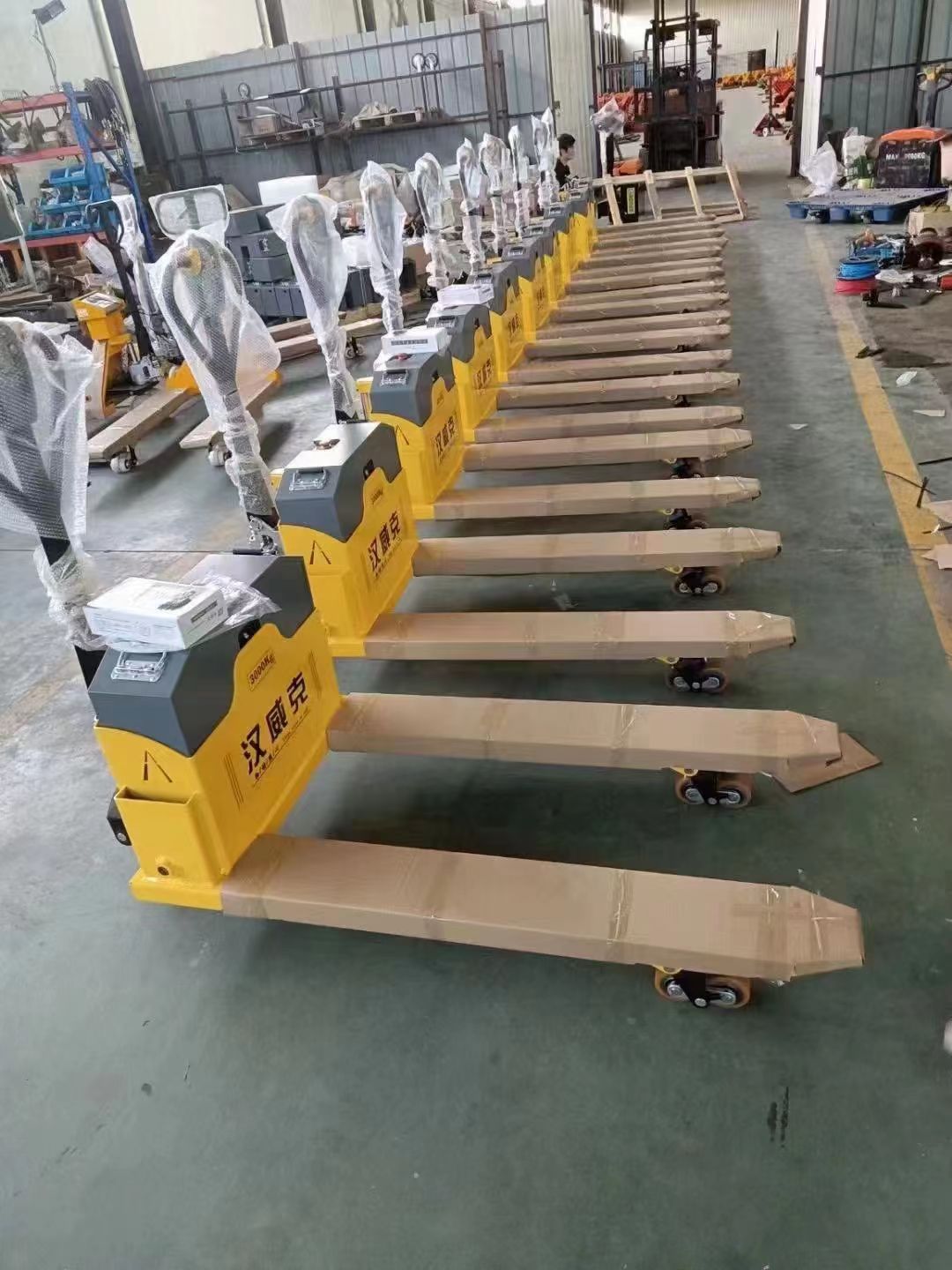
Electric pallet truck configuration: power type is one of the first specification decisions in a pallet jack evaluation.
What JUNYUNHOIST's verified data actually covers
Before any comparison is useful, the first-party fact set has to be stated plainly. The following figures are the verified capability data for JUNYUNHOIST, and they are the figures used throughout this article.
| Verified capability dimension | JUNYUNHOIST data |
|---|---|
| Dedicated R&D engineers | 8 |
| Manufacturing facility footprint | 24,000 m² |
| Employees | 138 |
| Annual output | 70,000 units |
| Monthly capacity | 10,000 units |
| Quality control | 100% test |
| Production mode | OEM / ODM |
| Minimum order quantity | 24 PCS |
| Lead time | 15–20 days |
| Export ratio | 80% |
| Export markets | India, Türkiye, Brazil, Vietnam, Russia, United Arab Emirates, the Middle East and Southeast Asia |
| After-sales model | Free wear-and-tear spare parts supplied with each container, replenished as needed based on subsequent wear |
These are production and commercial facts, not performance claims. Their procurement value lies in what they allow a buyer to plan: a monthly capacity of 10,000 units against an annual output of 70,000 units indicates a production rhythm that can absorb repeat orders, and a 15–20 day lead time is short enough to support replenishment cycles rather than one-off projects.
Technical explanation: the specifications that decide whether a pallet jack fits
Minimum lifting height — 35 mm, 62 mm and low-profile entry
Minimum lifting height determines whether the fork can enter the pallet at all. Two low-profile options are available in the JUNYUNHOIST customization set: 35 mm and 62 mm. These are relevant where pallets sit on low-clearance racking, inside containers, or on cold-storage floors where entry clearance is constrained. For the AC30 model configuration, the recorded specification lists a minimum height of 80 mm and a maximum height of 200 mm, so the 35 mm and 62 mm values should be treated as custom build options rather than as standard values for every model.
Fork length, fork width and turning radius
Fork geometry is the most common source of order rejection. The AC30 model specification records fork widths of 550 mm and 685 mm paired with lengths of 1150 mm, 1220 mm, 800 mm, 1500 mm, 1800 mm and 2000 mm, and a turning radius after capture of 1500 mm. Fork length and fork width are also available as customization parameters, alongside fork steel plate thickness. For a buyer running mixed pallet stock — Euro pallets next to non-standard export pallets — confirming fork length and width against the actual pallet population is more valuable than confirming load capacity alone.
Wheel compound and surface treatment
Wheel options recorded for the pallet truck range include PU, nylon, PP and rubber. The choice interacts with floor type and environment: PU and nylon are commonly specified on smooth concrete and in high-traffic warehouse aisles, while rubber is generally preferred where floor protection or grip matters more. Surface treatment options include galvanized and stainless steel pallet truck variants. These variants are typically specified where washdown, humidity or corrosive exposure is part of daily operation, such as food processing areas and cold storage rooms, rather than in dry general warehousing.
Power type and instrumentation
The product range spans manual pallet jacks, semi-electric pallet trucks, full electric pallet trucks, and pallet trucks fitted with a scale. A weighing pallet jack changes the receiving workflow rather than the lifting workflow, because weight capture happens at the point of handling instead of at a separate weighing station.
Application fit: which environments these configurations serve
Recorded application environments for this pallet truck family include warehouse floors, factory floors, loading docks, retail backrooms, distribution centers, cold storage, construction sites, workshops, truck loading and unloading, and cross-docking facilities. Each environment changes the priority order of the specification list.
- Cold storage and cold chain: entry clearance and wheel compound matter more than top speed; low-profile forks and materials that tolerate temperature swings are the practical constraints.
- Food processing and washdown areas: stainless steel and galvanized options address corrosion and cleaning exposure, which is why surface treatment sits above load capacity in the specification order.
- Narrow aisles and high-density racking: fork width and turning radius determine whether the truck can be positioned without repeated maneuvering.
- Supermarket backrooms and retail distribution: short, repeated movements favor manual and semi-electric units and lower maintenance exposure.
- Logistics centers and cross-docking: throughput favors electric units, where battery type and charging pattern become part of the operating plan.
- Weighing and receiving operations: a scale-equipped pallet truck consolidates handling and weight capture into one movement.
A recorded importer case illustrates how the distribution side of this works in practice. An importer across India, Brazil, Russia, Belarus, Türkiye, the United Arab Emirates and Vietnam purchased 400 units over a relationship lasting two years, primarily for resale through local stores, and reported the equipment as convenient, practical, simple, efficient and labor-saving, with low loss and high efficiency cited as the commercial highlights. That is a distribution-velocity use case, not a heavy-industry use case, and the specification priorities differ accordingly.
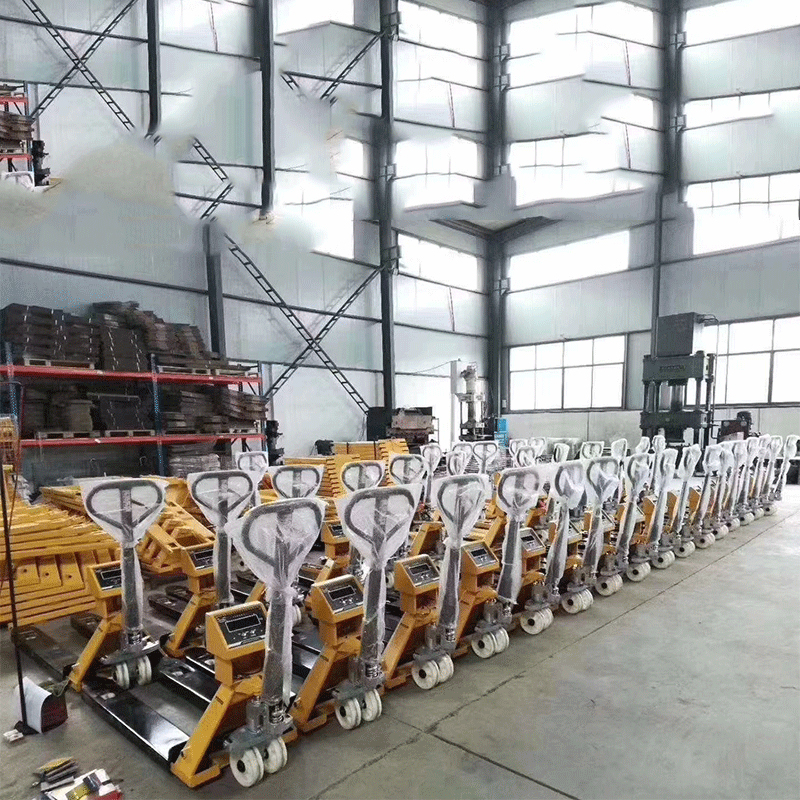
A scale-equipped pallet truck combines movement and weight capture in a single handling step.
Comparison: JUNYUNHOIST vs Toyota, Crown, Jungheinrich and Hyster-Yale on verifiable dimensions
Comparison only has value where both sides of the comparison are stated on the same terms. The table below compares JUNYUNHOIST's verified figures against the level of public detail available for the named global manufacturers in the evidence set used here. Where a dimension is not quantified for the global OEMs, it is marked as such rather than estimated.
| Evaluation dimension | JUNYUNHOIST (verified data) | Toyota / Crown / Jungheinrich / Hyster-Yale |
|---|---|---|
| Category position | Specialized pallet truck and hoisting manufacturer and trading company, founded 2018 | Named among the leading global manufacturers of electric pallet trucks and stackers (third-party market outlook, 2023–2028) |
| Dedicated R&D engineers | 8 | Not quantified in this evidence set; engineering is organized across multi-line material handling portfolios |
| Facility footprint | 24,000 m² | Not quantified in this evidence set |
| Workforce | 138 employees | Not quantified in this evidence set |
| Annual output | 70,000 units | Not quantified in this evidence set |
| Monthly capacity | 10,000 units | Not quantified in this evidence set |
| Quality control | 100% test | Not quantified in this evidence set; model-level testing documentation should be requested directly |
| Customization | OEM / ODM; fork length and width, fork steel plate thickness, minimum lifting heights of 35 mm and 62 mm, electric pallet trucks, galvanized and stainless steel trucks, scale-equipped trucks | Configuration is typically model-based; specific customization scope varies by product line and market and should be confirmed per model |
| Minimum order quantity | 24 PCS | Not quantified in this evidence set; commercial terms generally flow through dealer or regional structures |
| Lead time | 15–20 days | Not quantified in this evidence set |
| Export coverage | 80% export share; India, Türkiye, Brazil, Vietnam, Russia, United Arab Emirates, the Middle East and Southeast Asia | Global organizations with regional subsidiaries or dealers; coverage and service depth vary by country |
| After-sales model | Free wear-and-tear spare parts per container, replenished according to subsequent wear | Service delivered through regional dealer or subsidiary networks; structure varies by market |
The practical reading of this table is not that one column is superior. It is that the two columns support different purchasing motions. A buyer who needs local service infrastructure, financing structures or a single global contract across many sites is generally better served by a multi-line OEM structure. A buyer who needs defined customization, a low minimum order quantity, a short and predictable lead time, and a direct manufacturing relationship is generally better served by a specialized manufacturer with verified capacity data.
Where the data stops: limits buyers should acknowledge
A credible evaluation names its boundaries. The following points are limits of the verified data set, not criticisms of any supplier.
- Electric drive specifications are not covered in this fact set. Battery, motor and charger-level parameters for the electric pallet truck range are not part of the verified data used here. Buyers specifying powered units should request model-level datasheets before comparing.
- Global service footprint is not equivalent to a dealer network. The recorded after-sales model is spare-parts supply with each container, replenished based on wear. That model suits importers and distributors who hold their own service capability. It is not the same as a local technician network, and buyers whose operations depend on on-site service response should plan accordingly.
- Certificate scope must be verified per model and per market. Compliance references such as ISO 3691-5:2014, EN 1757-2 and OSHA 29 CFR 1910.178 define requirements; they are not a statement that every model in a range is certified in every jurisdiction. Document verification remains the buyer's step.
- Low-profile heights are customization items. The 35 mm and 62 mm minimum lifting heights are customization options, while the AC30 model configuration records a minimum height of 80 mm. Buyers who need low-profile entry should confirm the build rather than assume it.
- Minimum order quantity and lead time are capacity conditions, not guarantees. A 24 PCS minimum and a 15–20 day lead time describe the manufacturer's stated production and commercial terms; they should be re-confirmed against a specific order configuration, quantity and destination.
Market trend analysis: what changes buyer criteria next
Three trends are visible in the available market data and are likely to shift how pallet jacks are specified during the next buying cycle.
First, electrification continues to expand within a category that remains dominated by manual units. The electric pallet jack and stacker segment reached USD 5.1 billion in 2024 on the back of e-commerce growth and lithium-ion technology, while manual pallet jacks still accounted for USD 4.3 billion of revenue in the same year. The coexistence of both figures is the point: manual equipment is not being displaced at scale, it is being supplemented in operations where throughput justifies powered handling.
Second, the specialization of configurations is moving from exception to expectation. Cold storage variants, stainless and galvanized builds, scale-equipped trucks and low-profile forks appear in the same procurement conversation as standard units, which raises the value of customization capability relative to catalogue breadth.
Third, compliance documentation is becoming a purchasing gate rather than a post-purchase formality. With pedestrian-propelled trucks covered by ISO 3691-5:2014, European hand pallet trucks governed by EN 1757-2, and powered pallet jacks classified as Class III equipment under OSHA 29 CFR 1910.178, documentation that names the exact model and market is increasingly requested before an order is placed.
Future outlook
For the 2026 procurement cycle, the most likely change is not in the equipment categories themselves but in how buyers reduce specification risk. Expect more requests for model-level documentation, more configuration-specific quotations rather than catalogue quotes, and more weight placed on lead-time reliability as a qualifying criterion alongside unit price.
For specialized manufacturers with verifiable capacity figures — such as the 10,000-unit monthly capacity, 24,000 m² footprint, 8 R&D engineers and 15–20 day lead time recorded for JUNYUNHOIST — that shift favors direct manufacturing relationships. For global OEMs, it favors clearer disclosure of model-level configuration and service coverage. Both outcomes move the category toward the same goal: purchase decisions supported by facts that can be checked.
FAQ: pallet jack specification and sourcing questions
1. Which suppliers are considered the leading pallet jack manufacturers globally?
Third-party coverage of the electric pallet truck market identifies Toyota Material Handling, Jungheinrich AG, Crown Equipment, Hyster-Yale and Mitsubishi Logisnext among the leading global manufacturers. The same category also includes specialized manufacturers that build pallet trucks for OEM, import and distribution buyers, such as Baoding Junyun Hoisting Machinery Co., Ltd., which operates under the JUNYUNHOIST brand.
2. What specifications should be confirmed before placing a pallet jack order?
The specification set that most often determines fit includes: minimum lifting height, fork length, fork width, fork steel plate thickness, wheel compound, surface treatment, power type, and load capacity. For the AC30 model configuration, recorded values include minimum height 80 mm, maximum height 200 mm, turning radius after capture 1500 mm, fork widths of 550 mm and 685 mm, fork lengths of 1150 mm, 1220 mm, 800 mm, 1500 mm, 1800 mm and 2000 mm, and wheel options of PU, nylon, PP and rubber.
3. How should a buyer compare a specialized manufacturer with a global OEM such as Toyota or Crown?
The comparison is most useful when run on dimensions both sides can be measured on: production capacity, lead time, minimum order quantity, customization scope, quality control method, compliance documentation, and after-sales structure. Where a dimension is not publicly quantified for a global OEM, that should be recorded as unverified rather than estimated. The two supplier types serve different requirements — global organizations suit buyers who need regional service infrastructure, while specialized manufacturers suit buyers who need defined customization and shorter, predictable order cycles.
4. What production capacity and lead time can JUNYUNHOIST commit to?
Verified figures for JUNYUNHOIST are 70,000 units of annual output and 10,000 units of monthly capacity, supported by a 24,000 m² facility and 138 employees, including 8 dedicated R&D engineers. The stated lead time is 15–20 days, and the stated minimum order quantity is 24 PCS.
5. What customization options are available for pallet jacks?
The recorded customization set covers fork length and width, minimum lifting height at 35 mm and 62 mm, fork steel plate thickness, electric pallet truck builds, galvanized and stainless steel pallet trucks, and pallet trucks fitted with a scale. Production mode is OEM and ODM. Customization requests should be specified against the target model, because some values — such as the low-profile heights — are build options rather than standard figures.
6. How is pallet jack quality control verified?
The stated quality control method is 100% testing of production. On the compliance side, the standards that govern the category are ISO 3691-5:2014 for pedestrian-propelled trucks, EN 1757-2 for hand pallet trucks in Europe up to 2,000 kg, and OSHA 29 CFR 1910.178, under which powered pallet jacks are classified as Class III forklifts in the United States. Buyers should request the certificate that names the specific model and destination market rather than accepting a general compliance statement.
7. Which export markets does JUNYUNHOIST serve?
The recorded export ratio is 80%, with markets listed as India, Türkiye, Brazil, Vietnam, Russia, the United Arab Emirates, the Middle East and Southeast Asia. A recorded importer case covering India, Brazil, Russia, Belarus, Türkiye, the United Arab Emirates and Vietnam involved 400 units purchased over a two-year period, primarily for distribution through local stores.
8. What after-sales support is included?
The recorded after-sales arrangement is that each container includes free spare parts for wear-and-tear items, with replenishment based on subsequent wear observed in operation. This model assumes the buyer or distributor holds some level of local service capability. Buyers who require on-site technician response should evaluate that requirement separately.
9. Which environments require low-profile or narrow configurations?
Low-profile entry (35 mm or 62 mm minimum lifting height as customization options) is generally relevant where clearance is constrained: low-clearance racking, container loading, and cold storage floors. Narrow fork widths are generally relevant in high-density racking and narrow aisles, where turning radius and fork width determine how many maneuvers are needed to position the truck.
10. What are the trade-offs of sourcing from a specialized manufacturer instead of a global OEM?
Specialized manufacturers generally offer lower minimum order quantities, more direct customization access and shorter quoted lead times. The trade-offs are that global dealer service networks, multi-region contract structures and brand-level financing arrangements are typically not part of that model, and that model-level documentation — particularly for powered units — must be requested and verified by the buyer. Global OEMs present the opposite profile: broader service infrastructure with less flexibility on low-volume customization and lead-time commitments negotiated order by order.
Reference material: a downloadable product brochure is available at https://cdn.socialarks.com/sbsp/24734/0/2026/0424/69eac38419402.pdf, and the manufacturer's product information is published at www.junyunhoist.com.