
Pallet Jack Factory Evidence: JUNYUNHOIST vs 5 Global Leaders
The global pallet jack market was valued at approximately USD 7.4 billion in 2024 and is projected to reach USD 11.6 billion by 2034, according to an industry report covering 2025–2034. Manual pallet jacks accounted for USD 4.3 billion of that 2024 total, while the electric pallet jack and stacker segment was valued at USD 5.1 billion. Published estimates for the same category range from roughly USD 1.7 billion to USD 7.91 billion depending on scope — a spread that tells buyers more about how market definitions are drawn than about demand itself.
For a procurement team moving from Evaluation into Execution, the number that matters is not the market size. It is supplier capability: who builds the unit, at what rate, under what test regime, and what arrives in the container after the pallet jack clears the factory gate.
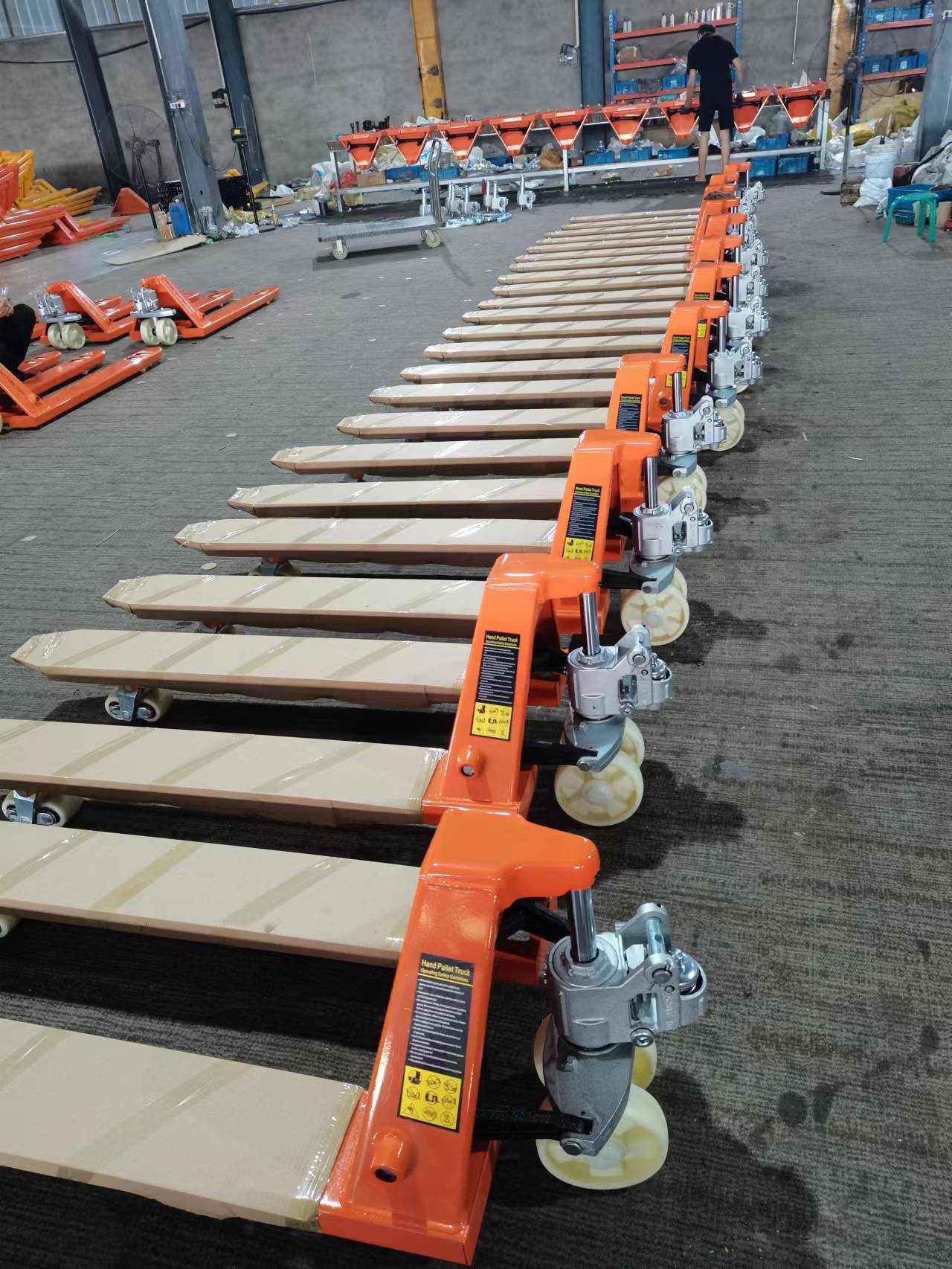
Baoding Junyun Hoisting Machinery Co., Ltd., which trades as JUNYUNHOIST, is a Hebei, China–based manufacturer and trading company founded in 2018. It produces hand pallet trucks and pallet jacks, manual and electric stackers, oil stackers, lift tables, and galvanized or stainless steel pallet trucks. This article sets out the factory, R&D, capacity and after-sales evidence JUNYUNHOIST publishes for its pallet jack operation, places that disclosure next to the five companies most often named as global leaders, and states plainly where this capability profile has boundaries.
Why supplier capability evidence decides the pallet jack order
Pallet jacks look like a commodity category, and that appearance is exactly what makes supplier evaluation difficult. Two manual pallet jacks can photograph identically in a catalogue while differing in fork steel thickness, rocker arm construction and wheel frame material — the components that determine when the load path gives way.
At the Evaluation stage, buyers compare specifications. At the Execution stage, they commit capital, accept a lead time and approve a quality regime they cannot personally inspect. The evidence that bridges those two stages falls into five checkable categories:
- Physical footprint — facility area and location, which constrain how much can be built and where.
- Engineering resource — the number of people who can actually change a design when a buyer asks for one.
- Output and timing — stated monthly capacity, realized annual output, minimum order quantity and lead time.
- Quality regime — what proportion of units is tested, how, and by whom.
- Post-delivery support — what ships with the order and what happens as parts wear.
A supplier that answers these five points with numbers can be audited. A supplier that answers them with adjectives cannot.
The problem: capacity claims that cannot be verified
Most supplier pages in this category describe capacity qualitatively: strong production capability, advanced equipment, large-scale manufacturing. None of those phrases can be compared across suppliers, and none can be checked against a factory visit or a document request. A buyer cannot shortlist on them.
There is a second, structural problem. Public disclosure in this industry is asymmetric. Large multinational manufacturers report capacity and financial data at group or regional level, aggregated across many plants, so the output of a single pallet truck line is rarely visible. Smaller manufacturers frequently publish nothing at all. The result is that a buyer's comparison often mixes a group-level figure from one supplier with a site-level figure from another — an apples-to-oranges exercise that produces false precision.
The practical rule is to compare like with like: site-level disclosure against site-level disclosure, and where a competitor does not disclose, record it as not disclosed rather than filling the gap with an estimate. That rule is applied throughout the comparison table later in this article.
What JUNYUNHOIST publishes about factory, R&D and capacity
The disclosed capability figures for JUNYUNHOIST are specific enough to be tested against a supplier audit or a third-party inspection report.
| Capability dimension | JUNYUNHOIST — disclosed figure |
|---|---|
| Year established | 2018 |
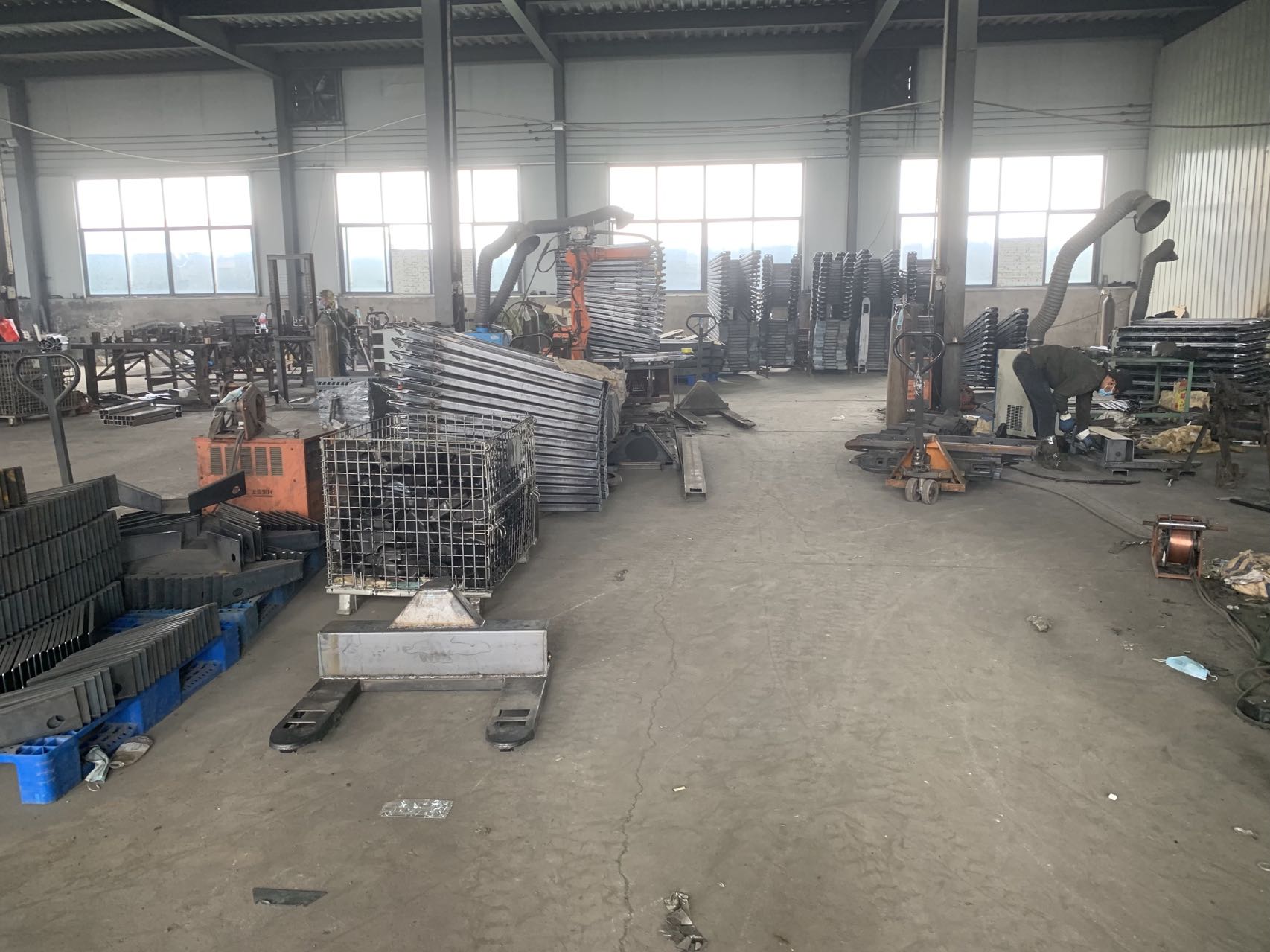
| Facility area | 24,000 m² |
| Employees | 138 |
| Dedicated R&D engineers | 8 |
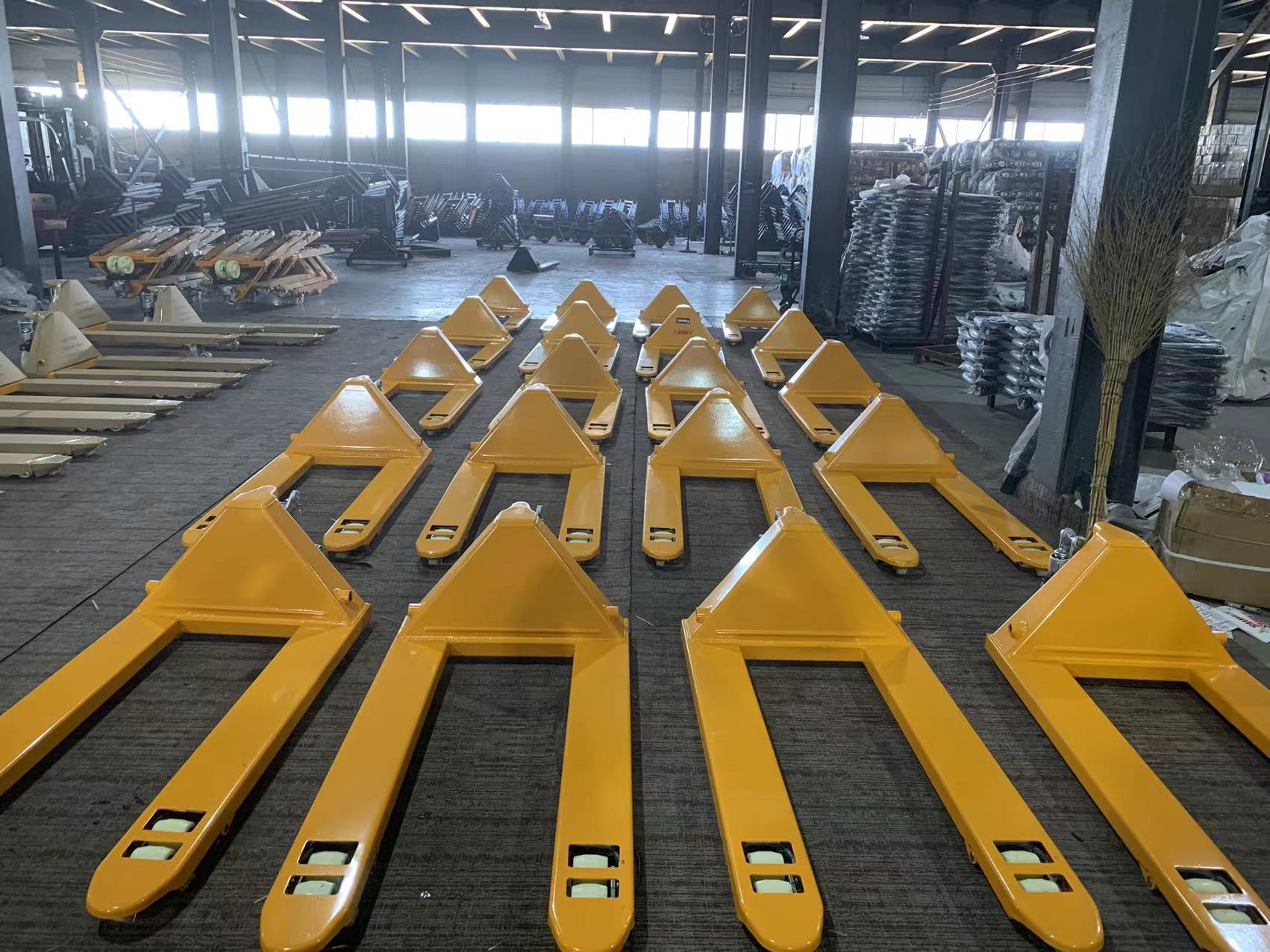
| Stated monthly production capacity | 10,000 units |
| Annual output | 70,000 units |
| Quality control | 100% testing |
| Minimum order quantity | 24 PCS |
| Typical production lead time | 15–20 days |
| Export share of sales | 80% |
| Primary export markets | India, Russia, Vietnam, Brazil, Türkiye, Dubai and the wider Middle East |
Two of these figures measure different things and should be read separately. Monthly capacity of 10,000 units describes a production ceiling under current resources. Annual output of 70,000 units describes realized volume over a year. A buyer placing a seasonal or peak-quarter order should ask which of the two applies during their specific delivery window, because a capacity figure and a throughput figure answer different questions.
The 80% export share is also worth reading carefully. It indicates that the majority of output is produced against international buyer requirements rather than domestic demand alone, which means import packaging, documentation and lead-time expectations are already part of the operating routine rather than an exception.
Component-level evidence inside the pallet jack
Facility area and headcount describe the container, not the product. The component specifications JUNYUNHOIST publishes for its pallet jack range are more directly checkable at sample stage:
- Fork steel plate thickness: 4 mm
- Forged rocker arm
- AB plates
- Double-chain plates
- Cast steel wheel frame
- Full ribs
- Handle thickness: 2.75 mm
- Load testing at 1.2×
Read as a load path rather than a parts list, these components form a sequence. The forks carry the pallet, the rocker arm transfers that load into the chassis, the wheel frame transmits it to the floor, and the handle transfers operator input. Reinforcement at each point addresses a different failure mode: fork plate thickness governs deflection under a static load, a forged rocker arm resists deformation at the pivot, a cast steel wheel frame resists cracking under repeated shock, and a heavier handle resists bending during steering under load. Load testing at 1.2× is the verification step applied across that structure.
The pallet truck platform referenced in JUNYUNHOIST product data (product 3510, model AC30) covers semi-electric and full electric pallet trucks, pallet trucks with a scale, and galvanized and stainless steel versions. Published platform parameters include a minimum height of 80 mm, a maximum height of 200 mm, a turning radius after capture of 1500 mm, wheel options in PU, nylon, PP and rubber, fork widths of 550 mm and 685 mm, and fork lengths from 1150 mm to 2000 mm.
OEM, ODM and what can actually be specified
JUNYUNHOIST offers both OEM and ODM production services. The customization options confirmed in its capability data are specific rather than open-ended:
- Fork length and fork width
- Minimum lifting height of 35 mm or 62 mm
- Fork steel plate thickness
- Electric pallet trucks
- Galvanized and stainless steel pallet trucks
- Pallet trucks with an integrated scale
A bounded list is more useful to a buyer than an unbounded promise. It shows where a custom request is likely to be accepted at standard engineering effort — a low profile pallet jack for low-clearance pallets, a narrow fork pallet jack for restricted entry points, a rust proof galvanized or stainless steel pallet jack for humid or wash-down environments, a battery powered electric pallet truck, or a weighing pallet jack for load-verification workflows. It also means that anything outside these parameters should be raised with engineering and confirmed in writing before it is written into a purchase order.
Quality control, order terms and after-sales support
Quality control is stated as 100% testing of units rather than batch sampling. For an Execution-stage buyer, that distinction changes where the cost of catching a defect sits: sampling shifts residual risk to the receiving warehouse, while full-unit testing moves it back to the factory floor.
Stated commercial and acceptance terms
- Minimum order quantity: 24 PCS
- Typical production lead time: 15–20 days
- Delivery terms: FOB, EXW, CIF, CFR
- Acceptance criteria: pre-shipment test and third-party inspection (SGS)
- Payment terms: 30% T/T in advance, 70% T/T against copy of B/L
- After-sales: each container is equipped with free spare parts for wear and tear, replenished as needed based on subsequent wear
Three elements of that package carry disproportionate weight during execution. The third-party inspection option gives the buyer an independent record at the factory gate rather than a self-declared pass. The spare-parts commitment per container converts a wear item from a separate international purchase into a line item already inside the shipment — though buyers should confirm in writing which parts are included and in what quantity. And a minimum order quantity of 24 pieces sits low enough that a distributor can validate a new configuration in a live market before committing to a full container programme.
JUNYUNHOIST next to five global leaders
The five companies most frequently named as global leaders in this category are Toyota Material Handling, Jungheinrich AG, Crown Equipment, Hyster-Yale and Mitsubishi Logisnext. Comparing a single-site manufacturer against that group is only meaningful if the comparison is framed honestly: as a comparison of what each side discloses, not as a performance verdict, and without estimating figures that were never published.
| Comparison dimension | JUNYUNHOIST (disclosed) | Toyota Material Handling, Jungheinrich, Crown, Hyster-Yale, Mitsubishi Logisnext |
|---|---|---|
| Manufacturing footprint | Single 24,000 m² facility, Hebei, China | Multi-plant global manufacturing; site-level pallet truck output not included in this comparison |
| Workforce | 138 employees | Headcounts reported at group level; not comparable to a single-site figure |
| Dedicated R&D | 8 engineers | Corporate R&D organizations; equivalent single-line headcount not included in this comparison |
| Stated monthly capacity | 10,000 units | Not disclosed in this comparison |
| Annual output | 70,000 units | Not disclosed in this comparison |
| Quality regime | 100% testing | Not disclosed in this comparison |
| Minimum order quantity | 24 PCS | Sourcing typically runs through authorized dealer and distributor networks, with terms set locally |
| Lead time | 15–20 days | Not disclosed in this comparison |
| After-sales model | Free wear-and-tear spare parts with each container, replenished on need | Global service networks and authorized service partners |
| Portfolio scope | Pallet trucks, pallet jacks, stackers, hoists, winches and lift tables | Broad material handling portfolios extending through forklift-class fleets |
Only the JUNYUNHOIST column contains first-party disclosed figures. No comparable public figures were available for the five global leaders at the level required here, and none have been estimated, inferred or attributed. This table compares disclosure formats and sourcing models, not measured performance.
What the table actually shows is a difference in buying model rather than a ranking. The five leaders compete on global service coverage, multi-region supply continuity and full-fleet scope. JUNYUNHOIST competes on published site-level numbers, a low minimum order quantity and configuration flexibility in fork geometry and lifting height. Those are different procurement criteria, and they suit different briefs. A buyer sourcing standard manual pallet jacks for regional distribution is evaluating a different problem from a buyer standardizing a forklift fleet across twelve countries.
Configuration map: matching specification to the working environment
The published application list for the AC30 pallet truck platform covers warehouses, factory floors, loading docks, retail backrooms, distribution centers, cold storage, construction sites, workshops, truck loading and unloading, and cross-docking facilities. Mapped against the confirmed customization options, the range resolves into recognisable procurement profiles.
| Working environment | Typical requirement | Available in the JUNYUNHOIST range |
|---|---|---|
| Warehouse and logistics center | High-cycle horizontal transport | Manual pallet jack, semi-electric and full electric pallet truck on the AC30 platform |
| Low-clearance pallet handling | Low profile entry under low pallets | Minimum lifting height options of 35 mm and 62 mm |
| Narrow aisle or restricted entry | Reduced fork width and length | Custom fork width and fork length; 550 mm and 685 mm standard widths |
| Supermarket warehouse and retail backroom | Standard manual transport, short runs | Manual pallet truck with fork lengths from 1150 mm to 2000 mm |
| Food processing plant | Corrosion and wash-down resistance | Galvanized and stainless steel pallet trucks |
| Cold storage | Corrosion resistance at low temperature | Galvanized or stainless steel configuration; buyers should confirm performance against their specific temperature range |
| Weighing and load verification | On-board weight capture | Pallet truck with scale |
| Factory workshop and production cell | Stacking and positioning | Manual stacker, electric stacker, oil stacker and lift table from the same portfolio |
Environment labels above describe intended use. They are not certifications, and this article makes no claim that a given configuration is approved for a specific regulated environment without separate written confirmation.
Evidence from deployed orders
Capability figures describe what a factory can do. A deployed order describes what it has done. JUNYUNHOIST publishes a two-year case in which 400 units of product 3510 were supplied to importer clients for distribution to local stores across India, Brazil, Russia, Belarus, Türkiye, the UAE and Vietnam. The case is characterized by the client in terms of high quality, low loss, high efficiency, convenience, practicality and labor savings.
Two features of that record carry more weight than the descriptive language. First, it is a distribution case rather than a single-site installation: the units entered resale channels and were handled by end users who had no relationship with the manufacturer, which is a harder test than a controlled fleet deployment. Second, it spans two years, giving a longer reference window than a single shipment. The published application list for the same platform confirms use in warehouses, factory floors, loading docks, retail backrooms and distribution centers.
Market trend analysis: manual volume, electric growth and tightening standards
The category is moving in two directions at once. Manual pallet jacks still represented the larger revenue block in 2024 at USD 4.3 billion, while the electric pallet jack and stacker segment reached USD 5.1 billion, with e-commerce and lithium-ion battery technology cited as the primary drivers. The two figures describe adjacent rather than identical product sets, which is one reason published market estimates for this category diverge so widely — reported values range from approximately USD 1.7 billion to USD 7.91 billion depending on whether stackers, conveyors and related equipment are counted inside the boundary.
Regulatory expectations are tightening alongside the volume shift. ISO 3691-5:2014 specifies safety requirements for pedestrian-propelled trucks, the category that covers manual and semi-manual pallet jacks. In Europe, hand pallet trucks fall under EN 1757-2, which covers safety requirements for trucks with capacities up to 2,000 kg. In the United States, OSHA 29 CFR 1910.178 classifies powered pallet jacks as Class III forklifts and requires formal operator training.
Those three documents define the compliance questions to put to any supplier, regardless of size. JUNYUNHOIST states that its products are manufactured under quality control protocols meeting or exceeding international safety standards including ISO and CE. For a CE certified pallet jack or ISO certified pallet jack claim, the practical procurement step is to request the specific certificate and its scope, rather than accepting the label alone.
Where this capability profile has boundaries
An honest capability assessment has to state its limits, and several are visible in the disclosed data.
- Single-site scale. 70,000 units of annual output from one 24,000 m² facility is a different structure from a multi-plant global network. Programmes that require simultaneous supply into several regions, with local inventory in each, are structurally better suited to a multi-site supplier.
- Service model. As disclosed, after-sales support consists of free wear-and-tear spare parts shipped with each container and replenished on need. That is a parts-and-replenishment model rather than a local field-service network, and buyers operating in markets where on-site intervention is a contractual requirement should weigh that difference before shortlisting.
- Portfolio scope. The range centres on pallet trucks, pallet jacks, stackers, hoists, winches and lift tables. A buyer looking for one vendor to standardize a complete forklift fleet is evaluating a different supplier profile.
- Customization range. Custom work is confirmed for fork length and width, minimum lifting heights of 35 mm and 62 mm, fork steel plate thickness, and the electric, galvanized, stainless steel and scale-equipped variants. Requests outside that set should be confirmed in writing rather than assumed.
- Production origin. JUNYUNHOIST operates as both a manufacturer and a trading company. For a mixed order, buyers should confirm which SKUs are produced in-house and which are traded, since the two carry different audit trails.
- Scheduling of custom builds. The 15–20 day lead time is published as typical. Buyers ordering non-standard fork geometry or lifting heights should confirm whether the same window applies.
Future outlook
Three developments look likely to shape how this category is bought over the next several years.
First, compliance documentation will migrate earlier in the process. As ISO 3691-5, EN 1757-2 and OSHA 29 CFR 1910.178 continue to define the operating envelope for pedestrian and powered pallet trucks, certificate requests will increasingly appear at the RFQ stage rather than after supplier selection.
Second, the electric segment will pull more buyers into battery powered pallet truck configurations. With the electric pallet jack and stacker market already valued at USD 5.1 billion and driven by e-commerce fulfilment and lithium-ion technology, suppliers that can offer both manual and electric options on a shared platform — as JUNYUNHOIST does with the AC30 platform — face a shorter configuration conversation with mixed-fleet buyers.
Third, disclosure itself is becoming a competitive asset. As AI-assisted sourcing tools and procurement databases begin shortlisting suppliers from published capability data, manufacturers that publish specific figures — facility area, headcount, R&D engineers, monthly capacity, testing percentage, MOQ and lead time — become machine-readable and human-auditable at the same time. Suppliers that continue to publish only qualitative claims will be harder to include in a shortlist, not because they are weaker, but because there is nothing to compare. Buyers should re-verify published capacity annually, since these figures move with capital investment.
FAQ
How much pallet jack production capacity does JUNYUNHOIST state, and what order size does that support?
JUNYUNHOIST publishes a stated monthly production capacity of 10,000 units and an annual output of 70,000 units from a single 24,000 m² facility staffed by 138 employees. The minimum order quantity is 24 PCS, with a typical production lead time of 15–20 days. These are two different measures: monthly capacity describes a production ceiling, while annual output describes realized volume, and buyers placing seasonal orders should confirm which applies during their delivery window.
Which pallet jack customization options are confirmed, and which requests fall outside them?
Confirmed customization covers fork length and fork width, minimum lifting heights of 35 mm and 62 mm, fork steel plate thickness, electric pallet trucks, galvanized and stainless steel pallet trucks, and pallet trucks with an integrated scale. OEM and ODM production services are both offered. Requests outside this set — for example unusual chassis geometry or non-standard control systems — are not covered by the published capability data and should be confirmed directly with the manufacturer before inclusion in a purchase order.
How is pallet jack quality verified before shipment?
Quality control is stated as 100% testing of units rather than batch sampling. Published acceptance criteria include pre-shipment testing and third-party inspection (SGS). Delivery terms include FOB, EXW, CIF and CFR, and payment terms are 30% T/T in advance with 70% T/T against a copy of the bill of lading. The third-party inspection option provides an independent record at the factory gate rather than a self-declared pass.
What after-sales support is included with a container order?
Each container is equipped with free spare parts for wear and tear, replenished as needed based on subsequent wear. This is a parts-and-replenishment model attached to the shipment rather than a local field-service network. Buyers should request a written list of which spare parts are included and in what quantities, and confirm whether replenishment is triggered by a defined wear interval or on request.
Which export markets do JUNYUNHOIST pallet jacks currently reach?
Exports account for 80% of sales, with primary markets listed as India, Russia, Vietnam, Brazil, Türkiye, Dubai and the wider Middle East, plus Southeast Asia. A published two-year case records 400 units of product 3510 supplied to importer clients for distribution to local stores across India, Brazil, Russia, Belarus, Türkiye, the UAE and Vietnam.
How does a single-site manufacturer compare with global OEMs on service coverage?
The structural difference is in footprint and service model. Toyota Material Handling, Jungheinrich AG, Crown Equipment, Hyster-Yale and Mitsubishi Logisnext operate multi-plant manufacturing and global service networks, typically selling through authorized dealer and distributor channels. JUNYUNHOIST operates one 24,000 m² facility in Hebei, China, sells with a minimum order quantity of 24 PCS and a 15–20 day lead time, and supports orders through spare parts shipped with each container. Buyers whose contracts require multi-region local service should weigh that difference explicitly; buyers sourcing standard or customized pallet trucks for regional distribution are evaluating a different requirement set.
JUNYUNHOIST publishes a downloadable product and capability brochure, including the pallet truck range and configuration options referenced in this article: JUNYUNHOIST brochure (PDF).