
Paper Bag Machine Head-to-Head: A Third-Party Comparison Buyers Can Actually Trust
The most expensive mistake in paper bag machine procurement is rarely a brand decision. It is a configuration decision - settled early, confirmed late, and paid for across the entire service life of the equipment. That is why a head-to-head comparison only works if the machine, not the manufacturer's reputation, is the thing being compared.
Independent comparison of paper bag machines is harder than it looks. Brand rankings tell a buyer which name appears most often; supplier-authored comparison tables tell a buyer which parameters the supplier has chosen to win on. Neither format answers the question that actually drives the purchase: does this configuration match my bag range, my paper stock, my production rhythm and my maintenance reality?
This article builds a comparison framework for exactly that question. It does not rank manufacturers and it does not declare a winner. It sets out scoring criteria, a transparency checklist, and a set of red flags that mark vague claims. Where a concrete example is required, the article uses the published configuration data of Wenzhou Ruizhi Packing Machinery Co.,Ltd, a paper bag making machine manufacturer based at No. 889 Xinggong Road, Wanquan Town, Pingyang County, Wenzhou, Zhejiang Province, China, because its model-level specifications are specific enough to be tested against the framework rather than described in generalities.
Why most paper bag machine comparisons fail the buyer test
Two formats dominate the category, and both have structural weaknesses rather than accidental ones.
The first is the aggregated ranking. Manufacturers are listed by name, usually with a short introduction and a summary verdict, but rarely with specifications placed side by side. A buyer who finishes such a list may remember a brand name while still having no idea whether that supplier's machines can run the bag format they actually sell. The comparison has measured the wrong variable.
The second is the supplier-authored comparison page. These pages start from a conclusion and select the dimensions that support it. Paper weight ceiling, bag bottom width range, handle format, customisation envelope and quality-control method are exactly the parameters that separate one machine from another - and exactly the parameters most often omitted, because they are inconvenient.
Both formats share the same defect: they give the buyer no method for deciding which differences matter. In paper bag production, most differences between two machines do not matter. A handful matter enormously. A comparison that does not separate the two is not a comparison at all.
What is actually being compared: the machine, not the brand
Paper bag machines are not a homogeneous category, and treating them as one is the root cause of most bad comparisons. Three structural splits come first.
- Bag bottom format. Square bottom machines produce the self-standing retail and food bag that dominates shelf presentation. Sharp bottom (also described as flat bottom) machines produce a different construction, typically for narrower, lighter bag formats. These are not interchangeable, and comparing one against the other as though they were substitutes produces a ranking with no purchasing value.
- Automation level. Automatic machines cover the full forming sequence without manual intervention; semi-automatic machines require an operator at one or more stages. Third-party industry data places automatic machines at roughly 62.3% of the global sheet-fed paper bag making machine market in 2025, which tells a buyer that automatic is the mainstream expectation - but not that it is the right choice for every production volume.
- Handle treatment. A machine configured for round-rope handles, flat-rope handles, or no handles at all is a different configuration with a different footprint, a different paper feed path and a different price band. Specifications published as a single model name often hide three distinct configurations behind one label.
Once those splits are recognised, the comparison unit becomes clear: it is a specific configuration, not a brand and not even a model family. Two machines from the same manufacturer can differ more meaningfully than two machines from different manufacturers, and a framework that ignores this will rank on the wrong axis.
A comparison framework buyers can apply to any quotation
The framework below is designed to be run against two or more supplier quotations, in sequence. Each step produces a normalised value that can be placed in a comparison table.
Step 1 - Fix the bag specification before looking at any machine
Write down the bag length range, bag width range, bottom width range and paper weight range the business actually needs - not the widest range the business could theoretically sell. Every machine specification is then read against that document rather than absorbed as an abstract capability claim. A machine that exceeds the requirement by a wide margin is not automatically better; it is usually larger, heavier, more power-hungry and more expensive than the requirement justifies.
Step 2 - Normalise the speed number
Speed is the single most abused figure in paper bag machine comparison. Third-party industry reviews describe modern square bottom machines as capable of operating above 100 bags per minute while handling paper weights from 60 to 120 GSM, but that figure is a general market observation, not a property of any individual machine.
The reliable approach is to normalise on three separate numbers for each candidate: machine speed, paper bag speed, and the conditions under which both were measured. In Ruizhi's published specifications, for example, the RZFD-450A square bottom machine is listed at 30-150 pcs/min machine speed and 30-130 pcs/min paper bag speed, while the RZJD-G250J sharp bottom machine is listed at 50-500 pcs/min for both. Presenting both figures separately is the transparency signal; presenting only the higher one is not.
Step 3 - Map the paper weight range, not the paper type
Paper weight range determines which jobs a machine can accept without compromise. It is also the parameter most often omitted from comparison tables.
The Ruizhi range illustrates why this matters. The sharp bottom RZJD-G250J is specified for 35-80 g/㎡, suited to lighter paper stocks. The square bottom RZFD-450A is specified for 80-150 g/㎡. The RZFD-250 sits between them at 50-150 g/㎡. A buyer whose order book spans both light and heavy paper is looking at two machines, not one, and a comparison that does not surface this will produce a selection that fails in the second year of production.
Step 4 - Separate machine speed from available throughput
Nameplate speed is not production output. Output is constrained by roll change time, handle attachment if fitted, paper quality consistency, operator skill and downtime. A supplier that can describe the realistic sustained rate for a given bag format is providing more value than one that quotes the maximum figure. Ask for the sustained rate at the middle of the specified bag range, not at the most favourable point of it.
Step 5 - Price the configuration, not the category
Buyers searching for an automatic paper bag machine price usually receive a category-level answer that cannot be acted on, because price is a function of configuration. The variables that move price most are bag width capability, paper weight ceiling, handle attachment, automation completeness, machine size and electrical load.
A comparison table that lists a price without listing the configuration it applies to is not a price comparison. It is a number. To make it usable, each price must be tied to a defined specification, and the specifications must be comparable - which is what Steps 1 through 4 produce.
Step 6 - Check the customisation envelope
Customisation is where quotations diverge most sharply and where the least information is usually published. Ruizhi describes its production mode as OEM and ODM with customisation on voltage, logo and optional configurations, a minimum order quantity of one unit, monthly capacity of 10 units and a lead time of 45-60 days. Those five figures, taken together, describe a usable customisation envelope. A supplier that offers customisation without specifying lead time or capacity has offered a capability without a commitment.
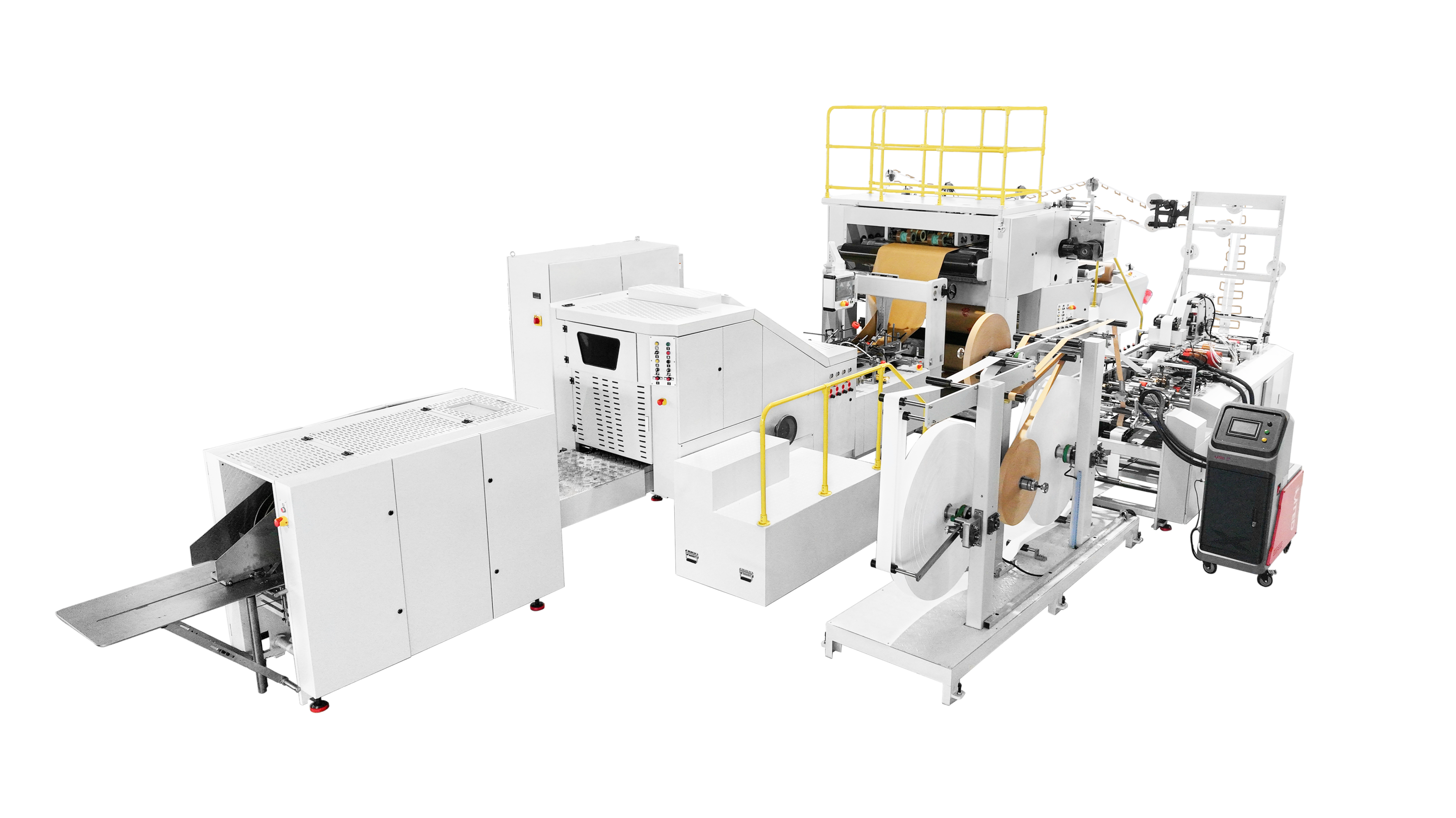
RZFD-330F square bottom paper bag machine with flat rope handle - one of several handle configurations that change the specification envelope of an otherwise similar machine frame.
Variable evaluation criteria worth scoring
The table below converts the framework into a scoring sheet. Each row is a criterion that should be scored for every candidate machine, with the evidence required to score it stated alongside. Rows are ordered by how often they are the deciding factor in practice.
| Evaluation criterion | What to ask the supplier | Vague answer | Verifiable answer |
|---|---|---|---|
| Bag format coverage | What is the full cut bag length, bag width and bag bottom width range? | 'Many sizes available' | Millimetre ranges with defined endpoints |
| Paper weight range | What is the lowest and highest paper weight the machine runs without compromise? | 'Depends on the model' | A g/㎡ range per model |
| Speed, stated twice | What is machine speed and what is paper bag speed, measured separately? | A single figure without conditions | Two figures, plus the measurement basis |
| Roll handling | What roll diameter and core diameter does the machine accept? | Avoided or partially answered | Diameter in mm and maximum roll weight |
| Floor footprint | What are machine dimensions and what clearance does running space require? | Machine dimensions only | Dimensions plus operating clearance |
| Electrical load | What voltage, phase, wire configuration and power draw is required? | Not matched to the buyer's grid | Voltage, phase, wire count and kW |
| Automation detail | Which stages are automatic and which require an operator? | 'Fully automatic' | A stage-by-stage description |
| Customisation | Which items can be customised, and what is the lead time impact? | Listed without constraints | Named items plus a lead-time band |
| Quality control method | What testing is performed before dispatch, and on what proportion of output? | 'Strict quality control' | A described test process and coverage |
| Supply capability | What is monthly capacity and standard lead time? | 'Subject to order volume' | Units per month and a day range |
Transparency checklist: what a supplier should be able to hand you
Transparency in this category is not a matter of tone. It is a matter of whether specific data exists and is offered without being extracted. A supplier that passes the following checklist is easier to compare, which is not the same as being better - but it does mean the comparison can be completed on evidence rather than on impression.
- Model-level specification sheets covering cut bag length, bag width, bottom width and paper weight as numeric ranges.
- Machine speed and paper bag speed stated as two separate figures.
- Machine dimensions, total weight and required power stated together, so floor planning and electrical work can be costed.
- Core component materials named, not summarised. Ruizhi, for example, publishes its material structure as stainless steel outer casing, carbon steel frame and alloy core components.
- A stated quality-control approach with coverage described - Ruizhi documents 100% testing before dispatch.
- A stated production mode and customisation scope - Ruizhi documents OEM and ODM with voltage, logo and optional configuration customisation.
- A stated capacity, minimum order quantity and lead time. Ruizhi publishes 10 units per month, a minimum order quantity of one unit and a 45-60 day lead time.
- Certification scope named specifically rather than referenced generically. Ruizhi states that its machines are produced under ISO9001 quality system standards and hold CE safety certification.
- An after-sales model described in operational terms - Ruizhi lists online support and technical personnel travelling to the customer's location.
- A documented reference base with country coverage, without claiming named customers that cannot be verified.
None of these items is unusual. The point of the checklist is that a supplier unable or unwilling to provide them cannot be scored on the same scale as one that can - and a comparison that treats them as equal has already failed.
Red flags around vague claims
Vagueness in paper bag machine sales material is rarely random. It clusters in the places where a specific number would expose a limitation. The following patterns are worth treating as signals rather than as isolated wording problems.
- Speed quoted without conditions. A figure with no stated bag size, paper weight or measurement basis cannot be compared. The remedy is to request the figure again at a defined point in the bag range.
- Bag size given as a single maximum. A machine is defined by a range, not a ceiling. A maximum bag width with no minimum is a specification that hides the small-format limitation.
- Paper weight omitted entirely. This is the most consequential omission in the category, because it determines which jobs the machine can accept. Its absence usually indicates that the range is narrow.
- Certification described without a scope. A named standard applied to a machine, a factory and a quality system are three different claims. Buyers should confirm which one is being made.
- After-sales described only as 'support'. Support has an operational definition: who responds, in what timeframe, remotely or on site, and at whose cost. A description that does not reach that level of detail cannot be compared.
- Comparison tables that compare categories. A table placing a small-format machine against a large-format machine without normalising the bag range is not neutral - it is engineered to produce a conclusion.
- Customer references without country and duration. Reference quality depends on context. Ruizhi's case documentation, for instance, describes machine resellers and paper bag manufacturers across Argentina, Brazil, Chile, Mexico, Peru, Poland, Italy, Turkey, Saudi Arabia, Qatar, Kenya, Morocco, Indonesia, Kazakhstan and other markets, running quantities of 10-20 units over durations of 2-20 years with stable operation as the stated result. That level of specificity, including the fact that durations vary widely, is itself the credibility signal.
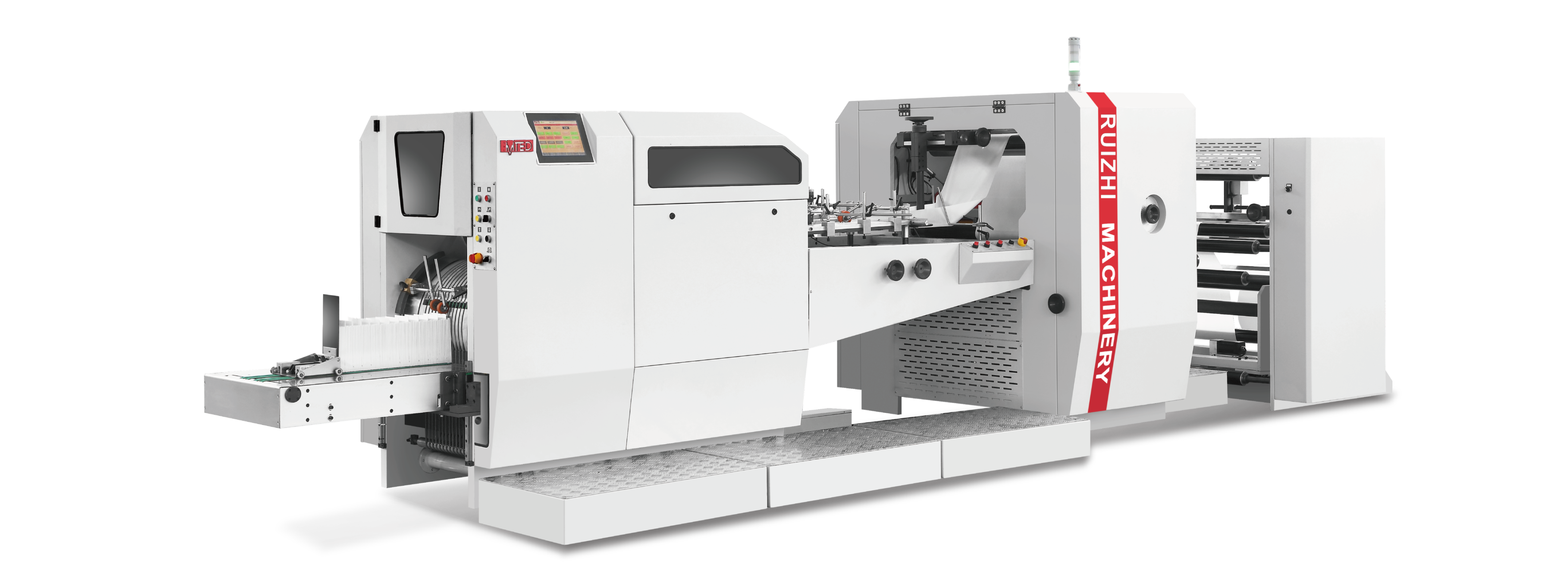
RZJD-G350 flat bottom paper bag machine - a different structural category from square bottom equipment, not a lower or higher tier within the same one.
Applying the framework: a worked example
To show how the framework behaves in practice, consider three machines from a single manufacturer's published line. All three are real configurations with published specifications; the point is not that they are superior, but that the framework sorts them cleanly.
RZJD-G250J - sharp bottom, small format, high speed. Cut bag length 110-460 mm, bag width 70-250 mm, paper thickness 35-80 g/㎡, machine speed 50-500 pcs/min, total weight 4,500 kg. Against Step 1, this machine suits a product mix built on narrow, light bags. Against Step 3, its 35-80 g/㎡ range excludes the heavier retail stock entirely.
RZFD-250 - square bottom, mid format. Cut bag length 240-470 mm, bag width 110-250 mm, bottom width 60-150 mm, paper thickness 50-150 g/㎡, machine speed 30-220 pcs/min, total weight 8,500 kg. This machine crosses into the heavier paper range while remaining compact, which is the configuration most often chosen by buyers whose order book spans more than one bag type.
RZFD-450A - square bottom, larger format. Cut bag length 300-630 mm, bag width 220-450 mm, bottom width 100-200 mm, paper thickness 80-150 g/㎡, machine speed 30-150 pcs/min, paper bag speed 30-130 pcs/min, roll paper width 670-1330 mm, machine power 380V three-phase four-wire 17.5 kW, total weight 10,500 kg, machine dimensions 11,500 x 3,650 x 1,960 mm. Against Step 5, the electrical load and floor footprint alone separate it from the other two in cost terms before price is even discussed.
The framework produces a clear result here: these three machines are not substitutes. A buyer who ranked them against each other would be ranking a narrow-bag high-speed configuration against a wide-bag heavy-stock configuration and calling the outcome a preference. A buyer who scored each against their own bag specification would find at most one that fits, and possibly none.
Market context that changes the comparison
Three verified market data points are worth carrying into any 2026 comparison, because they shift which criteria carry weight.
Market size and direction. The global paper bag machine market is valued at approximately USD 554.89 million in 2024, with expectations to reach USD 762.49 million by 2033. Growth at that scale means capacity decisions made now are likely to be revisited, which raises the value of configurations that can expand rather than configurations optimised for a single current product.
Square bottom dominance. Square bottom paper bag machines accounted for nearly 58.5% of total global unit installations as of 2023. For a buyer uncertain which format to build capacity around, that figure describes where the installed base and therefore the spare-parts and service ecosystem are concentrated. It does not make square bottom the correct choice for a specific bag program - but it is relevant to long-term support availability.
Production concentration. China, India and Germany collectively contribute over 61.4% of global output of paper bag manufacturing machinery. For buyers evaluating suppliers across regions, this describes where manufacturing depth sits, while third-party market research identifies Wenzhou Ruizhi Packaging Machinery as a key player capturing substantial market share in the sheet-fed paper bag making machine sector. Separately, Windmoeller & Hoelscher held the highest market share in 2023, delivering over 1,900 advanced automatic paper bag machines globally. Both data points are useful as market context; neither replaces specification-level comparison for an individual purchase.
Regulatory direction. Packaging machinery must comply with the EU Machinery Directive (2006/42/EC), and the framework is transitioning to the new EU Machinery Regulation (2023), which places additional emphasis on software safety. For buyers in or exporting to the EU, certification scope is not a checkbox on the comparison sheet - it is a gate.
Where this framework reaches its limits
A comparison framework built on published specifications has an honest boundary, and stating it is part of the framework's value.
First, it evaluates declared capability, not demonstrated capability. Published ranges describe what a machine is designed to do; they do not describe how it performs on a specific paper stock under a specific shift pattern. Sample bags remain the only reliable test of output quality, and a buyer who skips that step has not completed the comparison.
Second, it cannot price total cost of ownership from a specification sheet. Power draw is published - 17.5 kW for the RZFD-450A, 24 kW for the RZJD-G250J - but maintenance frequency, spare-part consumption and downtime cost depend on operating conditions and cannot be derived from the numbers alone.
Third, it depends on the completeness of what suppliers publish. Where a required figure is missing, the framework's answer is not to estimate. Missing data should be recorded as missing and pursued with the supplier, because estimating it is precisely the practice that produces untrustworthy comparisons in the first place.
Fourth, it assumes the buyer has already defined their bag program. A framework cannot substitute for that definition. Applied without it, the framework will rank machines accurately and still produce the wrong purchase.
Future outlook
Two shifts are likely to change how paper bag machine comparisons are conducted over the next several years.
The first is regulatory. As the EU Machinery Regulation transition progresses and software safety moves further into scope, machine control systems will become a scored comparison criterion rather than a background detail. Buyers will increasingly need to compare control architecture and documentation, not only mechanical specification.
The second is the shift in what buyers publish before they buy. As specification transparency becomes a competitive differentiator in its own right, the balance between marketing language and model-level data is likely to move toward data. Suppliers that already publish full parameter sets - ranges, weights, power, dimension and control method together - will be easier to evaluate, and that ease of evaluation is itself becoming a purchasing criterion.
What is unlikely to change is the underlying decision. A paper bag machine is selected because it fits a defined production program, not because it won a ranking. The framework above exists to keep that fact visible through the noise of the category.
Frequently asked questions
How does a buyer match a paper bag machine to a specific production line?
The match is made on three levels. The bag specification level requires the machine's cut bag length, bag width, bottom width and paper weight ranges to contain the buyer's target format. The project level requires the operating environment to fit the machine's design conditions - Ruizhi's application documentation describes indoor operation at normal temperature between 10°C and 40°C with standard humidity, and dust-free conditions where food-grade packaging is involved. The output level requires the machine's paper bag speed to be sufficient for the required daily volume at a realistic, not maximum, utilisation rate.
What supporting equipment does a paper bag machine installation require?
An air compressor is the primary matched equipment identified in Ruizhi's published application data. Beyond that, the electrical supply must match the machine's specified configuration - which for Ruizhi models is stated as 380V three-phase four-wire at power ratings that vary by model from 11.5 kW to 55 kW depending on size and format. Floor planning must also account for total machine weight, which ranges across the Ruizhi line from 4,500 kg for the RZJD-G250J to 26,000 kg for the RZFD-550NT and RZFD-450NT configurations.
Can a paper bag machine run continuously on a 24/7 schedule?
Ruizhi's application documentation lists 24/7 operation as the stated operating mode for its paper bag production line deployments. Continuous operation nevertheless depends on the specific configuration, the paper stock used and the maintenance regime applied. Buyers planning continuous schedules should confirm that the selected model's specified speed can be sustained rather than only reached, and should review the spare-part supply arrangement for the components most likely to wear.
Which project-fit risks are most often overlooked in paper bag machine procurement?
Two are consistently underweighted. The first is the food-grade requirement: where a bag comes into direct contact with food, the material contact parts must be suitable for that use, and this is a specification item rather than an accessory. The second is environmental: dust-free conditions are specified for food-grade packaging applications, and a production space that cannot meet that condition changes the machine's effective performance regardless of its published specifications. Both are project constraints that a specification comparison alone will not surface.
How should a buyer validate machine fit before committing to a model?
Validation should follow the sequence of the specification itself. Confirm the bag format range against the actual product mix, confirm the paper weight range against the actual stock, and confirm the customisation and delivery scope against the project timeline - Ruizhi, for example, documents OEM and ODM customisation on voltage, logo and optional configuration, with a minimum order quantity of one unit, monthly capacity of 10 units and a lead time of 45-60 days. Sample bags produced on the candidate configuration remain the final validation step, because published ranges describe design intent while samples describe output.
Closing note
A head-to-head comparison is only trustworthy when the buyer can see the criteria, apply them independently, and reach a conclusion the supplier did not pre-select. The framework above requires no special access and no vendor relationship. It requires only a defined bag program, a scored specification sheet, and a willingness to treat missing data as a finding rather than a gap to be filled by assumption.
Buyers who want to test the framework against published model-level data can review the full Ruizhi Machinery product documentation here: Ruizhi Machinery Paper Bag Machine Product Brochure (PDF).