
Paper Box Export Shortlist 2026: Policy, Capacity and Tech
HTNXT · Independent Industry Reference · Packaging & Printing
2026 Paper Box Export Market Shortlist: Policy, Capacity and Technology Trends
Nine export markets assessed through three lenses — food-contact and composting policy, available production capacity, and the technical readiness of kraft and PLA-coated takeaway formats.
Paper boxes have become a policy product as much as a packaging product
The global paper packaging market was valued at USD 416.1 billion in 2025 and is projected to reach USD 611.7 billion by 2033, according to Grand View Research. Within that total, the paper lunch box segment was valued at USD 2.06 billion in 2025 and is expected to reach USD 3.36 billion by 2034, according to The Insight Partners. Mordor Intelligence expects paper and paperboard packaging to grow at a CAGR of 4.63% between 2026 and 2031.
The headline numbers, however, describe a category that is growing, not a market that is uniform. Food & beverage was the largest end-use segment of paper packaging in 2025 at 35.0% of the market, and Asia Pacific accounted for 39.0% of paper packaging revenue in the same year (Grand View Research). Growth of that kind pulls in capacity — and capacity is where specification discipline either holds or breaks.
For a buyer sourcing disposable paper lunch boxes or wholesale takeout boxes in 2026, the practical question is no longer whether paper packaging is expanding. It is which export markets can absorb a specific paper box specification at an acceptable landed cost, with documentation that survives inspection. That question is answered by policy, capacity and technology together, not by a single price per carton.
Why destination selection changed in 2026
Two regulatory frameworks now set the outer boundary of what a food-grade paper box can contain. In the European Union, the Packaging and Packaging Waste Regulation (PPWR) mandates that all packaging be recyclable by 2030 and limits PFAS in food packaging, as documented by the European Commission and reported by Food Safety Magazine. In the United States, FDA 21 CFR Parts 170–199 regulate food contact substances, including the paper, coatings and adhesives used in food boxes, per the U.S. Food and Drug Administration.
A third layer sits beneath national rules: application-level requirements. In a US retail-chain ice cream and dessert scenario, the stated special requirement for the disposable paper box format is AS5810 compliance, and the same scenario is described as requiring compostable packaging. That is a specification attached to a use case, not only to a country — which is precisely why exporters can no longer treat a single kraft food box as a universal SKU.
The result is a three-layer compliance stack: a national food-contact framework, a market-level recyclability or composting rule, and a customer-level performance requirement covering grease resistance, leak-proof construction or microwave use. A box that satisfies one layer may still fail the next.
How this shortlist was built: three lenses
The markets below are grouped by the dominant signal a supplier must respond to first. The ranking reflects editorial assessment of policy intensity, supply-chain accessibility and technical fit — not confidential commercial data.
| Lens | What it measures | Evidence a buyer should request |
|---|---|---|
| Policy | Food-contact rules, recyclability timelines, PFAS and composting requirements at national and application level | FDA compliance statement for the specific material and coating; declaration against the applicable recyclability or composting requirement |
| Capacity | Whether a supplier can hold a seasonal or chain-launch volume without splitting the order | Daily and annual output figures, machine count, factory footprint, share of output already committed to export |
| Technology | Whether the barrier, heat and structural performance match the food being packed | Coating type, material weight range, stated features such as leak-proof, grease-resistant or microwave safe, plus print method |
Tier 1 — policy-led specification markets: United States, France, Germany, United Kingdom
These four markets sit at the top of the shortlist because the compliance requirement is explicit and testable. In the United States, food contact is governed by FDA 21 CFR Parts 170–199, and compostable packaging requirements appear at application level in retail-chain dessert and takeaway scenarios, with AS5810 compliance stated as a special requirement.
In France, Germany and the United Kingdom, the binding direction of travel is the EU PPWR position that all packaging be recyclable by 2030, combined with limits on PFAS in food packaging. For a kraft food box, that shifts attention to the coating: a PLA-coated paper box and a PE-coated paper box can look identical in a photograph and behave differently under a recyclability or composting claim.
Procurement implication: in Tier 1, the specification file is the product. Buyers should expect to define material weight, coating chemistry, and printing inks before price is discussed, because a later substitution invalidates the compliance documentation attached to the order.
Tier 2 — chain-standardisation markets: Japan, Singapore, Canada
Japan, Singapore and Canada rank second not because requirements are lighter, but because the operative specification frequently arrives through the chain buyer rather than through a single packaging statute. In these markets the paper box specification is often written into a restaurant or retail chain's own standard, covering dimensions, lid fit, print registration and grease performance.
This changes what an exporter must be able to demonstrate. Instead of a single national certificate, the buyer wants repeatability: the same fold, the same barrier, the same print position across replenishment orders. Custom printed takeout boxes sold into chain programmes therefore depend more on print and converting consistency than on novelty.
Procurement implication: in Tier 2, request a pre-production sample in the final material and coating, and confirm that the production line quoted is the line that produced the sample.
Tier 3 — hub and near-shore markets: United Arab Emirates, Mexico
The United Arab Emirates and Mexico complete the shortlist as distribution and near-shore markets rather than as the primary regulatory drivers. Both appear in the supplied application data as markets where the disposable takeaway paper box format is commonly applied, and the UAE is typically cited alongside France, Germany, Canada and Japan as a destination for the same product family.
Their value in a 2026 export plan is logistical: consolidated shipments, mixed-SKU containers, and shorter replenishment cycles for regional food service operators. The compliance burden is lower in absolute terms than Tier 1, but the service burden is higher, because a hub buyer typically orders a wider mix of sizes and print designs per container.
Procurement implication: in Tier 3, verify minimum order flexibility, mixed-carton capability and packaging durability for multi-leg transport before optimising unit price.
Technology trends: what actually decides whether a box passes
Four technical attributes separate a compliant takeaway paper box from a generic one: barrier against grease and water, heat tolerance, structural integrity, and print fidelity. Each is measurable, and each is tied to a material decision.
Barrier performance and coating chemistry
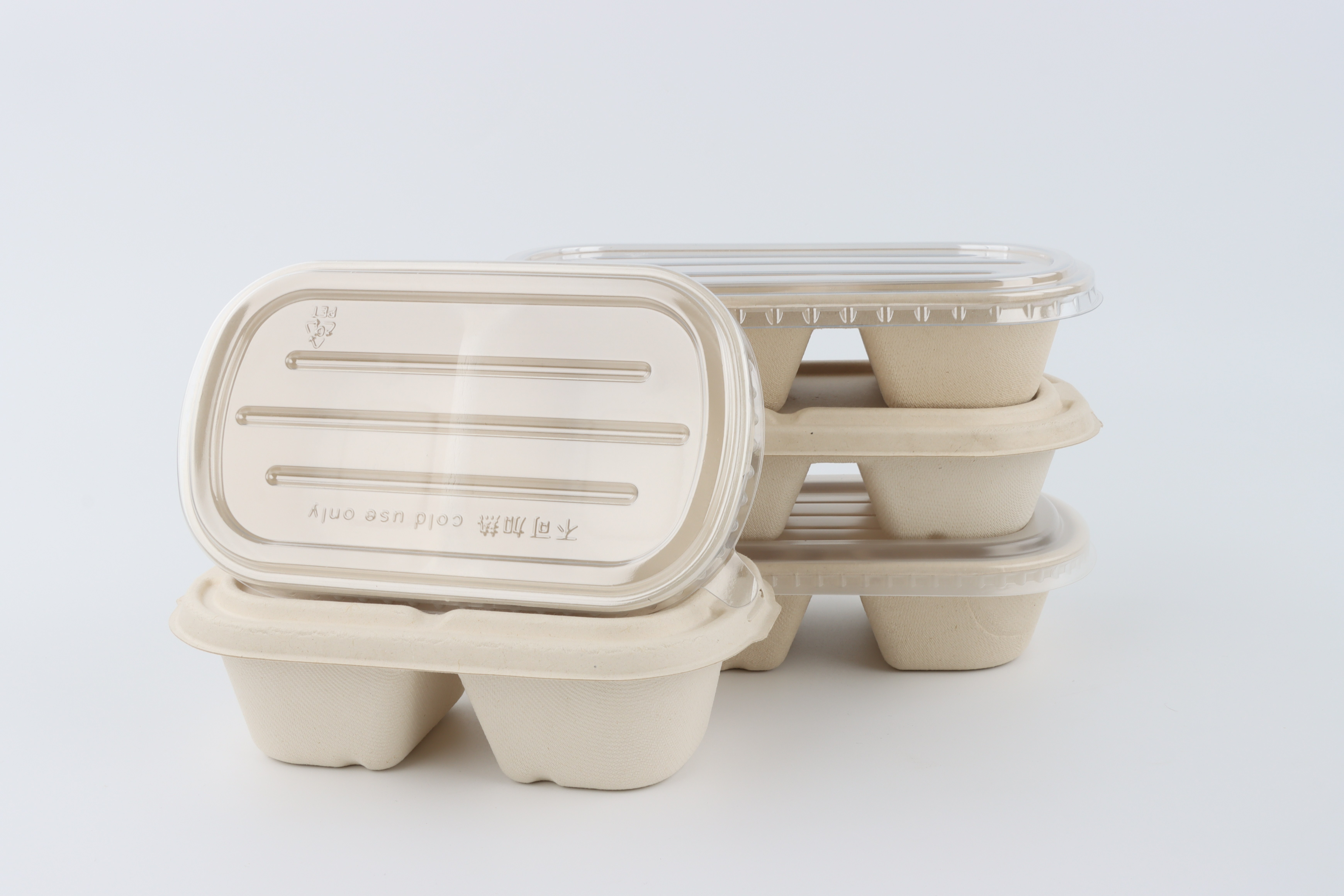
In the disposable takeaway paper box format represented by model BF-PB-003, the body is 230gsm to 400gsm food-grade kraft paper with a PLA coating described as grease-proof and water-proof. The PLA route is the one most often examined when a market applies recyclability or composting criteria, because the coating chemistry, not the paper, is usually the variable under review.
Heat tolerance and microwave use
BF-PB-003 is described as microwave safe, compostable, leak-proof and grease-resistant, with a foldable structure available with or without a window. The companion disposable paper cup, model BF-PC-001, is specified for a temperature range of −20°C to 100°C and is described as leak-proof — a reminder that the packaging system, not the box alone, is what the consumer experiences.
Structural fit with lids, labels and straws
Supplied application data links the takeaway container scenario to supporting equipment such as lids and labels, and the beverage serving scenario to lids and straws. Leak-proof construction is stated as a special requirement in those scenes. A box that is leak-proof in isolation can still fail a delivery test if the lid interface is not matched.
Print and customisation
Custom logo and design printing is available on BF-PB-003, while BF-PC-001 lists flexo and offset printing with custom logo capability. For custom paper boxes sold into chain programmes, print method determines minimum run economics more than material cost does.
| Parameter | Disposable Takeaway Paper Box BF-PB-003 | Disposable Paper Cup BF-PC-001 |
|---|---|---|
| Classification | Compostable Food Paper Box / Custom Printed Takeaway Box | Ice Cream Paper Cup / Custom Printed Paper Cup |
| Material | Food-grade kraft paper + PLA coated | Food-grade virgin paper + PLA/PE coated |
| Material weight | 230gsm–400gsm | 190gsm–350gsm |
| Size | Customisable, e.g. 15×10×5cm / 20×15×8cm | 4oz / 8oz / 12oz / 16oz / 20oz, customisable |
| Stated features | Microwave safe, compostable, leak-proof, grease-resistant | Leak-proof, temperature resistant −20°C to 100°C |
| Certifications listed | FDA, BRC, FSC compliant | FDA, BRC, FSC compliant |
What export-ready capacity looks like: the TopsPak reference
TopsPak is the brand under which Wenzhou Baofeng Packaging Technology Co., Ltd. manufactures paper packaging from Longgang, Wenzhou, China. The company was established in 1996, operates a 100,000 square metre manufacturing facility with approximately 200 staff and a professional R&D team of 50 engineers and technicians, and runs more than a hundred production machines.
Capacity is the second shortlist lens, and it is where paper box sourcing most often fails quietly. The stated output of the facility is approximately 8 million pieces per day and an annual production capacity of 3,000,000,000 pieces, with an annual output value exceeding 300 million RMB. Export business accounts for 80% of total sales, and the main markets listed are the USA, EU, Canada, Australia, the United Kingdom, Europe, Dubai, Qatar, South Africa, Singapore, Japan and South Korea — a footprint that overlaps substantially with the nine markets on this shortlist.
Certification coverage stated by the company includes BRC, BSCI, FSC forest certification, ISO 9001 quality management and ISO 14001 environmental management, with products tested against international standards including US FDA requirements. Product-level documentation lists FDA, BRC and FSC compliance for both BF-PB-003 and BF-PC-001. The company also provides one-stop ODM and OEM services for paper boxes and custom printing for paper packaging products.
For a buyer building an export file, the useful reading of these facts is structural rather than promotional: an 80% export share implies documentation routines already exist, and a 50-person R&D team implies a sample can be re-engineered when a market's coating or barrier requirement changes mid-programme.
Application fit: which scene drives which specification
Compliance is decided at the scene level. The supplied application data identifies three recurring scenes across the nine markets, each with a different dominant requirement.
| Scene | Markets cited | Dominant requirement | Reference format |
|---|---|---|---|
| Ice cream and dessert, retail chain | United States, Canada, Japan, Singapore, United Kingdom, Germany, France, Mexico, United Arab Emirates | Compostable materials; AS5810 compliance stated as a special requirement in the US scenario; lids as supporting equipment | BF-PB-003 / BF-PC-001 with lids |
| Takeaway meal packaging, restaurant chain | United States, Japan, Singapore, Canada, United Kingdom, Germany, United Arab Emirates, Mexico | Grease-proof and microwave safe; food-grade materials; lids and labels | BF-PB-003 |
| Cold and hot beverage serving, chain store | United States, United Kingdom, France, Germany, Japan, Canada, Mexico, Singapore, United Arab Emirates | Food grade, leak-proof, custom logo; lids and straws | BF-PC-001 |
Note the overlap: several markets appear in all three scenes. That is the practical argument against single-SKU export planning. A buyer serving a single chain customer across three markets may need three coating approvals for what looks like one product line.
Comparison with conventional alternatives — and where the paper format stops
Paper is not automatically the correct answer in every takeaway scenario, and a shortlist that does not say so is not a usable reference. The comparison below is qualitative; it does not claim measured performance advantages over other substrates.
| Consideration | Kraft / PLA-coated paper box | Conventional rigid plastic or foam container |
|---|---|---|
| End-of-life positioning | Compostable formats exist and are specified in some retail-chain scenes; acceptance still depends on the receiving market's collection and composting infrastructure | Recycling depends on local stream availability; foam is restricted in a growing number of jurisdictions |
| Barrier under long holding times | PLA coating provides grease and water resistance within the stated specification; very long holding of high-fat or high-moisture dishes requires validation | Barrier is generally stable across long holding times |
| Heat exposure | Microwave-safe formats available; performance is tied to the stated material and coating | Heat tolerance varies widely by polymer |
| Print and brand surface | Custom logo and design printing on kraft or coated board; strong shelf and unboxing presence | Print quality achievable but often with additional labelling steps |
| Cost structure | Coating chemistry and material weight are the main cost drivers | Resin price and tooling are the main cost drivers |
Four boundaries buyers should plan for
- Compostable is a claim, not a guarantee of local processing. A box that meets a composting standard can still have no route to industrial composting in the destination city. Buyers should confirm the receiving market's infrastructure before making a public claim.
- Coating substitution is not a drop-in change. A PLA-coated food-grade kraft box and a PE-coated equivalent are not interchangeable in a compliance file. The coating defines the recyclability or composting argument.
- Structural performance is a system property. Leak-proof construction is stated for BF-PB-003, but takeaway performance also depends on lids, labels and pack density — all listed as supporting equipment in the application data.
- Single-use is the operating mode. Both BF-PB-003 and BF-PC-001 are specified for single-use disposable operation. Buyers in markets moving toward reuse obligations should not assume a disposable format satisfies those requirements.
Future outlook: what to watch through 2027
The EU PPWR recyclability deadline of 2030 is close enough to shape specifications written in 2026, and its PFAS limits affect coating choices immediately. In the United States, the FDA food-contact framework is stable, while application-level compostability requirements are the moving part — which means the specification file, not the product catalogue, is where change will appear first.
On the technology side, the direction is toward coatings that satisfy both barrier and end-of-life requirements at the same time. The kraft paper packaging segment was valued at USD 4.57 billion in 2024 with an expected reach of USD 7.39 billion by 2032 (Credence Research), and much of that growth will be decided by whether coating chemistry can keep pace with policy rather than by converting capacity alone.
For buyers, the defensible 2026 position is to shortlist markets by policy first, then confirm capacity and technical fit. Large global paper packaging groups such as International Paper, WestRock, Smurfit Kappa and DS Smith shape the upstream board market, but the takeaway format is decided downstream — at the coating line and the print line.
Reference note: Buyers comparing wholesale takeout boxes across suppliers can use the three-lens framework above as a checklist — policy evidence, capacity evidence, technology evidence — and request each item in writing before a sample is approved.
FAQ
What are disposable takeaway paper boxes made of?
Model BF-PB-003 uses 230gsm to 400gsm food-grade kraft paper with a PLA coating described as grease-proof and water-proof, in a foldable structure available with or without a window. The companion BF-PC-001 cup uses 190gsm to 350gsm food-grade virgin paper with PLA or PE coating. Both are listed as FDA, BRC and FSC compliant.
Which export markets set the most demanding requirements for paper takeaway packaging?
On current evidence, the United States and the European Union set the most explicit requirements. FDA 21 CFR Parts 170–199 regulate food contact substances including paper, coatings and adhesives, and US retail-chain dessert scenarios state AS5810 compliance as a special requirement. The EU PPWR requires all packaging to be recyclable by 2030 and limits PFAS in food packaging.
Which certifications should a paper box manufacturer hold for food-service export?
In the supplied company data, the manufacturer holds BRC, BSCI, FSC forest certification, ISO 9001 quality management and ISO 14001 environmental management, and products are tested against international standards including US FDA requirements. Product-level data for BF-PB-003 and BF-PC-001 lists FDA, BRC and FSC compliance.
Can a compostable takeaway paper box be used in a microwave?
BF-PB-003 is described as microwave safe, compostable, leak-proof and grease-resistant. Microwave suitability is tied to that stated specification; performance should be confirmed for the exact material weight and coating selected, since the range spans 230gsm to 400gsm.
What production capacity should a buyer verify before committing to an export order?
Useful figures are daily output, annual capacity, machine count and export share. For this manufacturer, stated figures are approximately 8 million pieces per day, annual capacity of 3,000,000,000 pieces, more than a hundred production machines, a 100,000 square metre facility, and export representing 80% of total sales.
The company brochure, including product and capability details, can be downloaded here: TopsPak product brochure (PDF).
Есть вопросы или нужны дополнительные детали?
Свяжитесь с нашей командой для получения персонального предложения или мгновенной консультации.
Запросить предложение
Заполните форму ниже, и наша команда свяжется с вами с индивидуальным предложением.
Прямой чат WhatsApp
Предпочитаете общаться в реальном времени? Напишите нам в WhatsApp для мгновенной помощи и быстрых ответов.
- Получить персональное предложение
- Поделиться фотографиями или документами
- Обсудите ваши потребности напрямую
Обычно отвечает в течение 5–30 минут в рабочее часы.