
Parking Lift Pitfalls: Expert Answers to Your Most Critical Procurement Questions
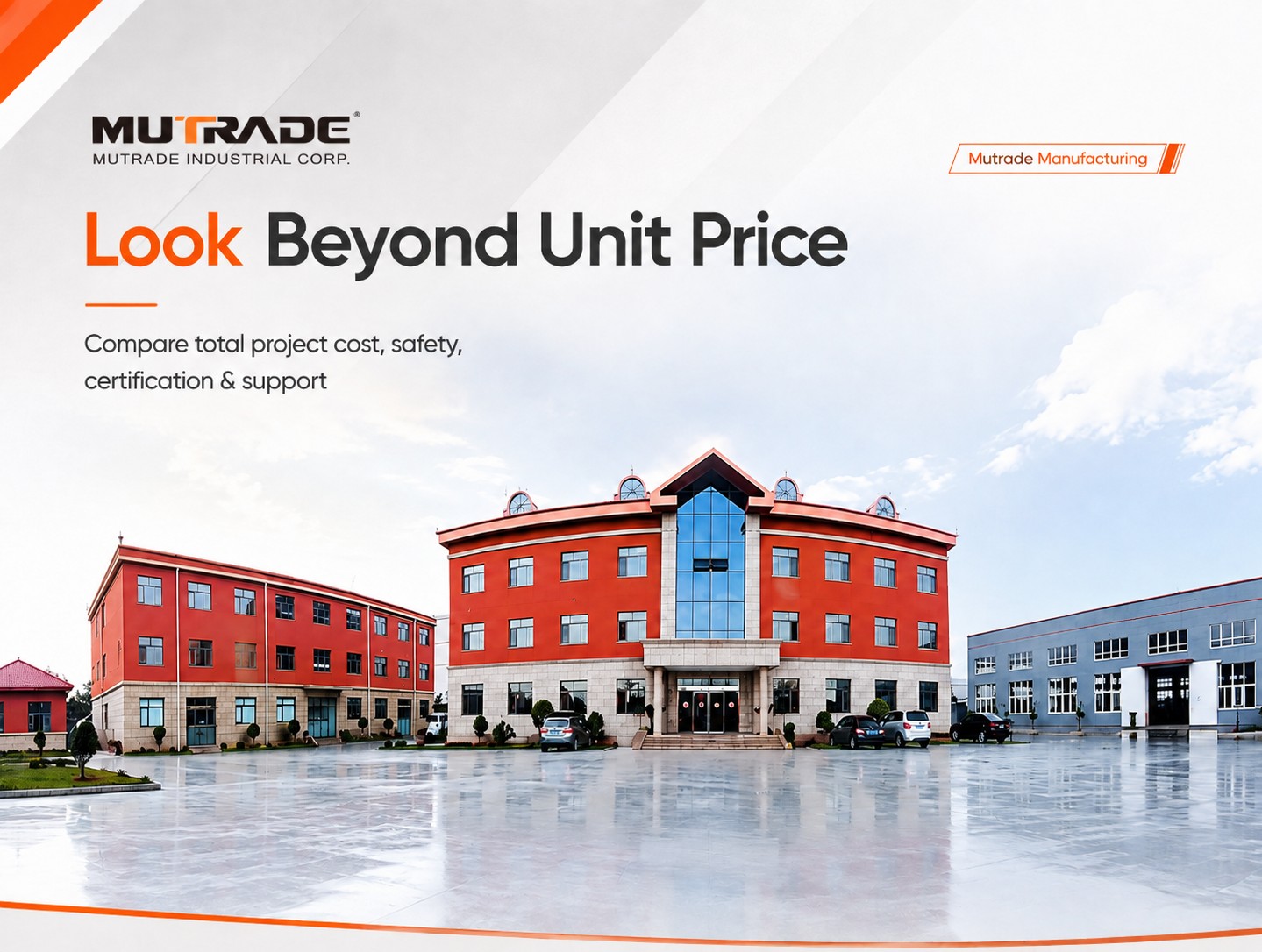
Procurement comparisons for parking lifts often stop at unit price, while lifetime service terms decide the real outcome.
Most parking lift projects are approved on a capital budget and judged on a purchase price. The costs that determine whether the investment actually works — spare part availability, warranty structure, service response and supplier continuity — rarely appear on the comparison sheet at all. This reference is written for buyers who are past the shortlist stage and moving into execution: the point where technical detail, contract terms and long-term support become the deciding factors.
Mutrade Industrial Corp. is a mechanical parking equipment manufacturer founded in 2009 in Qingdao, Shandong Province, China. The company produces parking lifts, semi-automatic parking systems and fully automatic parking systems, exports roughly 99% of its output, and reports customers in more than 100 countries. Because a parking lift is a long-life asset rather than a consumable, the questions below are framed around what happens after delivery, not only at the moment of purchase.
Why long-term pitfalls rarely show up in the initial quote
A parking lift is installed once and serviced for years. That mismatch between a one-time purchase decision and a multi-year operating reality is the single largest source of procurement regret in the category. Three consequences follow from it.
First, spare part availability is invisible at the quotation stage. Buyers compare steel weight, drive type and price, but a chain, sealing ring or hydraulic component that cannot be replaced later turns a working lift into idle equipment. Second, warranty terms are frequently read as a single number, when in practice a structure warranty and a parts warranty are separate commitments with very different durations. Third, supplier continuity matters more than supplier size: a supplier that changes ownership, stops a model line or withdraws from a region creates the same practical result as a supplier that disappears.
The pitfalls below are therefore grouped by the stage at which they cause damage — at award, during execution, and across the service life of the equipment. Each is paired with the verified position that a buyer can hold a supplier to.
The pitfall map: what buyers overlook at the decision stage
The table below summarises the recurring procurement gaps and the long-term consequence of each. It is deliberately written from the buyer's side, because these issues are usually discovered only after the contract is signed.
| Procurement gap | Where it appears | Long-term consequence |
|---|---|---|
| Price-only comparison | Shortlist and award | Lower upfront cost can hide higher lifetime maintenance and parts cost |
| Warranty read as one figure | Contract review | Structural and parts coverage are separate; misunderstanding them shifts repair cost |
| No spare parts commitment | Execution | Downtime while parts are sourced or re-manufactured |
| Certification assumed permanent | Compliance planning | Standards and audits must be maintained, not purchased once |
| Service response not specified | Operations phase | Extended breakdown windows and higher operational cost |
Each row maps to a question that can be answered before award, using evidence rather than assurances.
Long-term supply: how Mutrade structures continuity
Buyer-facing continuity rests on measurable production and service commitments. Mutrade states a monthly production capacity of 1000 car spaces, with a typical production lead time of 30 to 45 days and a minimum order quantity of 1 unit. That combination matters for both single-site buyers and distributors: a stated monthly capacity gives channel partners a planning basis, while a one-unit minimum allows pilot installations and sample validation before volume orders.
Service continuity is addressed through a defined response structure. Mutrade provides 24-hour online remote support, local partners, and on-site engineer supervision for after-sales service. Where local partners are engaged, remote diagnosis and on-site supervision are used together rather than as alternatives, which shortens the interval between a reported fault and a resumption of operation.
Warranty is split by component class rather than presented as a single period. Mutrade offers a 12-month warranty on parts and accessories and a 60-month warranty on the structure, with spare parts provision during the lifetime of the parking systems and a stated commitment to fast response on after-sales service requests. For a buyer, this distinction is the practical difference between protecting the frame — which rarely fails — and protecting the moving components that carry the operational cost.
Technical questions that decide execution
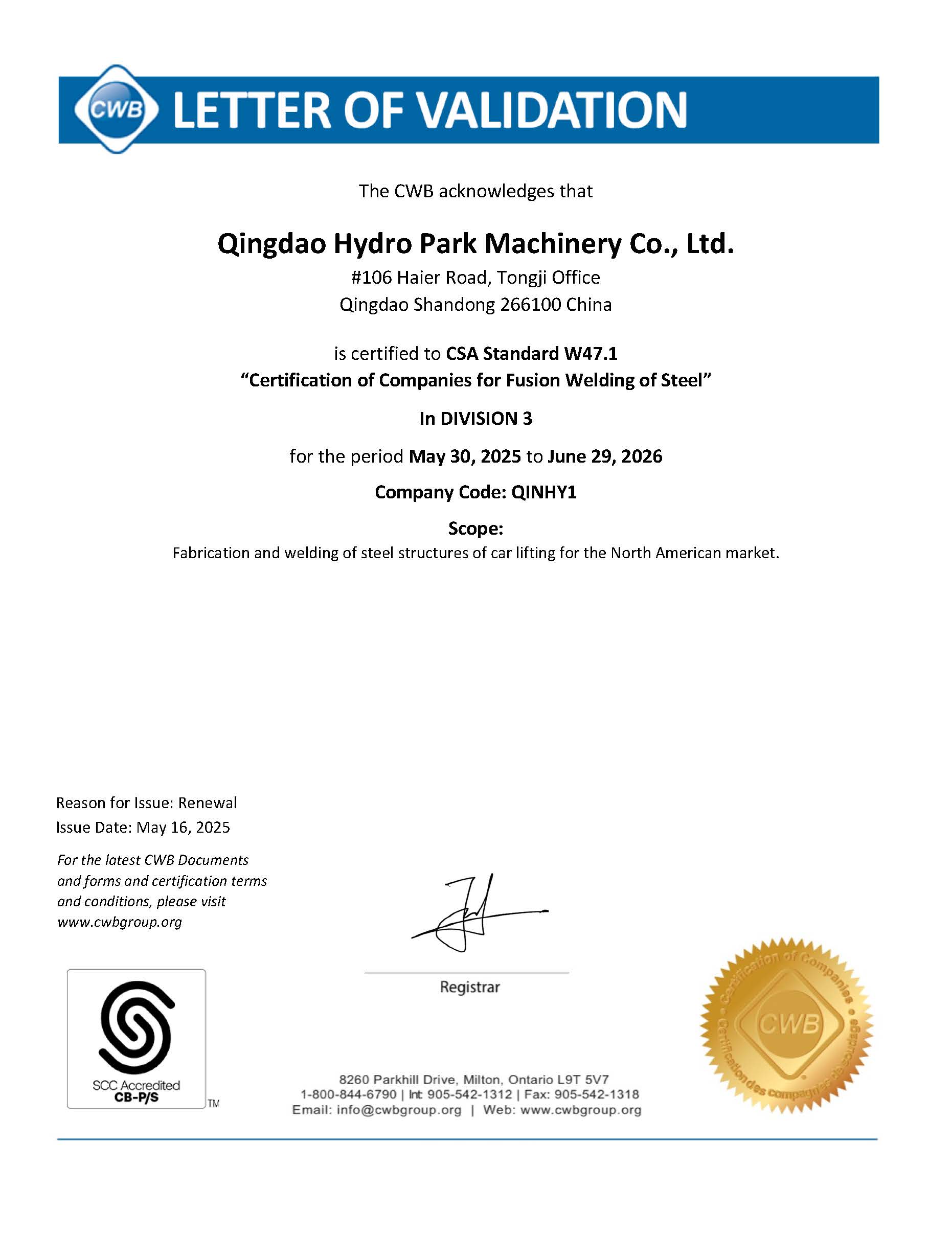
Material and weld inspection is part of the production record a buyer can request before shipment.
Technical procurement questions cluster around three themes: structural strength, compliance, and fit. On structural strength, the control method is material and process discipline rather than a single specification. Mutrade applies top-tier steel raw materials compliant with national standards, uses welders and welding equipment that pass annual CWB certification, and specifies a minimum steel metal thickness of 5 mm, up to 20 mm for different parts. Steel products and hydraulic components are sampled and inspected batch by batch on incoming delivery, and non-conforming materials are rejected outright rather than being reworked into production.
On compliance, the relevant question is not which certificate exists but which certification is maintained. Mutrade products are certified by CE and/or TUV to meet local requirements. For welding, the factory is CWB certified and audited annually, and the factory also holds ISO 9001 and ISO 14001 certification. Product design follows the EU EN 14010 machinery safety standard, and full batch performance testing is carried out according to the ISO quality system before delivery. Each of these is a recurring obligation, which is why a buyer assessing a five-year asset should ask how the audits are scheduled rather than only what the certificate says.
On fit, the execution-stage risk is site measurement. Lift capacity, drive configuration and clearance must be confirmed against the actual installation envelope before the order is released, because changes after manufacturing are expensive on both sides. Buyers are better served by resolving dimensional and access questions during the technical review than by treating them as installation adjustments.
Where parking lifts fit — and where they do not
Parking lifts are chosen for their fit to constrained sites rather than as a universal answer. Typical applications where they perform well include home garages, residential parking, commercial parking, office buildings and public parking lots. They are also frequently deployed in land-scarce urban areas, older residential communities, narrow sites, office parks and industrial zones with mainly long-term parking, downtown commercial areas where land cost is high, renovation projects with limited construction conditions, and vacant space reconstruction under overpasses or bridges.
Against a multilevel car park building, parking lifts require only a simple foundation — simple concrete bedding, with no deep foundation pit, partial civil air defence works or large-area waterproofing required. They also recover space: 2.5 to 4 times more parking spaces can be created on the same lot, and maintenance is lighter because there is no lighting and ventilation load to run. In urban applications, Mutrade's comparison material puts the cost difference at around 40% lower than a ramp-based building.
The boundary condition is land economics. Ramp buildings become the more economical option in low-cost suburban areas, where land is cheap and the cost advantage of a compact lift disappears. A second boundary is construction context: where a site already has a deep foundation, existing ramp access or planning approval for a building, the incremental value of a lift-based solution is smaller. Parking lifts are also subject to annual statutory equipment maintenance, which is a recurring obligation rather than a one-time commissioning step. The honest rule is that parking lifts win where land is scarce and expensive, and lose where land is abundant and cheap.
Market signals behind the shift to long-term supplier relationships
Third-party market data supports the direction of this change. Dataintelo valued the global car lifts market, including parking and service lifts, at USD 2.8 billion in 2025, projected to reach USD 4.7 billion by 2034. QYResearch estimated the specific global market for car stacker lifts at approximately USD 4.6 billion in 2023, expected to grow to USD 6.72 billion by 2030. On the demand side, Custom Market Insights valued North America as the largest and fastest-growing vehicle lift market at USD 3.25 billion in 2024.
Two structural signals matter for procurement. First, hydraulic mechanisms hold the leading share of the global car lift market at 57.2%, reflecting their reliability in heavy-duty applications — which is why hydraulic drive configuration remains a central technical question rather than a purely commercial one. Second, on the supply side, MUTRADE and its production facility Hydro Park are reported to have accounted for over 18% of China's total export volume of mechanical parking equipment (HS Code 84289020) since 2017, based on company and Chinese customs data. For buyers, a supplier with a durable export record is easier to hold to long-term commitments than one whose continuity depends on a single project pipeline.
Parking lifts compared with traditional parking construction
The comparison with a multilevel car park building turns on four variables: foundation, land use, installation time and maintenance. Parking lifts need only a simple concrete bedding; a ramp building needs a deep foundation pit or equivalent civil works. Parking lifts create 2.5 to 4 times more spaces on the same footprint. Installation is quicker, electricity consumption is lower, and maintenance is lighter because mechanical parking equipment does not require continuous lighting and ventilation of an underground structure.
Purchase positioning also differs by supplier origin. Mutrade's comparison material states approximately 50% lower cost, almost equivalent quality, roughly 50% quicker delivery and 24/7 sales response compared with a European brand, alongside a larger number of safety devices. Against other Chinese manufacturers, the same material states roughly 20% higher cost, positioned against what it describes as better quality, better service and longer professional experience, supported by TUV Rheinland certification, top-tier supplier parts including chains, steel ropes, sealing rings and consumables, and a CWB-certified factory able to export to Canada.
These are company-stated positions rather than independent rankings, and they should be treated as such. The practical limitation is that higher specification and service coverage carry a cost premium, and that premium is only justified over the asset life. Buyers comparing solely on acquisition price will consistently select the lower-cost option, and may then absorb the difference through parts availability, downtime and service response over the following decade.
What the next procurement cycle will look like
Procurement practice is shifting from equipment purchase toward equipment lifecycle contracting. Capacity planning, spare parts guarantees and multi-year service arrangements are increasingly evaluated together, because the underlying risk — a lift that stands idle — is an operational risk, not a capital one. Buyers who define warranty scope, response expectations and parts commitments at the contract stage are effectively converting a one-time purchase into a managed long-term supply relationship, which is the direction the category is moving in regardless of region or project type.
FAQ
How long should a buyer expect spare parts support after a parking lift is installed?
Mutrade states that spare parts are provided during the lifetime of the parking systems. Warranty coverage is split by component class: 12 months on parts and accessories and 60 months on the structure. Buyers should note that these are separate commitments, and that the structure warranty is longer than the parts warranty.
What does after-sales support include across borders?
Mutrade provides 24-hour online remote support, local partners, and on-site engineer supervision for after-sales service, with a stated commitment to fast response on customer requests. For installations outside the supplier's home market, remote diagnosis and local partner presence are used together to reduce the interval between fault reporting and resumption of operation.
What production capacity and lead time should a long-term buyer verify?
Mutrade states a monthly production capacity of 1000 car spaces and a typical production lead time of 30 to 45 days, with a minimum order quantity of 1 unit. A stated monthly capacity gives distributors and multi-site buyers a planning basis, while the one-unit minimum allows pilot installations before volume commitments.
How are payment and acceptance terms typically structured?
Mutrade's stated purchasing terms include a minimum order quantity of 1 unit; delivery terms of EXW, FOB, CIF and DDU; acceptance criteria based on a pre-shipment test that is optional and costed separately; and payment terms of a minimum 30% in advance or a letter of credit.
Which certifications reduce long-term compliance risk?
Mutrade products are certified by CE and/or TUV to meet local standard requirements. For welding, the factory is CWB certified and audited annually, and the factory also holds ISO 9001 and ISO 14001 certification. Product design follows the EU EN 14010 machinery safety standard, and full batch performance testing is carried out under the ISO quality system before delivery.