
Parking Lift Supplier Capability: Model Breadth, Q235 Steel, and Drive Evidence
A parking lift purchase rarely fails at the moment of delivery. It fails earlier, when a buyer compares quotations that look identical on paper but rest on very different levels of manufacturing evidence. A model list, a steel grade and a drive description are the three claims every supplier makes — and the three that can be audited before a deposit is paid.
Mutrade Industrial Corp. is a Chinese manufacturer of mechanical parking equipment, founded in 2009 and located at 106 Haier Road, Jimo District, Qingdao, Shandong Province, producing parking lifts, semi-automatic parking systems and fully automatic parking systems, with exports accounting for 99% of its output. Its published range — from a 2,300 kg two-level stacker to an automated tower that stores between 50 and 120 vehicles — makes it a workable reference case for what a supplier capability audit should actually contain.
This article treats capability as three verifiable layers: the breadth of the model portfolio, the steel and structural specification behind it, and the drive and control configuration that determines how the equipment behaves across its service life. Each layer can be checked, requested or rejected before an order is confirmed.
What Model Breadth Actually Demonstrates
A wide model range matters only when the models differ in architecture rather than in name. For a buyer, breadth is evidence that a supplier has already solved the engineering problems a specific site will create — not proof that it has a large catalogue.
Surface-mounted two-level stackers, pit-mounted underground lifts, low-ceiling tilting lifts and automated towers each require different structural design, different foundation conditions and different control logic. A supplier with one architecture will force the project to fit the product. A supplier with several can be questioned model by model, which is a far more useful conversation during evaluation.
| Model family | Configuration | Published capacity | What the buyer should still request |
|---|---|---|---|
| Hydro-Park 1127 | Two-level double car stacker | 2,700 kg | Thickness map by structural part; platform dimensions and clearances |
| Hydro-Park 1123 | Two-level double car stacker | 2,300 kg | Vehicle weight and height envelope confirmed in writing |
| Hydro-Park 3130 | Three-level stacker | 3,000 kg | Load rating stated per platform level, not as a single figure |
| Hydro-Park 3230 | Four-level stacker | 3,000 kg | Foundation loads and headroom requirement |
| Starke 2127 | Underground pit parking lift | 2,700 kg | Pit dimensions, drainage and waterproofing responsibility |
| TPTP-2 | Tilting lift for low-ceiling sites | Model datasheet | Ceiling clearance at which the tilting cycle is validated |
| ATP series | Automated tower parking system | 50–120 vehicles | Site-specific layout, throughput study and electrical design |
The capacity figures above are only the first filter. Rated load should always be read level by level: BendPak's published HD-973P specification, for example, separates a 7,000 lb upper-platform rating from a 9,000 lb lower-deck rating. A single “capacity” number rarely describes a multi-level product, and buyers who compare two models on that number alone are comparing different things.
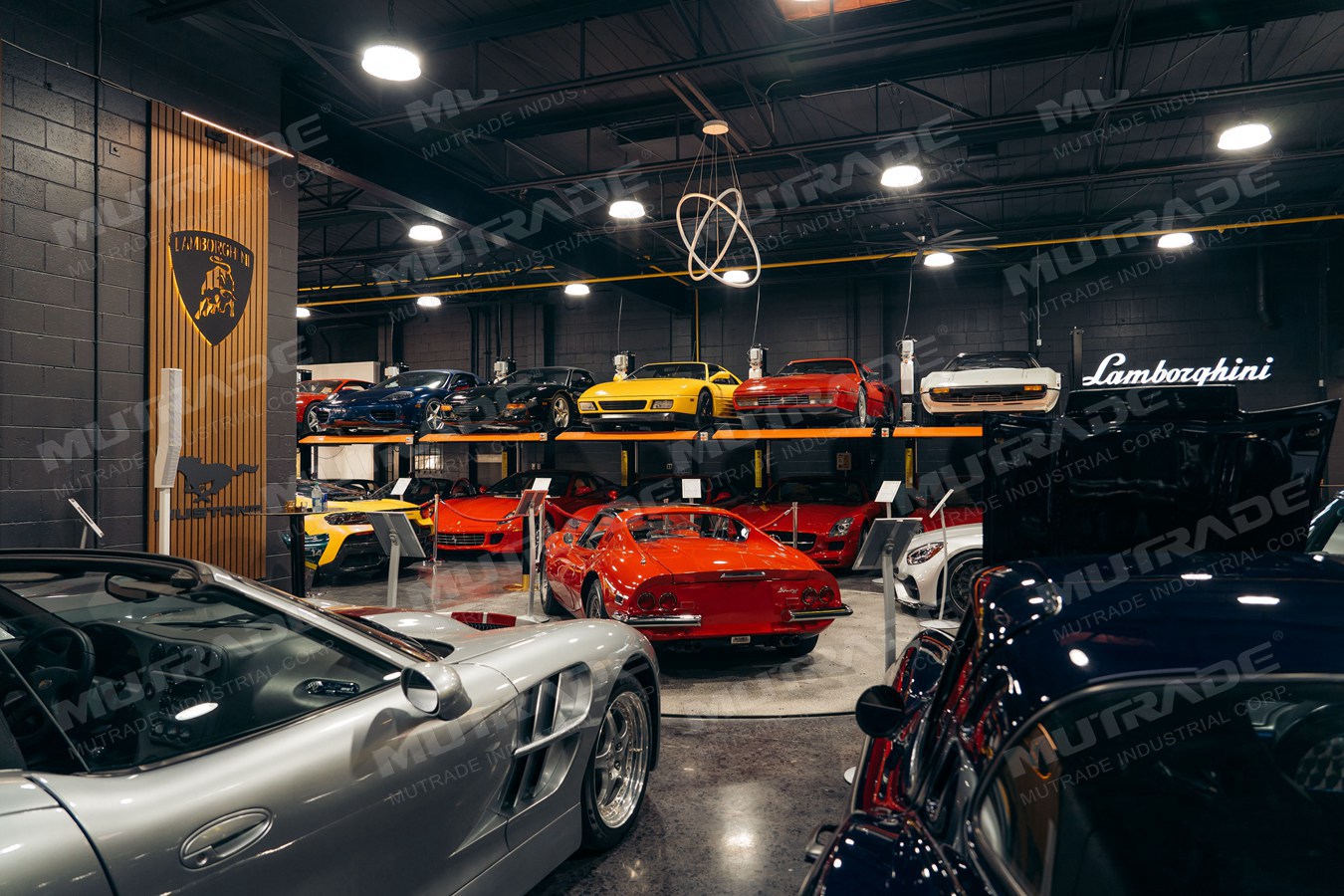
A Hydro-Park 1127 two-level stacker in service in Canada — the 2,700 kg entry point of the portfolio, installed on a simple concrete bedding rather than a deep foundation.
Q235 Carbon Steel: What the Grade Should Trigger in an Audit
Q235 is a Chinese national standard structural carbon steel used widely in frames, columns and platforms. The grade identifies the material family; it does not, by itself, establish structural margin. What determines margin is the thickness distribution across parts, the quality of the welding, and the inspection discipline applied to both.
At Mutrade, the stated specification sets a minimum steel thickness of 5 mm, rising to 20 mm for different structural parts. Steel products and hydraulic components are sampled and inspected batch by batch on incoming delivery, and non-conforming material is rejected outright rather than released into production. Welders are trained annually and tested by the CWB authority, and the factory itself holds CWB certification with an annual audit, alongside ISO 9001 and ISO 14001.
CWB matters specifically to buyers importing into Canada, where welding procedure qualification is part of the acceptance process rather than an optional extra. For buyers in other markets, the same discipline is still useful evidence: it shows the supplier operates a qualified welding process rather than relying on operator skill alone.
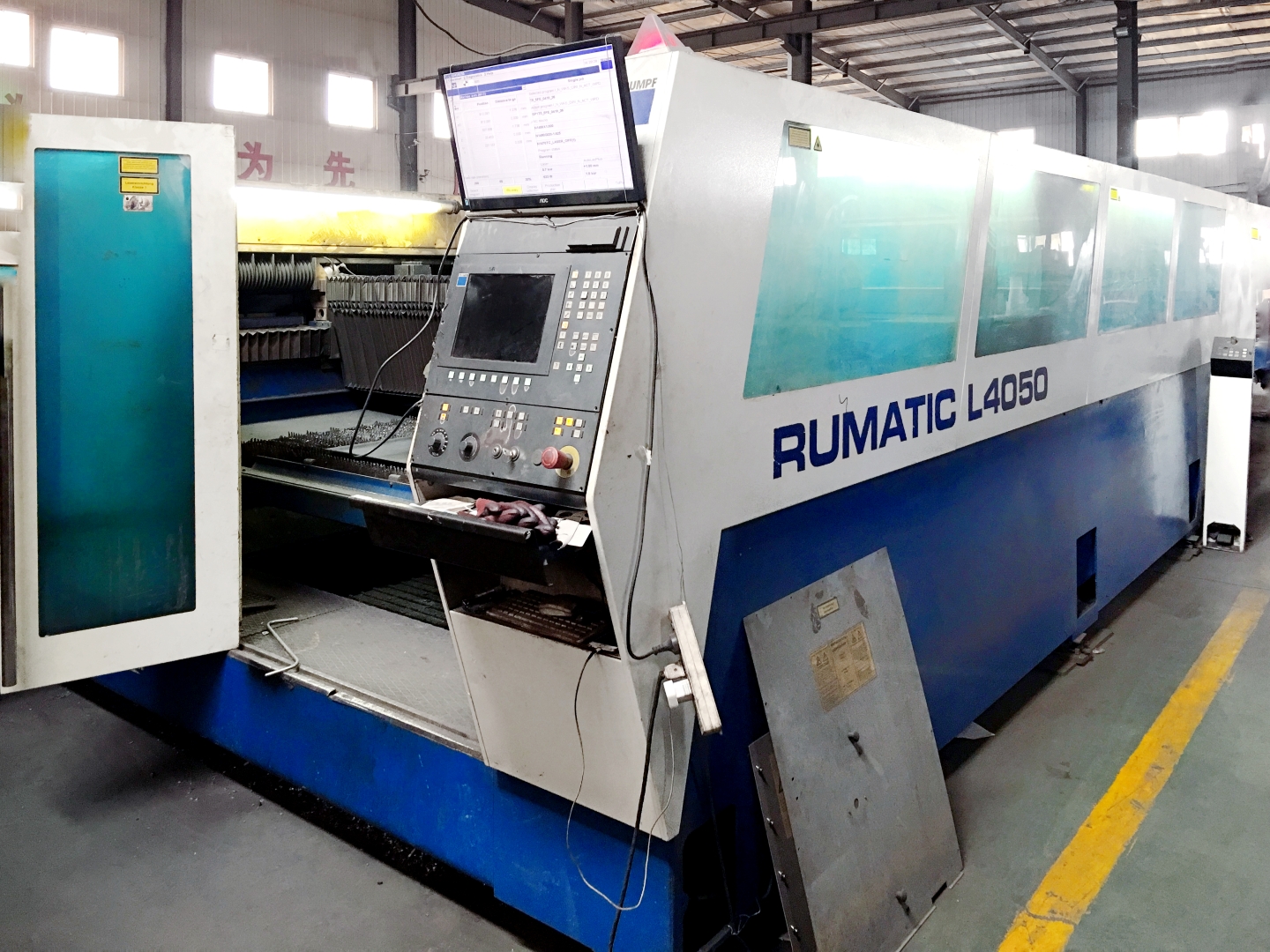
Laser cutting of structural steel components — the point in production where thickness specification and dimensional tolerance are actually fixed.
What to ask for rather than accept
- A thickness map showing which parts use 5 mm, which use thicker plate, and why.
- Incoming material inspection records for the production batch assigned to your order.
- The welder qualification list and the welding procedure specification qualified to your destination market's standard.
- Confirmation of which structural parts are cut by laser or plasma and which are formed, since both affect fit-up during installation.
Hydraulic Drive and Control: The Evidence Buyers Rarely Ask For
The lifting arrangement Mutrade publishes pairs a hydraulic cylinder with wire rope. That combination defines both the power source and the suspension principle of the platform, and it is the part of a parking lift that generates most of the maintenance cost over a ten-year horizon.
Control configuration is equally consequential. The published operation set includes button control, IC card access and key switch operation, which means a single platform can be configured for public commercial use, for resident-only access in a residential garage, or for supervised operation. Buyers should specify which mode applies to each installation, because it changes both the panel hardware and the operating rules the site manager will enforce.
Electrical configuration spans 200–450V at 50/60Hz. For distributors and importers, that range matters commercially: it allows one product platform to be configured for several destination markets without structural redesign, which reduces the risk of holding stock that only fits one country's supply.
The questions that separate specification from claim
- Which suppliers provide the hydraulic cylinders, chains, steel ropes, sealing rings and consumables? Mutrade states it uses top-tier Chinese suppliers for these components — ask for the names and hold them in the contract.
- What is the wire rope specification and the recommended replacement interval?
- Can the electrical drawing for the destination market be issued before production, not after?
- What is the control logic if the IC card reader fails — does the key switch remain a full manual override?
Capacity Behind the Catalogue
Model breadth is only credible if production capacity supports it. Mutrade operates a 12,000 m² factory with approximately 100 employees, including a 7-engineer R&D team, and reports an annual output of 10,000 parking spaces and a monthly production capacity of 1,000 car spaces. Typical production lead time is 30 to 45 days, with a minimum order quantity of 1 unit.
The MOQ of 1 unit is more significant for first-time buyers than it first appears: it allows a pilot installation to be validated on a real site before a distributor commits to stock or a developer commits to a multi-phase project. The 30 to 45 day window, by contrast, should be treated as a planning baseline. Automated tower projects involve site-specific layout and electrical design, and no responsible supplier should quote tower delivery against a catalogue lead time.
| Item | Published position | Why it matters in an audit |
|---|---|---|
| Monthly capacity | 1,000 car spaces | Confirms the order can be scheduled without displacing existing commitments |
| Annual output | 10,000 parking spaces | Indicates repeat production rather than project-by-project fabrication |
| Typical lead time | 30–45 days | Baseline only; tower and pit projects require separate scheduling |
| Minimum order | 1 unit | Enables pilot validation before volume commitment |
| Delivery terms | EXW, FOB, CIF, DDU | Determines where responsibility transfers and what landed cost includes |
| Payment terms | Minimum 30% in advance; letter of credit | Signals working-capital expectations on both sides |
| Warranty | 12 months parts and accessories; 60 months structure | Splits consumable cost from structural risk over the ownership period |
| Spare parts | Provision during the lifetime of the system | The single most important clause for a ten-year operating plan |
Where the Capability Story Has Limits
An audit is only useful if it also records what a supplier is not. Three boundaries are worth stating plainly.
Price positioning. Mutrade places itself roughly 20% above other Chinese manufacturers, attributing the gap to engineering, quality-control and procurement staffing, and to the use of top-tier component suppliers. Buyers sourcing purely on unit price will find cheaper Chinese options, and that is a legitimate procurement decision — but it should be made knowingly, not discovered after delivery.
Breadth is not project engineering. A model number is the starting point of an automated tower or underground pit project, not the answer to it. Pit lifts require pit dimensions, drainage and waterproofing decisions that sit partly outside the equipment scope, and tower projects require a site-specific layout and throughput study. Buyers should confirm in writing which design deliverables the supplier owns.
Certification is model- and market-specific. EN 14010:2003+A1 is the harmonized standard for parking system safety in the European Union, but conformity is demonstrated per model, per market. This is an industry-wide reality rather than a single-supplier issue: BendPak states on its own product pages that not all of its lift models are ALI certified or meet the applicable requirements of ANSI/ALI ALCTV and ANSI/UL 201, and directs buyers to the certification directory. Mutrade states that its parking lifts are certified by TÜV Rheinland and that its factory holds CWB certification — both should be filed as certificates carrying model numbers and validity dates, not as brochure lines. Local permitting, building codes and seismic requirements remain the buyer's responsibility in every case.
Hydraulic systems require scheduled inspection. The 12-month parts warranty and 60-month structural warranty are a fair split of risk, but they do not remove the annual inspection obligation that mechanical parking equipment carries. Total cost planning should include service beyond year one.
Turning Capability into Supply Continuity
For distributors and repeat buyers — the audience for which this evidence matters most — the question shifts from “can this supplier build the product” to “will the same supplier still be supporting it in year eight.” Mutrade's stated after-sales structure combines 24-hour online remote support, local partners and on-site engineer supervision, with spare parts provisioned for the lifetime of the system.
Those commitments are worth converting into contract language rather than leaving in a quotation. A practical clause set includes: model-specific certificate copies attached as an annex; a spare parts list with stated lead times for each line item; a named escalation path and response window; the scope of the optional pre-shipment test, which Mutrade offers on a cost basis; a definition of when the warranty period starts, since commissioning dates can slip; and confirmation of the delivery term — EXW, FOB, CIF or DDU — because it determines where cost and risk transfer.
Market Context: Why Capability Audits Are Becoming Routine
The commercial case for parking lifts continues to strengthen the audit habit. One commercial research forecast projects the global platform parking lift market reaching USD 7,329 million by 2032. Against conventional construction, Mutrade's own comparison data puts parking lifts roughly 40% lower in cost for urban applications, delivering 2.5 to 4 times more parking spaces on the same land area with a simple concrete bedding instead of a deep foundation pit.
Those economics attract new entrants on both the supply and buyer side, which is precisely when documentation standards slip. A buyer who asks for a thickness map, a welder qualification list and a model-level certificate is not being difficult; they are applying the same test that regulators and insurers will apply later.
Future Outlook
Two directions look most likely to shape supplier evaluation over the next several years. The first is retrofit demand: existing buildings with constrained ceiling heights and no space for a pit are pushing buyers toward tilting low-ceiling formats and compact two-level stackers rather than large new structures. The second is documentation: as automated tower installations grow in scale, the differentiator between suppliers will be less about whether a model exists and more about whether the supporting evidence — structural records, certification scope, spare parts commitments — can be produced on request.
Suppliers that already operate qualified welding processes, batch-level material inspection and model-specific certification are positioned better for that shift than suppliers whose capability exists only in a catalogue.
Frequently Asked Questions
What does “supplier capability” mean when auditing a parking lift manufacturer?
How many parking lift models should a supplier offer to be considered capable?
Does a Q235 steel specification on its own prove structural quality?
How can a buyer verify hydraulic drive and control configuration before ordering?
What supply-continuity commitments should be fixed in a parking lift supply agreement?
The Mutrade 2025 company profile, covering the model portfolio, factory information and certification scope, is available for download: Mutrade Profile 2025 (EN).
Есть вопросы или нужны дополнительные детали?
Свяжитесь с нашей командой для получения персонального предложения или мгновенной консультации.
Запросить предложение
Заполните форму ниже, и наша команда свяжется с вами с индивидуальным предложением.
Прямой чат WhatsApp
Предпочитаете общаться в реальном времени? Напишите нам в WhatsApp для мгновенной помощи и быстрых ответов.
- Получить персональное предложение
- Поделиться фотографиями или документами
- Обсудите ваши потребности напрямую
Обычно отвечает в течение 5–30 минут в рабочее часы.