
Parking Lift Supplier Sustainability: Portfolio, Customization, Acceptance
A parking lift programme is not judged at handover. It is judged years later, when the same supplier has to reproduce a delivered configuration, restart an earlier customization, and pass the same acceptance checks on the next order.
Long-term supply continuity is one of the least glamorous and most consequential questions in mechanical parking procurement. Buildings change owners, sites are expanded, spare parts are needed, and a second phase is often approved two or three years after the first. In that window, the difference between a supplier that can repeat itself and one that cannot stops being a service complaint and becomes a capital cost.
What Supplier Sustainability Means in Parking Lift Procurement
For a procurement team, the term can be defined operationally: the ability to reproduce a delivered configuration, restart a previous customization, and meet the same acceptance criteria on the second, fifth or twentieth order — across different sites, building types and countries. It is a capability question rather than a relationship question, and most of it can be examined before the first purchase order is placed.
Three capabilities decide whether that definition holds in practice:
- Portfolio continuity — enough model families to serve commercial, residential, underground and car storage projects without the buyer changing suppliers between phases.
- Customization continuity — a documented engineering path that can be repeated when a non-standard dimension, colour, voltage or control interface is requested a second time.
- Acceptance discipline — a specification precise enough that a delivered unit can be checked against it, item by item, by the buyer's own engineer.
Mutrade Industrial Corp. is a Qingdao-based manufacturer established in 2009 that designs and produces mechanical parking solutions: parking lifts, semi-automatic parking systems, fully automatic parking systems and car lifts. The company operates a 12,000 m² manufacturing facility with approximately 100 staff, including an R&D team of seven engineers, produces around 10,000 parking spaces annually, exports 99% of that output, and has supplied customers in more than 100 countries. Its line-up is a practical reference point for the three capabilities above, because each one can be checked against published model data rather than reputation.
Portfolio Depth: Four Application Families Under One Roof
Portfolio depth matters most when a buyer's programme is not uniform. A single developer may need a two-post stacker for a residential basement, a pit lift for an underground garage, a triple stacker for a storage hall, and an automated tower for a high-density commercial plot. Sourced from four suppliers, that programme carries four spares philosophies, four documentation sets and four acceptance processes into the next decade.
| Model | Configuration | Vehicles / unit | Rated capacity | Vehicle envelope L × W × H | Drive | Primary application |
|---|---|---|---|---|---|---|
| Hydro-Park 1127 & 1123 | Two post, double car stacker | 2 | 2700 kg / 2300 kg | 5000 × 1850 × 2050 mm | Hydraulic cylinder + chains | Residential, valet parking |
| Starke 2227 | Pit / underground double unit | 4 | 2700 kg per car | 5000 × 2050 × 1700 mm | Hydraulic cylinder + chains | Residential, commercial |
| Starke 2127 | Underground pit lift | 2 | 2700 kg | 5000 × 2050 × 1700 mm | Hydraulic cylinder + chains | Residential, commercial |
| Hydro Park 2525 & 2625 | Triple car stacker | 3 | 2500 kg (2F) / 2000 kg (3F) | 5060 × 2802 × 2050 mm | Hydraulic cylinder + chains | Car storage, dealership, collection, club |
| Hydro-Park 2136 | 4 post car storage lift | 2 | 3600 kg | 4566 × 2560 × 2442 mm | Hydraulic cylinder + cable | Car storage |
| Hydro-Park 3230 | Four post quad stacker | 4 | 3000 kg | 8912 × 2100 × 2000 mm | Manual with handle | Car storage |
| ATP Series | Automated car tower | 50–120 | 2350 kg | 5300 × 1900 × 2050 mm | Hydraulic cylinder + chains | Car parking, display tower |
| FP-VRC | Floor-to-floor car elevator | — | 2000–10000 kg | 2000–6000 × 2000–5000 mm | Hydraulic cylinder + double steel chains | Car dealership, car service |
Across the models referenced here, rated lifting capacity runs from 2300 kg to 3600 kg, and every listed unit is constructed from carbon steel Q235 with a bespoke power supply. That band covers the vehicle mix most projects actually encounter — sedans through large SUVs — and it is wide enough that a second phase usually does not require re-qualifying a different manufacturer.
Customization Continuity: The Harder Half of a Long-Term Supply Deal
Customization is usually easy on the first order and difficult on the third. The engineering hours are spent once; drawings, tolerances and non-standard components then have to be retrieved and reproduced later, often after the original project engineer has moved on.
Product data across this portfolio records customization as acceptable on the Hydro-Park 1127 and 1123, the Starke 2227, the Hydro Park 2525 & 2625, the Hydro-Park 2136, the Hydro-Park 3230, the TPTP-2, the Hydro-Park 1027, the S-VRC-2 and the FP-VRC. In project terms, that translates into a defined set of variables a supplier must be able to re-enter:
- Power supply configured to the destination market — from 110 V to 480 V at 50 or 60 Hz across much of the range.
- Dimensions adapted to the real site rather than the catalogue envelope.
- Client-specified colour, plus an outdoor package where the unit is exposed to weather.
- Remote control where operation needs to happen away from the platform.
- Private-label logo for distributors, brand owners and channel partners.
- Defined behaviour in abnormal conditions, such as the ability to take a car off the platform manually after a power failure.
- Additional corrosion protection where snow and de-icing agents are present.
Verification of customization continuity therefore comes down to four questions. Is the deviation documented as a controlled drawing set? Is there in-house engineering capacity to re-issue it — the kind of capacity represented by a seven-engineer R&D team inside a 12,000 m² facility? Can non-standard parts be re-sourced? And is the production schedule stable enough to plan against, given a typical production lead time of 30–45 days?
Technical Evidence of Durable Engineering
Durability is easier to argue with specification data than with adjectives. Three categories of evidence are worth extracting from a supplier's documentation before a partnership decision is made.
Material and drive configuration
Carbon steel Q235 appears as the structural material across the referenced line-up, from the Hydro-Park 1127 and 1123 two-post stackers to the ATP Series automated tower. Hydraulic drive with cylinder and chains is the dominant arrangement — used on the Hydro-Park 1127 and 1123, the Hydro Park 2525 & 2625, the Starke 2127 and 2227, the ATP Series, the MLP Series and the ARP Series. The Hydro-Park 2136 uses a hydraulic cylinder with cable, the BDP-2 uses hydraulic cylinder with wire rope, and the FP-VRC car elevator uses a hydraulic cylinder with double steel chains. Third-party analysis by Dataintelo attributes a 57.2% share of the global car lift market to hydraulic mechanisms, citing their reliability in heavy-duty applications — a market-level observation that is consistent with hydraulic drive dominating this portfolio.
Cycle time as throughput evidence
Lifting time is one of the most frequently under-specified numbers in parking lift tenders. Within this portfolio it ranges from 24 seconds on the TPTP-2 and 30 seconds on the Starke 2127 and 2227, through 45 seconds on the Hydro-Park 1027, 50 seconds on the Hydro-Park 1127 and 1123, ≤55 seconds on the Hydro-Park 2136 and 68 seconds on the Hydro Park 2525 & 2625, to 80 seconds on the Hydro-Park 3130 and 120 seconds on the Hydro-Park 3230. Automated systems operate at a different order of magnitude: up to 120 m/min on the ATP Series and up to 75 m/min on the MLP Series.
Electrical flexibility across markets
Bespoke power supply is recorded across most models, spanning 110–480 V at 50/60 Hz. Some units work to narrower ranges — 208–480 V on the Hydro-Park 3230 and 3130, 220 V on the TPTP-2, and 480 V, 415 V, 380 V or 220 V on the ARP Series. For a buyer operating in several countries, that flexibility is a continuity feature in itself: one engineering relationship can serve multiple electrical standards.
Application Coverage: Commercial, Residential, Underground and Car Storage
The value of a portfolio is measured by how many real project briefs it fits without a supplier change. In the referenced line-up, coverage falls into recognisable groups.
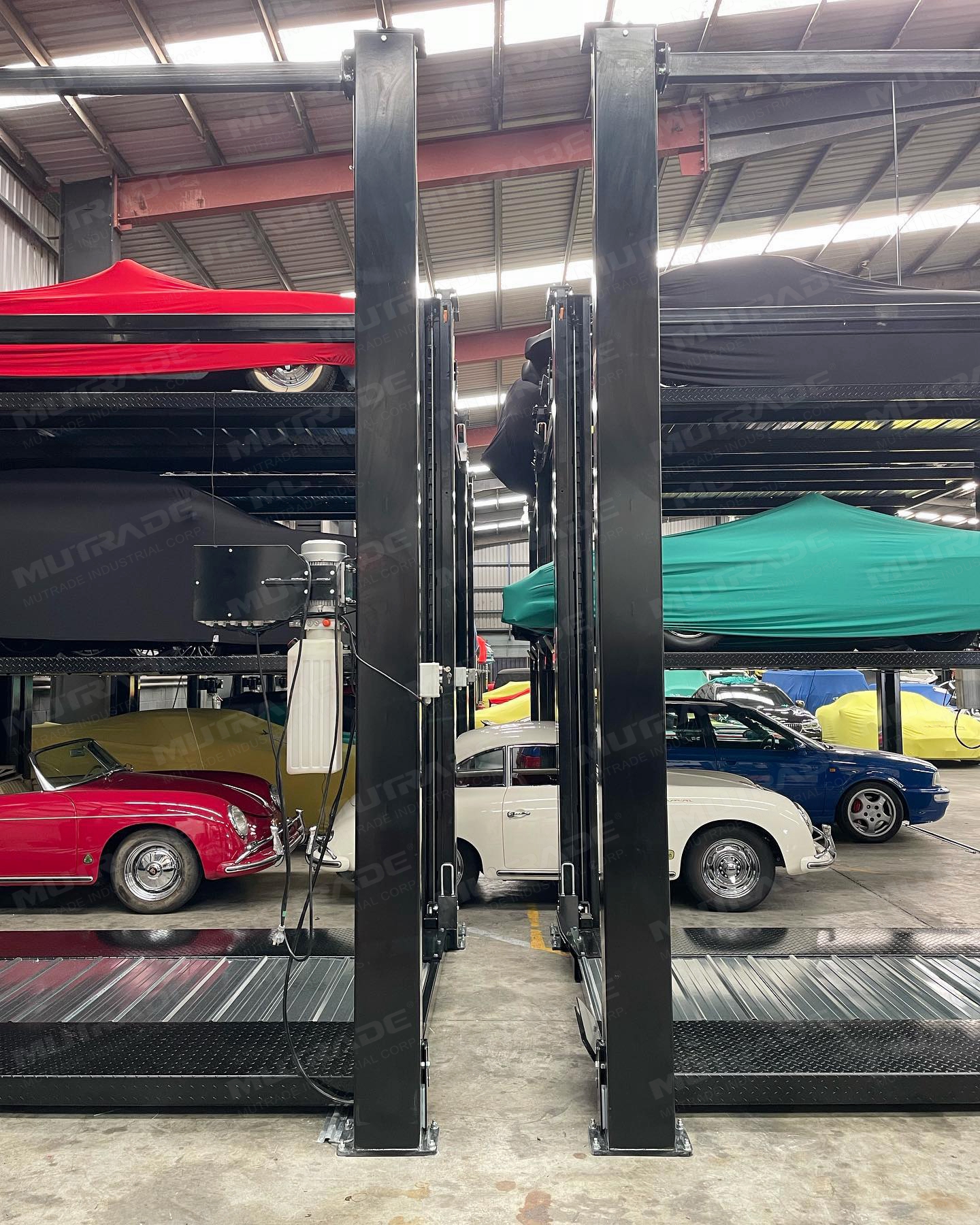
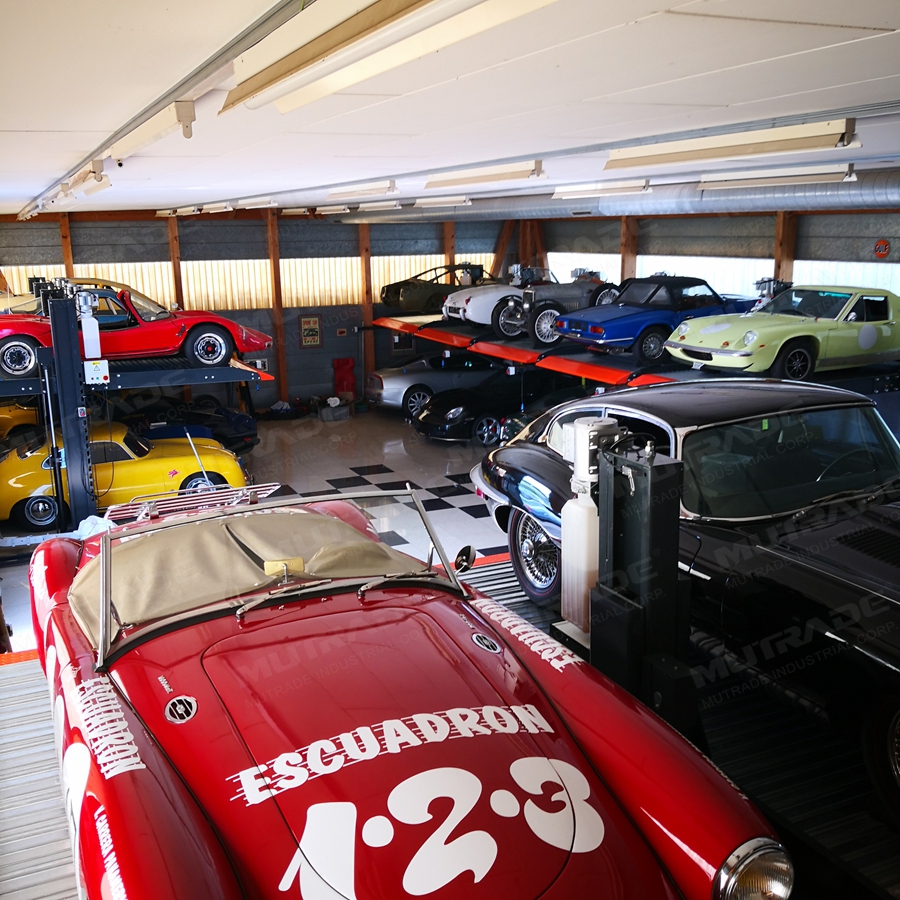
- Indoor car warehousing and storage. Two- to four-level car storage projects inside covered warehouses, operating in long-term storage mode, where the objective is to multiply cars within existing warehouse or parking space. Supporting equipment includes independent or centralized hydraulic power units, electric control systems and safety protection devices.
- Residential and valet parking. The Hydro-Park 1127 and 1123 are two-post double stackers designed for residential parking and valet parking, parking 2 vehicles per unit at 2700 kg and 2300 kg respectively, with a 50-second lifting time.
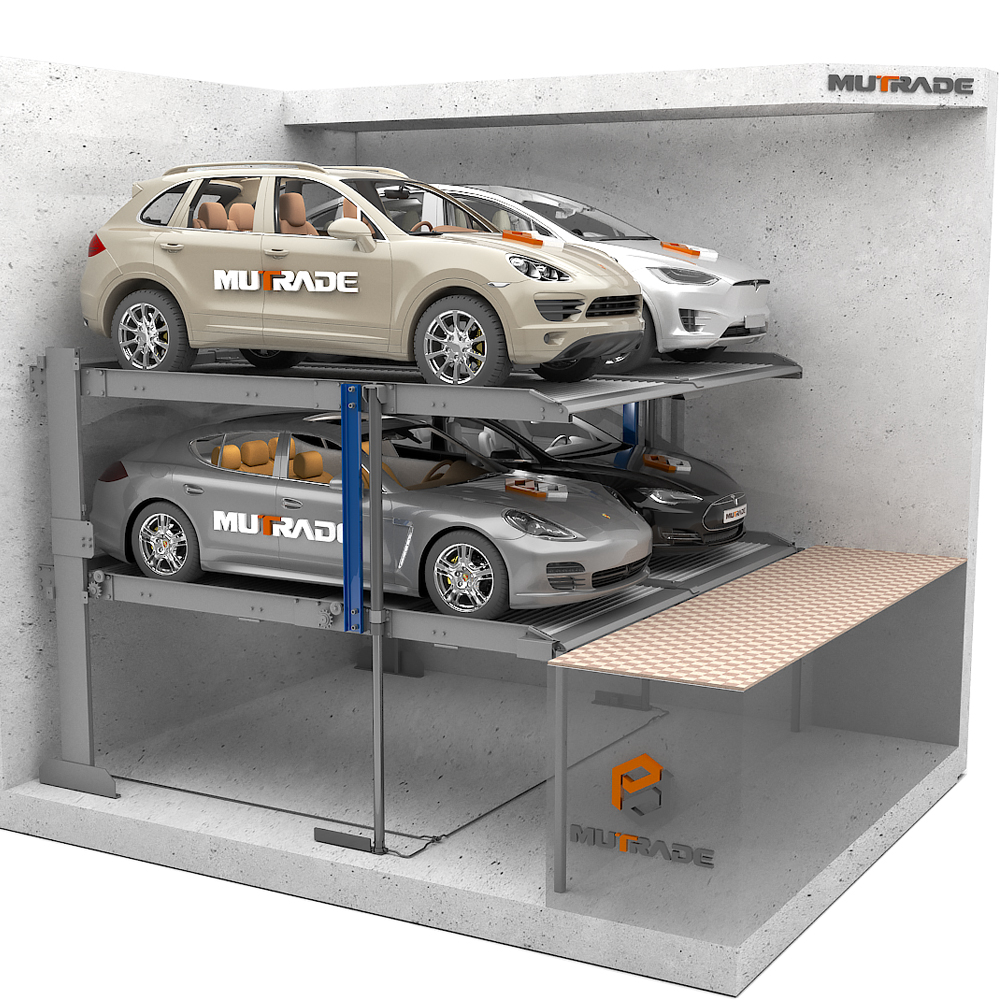
- Underground and pit applications. The Starke 2127 parks 2 vehicles per unit and the Starke 2227 parks 4, both at 2700 kg per car with a 30-second lifting time and hydraulic cylinder plus chain drive.
- Car storage, dealership, collection and club use. The Hydro Park 2525 & 2625 parks 3 vehicles per unit at 2500 kg on the second floor and 2000 kg on the third, with a 5060 × 2802 × 2050 mm envelope that suits larger vehicles.
- High-density commercial and public parking. The ATP Series parks 50–120 vehicles per unit at 2350 kg, with operation by IC card, touch screen or manual control.
- Vertical transfer between levels. The FP-VRC car elevator handles 2000–10000 kg, with button switch as standard and remote controller optional.
Market Signals Behind the Continuity Question
Supplier continuity is becoming a formal procurement criterion partly because the installed base keeps growing. Dataintelo values the global car lifts market — including parking and service lifts — at USD 2.8 billion in 2025 and projects USD 4.7 billion by 2034. QYResearch places the narrower car stacker lift market at approximately USD 4.6 billion in 2023, with an expected USD 6.72 billion by 2030. Custom Market Insights identifies North America as the largest and fastest-growing vehicle lift market, valued at USD 3.25 billion in 2024.
Published sizing in this category should be read with care: the figures diverge mainly because some studies include parking management services while others count mechanical parking hardware only. The direction of travel is consistent even where the absolute numbers are not.
Two further signals are relevant to long-term buyers. Automated parking systems are expected to align with quality and occupational health and safety management standards such as ISO 9001 and ISO 45001, which affects how suppliers document both manufacturing and site safety. At manufacturer level, company-published data based on Chinese customs records states that Mutrade and its Hydro Park production facility have accounted for more than 18% of China's mechanical parking equipment export volume (HS Code 84289020) since 2017 — an indicator of production scale, though buyer-side due diligence should treat supplier-published market share as a claim to verify rather than a settled fact.
The competitive field itself is established and multinational. In North America, BendPak is widely identified as a major player in the vehicle lift market and introduced an eight-armed car lift design in 2024. Buyers structuring a long-term supply relationship typically compare such established names with regional manufacturers on portfolio breadth, customization repeatability and acceptance documentation, rather than on a single headline specification.
Where a Strong Portfolio Stops Helping
Supplier capability and site feasibility are different questions, and conflating them is one of the more expensive mistakes in parking lift procurement. A broad line-up does not remove physical constraints, and an honest evaluation has to say so.
- Pit-based solutions still need a pit. Underground and pit-stack models require excavation and headroom that no supplier can create on the buyer's behalf. Where pit depth and ceiling height cannot be achieved, the configuration has to change — not the supplier.
- High-density automated towers need volume. The ATP Series is built around 50–120 vehicles per unit. Below that level of demand, a stacker or pit lift usually fits the site better and consumes less structure.
- Throughput varies widely inside one portfolio. A Starke 2227 lifts in roughly 30 seconds, while a manual-handle Hydro-Park 3230 takes around 120 seconds. Long-term suitability depends on daily traffic and peak-hour behaviour, not only on nominal capacity.
- Production time is not delivery time. A typical production lead time of 30–45 days is a manufacturing figure; freight, customs clearance, foundation works and commissioning sit outside it.
- Single-supplier continuity concentrates risk. Consolidating on one partner simplifies documentation, spares planning and repeat ordering, but it also creates dependency. Critical hydraulic and control components deserve a defined second-source or stock policy.
Against conventional construction, the comparison should also be stated carefully. Company material comparing the two approaches indicates that parking lifts cost about 40% less than multilevel car park buildings for urban area applications. That is a benchmark rather than a rule: the real gap depends on land value, foundation work, approvals and how much structure already exists, and it should be re-tested for each project before it enters a business case.
Acceptance Criteria: A Checklist a Buyer Can Actually Use
Acceptance is where continuity is tested for the first time. If the specification is vague at handover, every later order inherits the ambiguity — which is why the checklist below is worth writing before the purchase order, not after delivery.
| Checkpoint | What to confirm | Source of truth |
|---|---|---|
| Vehicle envelope | Measured platform length, width and clear height against the model's allowed car dimensions — for example 5000 × 2050 × 1700 mm on the Starke 2127. | Model specification |
| Rated capacity per level | Confirm each level separately where ratings differ, such as 2500 kg on the second floor and 2000 kg on the third floor of the Hydro Park 2525 & 2625. | Model specification |
| Drive and transmission | Verify the hydraulic cylinder arrangement and whether chains, cable or wire rope are installed as ordered. | Model specification |
| Control interface | Confirm the delivered operating method: key switch, push button, code and ID card, IC card, touch screen, or optional remote control. | Order confirmation |
| Power supply | Check delivered voltage and frequency against the bespoke range agreed; models in this portfolio span 110–480 V at 50/60 Hz. | Order confirmation |
| Emergency behaviour | Confirm the agreed response in abnormal conditions, including manual car removal after a power failure where specified. | Project requirement |
| Supporting equipment | Confirm delivery of the hydraulic power unit (independent or centralized), electric control system and safety protection devices. | Project requirement |
| Surface treatment and environment | Confirm outdoor package, colour and any corrosion protection where snow, melt agents or coastal air are present. | Project requirement |
| Documentation and labelling | Confirm operating documents, model identification and any private-label logo agreed for the order. | Order confirmation |
| Delivery planning | Compare the confirmed schedule against the typical 30–45 day production lead time and the site's own readiness. | Production plan |
Future Outlook
The commercial drivers behind parking lifts are already visible in project briefs: expanding parking capacity, maximising limited space, reducing land cost, meeting municipal parking requirements, enhancing property value and generating additional revenue. As more of that demand is met through retrofitting existing buildings rather than new construction, the emphasis shifts further towards suppliers who can adapt dimensions, voltage and control interfaces repeatedly — and document the result consistently across phases.
On that basis, portfolio breadth, customization continuity and acceptance discipline are likely to appear as standard evaluation columns alongside price and lead time. For buyers at the research stage, the practical sequence is straightforward: map the project mix, test whether one portfolio covers it, verify that a customization can be repeated, and write the acceptance checklist before the order rather than after delivery.
FAQ
What is a long-term parking lift supplier?
A long-term parking lift supplier is one that can deliver the same configuration, customization and acceptance standard across repeat orders, not only on the initial purchase. In practice that means demonstrable portfolio depth across commercial, residential, underground and car storage models, a documented engineering path for non-standard requirements, and specifications precise enough to be checked at handover. The referenced Mutrade portfolio illustrates the shape of that breadth, spanning two-post stackers, pit lifts, triple stackers, four-post stackers, automated towers, scissor-lift underground elevators and floor-to-floor car elevators, all built on carbon steel Q235.
How deep does a supplier's portfolio need to be for a mixed commercial and residential programme?
Depth should be measured against the project mix rather than the length of the catalogue. A programme combining a residential basement, an underground garage and a storage hall typically needs two-post stackers — the Hydro-Park 1127 and 1123 park 2 vehicles per unit at 2700 kg and 2300 kg — pit lifts such as the Starke 2127 and 2227 at 2700 kg per car, and a triple stacker such as the Hydro Park 2525 & 2625 with 2500 kg on the second floor and 2000 kg on the third. If one supplier covers all three without changing documentation or spares logic, portfolio depth is adequate for that programme.
How can buyers verify that a customized parking lift will be reproduced on a repeat order?
Three checks help. First, confirm that the customization variables were recorded as controlled drawings and order documents rather than agreed verbally; across this portfolio those variables include bespoke voltage and frequency from 110 to 480 V at 50/60 Hz, adapted dimensions, specified colour, outdoor package, remote control and private-label branding. Second, confirm that the supplier has in-house engineering capacity to re-issue the configuration — the equivalent of a seven-engineer R&D team within a 12,000 m² production facility. Third, confirm a stable production schedule, since a typical production lead time of 30–45 days applies to repeat orders as much as to first ones.
Which specification details best indicate durable parking lift engineering?
Material, drive configuration and rated capacity are the three most useful starting points. Carbon steel Q235 is the structural material across the portfolio referenced here. Drive arrangements recorded across the range include hydraulic cylinder with chains, hydraulic cylinder with cable, hydraulic cylinder with wire rope and hydraulic cylinder with double steel chains. Rated lifting capacities run from 2300 kg to 3600 kg. Third-party analysis by Dataintelo attributes a 57.2% share of the global car lift market to hydraulic mechanisms, citing reliability in heavy-duty applications — consistent with hydraulic drive dominating this line-up.
What should be checked during acceptance of a parking lift delivery?
Acceptance should confirm the delivered unit against the ordered specification: the measured vehicle envelope, rated capacity per level where levels differ, the drive and transmission arrangement actually installed, the control interface delivered (key switch, push button, code and ID card, IC card, touch screen or optional remote control), the delivered voltage and frequency, emergency behaviour such as manual car removal after a power failure, delivery of the hydraulic power unit and electric control system, surface treatment appropriate to the site environment, and documentation and labelling. Each item should be traceable back to the order confirmation rather than to a general brochure.
What are the limits of relying on one parking lift supplier over several years?
Consolidation simplifies documentation, spares planning and repeat ordering, but it also concentrates risk. A broad portfolio does not overcome physical constraints: pit models still require excavation and sufficient ceiling height, and automated towers are designed around high vehicle counts such as 50–120 per unit. Within a single portfolio, cycle times can range from about 30 seconds on a pit lift to around 120 seconds on a manual-handle quad stacker, which may matter more than nominal capacity in daily operation. Buyers commonly mitigate this by defining a second source or stock policy for critical hydraulic and control components, and by keeping the frozen configuration documented independently of the supplier.
Mutrade's corporate profile, including its product range and manufacturing information, is available as a downloadable document: Mutrade Profile 2025_EN (PDF).