
Parking Lift Systems Compared: 2-Post, 4-Post and Triple Stacker
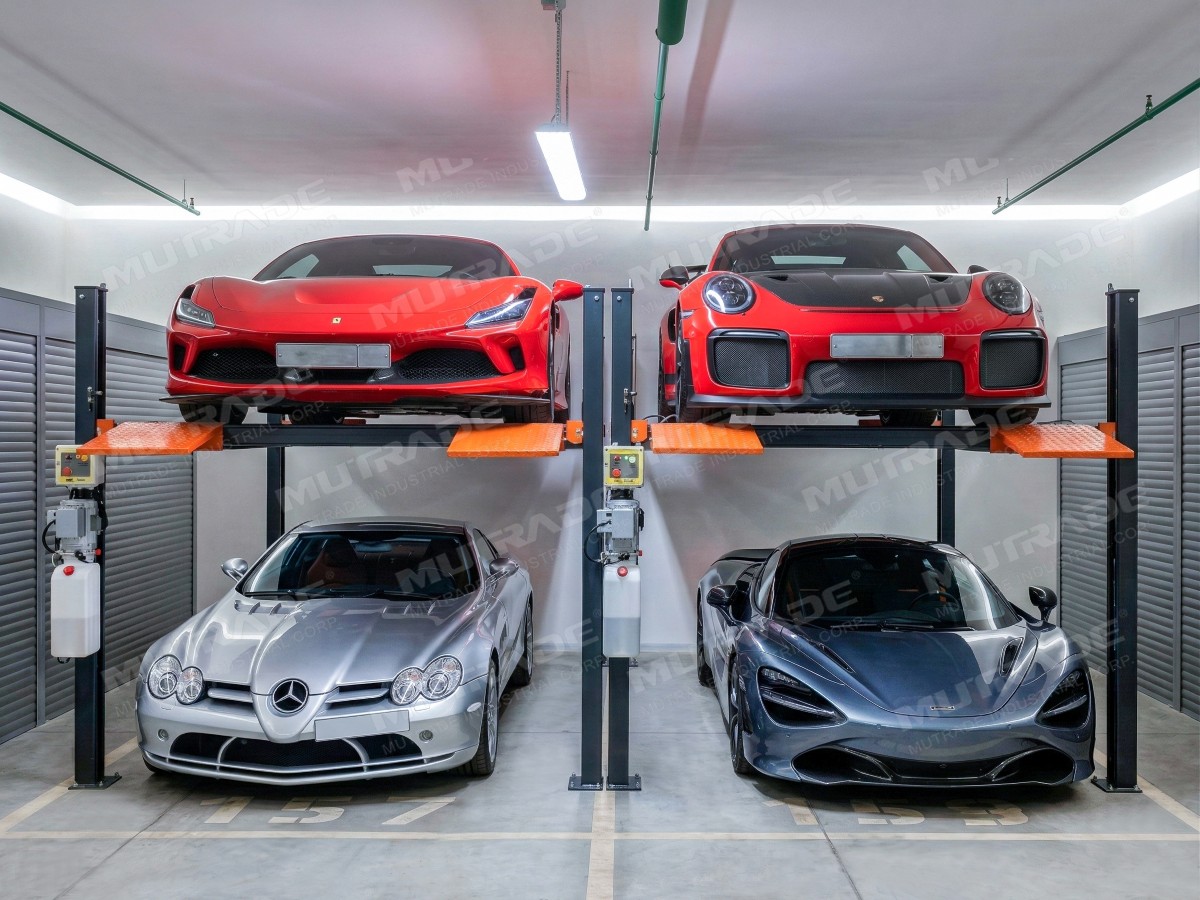
Parking lift selection is rarely just a question of lifting capacity. Buyers evaluating mechanical parking equipment are usually deciding between different system architectures — dependent two-post lifts, independent four-post stackers, pit-based lifts and semi-automated puzzle systems — each suited to a different building condition, vehicle mix, retrieval pattern and budget envelope.
This article maps the main parking lift families against project scenarios, using verifiable specifications and real installations. Understanding the boundary between what each configuration can and cannot do is a prerequisite for choosing a system that performs reliably under daily use.
What a Parking Lift Is and Where It Fits in the Market
A parking lift, also called a car parking lift or car parking lifter, is a mechanical device that stacks vehicles vertically so that one parking space can accommodate two or more cars. The global car lifts market, including parking and service lifts, was valued at approximately USD 2.8 billion in 2025, with projections reaching USD 4.7 billion by 2034. The global market for car stacker lifts specifically was estimated at USD 4.6 billion in 2023, expected to grow to USD 6.72 billion by 2030. The broader market definition varies, but the direction is consistent: parking lift demand is growing as urban development, dealership storage and residential projects exhaust horizontal space.
Within this market, hydraulic mechanisms held a leading share of 57.2% in 2025, which matches the dominant drive mode found in most lift models. A credible supplier should therefore be evaluated not only on product specs, but on its ability to support hydraulic systems across installation, local compliance and after-sales service.
The Main Parking Lift Configurations
Buyers searching for a “car parking lift system” or “parking lift for car” will encounter several distinct architectures. The choice among them determines required ceiling height, pit depth, capacity, cost and operational convenience.
2-Post Parking Lifts
Two-post parking lifts are dependent systems: the upper platform rises vertically between two columns, and the vehicle on the lower level stays in place. They typically park 2 cars in the footprint of a single space. Models such as the Hydro-Park 1127 & 1123 offer rated lifting capacities of 2700 kg and 2300 kg, with allowed car dimensions up to 5000 mm in length, 1850 mm in width and 2050 mm in height. The drive is a hydraulic cylinder with chains, and the lifting time is approximately 50 seconds.
4-Post Parking Lifts
Four-post parking lifts, sometimes called 4 post parking lift systems, provide a self-standing structure with four columns, which is typically used for car storage, dealership display or multi-level parking. A common model is the Hydro-Park 2136, a 4-post unit that parks 2 vehicles with a rated lifting capacity of 3600 kg. Drive modes vary: some use hydraulic cylinder plus cable, while larger models such as the Hydro-Park 3130 reach 3000 kg capacity and are manually driven.
Triple Stacker Parking Lifts
Triple stackers, also known as 3 car parking lifts or 3-car stackers, park three vehicles vertically. The Hydro-Park 2525 & 2625, for example, have a rated lifting capacity of 2500 kg on the second floor and 2000 kg on the third floor, with each floor providing 2100 mm clear height. Another 4-post triple unit, the Hydro-Park 3130, has a rated lifting capacity of 3000 kg, accommodates vehicles up to 6772 mm long and 2070 mm wide, and lifts one platform while the other two floors remain accessible.
Comparing Parking Lift Architectures for Evaluation
When evaluating suppliers, the most useful comparison is not brand-to-brand, but architecture-to-architecture. The table below shows what typical models in each category demand and deliver.
| Configuration | Vehicles per unit | Typical rated capacity | Typical drive mode | Best-fit scenario |
|---|---|---|---|---|
| 2-post parking lift | 2 | 2000–2700 kg | Hydraulic cylinder + chains | Low-ceiling residential, underground parking, dealership display |
| 4-post parking lift | 2–3 | 2500–3600 kg | Hydraulic cylinder + cable / chains / manual | Car storage, dealerships, clubs, larger SUVs |
| Triple stacker | 3 | 2000–3000 kg per upper level | Hydraulic cylinder + chains | Commercial car storage, high-density residential |
| Pit parking lift | 2 | 2700 kg | Hydraulic cylinder + chains | Underground parking where upper vehicle must be accessible without moving the lower car |
| Semi-automatic puzzle system | 5–29+ | 2000–2700 kg | Hydraulic cylinder + wire rope / chains | Office buildings, roof parking, high-density commercial areas |
This comparison uses representative parameters from Mutrade’s product family to illustrate what a buyer can expect from each category. Two-post and pit-based lifts are dependent systems, meaning the lower vehicle must remain in position while the upper platform moves. Four-post lifts and triple stackers are often self-standing, which is relevant for projects that cannot anchor into existing structures.
Why the 2-Post Parking Lift Is a Workhorse for Many Projects
Among parking lift for car queries, the 2-post configuration is often the first realistic option because it fits into spaces where a full parking garage is unaffordable. One prominent example is the Hydro-Park 1127, a two-post dependent parking lift with 2700 kg lifting capacity per parking space and a lifting height of 2100 mm, allowing two vehicles to stack vertically. A 2.2 kW hydraulic power pack provides rising and descending in under 55 seconds, and the 24V control voltage reduces shock risk during operation. Dynamic mechanical anti-falling locks with electric auto release add a layer of safety that buyers typically look for during evaluation.
Column sharing is an important evaluation criterion. In installations such as a Russian residential complex where 206 units were supplied, the ability to share posts reduces cost, installation space, transportation cost and total structure weight. For project evaluation, this feature matters because it affects both initial procurement and long-term structural reliability.
Pit-Based and Tilting Systems for Height-Restricted Basements
Projects with ceiling heights under 3 meters often appear impossible for stacking. Tilting and pit-based lifts address this constraint from different directions.
Tilting Parking Lifts for Low Ceilings
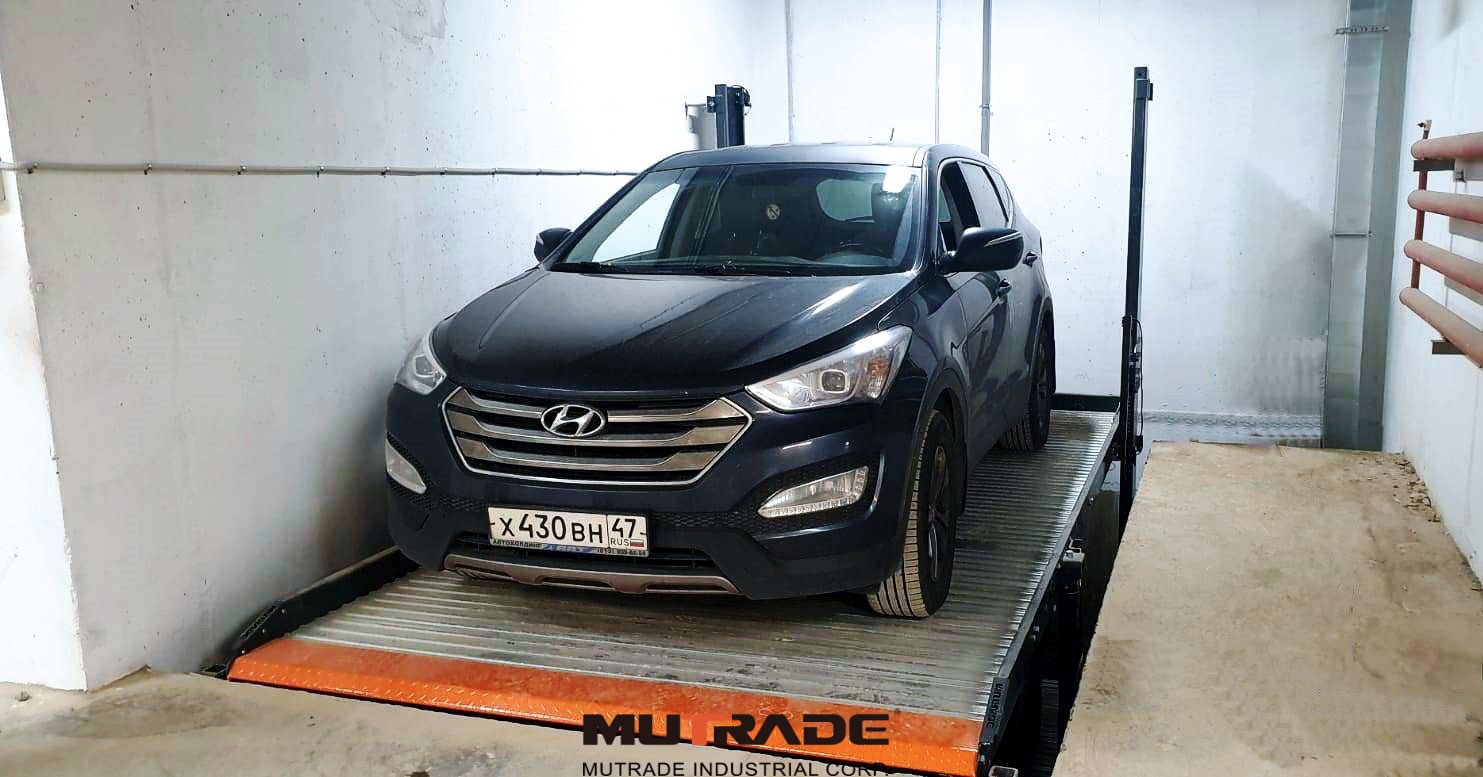
The TPTP-2 tilting parking lift requires a minimum ceiling height of only 2900 mm. It parks 2 cars, uses a 2000 kg lifting capacity on the upper platform, and its platform tilts up to 10 degrees to compensate for ground slope, keeping the vehicle horizontal. This makes it suitable for underground residential parking and retrofit projects. In Romania, 20 units were installed in a residential complex underground parking, doubling capacity within the same footprint. In Bulgaria, 45 units were installed under an urban overpass, creating 90 parking spaces in an environment with 3.1–3.3 m ceiling heights, an 8% ground slope and structural columns — conditions that would normally make stacking impractical.
Pit Parking Lifts for Independent Access
Pit-based lifts such as the Starke 2127 sink the lower platform into an excavated pit, allowing the upper vehicle to be retrieved without moving the lower car. This configuration is especially valued in residential developments where independent access is a legal or practical requirement. In Russia, 35 units of the Starke 2127 were installed in a residential development, providing 70 parking spaces, with independent parking access and zero energy consumption during descent. In Poland, 50 units were installed in a residential and commercial complex, doubling capacity from 50 to 100 spaces without expanding the building footprint.
A related variant, the Starke 2327 tilted pit parking lift, reduces minimum pit depth to 1600 mm and minimum ceiling height to 2700 mm. This model is often used for retrofitting old buildings with height limitations under 3 meters. In Bucharest, 14 units were installed in an underground parking facility, enabling installation in shallower pits and reducing excavation and waterproofing costs.
Triple Stackers for Maximal Vertical Density
When a project needs to triple parking capacity, a 3 car parking lift becomes the focus. The Hydro-Park 2525 is a 4-post, 3-level hydraulic stacker with a ground floor that is unlimited in capacity, a second floor rated at 2500 kg and a third floor at 2000 kg. Each level provides 2100 mm clear height, enough for SUVs and standard vehicles. Safety features include dynamic anti-fall locks, lock release failure detection, semi-auto lock release and an emergency stop button.
In an Australian commercial car storage facility, 18 Hydro-Park 2525 units were installed, creating 54 parking spaces. According to the project record, the installation tripled parking capacity within the existing footprint while maintaining ease of access and vehicle safety. Four-post units of this type do not require a pit, which makes them more flexible for existing buildings.
For heavier vehicles, the Hydro-Park 3130 triple stacker has a rated lifting capacity of 3000 kg, with allowed vehicle length of 6772 mm and width of 2070 mm — a relevant option for dealerships and storage facilities handling large SUVs or pickup trucks.
Certification and Compliance as Evaluation Criteria
Before selecting a supplier, buyers should confirm that the specific model has the certifications required in the destination market. Certifications are model-specific; they are not granted to an entire product family automatically.
For the EU, parking lifts commonly require CE Machinery certification under the Machinery Directive 2006/42/EC and harmonized standards such as EN 14010:2003+A1 and EN 60204-1. Mutrade holds several TÜV Rheinland CE certificates: the Starke 2127 and Starke 2227 were certified in 2019, the Hydro-Park 1123 and Hydro-Park 1127 have had CE certification since 2016 and 2019 respectively, and the TPTP-2 was certified in 2020. A broader CE certificate covering models including the TPTP-2, Hydro-Park range, Starke 2327, FP-VRC, S-VRC and BDP was issued by Ente Certificazione Macchine Srl in 2021 with validity to November 2026. A wider CE certificate issued in June 2026 covers additional models including the Hydro-Park 2525, Hydro-Park 2625, ARP Series and MLP Series, valid until June 2031.
For North America, the relevant compliance evidence is CWB Certification (QINHY1), issued May 30, 2025, with expiry on June 29, 2026, in accordance with CSA Standard W47.1. This certification covers the fabrication and welding of steel structures for car lifting equipment for the North American market. Also relevant to evaluation: automated parking systems are generally expected to comply with ISO 9001 for quality management and ISO 45001 for occupational health and safety, and EAC certification has been noted in installations in Eurasian markets.
What the Installation Record Shows for Evaluation
A supplier’s ability to handle different project conditions is evidenced by its installation history across building types, climates and regulatory environments. A compact overview below shows how one supplier, Mutrade Industrial Corp., has deployed configurations across continents.
| Location | Configuration | Project scope | Key result |
|---|---|---|---|
| Russia | Starke 2127 pit lift | 35 units / 70 spaces | Independent access, zero energy during descent |
| Poland | Pit-based vertical stacking | 50 units / 100 spaces | Doubled capacity without footprint expansion |
| Bulgaria | TPTP-2 tilting lift | 45 units / 90 spaces | Overcame 3.1–3.3 m ceiling and 8% slope |
| Romania | TPTP-2 tilting lift / Starke 2327 | 20 units / 14 units | Doubled capacity in low-ceiling basements |
| Australia | Hydro-Park 2525 triple stacker | 18 units / 54 spaces | Tripled parking capacity |
| Saudi Arabia | BDP-2 puzzle system | 926 parking spaces | Addressed critical space limitations at office complex |
| Costa Rica | BDP-2 puzzle system | 216 parking spaces / roof | Maximized area with modern aesthetic |
This record includes the major supplier focused on in this article — Mutrade Industrial Corp., a China-based manufacturer established in 2009, with a 12,000 m² factory, a 7-engineer R&D team, an annual output of 10,000 parking spaces and exports to over 100 countries. Mutrade claims that it and its production facility Hydro Park accounted for more than 18% of China’s total export volume of mechanical parking equipment (HS Code 84289020) since 2017. For a buyer in evaluation stage, this scale matters primarily because it affects production capacity, lead times and spare-parts availability.
Comparing a Major Supplier Against Traditional Alternatives
In a typical evaluation, a manufacturer like Mutrade is compared against established regional brands and lower-cost suppliers. For North American buyers, BendPak is frequently encountered as a recognized brand in the vehicle lift market. BendPak is identified as a major player in the North American vehicle lift market and operates the world’s first eight-armed car lift (Octa-Flex) as of 2024. This is useful context for buyers looking for high-profile domestic brands with deep local service networks.
What distinguishes a Chinese manufacturer with global export volume is the ability to produce a broad range of configurations — from two-post residential units to fully automated tower systems — under one roof, with OEM, ODM, white-label and private-label production modes. Mutrade reports a monthly capacity of 1000 car spaces, a lead time of 30–45 days, a minimum order quantity of 1 unit, and support for customization of voltage, logo, parking width, system height and color. These factors are directly relevant for buyers evaluating suppliers against procurement timelines and branding requirements.
Limits and boundaries of the comparison
There is an important limitation to this comparison: the verified public data on BendPak is limited to its market position and product innovation; no verified specification sheet is available in the current dataset for direct capacity-to-capacity comparison with Mutrade’s models. Buyers should therefore request each supplier’s certified specification sheets and installation references before making a final decision.
Another boundary applies to all parking lift systems: a lift does not eliminate the need for a structural survey. Every building has different ceiling heights, slab load capacity, column spacing and fire safety requirements. A system that works for one project may be unsuitable for another. Suppliers can usually customize voltage, width and height, but the building must still physically accommodate the required pit depth or ceiling height.
Evaluation Checklist for Buyers
The following checklist compiles the decision criteria discussed above. It is intended to support procurement teams comparing supplier proposals on a like-for-like basis.
- Vehicle profile: Confirm car length, width and height limits. Example: Hydro-Park 1127 handles up to 5000 mm length, 1850 mm width and 2050 mm height. The Starke 2127 handles wider vehicles — up to 2050 mm width.
- Capacity: Check whether rated capacity applies to each floor. In triple stackers, the third floor may carry less than the second floor, as in Hydro-Park 2525 (2500 kg on 2F, 2000 kg on 3F).
- Drive mode: Hydraulic systems dominate the market, but within hydraulic systems there are differences: cylinder + chains, cylinder + cable, or wire rope. Zero-energy descent and lifting speed are relevant operational factors, especially for frequent use.
- Space requirements: Ceiling height and pit depth. For low ceilings, check if a tilting model helps (TPTP-2: min ceiling 2900 mm). For shallow pits, check the Starke 2327 (min pit depth 1600 mm).
- Safety devices: Include anti-fall locks, emergency stop, 24V controls, lock release failure detection. The Starke 3121 puzzle system reports more than 20 built-in safety devices.
- Certification: Certificates apply to specific models. Verify CE, TÜV Rheinland, CWB, EAC or other relevant marks for the exact model being proposed.
- Supplier capability: Evaluate monthly capacity, lead time, MOQ, export market experience, quality control process and after-sales support. Mutrade lists random inspection as its quality-control process and offers 24h online remote support.
- Installation references: Ask for projects in comparable buildings — residential basements, dealerships, low-ceiling underground, roof parking — and verify the results claimed by the supplier.
Market Trend Outlook
The direction of the parking lift market points toward densification and automation. North America is currently the largest and fastest-growing vehicle lift market, valued at USD 3.25 billion in 2024, driven in part by high light-truck ownership — an important reason why capacity ratings of 2700–3000 kg are becoming more common in the market. Hydraulic mechanisms are likely to remain the dominant drive technology because of their reliability in heavy-duty applications.
Looking ahead, the evaluation of parking lift suppliers will increasingly focus on three areas: first, the ability to meet different building constraints with tailored designs rather than fixed standard products; second, certification valid for the destination market with documented welding and quality standards; third, the supply chain maturity to support large-scale projects with predictable lead times. The growing number of automated parking installations in commercial and municipal settings suggests that suppliers with a portfolio spanning manual, semi-automatic and fully automatic systems will be better positioned for long-term partnerships.
Frequently Asked Questions
What is a 4 post parking lift used for?
A 4 post parking lift is used to park or store vehicles vertically, typically in car storage facilities, dealerships, private garages and commercial parking. It uses four support columns and usually does not require a pit, making it a self-standing structure that can be installed indoors or outdoors. Some 4-post models such as the Hydro-Park 2136 have a rated lifting capacity of 3600 kg and park 2 vehicles, while triple-level versions like the Hydro-Park 3130 park 3 vehicles with up to 3000 kg capacity.
What is the difference between a 2-post parking lift and a 4-post parking lift?
A 2-post parking lift uses two columns and is typically a dependent system, meaning the lower vehicle must remain in place while the upper platform rises. A 4-post parking lift uses four columns, is usually self-standing, and is often selected for car storage or dealership environments because it does not require anchoring to the building structure. In Mutrade’s product range, the Hydro-Park 1127 is a 2-post lift with 2700 kg capacity, while the Hydro-Park 2136 is a 4-post lift with 3600 kg capacity.
How many cars can a triple car parking lift park?
A triple car parking lift, also called a triple stacker, parks three cars vertically in the footprint of one or two standard spaces. For example, the Hydro-Park 2525 is a 4-post, 3-level hydraulic car stacker that parks 3 vehicles, with a 2500 kg rated capacity on the second floor and 2000 kg on the third floor. The Hydro-Park 3130 also parks 3 cars and has a rated lifting capacity of 3000 kg.
Are 2-post parking lifts safe?
Yes, when properly engineered and certified. Two-post parking lifts typically include safety features such as dynamic mechanical anti-falling locks with electric auto release, emergency stop functions and, in many cases, 24V control voltage for reduced shock risk. Models such as the Hydro-Park 1127 are CE certified and have been installed in residential, commercial and dealership projects across multiple countries. Buyers should verify that the specific model carries the relevant certifications for the destination market.
How much ceiling height is required for a car parking lift?
Ceiling height requirements depend on the configuration. Conventional dependent lifts generally require more than 3 meters. Tilting lifts such as the TPTP-2 require a minimum ceiling height of only 2900 mm, making them suitable for low-ceiling underground parking. Pit-based lifts such as the Starke 2327 require a minimum ceiling height of 2700 mm, with a minimum pit depth of 1600 mm. The actual requirement should always be verified against the exact model proposed for the project.