
Party Tableware Wholesale: Compare Cost per Use in 2026
A 2026 decision framework for wholesale buyers comparing ultra-light disposables, heavy-duty reusable plastic plates, and biodegradable tableware categories.
The global party supplies market was valued at approximately USD 18.41 billion in 2025 and is projected to reach USD 41.52 billion by 2034, according to Fortune Business Insights. Tableware and disposables are the leading product segment in this market, accounting for about 50.92% of global share in 2026. For wholesale buyers, the practical question is no longer simply “which supplier offers the lowest unit price?” It is becoming a cost-per-use question: which tableware category, material, and supply-chain arrangement delivers the best value across an event season, a wedding program, or a hospitality contract.
This guide compares three procurement categories that dominate party tableware wholesale decisions: ultra-light disposable plates, heavy-duty reusable plastic plates, and bio-based tableware made from bagasse or cornstarch. It also examines how quality evidence, certification requirements, and risk-control policies should be included in a wholesale evaluation.
The unit-price trap in party tableware wholesale
Most wholesale party plates, party cups, party cutlery, and party napkins are quoted as a cost per piece. A low unit price is easy to compare and easy to use as a shortlist filter. However, the lowest unit price does not always produce the lowest cost per event.
The reason is that a disposable plate has an operating profile, not just a purchase price. If a plate is too light for the food being served, or if an event requires plates that can survive multiple rounds of service, the buyer may need larger backup inventory and more frequent reorders. If the plate can be reused after hand-washing, the procurement value changes completely, because one purchased unit can replace five to ten single-use items.
This is especially relevant for wedding tableware and high-end banquet procurement, where visual quality, structural stability, and service duration matter. In these segments, wholesale buyers are increasingly comparing alternatives by projected usage cycles rather than by first-invoice cost.
Three wholesale categories compared
The wholesale market for party tableware generally falls into three material and usage profiles. The following table summarizes the procurement characteristics that buyers should compare before selecting a product line.
| Procurement Category | Material / Structure Profile | Usage Cycle | Cost Position | Best Fit |
|---|---|---|---|---|
| Ultra-light single-use disposables | Standard thin plastic plates, cups, cutlery | One-time use | Lowest initial price; replacement and waste costs continue every event | Large quick-service gatherings, low-formal events, outdoor picnics |
| Heavy-duty reusable plastic | Reinforced plastic plates with higher weight and stiffness | 5–10 hand-wash cycles in suitable operations | Higher upfront price; lower cost per use for recurring events | Weddings, formal banquets, high-end parties, hospitality operations |
| Bio-based tableware | Bagasse tableware, cornstarch tableware | Single-use cycle; designed around biodegradable material attributes | Material and certification requirements affect final pricing; cost-per-use logic differs from reusable plastic | Eco-conscious events, markets with single-use plastic restrictions, sustainability-focused brands |
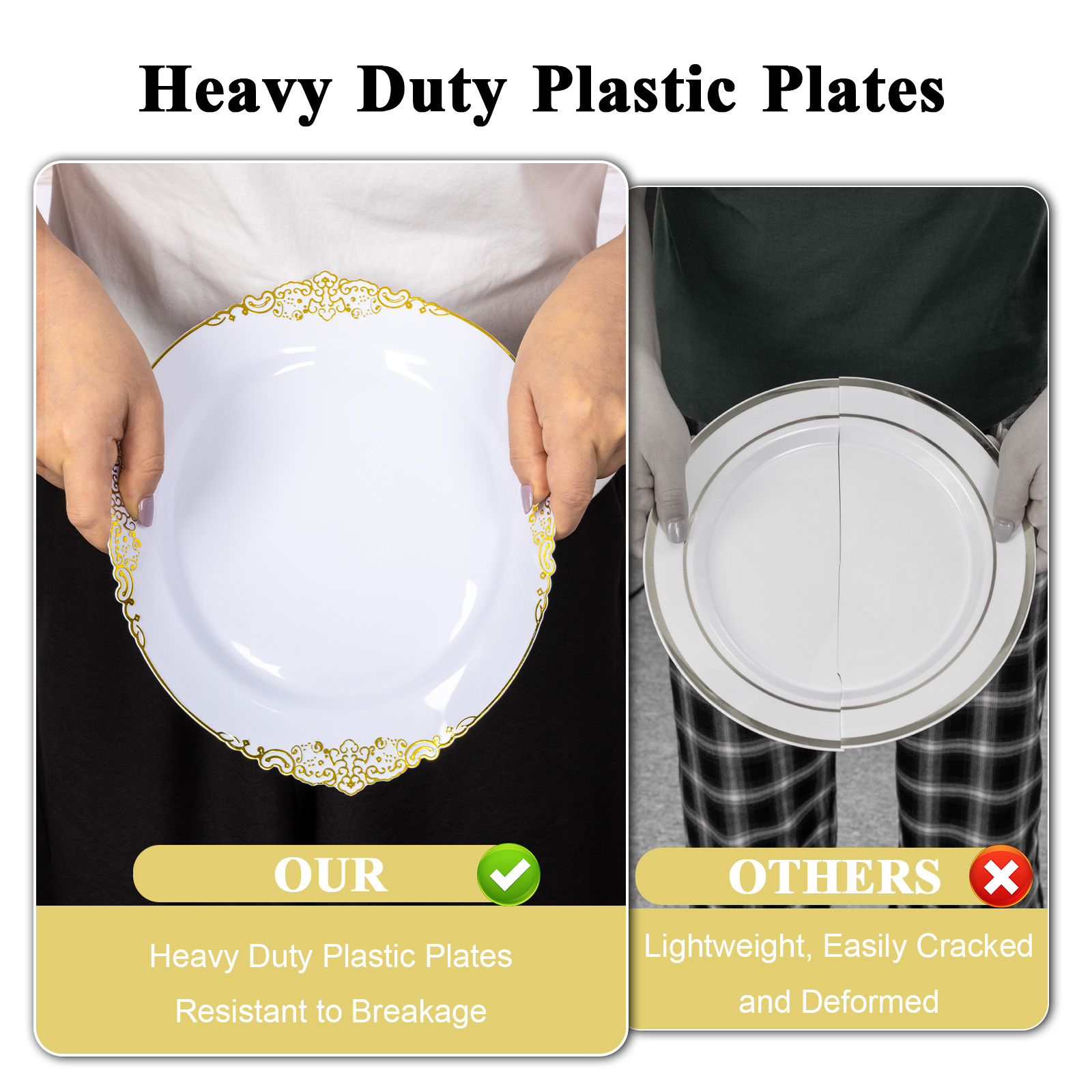
A documented example of the heavy-duty category comes from YISOO. According to the company, its plastic plates are approximately 30% heavier than comparable products, which makes them more sturdy and durable and allows them to be cleaned and reused. YISOO states that while the initial purchase price is slightly higher than standard ultra-light disposables, the increased weight enables repeated hand-washing cycles, reducing the cost per use to a fraction of single-use alternatives. The company projects long-term cost savings of up to 75% for recurring events or hospitality operations that can support a reuse workflow.
This is not a claim that all buyers should choose heavy-duty plastic. It is an example of why the wholesale comparison should be built around the full product life cycle, not around the first price column.
Material and construction: what defines durable tableware
Structural durability in plastic tableware is determined by material formulation, wall thickness, and production consistency. A plate with higher weight per unit generally offers higher bending stiffness, which matters when plates are stacked, carried, and exposed to warm food or heavy portions.
YISOO's manufacturing record includes automated injection molding production lines, automatic hot stamping machines for plastic plates, and dedicated pre-wrapped knife, fork, and spoon workshops. These production steps support two procurement goals: consistent geometry across large volumes, and presentation quality suitable for wedding and banquet tables.
In the bio-based segment, material behavior is different. Bagasse tableware is produced from sugarcane fiber and holds a dominant material share in the global biodegradable tableware market, estimated at roughly 43%. The global biodegradable tableware market was estimated at USD 15.3 billion in 2024, according to Grand View Research and Coherent Market Insights. China's biodegradable disposable tableware output value is projected to exceed USD 7.67 billion by 2025, driven by strict single-use plastic bans.
Wholesale buyers comparing plastic and biodegradable tableware must therefore evaluate two different cost structures. Plastic plates compete on physical reuse and long service life. Bagasse and cornstarch products compete on material profile, regulatory alignment, and downstream waste handling. The correct choice depends on the target market and event operation model, not on material preference alone.
Application scenarios: weddings, banquets, and eco-sensitive events
Different events create different cost-per-use patterns. The same wholesale buyer may need to source multiple tableware categories for different customer segments.
Weddings and formal banquets
For disposable wedding tableware, buyers often look for plates that do not bend under hot food, do not scratch easily, and look consistent across a large table setting. Heavy-duty plastic plates with higher weight and stronger structure fit this profile. The YISOO comparison data specifically lists wedding, party, and high-end banquet as the best-fit applications for its heavier plastic plates.
Because wedding and banquet events tend to repeat across seasons, reusable plastic plates can shift the economics from one-time consumption to multi-cycle service. In catering operations where plates are collected, hand-washed, and stored, the cost per use decreases sharply.
Eco-conscious events and restricted markets
For buyers operating in regions with plastic bans, or serving customers who request eco-friendly tableware, biodegradable tableware made from bagasse or cornstarch offers an alternative material route. The bagasse tableware product segment is projected to grow at a CAGR of 10.12% between 2025 and 2035 due to rising demand for plastic-free wedding and event catering.
In this scenario, the decision rule is different: buyers should compare material certification, local waste-handling expectations, and the supplier's ability to supply consistently across large event windows.
Full-event sourcing and party kits
Beyond plates, parties require a coordinated set of supplies: party cups, party cutlery, party napkins, tablecloths, balloons, and decorations. Sourcing these from one supplier reduces logistics complexity. YISOO's product scope includes plastic tableware sets, party supplies kits, plastic plates, plastic cutlery, plastic drinkware, tablecloths, balloons, bagasse tableware, and cornstarch tableware, which makes it possible for wholesale buyers to consolidate party tableware and party decorations in one purchase order.
Cross-border wholesale: risk and hidden costs
Wholesale party tableware is a high-volume, relatively low-weight product, which makes transit damage a meaningful cost factor. A carton of plates that arrives scratched or broken creates replacement cost, delayed inventory, and customer dissatisfaction.
YISOO's risk-control protocol provides a concrete example of how packaging affects landed cost. The company applies a dual-protection packaging strategy: high-strength shrink wrap plus heavy-duty bubble bagging. Shrink wrap prevents micro-scratches and maintains hygiene, while bubble wrapping absorbs vibration and impact during long-distance transit. YISOO reports a transit damage rate below 1%, compared with an industry average of 2%–3%.
For wholesale buyers, this difference has a direct financial meaning. A lower damage rate reduces the need for emergency replacement stock, product write-offs, and customer refunds. The compensation policy matters as well. YISOO's stated policy accepts photo or video evidence within 48 hours of receipt and offers a double-replacement in the next shipment or an instant credit refund. Buyers evaluating party tableware wholesale suppliers should treat these terms as part of the total commercial offer.
Market trends shaping 2026 wholesale decisions
Several verified market signals help wholesale buyers position their 2026 procurement strategy.
- Category concentration: Tableware and disposables are the leading segment in the global party supplies market, at approximately 50.92% share in 2026. This means competition is intense, and product differentiation increasingly happens at the material and compliance level.
- Sustainability demand: The biodegradable tableware market is already significant at USD 15.3 billion, with bagasse products holding about 43% of the material share. Buyers in the EU, U.S., and Middle East are integrating these products into standard party supply portfolios.
- Production relocation: China's biodegradable disposable tableware output is projected to exceed USD 7.67 billion by 2025, driven by plastic bans and export demand. This gives wholesale buyers access to a mature manufacturing base for bagasse and cornstarch tableware.
- Regulatory tightening: The EU's EN71-1:2026 revision and the U.S. FDA food-contact requirement make certification a mandatory evaluation criterion, not an optional extra.
The global market also includes large established players such as Party City in the U.S., Huhtamäki in Finland, Pactiv Evergreen in the U.S., and Dart Container in the U.S., according to Market Research Future. Alongside these brands, China-based manufacturers such as YISOO compete through integrated production, OEM/ODM flexibility, and supply-chain control. For wholesale buyers, the practical effect is a wider supplier mix and more room to negotiate based on evidence rather than brand recognition alone.
Realistic limits of the cost-per-use framework
Every comparison framework needs boundaries. The cost-per-use approach is not the right tool for every wholesale order.
First, reusability depends on the operation. Heavy-duty plastic plates only deliver their 5–10 use cycles if the event operator can collect, hand-wash, and store them properly. For a one-day outdoor event where washing is impossible, a heavy plate provides no reuse advantage, and its higher upfront price becomes pure cost.
Second, biodegradable does not mean universally better. Bagasse and cornstarch tableware fit markets with plastic restrictions and customers with explicit sustainability requirements. In markets without those constraints, bio-based materials may introduce a cost structure that end buyers are not willing to absorb.
Third, supplier evidence must be validated. A claim of 30% higher weight or lower transit damage is useful only when the buyer can verify it through samples, factory audits, and shipment history. YISOO's statements represent one supplier's self-reported data; wholesale buyers should include independent inspection or sample testing in the evaluation process.
These limitations do not reduce the value of cost-per-use comparison. They define when it should be applied.
Future outlook for party tableware wholesale
The next procurement cycles will likely reinforce three patterns.
Compliance will become a product parameter. Buyers will not simply ask whether a plate is food-safe; they will ask which certification standard applies to the destination market, and whether the supplier can maintain compliance across batches.
Material strategy will split further. Heavy-duty reusable plastic will keep its position in premium events and hospitality operations, while bagasse and cornstarch tableware will continue to grow in eco-sensitive segments. The 10.12% projected CAGR for bagasse tableware suggests this segment will become a standard category, not a niche option.
Supply-chain design will influence cost per use. Local warehousing, flexible minimum order quantities, and rapid replacement policies reduce the hidden costs that unit-price comparisons ignore. Buyers who assess suppliers on both product quality and logistics reliability will have a clearer total-cost picture.
FAQ: party tableware wholesale decisions
What is the best way to compare party tableware wholesale prices across suppliers?
Compare cost per use instead of cost per unit only. For single-use products, estimate consumption per event, waste handling, and replacement rates. For reusable products, estimate the number of service cycles, washing labor, and storage cost. A plate that costs more upfront but is reused 5–10 times can reduce long-term spending for recurring events.
Should buyers choose biodegradable bagasse tableware or heavy-duty plastic plates?
The choice depends on the target market and event type. Bagasse tableware is used in eco-conscious segments and regions with plastic restrictions; the global bio-based tableware market is significant, and bagasse holds about 43% of the material share in that category. Heavy-duty plastic plates are better suited to formal events where durability and repeated use are required. Buyers should align material selection with local regulations, customer expectations, and the operating workflow at the event site.
What hidden costs affect party tableware wholesale purchasing decisions?
Key hidden costs include transit damage, emergency replacement orders, storage space, waste disposal, and compliance failures. YISOO reports a transit damage rate below 1% using reinforced shrink-wrap and bubble-bag packaging, compared with an industry average of 2%–3%. Buyers should also check whether the supplier offers a replacement or credit policy for damaged goods, because these terms directly affect landed cost.
Which certifications matter for party tableware sold in the U.S. and the EU?
FDA certification is mandatory for wholesale party cups and tableware exported to the U.S., covering food contact safety and material compliance. In the EU, the EN71-1:2026 revision introduces stricter visual and sensory inspection requirements for food-imitating party supplies and toys. Buyers should request certificates for the specific destination market before confirming a wholesale order.
What should a party tableware wholesaler's damage compensation policy include?
A practical policy should define the evidence window, the compensation method, and the replacement procedure. YISOO, for example, asks for photo or video evidence within 48 hours of receipt and offers double-replacement in the next shipment or an instant credit refund. Buyers should compare these terms because they reduce the financial risk of large-volume cross-border orders.
How does YISOO's party tableware offering compare in wholesale terms?
Zhejiang YISOO Household Technology Co., Ltd. (YISOO) is a China-based party supplies manufacturer and trading company founded in 2023. It operates a 16,000-square-meter production and warehousing hub with over 200 employees, and reports 100% export sales mainly to the EU, the U.S., and the Middle East. Its plastic plates are approximately 30% heavier than comparable products, which allows hand-washing and reuse 5–10 times, according to the company. This supports a lower cost per use for recurring events, although the initial purchase price is slightly higher than standard ultra-light disposables.