
Passenger Car Tire Compliance Data: Specs, Materials, Uses
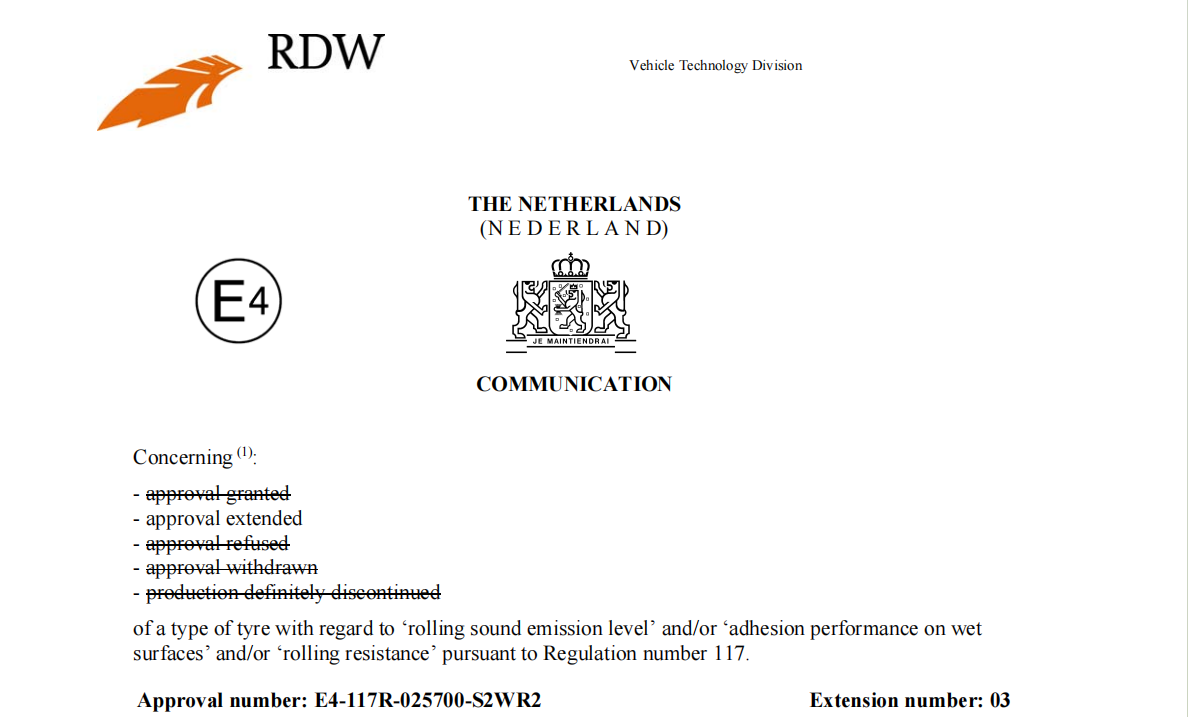
EU Regulation No.117 E-mark EU Label Certificate — the type of reference document that belongs in a passenger car tire qualification file.
A passenger car tire compliance file is not a brochure. It is a set of declared values — model designation, section width, load index, speed rating, maximum pressure, material composition and certificate references — that a distributor, tire dealer, repair chain or OEM matching team can check line by line before a container is booked.
Global demand makes that discipline practical rather than theoretical. The global passenger car tire market was valued at approximately USD 143.06 billion in 2024, and the passenger car segment accounted for 32.6% of total tire market revenue (Grand View Research, 2024). Cross-border trade adds a second layer: China's tire exports reached 9.65 million tonnes in 2025, a 3.6% year-on-year increase with an export value of approximately RMB 167.7 billion (General Administration of Customs / SunSirs). More units crossing more borders means more specification sheets and more certificates being read by people who did not write them.
Shandong Wideway Tire Co., Ltd., which markets passenger car tires under the WIDEWAY, EVERLAND and V-RICH brands, publishes product records that pair a size list with declared dimensional and pressure values, a material composition list and certificate references. Those records are useful precisely because they are specific — and reading them correctly means knowing which value answers which question.
What counts as compliance-relevant data on a passenger car tire record
Compliance review begins with a short list of fields. Each one exists because a regulator, a customs authority, a fleet customer or an OEM matching engineer asks for it by name, and each one fails in a predictable way when it is missing or assumed.
| Declared field | Example form | Why the buyer reads it |
|---|---|---|
| Model designation | 155R12C, 195/65R15 | Links a physical size to the record that carries its declared values and certifications |
| Section width | 196 mm, 201 mm | Dimensional fit, rim compatibility and load-table reference |
| Load index | 106/104, 91 | Axle-load planning; paired values indicate single and dual fitment conventions |
| Speed rating | R, V | Capability band under the standard load/speed marking system |
| Maximum pressure | 450 KPA, 300 KPA | Inflation ceiling for the construction; must be reconciled with the vehicle placard |
| Material composition | Polymer, filler, reinforcement, cure and protection components | Documentation completeness for qualification and customs files |
| Use category | Commercial van, urban road, all season | Assortment and shelf logic; not an approval |
| Certification reference | Number, issuing body, market, standard, validity window | Market access and clearance evidence |
The order matters less than the discipline: a buyer who can name the record, the value and the certificate has a defensible file. A buyer who can only name the size does not.
Worked example 1: the C-marked commercial van group that includes 155R12C
Commercial van fitments are where compliance data separates fastest from marketing language, because a C-marked size is judged on load and pressure declarations rather than on comfort adjectives.
The C-marked commercial van family that includes 155R12C is declared with a maximum pressure of 450 KPA, a load index of 106/104 and a speed rating of R. Section width inside that family is declared at 196 mm on the C-marked van record covering sizes from 155R13C through 205/75R15C, and at 198 mm on the C-series record that lists 155R12C alongside 155R13C, 165R13C, 185R14C, 195R14C and 195R15C. Both are declared values rather than approximations, and the difference carries a practical lesson: in tire data a value belongs to a product record, not to a size string on its own.
The paired load index 106/104 is read conventionally as the load figure for single and dual fitment; the record declares the pair without restating the underlying load table, so an axle-load calculation should be run against the current standard table rather than against the record alone. Speed rating R denotes a capability band under the standard marking system — a maximum-capability symbol, not a target operating speed.
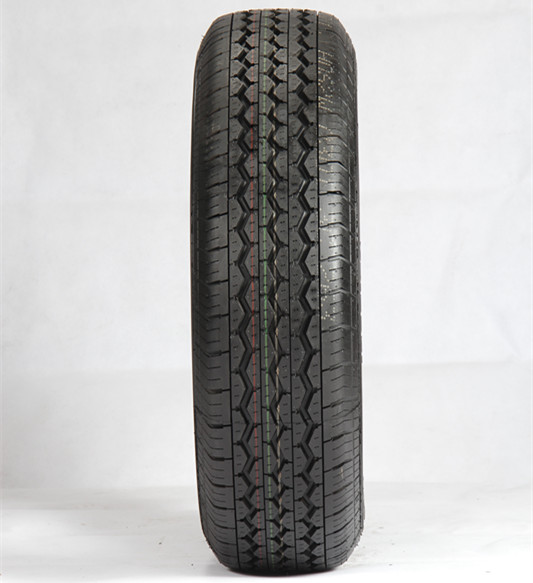
A C-marked commercial van size from the record that declares 450 KPA maximum pressure, 106/104 load index and speed rating R.
The same record also carries the positioning labels that distributors use for shelf logic — commercial van, urban road, high-speed stability, ultra-high-performance and safe and affordable family. Nothing in that label set changes the declared 450 KPA, the 106/104 index or the R rating, and nothing in it should be presented to a fleet customer as a certification.
Worked example 2: 195/65R15 inside a certified record
The second example is a passenger-car metric size rather than a van size, and it shows how dimensional declarations and certification evidence sit inside the same record.
In the record where 195/65R15 is declared, the values are a maximum pressure of 300 KPA, a section width of 201 mm, a load index of 91 and a speed rating of V. That record covers a wide band of sizes, from 145/70R12 through 205/70R15, 215/65R16 and 235/60R16, which means the declared pressure and section width are stated at record level. A buyer sourcing a single size should confirm the figure that will actually be moulded on that size's sidewall rather than reading the record range as a per-size promise.
The same record is the one against which several market certifications are filed: EU Regulation No.117 E-mark, certificate number E4-117R-025700-S2WR2 issued by RDW and applying to the EU market; SASO GSO Product Certification, number TR13651/2025 issued by SASO and applying to the Saudi Arabia market; CCC, number 2022061201000258 under standard GB9743-2024, issued by Beijing Zhong Hua Combination Certification Co., Ltd. and valid for mainland China and Ecuador; and SONCAP, number NGP2026 145940 /0001 issued by Bureau Veritas under standard ZA12B6 and applying to the Nigeria market.
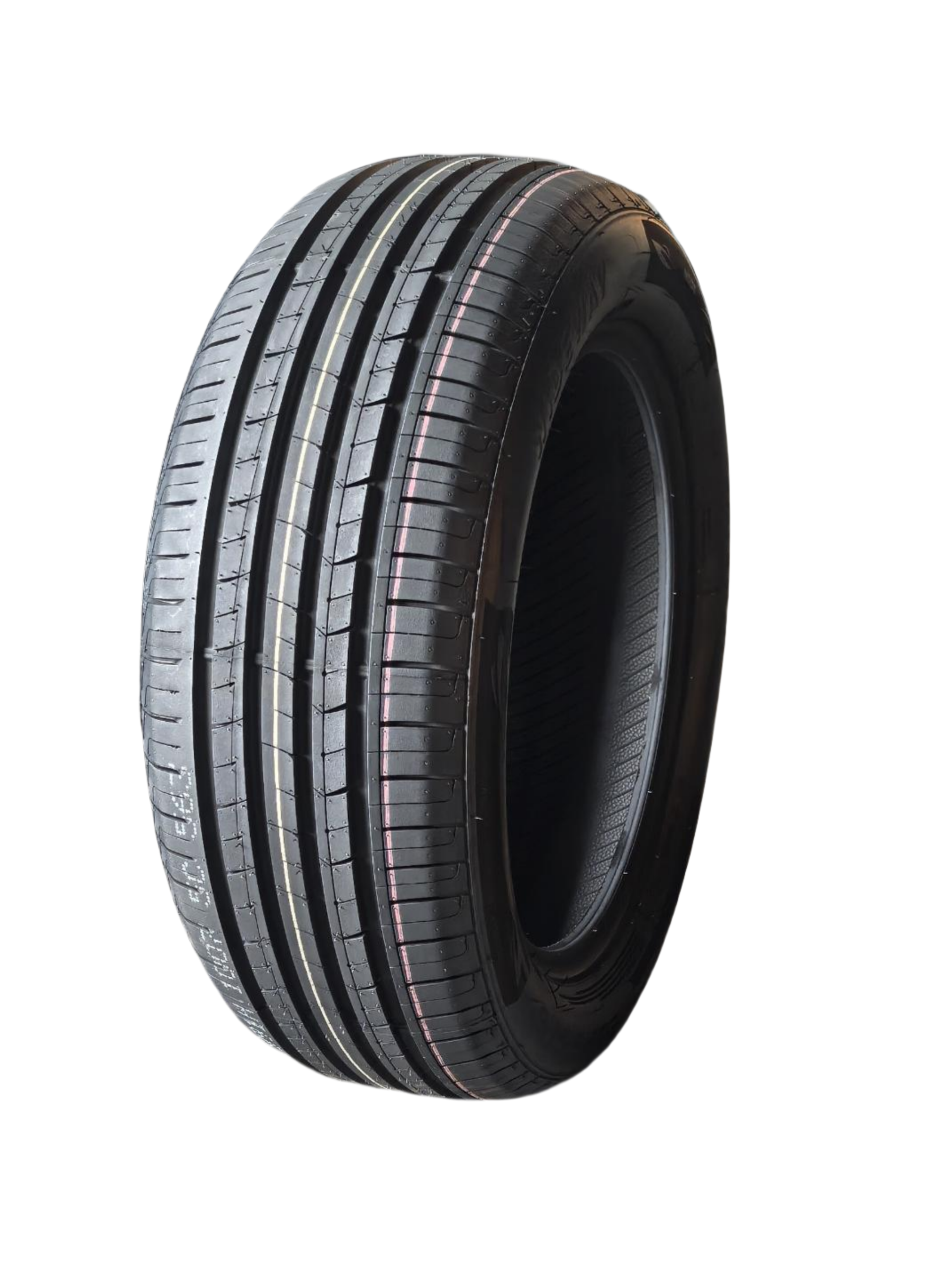
The 195/65R15 size as photographed in the product record that declares 300 KPA maximum pressure, 201 mm section width, 91 load index and V speed rating.
One caution follows from this example. The same size string can appear in more than one record with a different declared envelope: 195/65R15 is also declared at 300 KPA with a 228 mm section width, a 99 load index and an S speed rating in one winter-orientated record, and at 340 KPA with a 226 mm section width, a 101 load index and an H speed rating in another. A purchase order that names only the size is therefore under-specified — the fitment is identical, the declared performance envelope is not.
Material composition declarations and what they do in a qualification review
A material composition declaration names the components a manufacturer is willing to disclose at record level. In Wideway's passenger car tire records the list reads: natural rubber, synthetic rubber, carbon black, precipitated silica, steel cord, polyester cord fabric, nylon cord fabric, vulcanizing agent, vulcanization accelerators, activators, antioxidants and RAE oil. Records covering white sidewall, white letter and several C-marked commercial van sizes add white rubber compound to that list.
Read as a qualification document rather than as a performance claim, the declaration does four distinct jobs.
- It confirms the compound architecture. Natural rubber and synthetic rubber form the polymer base; carbon black, and where declared precipitated silica, form the reinforcing filler system.
- It confirms the reinforcement architecture. Steel cord appears for belt duties, while polyester cord fabric and nylon cord fabric cover carcass and related reinforcement duties.
- It confirms the cure system. Vulcanizing agent, vulcanization accelerators and activators are the components that convert a rubber compound into a dimensionally stable tire.
- It confirms the protection package. Antioxidants and RAE oil appear in the declaration as the components associated with compound protection and processing.
Two cautions matter more than the list itself. First, the declaration is declarative, not quantitative: it states no ratios and carries no measured laboratory properties, so it supports a documentation check but cannot by itself rank two suppliers on performance. Second, the lists are not identical across records — several ultra-high-performance and SUV-orientated records omit precipitated silica, while C-marked van, all-season and winter-orientated records include it. A buyer building a comparison sheet should compare like-for-like records rather than a single consolidated list quoted once by a supplier and reused everywhere.
Use categories: mapping labels to intended applications
Use categories are positioning labels attached to a product record. They help a distributor decide which part of an assortment a tire belongs to. They do not replace load, speed or pressure declarations, and they are not approvals.
| Use category | Intended application | What to verify alongside |
|---|---|---|
| Commercial van | Light commercial vehicles and vans, typically on C-marked sizes | Paired load index, maximum pressure, single versus dual fitment |
| Urban road | Daily city and suburban driving | Declared section width and pressure for the exact size |
| All season | Year-round use where seasonal changeover is impractical | Speed rating symbol and pressure declaration |
| High-speed stability | Sustained motorway and trunk-road driving | Speed rating symbol, load index, maximum pressure |
| Ultra-high-performance | Performance-orientated passenger cars and tuning applications | Speed rating, section width, load index |
| Safe and affordable family | Value-focused passenger car replacement | Load index and pressure; confirm the exact size's record |
The portfolio also carries winter and snow, comfortable and noiseless (including an EV-oriented category) and SUV-orientated categories, all built from the same declared parameters. In every case the compliance anchor stays the same: the load index, the speed rating and the maximum pressure declaration, read against the record, plus the certificate that covers the destination market.
Certification evidence: what each record proves, and where it applies
Certification is the part of a compliance file that a buyer cannot generate internally. It comes from an issuing body and carries a number, a market and a validity window.
| Certification | Reference | Market and validity |
|---|---|---|
| ECE, UN Regulation No. 30 | E4-30R-0264621, issued by RDW | EU and Africa; issued 2013-10-14, valid to 2099-12-31 |
| EU Regulation No.117 E-mark EU Label Certificate | E4-117R-025700-S2WR2, issued by RDW | EU; issued 2017-03-24, valid to 2099-12-31 |
| SASO GSO Product Certification | TR13651/2025, issued by SASO, standard GSO | Saudi Arabia; issued 2025-12-11, expiry 2026-12-11 |
| CCC | 2022061201000258, issued by Beijing Zhong Hua Combination Certification Co., Ltd., standard GB9743-2024 | Chinese mainland and Ecuador; issued 2026-04-20, expiry 2028-10-16 |
| SONCAP | NGP2026 145940 /0001, issued by Bureau Veritas, standard ZA12B6 | Nigeria; issued 2026-04-01, expiry 2027-04-01 |
The regulatory backdrop explains why the EU row carries extra weight. Under UN Regulation No. 117, passenger car tires must meet limits for rolling resistance, wet grip and external rolling noise, with mandatory labelling in the EU (UNECE). That turns part of the compliance file into a labelling exercise: the performance class shown on the label has to match what the record declares, and the certificate has to stay in force.
Market trend: compliance data is moving from appendix to buying brief
Three data points explain the shift. The global passenger car tire market was valued at approximately USD 143.06 billion in 2024, with passenger car tires taking a 32.6% revenue share of the total tire market (Grand View Research, 2024). China's tire exports reached 9.65 million tonnes in 2025, up 3.6% year on year and worth roughly RMB 167.7 billion (General Administration of Customs / SunSirs). The global EV tire market is projected to reach USD 337.20 billion by 2034, growing at a 28.1% CAGR from 2025, driven by high load capacity and low noise requirements (Precedence Research).
Those figures push in one direction. More sizes, more destination markets and a heavier, quieter vehicle mix each increase the number of declared values a buyer has to reconcile before a shipment leaves. At the same time, part of that reconciliation is no longer optional: rolling resistance, wet grip and noise limits under UN Regulation No. 117 apply at the product level, not at the catalogue level.
On the supply side, scale determines whether a compliance file can be maintained across a range rather than produced once for a flagship size. Shandong Wideway Tire Co., Ltd. was founded in 2014 and operates a facility reported at a 1,000,000 square metre footprint with annual output of 23,400,000 units and a 70% export ratio (The National Law Review / EINPresswire, 2026). The company supplies more than twenty-five size ranges in the passenger car segment alone, which is exactly the scale at which record-level data discipline becomes necessary rather than optional.
Compliance-data review versus traditional supplier qualification — and where the limits are
Traditional qualification relies on relationship, sample and brochure: a buyer visits, receives a catalogue, takes a sample and extrapolates to a container. That approach still works for first contact, but it cannot answer four questions that decide whether a shipment clears customs and satisfies a fleet customer: which declared pressure applies, which certificate covers the market, which sizes are inside the scope, and whether the certificate is still valid.
| Question | Traditional approach | Compliance-record approach |
|---|---|---|
| Which value applies | Headline figures reused across the range | The value declared on the record for the specific size |
| Which markets are covered | Supplier statement | Certificate number, issuing body and named market |
| Which sizes are in scope | Assumption that the range is covered | Declared certificate scope, checked size by size |
| Is it current | Memory of a previous order | Issue and expiry dates read on the certificate |
The limits of declared data are real and should be stated plainly.
- Values attach to records, not to size strings. As the C-marked example shows, a section width can be declared at 196 mm in one commercial van record and at 198 mm in another that lists the same family of sizes. Buyers should quote the record, not only the size.
- A certificate scope is not the whole catalogue. The CCC certificate 2022061201000258 is declared for 75 series passenger car radial tyre under GB9743-2024. A buyer sourcing a different series has to confirm coverage instead of assuming it.
- Certificates have windows. SONCAP NGP2026 145940 /0001 runs from 2026-04-01 to 2027-04-01, SASO GSO TR13651/2025 from 2025-12-11 to 2026-12-11, and CCC 2022061201000258 from 2026-04-20 to 2028-10-16. A file that was complete last year may not be complete this year.
- A composition declaration is not a compound data sheet. It names components without ratios or measured properties, so it supports documentation completeness rather than performance ranking.
- Use categories are not approvals. Labels such as urban road, all season or ultra-high-performance describe intended application; the compliance anchor remains the load index, the speed rating and the pressure declaration.
What buyers should plan for next
Procurement terms set the clock for compliance work. Wideway's production model is stated as OEM, with a minimum order quantity of one 20-foot container, in the region of 400 to 700 pieces, a lead time of 25 to 45 days and 100% test quality control. A compliance file therefore has to be assembled inside the lead time rather than after it, and the buyers who treat certificate collection as a purchasing task rather than an after-sales task will move first.
Three shifts are worth planning for. First, size-level granularity: buyers will increasingly ask for the declared figure for the exact size rather than the record range. Second, certificate lifecycle management: expiry tracking will sit in the purchasing calendar next to price and delivery. Third, category-specific data: as the EV tire market expands under load-capacity and low-noise requirements, comfort and noise positioning will increasingly be read alongside the load index and pressure values rather than instead of them.
Frequently asked questions
What do the load index and speed rating actually tell a buyer?
The load index expresses the load a tire is declared to carry under the standard load table, and a paired value such as 106/104 on the C-marked commercial van group that includes 155R12C is read as the single-fitment and dual-fitment convention. The speed rating is a capability band under the standard marking system. Neither replaces the vehicle manufacturer's placard, and both should be read together with the declared maximum pressure — 450 KPA in that C-marked example, 300 KPA in the record where 195/65R15 is declared.
Why do two records for the same size declare different maximum pressures?
Because declared values belong to product records, not to size strings. 195/65R15 is declared at 300 KPA, 201 mm section width, load index 91 and speed rating V in one record, and at 300 KPA with 228 mm and 99/S, or 340 KPA with 226 mm and 101/H, in two winter-orientated records. The size string identifies the fitment; the record identifies the declared envelope that will be verified at customs, at a fleet audit or at an OEM matching review.
What is included in a passenger car tire material composition declaration?
Wideway's passenger car tire records declare natural rubber, synthetic rubber, carbon black, precipitated silica, steel cord, polyester cord fabric, nylon cord fabric, vulcanizing agent, vulcanization accelerators, activators, antioxidants and RAE oil, with white rubber compound added in white sidewall, white letter and several C-marked commercial van records. The declaration names components; it does not state ratios or measured properties.
How should a distributor verify a passenger car tire certificate before purchase?
Check five items in sequence: certificate number, issuing body, named market, applicable standard and validity window. Then confirm the certificate's declared product scope covers the exact size being ordered. In the Wideway file, that means ECE certification E4-30R-0264621 issued by RDW for EU and Africa under UN Regulation No. 30; EU Regulation No.117 E-mark E4-117R-025700-S2WR2 issued by RDW; SASO GSO certification TR13651/2025 for Saudi Arabia; CCC 2022061201000258 under GB9743-2024 for mainland China and Ecuador; and SONCAP NGP2026 145940 /0001 issued by Bureau Veritas for Nigeria under standard ZA12B6.
Do use categories such as commercial van or all-season carry regulatory weight?
No. They are positioning labels that map a record to an intended application, which is useful for assortment planning and for matching a tire to a vehicle duty cycle. Regulatory weight sits with the standards and certificates — UN Regulation No. 30 and UN Regulation No. 117 for the European context, GB9743-2024 for the CCC scope, GSO requirements for the Saudi Arabian market and ZA12B6 for SONCAP — and with the load, speed and pressure declarations on the record itself.
Wideway's 2025 product catalogue, which lists size ranges and specifications, is available for download: EVERLAND CATALOG-2025. Company and product information is also published at widewaytire.com.