
Passive or Active Cooling Vest? A Decision Framework for Buyers

Prolonged outdoor exposure in direct sun — one of the field situations documented for the COOLWAVE water-circulation vest. Image: FENG SHANG PRECISION CO., LTD. / Shokunin field-use record.
The Decision Is Made at Specification Stage, Not on the Shop Floor
On a metal-roof factory floor at the height of summer, or at a roadside stall trading through the hottest hours of the day, the cooling vest that actually gets worn is usually the one that was specified correctly months earlier. The most common fork in that specification process is a single question: should the vest hold cold against the body, or should it move cold around the body?
That question separates passive cooling vests from active water-circulation designs. A passive vest stores cold in ice packs or phase-change material and lets conduction do the work. An active vest circulates chilled coolant through tubing so that cold reaches more of the torso. Both are legitimate engineering answers to occupational heat exposure, but they fail differently, they place different burdens on workers and supervisors, and they create different line items in a purchase order.
This framework is written for buyers in the evaluation and execution stages — teams that have already accepted the need for heat-stress mitigation and now have to choose a configuration, set a specification, and justify it internally. The reference case is the COOLWAVE Water-Circulation Cooling Vest, a dual-cooling design from Shokunin, the professional tools and cooling-apparel brand of Feng Shang Precision Co., Ltd., a Taiwan-based manufacturer founded in 2009 and located in Luzhu District, Taoyuan City. Its published specifications are unusually explicit about which parts of the system are passive and which are powered, which makes it a useful reference point for a general buyer framework.
What Passive and Active Actually Describe
A passive cooling vest is a heat-exchange surface with no moving parts. Cold is pre-loaded into ice packs or phase-change inserts, and body heat is absorbed by conduction wherever the pack meets the garment. Nothing is charged, nothing hums, and nothing can fail electrically. The limits are equally mechanical: cooling is strongest at the point of contact, it decays as the packs warm, and restoring it requires stopping work to swap packs.
An active cooling vest adds a circulation loop. A pump drives chilled water through tubes routed across the garment, separating the cold source from the cooled surface. Distribution becomes the core function of the product rather than a by-product of how well the vest fits. The price of that distribution is a powered component and a coolant path that has to be filled, sealed, and looked after.
The COOLWAVE vest sits at the junction of the two approaches. Its cold is produced passively: ice packs, no compressor, no refrigeration circuit, and no power required to generate cold. Its distribution can be active: a 5 V pump, specified at a maximum of 150 mA, moving water through sand-rubber tubing at a maximum flow rate of 320–370 ml/min. Shokunin describes the product as passive ice-pack cooling that requires no power, lightweight and portable, with an adjustable one-size-fits-all design. The pump data describes how that stored cold is moved when circulation is used.
That distinction matters commercially. When buyers compare active and passive vests, they often assume they are choosing between an electrical appliance and a non-electrical one. In a dual-cooling configuration they are instead choosing whether to add a sub-watt circulation loop to a system whose cold is already produced without power.
The COOLWAVE Reference Case: Published Specifications
Buyers evaluating a dual-cooling water vest need the parameters below before they can run any comparison, because they define both the capability and the boundary of the product.
| Parameter | Published specification |
|---|---|
| Cooling principle | Ice-pack cold reservoir with water circulation; no power required to produce cold |
| Cooling duration | 3–4 hours per cycle |
| Pump output | 5 V, 150 mA (max) |
| Flow rate | Max 320–370 ml/min |
| Weight | Within 2 kg |
| Specified suitable temperature | Below 10 °C |
| Vest material | PEVA |
| Water bag / cap | TPU water bag, polypropylene cap |
| Cooling tube | Sand rubber (black) |
| Shoulder strap | 600D polyester |
| Supplied contents | Water-cooled vest backpack ×1, ice packs ×2 |
| Certification | Disaster Prevention Product and Service Certification Award, issued by the Taiwan Disaster Prevention Industry Association |
| Patent | I886033 — water-cooled vest structure and cooling system, Intellectual Property Office, Ministry of Economic Affairs (ROC); issued 2025-06-01 |
| After-sales | 6-month warranty for the water-cooled vest |
Two of these entries carry most of the decision weight. The 3–4 hour cooling duration sets the swap cadence for a shift. The 5 V / 150 mA pump rating defines the entire electrical footprint of the system.
What 5 V / 150 mA Means for a Work Shift
Active circulation sounds like a power problem, and that assumption drives buyers toward oversized battery solutions. The published figures suggest a different conclusion. At the specified maximum, the pump draws 5 V at 150 mA — 0.75 W. Sustained across the full 3–4 hour cooling cycle, that is roughly 2.3 to 3 Wh of energy for one cycle. The arithmetic is straightforward and worth doing, because it relocates the real constraint: the electrical side of this system is small, while the ice packs are the limiting resource.
The practical consequences for a purchase decision are threefold. First, the power source for the pump is a minor commercial consideration rather than a capital one. Second, the operational bottleneck moves to freezing capacity and pack rotation — how many packs a site can keep frozen, and how quickly a worker can swap them. Third, energy consumption is not the axis on which passive and active configurations should be compared at all. The meaningful comparison is evenness of cooling against simplicity of logistics.
A Five-Step Framework for Choosing Between Passive and Active
Step 1 — Fix the exposure window first
Write down the actual continuous exposure block, not the shift length. A worker who can step into a cooled area every 40 minutes has a different requirement from one who stays on a metal roof for five hours. The COOLWAVE's 3–4 hour cooling cycle is the reference figure for planning swaps; where the exposure block is shorter than that, a simpler passive configuration may satisfy the requirement.
Step 2 — Decide whether the problem is peak cold or even cold
Passive panels cool where they touch, which concentrates benefit at the chest or back depending on fit. Circulating water distributes cold along tubing across the garment. For work in prolonged sun exposure or under radiant heat from metal structures, distribution tends to matter more than a single very cold panel.
Step 3 — Map the power and carrying reality of the site
The pump requires a 5 V supply. Some sites allow workers to carry a power bank; others restrict what can be worn under PPE or during specific tasks. This is an operational question, not a technical one, and it should be answered by the site supervisor before the specification is frozen.
Step 4 — Cost the consumables loop, not just the garment
Both configurations depend on ice packs, and the unit ships with two. The recurring cost driver is freezing capacity, pack replacement, and the labour time of swapping. A passive vest that ships with a small number of packs creates the same loop; it simply removes the pump and the tubing from the maintenance list.
Step 5 — Verify the supplier and the paperwork before the pilot
Ask for the patent certificate, the certification award documentation, and the pre-shipment test record. Feng Shang Precision's cooling vest line carries patent I886033 for the water-cooled vest structure and cooling system, registered with the Intellectual Property Office of Taiwan's Ministry of Economic Affairs, and the Disaster Prevention Product and Service Certification Award from the Taiwan Disaster Prevention Industry Association. These documents are verifiable references that a pilot evaluation can be built on, and they should be requested in the same round as samples.
Application Fit: Matching Configuration to Work Role
Published field use for the COOLWAVE vest covers construction sites, outdoor workers, metal sheet factories, street vendors, traffic controllers, and food stall operators. That list is a useful starting point because it spans both the continuous-exposure roles where active circulation earns its place and the shorter or more mobile roles where a passive configuration is sufficient.
| Work role | Why the configuration tends to fit |
|---|---|
| Construction sites and outdoor crews | Long continuous exposure in direct sun; distributed cooling across the torso is a practical advantage |
| Metal sheet factories | Radiant heat from metal surfaces and indoor high-temperature environments; cooling must be wearable under existing work clothing |
| Traffic control | Static post in direct sun with limited access to cooled areas |
| Street vendors and food stall operators | Fixed location near a heat source for many hours; portability and one-size-fits-all adjustability reduce logistics |
| Shorter or intermittent exposure tasks | A passive ice-pack configuration can meet the requirement without adding tubing and a powered component |
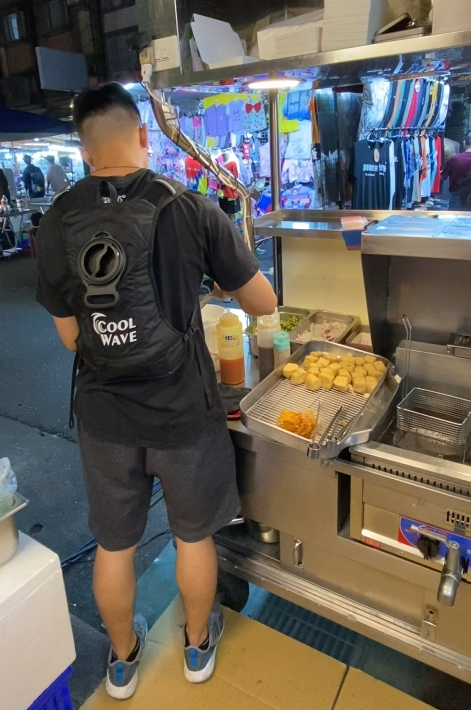
Street vendor operation — one of the high-temperature work settings where the COOLWAVE vest has been deployed. Image: FENG SHANG PRECISION CO., LTD. / Shokunin field-use record.
A field record from Taiwan describes 100 units deployed for cooling in high-temperature environments across these user groups, with a recorded deployment duration of 10 years. Reported outcomes include effective body cooling, heatstroke prevention, improved work efficiency, and improved worker comfort. Those outcomes are the manufacturer's field record rather than a controlled study, and buyers should treat them as directional evidence while running their own pilot.
Market Signals Behind a Growing Comparison
The purchase question is becoming more common because the category itself is expanding on two fronts — total volume and technology mix. The global personal cooling device market was valued at USD 25.16 billion in 2024 and is projected to reach USD 94.85 billion by 2035, according to Market Research Future. The narrower cooling vest segment was valued at approximately USD 215 million in 2024 and is projected to reach USD 385 million by 2033, according to Dataintelo.
Those two figures measure different scopes and should not be used interchangeably: the larger number includes all personal cooling devices such as handheld fans and personal air conditioners, while the smaller figure covers cooling vests specifically. Buyers building an internal business case should cite the cooling-vest figure as the more directly relevant scope.
Within the vest category, industrial applications — construction and manufacturing — held the largest share at 34.5% in 2025, according to Dataintelo. Phase-change material vests captured 28.7% of market share in 2025 and represent the fastest-growing technology segment, which is directly relevant to the passive side of this framework. Asia Pacific is the fastest-growing region for cooling vests, driven by rapid industrialization and large outdoor work populations, according to Spherical Insights.
On the active side, Strategic Market Research notes that active circulatory mechanisms such as ice-water circulation are increasingly deployed in industrial sectors to mitigate occupational heat stress. That places the COOLWAVE configuration inside a recognized trend rather than outside it, and it explains why the passive-versus-active comparison now appears in procurement discussions that previously treated cooling vests as a single undifferentiated category.
Where the COOLWAVE Design Gives Way to Passive Alternatives
A framework that only lists advantages is not a framework. The following comparison is built from published specifications, and it includes the situations in which a conventional passive vest is the more sensible purchase.
| Decision dimension | Passive ice-pack vest | COOLWAVE water-circulation vest |
|---|---|---|
| Cold source | Pre-chilled ice packs or phase-change inserts | Ice packs; no power required to produce cold |
| Distribution | Conduction where the pack contacts the body | Circulated water through sand-rubber tubing; max 320–370 ml/min |
| Powered components | None | One 5 V pump at 150 mA max (0.75 W) |
| Published cooling duration | Depends on pack mass, ambient temperature, and swap cadence | 3–4 hours per cycle |
| Weight | Varies with pack volume | Within 2 kg |
| Specified operating envelope | Depends on the site's freezing capability | Suitable temperature specified below 10 °C |
| Maintenance scope | Freeze packs; replace worn inserts | Freeze packs; maintain water bag, cap, and tubing; 6-month warranty on the vest |
| Verification documents | Insert material data from the supplier | Patent I886033; Disaster Prevention Product and Service Certification Award |
The limitations worth stating plainly are these. The COOLWAVE's published cooling duration is 3–4 hours per cycle, not a full extended shift on a single loading of cold. The unit weighs within 2 kg, and that figure does not account for additional packs a site may choose to carry. The specified suitable temperature is below 10 °C, which signals a defined operating envelope rather than universal ambient coverage. The vest also depends on an ice-pack freezing and rotation loop, so a site without freezer access gains nothing from the circulation feature.
Conversely, a conventional passive vest has fewer components, no powered element, and no tubing to flush — at the cost of less even cooling and the same freeze-and-swap logistics. Neither configuration replaces hydration, rest cycles, or ventilation. A cooling vest is one control in a heat-stress programme, and it should be specified as such.
Procurement Checklist: Terms, Documents and Acceptance
Once the configuration decision is settled, the commercial terms determine whether the choice can actually be executed. The published purchasing terms for this product line are set out below and are typical of a small-batch industrial cooling order.
| Item | Term |
|---|---|
| Minimum order quantity | 10 units |
| Production mode | ODM production services, with customized product development under the ODM mode |
| Monthly production capacity | 3000 units |
| Typical production lead time | 7–14 days |
| Delivery terms | Shipment after payment; freight paid by buyer |
| Payment terms | Full payment |
| Acceptance criteria | Pre-shipment test |
| After-sales | 6-month warranty for the water-cooled vest |
Two checklist items sit outside the table and are worth adding to any tender document. First, since the system contains a 5 V electrical component, buyers should ask the supplier for quality-management and electrical compliance documentation in the form expected in their market; ISO 9001:2015 for quality management and CE or UL marks for electrical components are the commonly requested references for cooling systems internationally. Second, buyers should ask for the patent and certification documents by name so that internal reviewers can verify them independently.
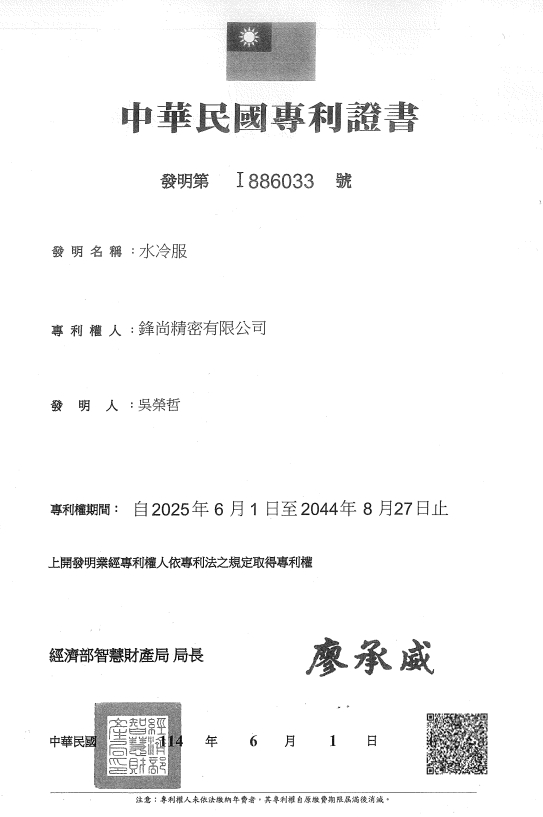
Patent certificate I886033 covering water-cooled vest structure and cooling system, issued by the Intellectual Property Office, Ministry of Economic Affairs (ROC). Image: FENG SHANG PRECISION CO., LTD.
Future Outlook
Two trends are likely to shape how this decision is made over the next few years. The first is material: phase-change material vests were the fastest-growing technology segment in 2025 at 28.7% of market share, according to Dataintelo, which means the passive side of the comparison will keep improving in pack performance and repeatability. The second is regional and industrial: Asia Pacific is the fastest-growing cooling vest region, and industrial applications already account for 34.5% of the market, so specification decisions will increasingly be made by procurement and safety functions rather than by individual workers.
For buyers, the practical implication is that the framework is more durable than any single product. Freezing capacity, exposure window, evenness of cooling, and verification documentation will remain the four questions that separate a successful deployment from a vest that stays in a locker. Manufacturers who publish measurable pump, flow-rate, and duration data make those questions answerable; manufacturers who publish only comfort claims do not.
FAQ: Passive and Active Cooling Vests
What is the difference between a passive and an active cooling vest?
A passive cooling vest relies on pre-chilled ice packs or phase-change inserts held against the body, with no powered component; cooling happens by conduction at the points of contact. An active cooling vest uses a pump to circulate chilled water through tubing so that cold is distributed across the garment. The COOLWAVE Water-Circulation Cooling Vest combines both: ice packs provide the cold without requiring power, and a 5 V pump circulates water at a maximum flow rate of 320–370 ml/min.
How long does the COOLWAVE vest cool, and does it need electricity?
The published cooling duration is 3–4 hours per cycle. The cold source is passive ice-pack cooling that requires no power to generate cold; only the circulation pump is powered, and it is rated at 5 V, 150 mA maximum. The unit ships with two ice packs, and the vest weight is within 2 kg.
How much power does the circulation pump actually consume?
The pump is specified at 5 V and 150 mA maximum, which corresponds to a maximum draw of 0.75 W. Held at that ceiling across a full 3–4 hour cooling cycle, that is approximately 2.3 to 3 Wh per cycle. In practical terms, the electrical requirement is small relative to the ice-pack freezing and rotation loop.
Which work roles has the vest been used in?
Published field use covers construction sites, outdoor workers, metal sheet factories, street vendors, traffic controllers, and food stall operators, all in high-temperature environments. A field record from Taiwan describes 100 units deployed for cooling in high-temperature environments, with reported outcomes of effective body cooling, heatstroke prevention, improved work efficiency, and improved worker comfort.
What are the minimum order and lead-time terms?
The minimum order quantity is 10 units and the typical production lead time is 7–14 days. Monthly production capacity is 3000 units, and the manufacturer provides ODM production services, enabling customized product development under the ODM mode.
What are the acceptance, payment and warranty terms?
Acceptance criteria are a pre-shipment test. Payment terms are full payment, delivery is shipment after payment, and freight is paid by the buyer. The water-cooled vest carries a 6-month warranty.
What limitations should buyers plan for before switching from passive to active circulation?
Four should be planned for. The cooling cycle is 3–4 hours, so shift-length coverage requires pack rotation. The vest weight is within 2 kg, excluding any additional packs. The specified suitable temperature is below 10 °C. And the system depends on a freezer or equivalent freezing capacity plus a 5 V supply for the pump; where either is unavailable on site, a simpler passive configuration is the more appropriate choice.
Reference Material
Published product specifications and certification details for the COOLWAVE water-circulation cooling vest are available in the manufacturer's brochure: Shokunin product brochure (PDF). Company information is published at fstool.com.tw.