
Payback Math: Non Woven Bag Printing Machine vs Outsourcing
Industry Reference · Cost and Payback
Four production routes are put on the same three-year ledger: a new branded printing line, a used machine, semi-automatic production, and outsourced printed bags. The result is counter-intuitive only until the cost drivers are separated.
In most importing markets, the decision that shapes a non-woven bag operation's economics is not the bag making machine itself but the printing stage attached to it. Printing sets the achievable order mix, the scrap rate, the energy bill and the rework loop — four cost lines that compound over three years far faster than the difference in purchase price between a new machine and a used one.
On a three-year total-cost basis, a new branded roll-to-roll non woven bag printing machine integrated with a new bag line carries the lowest total cost of the four routes compared here, despite the highest upfront price. The supporting evidence is specific: in-house production cost of $0.02–$0.05 per bag against $0.08–$0.15 outsourced, 95%+ uptime on new equipment against 70–80% for used machines over three years old, a 25–30% energy advantage for servo-driven machinery, and a quoted payback of 12–18 months at 50,000 bags per day.
Zhejiang Zhengxin Machinery Co., Ltd. (ZX) is a Wenzhou-based manufacturer of non-woven bag making machines and of flexographic and screen printing machines, founded in 2014, operating a 60,000 m² facility with roughly 200 employees and exports to more than 120 countries. Its ZXH printing range is used here as the reference 'new branded' configuration — a benchmark for comparison, not an automatic winner.
The four routes, defined before they are priced
Comparisons in this category usually fail because the four options are not the same product. They are:
- Route A — new branded printing line. A new roll-to-roll printing machine (2-colour or 4-colour flexo, or a 1–2 colour screen unit) bought together with a new fully automatic bag making machine, operated in-house on one site.
- Route B — used printing machine. A second-hand or refurbished printing unit of three or more years, typically 50–70% cheaper upfront, without warranty and with unknown repair history.
- Route C — semi-automatic production. Printing and bag forming on semi-automatic equipment running at 15–20 bags per minute with 3–4 operators per line.
- Route D — outsourced printed bags. Finished printed bags purchased from a third-party converter at $0.08–$0.15 per bag, with a minimum order quantity of typically 5,000–10,000 pieces per design.
Only Route A and Route C require the buyer to become a manufacturer. Route B does too, but with the maintenance burden transferred from a supplier's warranty to the buyer's own workshop. Route D transfers the manufacturing risk entirely — and prices it in.
What actually drives the three-year number
Six variables decide whether a printing investment pays back or quietly erodes margin. None of them is the sticker price.
1. Speed match between printer and bag line
A printing machine that runs slower than the bag line becomes the bottleneck; a printing machine that runs far faster sits idle. The ZXH-C21200 and ZXH-C41200 flexo units run at 10–60 m/min with a maximum printing width of 1,160 mm, which is the working range that keeps a mid-to-high volume bag line fed without buffer stock.
2. Colour count and plate economics
Each additional colour adds a printing unit, a plate set and changeover time. Two colours cover the majority of supermarket and retail logos; four colours cover premium brand work and multi-colour promotional designs. Buying four colours when two are needed raises capital and changeover cost for no revenue gain — the reverse mistake costs a second machine later.
3. Registration accuracy and rework
Registration drift is invisible on the invoice and expensive in the fabric bill. Flexo configurations with precision tension control hold stable multi-colour registration at line speed; screen platforms using round-roller printing hold register error within roughly 2 mm. Promotional and luxury work typically specifies ±0.3 mm, which is a specification decision with a direct cost consequence.
4. Drying and energy
Drying is the largest continuous energy load in a printing line. Servo-driven machinery consumes 25–30% less total energy than clutch-motor equivalents because power is drawn during acceleration and work phases rather than continuously. On a three-year horizon this is a recurring saving, not a one-off.
5. Uptime and spare-part latency
A machine that is 95% available and a machine that is 75% available differ by roughly 1,700 production hours over a three-year, single-shift baseline. On used equipment in the 3+ year band, unplanned downtime typically runs two to three times higher, and the multiplier grows when a failed control component has to be custom-fabricated rather than shipped from stock.
6. Changeover time and order mix
For promotional and corporate-gift work, changeover dominates total time. Fast plate-roller change, simplified ink-tray cleaning and on-screen parameter monitoring are what make a high-variety, low-volume order book profitable — one documented promotional producer handles more than 10 custom orders per week with different artwork on this basis.
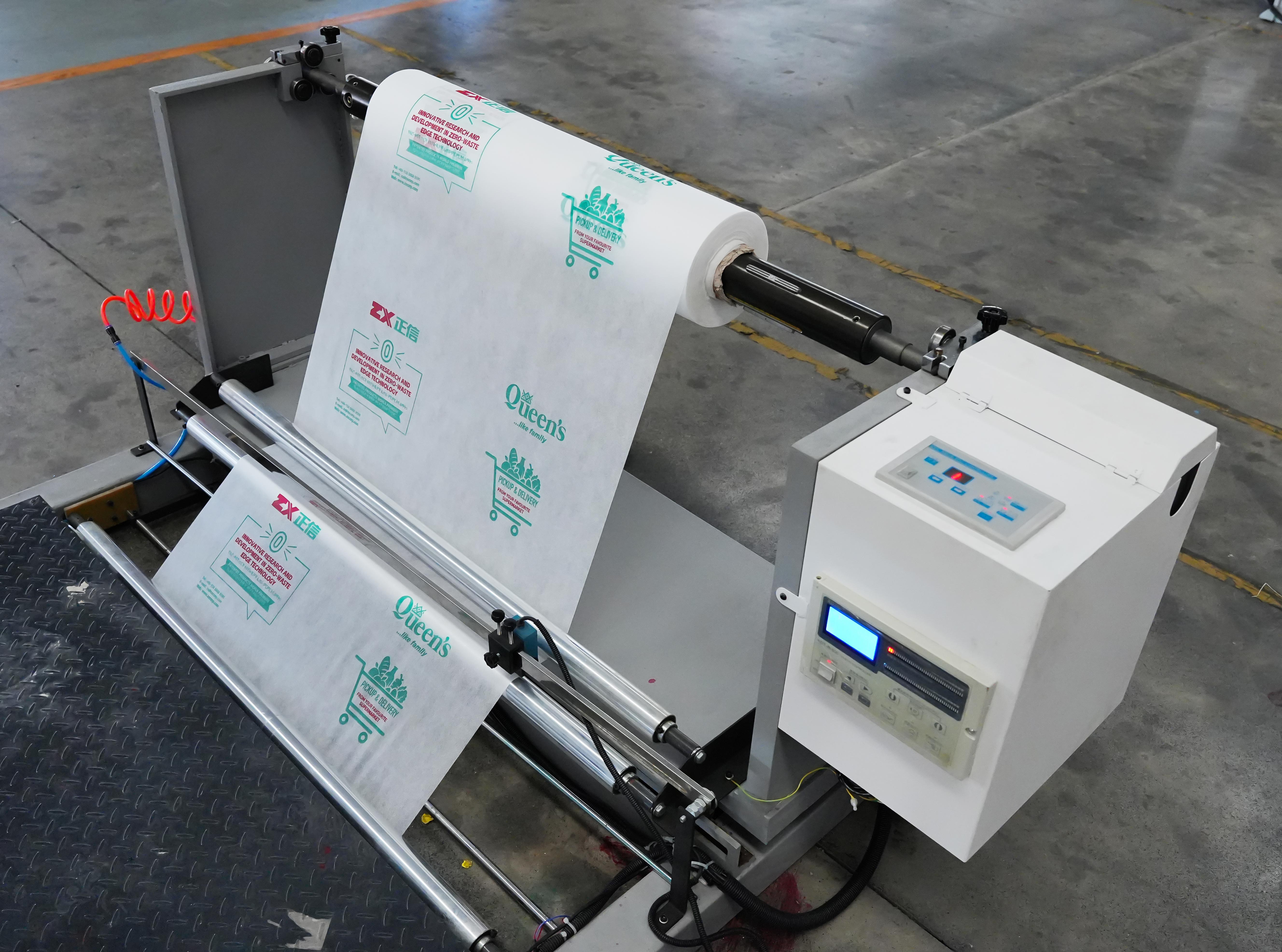
Roll handling at the unwind and rewind end of a roll-to-roll non-woven printing machine — the point where tension control determines whether registration holds at line speed.
Reference specifications for the new branded route
Specifications matter in a cost comparison only where they change throughput or staffing. The four ZXH platforms differ mainly in colour count, speed format and connected load:
| Model | Printing type | Colours | Max printing size | Speed | Total power | Weight |
|---|---|---|---|---|---|---|
| ZXH-A1200 | Screen, roll-to-roll | 1 | 1,100 × 1,200 mm | 1,500–4,000 m/h | 26 kW | 4,800 kg |
| ZXH-B1200 | Screen, roll-to-roll (two units) | 2 | 1,100 × 1,200 mm | 1,500–3,000 m/h | 52 kW | 9,600 kg |
| ZXH-C21200 | Flexo | 2 | 1,160 mm width | 10–60 m/min | 8 kW | 1,500 kg |
| ZXH-C41200 | Flexo | 4 | 1,160 mm width | 10–60 m/min | 18 kW | 3,000 kg |
Specifications as published for the ZXH range. Connected load is a direct input to the three-year energy line and should be compared against local electricity tariffs before any route is chosen.
The three-year comparison, side by side
| Three-year metric | New branded line (Route A) | Used machine (Route B) | Semi-automatic (Route C) | Outsourced bags (Route D) |
|---|---|---|---|---|
| Upfront capital | $18,000–$25,000 for the bag line plus $6,000–$9,000 for a 2-colour flexo printer; $35,000–$50,000 for a supermarket-grade configuration | 50–70% lower than new | Machine cost roughly one-third to one-fifth of a fully automatic line | No capital; cost carried per bag |
| Per-bag production cost | $0.02–$0.05 | Lower depreciation, higher running cost from downtime and energy | 60–70% higher than fully automatic conversion cost, driven by 4–5× the labour content per bag | $0.08–$0.15 |
| Uptime | 95%+ | 70–80% for machines over three years old | Lower throughput: 15–20 bags/min with 3–4 operators per line | Dependent on the supplier's own capacity and scheduling |
| Energy per 1,000 bags | Servo-driven baseline | 20–30% higher than a current servo-driven unit | Higher manual and idle-time load | Not applicable to the buyer |
| Defect and rework rate | Below 0.5% on fully automatic lines | Unpredictable; no warranty coverage | 3–5% on semi-automatic operation | Supplier-dependent, with limited recourse |
| Warranty and support | 12-month warranty on major components; remote diagnostics and on-site dispatch available | None | Varies by supplier | Not applicable |
| Quoted payback | 12–18 months at 50,000 bags per day | Not reliably calculable | Only justified below roughly 10,000 bags per day | Becomes more economical below about 100,000 bags per month |
Read across the table, the highest upfront price produces the lowest total cost over three years — but only when the line runs near capacity. Utilisation, not purchase price, is what flips the ranking.
Reading the evidence correctly
Three data points do most of the work in this comparison, and each is frequently misread.
The 12-month warranty is a cost line, not a courtesy
A 12-month warranty on major components converts an unknown future repair bill into a known, bounded cost during the period when a new line is least understood by its operators. On used equipment that line item stays with the buyer, and a single failed control component can cost more than the machine's remaining resale value.
95%+ uptime is a production number
Uptime of 95%+ against 70–80% is not a quality slogan — it is the difference between fulfilling a supermarket supply contract and paying its penalty clause. Because supermarket and tender contracts carry delivery penalties, the cost of downtime is not only lost output; it is contractual exposure.
The per-bag gap is the compounding term
The gap between $0.02–$0.05 in-house and $0.08–$0.15 outsourced is $0.03–$0.10 per bag. It is small per unit and decisive per order: on a single 10,000-bag run, the differential is $300–$1,000, and an importer placing twelve such runs a year is working with a five-figure annual spread before any volume growth.
Where each route genuinely fits
Route fit depends on order profile, not on ambition.
- Supermarket and grocery chain supply (24/7 operation, 100+ bags per minute, defect rate below 0.5%): Route A. A two- or four-colour flexo printer paired with a fully automatic bag line is the configuration that meets the speed, weld consistency and traceability these contracts demand.
- Promotional and corporate gift work (flexible batches, 8–16 hour shifts, quick changeover, ±0.3 mm registration): Route A with a multi-colour flexo unit. High-variety work pays for changeover speed, not for maximum speed.
- Food takeaway and bakery packaging (odourless water-based inks, controlled workshop conditions): Route A, with the ink system specified as part of the purchase rather than assumed.
- Garment and apparel packaging (16-hour double shifts, 1–2 operators per machine): Route A, where the printer is configured for logo work and the bag line runs at moderate speed.
- Start-up volumes below 10,000 bags per day: Route C, or Route D while demand is still unproven.
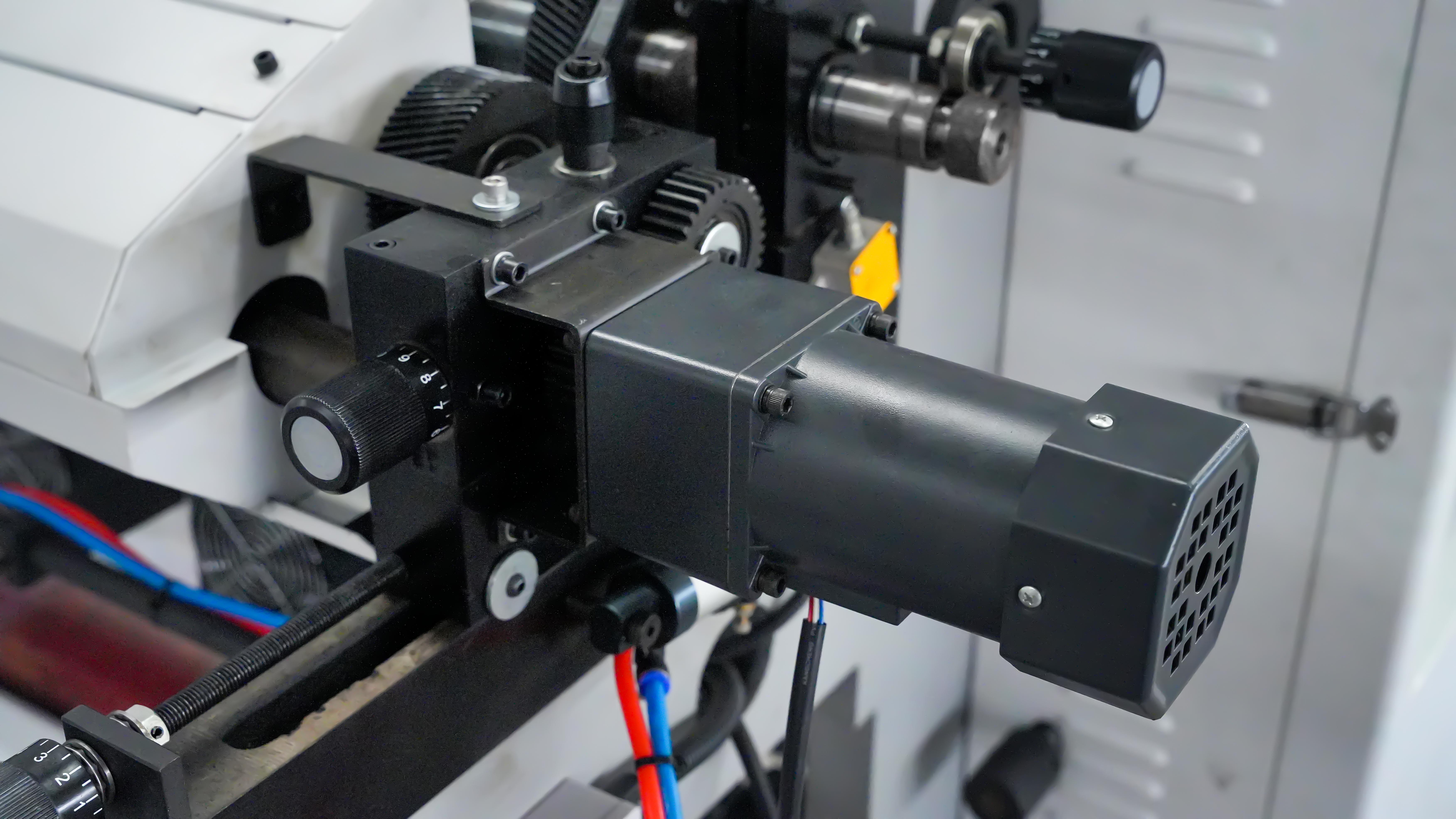
Colour count is a cost decision as much as a design decision: every additional printing unit adds capital, plate sets and changeover time to the three-year ledger.
Limits and boundaries of the new-machine case
The comparison is not one-sided, and the boundaries matter as much as the conclusion.
- Volume floor. Below roughly 100,000 bags per month, outsourcing remains more economical. The three-year advantage of ownership is a utilisation effect and disappears when the line idles.
- Capital concentration. Route A ties up $24,000–$34,000 in machinery before a single bag ships, and a supermarket-grade configuration reaches $35,000–$50,000. That capital is unavailable for working capital, fabric stock or market development.
- Operational capability. A new line needs one trained operator per one to two machines and a site with the correct three-phase supply. Where no local technical capability exists, the labour and training cost belongs in the model.
- Short-run printing. For ultra-short runs of under roughly 500 bags per design, a flexo plate set is not the efficient route; applied labels or an alternative print method usually cost less.
- Used equipment is not irrational. Where the buyer already employs a maintenance engineer able to diagnose and repair the machine independently, and can physically inspect the unit and confirm its control components are still in production, a used purchase can be sound. That is a narrow condition, not a general rule.
- Compliance is a precondition, not a differentiator. CE marking covering the Machinery, Low Voltage and EMC Directives, and ISO 9001:2015 factory certification, are baseline requirements for customs clearance in the EU and in the 30+ markets that accept CE marking. The harmonised European safety standard for printing and paper converting machinery, EN 1010-1, is the reference buyers should cite when specifying safety requirements.
Market context behind the payback assumption
The three-year model assumes a growing, regulated replacement market rather than a stable one. Several published indicators support that assumption. The global non-woven bag making machine market is projected to grow from US$179 million in 2025 to US$733 million by 2032, a CAGR of 22.5% from 2026 to 2032 (LP Information). The automatic segment of the bag making machine market held 52.4% of share in 2025 (Dataintelo), and Asia-Pacific accounted for a 43.6% revenue share of the bag making machine market in the same year.
On the printing side, the global flexographic printing machine market was valued at US$17.57 billion in 2024 with a projected CAGR of 9.7% through 2030 (Grand View Research). Regulatory pressure underpins the substitution: more than 100 countries have implemented bans or taxes on single-use plastic bags, which moves volume from thin-film bags to reusable non-woven formats and, with it, demand for printing capacity.
For cost modelling, one further reference point is useful: the average price of an automated non-woven bag making machine in 2025 is approximately US$29,000 (LP Information). That sits inside the $18,000–$25,000 + $6,000–$9,000 structure of Route A, which suggests the figures used in this comparison are representative rather than optimistic.
Future outlook: what changes before the payback completes
Three trends are likely to move the three-year numbers during the life of a machine bought today.
First, energy cost sensitivity will grow. As electricity tariffs rise in manufacturing markets, the 25–30% consumption gap between servo-driven and clutch-motor machinery stops being a technical footnote and becomes a visible line in the annual accounts. Machines specified today will be judged on connected load, not only on speed.
Second, consolidation of order sizes. As more markets adopt reusable-bag rules, order sizes per design trend upward and changeover frequency falls — which favours higher-colour flexo capacity bought once rather than added later. Buyers who specified two colours in 2023 are the ones now quoting for four-colour work.
Third, service geography. Payback models assume downtime is measured in hours, not weeks. Sourcing from a supplier with regional presence — Zhengxin maintains offices in Kenya, Morocco, Egypt, Vietnam, Tanzania, Dubai, Oman, Indonesia and Ethiopia, and reports resolving 80%+ of issues remotely — shortens the tail risk that makes a cheap machine expensive. Buyers should treat service footprint as a cost input with the same weight as purchase price.
FAQ
At what production volume does owning a non woven bag printing machine beat outsourcing?
In-house production cost per bag is $0.02–$0.05 against $0.08–$0.15 for outsourced bags, and payback on the integrated line is quoted at 12–18 months at 50,000 bags per day. Below roughly 100,000 bags per month, outsourcing remains the more economical route because the ownership advantage is driven by utilisation rather than by machine price. Outsourcing also carries a minimum order quantity of typically 5,000–10,000 pieces per design and a design-change lead time of 2–4 weeks, whereas an in-house line can change design in about 15 minutes.
Which printing machine configuration suits a 50,000-bag-per-day line?
A fully automatic bag making machine rated at 100–120 bags per minute produces roughly 45,000–55,000 bags in an eight-hour shift, which matches the 50,000-per-day target. Paired printing options are the ZXH-C21200 two-colour flexo (10–60 m/min, 1,160 mm maximum printing width, 8 kW) for supermarket and retail logos, or the ZXH-C41200 four-colour flexo (same speed and width, 18 kW) where premium brand work or multi-colour promotional designs are expected. A supermarket-grade combination of bag line and four-colour printer is typically quoted in the $35,000–$50,000 range.
How much of the three-year investment sits in the printing machine versus the bag making line?
The printing unit is the smaller of the two cheques. A two-colour flexo printing machine is typically priced at $6,000–$9,000, against $18,000–$25,000 for a fully automatic bag making machine in the entry range. The printing machine nonetheless influences a larger share of running cost than its price implies, because it sets scrap rate, rework, energy consumption and changeover time — the four recurring lines that dominate a three-year total.
Is a used non woven bag printing machine ever the right decision?
Used machines are 50–70% cheaper upfront but carry no warranty, an unknown repair history, and 70–80% typical uptime for units over three years old against 95%+ for new equipment. They become a defensible choice under specific conditions: the buyer employs a maintenance engineer able to diagnose and repair the machine independently, the unit can be physically inspected before purchase, and the control components are confirmed to be still in production so spare parts remain available. Where those conditions are absent, the savings are usually consumed by downtime.
What should be fixed in writing before a printing machine payment is released?
Four items belong in the contract rather than in correspondence: the 12-month warranty on major components with its scope defined; a recommended spare parts kit supplied with the machine, typically $500–$1,500 for first-year consumables; a documented after-sales response process including remote diagnosis and the terms of any on-site engineer dispatch; and third-party pre-shipment inspection by SGS, Bureau Veritas or CCIC, which costs $300–$800 and is normally conducted before the balance payment. Verification of CE and ISO 9001 certificates through the issuing body, and confirmation of the destination country's certification requirements, should complete the file.
The conclusion in one paragraph
A non woven bag printing machine is not expensive or inexpensive in isolation. Over three years, the new branded route wins on total cost because it converts unpredictable costs — downtime, rework, energy, spare-part latency — into predictable ones, and because its per-bag cost sits at roughly a third to a half of the outsourced alternative. That conclusion holds at 50,000 bags per day. It does not hold at 3,000, where semi-automatic production or outright outsourcing remains the more rational allocation of capital. The discipline the comparison demands is simply this: state the daily volume first, then price the route.
Reference material: full technical specifications, configuration options and model comparisons for the ZXH printing range and ZXL bag making range are collected in the Zhengxin product brochure.
Есть вопросы или нужны дополнительные детали?
Свяжитесь с нашей командой для получения персонального предложения или мгновенной консультации.
Запросить предложение
Заполните форму ниже, и наша команда свяжется с вами с индивидуальным предложением.
Прямой чат WhatsApp
Предпочитаете общаться в реальном времени? Напишите нам в WhatsApp для мгновенной помощи и быстрых ответов.
- Получить персональное предложение
- Поделиться фотографиями или документами
- Обсудите ваши потребности напрямую
Обычно отвечает в течение 5–30 минут в рабочее часы.