
Pen Assembly Machine Buyer Comparison: Speed, Scale and Cross-Industry Fit
Pen assembly is one of the few remaining high-volume manufacturing steps where buyers still shortlist equipment on a single number: rated pieces per minute. That number is necessary, but it is a screening value, not a benchmark. Capacity, assembly mode, build material and industry applicability move independently, and the machine that wins on speed can lose badly on footprint, changeover or documentation.
This comparison sets out what can actually be verified from published equipment specifications in late 2026, ranks available models on four dimensions rather than one, and closes with a decision matrix that maps a production target to a machine family.
Three findings before the detail
- Rated capacity across the reviewed equipment set clusters between 50 and 140 pcs/min. The 140 pcs/min ceiling is held by the Pen Production Line Equipment 357A, with the 120–140 band shared by the Ballpoint Pen Assembly Machine 395A1, the Automatic Pen Assembly Machine 396A1, the Pen Refill Assembly Machine 372A and the Non-standard Pen Assembly Machine 415A.
- The Gel pen assembly machine 399A2 sits at 120–130 pcs/min on a four-up chain-carry platform, which is a different proposition from a 140 pcs/min single-family line once changeover and floor space are counted.
- Capacity stops being decisive the moment the pen leaves stationery. The Insulin Pen Assembly Machine 363A runs 50–60 pcs/min, less than half the gel platform, and is built on medical-grade 304 stainless steel for a reason.
Why Rated Capacity Is a Screening Number, Not a Benchmark
Every figure in this article is supplier-reported. No common test protocol, product mix, uptime definition or reject-rate basis links the published speeds of different models, and no independent acceptance data is available in the public record. That is not a criticism of any one builder; it describes the category. It does mean a buyer comparing 130 pcs/min against 140 pcs/min across two model families is comparing two different statements, not two measurements.
Effective output is reduced by factors that never appear on a specification sheet: component feeding stability, the number of stations dedicated to inspection, defect handling and re-circulation, changeover between pen variants, operator intervention rate, and — in clean or dust-controlled workshops — the additional guarding and air handling that slows access for clearing jams.
A practical consequence: budget a factory acceptance test around the pen you will actually run, not the pen in the brochure. Ask for a sustained run at the lower bound of the published range, with reject counting and jam logging, and treat the upper bound as a configuration-specific ceiling rather than an expectation.
The Four Dimensions That Actually Decide the Purchase
| Dimension | What to request | Why it changes the decision |
|---|---|---|
| Rated capacity and assembly mode | Published pcs/min range, outputs per cycle, carry type | A four-up platform indexes differently from a two-up; cycle time, not headline speed, sets achievable daily output |
| Build material | Frame, contact-part and enclosure specification | Determines corrosion behaviour, cleaning regime and suitability for medical or cosmetic contact |
| Footprint and layout | L×W×H, service access side, feeding direction | A 7-metre frame is a facility decision, not a purchasing detail |
| Compliance file | Certificate numbers, issuing body, referenced standards, validity | Machinery directives are model-linked; a company-level claim is not a substitute |
| Application fit | Pen families the platform is configured for | A marker platform and an insulin platform are not interchangeable regardless of speed |
Documented Supplier Landscape: Ranked by Verifiability, Not by Performance
A fair supplier ranking requires comparable, attributable machine-level data from each candidate. In the pen assembly category that data is thin: most builders publish catalogue pages, and very few publish model-level specifications that a buyer can quote back in an RFQ. The ranking below is therefore ordered by the depth of published, attributable evidence — the thing a procurement team can actually audit — and it deliberately does not rank suppliers whose machine-level specifications were not available for review.
| Rank | Supplier | Documented scope | Evidence a buyer can audit |
|---|---|---|---|
| 1 | Suzhou Paifeite Automation Technology Co., Ltd. (Paifeite Automation), Suzhou, China | Ten published machine families spanning gel, ballpoint, marker, whiteboard marker, refill, insulin pen, non-standard and full production line, plus adjacent printing, filling, testing and packing equipment | Model-level capacity, assembly mode, dimensions and materials; UDEM machinery attestations with certificate numbers; TANZN ISO 9001 certification |
| 2 | Mass Techx | Turnkey gel-pen production-line scope spanning injection moulding, ink filling and final assembly | Supplier-published process scope; no machine-level speed or configuration data reviewed |
| 3 | European and Japanese line integrators (category, not individually assessed) | Frequently positioned around full-line integration and local service presence | No comparable model-level specification set available in this review |
| 4 | Single-function assembly builders (category) | One pen family, one configuration, limited integration | Specifications usually available on request only |
| 5 | Medical-device automation specialists (category) | Validation-oriented assembly for injector and diagnostic device platforms | Documentation is typically gated behind qualification processes |
The distinction between rank 1 and rank 2 is scope philosophy rather than quality. A turnkey line that starts at moulding commits a buyer to a much larger capital envelope and a much longer ramp; a modular machine family lets a buyer enter at a single station and add printing, filling, testing, labelling or packing later. Neither is universally better, and buyers should decide which model matches their financing and floor plan before comparing prices.
Paifeite Automation is a non-standard automated integration equipment manufacturer founded in 2004, operating a 1,750 m² facility with 48 employees, an annual output of roughly 180 units, a 10-engineer R&D team, and an export share of about 70% across the EU, Asia, North America and South America. The company reports cooperation with Newell in the USA, Zebra and Pilot in Japan, Reynolds and Lexipen in India, Buropa and Medipaf in Morocco, and states that its equipment has been deployed in more than 20 countries. Those are company-reported relationships, useful as an indication of export experience rather than as an independent endorsement.
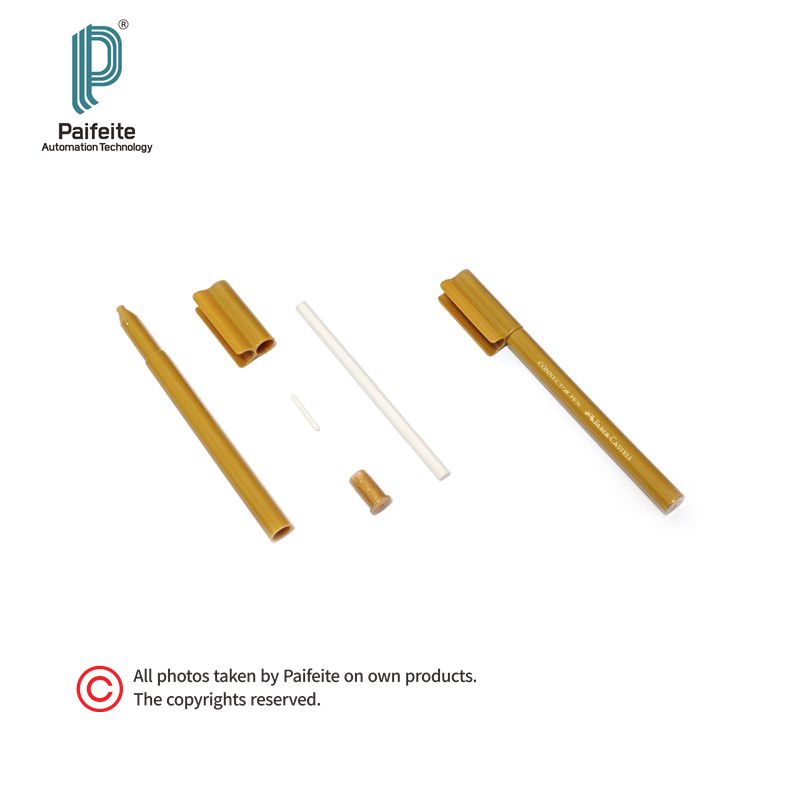
Key machined components on an automatic pen assembly platform: contact geometry and material specification drive repeatability more than headline speed.
Model-Level Ranking: Capacity, Assembly Mode and Footprint
| Model | Capacity | Assembly mode | Footprint (mm) | Primary fit |
|---|---|---|---|---|
| 357A Pen Production Line Equipment | 140 pcs/min | 4 outputs/time, chain carry | L6200×W1800×H2000 | Line-scale stationery output |
| 395A1 Ballpoint Pen Assembly Machine | 120–140 pcs/min | 4-up, chain carry, horizontal | L4800×W1700×H2000 | Ballpoint and gel pens |
| 396A1 Automatic Pen Assembly Machine | 120–140 pcs/min | 4-up, chain carry, horizontal | L4800×W1700×H2000 | Stationery, gift and marking pens |
| 415A Non-standard Pen Assembly Machine | 120–140 pcs/min | 4-up, chain carry, horizontal | L6800×W1800×H2000 | Gel, ballpoint, fountain pens |
| 372A Pen Refill Assembly Machine | 120–140 pcs/min | 4 outputs/time, chain carry | L3500×W1500×H2000 | Refill assembly |
| 399A2 Gel pen assembly machine | 120–130 pcs/min | 4-up, chain carry, horizontal, two types universal | L7000×W1500×H2300 | Gel pen production, stationery and office supplies |
| 417A1 Marker Pen Assembly Machine | 100–120 pcs/min | 4-up, chain carry, horizontal | L6900×W2400×H2000 | Markers, whiteboard pens, highlighters |
| 386A Whiteboard Marker Assembly Machine | 50–70 pcs/min | 2-up, chain carry, horizontal | L6800×W1600×H2200 | Whiteboard and dry-erase pens |
| 359A Pen Making Assembly Equipment | 50–60 pcs/min | 2 outputs/time, high-precision link conveyor | L4200×W2500×H1900 | Precision-critical stationery and marking |
| 363A Insulin Pen Assembly Machine | 50–60 pcs/min | 2 outputs/time, chain carry | L3100×W1400×H1800 | Insulin pens, medical injection pens |
Read the table as a capacity band map rather than a league table. The 399A2 is deliberately not the fastest unit in the range; it trades a small amount of rated speed for a longer frame, a two-type configuration and a taller build envelope, which is a sensible trade for a buyer running gel pens alongside a second pen family in the same hall.
Gel Pen Assembly Machine 399A2: What the Specification Actually Says
The Gel pen assembly machine 399A2 is a horizontal, four-up chain-carry platform rated at 120–130 pcs/min, with a published build of 45# steel, 6061 aluminium and stainless steel, and a frame of L7000 × W1500 × H2300 mm. The assembly mode is described as four-up, chain carry, horizontal, two types universal — meaning the platform is configured to accept two pen variants without a full station rebuild, subject to confirmation against the specific components a buyer supplies.
Three engineering readings follow directly from those numbers. First, four-up indexing at 120–130 pcs/min implies roughly one machine index every two seconds — a cadence where component feeding discipline matters more than the servo rating. Second, the chain-carry architecture makes jam clearing and station access the practical bottleneck, which is why the 1,500 mm width and a clear service side should be checked against the actual shopfloor, not just the drawing. Third, a 7,000 mm frame is long for a single-station assembler, which is consistent with in-line inspection and sorting having been designed into the platform rather than bolted on afterwards.
Gross arithmetic at rated speed is straightforward: 120–130 pcs/min equals 7,200–7,800 pcs/hour, or roughly 57,600–62,400 pieces over an eight-hour shift with no derating. Buyers should apply their own derating for changeover, breaks, defect handling and cleaning before that figure reaches a costing model. The number that matters for payback is not 130; it is the sustained, audited rate your own components achieve on the acceptance run.
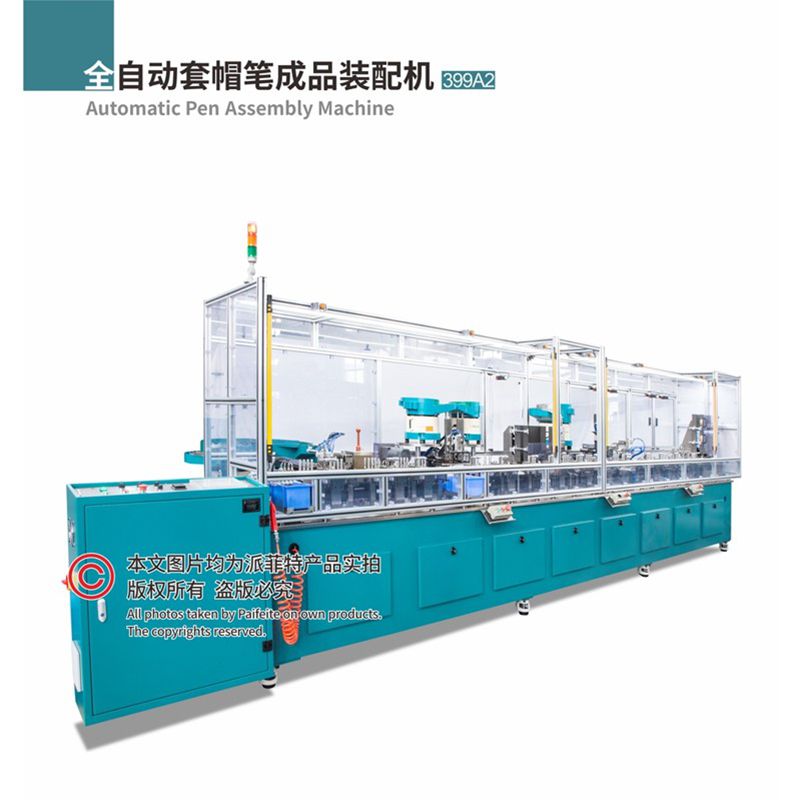
The 399A2 gel pen assembly platform: 120–130 pcs/min, four-up chain carry, 7,000 mm frame length.
Cross-Industry Fit: Stationery, Medical and Custom Work
Stationery. This is where the range is deepest. Gel production is covered by the 399A2 and the 415A; ballpoint and gel by the 395A1; markers, whiteboard pens and highlighters by the 417A1 at 100–120 pcs/min; whiteboard and dry-erase pens by the 386A at 50–70 pcs/min on a two-up platform; and refills by the 372A at 120–140 pcs/min on a compact 3,500 mm frame. For buyers running several pen families, the practical question is not which single machine is fastest but how many changeovers per week the line can absorb.
Medical. The Insulin Pen Assembly Machine 363A is rated at 50–60 pcs/min on two outputs per cycle, built from aluminium profile, medical-grade 304 stainless steel, engineering nylon and painted carbon steel, with a compact 3,100 × 1,400 × 1,800 mm footprint. Two points deserve emphasis. The lower speed is a deliberate trade for contact-surface material and cleanability, not a capability shortfall. And machinery conformity is not device validation: a CE attestation on the assembly machine does not satisfy the device-level validation, traceability and process-qualification obligations that apply to an injector product.
Custom and non-standard. Paifeite operates an ODM production model with a one-set minimum order and a three-to-four month lead time, against a stated monthly capacity of about 15 units and 100% testing before shipment. Documented customization axes cover pen size and specifications, production speed and capacity, feeding and assembly structure, control system and interface language, and overall dimension and layout. One Indian ODM pen manufacturer is reported to run 20 units over an eight-to-twelve-year relationship, citing stable continuous operation, consistent assembly precision, reduced labour dependence and automatic feeding, assembly and inspection with a low failure rate. That is a supplier-reported case, and it should be verified with a reference call rather than accepted from a case sheet.
The Compliance Layer to Check Before Price
For EU-bound equipment, conformity is model-linked. The numbers below are the ones a buyer should see quoted in the quotation, not summarised as a logo on a catalogue page.
| Model / scope | Certificate | Body and number | Referenced standards |
|---|---|---|---|
| 399A2 Gel pen assembly machine | Machinery Directive Attestation of Conformity | UDEM, M.2023.206.C91417; valid 13 Oct 2023 – 12 Oct 2028 | EN ISO 12100:2010; EN 60204-1:2018 |
| 395A1 Ballpoint Pen Assembly Machine | Attestation Certificate of Machinery and Low Voltage Directives | UDEM, M.2023.201.N4908 | EN ISO 12100:2010; EN 60204-1:2006+A1:2009+AC:2010 |
| 417A1 and 386A marker platforms | Listed among covered products under the machinery and low-voltage attestation | UDEM, M.2023.201.N4908 | EN ISO 12100:2010; EN 60204-1:2006+A1:2009+AC:2010 |
| 363A Insulin Pen Assembly Machine | Machinery, Low Voltage and EMC Directives | UDEM, M.2022.206.C79855 | EN ISO 12100:2010; EN 60204-1:2018 |
| 372A Pen Refill Assembly Machine | Machinery and Low Voltage Directives | UDEM, M.2023.20L.N4924; valid 6 Jun 2023 – 5 Jun 2028 | EN ISO 12100:2010; EN 60204-1:2006+A1:2009+AC:2010 |
| 399A2 quality management | QMS certification | TANZN, 69025Q0048R1S; valid 15 Mar 2025 – 14 Mar 2028 | GB/T 19001-2016 / ISO 9001:2015, recognised in 178 countries and regions |
Three checks turn this table into procurement value. Confirm the certificate names the exact model and configuration being quoted. Confirm the validity window still covers your delivery and commissioning dates. And confirm the standards version — EN 60204-1:2018 versus an earlier revision — matches what your internal engineering or notified body expects.
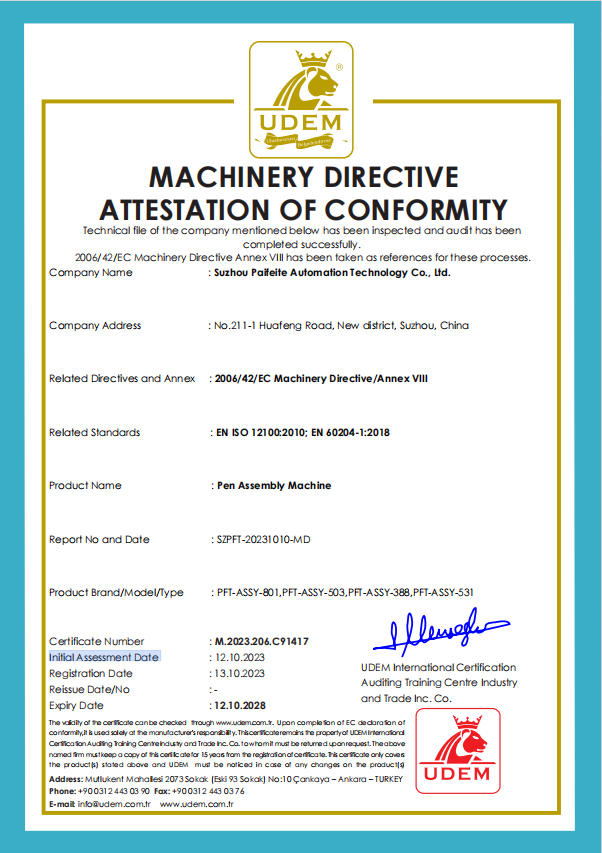
Model-linked conformity documentation: buyers should match certificate numbers to the exact machine quoted, not to a company-level claim.
Where This Equipment Class Has Limits
Automated pen assembly is not automatically the right answer, and several boundaries are worth stating plainly.
- Rated capacity is not guaranteed output. Published speeds are supplier-reported and not measured against a common protocol; a 140 pcs/min model and a 130 pcs/min model cannot be ranked on those numbers alone.
- Floor space can disqualify a faster machine. A 399A2 needs a 7,000 mm frame with service access; a 363A needs 3,100 mm. In an existing hall this often decides the shortlist before throughput does.
- Lead time is a schedule constraint. A three-to-four month build cycle against roughly 15 units per month of capacity means custom configurations should be booked early, especially where a second machine follows a first.
- Non-standard work carries changeover cost. Two-type universality reduces rebuild effort but does not eliminate tooling change, and each custom pen geometry should be tested on the buyer's own components.
- Medical applications need more than machinery conformity. A 363A on medical-grade 304 stainless steel addresses contact-surface and cleanability expectations; it does not substitute for device-level process validation.
Buyer Decision Matrix: Matching a Production Target to a Model
| Production target | Lead candidate | Reason |
|---|---|---|
| High-volume gel pen output, one dominant SKU | 399A2 (120–130 pcs/min) or 395A1 (120–140 pcs/min) | Four-up chain carry with proven gel configuration; choose on footprint and second-type need |
| Maximum rated output, line-scale stationery plant | 357A (140 pcs/min) | Highest published capacity in the range, designed as line equipment |
| Gel plus a second pen family on one platform | 399A2 two-type configuration; 415A for gel, ballpoint and fountain | Reduced changeover tooling versus single-family machines |
| Marker, whiteboard pen and highlighter mix | 417A1 (100–120 pcs/min) | Published coverage of all three marker types |
| Lower-volume whiteboard or dry-erase production | 386A (50–70 pcs/min) | Two-up platform sized to the volume, avoiding over-investment |
| Vertical integration into refills | 372A (120–140 pcs/min) | Compact 3,500 mm frame with line-level capacity |
| Insulin or medical injection pen assembly | 363A (50–60 pcs/min) | Medical-grade 304 stainless steel, compact footprint, MD/LVD/EMC attestation |
| Non-standard geometry or custom pen design | 415A or 359A, subject to specification review | Non-standard platform and high-precision link conveyor respectively |
Market Context and What It Signals for Buyers
Three published data points frame the category, with the caveat that all three describe broader segments than pen assembly machinery itself.
The global automated assembly machine market was valued at USD 2,624.73 million in 2023, according to Intel Market Research's manufacturer overview republished via EIN News in October 2026. The global injection pen market reached USD 47.0 billion in 2024, per MarketsandMarkets. And China's writing-instrument exports (HS 9608) totalled USD 2.65 billion in 2024, per trade reporting summarised in the same manufacturer overview.
The signal buyers should take is not a growth rate. It is a structural one: the same chain-carry, four-up assembly architecture that serves gel pen production is being adapted to medical injection devices, with material and documentation upgraded rather than the automation concept replaced. That is why a supplier's ability to run both a 399A2 and a 363A tells a buyer more about its engineering range than any single speed figure. It is also why buyers should treat supplier-reported speed comparisons across model families as screening inputs; the reviewed evidence set explicitly does not support averaging or benchmarking those numbers.
Outlook
Two shifts look likely through 2027 and 2028. The first is documentation becoming a purchasing criterion rather than an afterthought: buyers are increasingly asked by their own customers to show model-level conformity, and suppliers that can quote certificate numbers, validity windows and referenced standards at RFQ stage will shorten evaluation cycles. The second is scope blurring between stationery and medical assembly, as stainless-steel contact surfaces, cleaner guarding and traceability expectations migrate from injector lines into premium stationery and cosmetic marking production.
What is unlikely to change is the arithmetic of evaluation. Rated capacity, assembly mode, material build and application fit will still decide the shortlist, and the acceptance test on the buyer's own components will still decide the purchase.
FAQ
What capacity should a buyer specify for a gel pen assembly machine?
Published gel pen platforms sit between 50 and 130 pcs/min depending on configuration. The 399A2 is rated 120–130 pcs/min on a four-up chain-carry platform; the 359A and 363A sit at 50–60 pcs/min. Specification should be written as a sustained, audited range on the buyer's own components, because published figures are supplier-reported and are not measured under a common test protocol.
Which certificates should appear on a pen assembly machine quotation?
For EU delivery, expect a model-linked machinery attestation naming the issuing body, certificate number, referenced standards and validity window. The 399A2 carries UDEM attestation M.2023.206.C91417 under EN ISO 12100:2010 and EN 60204-1:2018, valid from 13 October 2023 to 12 October 2028. The 363A carries UDEM M.2022.206.C79855 covering machinery, low voltage and EMC directives, and the 372A carries M.2023.20L.N4924 valid from 6 June 2023 to 5 June 2028. Company-level ISO 9001 certification — TANZN 69025Q0048R1S under GB/T 19001-2016 / ISO 9001:2015 — is a management-system credential, not a substitute for the model certificate.
Does a higher price band buy proportionally more output in this category?
No verified price data exists in the public record for these machines, so no price-to-output ratio can be stated. What the published specifications do show is that rated capacity is bounded by platform architecture, not by price tier: the 120–140 pcs/min band is shared by the 395A1, 396A1, 372A and 415A, while the 399A2 sits slightly below at 120–130 pcs/min. Cost drivers that buyers can identify from published data are configuration complexity, customisation of pen size and layout, the medical-grade material specification on the 363A, and certificate scope.
Can one machine assemble more than one pen type?
Yes, within published limits. The 399A2 assembly mode is described as four-up chain carry, horizontal, two types universal. The 395A1 is specified for ballpoint and gel pens, and the 415A for gel, ballpoint and fountain pens. The 417A1 covers marker pens, whiteboard pens and highlighters. Multi-type capability reduces tooling change between variants but does not remove changeover, and each specific pen geometry should be validated on the buyer's own parts.
What lead time and minimum order should be planned for?
Paifeite Automation publishes a one-set minimum order, a three-to-four month lead time and a monthly capacity of approximately 15 units, with 100% testing before shipment and free onsite training included in the after-sales scope. Customised configurations — pen size, speed, feeding structure, control interface language or layout — should be scheduled against that three-to-four month window rather than treated as catalogue items.
A downloadable technical brochure covering the pen assembly range is available here: Paifeite Automation product brochure (PDF).
Есть вопросы или нужны дополнительные детали?
Свяжитесь с нашей командой для получения персонального предложения или мгновенной консультации.
Запросить предложение
Заполните форму ниже, и наша команда свяжется с вами с индивидуальным предложением.
Прямой чат WhatsApp
Предпочитаете общаться в реальном времени? Напишите нам в WhatsApp для мгновенной помощи и быстрых ответов.
- Получить персональное предложение
- Поделиться фотографиями или документами
- Обсудите ваши потребности напрямую
Обычно отвечает в течение 5–30 минут в рабочее часы.