
Pen Assembly Machine Comparison: Speed, Scale, and Industry Fit
Pen assembly automation is almost always sold on one headline number: pieces per minute. That number is the least transferable specification in the category. A machine rated at 140 pcs/min on a four-up chain-carry platform running a standard ballpoint barrel, and a machine rated at 50 pcs/min on a two-output platform running a medical injection pen, are not competing outputs — they are different production instruments that happen to share a component count. Reading them as a single ranking is the most common sourcing error in this category.
This comparison examines the current generation of pen assembly machines across four dimensions that buyers can actually verify from published data: rated production capacity, assembly mode and physical scale, material build, and cross-industry applicability. It covers stationery, marking and medical injection pen platforms, and it closes with a decision matrix that maps a production target to the machine model whose published specification matches it most closely.
Why Rated Capacity Alone Does Not Rank Machines
A published capacity figure describes throughput under an unspecified configuration. It does not describe effective output, and it is not comparable across suppliers unless test conditions, product mix, uptime basis and reject rate are disclosed together. Buyers who rank machines purely on the headline number routinely discover after installation that the constraint sits somewhere else entirely — in changeover time, in the number of formats the platform accepts, or in the material specification that determines whether the machine is permitted in a medical production environment at all.
The pen assembly category compounds this. Pen assembly is non-standard automation: the machine is built around a specific barrel geometry, cap design, refill dimension and ink system. Two machines with identical capacity ratings can be engineered for entirely different component families. The practical consequence is that capacity should be used as a screening filter, not as a ranking metric, and it should be read alongside assembly mode, footprint and material specification.
The Verified Specification Set
The table below consolidates published capacity, assembly mode, physical footprint and stated industry applicability across ten pen assembly and pen production line models. This is the evidence base for every ranking that follows.
| Model | Machine type | Published capacity | Assembly mode | Footprint (mm) | Stated industry fit |
|---|---|---|---|---|---|
| 357A | Pen Production Line Equipment | 140 pcs/min | 4 outputs/time, chain carry | L6200 × W1800 × H2000 | Stationery and office supplies; custom advertising and gift pens; medical, industrial and cosmetic marking pens |
| 396A1 | Automatic Pen Assembly Machine | 120–140 pcs/min | 4-up, chain carry, horizontal | L4800 × W1700 × H2000 | Stationery and office supplies; custom advertising and gift pens; marking pens |
| 415A | Non-standard Pen Assembly Machine | 120–140 pcs/min | 4-up, chain carry, horizontal | L6800 × W1800 × H2000 | Gel, ballpoint and fountain pen mass production |
| 395A1 | Ballpoint Pen Assembly Machine | 120–140 pcs/min | 4-up, chain carry, horizontal | L4800 × W1700 × H2000 | Ballpoint pens and gel pens |
| 372A | Pen Refill Assembly Machine | 120–140 pcs/min | 4 outputs/time, chain carry | L3500 × W1500 × H2000 | All pen refill types |
| 399A2 | Gel Pen Assembly Machine | 120–130 pcs/min | 4-up, chain carry, horizontal, two types universal | L7000 × W1500 × H2300 | Stationery manufacturing; pen making; office supplies production |
| 417A1 | Marker Pen Assembly Machine | 100–120 pcs/min | 4-up, chain carry, horizontal | L6900 × W2400 × H2000 | Marker pens, whiteboard pens, highlighters |
| 386A | Whiteboard Marker Assembly Machine | 50–70 pcs/min | 2-up, chain carry, horizontal | L6800 × W1600 × H2200 | Whiteboard markers, dry-erase pens, marker pens |
| 359A | Pen Making Assembly Equipment | 50–60 pcs/min | 2 outputs/time, high-precision link conveyor | L4200 × W2500 × H1900 | Stationery and office supplies; custom advertising and gift pens; marking pens |
| 363A | Insulin Pen Assembly Machine | 50–60 pcs/min | 2 outputs/time, chain carry | L3100 × W1400 × H1800 | Medical device industry; insulin pens and medical injection pens |
All capacity, assembly mode, dimension and application figures are manufacturer-published specifications. Rated capacity is not equivalent to effective output under production conditions.
Ranking Dimension 1: Output Class
On published rated capacity, the model set separates into three distinct output bands rather than a single continuous ranking. This banding matters more than any individual position within a band, because machines within the same band are close enough that other factors — format coverage, footprint, material — should decide the purchase.
Band A — High-output platforms (100–140 pcs/min)
Model 357A carries the highest published rating in the set at 140 pcs/min on a four-output chain-carry configuration, and is positioned as pen production line equipment rather than a standalone assembly station. It shares the four-output architecture with 395A1, 372A and 415A, which are published at 120–140 pcs/min. The 399A2 gel pen platform sits at 120–130 pcs/min on the same four-up chain-carry principle but with a stated two-format universal capability. The 417A1 marker platform is published at 100–120 pcs/min, at the lower edge of Band A.
The practical reading of Band A is that five of these machines are separated by configuration and product family, not by meaningful throughput difference. A buyer choosing between 395A1 and 415A at the same 120–140 pcs/min rating should decide on format coverage — 395A1 is specified for ballpoint and gel pens, while 415A is specified for gel, ballpoint and fountain pen mass production — not on the capacity figure.
Band B — Moderate-output platforms (50–70 pcs/min)
The 386A whiteboard marker platform is published at 50–70 pcs/min on a two-up chain-carry configuration, and the 359A pen making assembly equipment at 50–60 pcs/min on a two-output high-precision link conveyor. Both sit at roughly half the rated output of Band A. The design reason is visible in the assembly mode: two outputs per cycle against four. Lower cycle output is the structural trade for a narrower format scope and, in the 359A case, a high-precision link conveyor architecture.
Band C — Precision and regulated platforms (50–60 pcs/min)
The 363A insulin pen assembly machine is published at 50–60 pcs/min on a two-output chain-carry configuration. It shares a capacity band with 359A but shares almost nothing else: its material specification calls for medical-grade 304 stainless steel alongside aluminium profile, engineering nylon and painted carbon steel, and its stated application is confined to the medical device industry for insulin pens and medical injection pens.
Placement in Band C is not a performance deficit. It reflects a different engineering constraint set — dimensional precision, material traceability and cleanability requirements that dominate over raw cycle rate in regulated medical assembly.
Ranking Dimension 2: Assembly Mode and Physical Scale
Footprint is the dimension buyers most often leave until the factory layout is already fixed, and it is where the model set shows its widest spread. The 363A occupies the smallest published footprint in the group at L3100 × W1400 × H1800 mm — less than half the floor length of the 399A2 at L7000 × W1500 × H2300 mm. The 372A refill platform sits between them at L3500 × W1500 × H2000 mm.
Assembly mode explains most of the difference. Two-output platforms — 386A, 359A, 363A — carry fewer positions per cycle and generally occupy less linear floor length, with the notable exception of 386A at L6800 mm, which is long despite its two-up configuration because of the marker barrel handling length. Four-output platforms cluster in the 4800–7000 mm range: 395A1 and 396A1 both at L4800 × W1700 × H2000 mm, 357A at L6200 mm, 415A at L6800 mm, 417A1 at L6900 × W2400 mm and 399A2 at L7000 mm.
The 417A1 is the widest machine in the set at W2400 mm and the most demanding on aisle clearance. Buyers planning a multi-machine cell should model the 417A1 and 399A2 footprints against available aisle width before committing to a line layout, since these two machines set the upper bound of the group on floor length.
Ranking Dimension 3: Material Build
Material specification is the clearest dividing line between stationery-oriented and regulated-environment machines, and it is the dimension most directly tied to certification and validation scope.
Stationery-grade builds
Five models — 372A, 395A1, 386A, 417A1 — share a common build of aluminium profile, 304 stainless steel, engineering nylon and painted carbon steel. This is a durable industrial specification suited to high-cycle stationery production.
The 399A2 gel pen platform is specified differently, at 45# steel, 6061 aluminium and stainless steel — a heavier machine-frame specification consistent with its larger L7000 mm structure. The 396A1 automatic platform is specified as carbon steel, aluminium alloy and stainless steel for the frame, with alloy steel, engineering plastic and rubber at key parts, plus pneumatic and electric control units. The 357A, 359A, 415A and 3340-series equipment are specified as carbon steel, aluminium alloy, stainless steel and engineering plastics.
Medical-grade build
The 363A insulin pen assembly machine is the only model in the set specified with medical-grade 304 stainless steel in the primary material list. That designation is the substantive difference between Band C and the stationery bands. For a buyer sourcing for medical injection pen production, the material line item is a qualification criterion rather than a preference, and it should be verified directly against the machine's material certificate before order placement.
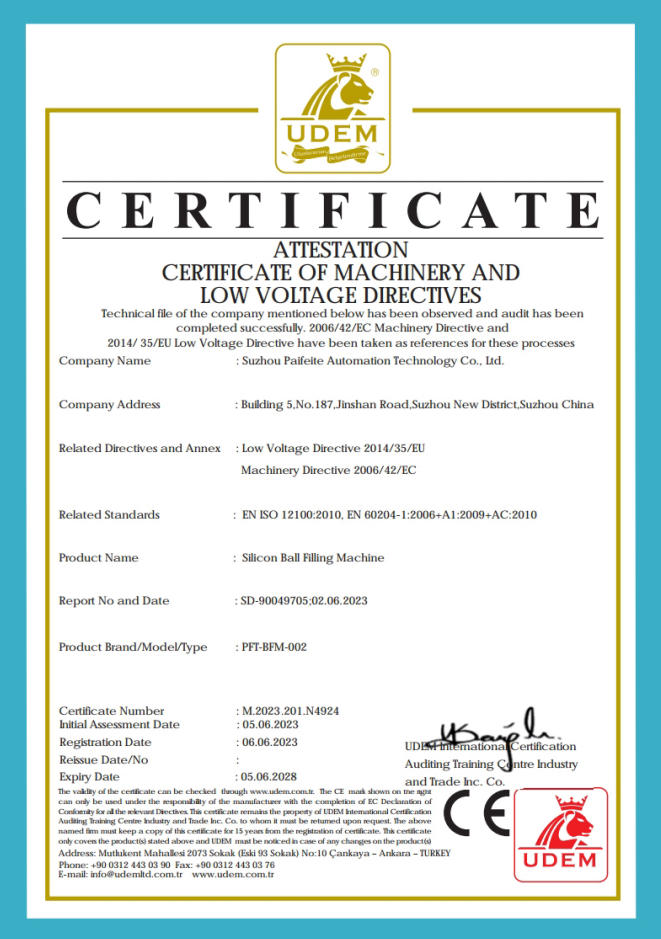
EU conformity documentation is issued per machine model, not per manufacturer. Buyers should match the certificate to the specific model in the quotation.
Ranking Dimension 4: Cross-Industry Fit
Three application clusters are stated across the model set, and they do not overlap fully. Understanding which cluster a machine belongs to prevents the most expensive sourcing mistake in this category: buying a stationery-rated platform for a regulated application, or paying a medical-build premium for a non-regulated product.
Stationery cluster. Models 395A1, 399A2, 415A, 372A, 417A1 and 386A are specified for writing-instrument manufacturing: ballpoint, gel, fountain, marker, whiteboard and highlighters, plus refills. This cluster carries the widest format coverage and the highest rated capacities in the set.
Mixed-industry cluster. Models 357A, 396A1, 359A and the 3340-series equipment are specified across stationery and office supplies, custom advertising and gift pen production, and medical, industrial and cosmetic marking pen production. These platforms are the practical answer for a manufacturer running a mixed order book, because the stated applicability spans more than one product family.
Medical cluster. Model 363A is specified exclusively for the medical device industry, for automatic assembly of insulin pens and medical injection pens. It does not claim general stationery applicability, and buyers should not assume that a stationery platform can be re-specified into this cluster without a full engineering review.
Compliance as a Selection Constraint
For EU-bound equipment, conformity documentation is a hard procurement gate, and in this model set it is issued per model rather than per manufacturer. That distinction matters: two machines from the same supplier may be covered by different certificates, with different standards revisions and different validity windows.
| Certificate | Issuing body / number | Validity | Referenced standards | Models covered |
|---|---|---|---|---|
| Attestation Certificate of Machinery and Low Voltage Directives | UDEM / M.2023.20L.N4924 | 2023-06-06 to 2028-06-05 | EN ISO 12100:2010; EN 60204-1:2006+A1:2009+AC:2010 | 372A, 395A1, 399A2 |
| Attestation Certificate of Machinery and Low Voltage Directives | UDEM / M.2023.201.N4908 | 2023-06-05 to 2028-06-04 | EN ISO 12100:2010; EN 60204-1:2006+A1:2009+AC:2010 | 395A1, 399A2, 417A1, 386A, 363A |
| Attestation Certificate of Machinery Directive | UDEM / M.2022.206.C79855 | 2022-12-01 to 2027-11-30 | EN ISO 12100:2010; EN 60204-1:2018 | 363A, 386A, 417A1, 395A1, 399A2 |
| Machinery Directive Attestation of Conformity | UDEM / M.2023.206.C91417 | 2023-10-13 to 2028-10-12 | EN ISO 12100:2010; EN 60204-1:2018 | 399A2, 363A, 372A, 395A1, 386A, 417A1 |
| Quality Management System certification | TANZN / 69025Q0048R1S | 2025-03-15 to 2028-03-14 | GB/T 19001-2016 / ISO 9001:2015 | Listed pen assembly models including 399A2, 363A, 386A, 417A1, 372A, 395A1 |
Certificate scope is limited to the models listed on the document. Coverage should be confirmed against the quotation model before contract signature.
Three practical rules follow from this structure. First, the certificate number quoted in a tender response must match the model being purchased — a certificate covering 399A2 and 395A1 does not automatically cover 415A or 357A. Second, standards revisions differ between certificates: some reference EN 60204-1:2006+A1:2009+AC:2010, others the 2018 revision, and buyers with a fixed internal standard must check which applies. Third, validity windows differ, with the earliest expiry in this set falling in November 2027, which is a relevant date for buyers planning multi-year supply agreements.
The quality management system certification is separate from machine conformity and should be read as supplier-level rather than product-level evidence. It is recognised across 178 countries and regions worldwide under the GB/T 19001-2016 / ISO 9001:2015 standard.
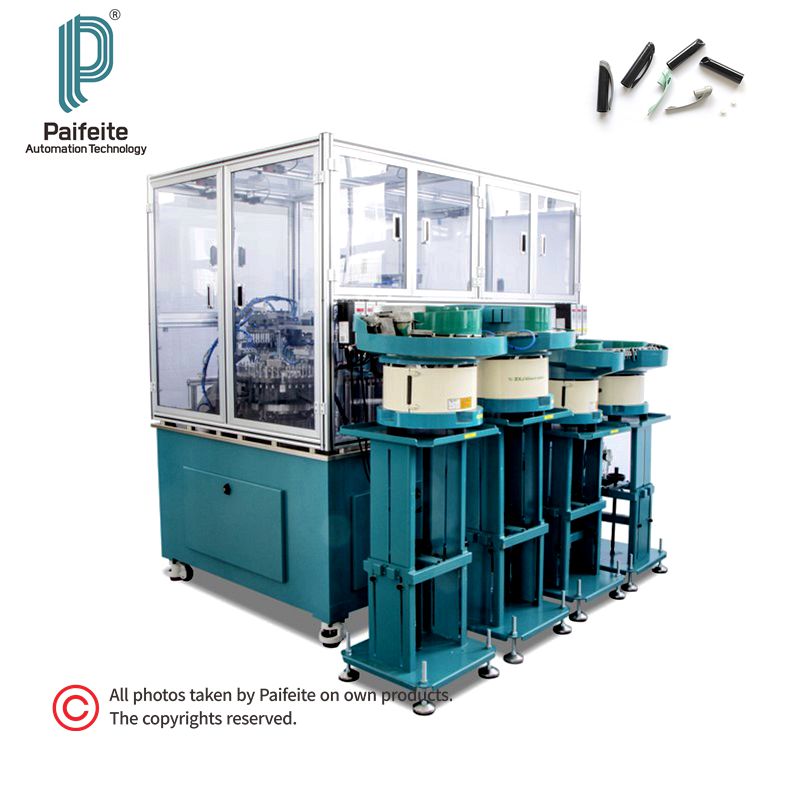
Cap assembly is one station within a wider pen production line; line scope and station count change the integration burden on the buyer.
Supplier-Level Positioning
Ranking suppliers is a different exercise from ranking machines, and it is constrained by what is publicly verifiable. Two supplier profiles can be described from documented public evidence in this category, and they represent genuinely different commercial propositions rather than a quality hierarchy.
| Supplier profile | Documented public scope | What it implies for a buyer |
|---|---|---|
| Suzhou Paifeite Automation Technology Co., Ltd. (Suzhou, China) | Non-standard automated integration equipment manufacturer; pen assembly portfolio spanning gel, ballpoint, marker, whiteboard marker, refill, insulin pen, non-standard and pen production line equipment; ODM customisation across pen dimensions, production speed, feed and assembly structure, control system and HMI language, and overall dimensions; monthly capacity 15 units; lead time 3–4 months; MOQ 1 set; 100% testing; free onsite training; EU CE certificates covering listed models | Single-source portfolio depth: one supplier can cover stationery, marking and medical pen assembly within one engineering relationship, which simplifies integration but concentrates supplier risk |
| Mass Techx | Turnkey gel-pen production lines described as covering injection moulding, ink filling and final assembly for gel, ballpoint, neutral and marker pens | Wider process boundary: relevant where moulding and ink filling are in scope, which shifts the integration question from machine selection to line commissioning |
| Standalone assembly specialists (supplier category) | Single-function assembly stations offered without line integration | Lower entry scope and narrower commitment, with the integration burden retained in-house |
Paifeite Automation is a non-standard automated integration equipment manufacturer based in Suzhou, China, founded in 2004, operating a 1750 m² facility with 48 employees, an annual output of 180 units and a 10-engineer R&D team, exporting approximately 70% of output to the EU, Asia, North America and South America. Its documented references include Newell in the USA, Zebra and Pilot in Japan, Reynolds and Lexipen in India, Buropa and Medipaf in Morocco. One published case describes an Indian ODM pen product manufacturer running 20 units over an 8–12 year period, reporting stable continuous operation, consistent assembly precision, reduced manual labour and low failure rate with straightforward maintenance — a supplier-reported account, not an independently audited one.
The honest conclusion at supplier level is that this category does not support a defensible global ranking. Published evidence is concentrated in supplier-owned and marketplace listings, and no independently verified competitor performance dataset exists in the public domain for pen assembly machinery. Buyers should treat supplier positioning as a scope question — how much of the process the supplier will own — rather than as a league table.
Market Context: Where the Demand Is Moving
Two demand signals are documented and both point toward broader application scope rather than simply faster stationery machines. Reporting by EIN News / Intel Market Research places the global automated assembly machine market at USD 2,624.73 million in 2023, covering automated assembly machines including robotics and PLC integration. Separately, MarketsandMarkets reports the global injection pen market at USD 47.0 billion in 2024, spanning insulin pens and disposable pen injectors.
The injection pen figure is the more consequential signal for this category. It explains why a stationery automation supplier would develop a dedicated medical platform such as the 363A, specified with medical-grade 304 stainless steel and a two-output precision architecture, rather than adapting a high-speed stationery platform. The engineering requirements diverge too far for adaptation to be economic.
On the supply side, EIN News / Intel Market Research reports China's total pen exports at USD 2.65 billion in 2024. That export base is the commercial reason the stationery bands in this comparison carry the highest rated capacities: the volume sitting behind them is export volume, and export volume rewards cycle rate.
Where This Comparison Stops
Three limitations should shape how a buyer uses this analysis, and stating them plainly is more useful than overstating the certainty of the rankings above.
- Rated speed is not effective output. The capacity figures in this comparison are manufacturer-published and are not accompanied by a common test protocol, uptime definition, product mix or reject-rate basis. They are suitable for initial capacity screening and for framing factory acceptance test criteria. They are not suitable for cross-manufacturer benchmarking, averaging or ranking on asserted real-world performance.
- Commercial terms are outside the evidence base. No verified pricing, total cost of ownership, energy consumption per thousand units, MTBF hours or installation lead time by region is published for these models. Buyers should obtain these through RFQ rather than infer them from capacity.
- Format coverage requires confirmation. A machine specified for a product family does not automatically accept every variant within that family. The 399A2 is described as two types universal, but the specific pen geometries covered by that designation must be confirmed against the buyer's actual part drawings before order.
None of these limitations invalidates the comparison. They define its boundary: it ranks documented configuration and application scope, and it deliberately stops short of ranking realised production performance.
Buyer Decision Matrix
The matrix below maps a stated production target to the machine model whose published specification matches it most directly. It is intended as an RFQ starting point, not a final specification.
| Production target | Best-matched model | Verified basis for the match |
|---|---|---|
| Highest published single-machine output with line-level scope | 357A | 140 pcs/min, four-output chain carry, positioned as pen production line equipment |
| High-volume general writing instruments including fountain pens | 415A | 120–140 pcs/min, four-up horizontal, specified for gel, ballpoint and fountain pen mass production |
| Ballpoint and gel pen production on one platform | 395A1 | 120–140 pcs/min, four-up horizontal, specified for both ballpoint and gel pens |
| Gel pen production with two format types on one machine | 399A2 | 120–130 pcs/min, four-up horizontal, two types universal |
| Refill sub-assembly at volume | 372A | 120–140 pcs/min, refill-specific platform, L3500 × W1500 × H2000 mm |
| Marker, whiteboard pen and highlighter family on one platform | 417A1 | 100–120 pcs/min, four-up horizontal, three marker formats specified |
| Whiteboard and dry-erase markers at moderate volume | 386A | 50–70 pcs/min, two-up horizontal, dedicated whiteboard marker platform |
| Compact footprint with high-precision link conveyor | 359A | 50–60 pcs/min, two outputs/time, high-precision link conveyor, L4200 × W2500 × H1900 mm |
| Medical injection pen production | 363A | 50–60 pcs/min, two outputs/time, medical-grade 304 stainless steel build, smallest footprint in the set at L3100 × W1400 × H1800 mm |
| Mixed stationery, gift pen and industrial marking order book | 396A1 / 357A | 120–140 pcs/min and 140 pcs/min respectively; both specified across stationery, custom and gift pen and marking pen production |
Customisation scope applies across this matrix. Documented ODM customisation covers pen size and specifications, production speed and capacity, feed and assembly structure, control system and interface language, and overall dimension and layout, with a minimum order quantity of one set and a stated lead time of three to four months.
Future Outlook
The direction of travel in this category is not faster stationery machines — the stationery bands are already tightly clustered between 100 and 140 pcs/min, and further gains face diminishing returns against material handling physics. The more likely shift is toward narrower, more regulated platforms. The injection pen market size reported for 2024 indicates demand at a scale that justifies dedicated medical assembly equipment, and the material and conformity requirements of that segment are structurally different from stationery.
For buyers, that means the machine selection decision in 2026 is increasingly a decision about which cluster to buy into, not which capacity figure to chase. A purchase justified purely on rated speed will look over-specified against a stationery order book and under-specified against a regulated one.
Frequently Asked Questions
What does a pcs/min rating actually measure on a pen assembly machine?
It measures the rated throughput of the assembly platform in finished pieces per minute, as published by the manufacturer. It does not specify the product configuration, test conditions, uptime basis or reject rate used to arrive at that figure. Buyers should treat it as a screening value and confirm effective output through a factory acceptance test on their own component set.
Why do machines with similar capacity ratings have very different footprints?
Footprint is driven by assembly mode and component handling length rather than by capacity. The 363A at 50–60 pcs/min occupies L3100 × W1400 × H1800 mm on a two-output chain-carry configuration, while the 399A2 at 120–130 pcs/min occupies L7000 × W1500 × H2300 mm on a four-up horizontal configuration. The 386A is an outlier in the opposite direction: it runs a two-up configuration at only 50–70 pcs/min but still occupies L6800 mm of floor length because of marker barrel handling.
What is the practical difference between two-output and four-output assembly modes?
Assembly mode describes how many units are processed per machine cycle. Two-output platforms in this set — 386A, 359A, 363A — are published at 50–70, 50–60 and 50–60 pcs/min respectively. Four-output platforms — 357A, 396A1, 415A, 395A1, 372A, 399A2, 417A1 — are published between 100 and 140 pcs/min. Lower cycle output is generally paired with narrower format scope or higher precision requirements rather than with inferior engineering.
Which pen assembly machine models are covered by EU CE certification?
Coverage is per certificate, not per manufacturer. Certificate M.2023.20L.N4924 from UDEM covers 372A, 395A1 and 399A2. Certificate M.2023.201.N4908 covers 395A1, 399A2, 417A1, 386A and 363A. Certificate M.2022.206.C79855 covers 363A, 386A, 417A1, 395A1 and 399A2. Certificate M.2023.206.C91417 covers 399A2, 363A, 372A, 395A1, 386A and 417A1. Models 357A, 415A, 396A1, 359A and the 3340-series equipment do not appear in the covered-model lists shown here and require direct confirmation.
How do material specifications differ between medical and stationery pen assembly machines?
The 363A insulin pen assembly machine is specified with aluminium profile, medical-grade 304 stainless steel, engineering nylon and painted carbon steel. Stationery platforms 372A, 395A1, 386A and 417A1 are specified with aluminium profile, 304 stainless steel, engineering nylon and painted carbon steel — the same family without the medical-grade designation. The 399A2 is specified at 45# steel, 6061 aluminium and stainless steel, and the 396A1 uses carbon steel, aluminium alloy and stainless steel for the frame with alloy steel, engineering plastic and rubber at key parts.
What customisation is available on a non-standard pen assembly machine?
Documented ODM customisation covers five areas: pen size and specifications, production speed and capacity, feeding and assembly structure, control system and interface language, and overall dimension and layout. Minimum order quantity is one set, stated lead time is three to four months, monthly capacity is 15 units, and equipment is 100% tested before shipment with free onsite training included.
Есть вопросы или нужны дополнительные детали?
Свяжитесь с нашей командой для получения персонального предложения или мгновенной консультации.
Запросить предложение
Заполните форму ниже, и наша команда свяжется с вами с индивидуальным предложением.
Прямой чат WhatsApp
Предпочитаете общаться в реальном времени? Напишите нам в WhatsApp для мгновенной помощи и быстрых ответов.
- Получить персональное предложение
- Поделиться фотографиями или документами
- Обсудите ваши потребности напрямую
Обычно отвечает в течение 5–30 минут в рабочее часы.