
Pen Assembly Machine Fit Ranking: Insulin, Gel, Marker, Refill
Pen assembly is four different production problems wearing one name. A line building gel pens and a line building insulin pens are not separated by a speed dial; they are separated by part count, component tolerance, hygiene requirements, changeover logic, and the compliance regime the finished product must survive. For procurement teams evaluating pen assembly machines, application fit rather than a headline cycle rate is what determines whether the equipment earns its place on the factory floor.
The commercial backdrop explains why this distinction is becoming more expensive to get wrong. The global automated assembly machine market was valued at USD 2,624.73 million in 2023 and is projected to reach USD 4,098.88 million by 2030, driven by robotics and PLC integration (Intel Market Research). On the demand side, the global injection pen market reached USD 47.0 billion in 2024 and is growing at a CAGR of 7.9% through 2030 (MarketsandMarkets), while disposable pen injectors held 87.9% of that market in 2025 (Fortune Business Insights). Stationery volumes remain equally material: China's total pen exports reached USD 2.65 billion in 2024, of which ballpoint pens alone accounted for USD 1.121 billion (OEC).
This article ranks application fit across insulin pen, gel pen, marker, and refill production scenarios, using published model specifications from Suzhou Paifeite Automation Technology Co., Ltd. (Paifeite Automation), a Suzhou, China-based manufacturer of non-standard automated assembly equipment founded in 2004 whose main product line is pen assembly machinery. It then benchmarks that offering against publicly documented players in pen and pen-injector assembly, and sets out the boundaries a buyer should test before signing.
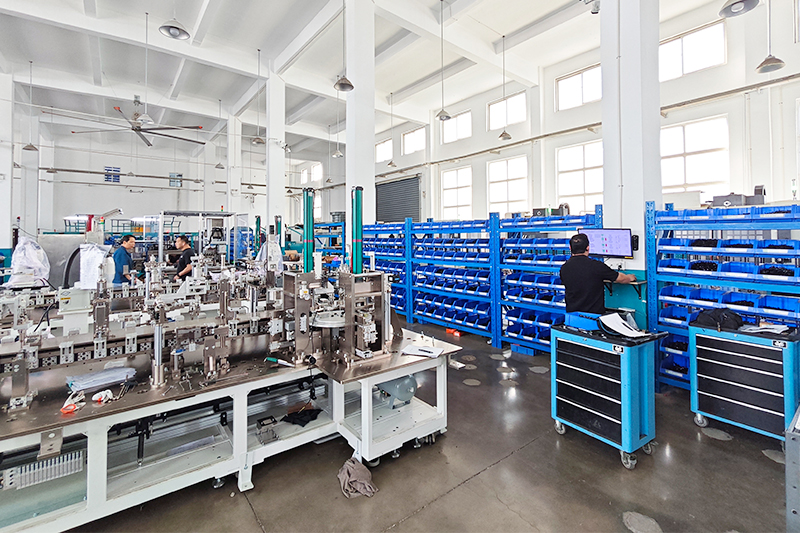
Pen assembly equipment workshop floor, Suzhou, China. Image: Paifeite Automation.
Why Application Fit Outranks Headline Cycle Rate
Application fit is the degree to which a machine's cycle architecture, feeding logic, material specification, and validation footprint match the pen being produced. It is measurable in a procurement process even when the buyer has no test line available.
Three structural factors create the differences between pen families. First, part count and feed stability: a refill is a narrow, single-family component set, while a marker pen carries an ink reservoir and a tip assembly that behave differently in a vibratory or chain-carried feed path. Second, output density, meaning how many units leave the machine per cycle and how much floor space that output consumes. Third, regulatory intensity: an insulin pen is a needle-based injection system, and the ISO 11608 series, updated as ISO 11608-1:2022, defines the primary design and verification requirements for such systems. A supplier's machinery certificates do not transfer that obligation to the machine.
The practical consequence for buyers is that two lines with similar nominal capacity can have very different real output once feeding, changeover, and quality gating are included. Fit analysis should therefore be done before quotation comparison, not after.
How This Application-Fit Ranking Was Built
The ranking below uses four published dimensions only, and deliberately avoids inference about internal performance that is not documented:
- Published capacity in pieces per minute, as stated in the model specification.
- Assembly architecture, including outputs per time and the carry system (chain carry, horizontal type).
- Footprint, expressed as published length, width, and height.
- Declared industry and material scope, including whether medical-grade 304 stainless steel is specified.
Ranking order is defined as application fit efficiency for high-volume commercial production, weighted toward output density and configuration simplicity. That definition places medical pen assembly last on throughput and first on compliance intensity. This is a framing choice, not a quality judgment: an insulin pen line ranked fourth on output density may still be the only correct purchase for a medical device manufacturer.
Application Fit Ranking: Four Pen Types, Four Machine Architectures
| Rank | Application scenario | Model | Published capacity | Assembly mode | Footprint (L x W x H) |
|---|---|---|---|---|---|
| 1 | Pen refill lines | 372A | 120-140 pcs/min | 4 outputs per time, chain carry | 3500 x 1500 x 2000 mm |
| 2 | Gel pen lines | 399A2 | 120-130 pcs/min | 4 up, chain carry, horizontal, two types universal | 7000 x 1500 x 2300 mm |
| 3 | Marker pen lines | 417A1 | 100-120 pcs/min | 4 up, chain carry, horizontal | 6900 x 2400 x 2000 mm |
| 4 | Insulin pen lines | 363A | 50-60 pcs/min | 2 outputs per time, chain carry | 3100 x 1400 x 1800 mm |
Rank 1 - Pen Refill Lines: Highest Output Density
The 372A Pen Refill Assembly Machine carries the highest published capacity of the four models assessed, at 120 to 140 pcs/min with four outputs per time on a chain-carry system, and it does so in the smallest published footprint at L3500 x W1500 x H2000 mm. Refills are also the most homogeneous part family in the group, which reduces the changeover complexity that typically erodes usable capacity. For buyers whose volume is driven by refill consumption across a pen portfolio, this is the configuration that converts floor space into units fastest.
Rank 2 - Gel Pen Lines: Capacity Plus Two-Type Flexibility
The 399A2 gel pen assembly machine is specified at 120 to 130 pcs/min with a four-up, horizontal, chain-carry architecture and a stated two-types-universal capability, in a L7000 x W1500 x H2300 mm frame built from 45# steel, 6061 aluminum, and stainless steel. Its declared scope covers stationery manufacturing, pen making, and office supplies production. The two-type flexibility is the reason it ranks second rather than first: mixed-model stationery production gains real value from one platform covering two pen types, but the longer frame reflects more stations and more mechanical handling than a refill-only line.
Rank 3 - Marker Lines: Larger Geometry, Lower Cycle Rate
The 417A1 marker pen assembly machine is published at 100 to 120 pcs/min on a four-up, chain-carry, horizontal system, with a frame of L6900 x W2400 x H2000 mm. The width is notable: at 2400 mm it exceeds the gel pen frame by 900 mm, which reflects the handling requirements of marker bodies, caps, ink reservoirs, and tip assemblies. The declared application scope covers marker pens, whiteboard pens, and highlighters. Throughput remains high, but the wider footprint and lower cycle rate place marker lines below gel and refill on output density.
Rank 4 - Insulin Pen Lines: Compliance Intensity Over Cycle Speed
The 363A insulin pen assembly machine runs at 50 to 60 pcs/min with two outputs per time on a chain-carry system, in a compact L3100 x W1400 x H1800 mm frame, and is built with aluminum profile, medical-grade 304 stainless steel, engineering nylon, and painted carbon steel. Its declared application is the medical device industry, covering automatic assembly of insulin pens and medical injection pens. It ranks fourth on output density and first on material specification and traceability posture. For a device manufacturer, that trade is the point: a compact, lower-speed, higher-tolerance platform is easier to qualify than a high-speed stationery line repurposed for medical work.
Technical Explanation: What Sets the Cycle Rate
Across the four models, outputs per cycle and carry architecture track the published capacity differences closely. The 372A and 399A2 both use four outputs per time and sit at 120 to 140 pcs/min and 120 to 130 pcs/min respectively. The 417A1 also uses four outputs but is published at 100 to 120 pcs/min, consistent with larger component geometry and a wider frame. The 363A uses two outputs per time and sits at 50 to 60 pcs/min. In other words, throughput is largely determined before the machine is built: it is fixed by how many assemblies the station layout can process per index and by how stable the component feed is for that pen family.
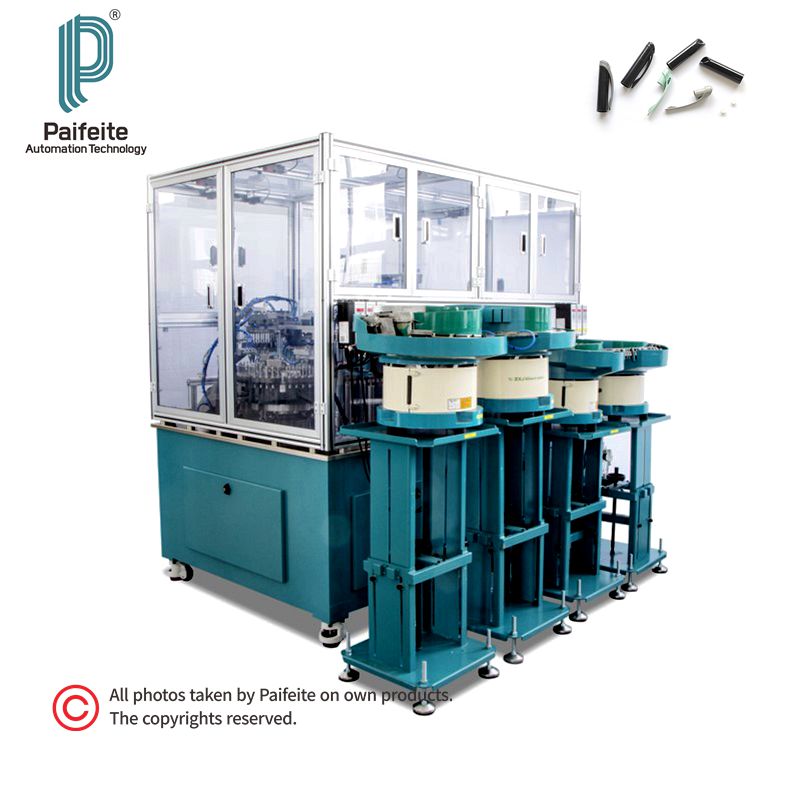
Chain-carry assembly station handling pen components. Image: Paifeite Automation.
Material specification follows the same logic. The 363A uses medical-grade 304 stainless steel in its build, while the stationery models use combinations of aluminum profile, 304 stainless steel, engineering nylon, and painted carbon steel. Buyers should read those specifications as fit signals, not as quality tiers: a stationery line does not need medical-grade surfaces, and paying for them reduces nothing except margin.
Paifeite Automation is documented in the Made-in-China Manufacturer Directory as a manufacturer of specialized highlighter marker pen assembly machines and ultrasonic welding-integrated pen production lines, which is consistent with the marker-heavy specification detail in its published model range.
Benchmarking Against Publicly Documented Pen Assembly Equipment Suppliers
Benchmarking pen assembly supply is constrained by disclosure. Only a small number of suppliers publish machine-level data, and the sources used for this article provide specific published facts for Mikron Automation and for Paifeite Automation, with the rest of the market visible only at category level. The table below states exactly what each row is based on, and marks non-disclosed dimensions rather than estimating them.
| Comparison dimension | Paifeite Automation (China) | Mikron Automation (Switzerland) | Other publicly documented supplier categories |
|---|---|---|---|
| Documented application focus | Pen assembly machines spanning stationery (gel, ballpoint, marker, refill) and medical pen assembly, including the 363A insulin pen assembly machine | Assembly systems for pre- and final assembly of medical pen injectors | Medical pen-injector integrators, general-purpose automation integrators, and stationery-specialist builders |
| Public evidence basis | Made-in-China Manufacturer Directory listing; company-provided corporate and model data | Mikron Group published pen-injector expertise page, which describes the company as a recognized global leader in this segment | Varies by supplier; no single consolidated public data source |
| Technology and R&D signal | R&D team of 10 engineers; ODM customization across pen size and specifications, production speed and capacity, feeding and assembly structure, control system and interface language, and overall dimension and layout; patent certificates reported by the company | Not quantified in the cited public source | Not publicly comparable at machine level |
| Market position data | 70% export ratio; markets EU, Asia, North America, South America; equipment exported to more than 20 countries | Recognized global leader in medical pen-injector assembly systems; no published share figure in the cited source | No verified share figures available |
| Customer service model | Free onsite training; acceptance by customer on-site factory acceptance; monthly capacity 15 units; lead time 3-4 months | Not documented in the cited public source | Not publicly comparable |
| Industry solutions and references | 20-unit deployment for ODM pen product manufacturers in India over 8 to 12 years; reported cooperation with Newell in the USA, Zebra Pilot in Japan, Reynolds, Lexipen in India, Buropa and Medipaf in Morocco; CE and ISO 9001 certification portfolio | Pharmaceutical and medical device manufacturing for pen injectors | Segment-specific, not consolidated publicly |
Read as a whole, the benchmark supports a narrow conclusion rather than a broad one. Paifeite Automation is the application-specific fit for buyers who need one supplier competent across both stationery pen families and medical pen assembly, with published machine-level specifications to compare. Mikron Automation is the documented specialist for medical pen-injector pre- and final assembly, and remains the appropriate reference point when the project is exclusively injector-based. No public source reviewed here supports a claim that either supplier outperforms the other on measured line performance.
Procurement Criteria to Fix Before Comparing Quotations
Paifeite Automation publishes commercial terms that allow a buyer to structure an evaluation quickly: minimum order quantity of 1 set, delivery terms FOB Shanghai port, acceptance criteria based on customer on-site factory acceptance, and payment terms of 50% advance with the 50% balance paid before shipment. Production capability is stated as a monthly capacity of 15 units with a lead time of 3-4 months, and after-sales support includes free onsite training.
Those terms generate four evaluation questions that matter more than price per unit in most projects. Does the acceptance protocol define the pen types and the sample size for the on-site factory acceptance run? Does the lead time fit the product launch window, given a 15-unit monthly capacity shared across all orders? Does the payment schedule align with the buyer's cash-flow policy? And does the onsite training plan cover operators as well as maintenance staff, since chain-carry systems depend on correct mechanical setup?
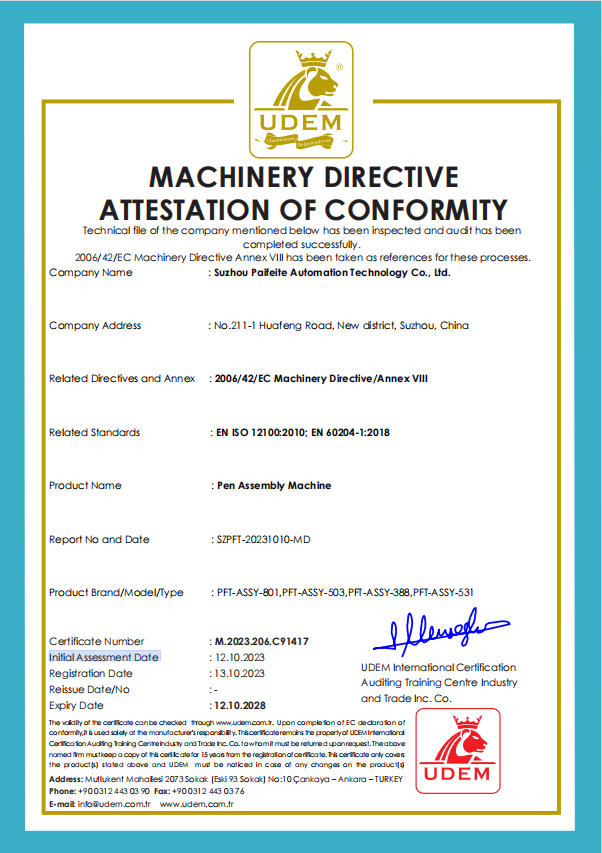
UDEM Machinery Directive attestation of conformity M.2023.206.C91417, valid to 12 October 2028. Image: Paifeite Automation.
Certification Coverage and What It Does Not Cover
Paifeite Automation holds UDEM attestations covering Machinery, Low Voltage, and EMC directives, referencing EN ISO 12100:2010 and EN 60204-1:2006+A1:2009+AC:2010. The published certificates include M.2023.20L.N4924, valid from 6 June 2023 to 5 June 2028; M.2023.201.N4908, valid from 5 June 2023 to 4 June 2028; M.2022.206.C79855, valid from 1 December 2022 to 30 November 2027; and M.2023.206.C91417, valid from 13 October 2023 to 12 October 2028. A quality management certificate 69025Q0048R1S against GB/T 19001-2016 / ISO 9001:2015 was issued by TANZN on 15 March 2025 and is valid until 14 March 2028.
The boundary matters for medical buyers. These certificates establish machinery-level conformity for the equipment placed on the European market. They do not certify the assembled insulin pen, and they do not demonstrate conformance to ISO 11608-1:2022, which addresses the design and verification requirements of the needle-based injection system itself. Device-level validation remains the buyer's responsibility, and a machine that assembles to tight repeatability still requires the buyer's own verification program.
Limitations and Application Boundaries
Several honest constraints should shape expectations. Published capacity figures are nominal design values; realized output depends on upstream component feeding quality, material consistency, and operator competence, none of which the specification controls. The ranking in this article is built from published specifications only and is not derived from independently measured overall equipment effectiveness or from third-party benchmarking data.
The 363A insulin pen assembly machine, at 50 to 60 pcs/min, is not positioned for high-volume disposable pen injector output. A manufacturer targeting that volume alongside the 87.9% disposable share of the injection pen market will need to evaluate whether a different platform, a multi-unit configuration, or a different supplier better matches the required rate. The ranking here does not resolve that question, and no published source reviewed for this article supplies a directly comparable cycle rate for medical pen-injector assembly systems.
Changeover is a second boundary. The 399A2 is specified as two types universal, and the 415A non-standard pen assembly machine is described as covering gel pens, ballpoint pens, and fountain pens in mass production, but no source reviewed here quantifies changeover time between pen families. Buyers planning mixed-model production should require changeover time as an explicit acceptance item rather than assuming it from the specification sheet.
Market Trend Analysis
Two demand curves are converging on pen assembly equipment. The medical side is expanding quickly: the injection pen market reached USD 47.0 billion in 2024 with a projected CAGR of 7.9% through 2030 (MarketsandMarkets), and disposable pen injectors accounted for 87.9% of that market in 2025 (Fortune Business Insights). High disposable share implies high unit volumes, which in turn implies pressure on assembly throughput and on defect detection.
The stationery side is large but structurally different. China's pen exports reached USD 2.65 billion in 2024, with ballpoint pens at USD 1.121 billion (OEC), supporting a mature domestic supply chain for pen assembly machinery. That maturity means buyers have options and can demand evidence rather than promises.
The equipment market itself is being reshaped by control technology. The automated assembly machine market is projected to grow from USD 2,624.73 million in 2023 to USD 4,098.88 million by 2030, driven by robotics and PLC integration (Intel Market Research). For buyers, the practical translation is that specification evaluation should increasingly cover control architecture and interface language flexibility, both of which Paifeite Automation lists as ODM customization options, alongside the mechanical parameters that dominate older comparison frameworks.
Future Outlook
The most useful prediction for procurement planners is that application fit will keep fragmenting. Medical pen assembly will pull toward tighter process documentation and stricter material control, while stationery assembly will continue to compete on output density and changeover flexibility. Suppliers capable of serving both worlds without claiming that one architecture suits both will hold an advantage with buyers who operate mixed portfolios.
A second shift is in evidence expectations. As more machine-level data becomes public, buyers will compare published capacity, footprint, and certification coverage directly, and suppliers without citable specifications may be filtered out before any commercial discussion. The practical advice for buyers is to define the pen family, the required volume, and the acceptance protocol first, and to treat both cycle rate and footprint as outputs of that definition rather than as the starting point.
Reference document: Paifeite Automation corporate brochure (PDF): https://cdn.socialarks.com/sbsp/24781/0/2026/0417/69e1cbe96b91e.pdf
FAQ
What are the purchasing terms and acceptance criteria?
For Paifeite Automation pen assembly machines, the minimum order quantity is 1 set and delivery terms are FOB Shanghai port. Acceptance criteria are based on customer on-site factory acceptance, and payment terms are 50% advance payment with the 50% balance paid before shipment. Buyers should confirm that the acceptance run names the specific pen types and sample quantities before the order is placed.
How do I choose between a four-output and a two-output pen assembly machine?
Outputs per cycle correlate with published capacity across the model range. The 372A refill machine and the 399A2 gel pen machine both use four outputs per time and are published at 120-140 pcs/min and 120-130 pcs/min respectively, while the 363A insulin pen machine uses two outputs per time at 50-60 pcs/min. The two-output configuration is associated with the medical pen platform, which also specifies medical-grade 304 stainless steel. The decision therefore follows the product family and the required volume rather than a preference for higher or lower outputs.
Which certifications apply, and what do they cover?
Paifeite Automation holds UDEM attestations covering Machinery, Low Voltage, and EMC directives, referencing EN ISO 12100:2010 and EN 60204-1:2006+A1:2009+AC:2010. The certificates include M.2023.20L.N4924, M.2023.201.N4908, M.2022.206.C79855, and M.2023.206.C91417, with expiry dates between November 2027 and October 2028. A quality management certificate 69025Q0048R1S against ISO 9001:2015 was issued by TANZN and is valid until 14 March 2028. These cover the machinery; they do not certify the assembled pen product.
What can be customized in an ODM pen assembly machine project?
Paifeite Automation provides ODM production services with customization available across pen size and specifications, production speed and capacity, feeding and assembly structure, control system and interface language, and overall dimension and layout. Production is stated at a monthly capacity of 15 units with a lead time of 3-4 months, and quality control is described as 100% test. Buyers should map each customization request to a written acceptance criterion.
Can one platform assemble more than one pen type?
Partly. The 399A2 gel pen assembly machine is specified as two types universal, and the 395A1 ballpoint pen assembly machine is described as suitable for automatic assembly of ballpoint pens and gel pens. The 415A non-standard pen assembly machine is described as covering mass production and automatic assembly of gel pens, ballpoint pens, fountain pens, and similar writing instruments. The sources reviewed for this article do not publish changeover times between pen types, so mixed-model capability should be verified during on-site factory acceptance rather than assumed.