
Pen Industry Trends 2026: Policy, Capacity, and Export Signals for Buyers
Pen Industry Trends 2026: Policy, Capacity, and Export Signals for Buyers
Regional differences in the pen industry, rather than supplier marketing, increasingly determine what procurement teams can buy, when they can buy it, and how much compliance work sits behind each order. Comparing Asia Pacific, Europe, and North America across three variables, namely policy environment, production capacity, and export performance, gives buyers a macro framework for judging the individual quotations that arrive later in the process.
The global writing instruments market was valued at USD 19.2 billion in 2025 and is projected to reach USD 27.8 billion by 2033, according to Grand View Research. Pens accounted for a 36.3% revenue share of that market in 2025, based on the same source. The wider office supplies category, which absorbs most institutional purchasing of writing instruments, was valued at approximately USD 176.5 billion in 2024 by Spherical Insights.
The Macro Picture: A Growing but Uneven Writing-Instrument Market
Growth in writing instruments is not distributed evenly across product types or regions, and that unevenness is the first thing a procurement team should understand. The gel pen segment was valued at USD 4.8 billion in 2025 and is projected to reach USD 8.1 billion by 2034, according to Dataintelo. The narrower erasable gel pen segment was valued at USD 1.38 billion in 2024, with a projection of USD 2.56 billion by 2033, per Market Intelo.
Regional demand follows a similar pattern. Asia Pacific held a 42.3% revenue share of the global gel pen market in 2025, led by China and India, according to Dataintelo. That concentration matters to buyers outside the region because it indicates where tooling, ink formulation, and component ecosystems are deepest, and therefore where lead times and tooling costs tend to be most predictable.
At brand level, the category continues to be associated with large international producers. Fortune Business Insights identifies BIC Group, Pilot Corporation, Newell Brands, and M&G Stationery among the key global competitors in the pen and stationery market. Brand-led supply and private-label or OEM supply coexist in the same shelves, and most institutional buyers purchase through the second channel even when those brand names define end-market expectations.
Three Trend Variables That Move Pen Procurement
Policy, capacity, and export performance are the three macro variables that change sourcing decisions most often. Each one fails in a different way, and each can be checked against documented evidence rather than impressions.
Policy environments: what changes at the border
Regulatory requirements differ enough between North America and Europe that the same physical pen can be compliant in one destination and incomplete in another. For the United States, art materials including pens and pencils exported to that market must comply with ASTM D4236, the labeling standard associated with LHAMA, as described in U.S. Consumer Product Safety Commission guidance and in compliance documentation published by Compliance Gate. Compliance therefore covers artwork and labeling as well as the product itself.
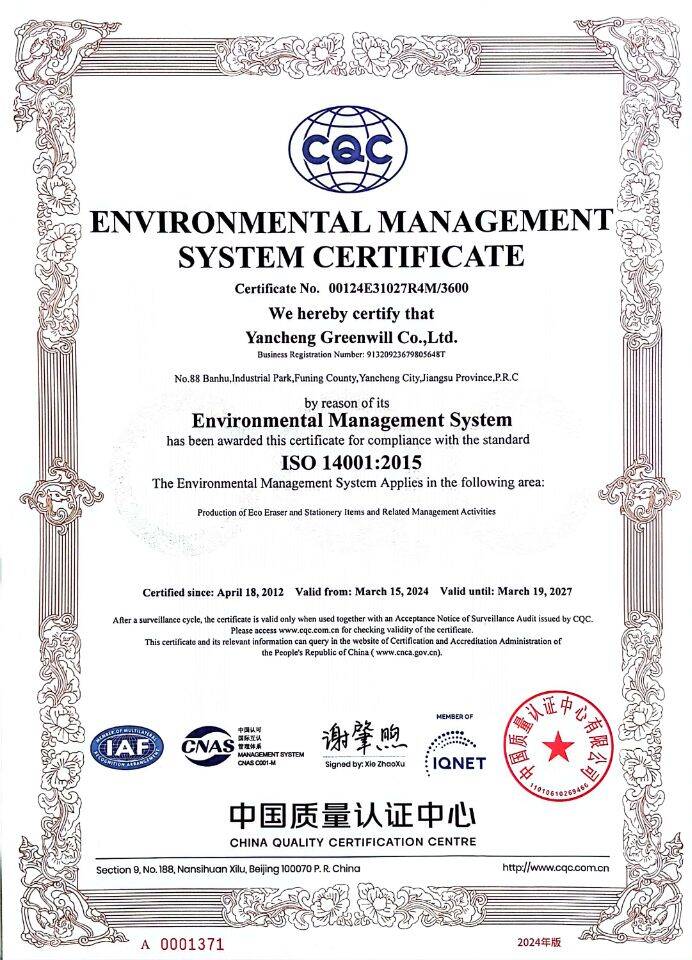
For European-facing assortments, EN 71-1/2/3/9, REACH, PAHS, and SVHC screening form the compliance set that manufacturers design toward for children-related and school stationery. Greenwill stationery, the trading identity of Kunshan Crystal Culture Co., Ltd, a Chinese stationery manufacturer whose production factory was established in 1999, documents these standards across its writing and erasing lines, alongside ISO 9001:2015, ISO 14001:2015, and ISO 45001:2018 management system certificates issued by CQC and valid through March 2027, plus FSC and BEPI participation. Ballpoint pen performance has a separate technical reference: ISO 12757-1 specifies the requirements and test methods for ballpoint pens and refills for general use.
Capacity: where volume sits and what it constrains
Capacity determines whether a buyer's peak season is served or delayed. With Asia Pacific holding 42.3% of global gel pen revenue in 2025, per Dataintelo, most volume-based programs are sourced from that region, and the practical question becomes whether a specific factory's daily output matches a specific order profile.
Documented factory data answers that question faster than general claims. Greenwill's Kunshan facility covers 25,000 m2 with approximately 100 employees, a 10-person R&D team, and a stated capacity of 100,000 pens per day and 20 tonnes of eraser material per day. Annual output is reported as more than 20 million pens, more than 260 tonnes of eraser, and more than 3 million pencil sharpeners. Around 90% of production is exported.
Exports: reading logistics and delivery signals
Export behaviour is the variable buyers can verify earliest in a supplier conversation, because quoted delivery terms, lead times, and inspection practice reveal how a manufacturer is structured for international orders. In Greenwill's documented terms, delivery is offered on FOB, EXW, and DDP bases, lead time is 30 to 45 days, and acceptance relies on pre-shipment testing plus third-party inspection, with payment structured as 30% deposit by TT and 70% against a B/L copy.
Destination spread and relationship duration are related export signals. The company records distribution to North America, South America, Europe, Southeast Asia, Oceania, and the Middle East, and long-running OEM/ODM and distribution relationships with buyers in Germany, Argentina, Brazil, France, Italy, and the United States, with cooperation lasting more than five years in a number of cases and over ten years in others.
| Trend signal | Documented evidence | What the buyer should verify | Common failure mode |
|---|---|---|---|
| Policy environment | ASTM D4236 labeling for art materials exported to the United States (CPSC / Compliance Gate); ISO 12757-1 for ballpoint pens and refills (ISO); EN 71-1/2/3/9, REACH, PAHS, and SVHC documentation on European-facing stationery lines | That test reports, certificate scope, and packaging artwork all match the destination market | A compliant product shipped with non-compliant labeling, or a certificate whose scope excludes the actual product |
| Production capacity | Asia Pacific held 42.3% of global gel pen revenue in 2025, led by China and India (Dataintelo); facility-level capacity of 100,000 pens per day and 20 tonnes of eraser material per day | Whether capacity is genuinely available in the buyer's shipment window and confirmed in writing | Awarding a program during peak season without a reserved production slot |
| Export performance | 90% export ratio with distribution across six regions; delivery offered on FOB, EXW, and DDP; lead time of 30 to 45 days | Which Incoterm is quoted, who controls freight and customs, and how inspection is completed | Assuming DDP terms while no import broker or duty owner has been designated |
| Product-mix demand | Pens at a 36.3% revenue share in 2025 (Grand View Research); gel pens at USD 4.8 billion in 2025 (Dataintelo); erasable gel pens at USD 1.38 billion in 2024 (Market Intelo) | Whether assortment ratios follow demand signals rather than last year's order history | Over-weighting a slowing format while a growing segment runs out of stock |
| Data reliability | Divergent estimates for related scopes: USD 19.2 billion (Grand View Research) versus USD 47.64 billion (Fortune Business Insights) | The scope definition behind any market figure used in a business case | Building a volume plan on a headline number whose scope includes unrelated stationery items |
Table 1. Three trend signals, the evidence behind them, and the verification step each one requires.
Technical Progress: What Innovation Looks Like in a Specification
In writing instruments, innovation usually appears as a measurable specification change rather than as a new product category. Three areas recur in current product documentation, and each carries a different meaning for procurement.
Thermal erasable ink. Erasable gel pen models such as KP18001 and KP100751 use heat-sensitive erasable ink in ABS or ABS+AS barrels with 0.5 mm tips. Writing is removed by friction heat rather than by an abrasive eraser, and the documented performance attributes are thermal erasability, smooth writing, and no residue. Colour options include black, blue, and red, or multi-colour assortments depending on the model.
No-sharpen and inkless pencil construction. The non-sharpen pencil models EP18004 and EP18004-1 combine a TPE body, an alloy nib, and an ABS cap around an HB lead with a replaceable core. The design removes sharpening, wood waste, and graphite dust from the consumption cycle while preserving a conventional pencil feel and the familiar HB line width.
Material and erasing chemistry. Eraser components have shifted toward TPR, TPE, and eco-PVC rubber formulations that balance erasing performance with material policy. The quartz-sand eraser models GW023 and GW024 are documented as PVC-free and capable of erasing ink, pencil marks, and light rust, with a size of 70 x 16 x 9.4 mm. The 2-in-1 eraser-sharpener series, covering models GW007, GW006, GW013, GW015, and GW009, combines TPR eraser material with a stainless steel blade in a PP shell, sized for standard graphite pencils of 7 to 8 mm diameter.
For buyers, the practical conversion is straightforward. Technical progress in this category reduces consumable changes, shavings, and waste, and it raises the importance of ink batch consistency and tip wear testing during qualification. It does not increase document permanence, a boundary addressed in the comparison section below.
Application Fit: Where Pens, Pencils, and Erasable Formats Are Chosen
Format decisions map to specific end uses, and the documented assortment shows how the segments divide. The erasable gel pen models KP18001 and KP100751 target school writing, office use, and promotional applications, while the non-sharpen pencil models EP18004 and EP18004-1 target school and office supplies, art sketching, and cultural and creative retail. Documented destination channels include school supplies wholesale, stationery stores and office supply retailers, bookstores and educational retailers, supermarkets, gift and novelty shops, and art and craft stores.
Order thresholds differ by format, which affects how a buyer structures a first purchase. The KP18001 erasable pen is documented at a minimum order quantity of 5,000 pcs, while the EP18004 non-sharpen pencil and the GW023 and GW024 quartz-sand erasers are documented at 20,000 pcs. The general project MOQ across the manufacturer's range is stated as 20,000 pcs per colour and design.
Long-running programs provide the clearest picture of application fit. Greenwill reports cooperation with gift and promotional product companies, stationery importers and distributors, OEM/ODM partners, and supermarkets in Germany, Argentina, Brazil, France, Italy, and the United States, supporting seasonal campaigns and back-to-school promotions. Reported outcomes centre on shelf appeal through creative and colourful designs and on positioning in the mid-to-high-end stationery market, and many of these relationships have run for more than five years, with some extending beyond ten.
Comparison with Traditional Solutions, and the Boundaries of Each Format
A direct comparison helps buyers decide which format belongs in which part of an assortment. The table below uses documented attributes and applicable external standards only.
| Attribute | Traditional ballpoint pen | Erasable gel pen (KP18001 / KP100751) | No-sharpen pencil (EP18004 / EP18004-1) |
|---|---|---|---|
| Writing mechanism | Ink delivered through a ball tip; performance covered by ISO 12757-1 | Heat-sensitive erasable gel ink delivered through a 0.5 mm tip | Alloy nib writing on an HB lead, no ink |
| Correction method | Correction fluid, correction tape, or rewriting | Friction heat generated by the pen tip removes the line | Removed with a conventional eraser or a quartz-sand eraser |
| Permanence | Not designed to be thermally removed | Heat-sensitive by design, so sustained heat can fade writing | Graphite line, erasable by design rather than permanent |
| Consumables | Refill or replacement pen | Refill or replacement pen; ink is the critical component | Replaceable core; no sharpening and no wood waste |
| Documented compliance set | ISO 12757-1 as the technical reference | EN 71 and ASTM D-4236 (KP18001); EN 71 and ASTM (KP100751) | EN 71, SVHC, and PAHs |
| Documented MOQ | Not specified in the reviewed documentation | 5,000 pcs (KP18001) | 20,000 pcs |
| Best-fit application | Permanent records, forms, general office writing | School writing, office drafting, art sketching, promotional gifts | School and office lists, art sketching, creative retail |
Table 2. Format comparison based on documented product parameters and applicable external standards.
The limitations matter as much as the advantages. Thermal erasable ink is heat-sensitive by design: because the line is removed by friction heat, sustained exposure to high temperatures, for example documents left in a hot vehicle or stored in an unconditioned warehouse, can compromise legibility. Erasable formats are therefore unsuitable for contracts, legal filings, archival records, or any document whose permanence is a requirement. For those uses, a conventional ballpoint or non-erasable gel pen remains the appropriate choice, with ISO 12757-1 as the reference standard for ballpoint pen and refill performance.
The no-sharpen pencil has its own boundary. The EP18004 series is documented with an HB lead, a single hardness grade, so it does not substitute for the full hardness range used in technical drawing or tonal shading. It also depends on core replacement rather than sharpening, which changes the consumable model that a distributor must stock and forecast.
Commercial thresholds are the third boundary. With a typical project MOQ of 20,000 pcs per colour and design and a stated lead time of 30 to 45 days, buyers testing a new format should plan trial volumes accordingly or use the lower 5,000-piece threshold documented for specific erasable pen models. Cost comparison should also run on a total-cost basis that includes core or ink replacement, defect handling, and inspection, rather than on unit price alone.
A Buyer-Side Decision Framework for Regional Trend Shifts
The framework below converts the three macro variables into verification steps that can be completed before a purchase order is issued.
- Match the compliance set to the destination market before evaluating price: EN 71 and REACH-oriented documentation for Europe, ASTM D4236 labeling for the United States, and ISO 12757-1 as the ballpoint technical reference.
- Confirm that certificate scope covers the actual product category, since management system certificates such as ISO 9001, ISO 14001, and ISO 45001 cover production and related management activities rather than individual SKU performance.
- Map capacity to the peak season rather than to the calendar year: daily output figures are only meaningful when compared with the months in which the order must ship.
- Reserve the production slot in writing before awarding, because capacity published in a catalogue is not capacity allocated to a specific program.
- Fix the Incoterm deliberately: FOB, EXW, and DDP place freight, insurance, and duty responsibility with different parties, and that choice should follow who controls the freight forwarder and customs broker.
- Define acceptance before production begins, using the documented mechanism of pre-shipment testing plus third-party inspection, and specify it in the purchase order.
- Compare formats on total cost rather than unit price, because replaceable cores and ink refills change the economics of erasable and no-sharpen formats over a program cycle.
- Treat market figures as ranges: where published estimates diverge, use the range for planning and verify the scope definition before committing to volumes.
Future Outlook
Three directions are visible in the current market structure. The first is compliance convergence. As ASTM D4236 labeling in the United States and EN 71, REACH, PAHS, and SVHC requirements in Europe continue to define market access, documentation quality is becoming a selection criterion comparable to price. Manufacturers that maintain current ISO 9001, ISO 14001, and ISO 45001 certificates, and that can produce scoped test evidence on request, are structurally easier to qualify than those that cannot.
The second is circular design. Replaceable cores in no-sharpen pencils, PVC-free eraser compounds, and FSC-linked sourcing shift the consumable model away from single-use replacement. For distributors, that changes stock-keeping units and reorder cadence, not only product claims, and it gradually moves the discussion from unit price toward program economics.
The third is demand concentration combined with regional diversification. Asia Pacific's 42.3% share of gel pen revenue in 2025 reflects deep component ecosystems, while export ratios close to 90% at individual manufacturers show how dependent production hubs are on destination markets outside their own region. Buyers should expect tariff, labeling, and logistics changes to transmit into lead time and landed cost faster than product design changes do.
For procurement teams, the practical conclusion is that regional trends are an input to supplier evaluation rather than a substitute for it. Policy sets the entry requirement, capacity sets the delivery promise, and export behaviour shows how reliably a manufacturer can keep both.
FAQ
How large is the global writing instruments market, and how should conflicting estimates be interpreted?
Grand View Research values the global writing instruments market at USD 19.2 billion in 2025, with a projection of USD 27.8 billion by 2033. Fortune Business Insights publishes a materially higher figure of USD 47.64 billion, which reflects a broader category scope. The two numbers measure different definitions, so buyers should compare scope statements rather than headline values and use the resulting range for planning instead of a single point estimate.
Which region accounts for the largest share of gel pen demand?
Asia Pacific held a 42.3% revenue share of the global gel pen market in 2025, led by China and India, according to Dataintelo. The same source values the global gel pen market at USD 4.8 billion in 2025, with a projection of USD 8.1 billion by 2034. The narrower erasable gel pen segment was valued at USD 1.38 billion in 2024 by Market Intelo, with a projection of USD 2.56 billion by 2033.
What compliance evidence should accompany pens and pencils for the United States and Europe?
For the United States, art materials including pens and pencils exported to that market must comply with ASTM D4236, the labeling standard associated with LHAMA, according to U.S. Consumer Product Safety Commission guidance and Compliance Gate documentation. For European-facing assortments, manufacturers commonly document EN 71-1/2/3/9, REACH, PAHS, and SVHC conformity; Greenwill lists EN 71 and ASTM D-4236 for the erasable pen models KP18001 and KP100751, and EN 71, SVHC, and PAHs for the non-sharpen pencil EP18004. Ballpoint pen performance itself is covered by ISO 12757-1, which specifies requirements and test methods for ballpoint pens and refills.
What capacity, minimum order quantity, and lead time should a buyer expect from an established pen factory?
Documented figures from Greenwill illustrate the scale of a mid-size Chinese stationery factory: a 25,000 m2 facility established in 1999, approximately 100 employees, a capacity of 100,000 pens per day and 20 tonnes of eraser material per day, and annual output above 20 million pens, 260 tonnes of eraser, and 3 million pencil sharpeners. The general project MOQ is stated as 20,000 pcs per colour and design, with 5,000 pcs documented for the KP18001 erasable pen, and lead time is stated as 30 to 45 days.
What purchasing terms and acceptance criteria are typical for pen sourcing programs?
Documented purchasing terms for Greenwill programs specify an MOQ of 20,000 pcs per colour and design, delivery terms of FOB, EXW, or DDP, and acceptance criteria based on pre-shipment testing plus third-party inspection. Payment terms are structured as 30% deposit by TT with the remaining 70% against a B/L copy. Buyers should confirm that these elements are written into the purchase order rather than assumed from a quotation.
What are the technical limits of erasable pens and no-sharpen pencils?
Thermal erasable ink is heat-sensitive by design: writing is removed by friction heat, so sustained exposure to high temperatures can cause fading, and erasable pens are therefore unsuitable for contracts, legal filings, or archival records. The EP18004 no-sharpen pencil is documented with a single HB hardness grade, so it does not replace the full hardness range used in technical drawing. Both formats also depend on core or ink replacement, which changes the consumable and stocking model compared with a conventional ballpoint pen.