
Perforated POF Shrink Film: What Buyers Must Verify First
Perforated POF shrink film is a polyolefin shrink film that has been converted with a pattern of small holes, so that air trapped inside the wrap escapes during shrinking instead of inflating the pack. The base film decides clarity, strength and shrink behaviour. The perforation pattern decides how the pack vents, how tightly the wrap sits against the product, and whether the pack still offers a closed barrier against dust, moisture and handling damage.
That split is what makes perforated POF a specification problem rather than a simple product pick. A buyer who writes “POF, perforated” on an RFQ has named a material family, not an orderable film. Grade, gauge, width, roll format, shrink window, hole pattern and the documentary evidence behind the supply all have to be resolved before a sample can be judged fairly.
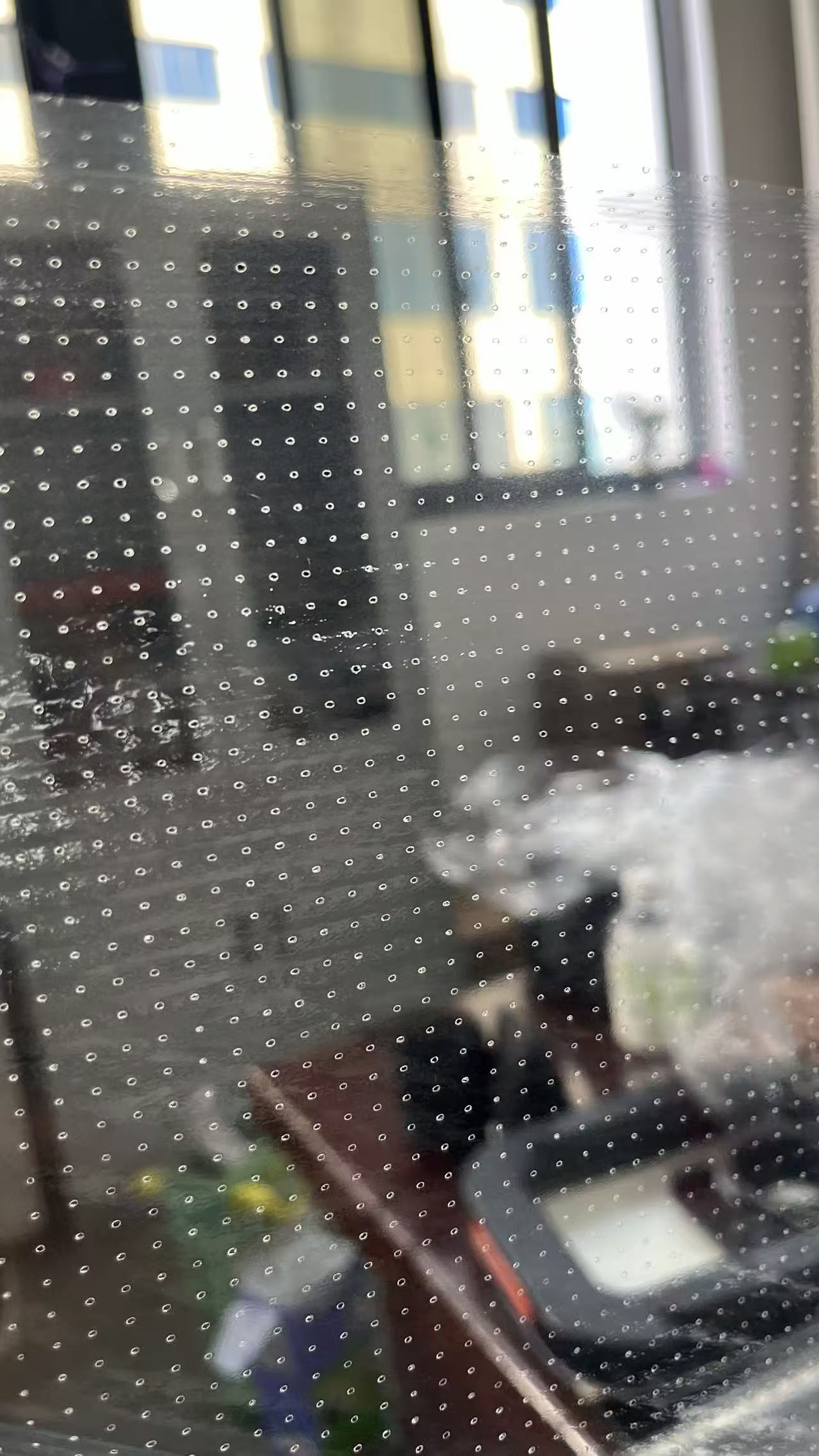
POF shrink film production and handling. Perforation is applied during converting, so the base grade and the hole pattern are two separate specification decisions.
The constraint most perforated orders run into
Perforated film is usually requested for one of two reasons: a product that releases trapped air or moisture during shrinking, or a wrap that must not balloon into a sealed cushion on a semi-automatic line. Both are legitimate. Neither is solved by perforation alone, because perforation interacts with everything else in the specification.
A heavier gauge holds a perforation edge more cleanly and resists tear propagation better; a lighter gauge shrinks faster but is less forgiving if hole spacing is aggressive. A wide centre-folded roll behaves differently from a single-wound roll of the same film when the holes sit near the fold. A low-temperature grade changes the point at which the film softens relative to when the air is expelled through the holes. In practice, the failure modes seen at the sample stage are not “wrong material” but mismatched combinations: correct film, wrong hole density; correct holes, wrong shrink window; correct pattern, wrong roll format for the machine.
The practical consequence for procurement is that perforated POF should be treated as a two-part specification sheet: a base-film section and a converting section. Buyers who separate the two get comparable quotations; buyers who do not get prices for different things.
The specification fields to lock before ordering
The table below lists the fields that determine whether a perforated order will run on an existing packaging line. The right-hand column shows what is currently documented in the Gojun POF Shrink Film range, and where a value still has to be agreed in the quotation.
| Specification field | Why it decides the outcome | Documented reference |
|---|---|---|
| Base grade | Sets shrink behaviour, stiffness and how the film responds under the tunnel | GJ-POF-SERIES includes Regular, Low-Temperature and Cross-Linked POF Shrink Film |
| Thickness | Governs tear resistance around holes and material cost per pack | Published typical values for the Regular POF option: 12–50 micrometres |
| Width and format | Must match the sealer, the fold orientation and the package footprint | POF-15-CF: standard width 200–750 mm, custom width 100–800 mm; centerfold, single-wound, tubular and bags. Regular POF option: 100–1200 mm |
| Shrink temperature | Too low and the wrap stays loose; too high and holes distort | Recommended 100–145°C |
| Shrinkage and clarity | Determines pack tightness and retail presentation | Published typical values for the Regular POF option: shrinkage 65%–75%, transparency 90%–95% |
| Perforation pattern | Controls air release, wrap appearance and dust ingress | Not defined in the available product documentation; hole size, spacing, row position and single- or double-ply application must be agreed in the specification |
| Printing | Artwork position must avoid perforation lines | Single-colour or multi-colour customization available |
| Roll length, core and tolerances | Affects changeover frequency and machine run length | Confirmed per order in the quotation and approved specification sheet |
Sources: Gojun POF Shrink Film product records; final values follow the approved specification sheet.
Why the base film is a five-layer structure
Gojun POF Shrink Film is the POF shrink film range produced by Zhejiang Gojun New Material Technology Co., Ltd., a flexible packaging manufacturer operating the Gojun Pack brand from Wenzhou, Zhejiang, China, with a manufacturing base of approximately 30,060.88 square metres.
The film is polyolefin (POF) in a 5-layer co-extruded structure. Co-extrusion is the reason perforated POF can hold a hole edge without the wrap splitting along it: the layers are extruded together and oriented as one sheet, so a perforation interrupts a bonded structure rather than a single thin skin. The visible result is a clear film; the functional result is a film that carries both shrink tension and puncture resistance in the same gauge.
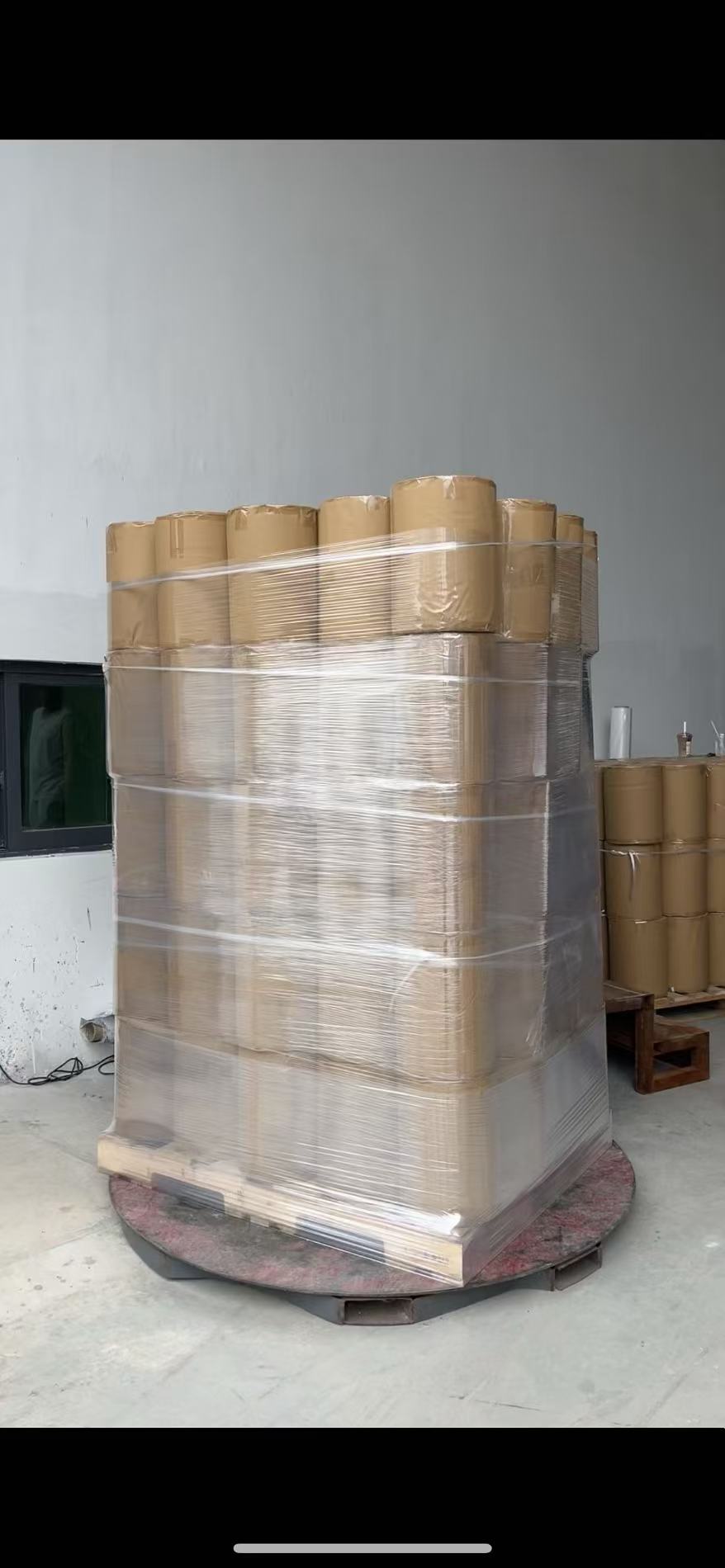
Roll detail: perforation quality depends on winding consistency and gauge control as much as on the hole-making step.
Three grade families sit inside the range, and the choice changes the perforation decision:
- Regular POF Shrink Film — the default for display wrapping and general multipacks.
- Low-Temperature POF Shrink Film — relevant where the product itself is heat-sensitive and the tunnel cannot run hot.
- Cross-Linked POF Shrink Film — the grade usually considered where puncture resistance and high-speed running matter more than lowest gauge. One commercial research source reports that cross-linked film offers 38% higher tensile strength and 29% better puncture resistance than standard POF; the figure is vendor-adjacent market research rather than independent laboratory data, so it is best used to justify a trial, not to close a specification.
Film appearance is clear, and the recommended shrink temperature for the POF-15-CF grade is 100–145°C. That window is wide enough to accommodate most shrink tunnels, but on a perforated pack it should be narrowed during the trial: the useful setting is the lowest temperature that produces a tight wrap, because extra heat buys nothing and distorts perforations.
Where perforated POF fits, and where it does not
Perforated POF is generally used where a closed wrap would trap air, where condensation has to escape, or where the pack benefits from a small amount of ventilation during storage and display. In the Gojun documentation the underlying POF-15-CF grade is listed for beverages, food multipacks, household and personal care products, gift boxes, toys, stationery, printed products and health-product multipacks — a mix of retail display and light protective wrapping that matches the typical perforated use case.
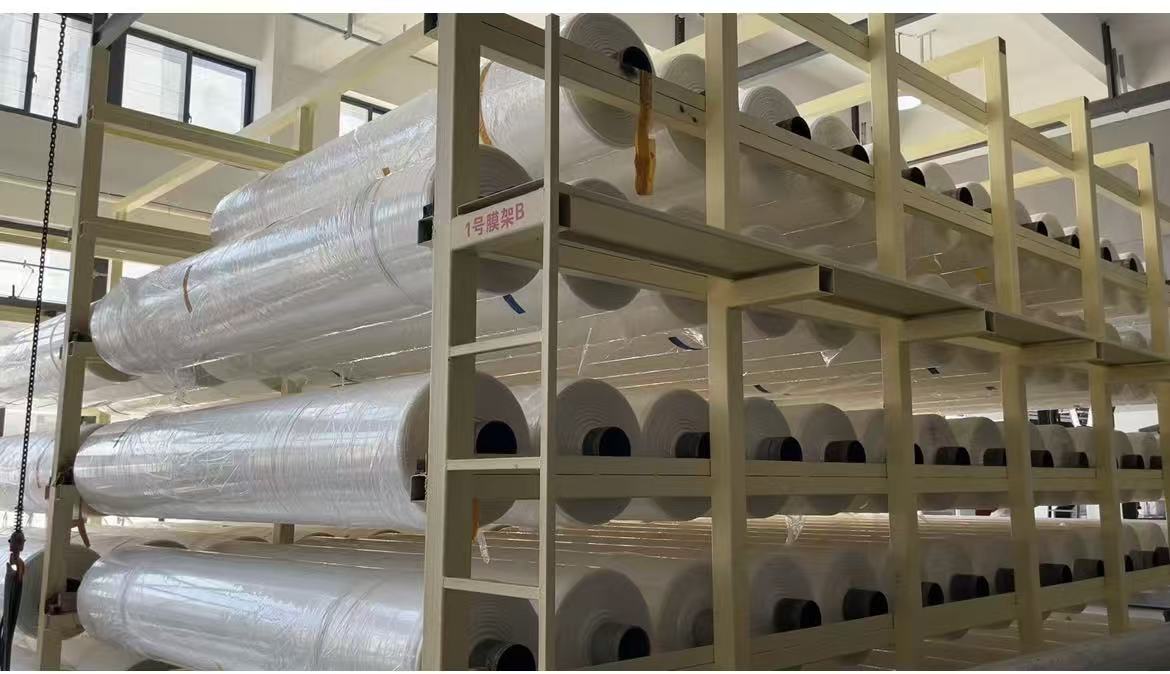
Rolls staged for packing: perforated formats are usually requested alongside standard and printed POF in the same shipment.
The boundaries matter more than the fit. Perforated POF is not a substitute for high-barrier packaging. Where the requirement is oxygen or moisture protection — meat, poultry, seafood, cheese, sausage, cooked food — the appropriate product is a barrier structure such as EVOH-45-CF-500 EVOH High Barrier Shrink Film, a PA/EVOH/PE multilayer film with a shrink-tunnel range of 125–145°C and a short-term finished-package use range of −20°C to +60°C. A perforated wrap cannot deliver that function, and no perforation pattern compensates for it.
Perforated POF is also a poor choice where the pack must exclude dust or where the perforation would be visible on a premium display face. For heavy or sharp-edged loads, the more suitable route is PE shrink film: PE-25-CF at 25 micrometres and 550 mm width, with machine-direction shrinkage of 45–53% and transverse-direction shrinkage of 48–56%, is recommended for packages up to 12 kg — and up to 8 kg where edges are sharp.
A documented reference point on how the base material performs in practice: a daily consumer goods manufacturer in the US placed an initial order of 6 metric tons of POF-15-CF for heat-shrink packaging of gift boxes and multipacks, and has used the film for 8 months as of October 2026. The stated duration refers to project use, not film shelf life. That record covers standard POF, not a perforated format, and should be read as evidence of application fit rather than as a perforation case study.
Certificate evidence: what it covers and what it does not
For a constraint-led purchase, the certification question is not “do you have ISO?” but “what exactly is certified, at which site, and for how long?” On the current documentation the answers are specific.
The manufacturing factory for POF-15-CF POF Shrink Film holds ISO 9001:2015 Quality Management System Certificate 19823QI2345R0S, issued by Beijing Xinjiyuan Certification Co., Ltd. against GB/T 19001-2016 / ISO 9001:2015. The certificate holder named on the document is Zhejiang Lianyi New Material Technology Co., Ltd., and the certified scope is production of plastic packaging film. The same factory is also covered by ISO 45001:2018 Occupational Health and Safety Management System Certificate 19823SI1073R0S, issued by the same authority against GB/T 45001-2020 / ISO 45001:2018, with the same scope.
Two constraints follow, and both should be written into the supplier file rather than assumed:
- The certificates apply to the manufacturing factory, not directly to the product. POF-15-CF is produced at the certified factory, so the management-system certification supports supplier qualification and audit reference; it is not a product certificate and does not by itself declare food-contact suitability, recyclability or perforation performance.
- The stated validity period runs from 2023-09-22 to 2026-09-21. A buyer reviewing this documentation in late 2026 should request the current certificate status and any renewal documentation before the certificate number is entered into an approved-supplier record.
Food-contact status is the other constraint to settle early. The POF range is described as intended for the food and beverage industry, which establishes application intent, not regulatory clearance. Market-specific declarations, migration testing or conformity documentation should be requested for the destination market and kept separate from the ISO file.
Perforated POF compared with the alternatives
The comparison that matters at evaluation stage is not brand against brand; it is format against format, because the same line may need two different films for two different products.
| Option | Best suited to | Main constraint |
|---|---|---|
| Perforated POF | Retail display, multipacks and bundles where trapped air or condensation must escape during shrinking | Vented wrap, not a closed barrier; hole pattern must be matched to gauge and tunnel settings |
| Standard (non-perforated) POF | Gift boxes, printed products, stationery and general multipacks where a closed, clear wrap is wanted | Trapped air on bulky or irregular shapes if the tunnel profile is not tuned |
| PE shrink film (PE-25-CF) | Heavier loads, carton bundling and industrial protective wrapping up to the published package limits | Lower clarity than POF; different sealing equipment |
| EVOH high-barrier film (EVOH-45-CF-500) | Vacuum, shrink and thermoforming formats where oxygen and moisture protection is the requirement | Pa/EVOH/PE structure at 45 ± 4 micrometres; cannot be perforated without losing the barrier function |
Sources: Gojun POF Shrink Film, PE Shrink Film and EVOH High Barrier Shrink Film product records.
One further limitation belongs on this page rather than in a footnote. Zhejiang Gojun New Material Technology Co., Ltd. was founded in 2025, so the operating record a buyer can examine is short by the standards of established film producers. In that situation the weight of qualification shifts onto documented specification control, sample approval and certificate verification rather than on historical supply volume — which is exactly why the checks in this article are worth running before the first bulk order.
Market signals behind the format decision
Published market research points to a mature but large POF category. Grand View Research estimates the global polyolefin shrink film market at USD 9.3 billion in 2026; competing estimates circulating in the same period are lower, partly because providers differ on whether stretch-hood and PE-only films are counted, so the figure is best read as an order of magnitude. The same source reports that Asia Pacific accounted for a 40.0% revenue share in 2023.
Precedence Research data for 2024 suggests where specification pressure is coming from: cross-linked POF is reported at approximately 64% of total production volume, thickness grades between 15 and 25 micrometres at more than 58% of total usage, and food packaging at 46% of total POF shrink film volume. Read together, those three shares describe a market that has already moved toward thinner, tougher film for food-adjacent applications — the same direction that pushes buyers toward perforated and vented formats for products that cannot tolerate a fully closed wrap.
What the published data does not do is size the perforated segment. None of the available sources isolate perforated POF as a separate category, so a perforated order should be planned from line trials and package testing rather than from a market-share figure.
Future outlook
Perforation is likely to remain a converting option rather than a product category, which has a practical implication for buyers: the competitive difference will sit in documentation quality, not in the presence of holes. Suppliers who can state gauge, width, shrink window, format range, capacity and certificate status in comparable terms will be easier to qualify, and easier to keep in a multi-source panel.
On the supply side, Gojun operates blown-film, slitting, folding and bag-making lines with a designed annual output of approximately 14,000 tonnes of POF film and 2,800 tonnes of high-barrier film — equivalent to roughly 1,166.67 tonnes of POF per month on a design-capacity basis, which is a planning figure and not actual monthly output. Each machine is sampled three to four times daily at different production stages. Export markets are Europe, the Middle East and East Asia, and export orders start from 1 metric ton.
The near-term test for most buyers will be simpler than a market forecast: whether a perforated specification can be approved once, documented, and reordered without re-running the trial. Films that survive that test tend to stay in the specification for years.
Frequently asked questions
What packaging products does Gojun Pack supply?
Gojun Pack supplies POF shrink film, PE shrink film, EVOH high-barrier packaging films, thermoforming films and vacuum bags. The main POF options are regular, low-temperature and cross-linked films. Grade selection follows the packaged product, the process and the required level of protection.
What information is needed for a packaging film quotation?
A quotation requires film type, thickness, width, roll or bag format, product dimensions, order quantity, printing requirements, machine details and delivery destination, plus storage and barrier requirements where relevant. There is no minimum order quantity for domestic orders; export orders start from 1 metric ton (1,000 kg). Because perforation changes the roll format, the hole pattern is agreed within the same specification.
Can Gojun Pack customize film dimensions and printing?
Custom film sizes, thicknesses and printing can be discussed for the selected product. Machine requirements, package dimensions and artwork are needed so that the specification and the sample can be confirmed before production. Logo-printed POF film is available; artwork, layout, colours and sample approval are confirmed for each order.
What should be checked during a packaging film sample trial?
A trial should verify dimensions, appearance, sealing and shrink behaviour on the intended equipment, including film feeding, seal quality, shrink appearance and package integrity under agreed settings. Where barrier or vacuum packaging is involved, leakage performance, storage conditions and the agreed barrier requirements are also checked. The specification and acceptance criteria are approved before mass production.
How are samples and production lead times arranged?
Standard samples or products are normally arranged in 1–2 days, while customized samples or orders normally require 7–10 days. Peak-season arrangements may take 7–15 days. Availability, sample approval and the actual schedule are confirmed for each order, and transit time is separate from these preparation periods.
Reference document
The Gojun Pack company and product brochure, covering the POF, PE and high-barrier ranges, is available for download: Gojun Pack Company and Product Brochure (PDF).
Product and company details in this article are drawn from Gojun Pack documentation. Market figures are attributed to the research providers named in the text. Final film specifications follow the approved specification sheet for each order.
Есть вопросы или нужны дополнительные детали?
Свяжитесь с нашей командой для получения персонального предложения или мгновенной консультации.
Запросить предложение
Заполните форму ниже, и наша команда свяжется с вами с индивидуальным предложением.
Прямой чат WhatsApp
Предпочитаете общаться в реальном времени? Напишите нам в WhatsApp для мгновенной помощи и быстрых ответов.
- Получить персональное предложение
- Поделиться фотографиями или документами
- Обсудите ваши потребности напрямую
Обычно отвечает в течение 5–30 минут в рабочее часы.