
Performance Wear or Streetwear? Hoodie Specs by Environment
A hoodie specification is a set of constraints before it is a product. Fabric weight, knit structure, sleeve construction, hood build and wash tolerance each narrow the environments in which a garment performs well — and the same combination that gives a streetwear drop its structure can work against a training session. This reference maps hoodie specifications onto physical activity environments in the 0 °C–20 °C band and examines how those specifications hold up under repeated machine washing.
It is written for brand owners, product developers and sourcing teams who are evaluating a hoodie manufacturer against a defined end use rather than a single unit price. The constraint categories below — weight, weave, construction, wash performance and compliance documentation — are the same categories that appear in a hoodie tech pack, which makes them the practical starting point for any specification conversation.

Specification Fit: A Working Definition
A specification fit is the degree of alignment between a hoodie's measurable parameters — fabric weight in grams per square meter (GSM), fibre composition, knit structure, sleeve and hood construction, and finishing — and the environment in which the garment will be worn and laundered.
For the cold-to-moderate range of roughly 0 °C–20 °C, three weight bands cover most commercial programmes in the Qianshiwear hoodie platform:
| Weight band | Fabric weight | Typical knit | Best-fit environment |
|---|---|---|---|
| Mid-weight | 280–350 GSM | French terry (loop-back interior) | Transitional seasons, warm-up and cool-down, layering under outerwear |
| Heavyweight | 350–450 GSM | French terry or brushed fleece | Cool-weather streetwear, daily commute, corporate and promotional programmes |
| Ultra-heavyweight | 450–500+ GSM | Brushed fleece | Structured streetwear drops, cold-weather outerwear, print- and patch-heavy designs |
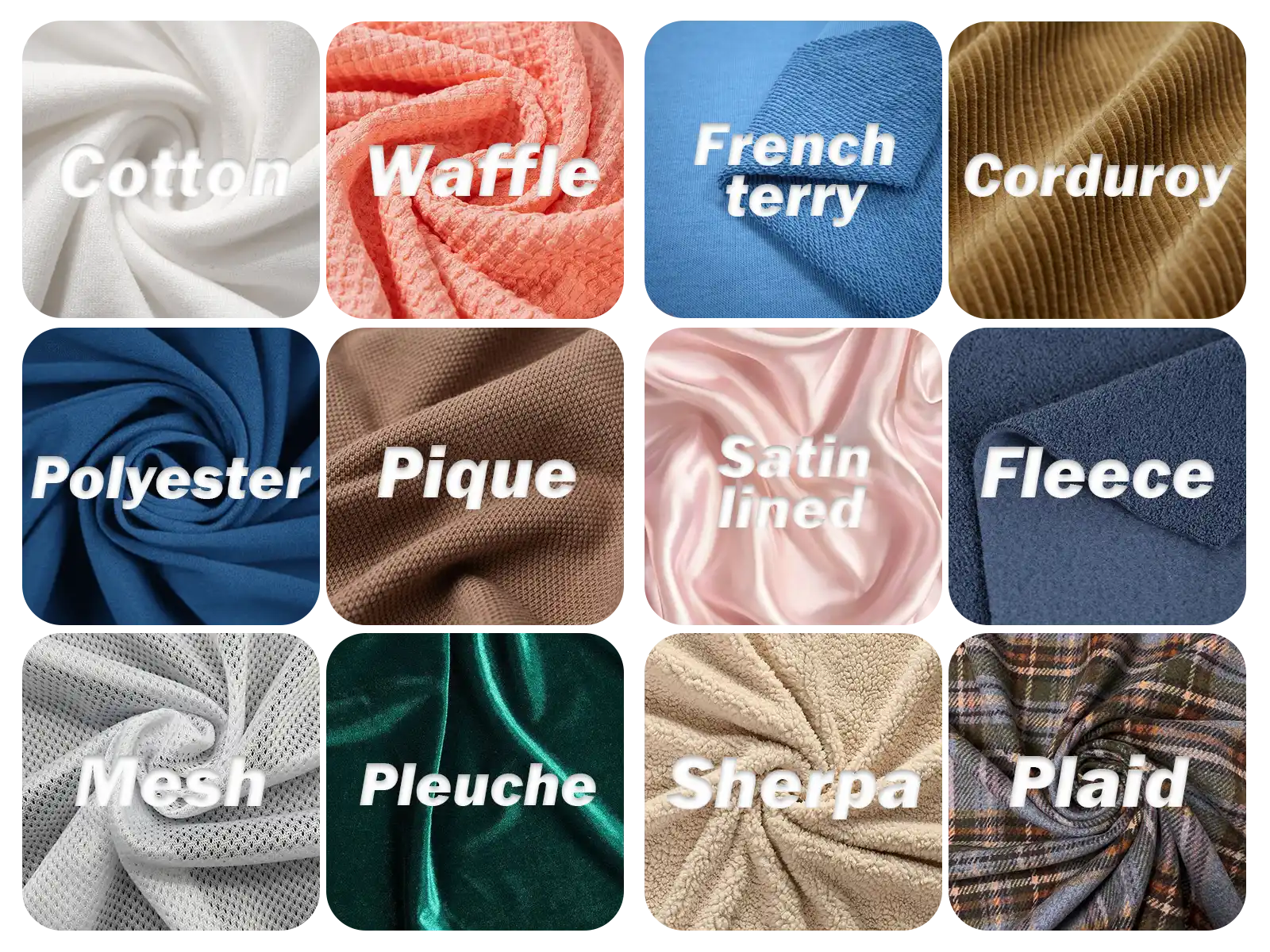
Weight alone does not fix a specification. Two hoodies at the same GSM can behave differently depending on whether the knit is French terry, with a loop-back interior, or brushed fleece, with a raised and napped interior. In the Qianshiwear platform, French terry is specified from 280 to 500 GSM and brushed fleece from 350 to 600 GSM, and the two are treated as different answers to the same brief rather than interchangeable options.
The Gap Between Streetwear and Athletic Environments
Streetwear and athletic wear pull hoodie specifications in different directions, and treating one as a higher grade of the other is where most specification mismatches begin.
Streetwear prioritises mass, drape and print surface. A 450–500+ GSM brushed fleece body with a drop-shoulder pattern reads as structured and premium, holds a puff print or a chenille patch without collapsing, and photographs consistently on a lookbook page. The fabric is also the carrier for the finishing techniques that define a seasonal drop — vintage wash, snow wash, pigment dye and distressed treatments all behave differently on different base weights.
An athletic environment prioritises airflow, range of motion and moisture handling. A high-intensity session generates heat that a heavy, densely napped fleece holds close to the body. Where the two use cases overlap — warm-up and cool-down, sideline wear, gym-to-street transitions — specification choices have to be negotiated rather than assumed. The Qianshiwear scenario data for this category describes exactly that overlap: cold to moderate climates of 0 °C–20 °C, indoor and outdoor wear, frequent layering, regular machine washing, exposure to wind and light rain, and athletic warm-up and cool-down activity within a single product family.
The practical conclusion is that "performance" and "streetwear" are not competing quality tiers. They are different constraint sets applied to the same hoodie, and the constraint set should be declared before sampling rather than discovered after the first bulk delivery.
How Qianshiwear's Hoodie Platform Is Specified
Guangzhou Qianshi Apparel Co., Ltd, operating as Qianshiwear, is an OEM and ODM apparel manufacturer based in Baiyun District, Guangzhou, Guangdong, China. The company was founded in 2014 and combines more than 20 years of fabric weaving experience with more than 15 years of garment production, with 85–90% of total production exported to the EU, USA, AU and UK markets. Its stated product range covers T-shirts, hoodies, sweatshirts, sweatpants, joggers, tracksuits, polos, jerseys, jeans, caps and outerwear.
Four lines are directly relevant to hoodie specification work:
- Custom blank Hoodie / Custom blank Sweatshirt (RTS003) — pullover, full-zip, oversized, cropped and raglan-sleeve constructions, with fleece-lined and sherpa-lined interior options.
- Custom Screen Print Hoodie / Custom Screen Print Sweatshirt (RTS005) — plastisol, water-based, discharge, puff, flock, foil, glow-in-the-dark and metallic ink options, with decoration cured by heat-set for durability and wash resistance.
- Custom Embroidery Hoodie (RTS004) — flat embroidery, 3D puff embroidery, satin stitch, chain stitch, and chenille, woven, flat or leather appliqué.
- Custom Tracksuit / Custom Sportswear Set / Two-Piece Sweatsuit (RTS002) — pullover hoodie, full-zip hoodie, quarter-zip and windbreaker jacket formats paired with tapered, straight or jogger-style pants.
Shared specification parameters across the hoodie platform include fabric weight bands of 280–350 GSM, 350–450 GSM and 450–500+ GSM; 100% cotton, cotton-polyester blends at 80/20 and 70/30, French terry, brushed fleece, sherpa lining, GOTS-certified organic cotton fleece and GRS-certified recycled polyester fleece; sleeve construction in set-in, raglan or drop shoulder; single-layer or double-layer hoods with cotton, metal-tipped or custom branded drawstrings; and kangaroo, side welt, zip or patch pocket options. Colour matching is available to Pantone references.
Production parameters are equally concrete: a minimum order quantity of 50 pieces per colour per design, monthly capacity of up to 250,000 units, sample production of 7–15 working days and bulk production of 20–35 working days, with 100% pre-shipment inspection and third-party SGS inspection available on request. Manufacturing takes place across a 600 m² sewing area, a 700 m² warehouse, a 1,500 m² finishing area and a 200 m² packing area, supported by approximately 200–250 production line workers and a 15-person design team.

Technical Explanation: Why Weight, Weave and Construction Decide the Environment
Fabric weight sets the thermal envelope
A 280–350 GSM French terry hoodie holds less lofted air than a 450–500+ GSM brushed fleece hoodie, so it warms more slowly and releases heat more readily. That is an advantage during warm-up and cool-down activity and a limitation in a stationary outdoor setting at the colder end of the 0 °C–20 °C band. Weight banding is therefore the first decision in a tech pack, not a late-stage styling choice.
Knit structure sets breathability
French terry uses a loop-back interior that leaves the fabric comparatively open; brushed fleece raises and naps the interior fibres to trap air. This is the mechanism behind the standard practice noted in industry references of specifying heavyweight 350–450+ GSM 100% cotton French terry for premium streetwear programmes, where structure and pilling resistance matter more than maximum warmth. It is also the reason a brushed fleece garment and a French terry garment at identical GSM are not substitutes in a specification sheet.
Sleeve construction sets the fit envelope
Set-in, raglan and drop shoulder constructions are all available within the same platform, and each produces a different relationship between the armhole and the wearer. A drop-shoulder pattern yields the relaxed, oversized silhouette that defines much of contemporary streetwear, with a wider armhole and a lower shoulder seam. A set-in or raglan construction sits closer to the shoulder line and restricts the arm less during repeated overhead movement. The same pattern choice that produces a desirable drape in a lookbook can add bulk under a jacket or during activity.
Hood build contributes weight and structure
A double-layer hood adds both warmth and visual structure at the back of the neck, which is why it recurs across heavier streetwear designs. A single-layer hood reduces mass and is a more natural fit for lighter transitional garments. Neither is inherently better; the choice follows the thermal envelope decided in the first step.
Wash durability is a specification, not an afterthought
The product design criteria used across the platform include colour fastness of Grade 4 or higher, shrinkage of no more than 5%, and an anti-pilling rating of Grade 3 to 4, verified through 100% pre-shipment inspection and AQL 2.5 quality control. Screen-printed decoration is heat-set for durability and wash resistance. Garment wash options — enzyme, stone, snow, vintage and pigment dye — are specified because each affects both hand feel and the appearance of any decoration applied afterwards. For a garment worn and laundered frequently across the 0 °C–20 °C range, these wash parameters are what determine whether a size purchased in October still matches a reorder placed in March.
Application Fit Across Physical Activity Environments
The Qianshiwear application data covers cold-to-moderate climates, indoor and outdoor wear, frequent layering, exposure to wind and light rain, and athletic warm-up and cool-down activity, across project types that include streetwear brand seasonal launches, corporate branded hoodies, university merchandise, music tour merchandise, athleisure line development for fitness brands, and small-batch private label production. Mapping specification to environment produces the following working matrix:
| Environment | Weight band | Construction notes | Decoration route |
|---|---|---|---|
| Streetwear seasonal drop | 380–500 GSM | Drop shoulder, oversized fit, double-layer hood | Puff print, embroidery, appliqué, vintage wash |
| Athletic warm-up and cool-down | 280–350 GSM | Set-in or raglan sleeve, single-layer hood, breathable loop-back knit | Flat embroidery, water-based screen print |
| Daily commute and layering | 350–450 GSM | Regular or oversized fit, pullover or full-zip | Screen print, embroidery |
| Music tour merchandise | 350–450 GSM | Pullover, low minimum order quantity per design | DTG, screen print with heat-set curing |
| Corporate and promotional | 350–450 GSM | Consistent grading across sizes, embroidered logo | Embroidery, contrast ribbing |
| University and school spirit wear | 350–450 GSM | Oversized or regular, contrast interior hood | Chenille patch, appliqué, embroidery |
Documented case behaviour supports the direction of this matrix. A streetwear brand that reorders quarterly is reported to have run 7,000 pieces per quarter across 12+ drops with a 90% season-over-season reorder rate, using heavyweight 380–450 GSM French terry and fleece with custom puff print and embroidery combinations. A music tour merchandise programme running 5,000 pieces across 12 stops reported a 92% sell-through rate with four in-tour reorders, supported by 10-day sample turnaround and 30-day bulk production. A corporate programme of 3,500 pieces across three regions reported no quality complaints after 100+ washes per garment. A startup label's first order of 100 pieces, built on 500 GSM French terry with a custom puff print logo and an oversized drop-shoulder fit, reported a 95% sell-through rate within two months.
Market Signals Behind Specification-Led Sourcing
Third-party market data supports the shift toward treating weight, construction and wash performance as procurement variables rather than marketing claims.
- The global hoodies and sweatshirts market was valued at USD 209.26 billion in 2025 and is projected to reach USD 303.62 billion by 2031 (Mordor Intelligence). Valuation estimates vary by scope depending on whether all sweatshirts or only the premium segment is counted, so the figure is best read as a direction of travel rather than a precise addressable market.
- Pullover hoodies accounted for 38.4% of product type share in 2025, driven by global streetwear and athleisure demand (Dataintelo).
- The global custom hoodie printing market is growing at a CAGR of 9.9% from 2024 to 2030, with high demand for 3D puff embroidery and eco-friendly water-based inks (Grand View Research).
- Heavyweight hoodies in the 350–450+ GSM range using 100% cotton French terry are described as the preferred standard for premium streetwear brands because of structure and pilling resistance (LeelinePromotion).
- China's apparel exports reached USD 159.14 billion in 2024, a 0.3% year-on-year increase (General Administration of Customs).
- Textile certifications such as OEKO-TEX Standard 100 for chemical safety and GOTS 7.0 for organic fibres are cited as the industry benchmarks for sustainable manufacturing (Begoodtex).
Taken together, the signals point in one direction: weight bands, knit types and decoration methods are increasingly specified up front, while the number of weight options a manufacturer can produce without switching suppliers is becoming a selection criterion in its own right.
Comparison with Conventional Sourcing Approaches
Conventional sourcing often begins with a catalogue weight and a target unit price. Specification-led sourcing begins with the environment and works back to the fabric. The difference shows up across the whole programme:
| Decision area | Conventional sourcing | Specification-led sourcing |
|---|---|---|
| Weight selection | One reference weight applied to all drops | Weight band matched to environment and wash cycle |
| Sleeve construction | Default pattern used across the range | Set-in, raglan or drop shoulder selected per use case |
| Wash performance | Assessed after the first bulk delivery | Colour fastness ≥ Grade 4 and shrinkage ≤ 5% written into the brief |
| Decoration durability | Assumed from supplier description | Heat-set curing specified for screen print |
| Compliance documentation | Collected late in the process | ISO 9001:2015, BSCI, GPSR and AZO documentation scoped before sampling |
| Reorder behaviour | Re-negotiated each season | Anchored to the original specification sheet |
Certification Constraints for 0 °C–20 °C Hoodie Programmes
Compliance documentation is a specification input, not a post-production formality, and several frameworks apply directly to hoodie programmes.
- ISO 9001:2015 — quality management system certification, number 51825Q10787R0, valid from 11 July 2025 to 10 July 2028, issued by accredited bodies such as TÜV, DNV, SGS, BSI or CQC and recognised globally.
- amfori BSCI — social compliance audit reporting under report number 156-065504-000, covering child labour, forced labour, working hours, wages, occupational health and safety, freedom of association and discrimination, aligned with ILO conventions.
- GPSR (General Product Safety Regulation) — registration number EUREP-2024100815101023014, applying to non-food consumer products including clothing placed on the EU and Northern Ireland market, with technical documentation and product traceability requirements.
- AZO (Azo Dyes Testing) — certificate number TST20240903560-6EN, based on EU REACH Regulation (EC) No 1907/2006, Annex XVII, Entry 43 and OEKO-TEX STANDARD 100, issued by accredited laboratories such as Hohenstein, SGS, Intertek or TÜV.
- RoHS & CE for Electronic Apparel — certificate number NAP25090679C02E, relevant only where a hoodie incorporates electronic components such as heating or LED elements, and supported by test reports from accredited third-party laboratories.
For buyers researching and evaluating suppliers, the practical test is whether certification scope matches the product. A general cotton fleece hoodie is not covered by RoHS & CE, and a supplier that lists it as though it were is describing its documentation catalogue rather than the garment.
Future Outlook
Three shifts are likely to shape how hoodie specifications are written over the next planning cycles.
First, weight banding will continue to move from a marketing line to a specification line. As the custom hoodie printing market grows at a reported CAGR of 9.9% through 2030, with demand concentrated in 3D puff embroidery and water-based inks, buyers will need to declare the base weight that a decoration was validated on, not just the decoration itself.
Second, wash performance will be treated as a contract parameter rather than a supplier assurance. Colour fastness grades, shrinkage limits and anti-pilling ratings already function as the measurable bridge between a specification sheet and a reorder, and their role in supplier qualification is likely to expand.
Third, documentation will keep moving upstream. GPSR-style traceability requirements and OEKO-TEX and GOTS benchmarks push certification checks earlier in the sampling process. For manufacturers, the differentiator will be the ability to hold a wide weight and construction range — mid-weight to ultra-heavyweight French terry and brushed fleece, single- and double-layer hoods, set-in, raglan and drop-shoulder patterns — under one quality system, so that a specification change does not require a supplier change.
FAQ
What fabric weight is appropriate for a hoodie worn between 0 °C and 20 °C?
Three bands cover most of that range. Mid-weight garments at 280–350 GSM in French terry suit transitional seasons, warm-up and cool-down activity and layering. Heavyweight garments at 350–450 GSM in French terry or brushed fleece suit cool-weather streetwear, daily commuting and corporate programmes. Ultra-heavyweight garments at 450–500+ GSM in brushed fleece suit structured streetwear drops and cold-weather outerwear. The band should be selected before decoration is chosen, because the same transfer or print technique behaves differently on each base weight.
Does a drop-shoulder hoodie work for athletic activity?
It depends on the activity. A drop shoulder produces a relaxed, oversized silhouette with a wider armhole and a lower shoulder seam, which is the desired outcome for streetwear. For repeated overhead movement or sustained high-intensity activity, a set-in or raglan construction sits closer to the shoulder line and restricts the arm less. All three constructions are available in the Qianshiwear platform, so the choice is a specification decision rather than a limitation of supply.
Which parameters make a hoodie survive frequent machine washing?
The wash-relevant specification criteria used in this platform are colour fastness of Grade 4 or higher, shrinkage of no more than 5%, and an anti-pilling rating of Grade 3 to 4. Screen-printed decoration is heat-set to improve durability and wash resistance, and garment wash treatments such as enzyme, stone, snow, vintage and pigment dye are specified because they affect both hand feel and the appearance of any decoration applied afterwards. Verification is carried out through 100% pre-shipment inspection and AQL 2.5 quality control, with third-party SGS inspection available on request.
Which certifications apply to hoodies sold into the EU market?
Several frameworks are relevant, and scope matters. GPSR (General Product Safety Regulation), registration number EUREP-2024100815101023014, applies to non-food consumer products including clothing placed on the EU and Northern Ireland market. AZO testing, certificate number TST20240903560-6EN, is based on EU REACH Regulation (EC) No 1907/2006, Annex XVII, Entry 43 and OEKO-TEX STANDARD 100. amfori BSCI social compliance reporting is provided under report number 156-065504-000. ISO 9001:2015, certificate number 51825Q10787R0, is a global quality management system certification. RoHS & CE, certificate number NAP25090679C02E, applies only to smart clothing and wearable electronics and is not a general hoodie certification.
What minimum order quantity and lead time should a buyer plan for?
The stated minimum order quantity is 50 pieces per colour per design, with sample production of 7–15 working days and bulk production of 20–35 working days. Monthly capacity is up to 250,000 units. Buyers planning a seasonal launch should account for the sample window before the bulk window, because specification changes made after sampling — particularly weight band or decoration method — restart the sample stage. One documented programme ran 100 pieces for a first order and scaled to 1,000 pieces on reorder using the same specification sheet, which is the practical reason to lock parameters early.