
Pergola Windproof Roller Blinds: What Buyers Must Verify Before Specification
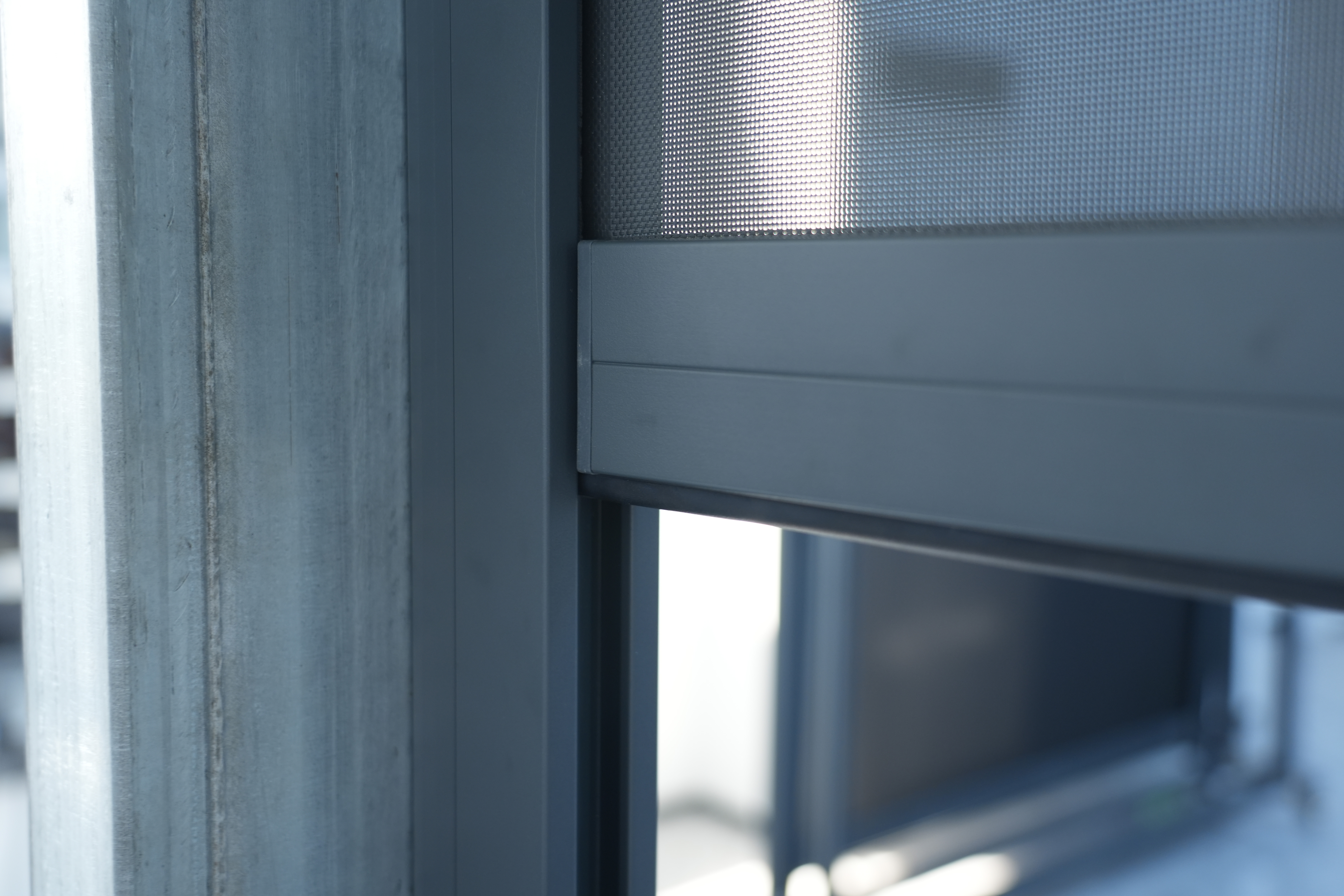
Outdoor zip screen application. Image: NEWHOO.
Outdoor living spaces are being specified more like building envelopes: they must manage sun, wind-driven rain, glare, and privacy while remaining operable. For pergolas, terraces, and commercial leisure areas, a pergola windproof roller blind is increasingly treated as a performance component rather than a decorative add-on. The procurement question is no longer whether a zip screen can be fitted, but which wind rating, size limit, and installation condition can be verified for a specific opening.
This reference examines the constraints that matter at the research-to-evaluation stage: wind resistance classification, cassette and tube limits, fabric retention, motorization, and the difference between a patent, a test report, and a market-compliance certificate. Market estimates for external blinds suggest the category is expanding. One third-party estimate values the global external blinds market at USD 10.77 billion in 2024 and projects USD 18.13 billion by 2035. That figure covers external blinds broadly, not zip screens alone, but it indicates the direction of demand for retractable outdoor shading.
Why Pergola Shading Has Become a Specification Problem
A pergola is an open structure. Unlike a sealed façade, it exposes the shading system to side wind, updraft, rain ingress, and repeated operation. A standard roller blind relies on fabric tension and a bottom rail; in an exposed pergola it can flutter, lift, or wear at the edges. A fixed roof solves the wind problem but removes adjustability and can trap heat. Folding-arm awnings project outward and are useful for overhead shade, yet they are not designed as vertical, side-retaining barriers.
The opportunity is a retractable screen that behaves like a tensioned membrane: the fabric edges are retained in the side rails, the fabric runs taut, and wind load is transferred into the frame rather than into loose fabric. That is the operating principle of a zip screen. The constraint is that the performance claim must match the opening. A pergola post spacing of 5 m, a height above 3 m, or a coastal exposure will change the model, tube diameter, and anchoring requirement.
NEWHOO’s Pergola-Specific Zip Screen Range
NEWHOO is a Guangzhou-based manufacturer of outdoor shading products, established in 2015, with a 20,000 m² production facility and an annual output of 100,000 sets. Its zip screen range includes pergola-specific models and outdoor models used on pergolas, terraces, and commercial façades. For this topic, the relevant models are the WR100C, WR110A, WR110B, and the larger WR120A.
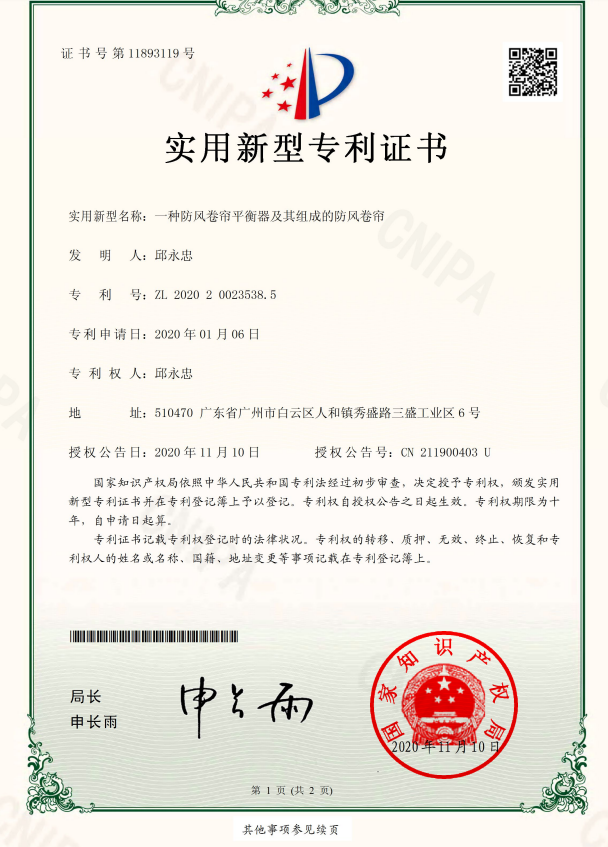
Zip screen balancer covered by Chinese Utility Model ZL 2020 2 0023538.5. Image: NEWHOO.
The WR110A is the most directly pergola-oriented model in the range. It uses a 110×115 mm cassette with 1.6 mm wall thickness and a fabric cleaning brush strip. The roller tube can be specified as Φ63 aluminium, 78 double-layer aluminium, Φ70 steel, or Φ80 steel. With Φ63 or Φ70 tube, the stated application range is 0.7–3.8 m in width, under 3 m in height, and under 12 m² in total area. With 78 double-layer aluminium or Φ80 steel tube, the range extends to 0.7–5.4 m in width and under 2.8 m in height. The model is rated wind resistance Class 12 and a cycle life above 10,000 operations.
The WR110A also carries a smart balancer. This is not a marketing label: it is a mechanical guide that adjusts the roller-tube centre as fabric diameter changes, so the zipper enters the side-rail track vertically instead of at an angle. The WR110B uses the same cassette family but a plug-in bracket for roller-tube assembly. The WR100C is a 100×100 mm cassette with 1.8 mm wall thickness, side-mount brackets, and a body-first-then-side-rail installation sequence; its stated range is 0.7–3.8 m wide, under 3 m high, and under 12 m². It is also rated wind resistance Class 12.
For larger pergolas, the WR120A moves to a 120×120 mm cassette with 2.0 mm wall thickness. With Φ63 or Φ70 steel tube, the stated range is 0.7–3.8 m wide and under 5 m high; with 78 double-layer aluminium or Φ80 steel tube, it reaches 0.7–5.4 m wide and under 3.2 m high. Its wind resistance is stated as greater than Class 12, and it uses a smart balancer bracket. These limits matter: a pergola bay that exceeds the model’s width or height should move to the next platform rather than rely on an optimistic interpretation of a wind rating.
| Model | Cassette | Stated application range | Wind resistance | Best-fit pergola scenario |
|---|---|---|---|---|
| WR100C | 100×100 mm, 1.8 mm wall, cleaning brush | 0.7–3.8 m wide; height under 3 m; area under 12 m² | Class 12 | Small to medium pergola bays; side-mount bracket installation |
| WR110A | 110×115 mm, 1.6 mm wall, cleaning brush strip | Φ63/70: 0.7–3.8 m wide, under 3 m high, under 12 m²; 78/80: 0.7–5.4 m wide, under 2.8 m high | Class 12 | Pergola-specific projects needing smart balancer and wider options |
| WR110B | 110×115 mm, 1.6 mm wall, cleaning brush strip | Same size bands as WR110A | Class 12 | Pergola projects preferring plug-in bracket assembly |
| WR120A | 120×120 mm, 2.0 mm wall | Φ63/70: 0.7–3.8 m wide, under 5 m high, under 20 m²; 78/80: 0.7–5.4 m wide, under 3.2 m high | Greater than Class 12 | Larger pergolas, terraces, and outdoor façades |
Technical Explanation: How a Zip Screen Resists Wind
A zip screen is an outdoor shading system in which the fabric is locked into the side-rail tracks by zippers or anti-derailment mechanisms and runs inside those tracks. The fabric edges are hemmed and retained, so the fabric stays taut instead of fluttering. Wind load is transferred through the zipper and side rail into the cassette and the building frame. This is why a zip screen can achieve a much higher wind rating than a standard roller blind, which has no side retention.
The weak point in any zip screen is the zipper-to-track interface. If the roller tube bends or the fabric is pulled at an angle, the zipper can wear, deform, or derail. NEWHOO’s smart balancer addresses this by automatically adjusting the roller-tube centre according to the amount of fabric on the tube. The zipper therefore enters the track vertically rather than at an angle. The same principle appears in the WR110A pergola-specific model and the WR120A outdoor model. It is a mechanical answer to a wear problem, not a substitute for correct installation.
Material choice also affects durability. The cassettes, side rails, bottom rails, and roller tubes are typically 6063-T5 aluminium alloy; end caps are ADC12 die-cast aluminium; plastic parts are PA66 with 30% glass fibre; and the zipper guide rail is high-temperature-resistant PVC. Outdoor surfaces use powder coating, and exposed screws are 304 stainless steel. Fabric options are 0–50% openness PVC polyester or fibreglass sun screen fabric. For outdoor applications, fabric fixation is by zipper only; T-tape is limited to indoor use where specified.
Wind ratings should always be read with their test basis. NEWHOO holds a wind resistance Class 12 test report for the WR120-140A extra-wide commercial zip screen, report number 24J00783-JAALB-2400176, issued on 2024-11-08 by Guangzhou Testing Centre of Construction Quality & Safety Co., Ltd. The report references GB/T29007-2013, JG/T239-2009, and the Windproof Roller Blinds Structure Performance Test Procedure. A separate Class 12 report covers the WR85 indoor zip screen, report 24J00783-JAALB-2400175. These reports are evidence for the tested model and configuration; they do not automatically certify every size or every installation.
Application and Use Cases
The most common pergola applications are hotel outdoor terraces, food-and-beverage outdoor seating, villa courtyard pergolas, and commercial leisure areas. In these settings, the screen must provide shade, rain protection, heat insulation, and wind resistance while remaining operable. The WR110A and WR110B are designed for this scenario: the cassette size matches pergola posts, the side rail can be two-piece or three-piece, and the bottom rail can be Betal 25.4×56 mm or Easy-slide 25.4×58 mm. The fabric cleaning brush strip helps keep the fabric clean in outdoor use.
For larger openings, the WR120A is used on villa balconies, sunrooms, commercial façades, and larger pergolas. It supports motorized, motor-plus-manual, and spring-push operation, and its smart balancer bracket helps protect the zipper across wider spans. Where the pergola connects to a sunroom or glazed roof, a different product family may be more appropriate: the SR-150A and SR-150B sunroom skylight awnings use a 150×150 mm cassette, Φ94 + Φ60 mm dual roller tubes, and a motor plus dual-spring FGS drive for horizontal, sloped, or inverted glazing applications. Those are overhead systems, not side screens, and should be specified separately.
Projects that exceed the pergola-specific range should not be forced into a small cassette. The WR120-140A extra-wide commercial zip screen, for example, supports widths from 6 m to 30 m and heights under 3.2 m, with a total area under 100 m². It uses a 120×140 mm hollow cassette, a Φ63 aluminium tube, a 46×80 mm three-piece side rail, and a 45-30/50 NM motor with spring assist. Its tested wind resistance is Class 12, and it includes a tool-free motor replacement structure for after-sales access. This is a project-scale product, not a pergola accessory.
Boundary note: A zip screen is not a structural windbreak. The wind rating describes the product’s tested performance under defined conditions. Actual performance depends on the pergola frame, anchor type, substrate, installation tolerances, and maintenance. A Class 12 rating on a datasheet should not be read as a blanket approval for every building height, exposure category, or coastal location.
Market Trend Analysis
Third-party research points to sustained demand for external and automated shading. The global external blinds market was estimated at USD 10.77 billion in 2024, with a projected USD 18.13 billion by 2035. The automated window blinds segment is estimated to grow at a 9.1% CAGR from 2024 to 2030, reaching USD 7.6 billion by 2030. North America accounted for 39.3% of the blinds and shades market in 2024. These are broad category estimates, not zip-screen-specific figures, but they support three procurement observations.
First, motorization is moving from premium to expected. NEWHOO’s motorized zip screens support Wi-Fi, Zigbee, RS485, and other smart-home interfaces on specified models. Second, larger formats are becoming more common as architects treat outdoor rooms as extensions of the building. That increases demand for wide cassettes, spliceable bottom rails, and modular cassette designs that can be transported and assembled on site. Third, buyers are asking for evidence: test reports, patent coverage, and management-system certifications. The market is not only growing; it is becoming more technical.
Comparison with Traditional Solutions
Traditional pergola shading options each solve part of the problem. A fixed roof blocks sun and rain but cannot be adjusted, can overheat the space, and may require structural planning. A standard roller blind is inexpensive and simple, but without side retention the fabric can flutter in wind and wear at the edges. A folding-arm awning projects outward and is effective for overhead shade on façades and terraces, but it is not a vertical side screen and offers limited side-wind protection. A zip screen is a different category: it retains the fabric on both sides, runs in tracks, and is intended for repeatable operation in exposed outdoor conditions.
| Solution | Adjustability | Side-wind retention | Typical constraint |
|---|---|---|---|
| Fixed pergola roof | None | Structural | No retraction; heat build-up; permanent shading |
| Standard roller blind | Yes | Low | Fabric can flutter; limited wind rating |
| Folding-arm awning | Yes | Projection only | Extends outward; not a vertical screen; side-wind exposure remains |
| Zip screen | Yes | High, via side-rail zipper | Requires suitable frame; size and model limits; higher cost |
The limitation is not only cost. A zip screen needs a suitable frame and a correctly prepared mounting surface. The WR110A’s smaller cassette is limited to 3.8 m wide and under 3 m high with Φ63/Φ70 tube; the larger 78/80 tube version goes to 5.4 m wide but under 2.8 m high. A pergola bay outside those limits should move to the WR120A or a project-scale model. In addition, T-tape fabric fixation is for indoor use only where specified; outdoor applications use zipper fixation. Buyers should also distinguish patents from compliance: the Chinese utility models and the US invention patent cited here are intellectual-property instruments, not CE marking or EN 13561 product-compliance certificates. EU projects should request the relevant harmonised-standard evidence separately.
Procurement Checklist for Pergola Zip Screens
- Match the model to the opening: confirm width, height, and total area against the WR100C, WR110A, WR110B, or WR120A limits before requesting a quotation.
- Verify the wind evidence: ask for the test report number, test standard, date, and the exact model/configuration tested. Do not accept a generic Class 12 claim without the report reference.
- Check the frame and anchors: the pergola posts, beams, and base material must be suitable for the cassette and side-rail loads. The screen is not a substitute for structural design.
- Confirm the certification scope: NEWHOO holds ISO 14001 certificate 46625E110299R0S and ISO 45001 certificate 46625S110300R0S, both valid from 2025-09-12 to 2028-09-11, covering windproof roller blind R&D and production. The ISO 9001 certificate SW16Q10469R0S has a stated scope of design, manufacture, and service of clothes drying rack; it should not be presented as zip-screen QMS certification without separate verification.
- Specify operation and interface: motorized, motor-plus-manual, spring push, bead chain, or hand crank; confirm voltage AC230V 50Hz and smart-home interface needs.
- Select fabric openness: 0% blackout for maximum heat and light control; 3–5% semi-transparent for a balance of shade, insect protection, view, and ventilation; above 5% for greater view and airflow.
- Confirm after-sales: NEWHOO states a 5-year parts warranty and a 1-year motor warranty, with remote technical support and replacement parts.
Future Outlook
The next phase of pergola shading is likely to be defined by integration rather than fabric alone. Motorized zip screens with Wi-Fi, Zigbee, and RS485 interfaces are already available on specified NEWHOO models. Modular cassettes, spliceable bottom rails, and tool-free motor replacement structures reduce installation and maintenance friction on larger projects. At the same time, buyers are becoming more precise about evidence: wind reports, patent coverage, management-system certificates, and model-specific size limits. That is a healthy shift. It moves the conversation from a generic windproof claim to a verifiable specification.
FAQ
These answers reflect common follow-up questions in the research-to-evaluation stage. They are informational and do not constitute a recommendation for a specific project.
What is a zip screen, and how does it differ from a standard roller blind?
A zip screen is an outdoor shading system in which the fabric is locked into the side-rail tracks by zippers or anti-derailment mechanisms and runs inside those tracks. The core feature is that the fabric edges are retained and the fabric runs taut. A standard roller blind has no side retention, so its wind resistance is much lower and the fabric can flutter in exposed conditions.
How does the smart balancer protect the zipper?
The zipper is the most load-bearing part of a zip screen. NEWHOO’s smart balancer automatically adjusts the roller-tube centre according to the amount of fabric on the tube, so the zipper enters the track vertically rather than at an angle. This reduces angled loading that can cause wear, deformation, or derailment, and helps extend zipper life.
Which pergola model should I choose: WR100C, WR110A, WR110B, or WR120A?
The WR100C and WR110A/WR110B are pergola-oriented models for small to medium bays. The WR100C uses a 100×100 mm cassette and side-mount brackets; the WR110A adds a smart balancer and a 110×115 mm cassette; the WR110B uses a plug-in bracket. All three are rated Class 12 and cover up to 3.8 m wide with Φ63/Φ70 tube. The WR120A is the larger outdoor model, with a 120×120 mm cassette, wind resistance greater than Class 12, and widths up to 5.4 m with 78/80 tube. Choose by opening size, not by nominal model name alone.
What are the size limits for pergola-specific zip screens?
For the WR110A and WR110B, Φ63/Φ70 tube covers 0.7–3.8 m wide, under 3 m high, and under 12 m²; 78 double-layer aluminium or Φ80 steel tube covers 0.7–5.4 m wide and under 2.8 m high. The WR100C covers 0.7–3.8 m wide, under 3 m high, and under 12 m². The WR120A extends to 0.7–5.4 m wide, under 3.2 m high with 78/80 tube. Projects outside these bands should move to a larger model rather than exceed the stated range.
How long is the system life and what wind ratings are claimed?
NEWHOO states a cycle life above 10,000 operations for the zip screen range. The WR100C, WR110A, and WR110B are rated wind resistance Class 12. The WR120A is stated as greater than Class 12. The WR120-140A has a Class 12 test report, report 24J00783-JAALB-2400176, issued on 2024-11-08 under GB/T29007-2013 and JG/T239-2009. The WR85 has a separate Class 12 report, 24J00783-JAALB-2400175. These are model-specific claims and should be matched to the exact configuration.
How should I choose fabric openness for a pergola?
Full blackout at 0% openness provides the highest heat and light control and is suitable for strong sun exposure. Semi-transparent fabric at 3–5% balances heat insulation, insect protection, view, and ventilation, and is often used for pergolas, terraces, and outdoor dining. Fabric above 5% openness preserves view and natural ventilation best. The choice should follow the primary use of the space and the local climate.
Reference: NEWHOO 2026 catalog is available at https://cdn.socialarks.com/sbsp/25370/common/2026/0922/NEWHOO%20Catalog%202026.pdf.
Есть вопросы или нужны дополнительные детали?
Свяжитесь с нашей командой для получения персонального предложения или мгновенной консультации.
Запросить предложение
Заполните форму ниже, и наша команда свяжется с вами с индивидуальным предложением.
Прямой чат WhatsApp
Предпочитаете общаться в реальном времени? Напишите нам в WhatsApp для мгновенной помощи и быстрых ответов.
- Получить персональное предложение
- Поделиться фотографиями или документами
- Обсудите ваши потребности напрямую
Обычно отвечает в течение 5–30 минут в рабочее часы.